Apparently the erstwhile Twitter and Bluesky founder Jack Dorsey has funded a relaunch of the social video service Vine in the form of "diVine", a new app/service that not only does what Vine did, but also has an archive of "more than 100,000" Vine videos from before the service shut down.
Vine, for the unfamiliar, was a service where you could post six-second looping videos. And that was pretty much it.
Some people I've seen are really excited about this and I do not understand it. To my eye, Vine's six-second videos were not only the height of pointlessness, they were the beginning of one of my least favourite evolutions of the Web: the obsession with "short-form content" that has led us to today's TikTok-obsessed society, and the fact that some people would inexplicably rather get their news in vertical video form from someone holding a camera too close to their face, yelling and presenting subtitles for what they're saying one word at a time in an obnoxiously loud font.
To some folks, Vine was the height of comedy, and I still don't get it. I've seen supposedly popular Vine skits and found them painfully unfunny. To others, it was a place to enjoy music loops, but I'd rather listen to full tracks rather than six-second loops. To others still, I'm sure it was a place to perv on girls dancing (which is, to this day, one of the first things many people suggest to me when I indicate my distaste for TikTok), but if I want to get my rocks off to sexy girls, the Internet has been built on that for decades.
When Vine was originally a thing, I downloaded it to see what all the supposed fuss was about, but deleted it in less than an hour after completely failing to understand the appeal. I had absolutely no desire to make six-second videos of my own, and the six-second videos the app had put in front of me as a new user did not convince me of the platform's value as a means of expressing oneself.
Like I say: to me, Vine was the beginning of the brain-addled, attention-deficit Internet of today, where no-one is capable of focusing on anything for more than about six seconds. I didn't want to support it back then, and I'm certainly not celebrating it coming back now.
Interestingly, this sort of ties in with something else I wanted to talk about, which was that Metroid Prime 4 previews have been met with a certain degree of consternation following the reveal of an apparently quite annoying "sidekick" character. I can't comment on whether or not he actually is annoying myself as I haven't really looked into any of the coverage as yet, but what I did find interesting was the following Bluesky post:
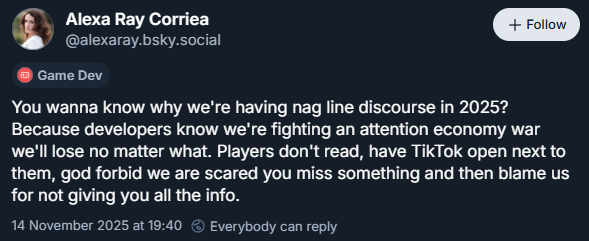
"Nag lines" are those moments when a sidekick or companion character continually bugs you to do something in a video game, with one of the most notorious examples being the now-elderly "Shoot the Hinges" YouTube video. These days they tend to be a little more elaborate, but they're widely disliked by a lot of people for either stating the obvious or giving away things that the player could have otherwise discovered organically. In some cases, games that launched with extensive "nag lines" ended up patching them out after people complaining — Alexa Ray Corriea, author of the above Bluesky post, cites Horizon: Forbidden West as just one example.
But she also has a point. Nag lines are there because of the not-unreasonable assumption that a statistically significant proportion of people playing a game aren't really paying attention. Whether it's because they're listening to a podcast, watching a YouTube video or stream, scrolling through social media, posting in group chats, flipping through TikTok, swiping people on Tinder or whatever it is people do these days, their attention isn't 100% on the game, because today's Internet practically encourages you to act like an ADHD squirrel rather than settling down and focusing on anything.
And to me, Vine was the beginning of that. Actually, that's not quite true; I was very resistant to joining Twitter in the beginning, because I wasn't a big fan of the microblogging format for similar reasons, but I got over that and found some value there. Vine, though… I never found that value there. I never understood what it was for, or what the appeal was. And I firmly believe that Vine and its subsequent imitators like TikTok had an incredibly adverse effect on anyone who found themselves addicted to them, because they normalised and commodified short-form content and turned people into dribbling consumers of content.
I feel like this is a problem we need to address. Actually, I feel like we're long overdue addressing it. Because at the moment the norm, particularly in big-budget triple-A games, which is where "nag lines" are most frequently heard, is to pander to the lowest common denominator in terms of attention span and intelligence, and that results in experiences that are annoying and patronising to anyone even slightly above that minimum basic standard.
But the statistics back it up, unfortunately. Do you know the most depressing YouTube analytic? It's "watch time", which indicates that a significant number of people will click into a video, watch it for less than ten seconds and then click away. The same is true with websites; the assumption — which is, unfortunately, not too far from the truth — is that people will decide whether or not to stick around within less than five seconds.
There is so much competing for our attention online at any given moment, and the modern Internet has conditioned many of us to believe that we must consume as much content as possible, as quickly as possible. A member of a Discord I'm in once proudly explained how they "kept up" with all the content they wanted to consume, and it was a frankly terrifying account of watching some things at double speed, trusting AI summaries (which, let's not forget, are frequently wrong) and never actually taking time to really enjoy and digest something.
I am, at least, thankful that the entire world hasn't gone the short-form, attention deficit route. I am presently playing through The Legend of Zelda: Tears of the Kingdom, and that game couldn't be further away from this whole philosophy if it tried. No nag lines, no pressuring you to constantly be doing, no constantly rewarding you for every little meaningless thing you do, no achievements, no social features — just a big ol' world to explore, with lots of things scattered throughout it that you'll only ever stumble across by accident if you're being curious, taking your time and really drinking everything in. (I say all this with the caveat that the Switch 2 version features a certain amount of ADHD gaming features such as a "daily bonus" you can access via your mobile phone, but all this stuff is easily ignored — and by that I mean "it doesn't appear unless you specifically ask for it", not "it only does a few little pop-ups" — and can be turned off altogether if you find it intrusive.)
I've said many times over the last couple of decades that I don't feel like the modern world is built for me at all. And I mean that in numerous different ways. I am thankful that I still have a few ways to escape from the sheer manic energy of it all, but I worry that one day it won't be possible to hide from all this any longer.
In the meantime, "diVine" can go fuck itself. Actually, no. I will give it a moment's praise for the fact it is specifically weeding out AI-generated slop and not allowing it on the platform. But then I will still tell it to go fuck itself.
Want to read my thoughts on various video games, visual novels and other popular culture things? Stop by MoeGamer.net, my site for all things fun where I am generally a lot more cheerful. And if you fancy watching some vids on classic games, drop by my YouTube channel.
If you want this nonsense in your inbox every day, please feel free to subscribe via email. Your email address won't be used for anything else.