#oneaday Day 309: The most enduring game genres are the ones we used to think were too prolific

I settled down this evening to play some PC Engine games on my Coregrafx Mini, a delightful little mini system that I'm very fond of, but which I realised contains a number of games that I haven't explored at all as yet. The pull of Soldier Blade is, I'm afraid, often far too much to resist, as it was once again this evening — though I did at least spend some time with Lords of Thunder, which I've not got around to trying before. (It is hard.)

One thing occurred to me while I was playing, and that is the title of today's post: the fact that game genres we used to think were overdoing it a bit have ended up being the most enduring; the ones that have "aged the best".

What I mean by this is that back in the 16-bit console era in particular — I'm talking Mega Drive, Super NES and PC Engine to an extent (yes, I know the PC Engine isn't actually 16-bit, but its capabilities put it pretty much up there with the Mega Drive, so shut up) — reviewers were often a bit jaded and cynical any time certain types of game showed up. There was a near-constant cry of "where's the originality?" among critics of the period, and this, to an extent, filtered down to members of the public who, at the time, only really had the word of the folks who wrote for the magazines to go on, since the Internet wasn't yet a thing.

There are several game genres that spring immediately to mind when I think about this: shoot 'em ups, fighting games and beat 'em ups. Yes, the latter two are different, despite the term "beat 'em up" being used interchangeably to describe both in the UK in the late '80s and early '90s. (If you're wondering, fighting games refer to competitive games where combatants — either human or computer-controlled — fight in closed arenas one-on-one, or perhaps in tag team battles, while beat 'em ups typically involve one or more players cooperating against a stream of enemy characters, often, though not always, going on a journey as they do so.)

Shoot 'em ups, beat 'em ups and fighting games reached a point where they elicited little more than groans from the jaded reviewers of the period. This led to situations that are laughable in retrospect, such as the TV show GamesMaster rating the UK release of the absolutely classic and genre-defining NES beat 'em up River City Ransom (known as Street Gangs over here) just 32%. In the show's defence (slightly), the game didn't show up over here until 1992, three years after its original release and well into the next generation of games consoles. Still, 32% is an embarrassing rating for a game that is quite rightly regarded as incredibly important to gaming development and history. But I digress.

The point is, members of the games press were — perhaps understandably — jaded at the number of shoot 'em ups, beat 'em ups and fighting games that were coming out, particularly from 1991 onwards, post-Street Fighter II. I say "perhaps understandably" because gaming back then didn't have quite the same breadth it does today; technology precluded certain types of game that we take for granted today from being made back then. Consequently, for someone whose job it was to look at the games coming out each month and then write about them, one could understand why it might get a bit tiresome if there didn't appear to be much variety — or originality, as was the constant refrain back then — in each new crop of new stuff.

But, as it turns out, there were a lot of shoot 'em ups, beat 'em ups and fighting games made for a very good reason: these are three very flexible genres that you can do a lot with, and all three of them have also scaled well with advancing technology.

Let's focus on shoot 'em ups, because that's what I've been playing this evening. You can go back to a shoot 'em up from 30-40 years ago (Xevious is 42 years old, fact fans, and Space Invaders is just shy of 50) and still have a good time with it today, even if you weren't there for it first time around. The genre has evolved over time, yes, in terms of both presentation and mechanics. But there's a timeless quality to it that means, outside of games that really didn't get it even when they were originally released — and there are plenty of those — the 30-40 year old games are just as playable and accessible today as they ever were. Likewise, if it were possible to take a game like, say, Eschatos back to the past, a Raiden fan would be immediately at home.

The same is true for both fighting games and beat 'em ups, too. I probably don't need to tell you that fighting games remain one of the most popular forms of competitive video game out there; while they have grown in complexity over the years, the fundamentals are still pretty much just as they were in 1991 with Street Fighter II. In fact, some fighting game pros even specifically recommend beginners should start with Street Fighter II to get accustomed to the genre without added complications like special meters and peculiarly named mechanics found in later titles.

The beat 'em up has had a slightly rougher ride over the years — at least it seems that way to begin with. It found favour until the early '90s due to it being a great means of showcasing beautiful character and background pixel art. It reached a particular high with Konami's excellent licensed arcade games such as Teenage Mutant Ninja Turtles, The Simpsons and Asterix (kudos if you played the last one, it remains my fave of those games), but then sort of fell off the map a bit for a while.

At least, it seemed to. What actually happened is that it became the basis for a whole bunch of other, brand new genres that were suddenly made possible thanks to the advent of the 3D age: action-strategy games like the Dynasty Warriors series; arena combat games like the Senran Kagura titles; character action games like the God of War, Devil May Cry and Bayonetta series. All are definitely their own discrete types of game these days, but they can all be traced directly back to beat 'em ups. And, in more recent years, the traditional belt-scrolling beat 'em up has made a triumphant comeback with excellent titles like Streets of Rage 4, Fight 'n' Rage and Teenage Mutant Ninja Turtles: Shredder's Revenge.

I think the difference people would point to today, as outlined above, is that these days, we have a lot more choice. Hundreds, possibly thousands, of new games come out each week, and they cover all manner of interactive experiences, ranging from the comfortably familiar to the gleefully experimental. Shoot 'em ups, fighting games and beat 'em ups are no longer seen as passé and unoriginal because they get more lost in the noise these days — and, with the possible exception of fighting games, they have somewhat declined in importance to the overall market. If a company wants to make money these days, they do a big open world game or a cinematic action game about a middle-aged white dude being sad. Shoot 'em ups and beat 'em ups in particular have become niche interest, and fighting games, although popular and doubtless very important to the bottom line of companies like Capcom, have a considerably higher barrier to entry than they used to.

But none of them have gone away. None of them have declined in importance so much as to be completely unviable as a commercial prospect today, or completely unknown to those who came to gaming in more recent years. And many of those games that were decried as unoriginal, boring takes on crowded genres back in the early '90s are judged much more generously and accurately today.

And that's good. When the day comes when there's a gaming system with no good shoot 'em ups or beat 'em ups (I can personally take or leave fighting games, to be honest, but I do respect them), that's the day I don't buy that gaming system. Thankfully I don't think that day's coming any time soon — and even if it did, there is a vast library of stuff from the years that have led us up until this point to explore, both through emulation and official rereleases for modern platforms. I think I'll probably be OK.


Want to read my thoughts on various video games, visual novels and other popular culture things? Stop by MoeGamer.net, my site for all things fun where I am generally a lot more cheerful. And if you fancy watching some vids on classic games, drop by my YouTube channel.

If you want this nonsense in your inbox every day, please feel free to subscribe via email. Your email address won't be used for anything else.
#oneaday Day 161: Plans for Tomorrow

Tomorrow I'm going to do some streaming, as I have done the past few weeks. 8pm UK time, twitch.tv/pjedavison. Be there, or… don't be there, I guess. But it'd be nice if you were.

Rather than grinding through another layer of Mon-Yu, though, I thought it'd be a nice opportunity to play some shoot 'em ups and, assuming his availability lasts, have a bit of a chat with my good friend Chris, who enjoys a good shoot 'em up. We haven't had the opportunity to record a MoeGamer Podcast for a very long time, and while this isn't quite the same thing, it'll be fun to have a good chat. As an American, Chris is quite understandably a bit under the weather about… everything, so hopefully a bit of fun will take his mind off things for a couple of hours.

Anyway! I don't have overly specific plans other than "play some fun stuff", but I'm going to keep it limited to the Evercade Toaplan Arcade cartridges, of which there are now four. (Well, technically there will be four by the end of the year, but since I work for Blaze I have the last two already.) These are, for me, personal highlights of the complete Evercade library, and I'm thrilled to have worked on all of them.

The games are fantastic, and we were fortunate enough to have access to former Toaplan staffers such as Masahiro Yuge and Tatsuya Uemura to provide some additional commentary for the manuals. I even managed to get some commentary from Tim Follin for Toaplan Arcade 4, since that features the NES port of Sky Shark, which has a soundtrack by the great man himself — though he doesn't think it's his best work!

I'm not sure how well streaming copes with something as frenetic as a shoot 'em up, but it'll be an interesting experiment regardless. Rationally speaking, if a stream can cope with modern 3D games such as first-person shooters and real-time strategy games, I'm sure it can cope with spaceships going boom.

Like I say, I haven't decided specifically what I might play on stream as yet; I'll just take things as they come. I'll probably give the new collections some love, though, as they have a number of games that I think are particularly interesting and noteworthy. Toaplan Arcade 3, for example, has both Batsugun and Batsugun Special Version, which are spectacularly good games, but I want to give Vimana some love, too, as that's one very few people have heard of and I really like it.

A word of caution: don't come to this stream expecting high-level play, or anything other than very basic competence. I love shoot 'em ups, but I'm not super-good at them. This is probably because, like many things, I don't put enough practice in to get good, which is where I think a stream like this might be fun. I can take some time to practice, chat, talk strategy and just generally shoot the breeze — and hopefully having an additional participant in the mix will present some fun topics of discussion. We'll try not to rant too much about the state of the modern world.

So yeah. That's the plan for tomorrow. I'll be going ahead with the stream regardless of whether Chris is available (but he's said he should be) so please do stop by for a bit if you feel like it! See you then!


Want to read my thoughts on various video games, visual novels and other popular culture things? Stop by MoeGamer.net, my site for all things fun where I am generally a lot more cheerful. And if you fancy watching some vids on classic games, drop by my YouTube channel.

If you want this nonsense in your inbox every day, please feel free to subscribe via email. Your email address won't be used for anything else.
2071: Eschatos

0071_001

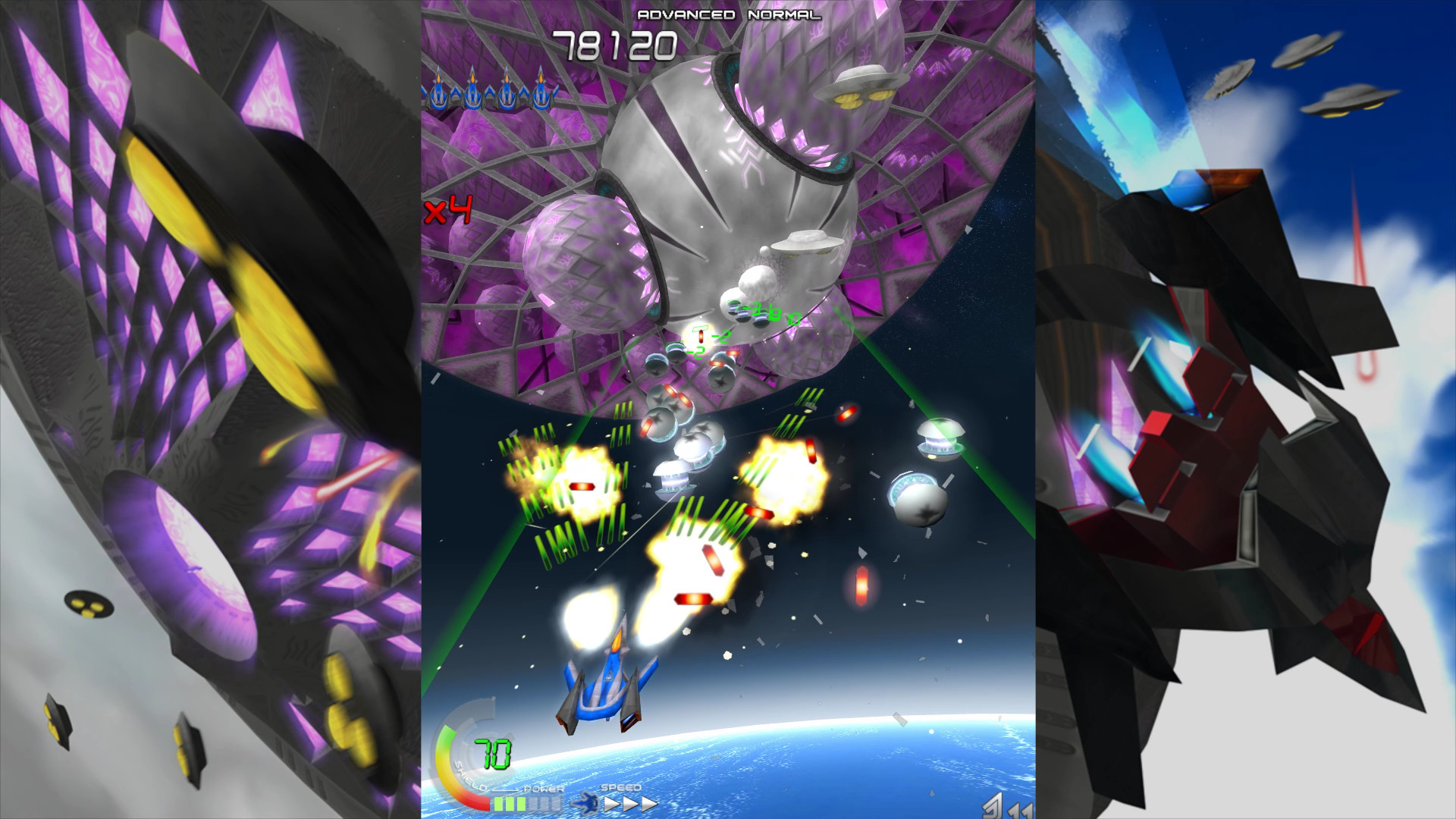
The other day, I talked a bit about shoot 'em up Cardinal Sins. Today, I've been spending some time with its follow-up (or, more accurately, the follow-up to Judgement Silversword) Eschatos.

Eschatos is very obviously cut from the same cloth as its predecessors, since it plays almost identically. Its main difference is the fact that it's a considerably more technically advanced game, boasting dynamic camera angles, full 3D polygonal graphics and all manner of other goodies. It's not the most stunning game you'll ever see, but it looks good for a game of this type, and it runs gloriously smoothly, which is of vital importance to the genre.

(At least, the original Xbox 360 version of Eschatos runs gloriously smoothly; at the time of writing the newly translated PC version has some framerate issues on nVidia cards, but the devs are working on resolving this.)

Eschatos is a shoot 'em up that understands that shoot 'em ups should be thrilling theme park rides: exciting and surprising at first, predictable after a few goes. That "predictable" part is important: the essence of getting good at a game of this type is learning what the game is going to throw at you and then dealing with it accordingly, which is something you can only do with practice.

eschatos

Eschatos makes the learning process quite straightforward by splitting each of its stages into areas, and each of its areas into waves. In order to get the best scores, you need to completely clear waves in succession (which increases your score multiplier) as quickly as possible (which nets you a time bonus, multiplied by your multiplier). Even boss encounters are broken down in this way, making it relatively straightforward to learn what to expect, with the challenge then coming from correctly and consistently dealing with it.

It's particularly nice to note that the scoring system is easy to understand and parse, even on the game's "Advanced" mode; having largely come to modern shoot 'em ups through Cave games, which tend to have some of the most complicated scoring mechanics known to man, this is a very pleasant surprise indeed, because it makes it easy to understand how to get better at the game: destroy more stuff more quickly, simple as that. (This is where someone chimes in and points out it's actually much more complicated than that, naturally…)

I'm a fan. I must confess the 360 version had been on my shelf for a while unplayed, but the event release of the Steam version (and the realisation it could do with a patch) inspired me to dig it out again. I'm once again reminded that Japanese devs really are the masters of their craft… and, apparently, of glorious FM synthesis music that sounds like it's straight out of a Mega Drive game.

Time to go chase some high scores!

1230: In Pursuit of Score

Jun 01 -- HiscoresThe sole aim in a lot of video games circa the '80s and early '90s used to be to attain a high score. But in all but a few genres of gaming, that simple pleasure of watching a number get steadily higher — a number which proved indisputably how much better than your friends you were — has fallen by the wayside. This is kind of a shame because, having been playing a bunch of games recently in which the old-school objective of "score as many points as possible" is their reason for existence, it's, you know, fun. Lots of fun.

My fondest memories of high-score chasing in recent years came with two different Xbox Live Arcade games: Geometry Wars 2 and Pac-Man Championship Edition DX. Both of these games got their hooks into both me and my friends and saw us eschewing bigger, more exciting, more impressive releases that were around at the time in favour of simply pumping in virtual quarter after virtual quarter. Geometry Wars 2 in particular completely monopolised the gaming time of a number of us for a good several weeks, as each of us vied for dominance of the game's six different leaderboards. It became a sort of hypnotic ritual — fire up the game, start up (say) Pacifist mode, play, die, immediately restart and repeat. Three hours later, I'd look up and see that, well, three hours had passed, and that my hands had locked into a claw shape only suitable for 1) holding a controller or 2) in a pinch, wanking.

Since those two games, however, there haven't been that many other titles that have drawn the attention of my friends and I quite so consistently. This is a shame, as I greatly enjoyed that feeling of competition, and relished the opportunity to take a snapshot of my latest high score and rub it in the face of a competitor via some form of social media. (This is where the term "Be A Dick Mode," often stylised as the hashtag "#beadickmode" on Twitter, originated.)

I've been thinking about how and why there hasn't been a simple score-attack game to get everyone's teeth into for a long time. And the only plausible reason I can think of is the fact that gaming has grown even more broad and diverse since that time. The rise of mobile phone games in particular has all but eliminated the perceived need for "simple" arcade games with a score attack mechanic, which is somewhat sad.

Bejeweled Blitz remains popular, of course, but I now refuse to play that game because it's become infested with pay-to-win crap. Leaderboards are utterly meaningless if you sell advantages to players, which is what PopCap's doing. Unfortunately, I appear to be in a minority thinking this, as the "Blitz" puzzle template is immensely popular — in-app purchases and all — with the latest addition to the formula being a rather sorry addition to the Tetris legacy from EA. I'm just not interested; what's the point in playing if all it takes to top the leaderboards is being more willing to dip your hand into your pockets than your rivals? Bullshit, I say. Bullshit!

Fortunately, there is a degree of respite, albeit one that I'm yet to convince my friends to engage with. The shmup genre — which people on the Internet don't quite seem able to agree as to whether it's flourishing or dying — remains a resolutely score-focused genre, and demands a great deal from its players both in terms of simple manual skills and in the learning of often-complex scoring mechanics. Like a good fighting game demands that you spend time exploring its systems and getting to know how everything fits together, a good shmup demands that you study it, figure things out and then try to put all that knowledge into practice while attempting to avoid fiery laser death.

It's immensely satisfying when you figure out how a particular game "works", and the first time you see your score skyrocketing into the high millions or even billions. It's a genre that brings thrills and excitement with minimal effort expended on storytelling or trying to do anything particularly "artistic", but at the same time the finished result can be oddly beautiful — hypnotic bullet patterns; the "dance" of the player's ship navigating through these perilous onslaughts; the sheer, unrelenting energy of most of these games. But these games aren't trying to say something in the same way that an arty indie platformer is trying to say something; no, instead, all they're trying to say is "c'mon, one more try and you'll beat that score" or "c'mon! Bet you can't clear me in one credit."