#oneaday Day 653: Web best (forgotten) practice

When I was first interested in Making A Website, back in the early days of being able to Go On The Internet, itself part of Going On The Computer, I learned a number of supposed Best Practices that I still habitually follow to this day as much as possible. And yet reading a recent article about how a single article on PC Gamer is a 37MB initial download, followed by nearly 500MB of ads downloaded in the background over the course of five minutes or so, I can't help feeling like a lot of them have been forgotten about.

Here's a few that I can remember off the top of my head:

  • Keep your pages lightweight. Don't be afraid of all-text pages. Compress your images. Don't upload them at an unnecessarily huge size or using a file format that doesn't compress them unless there is some reason for needing to see them at high resolution and lossless quality. Arguably this one is even more important today as a lot of people are looking at websites on phones, but 37MB for an initial download is bananas, even bearing in mind today's average Internet connections, even over the airwaves on your phone, are much faster than they were 20+ years ago.
  • Hyperlinks should be inline rather than an instruction. That means if you're linking to something, you put the hyperlink where you mention the thing rather than spending a whole other sentence saying "Click here to see the thing!" This one is quite often argued against these days in favour of "calls to action", but if your website is not a marketing website, you don't need to give a shit about "calls to action". Save yourself some words, make your writing better and just link to the thing. The "click here" is implied by the text being a different colour. That's how hypertext works!
  • Hyperlinks to other pages on your site stay in the same tab/window. Hyperlinks to other websites go in a new tab/window. target="_blank" is so easy to include, and most CMS packages have the ability to choose whether or not a link opens in a new tab without you having to do any sort of HTML shenanigans yourself. The reasoning behind this is that you actually want to keep people on your website, so if you're linking to something relevant that is not on your site, when the reader closes the tab for that external resource, your site will be right there waiting for them where they left it.
  • Metadata doesn't belong in content. We all know that social media made a real mess of this, but outside of platforms designed around metadata being part of content, you don't need to put things like #hashtags in your articles, because most CMS platforms have some sort of tag facility built-in, and even if you're hand-coding a site, you can still include metadata tags in a way that is invisible to the end user. You are (hopefully) writing a page to be useful to a person, not a machine. In fact, in these days we live in, making a page more friendly to a person than to a robot will make you stand out considerably.
  • Don't interrupt the reader. If someone has clicked on a page, they're there to read the thing they clicked on, not to subscribe to your newsletter, not to watch a video and not to click away to a related article. If you must include those things, put them at a relevant point in the text (e.g. a video showing the thing you're talking about in the article, a link to a source you're quoting) or, if they don't fit into the flow, at the end of the piece so the reader has somewhere to go next. If you're giving the reader "FURTHER READING:" options after just one or two paragraphs, all you're doing is implying to the audience that the rest of the article isn't worth reading.

Most of these are broken on the daily by commercial websites, usually in the name of "SEO best practice" or whatever. The last one in particular drives me bonkers. I just want to read the article! I do not need linking to something tangentially related after I've only read the introduction, and I certainly do not want to subscribe to your fucking newsletter until I have read your entire piece!

Many of these rules were originally put in place because a lot of people were still using dial-up Internet at the time, and if you gave someone with even the very fastest dial-up modems a 37MB single page? Well, they just wouldn't be reading that page. In the process, however, these rules made for a Web that was clean, straightforward to navigate and consistent in its design language. And we've lost a lot of that in the attention-deficit, ad-riddled, bloated mess that the modern Web is.

"I want the old Web back" is a lot more than just starting your own blog in favour of corporate-controlled social media websites. The rules above are a good start. Generally respecting your audience — including their time and network bandwidth — is a good next step.


Want to read my thoughts on various video games, visual novels and other popular culture things? Stop by MoeGamer.net, my site for all things fun where I am generally a lot more cheerful. And if you fancy watching some vids on classic games, drop by my YouTube channel.

If you want this nonsense in your inbox every day, please feel free to subscribe via email. Your email address won't be used for anything else.


#oneaday Day 629: Another site falls to AI

Earlier today, a review was being shared around. It was a featured review on Metacritic for the new Resident Evil Requiem, and it was very obviously AI-generated — both in terms of the review text itself, and the image and biography of the completely fictional author.

Now, I know there is plenty we can criticise Metacritic for, but to the site's credit, after being made aware of the situation, the review was not only pulled from Metacritic, but the site in question was blacklisted from being featured on there for future reviews, too.

The site in question was VideoGamer.com — not a site I ever particularly frequented, but one that has been around for many years, and one of many, many old games press brands that have been bought up by private equity and turned into sites filled with AI-generated drivel, usually in the form of undisclosed advertorial features pointing people towards shady gambling sites. VideoGamer is not the first site to fall in this way; previous victims have included AdventureGamers and The Escapist, and there are almost certainly countless more that we haven't found as yet.

My initial reaction to anything like this happening is to ask "why?"

Why are once-good sites being replaced with AI-generated drivel? Who do they think is reading this stuff? Why do the people in charge of these hollowed-out husks of websites think this is, in any way, a good idea?

The answer, of course, is that this is the natural endpoint of SEO-driven online writing. The sole reason these articles exist is to get people to click on them and generate advertising revenue for the site's owners. And if they can do that without having to do anything silly like pay actual people to write actual articles, so much the better! (Although the more astute among you out there may well point out that being an AI power user probably doesn't end up much cheaper than hiring an actual person — particularly in the games press, where, as Mat Jones of IGN put it earlier today, "games freelancers will turn in 2,000 words for an egg sandwich". I wish it wasn't true.)

Couple this with the news that Eurogamer and surrounding sites are suffering some considerable layoffs and things do not look altogether rosy. I also learned that VG247 is now little more than an SEO guideslop site; I never really liked that site all that much, but since most of my USgamer stuff ended up archived there after USgamer itself closed down, I do have a certain attachment to it.

The frustrating thing for me is that all this seems so unnecessary. Video games, as an industry, creative medium, art form, whatever you want to call them, are huge. One would assume that would mean they would need a specialist press around to cover them effectively, but given that so many sites have been gutted over the last few years — and, in many cases, replaced with AI slop — something doesn't quite seem to add up.

Sure, we've seen the rise of sites like Aftermath, who do good work, and it was gratifying to see Giant Bomb successfully extricate themselves from their former corporate overlords — full disclosure: I subscribe to both to support them — but neither of them quite take the place of what we used to have. And you can interpret that however you will, because the same is true if you think I'm referring to traditional "news, previews and reviews" websites, or if you think I'm referring to magazines. (Spoiler: I'm talking about both.)

Part of this feels like an extension of the whole "New Games Journalism" discussion we had in the latter-day 1up years. And while that discussion went to some odd places, I do acknowledge that there is some valuable work going on over at a number of worker-owned, reader-supported sites, particularly when it comes to telling the stories of people who work in games. But sometimes you just want to read something simple like what someone thought of a game you're interested in, y'know? And that side of things seems to very much be a dying breed.

One might argue that there's less need for that, what with social media, online discussion and "influencers" (you will never get me to not use scare quotes around that odious term) dominating the way games are promoted online these days. But I still like to read a straightforward review of something — and the continued existence of Metacritic, as flawed as it is as a concept, suggests that there's still a place for that sort of thing.

I can't help but wonder where all this will end up. With people starting to get interested in physical media once again, I would love to see proper magazines become a thing again. I suspect that won't happen, but we certainly can't go on like this. Can we? This feels like how you actually end up with a completely dead Internet.


Want to read my thoughts on various video games, visual novels and other popular culture things? Stop by MoeGamer.net, my site for all things fun where I am generally a lot more cheerful. And if you fancy watching some vids on classic games, drop by my YouTube channel.

If you want this nonsense in your inbox every day, please feel free to subscribe via email. Your email address won't be used for anything else.

#oneaday Day 376: The death of ambition

Earlier today, Dave Gilbert, renowned modern adventure game developer and publisher, happened to point out that Adventure Gamers, a website with a near 25-year history, had, at some point, sold out and become an online casino shilling site, leeching off the prior content — which, after 25 years, you can bet had some decent SEO juice, even with the myriad changes to such algorithms over the years — in order to hook people into shady gambling sites.

My immediate reaction to this was "ew, gross", shortly followed by "I bet I could make a really good adventure game site". Unfortunately, this thought was then almost immediately followed by "…but why should I bother?"

This isn't the first time I've thought something along these lines. The modern Web is killing, stifling any sense of ambition I might have once had. It's not one, single thing like generative AI causing me to feel this way — though you better believe the amount of AI slop out there is a big part of it — but rather a continual piling-up of little micro-enshittifications. Over the course of the last 10 years in particular, these micro-enshittifications have all accumulated into the garbage fire that is the Web of 2025: a place where it's hard to find reliable information, where it's even harder to verify whether what you're looking at is reliable information, and where the people with the power to make a difference don't seem to give a shit.

Let me tell you a little bit about myself, in case you've not been here on the previous occasions I've done so.

When I was a kid, I grew up surrounded by computers: specifically, the Atari 8-bit and ST, with MS-DOS and Windows PCs following along around the early '90s. For pretty much my entire childhood, my Dad and my brother were both regular contributors to an Atari magazine initially called Page 6 and later New Atari User, after it took over the name from a publication that was bowing out of the Atari 8-bit scene.

I loved getting a new issue of Page 6 every couple of months; I loved reading through all the features, even if I didn't understand all of them, and it gave me great pride to see my Dad and my brother's name in print pretty much every issue after a certain point. My Dad would cover flight simulators, productivity software and the use of music technology, while my brother would cover Atari ST games. We got a lot of free software out of this arrangement — much of which is now in my possession — and it's fair to say that this played an instrumental role in defining my interests and hobbies growing up.

When my brother left home, he had decided to forego university in favour of a staff writer position on a magazine called Games-X. This was a risky and ultimately unsuccessful venture on the part of publisher Hugh Gollner, but it was a nice idea: a weekly games magazine that covered new releases for the home computers and consoles that were around at the time — the tail end of the 8-bit era, the heyday of the ST and Amiga, and the days when the Mega Drive and SNES were just starting to get some attention.

I was immensely proud to have a family member in the games press, published every week in an actual magazine you could walk into a newsagent and buy. (Page 6 had a stint on newsstands, too, but it eventually went back to its roots as a subscription-only magazine, clinging on to dear life until 1998, impressively.) And my pride only continued after Games-X folded and my brother followed Gollner to the then-fledgling Maverick Magazines, where he initially worked as a staff writer on Mega Drive Advanced Gaming, while his girlfriend at the time held the same position on its Super NES counterpart Control.

It continued further still as he worked his way up the ranks, through several publications and publishing companies, until eventually he found himself in the United States working on the Official PlayStation Magazine and Electronic Gaming Monthly, and helping to launch the pioneering video game social networking site 1up.com — dearly missed.

Every step of the way, I followed his career with interest, conscious of the fact that I was 10 years younger than him, thinking "one day I'll get my chance; I really want to follow in his footsteps, and one day I'll have that opportunity if I just keep trying."

I did keep trying. I did some articles for Page 6, just as my brother had. I did some freelance contributions to PC Zone and the Official Nintendo Magazine, back in the days when one article would get you the money that two months' worth of news posts nets you today. I worked on some little sites, most of which have now disappeared, sadly, and I eventually had the opportunity to work on both GamePro and USgamer, two decent-sized but, admittedly, American sites.

For some reason I had found the UK games press perpetually impossible to crack after a certain point, and after attending a few PR events on behalf of both GamePro I understood why: there was very much a heavily cliquey, old boys' club thing going on, and as a socially awkward (and what I now know to be) autistic loser, that was not something I felt in any way able to crack my way into.

But still I wanted to believe. I wanted to believe that GamePro was the start of something big, until we were told via email one morning just before Christmas that none of us had jobs any more. I wanted to believe that USgamer was another opportunity for something big, until I found myself screwed over and, once again, informed via email, this time on my actual birthday, that I no longer had a job.

After that, I didn't seek any further positions in the games press. I'd taken too many beatings. But I didn't want to give up. That's when I started MoeGamer, which initially began as a means of continuing some of the work I'd done at USgamer covering Japanese games that other publications didn't give the time of day. This was work that people in both the industry and from the "public" side of things told me that they found valuable and helpful, because I wasn't just going "ew, anime art" and writing things off as "pandering" or whatever.

Long-term, I wanted to build MoeGamer into something that really stood by itself: a site where you could look up information on a wide variety of games and find some thoughtful, well-considered writing about it. And I think I have achieved that, even if I don't have the time or energy to update it as often as I'd like; the one positive about my previous job, which was beyond tedious, was that it gave me ample time and energy to write new articles and make new videos.

I still never really "made it", though. Few people online know who I am; even fewer go "oh, wow, a Pete Davison article, gotta read that" — although I do have a pleasingly enthusiastic following in the Evercade community, at least, thanks to my work on the official site — and I just find myself wondering… was all this for nothing? Is there even any point trying any more?

The Adventure Gamers thing stings, because were it 10-15 years ago, I'm pretty sure I could have put together a banger of an adventure game-centric website, developed a decent following and kept it up and running for 25+ years without selling out to online casino shills. But now, from every corner of the Web I read horror stories about sites struggling for discoverability, struggling to earn the money to keep the lights on and struggling to get anyone to give a shit about the written word. There are rare outliers, and the rise of worker-owned, reader-supported initiatives such as Aftermath and Giant Bomb is encouraging — but both of those (and others like them) already had ready-made, built-in audiences thanks to the people involved and their prior positions; how long would a brand-new website with a specialist focus even last these days, if it wasn't "the next project from [insert big name site] alumnus, [name]"?

I feel utterly demoralised. I feel like what was once my dream career just doesn't really exist any more. I recognise that I'm extraordinarily fortunate to have fallen into the position I'm in now, where I get to work on games that I care about, crafting written material to help people understand and appreciate quite why I love them so much — and hopefully help said readers learn to love them, too — but there are days of increasing frequency when I wonder if anyone really gives a toss. The days when I have people screeching obscenities at me on social media because they can't buy a cartridge that is out of print. The days when I have to deal with endless, mind-numbing, Queen's Duck-level "feedback" from people who absolutely don't care about the games I'm working on as much as I do. The days when I'm genuinely fearful for the history and legacy of the hobby I love so much, and where I weep for the traditional, written-word games press, a side of the industry which almost doesn't exist at all any more.

I was born 10 years too late. And believe me, it really sucks to have spent a significant portion of your life thinking "I really want to do that", only to find out, much too late, that "that" just isn't really a thing any more.

The obvious answer to all this is something I've thought of and felt before — that even if there doesn't seem to be a "place" for something, you should do it anyway, because someone, somewhere, will appreciate it. But with every site sold to private equity companies and gutted to turn into an AI slop factory, the motivation and ambition to do something significant and meaningful diminishes, bit by bit. What was once a roaring flame of determination is now little more than a flicker. And I hate that.


Want to read my thoughts on various video games, visual novels and other popular culture things? Stop by MoeGamer.net, my site for all things fun where I am generally a lot more cheerful. And if you fancy watching some vids on classic games, drop by my YouTube channel.

If you want this nonsense in your inbox every day, please feel free to subscribe via email. Your email address won't be used for anything else.

#oneaday Day 22: Trends Have Made the Internet Boring

See? I told you I'd be back. And I thought I'd talk about something other than Final Fantasy XIV: Dawntrail. Specifically, as the title says, I want to talk about how trends have made the Internet boring. Or perhaps more accurately, why everyone all wanting to do the same thing all at once makes things deathly boring.

There are a few practical examples I'd like to give. First is a YouTube channel I was introduced to recently called Obscurest Vinyl. This channel is run by a designer and musician who found some joy in creating fake record sleeves for songs with names you definitely wouldn't have gotten away with in the eras they're parodying. Songs like the wonderful Pullin' Out My Pubes (She Loves Me Not) by The Sticky Sweethearts:

You'll notice from that video that the record label now has some music attached to it. I was initially a little perturbed to discover that the person behind the Obscurest Vinyl YouTube channel had been using AI music generation to create the tracks, though my mind was set somewhat at rest by how he had written the lyrics (which are generally far too offensive to be the product of the typically rather po-faced Large Language Model AI bots) and tinkered with the initial output to make it flow properly, incorporate all the filthy language and sound consistent with the other works from the same fictional "artists" on the channel.

Of course, what the YouTube algorithm then did was go "oh, you watched a video about a fake record with lyrics about someone gluing their balls to their butthole, HERE, HAVE A MILLION MORE OF THEM". And it became very apparent that Obscurest Vinyl has a lot of copycats out there, none of which have anywhere near the same magic; these other channels are just trying to ride a trend.

This, of course, is symptomatic of one of the main things that is killing the Web right now: excessive Search Engine Optimisation or SEO. Have you ever searched for some information on something, only to find a billion unrelated websites all magically having articles headlined "What Time Is The Superbowl On?" or "Where Do You Unlock Pictomancer in Final Fantasy XIV?" That's SEO at work, and that's a problem that is only getting worse with the amount of AI sludge that is being fed into the Internet at large. Sites want quick and easy clicks, so they look at what people are searching for — the trends of the hour — then provide a hyper-specific article about the thing.

Helpful? Arguable. I hate it, because I'd rather have the information directly from the original source — in the latter case above, for example, it took me a fair bit of scrolling before I got past all the websites jockeying for SEO juice to the actual website for Final Fantasy XIV, the thing I was looking for.

More than being frustrating if you want the information straight from the horse's mouth, it just makes the Web boring as fuck, because every site (including a lot that should really know better) are doing the exact same thing. Daily Wordle solutions. Individual articles for things that would have been much better incorporated into an FAQ. Outright copying and plagiarism of other sites. It really is a shame to see what online media has become — and frustrating to see that certain portions of the creative types on sites such as YouTube are more obsessed in chasing trends with transparently copycat material rather than, you know, being creative.

I don't know what the endgame of all this is. I hope we're in a "things will get worse before they get better" kind of situation, but honestly right now, it feels unlikely that the "get better" part will happen. The Web gets demonstrably worse, less useful and less fun day by day. And we've all let it happen. I don't know if we can undo that.


Want to read my thoughts on various video games, visual novels and other popular culture things? Stop by MoeGamer.net, my site for all things fun where I am generally a lot more cheerful. And if you fancy watching some vids on classic games, drop by my YouTube channel.

If you want this nonsense in your inbox every day, please feel free to subscribe via email. Your email address won't be used for anything else.

I'm completely burnt out with the intellectually, creatively and morally bankrupt world of clickbait.

Today's post is inspired by a few things. Firstly, the culture of mistrust I wrote about the other day. Secondly, a YouTuber that my wife Andie and I used to like resorting to "I MADE THE MOST VIRAL TIKTOK RECIPES!" format. (Andie doesn't have a problem with this. I emphatically do, as will become clear shortly.) And thirdly, some of the outright lies I've read online today while attempting to find a perfectly simple piece of information.

Let's address these one at a time, as each of them are symptomatic of something slightly different.

I Played 100 Days of Viral TikTok Recipes

Photo by Karley Saagi on Pexels.com

As someone who does YouTube as a hobby, it's infuriating to see the supposed "professionals" fall into a rut of simply baiting The Algorithm with the exact same types of "content" all day, every day.

I Played 100 Days of [Game]. I Made Viral TikTok Recipes. This is the Worst [x] Ever. Thrifting with My Completely Charisma-Free Mom.

There's stuff on YouTube that I like and continue to watch. But this is the stuff that tends to languish in the wake of TOP CRINGE COMPILATIONS!! and FUNNIEST TIKTOKS I COULD FIND!! And this pisses me off. Because it demonstrates a complete and utter lack of creativity.

Yes, one could argue that there's at least some creativity at play in editing these videos and picking the material to use in them — but even then, they're incredibly predictable, regardless of who they are. You can expect to hear the Metal Gear alert noise, Kevin MacLeod's Local Forecast, that "anime oooooh" noise in a significant proportion of popular videos out there, and you'll see all the same visual tricks, too — jump cuts, crash zooms with a red tint on the screen and heavy screen shake, "A Few Moments Later" SpongeBob memes.

It's infuriating. Like, it makes me genuinely angry. I know it shouldn't. I know it's dumb to get angry at people following trends. But it really does make me legitimately furious.

Why? Because I know there are lots of people working their arses off to make quality YouTube videos (note: not "content") and getting very little reward, relatively speaking for doing so. Instead, the endless assembly line of identikit Content continues to churn, cluttering up everyone's YouTube feeds with worthless garbage that provides precisely 0% more cultural enrichment value than simply staring at the wall for 12 minutes.

It particularly sucks to see video makers I used to like resort to this sort of thing — but I guess if you're making a job out of it, it becomes an unfortunate necessity after a while. For every viewer like me who unsubscribes from a channel once it becomes a clickbait factory, it seems at least a hundred more take my place. So there's zero incentive to change.

The PS5 Pro's release date has NOT been "revealed"

Photo by lil artsy on Pexels.com

Earlier today, Andie and I were talking about how long various consoles were on the market, and as part of this discussion we looked up the release dates of the PlayStation 4 and PlayStation 5, pondering if and when a PS6 might ever be a thing — and if it would have a disc drive, which was the main point of our conversation.

When Googling the latter case, I was promptly confronted by a wall of articles that claimed the PS5 Pro's release date had been "revealed".

Needless to say, it had not been revealed. Instead, what had happened was a single gaming site that no-one had ever heard of had claimed that "insider sources" (anonymous, of course) had "confirmed" the PS5 Pro was "in development" and would "probably" release in "late 2024". This had then been parroted pretty much verbatim (albeit with some variation in the supposedly "revealed" release date) by a variety of other gaming sites you've never heard of, and this had happened so much that Google had figured it was worth showing to anyone who was searching for a simple piece of information: the actual, real PS5's release date. You know, the one where a product that actually exists was actually released.

Essentially, what we ended up with was a page of search results that were nothing but speculation at best, outright lies at worst. And there will be no consequences whatsoever for any of the sites that were engaging in this behaviour; in fact, they will almost certainly have been rewarded with happy big traffic numbers, and you can bet those pages have ads coming out the wazoo on them, too.

As someone who, as a child, had aspirations of joining the games press, and hoped he would be able to do that more than pretty much anything in the world, this is heartbreaking to see. And it's doubly frustrating when I run a site on which our writers take pride in composing honest, thoughtful, well-researched pieces rather than simply rushing to jump on the latest trend in order to squeeze out another few cents of ad revenue.

How to find all the blue medallions in Resident Evil 4 Remake

Photo by Negative Space on Pexels.com

Speaking of which, one trend which was just starting to take hold when I left USgamer in 2014 was the odious rise of "guide content". For the unfamiliar, this is an SEO-baiting tactic in which sites post individual articles that supposedly answer each and every possible question people on Google might have about anything vaguely relevant and popular.

It's a completely unsustainable approach to "content generation", particularly if you have any standards about the quality of the articles on your site whatsoever, and it means that, again, if you're searching for specific pieces of information, you have to wade through 500 sites that have clickbaited their way to the top of Google's search results, with no guarantee that their information is reliable or helpful.

I'll give you an example. Prior to picking up my PS5, I was curious how the "PS4 Boost" mode worked. This is where the PS5 is able to run certain appropriately updated PS4 games with better performance than the original PS4 (and in some cases, PS4 Pro) would have been capable of.

The things I were curious about were simple: did this work with all PS4 games, or just select ones, and did I have to do anything to make it work?

The answers to these questions, by the way, are "no" and "no".

While attempting to uncover these simple answers, I stumbled across a full-blown, surprisingly lengthy article entitled "How to Enable PS5 Game Boost". Please recall that the answer to the question "do you have to do anything to make Boost mode work?" is "no", and then marvel at the fact that multiple sites, not just the one I found, managed to spin this simple answer out into at least 600 words of complete garbage, because you need at least 600 words for SEO purposes, don't you know.

I'm so tired of this. To the layman, it might seem like it's very convenient. But as someone who has worked in the commercial press and now works on the more "indie" side of things, it's infuriating, because I know these articles do not exist out of a desire to be helpful. As with all other clickbait — because that's what these articles are — the aim is simple: gain traffic, and, by extension, ad revenue.

I'm so tired. So tired. The Internet was an exciting place when I was a kid and everyone was just getting to know it. Now, it's nothing more than a mindless, soulless content factory where everyone is bidding for your attention so they can inject yet more ads directly into your eyeballs.

There are little havens where this isn't the case, of course. But they become more and more difficult to find with each passing day. And it honestly worries me quite a bit.

But at this point, it's also hard to know what to do, if anything. If I criticise this sort of thing, no-one listens. (I'm writing this today largely to vent my own spleen rather than to convince anyone else.) If I give up and engage in it myself just to join the rat race, I'm part of the problem. And if I abandon the Internet entirely, I deprive myself of something that is still, in some ways, a useful resource — and in some other ways, an essential utility for modern life.

So I guess I'll keep doing what I always do. Do my own thing, occasionally complain about how much everything else sucks, then repeat until my inevitable death from a brain aneurysm.

2242: Another Frustrating Way Clickbait Ruins the Internet

0242_001

Earlier today, I was browsing around the Internet looking for some tips and tricks on how to better play Dungeon Travelers 2. I tried GameFAQs, and the content there was disappointingly light, though there is a good character guide at least. Then I resorted to Google, and I was reminded of something that's been bugging me for a while.

Here's my Google results for "dungeon travelers 2 walkthrough":

Dungeon Googlers 2.png

"Oh," I thought, skipping past the GameFAQs entry because I'd already checked it out. "There's some more walkthroughs out there. IGN have got one, huh? Well, that should be decent enough."

As anyone who has ever attempted to look at one of IGN's walkthroughs — or indeed one on the "GameWise" site above it — will know… no. This is emphatically not the case. Here is IGN's walkthrough for Dungeon Travelers 2:

IGN DT2.png

That's right! There's absolutely fuck all there besides the most basic database information for the game itself. And if you thought GameWise might be any better, being higher ranked on Google? Nope.

GameWise DT2.png

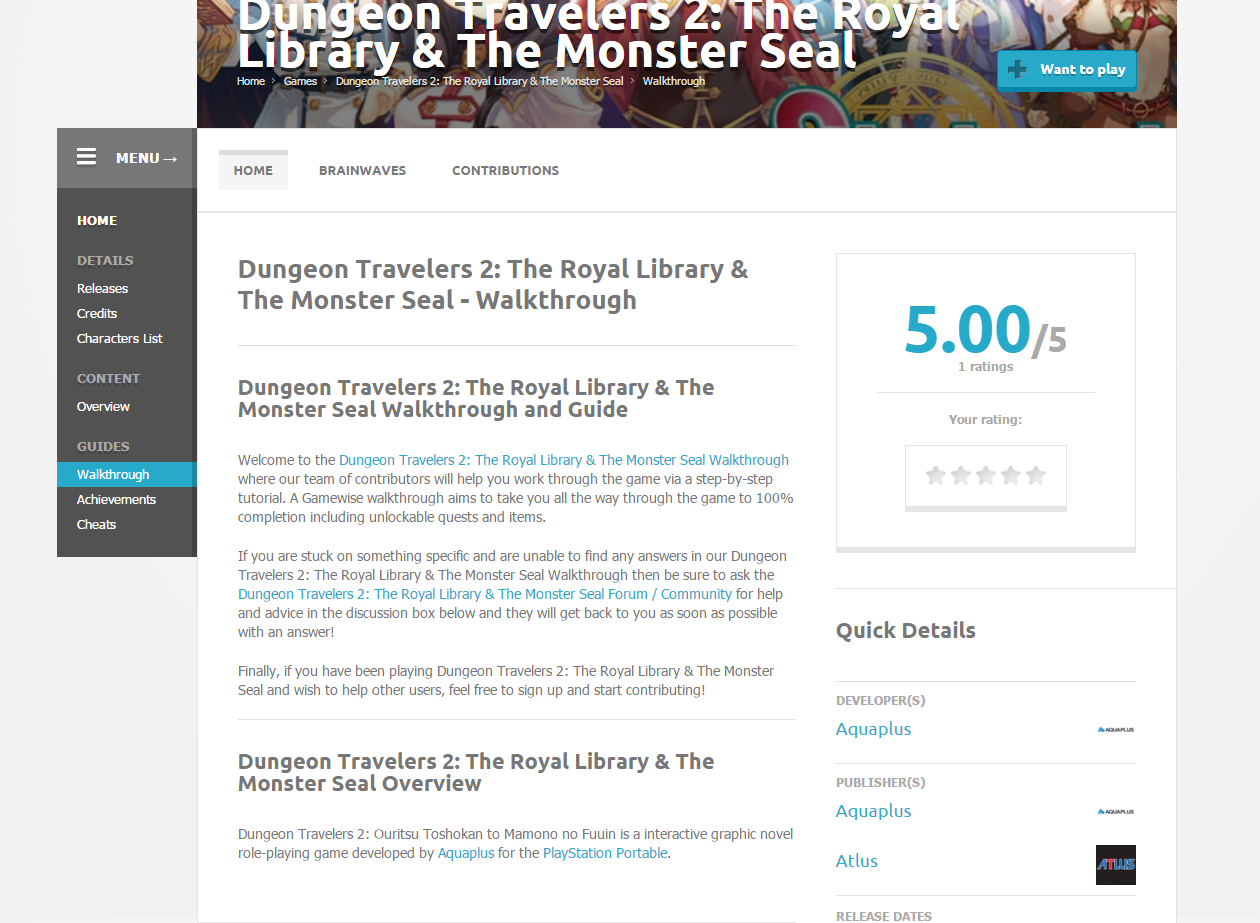
GameWise takes considerably more words to say that it doesn't have any content for the guide, and outright lies to the reader by saying its "team of contributors will help you work through the game via a step-by-step tutorial" and that it will "take you all the way through the game to 100% completion including unlockable quests and items". It's boilerplate text, of course, but it's complete bollocks and, more to the point, it's evidence of a particularly dishonest practice that goes on alarmingly frequently these days: sites that put up "landing pages" for things that people might be searching for, then don't populate them with content right away (or sometimes, as we can see here, at all) so that they can get some of that sweet, sweet ad revenue by someone who doesn't know any better clicking on them without having to put any actual work in.

This is actively making the Internet less useful, particularly as both IGN and GameWise have clearly made the effort to get themselves highly ranked on Google as a "trustworthy" source. And indeed both of these sites may well have helpful walkthroughs and guides for more mainstream, popular games, and in that instance, them showing up on Google is absolutely fine. But to list a "false positive" result like this is extremely dishonest and incredibly frustrating for the reader.

I'm reminded of the evolution of my time at USgamer. When the site launched, each of us on the team were specifically given pretty much free reign to cover what we wanted in our own personal style: the thinking was very much along the lines of 1up.com back in the glory days, when there would be distinct "personalities", each with their own specialisms, building up their own communities of readers. It was great; it was fun to write, and the community appreciated this honest style of writing.

Unfortunately, it didn't satisfy the suits as it wasn't raking in enough ad revenue. So out went the freedom and in came a more strict regime. Whereas once I took the approach that I had once taken so successfully on GamePro — look out for things that looked interesting that other sites hadn't covered in detail, then cover them in detail — I was reduced to having to seek approval for every news story I posted, and this led USgamer's news section to start looking more and more like every other gaming news site out there, covering the same old stories in the same old way.

This only got worse once I got laid off and was working out my notice; the site started to post guide content for recently released games, partly through the site's partnership with Prima Games, whose website was also part of the Gamer Network umbrella. I had to split guides into parts so they could be published across several days and rake in more clicks than they would have done if posted all in one lump; worse, I didn't have the creativity to write my own stuff, since all the content was already done and I was pretty much reduced to being a data entry person, editing and tidying up the raw copy so it looked good on the site. And, of course, even worse than that, the hours that I was tied up pissing around with these stupid guides were hours that I couldn't spend writing more interesting things or telling people about games they might not have heard of before. (I am 100% sure that this was deliberate.)

Guide content has its place, but it should be on a dedicated site that specialises in it — such as GameFAQs — not used as insultingly transparent bait to get people to visit your site and cross your fingers that they might read something else you've written while they're there. (They won't.) And it absolutely, definitely should not be used in the way IGN and GameWise use it, which is to hook people in without actually providing any content at all.

It's not just guide content, of course — IGN in particular has been caught playing the SEO game with articles about games and tricking Google into thinking they are "reviews" when they're nothing of the sort — but guide content represents by far the most egregious examples of this bullshit going on.

If you are engaging in this, you are making the Internet a less useful place to find information. Stop being a cunt and write something helpful to go with your beautifully optimised search engine bullshit, or don't list the page at all.

2212: The Stat Connection

0212_001

"Go to your Stats page and check your top 3-5 posts. Why do you think they’ve been successful? Find the connection between them, and write about it."

Daily Post, February 9, 2016

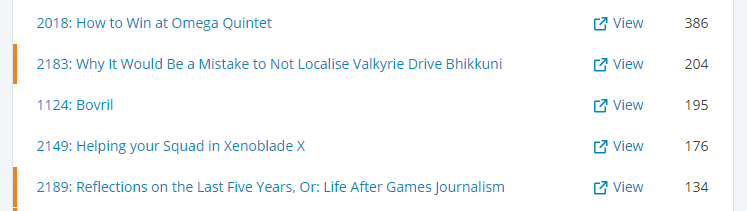
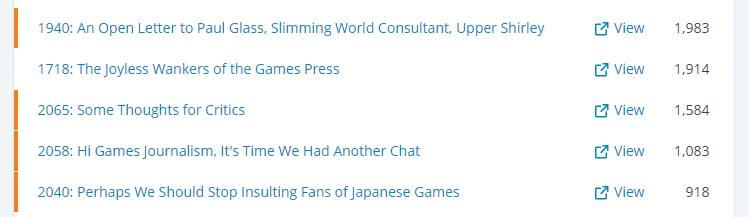
All right. Let's have a look, then. Since we're not that far into 2016 and WordPress doesn't appear to have an "all time" function to search top posts, I'll provide the top five posts (excluding the homepage, which makes up the majority of pageviews but doesn't tell me much) for both 2016 so far and 2015. In other words, these are posts that people saw the title of (probably on social media or via a search engine) and directly clicked through to, rather than simply checking my front page each day.

Here's 2016 so far:

blog2016.png

And here's 2015:

blog2015.png

All right. So let's get analysing.

Since I write about a wide variety of topics on this blog — regular readers will know that it's my personal outlet for venting about whatever is on my mind on any given day rather than any attempt to provide a coherent editorial experience — it's perhaps not surprising that not all of the entries in these two lists have something in common, but there are a few common themes along the way.

How to Do Stuff

Let's look at 2016, first. Both How to Win at Omega Quintet and Helping your Squad in Xenoblade X were written in 2015 (indicated by them not having the orange bar next to them), yet have remained consistently popular since I wrote them. The reason for this is that they are instructional content: guides for video games. Instructions or guides are consistent traffic magnets, regardless of the subject matter of your site, because one of the most common things people search the Internet for is how to do something. Video games sites often use guide content for current popular games to attract visitors to their site and guarantee a baseline of ad revenue, then cross their fingers that readers will click through to other, less "baity" content. It doesn't always work like that, of course, which is why we've seen a rise in deliberately provocative "clickbait" content across the board, not just in games journalism.

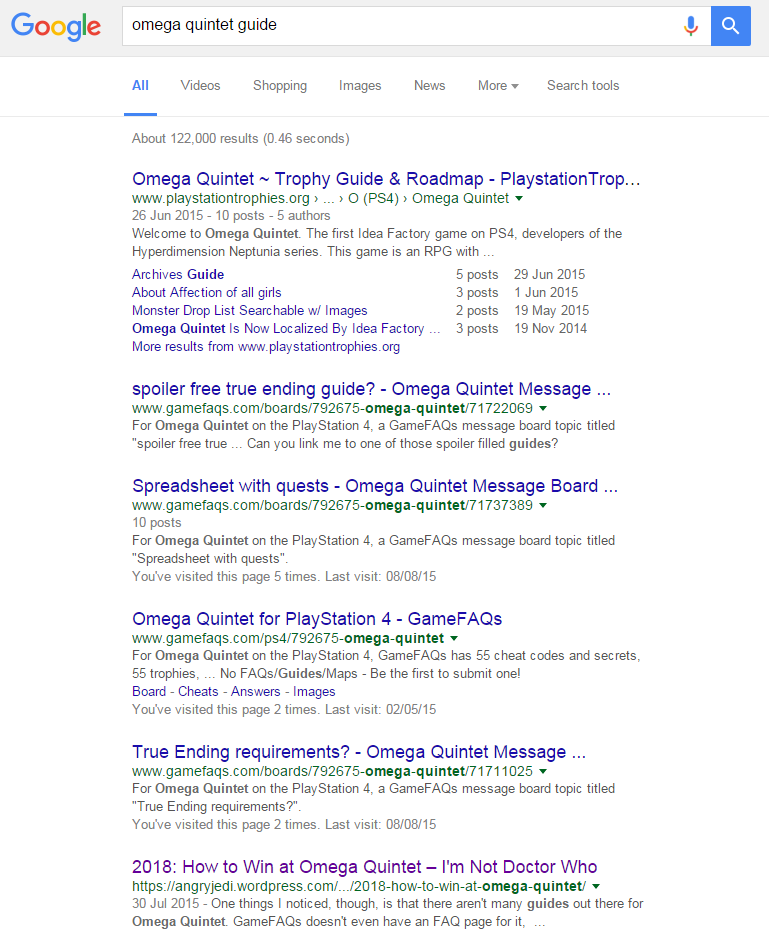
Anyway. The reason that my guide content for both Omega Quintet and Xenoblade X proved popular is that these were both games that had a specific audience, but neither of them were "big" enough for a commercial site to want to devote time and column inches to them. In other words, those searching for help when playing Omega Quintet and/or Xenoblade X would be out of luck when searching the big video games sites, but a cursory Google search would doubtless throw up my posts here fairly early on — indeed, at the time of writing, my post on Omega Quintet appears sixth in my (admittedly personalised) Google search results, embarrassingly with a typo in the preview text which I have now corrected:

omegaguidegoogle.png

It's for this reason that a couple of my other previous posts have proven popular over time: my post on How to Play Pocket Academyfor example, detailing the baffling and frankly illogical mechanics of Kairosoft's mobile-based school sim, rode high in my rankings for quite some time. I tell you: if you want traffic, write posts that tell people how to do stuff, and preferably how to do stuff that mainstream sites haven't covered.

The Power of Sharing

My most popular posts are always several orders of magnitude more popular than their nearest rivals, with perhaps the most impressive example being 2015's An Open Letter to Paul Glass, Slimming World Consultant, Upper Shirley. This post was pretty far from my more regular subject matter on popular media, particularly video games, and yet it was my most popular individual post for 2015. Why? Because it had the absolute shit shared out of it.

Paul Glass was the consultant at our local Slimming World group when I first joined, and his enthusiasm and belief in the programme was and is a big part of why I've stuck with it and had so much success over the course of the last year — I've lost six stone in a year, hopefully with more still to come off. When he revealed that he would be leaving the group to spend more time with his family in far-off climes, I felt it important to express my feelings about what he had helped me accomplish in such a way that I could be clearly understood. I'm shy and socially anxious by nature, and at the time I wrote this I'm not sure how confident I would have felt saying all those words in person, but writing them down on paper is no big deal: I can "fire and forget" that way.

Something told me that I should probably share this post a little wider than just my Twitter followers, though, and so I decided to make one of my extremely irregular visits to Facebook to post a link to the letter on the Facebook group for the Slimming World group in question. That one simple action caused that one single post to absolutely explode in popularity, as it was shared by group members, Paul himself, and subsequently by other people I'd never met involved with Slimming World in various capacities, either as group members or staff.

You never can quite tell what the next big viral sensation is going to be, but there is one thing that all my popular posts do tend to have in common:

The Passion of the Post

It is, I feel, no coincidence that my most widely shared, most popular posts are those in which I feel most passionate about the things that I am writing about. I am a person who, I feel, can express their passion for something pretty clearly through my writing. And indeed, due to the aforementioned shyness and social anxiety mentioned above, I find writing to be the easiest means through which I can express that passion to an audience that can — hopefully — appreciate what I'm saying, or at least respect it.

2015's most popular posts were all about passion, from my letter to Paul to Perhaps We Should Stop Insulting Fans of Japanese Games. Four out of the five posts above were about video games — four out of the five posts were pretty much about the same thing, in fact, which was critics' regular dismissive and unfair treatment of both Japanese game developers and the fans of the games they make — but these posts all resonated deeply both with myself and with the circle of friends I've cultivated on social media, most of whom share the same interests as me.

Consequently, much as my letter to Paul got shared far and wide, so too did The Joyless Wankers of the Games Press (actually written the year before in response to an absolutely atrocious review of Fairy Fencer F on my former stomping grounds of USgamer), Some Thoughts for Critics (a response to Jim Sterling's dreadful and ill-informed review of Senran Kagura 2), Hi Games Journalism, It's Time We Had Another Chat (a response to Mike Diver's equally dreadful and ill-informed review of Senran Kagura 2, a game which is a ton of fun but which proved to be a whipping boy for self-described "progressive" types on the grounds of the female characters' big jiggly breasts) and the aforementioned Perhaps We Should Stop Insulting Fans of Japanese Games (a response to an extraordinarily narrow-minded editorial on USgamer by my former editor Jeremy Parish, and almost certainly the reason he has me blocked on Twitter). I saw these posts get shared and reshared, not only on Twitter, but also on Facebook and Reddit, the latter of which I don't really use myself.

The things I had written had clearly got the strength of my feelings across, and other people felt like they could relate to them in some way — either agreeing or disagreeing — and this caused them to explode in popularity, at least in terms of numbers. The same, too, can be said for 2016's Why It Would Be A Mistake to Not Localise Valkyrie Drive Bhikkunian impassioned plea for the progressive loudmouths not to stop Senran Kagura creator Kenichiro Takaki's new game making it over to Western shores.

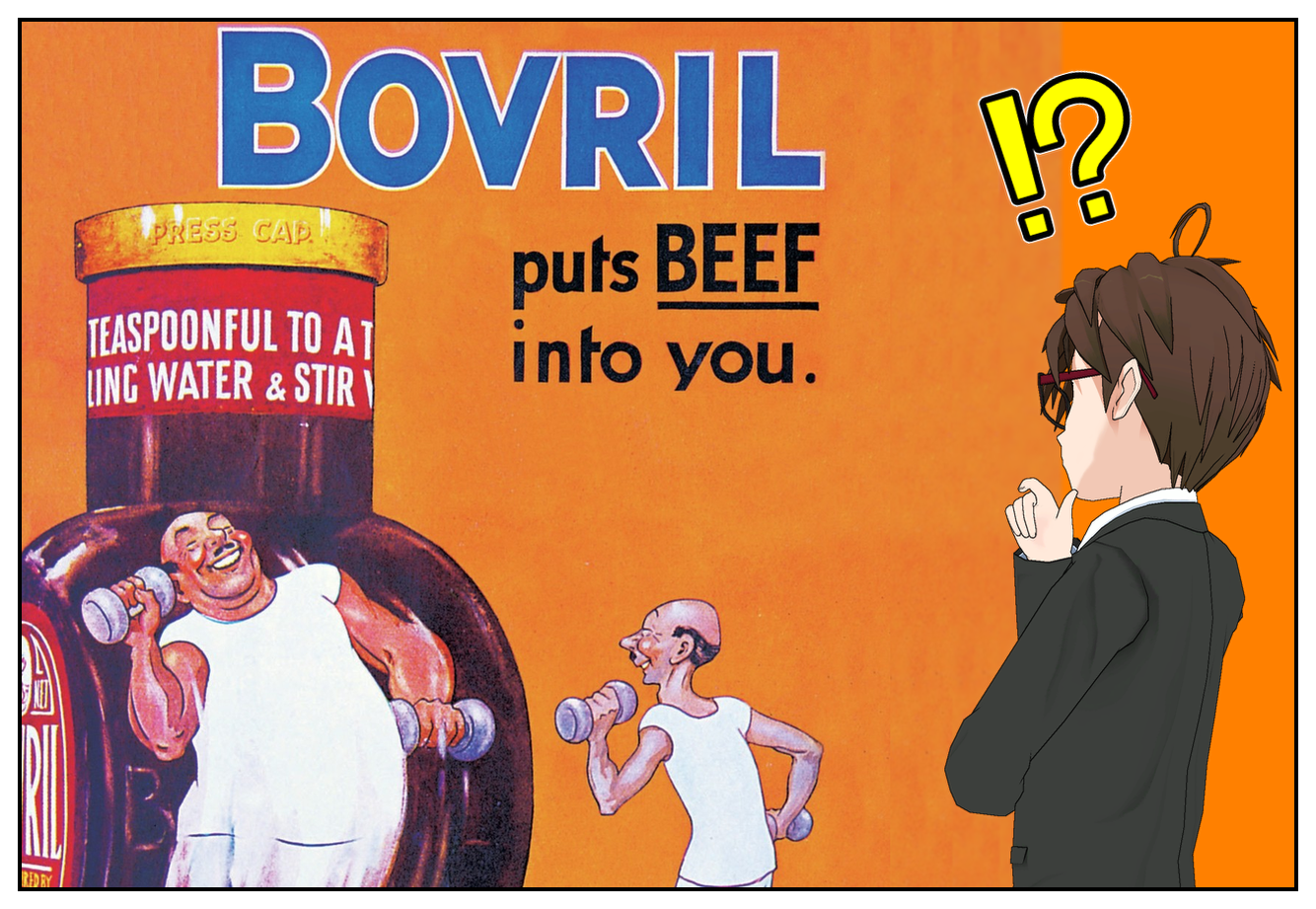
Bovril?

I'll be honest, I have no idea why a post from 2013 about beef-and-yeast-extract black sticky substance Bovril is my third most popular post this year so far, but oddly enough this post has been consistently popular: it finished 2015 in sixth place, just after my various rants at the games journalism industry and also ranked sixth in 2014, but only managed 19th place in its original year of publication.

It's not even a particularly exciting post: it simply describes what Bovril is and how I feel about it. It doesn't even appear on the front page of Google results for Bovril. But I guess it meant something to someone somewhere. Perhaps not many people write about Bovril on the Internet, and my post offered a safe space for Bovril fans to convene and share in silent contemplation of salty beef drinks. Or perhaps it's just one of those things that can't quite be explained.

So what can we learn from this?

There are a few things you can probably see my most popular posts have in common. To my eye, these things are:

  • A clear, conversational title that makes it clear what the post is about — i.e. a simple subject line rather than a "title" that tries to be clever or funny
  • Passion for the subject — clear emotion, either positive or negative, is infectious and relatable
  • Scope for sharing — be it a topic that a lot of people feel strongly about, or something that is written in such a way that presents a strong argument in favour of or against something
  • Complete honesty — even at the expense of a few "bridges" if necessary
  • Instructions on how to do stuff — particularly if nowhere else has published instructions on how to do that stuff

Not all of my most popular posts have all of the above elements — although I do make a specific effort to apply the "complete honesty" element to everything I write — but these are, by far, the most common factors that all of my most popular posts have between them.

I hope that's proved as enlightening for you as it has for me: it's certainly given me some food for thought with regard to what to write about going forward from here, so I'd say both as a writing exercise and an analytical investigation, this post has been a great success.

Thanks, Daily Post!