#oneaday Day 547: School books

I've been thinking about school again. I do that a lot for some reason. Nostalgia for happier days in the past, perhaps. A melancholy reflection on a failed career. Or an earnest desire to go back. It doesn't really matter. I do it a lot, regardless.

One of the things that my brain has decided to fixate on today is the concept of "school books" — specifically, exercise books. I don't know why, but I really liked having a book for each subject's work.

Obviously, from a practical, logistical perspective, it makes sense to have one book per subject, particularly in secondary school, because pupils tend to have different teachers for different subjects. But it also makes sense in primary school to a certain degree, as it allows the teacher to clearly demarcate different subjects' work — which is taught at different times in the week — and for the pupils to easily compartmentalise the various things they've been learning.

I don't know. There was something inherently pleasing about every subject having its own colour, and I bet a lot of schools around the country used a similar colour scheme. We had red for English Language, green for English Literature, grey for Maths, orange for Science, blue for Languages, a different green for the subjects grouped under "Humanities" at our school (Geography, History, R.E.), and your Journal would be a different colour according to what year you were in.

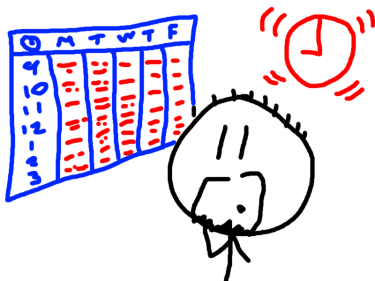
That Journal was a handy little thing, too. It was essentially a weekly planner where we could record any homework we got from our subjects and the date it was due; it was then, of course, up to us to check it regularly and ensure we actually did that homework. This was before any sort of handheld electronic devices with reminders on them — pre-"smart" mobile phones didn't become particularly widespread among me and my peers until we were into sixth form. It was a good and healthy thing to do, I think; it helped teach us matters of personal responsibility — and also occasional bullshitting on the inevitable occasions when we had forgotten to check it properly.

The Journal was treated like some sort of holy book, though. Every single week, we had to get it signed by our parents to prove that they had seen we had been recording our homework, and every week, our form tutor had to sign it to confirm that our parents had signed it. A space on each week's spread was also set aside for any communications between our form tutor and parents — for more serious infractions, of course, you got a Letter Home from the school office, but for minor things (and not necessarily problems!) there was this space in the Journal.

Heaven help you if you doodled anywhere on your Journal, though. Defacing it in any way was an immediate ticket to having to buy — yes, buy — a new one. As you might expect, the end of term rolling around was an immediate signal to many of us to immediately deface the crap out of the Journal for the term just gone. These defaced Journals became companions to "The Rough Book" among me and my friends — there was something about the neatly laid out tables in the Journal that made it ripe for customising with ridiculous doodles. My favourites were ones where we absolutely covered the page with tiny stick figures, all standing on the various lines of the table, flinging themselves off the edge and getting up to no good. I kind of wish I still had some of those.

It was the same for your subject exercise books, of course. Some teachers insisted that, as our inaugural piece of homework for a new term, we should cover our exercise book as a means of discouraging and/or preventing any doodling on the cover. Most people went the "wrapping paper" route, but there was a fun degree of self-expression among us all, and there was always some posh git who would laminate the cover of their book at their Dad's office or whatever.

I realise, of course, that the relative strictness with which we were taught to treat our school equipment can be looked on, from some perspectives, as being stifling to creativity and borderline authoritarian. School in general has always been designed as a means of, among other things, socialising us into becoming "good citizens" — and part of that, at least when I was at school, involved treating things with respect — whether they were the things that had been given to you by the school, the things you had brought in from home, or the things your peers were using.

It didn't always happen, of course, but there was a certain degree of pride that pretty much everyone had in their school possessions. Outside of covering books, one of the best ways to express one's individuality was through the stationery you brought to school — and the pencil case in which you kept that stationery. Some folks had cool, branded, zippered pencil cases; others had little tins. I remember my proudest pencil case at school was a Nintendo-branded tin with Super Mario Bros. pixel art on the front; it was also one of my least practical pencil cases due to its size, but I loved it nonetheless.

Anyway, you'd think I'd have a point about all this but I really don't. Something just got me thinking about the colour of school books, so that's what I've talked about today. Hey! They can't all be winners. Or perhaps you found this absolutely fascinating, in which case I am happy to have served.

Either way, at 20 past midnight I think it's probably time to go to bed.


Want to read my thoughts on various video games, visual novels and other popular culture things? Stop by MoeGamer.net, my site for all things fun where I am generally a lot more cheerful. And if you fancy watching some vids on classic games, drop by my YouTube channel.

If you want this nonsense in your inbox every day, please feel free to subscribe via email. Your email address won't be used for anything else.

#oneaday Day 541: Back to school

I often think about my time at school and, while there were certainly elements of my experiences as a teenager I am very glad to have left behind, there's a lot I miss — to such a degree that I often find myself wondering if there is any sort of way one can get oneself into a situation, as an adult, that works similarly to school. A situation that isn't, like, prison or something.

I thrived in school — particularly secondary school. For the most part, I dealt well with the inherently predictable nature of a timetable — though I have recurring quasi-nightmares about being back at school and not having a clue what my weekly schedule is — and I didn't even mind having homework all that much. I did well in lessons, though I tended to be fairly quiet rather than the sort of person who was always the first to answer teachers' questions, and I ended up with good grades. Not perfect grades, mind, but good grades, nonetheless.

I'm not really sure what it is about the school experience — as opposed to, say, university — that I find so particularly appealing. Perhaps it's the inherent variety of things that you study, at least up until you start choosing "Options" for Years 10-11 and, if you're going on to do them, Years 12 and 13. There's definitely an element of that, because when I think back on some of my fondest memories of time at school, the visual part of the memories is very much associated with my "lower school" experience — Years 7-9.

That was the time when you study all sorts of things, with multiple subjects every day, and each and every day was packed with things to do. Sure, you didn't always like every one of those things you had to do each day — for me, Maths and P.E. were my particular bugbears — but you endured them, along with the things you actually liked, and sometimes you'd even surprise yourself with how well you ended up performing. I have zero achievements of note in P.E., but I did get an "A" in Maths at GCSE, which was pleasing.

Early secondary school is a time you get exposed to a lot of things you wouldn't have thought about studying, too. I remember being surprised how much I enjoyed language lessons — particularly German, which I liked more than French — and Science, although not a subject I had any intention of pursuing beyond a passing interest, was always full of interesting and unusual situations.

As you might expect, my biggest strengths were English and Music. In English, I relished the opportunity to write a lengthy essay about something we'd been studying — whether it was on the "language" or "literature" side of the fence — while in Music, I was often quite ambitious with my compositions, and in terms of performance I was considerably ahead of anyone else in my class thanks to the years of private piano lessons I'd had by that point.

It was nice to be good at something, and to have tangible proof that I was good at it in the form of good grades, certificates and, eventually, qualifications. I think that might be one of the things I miss the most in life as an adult — the simple knowledge and confidence that you can do something, and that someone is going to acknowledge that you are good at something, even reward you for it. It didn't have to be a big reward — I was a sucker for the "Merits" and "Commendations" we had at secondary school, and those were just little signatures on a page of our Journal and occasional certificates — but that little bit of acknowledgement that yes, there was something you were good at, and that gave you value as a human being, was pleasant.

I am not, obviously, advocating for modern employers to start implementing systems of "Merits" and "Commendations" for their employees, because I feel that most people would probably find the whole thing incredibly patronising. Interestingly, back during my brief period of time working for the shithole energy company SSE, I found myself thinking that a lot of the way the company did things was like how it was back in school — but in that situation, it was a negative thing. The difference? SSE wasn't interested in celebrating the successes of people and the things they were good at — they were, instead, obsessed with making themselves, as a company, look good, and specifically going looking for things they could reprimand their employees for.

Schools have to have a solid behavioural policy in place, of course, but I always found it pretty easy not to run afoul of it — and on the few occasions when I did, I knew it was a completely fair cop. SSE, meanwhile, would bollock you if you didn't hold the handrail when going up some stairs, for going under your desk to pick up a pen you'd dropped without wearing a "bump cap", and for not reporting the fact that you'd spilled a tiny bit of water from your cup carrying it back from the cooler to your desk — and all that absurdity meant that there was no time left to actually praise anyone for doing a good job.

So you can't just transplant elements of the school structure into a corporate environment without thinking about the things that make school good for those who thrive in that environment. I don't know what the answer is, and at this point I'm not even entirely sure what the question is any more either. I'm rambling. I'm tired. I'm a bit cold. So I think I'll leave that there and go to bed!


Want to read my thoughts on various video games, visual novels and other popular culture things? Stop by MoeGamer.net, my site for all things fun where I am generally a lot more cheerful. And if you fancy watching some vids on classic games, drop by my YouTube channel.

If you want this nonsense in your inbox every day, please feel free to subscribe via email. Your email address won't be used for anything else.

#oneaday Day 436: RIP my sixth form

When I originally went to secondary school, my school was known for having a good sixth form. For those unfamiliar (i.e. not British, I suspect), a sixth form is where you go for "further education" (as opposed to "higher education", which is university) after your compulsory 11 years of school in the UK. It's called sixth form as a hangover from the old method of numbering school years, where primary education didn't really have a fixed method of distinguishing year groups beyond "infants" and "juniors", and then secondary education from 11 onwards started at "first form" all the way up to "fifth form". Today, primary education starts at Reception, then goes from Y1 to Y11 as one continuous run from primary to secondary, with most secondary schools starting with Y7. While some people do refer to sixth form as "Y12 and Y13", the term "sixth form" has, for one reason or another, stuck.

Anyway, none of that is the point. The point is, my school used to be known for having good sixth form provision. It's one of the reasons I went there, as I was a bright child and it was probably a given that I was always going to stay on into post-compulsory education, and indeed I did — two years of sixth form, then four years at university. I was fortunate enough to be in a year group that was the first to take advantage of a brand new sixth form centre built (well, adapted from the former upper school dining hall) on the premises, and it was a really lovely facility. I had a wonderful time there; I enjoyed my studies, I made and solidified a number of friendships, and, as I've remarked a number of times in this blog, I think I count those two years as possibly the happiest, most content of my life.

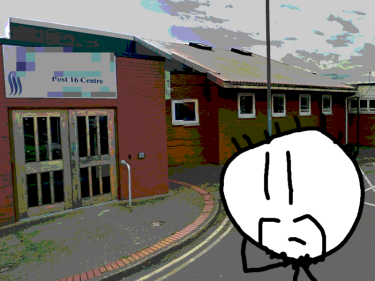
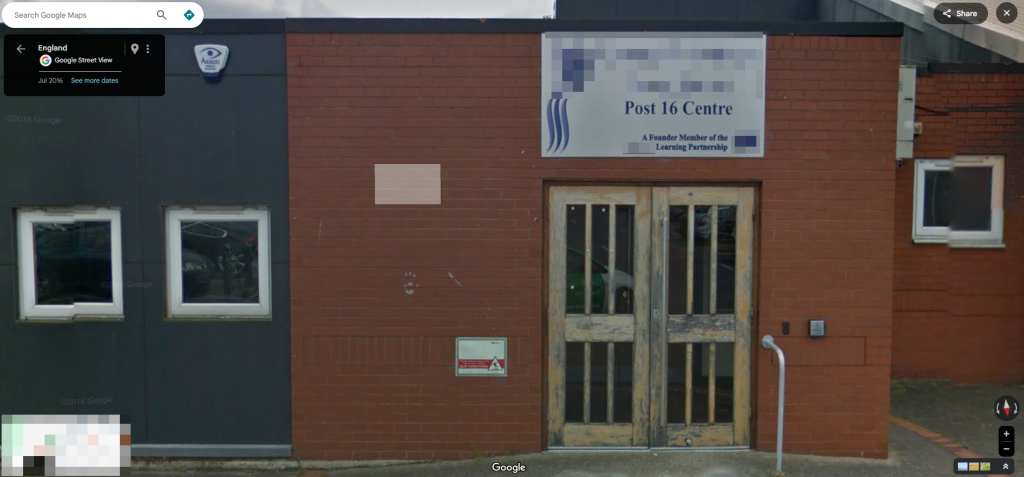
Every so often, I like to check in on my old school. No real reason, I'm always just curious how it's doing. It never was an amazing school, outside of the sixth form provision, and it's certainly had its challenges over the years. What I was rather surprised to see when I took a Google Street View down to the premises was this:

(Pixelations are mine; I just don't want randos looking up my old school for whatever reason.)

I saw those doors and thought, hang on. That doesn't look right. That building used to be the pride and joy of the school campus, so why haven't they painted the doors for what looks like several decades at this point?

It's because, it seems, the sixth form that was once one of the best things about that school is no more — and, in fact, it has not been a thing since 2015. (The photo above was taken in 2016, which just goes to show how frighteningly quickly a building can start looking dilapidated and shitty.) I found this out from looking at the school's Wikipedia page — I was surprised to discover it even had a Wikipedia page — but there it was, the cold, hard facts. I followed the links to see the news and yes, it seems it's true; the "Post-16 Centre" where I had such amazing, wonderful memories, is no more.

Now, I suspect the school today has made use of this building rather than just leaving it there; there's no way for me to know short of actually going to visit it, and I haven't been there in person for probably more than 30 years at this point. I see from its prospectus and willingness to book out its various large "venues" to the community — something the school had always done, making it a true "community school" — that it has a "performing arts space" that may or may not make use of that old space. Hard to tell, really.

Regardless, I feel a bit sad about this. That sixth form centre opened with such positivity and excitement for the future, and it was genuinely exciting to be part of it. The facilities were good, there were comfortable common areas to relax and socialise, and we felt proud to be part of something new and wonderful. I was surprised and saddened to see that the dream for that space apparently hadn't lasted; the school now has no sixth form provision of its own at all, instead collaborating with another local school (a longstanding "rival" back when I was there, but now part of the same "educational partnership", whatever that means) to provide sixth form provision for both schools' students.

I don't know if all this is because sixth form numbers were on the decline, or the building wasn't cost-effective, or whatever. All I do know is that it's a shame, and I feel a bit sad. You really can't go back, but at least you always have those precious memories, I guess.


Want to read my thoughts on various video games, visual novels and other popular culture things? Stop by MoeGamer.net, my site for all things fun where I am generally a lot more cheerful. And if you fancy watching some vids on classic games, drop by my YouTube channel.

If you want this nonsense in your inbox every day, please feel free to subscribe via email. Your email address won't be used for anything else.

#oneaday Day 312: Memories of Me: the teachers who inspired me

I've talked before about how I think my schooldays, and particularly my time in Sixth Form (which was at the same school) were among the happiest times of my life. Once I'd got over an initial bout of bullying in Year 7, of course, which was resolved by me punching my tormentor firmly in the face just as the headmaster was coming around the corner.

One of the reasons I think back so fondly on my time at school — particularly secondary school, which is what I'm going to focus on today — is because I had a lot of great teachers who inspired me, encouraged me, recognised the things I was good at and generally did a great job of making me feel like I wasn't a completely worthless human being with terrible hair, atrocious dress sense and a complete inability to socialise normally. (Retrospectively, of course, I recognise that the latter aspect — and perhaps some of the others too — stem from my autism, but I didn't know that back then.)

I thought I'd describe a few of them today. I don't know what happened to any of them after I left school, as I didn't stay in touch with any of them — something I kind of regret a bit, now — but I can say, with confidence, that they made a positive impact on my life in some way, and the memories I have of the time I spent learning with them are some of my most treasured.

Let's think through subject by subject.

In the English department, I had a run of excellent teachers over the course of the years of both compulsory and post-compulsory education. There was Ms Derbyshire, who reminded everyone of Victoria Wood with her general demeanour and tone, and who had a delightful sense of humour. There was Mr Bowie, who was probably the "coolest" teacher in school, who knew his stuff and managed to be knowledgeable without being a nerd. He taught me about Jeff Buckley. There was Miss Idziacysyk (I think that's how you spell it — it's been a very long time since I wrote it and Google is no help!), who took no shit but was also a really knowledgeable teacher of both English Language and English Literature. And there was Mr Lack, who was a kind and gentle soul unless you pissed him off.

In Maths, I should give particular praise to Mr Wilbraham, who had a… strange reputation to anyone who had never taken classes with him — a reputation I shan't repeat out of respect for him… and the fact we never really knew if it was true or not — but who turned out to be an excellent, friendly, supportive and good-natured teacher. I disliked Maths intensely, but I put up with it and somehow managed to remain in the top group for it throughout the entire time I was forced to take it, and the lessons with Mr Wilbraham in Year 10 and 11 were probably the closest I had to "favourite Maths lessons".

In Science, I had a lot of great teachers, too. There was Miss Bartlett, who everyone fancied because she had long blonde hair and wore quite short skirts, but who also got us involved in doing practical experiments pretty much from our first lesson in Year 7. There was Mr Allured, who had a booming voice you could hear a mile off, and a personality (and moustache) that made him feel like everyone's dad. And there was Mr Maskell, who looked like Harry Secombe and was a cheerful soul, always keen to show us his "volcano" experiments in the fume cupboard.

Music was a focus of my time at secondary school, and I had a wonderful time studying with, at various times Mrs Choy-Winters, Mr Murrall, Mr Wrigley and Miss Garrick. Each had their own specialisms, but all were incredibly supportive of me, and keen to make use of the fact that my musical skills, particularly on the piano, were significantly ahead of pretty much all of the rest of the school. I ended up doing a lot of accompanying various musical groups during my time at school; school concert nights were some of my favourite times of the year. There's probably a whole post in me just on school concerts, so I'll save any further discussion of that for then. I will just add that I have recurring mild nightmares about disappointing my Music teachers and no-one else from this list.

I managed to wangle things at GCSE so I could do Theatre Studies alongside Music instead of having to do an Art or Technology class I really didn't want to do. There was only one drama teacher at our school, known as Miss Unsworth — although the headteacher Mr Cragg occasionally taught drama lower down the school — and she was quite the character. She was definitely a "theatre person", and she taught us a lot both through our lessons and in the productions of The Wizard of Oz and Twelfth Night I took part in during my time at school.

In Modern Languages, we had the good fortune to have a native German speaker known as Herr Haubert. We used to take the piss a bit because of his somewhat stern attitude, his rather severe moustache and the fact he perpetually smelled of spearmint — for some reason, our teenage selves became convinced that this was because he was always chewing mint flavoured condoms, not actual mints or gum, which would have made more sense — but I can't deny that he was a good teacher. Immersing us in the target language right from the first lesson, I can still remember a decent amount of German that I learned in those classes. Not enough to be confident or fluent, but definitely enough to get by in an absolute emergency.

In the Humanities, or "Hums", we had several great teachers. There was Mr Watts, who was our formidable head of Sixth Form, an excellent history teacher and someone who didn't believe anyone under the age of 15 had any right to exist in his line of sight; Mr Mason, an ageing hippie who taught Geography and could bring an entire class to silence by lowering the volume of his voice rather than raising it; and Mrs Lloyd, who helped make my A-Level Sociology studies entertaining and fascinating.

I had a look back at my school's website, knowing full well that I was there a very long time ago at this point and thus was unlikely to see any familiar names, and I was proven correct. I suspect many of the people I've just mentioned have retired or perhaps even passed on by this point, which is somewhat humbling to think about. Wherever they are and whatever they're doing, though, I hope they know that they had an impact on me, and that I still think about them very fondly. It's true that your school days play a crucial role in defining who you are — and the teachers who guide you through those school days are an incredibly important part of that.

So thanks to all of the teachers of my youth, both the ones I've mentioned and the ones I've inevitably forgotten. My life may not have gone exactly as planned in numerous ways, but I always felt I had a solid foundation to build from, and it was all thanks to them.


Want to read my thoughts on various video games, visual novels and other popular culture things? Stop by MoeGamer.net, my site for all things fun where I am generally a lot more cheerful. And if you fancy watching some vids on classic games, drop by my YouTube channel.

If you want this nonsense in your inbox every day, please feel free to subscribe via email. Your email address won't be used for anything else.

#oneaday Day 292: Thriving within limitations

Most of you reading this who are at least A Certain Age will probably think back on your school days with varying degrees of fondness, but I suspect pretty much all of you are glad that those days are behind you for one reason or another — the chief one being the freedom you have once you are no longer constrained to an institution's timetable and rules.

As I get older, this is probably the rose-tinted nostalgia talking, but I increasingly miss that whole sense of structure that the school day had. I'm talking as a student here, not as a teacher; as a teacher, the school timetable was nothing but a source of stress, particularly when I forgot I was supposed to be "on duty" (whatever that actually means) and ended up on the receiving end of snarky comments from dickhead colleagues. But I digress.

No, I'm talking about the sense of structure you have when you are a student: the knowledge of exactly what is going to happen when for the day ahead, and the fact that you know your time is most likely going to be spent in at the very least a vaguely productive manner for the next 8 hours.

Sure, there were always the lessons that summoned up the inevitable sense of dread — Maths for me — and, of course, there was always the blind panic you'd feel when you realised you hadn't done the homework for the lesson that was scheduled for immediately after break, leading to frantic completion of said homework outside, leaning on a wall and hoping your teacher for the next period doesn't wander past and clock what you're doing.

But for the most part, it was nice to wake up of a morning and know what to expect. It was nice to have "favourite days" because that's when your best lessons were. It was nice to know exactly when you'd have the opportunity to work with your friends, or learn from a favourite teacher.

If this all sounds insufferably swotty, I don't know what to tell you; outside of some bullying incidents (where I was the victim, I hasten to add) I mostly thrived in secondary school in particular, and I enjoyed having things that I was good at, and which got acknowledged as things I was good at. Because heaven knows I wasn't "cool", and I knew that wasn't likely to change, ever.

I often find myself thinking whether the daily grind of work could be made better if I split it into discrete "periods" like the school day, with specific times set aside to do specific things. I suspect it actually might, but actually developing that schedule has been my sticking point. As a lot of my work is pretty self-directed, I'd be responsible for both setting and sticking to that schedule, and I'm not sure that's what worked well for me back when I was at school. Rather, I think I thrived because I had a schedule set by someone else, and during that schedule I was told exactly what to do, and exactly what was expected of me — again, by someone else.

I know part of "growing up" is being able to do those things for yourself, but lest we forget, I am what is politely termed these days as "neurodivergent", and thus I find myself wondering if I wouldn't just be better off in a situation where someone sits me down, says "9am-10am, you're doing this. 10am-11am, you're doing this. Then go have a bit of a break. Then 11.15-12pm, you're doing this…" and so on.

Sure, we have weekly Teams meetings (God, I hate Teams meetings… scratch that, I hate meetings in general) but those aren't exactly what one might call "engaging" in the same way a good old-fashioned school lesson was. Perhaps I was just fortunate enough to have, on average, very good teachers, and in other places, school is, in fact, ideal preparation for a life of adult misery in Teams meetings. But I doubt it.

Anyway, perhaps I should actually make an effort and try the "schedule" thing for myself. Who knows, it might actually work? Can't hurt to try, right?


Want to read my thoughts on various video games, visual novels and other popular culture things? Stop by MoeGamer.net, my site for all things fun where I am generally a lot more cheerful. And if you fancy watching some vids on classic games, drop by my YouTube channel.

If you want this nonsense in your inbox every day, please feel free to subscribe via email. Your email address won't be used for anything else.

#oneaday Day 218: Memories of Me: Sixth Form

I occasionally find myself pondering when I think the happiest time in my life was, and I always conclude with one of two closely related period: sixth form (for non-British folks, this is the optional "Year 12" and "Year 13" you take if you want to stay on in non-compulsory education after finishing secondary school, typically taken before going to university) and my four years at university (three on my BA in English and Music, one on my PGCE in Music). Today I want to reminisce a bit about the former.

There was absolutely no question as to whether or not I was going to stay on at school after I finished compulsory education. My life has, to date, followed the typical autistic/ADHD trajectory of performing very well in school, then sliding into tepid mediocrity in adult life, so at the point I was finishing my GCSEs, I knew that I wanted to stay on and keep studying. I ended up choosing English Language, English Literature, Sociology and Music as my four subjects; at my school, it was considered unusual to take four A-Levels (five if you count General Studies, but no-one in their right mind does, for reasons that will become apparent), but all my teachers agreed that I could handle it. So I did. (And I did.)

I was excited about sixth form. I had seen my brother pass through sixth form at the same school some ten years earlier, and I knew what a good time he'd had while he was there. He'd made some good friends, he'd had a band, he had a long-term girlfriend, and he'd studied some interesting-sounding stuff that wasn't anything like the boring old National Curriculum gubbins I'd gone through lower down the school. I was looking forward to the whole experience, though I was also nervous about a few things.

One of them was the fact that I'd have more contact with a teacher known as Mr Watts, who was renowned at our school as one of the most terrifying teachers there was. He taught History, had a severe-looking moustache that always make it look like he was furious and, to be fair, he often seemed to be furious — particularly at anyone under the age of 15.

I'd actually had a year of Mr Watts as a History teacher in… Year 9, I think it was? Kids of that age are just on the cusp of what he considered to be actual human beings, so we got a bit of a taste of what he was really like. He could still be terrifying if someone stepped out of line, sure, but he also had a wicked sense of humour, and was a genuinely excellent teacher.

That didn't stop me being nervous about the fact he was head of Sixth Form, though. I don't really know why, because I wasn't the sort of kid who got into trouble particularly regularly (I think I had a grand total of two detentions during my entire time at school, at least one of which I managed to wangle my way out of thanks to music rehearsals) but Mr Watts just had that sort of impressive aura about him that made you want to stay well and truly in line.

Thankfully, we quickly discovered that Head of Sixth Form Mr Watts was a completely different person to History Teacher Mr Watts. He was much more down-to-earth, much more willing to let that sense of humour shine through, and extremely supportive of anyone who came to him with questions or concerns. He was a comforting presence, in other words; it was a surprise to many of us, to be sure, but a welcome one.

Our year was the first to make use of the new sixth form centre that had been built on our school's campus. The Upper School Dining Hall (aka just "Upper Dining") had given its life so that the Sidney Banks Sixth Form Centre may live, and it was great. The building, being new, was in great condition, and it was outfitted with reasonably decent PCs for the period; prior to joining the sixth form, most of our computer-related lessons in school had been on Acorn Archimedes computers, but by the time we reached sixth form, proprietary platforms like the ol' Archie were falling out of favour as Windows 95-equipped PCs became the norm in homes, offices and society in general.

The sixth form centre mostly consisted of computer rooms, in fact. Each of its "classrooms" were in fact just rooms with tables and a bunch of PCs, and the main large room in the middle was split in half between the common room and a study area (with more computers), with a sliding divider door allowing for the rooms to be separated completely when necessary.

In the common room, we didn't have a lot of exciting facilities, but I recall we did have a stereo, and folks tended to bring magazines in and leave them for others once they were done with them. For the most part, though, the common room was a space for chilling out, hanging with friends and making use of any of your own entertainment that you had happened to bring.

As it happened, I ended up spending a lot of my time in sixth form in the Art room. My friends Ed and Woody were both studying Art, so in the times where I wasn't attending my own lessons, I tended to hang with them in there. Since the number of folks studying Art at A-level was relatively small, they had their own little common area in the corner of the art room; again, it wasn't really equipped with anything other than a few chairs, but it was a nice place to just hang out.

One thing we were supposed to do as part of our time at sixth form was attend General Studies lessons. We would, we were told, get another A-level out of these lessons, but after attending just one or two at the start of our time in sixth form, we realised that they were largely worthless, so we just… stopped going. And, as part of the whole "treating us as adults" thing that came along with joining the sixth form, no-one ever pursued us about it or queried us on it.

Well, that's not quite true. One General Studies period we did see Mr Watts out and about, seemingly looking for people, so we hid under the chairs in the Art room common area. But that was just once. We all did the exam at the end of our two years in sixth form; I don't know how anyone else did, but I got an "A" having attended one lesson in two years. That should give you a general idea of what General Studies is all about. (One of the questions on the final exam paper was "In Alice in Wonderland, the text describes the Cheshire Cat as 'disappearing tail first'. Assuming the cat did not simply vanish, which direction must he have moved to disappear in this way?")

I mostly enjoyed my A-level studies. I particularly enjoyed English Language, because we got to write essays about swearing, and English Literature exposed me to a variety of interesting novels and plays that I probably wouldn't otherwise have read. Sociology was a thoroughly interesting subject to study, too, and the overall "vibe" of those classes was quite interesting given I was the only boy present; the rest of the class was all girls, and our teacher, Mrs Lloyd, was, of course, a lady also. I wasn't made to feel out of place or anything, I hasten to add; in fact, throughout my time at secondary school, I'd become good friends with a lot of the girls in that class already, so it was nice to have some time where it was just me and them.

Music was a good time, also. At the time I was doing A-level Music, I was also preparing to take my Advanced Certificate practical exam, and doing so basically exempted me from having to do some of the Music A-level, which was pretty neat. The only bit of the Music course I didn't like was learning about how to do Baroque four-part harmony; it felt like it was frustratingly bound by rules rather than truly creative, and I didn't like the teacher much, either. He wasn't one of the regular Music teachers; he was actually the peripatetic strings teacher.

One of the best things about sixth form was how we weren't obliged to stay on the school campus all day if we didn't have lessons. That meant we often walked into town; it was probably about a mile's walk from the school to the town centre, and being young and (relatively) spry at the time, we could do this in a not-unreasonable amount of time.

Our typical town routine involved wandering down there, getting a steak slice and a Belgian Bun from The Baker's Oven, then visiting the CD shop Barneys and computer shop First Compute. Inevitably, upon a visit to the latter, I would be encouraged by my friends to pick up a new game, which I often did, and then we'd head back to school. The reason I was able to grab so many new games at the time was because I'd done some occasional freelancing for PC Zone and the Official Nintendo Magazine, and back in those days you'd get £500 for one article — an absolute fortune to a teenage kid, and, hell, an absolute fortune to anyone involved in freelancing for the games press today.

On one trip to First Compute, I happened to see that a budget rerelease of a piece of software called Klik and Play for PC was on one of the racks. I recalled reading a fun review of this in PC Zone by the one and only Charlie Brooker; a review that had attracted numerous complaints (as did many other pieces Brooker contributed) for using a game in which you knocked a decapitated Frenchman's head around the screen as its demonstration project.

I was attracted to Klik and Play because it promised programming-free game making. I'd previously learned to program in BASIC on Atari 8-bit and STOS on Atari ST, but had never really got into the upper echelons of "knowing how to code", and by this point in the late '90s, "coding" had moved into realms like C and Java, and I didn't really understand those at all. Klik and Play promised to allow creativity without needing to get super-technical, so I was excited to give it a go.

And boy did we love it. Not just me, but my friends Ed and Woody, too, since of course I let them borrow the disc and install it on their own PCs. We made so many stupid games with Klik and Play, many of which remained unfinished, but our crowning achievement was, without a doubt, Pie Eater's Destiny.

This was a game where we'd started with the title, which was intended to take the piss out of our mutual friend Andrew, who was a big lad and enjoyed the game Fighter's Destiny on Nintendo 64. It grew a life of its own after I was demonstrating how to use Klik and Play to Ed and Woody one day, and I imported a scanned image of Andrew's face as an enemy sprite, then added a ripped Contra sprite for the player to move around and shoot at the giant head.

Something about this stupid, humble beginning captured our imagination, and we ended up making a full game with full voice acting, with each level unfolding as a single boss fight against a digitised head of someone we knew, culminating with a battle against the most powerful force in the galaxy: Mr Watts.

Naturally, once Pie Eater's Destiny was completed, we brought it in to school to install on the sixth form computers, and we ended up showing it to Mr Watts. We were initially nervous about this, but the moment he saw that he was the villain, with his introductory line being simply "YOU PATHETIC BASTARDS, YOU WILL NEVER DEFEAT ME! MUHAHAHAHAHAHAHA", he was absolutely delighted with it.

My time at sixth form is full of wonderful memories like these. I don't recall a single moment of being unhappy while I was at sixth form, and dear Lord, I miss living that life and being that person.

But you can't go back, can you? So these memories have to remain just that: memories. Still, I will always have them, and when times get tough I can think back to a time where life just seemed simpler, easier, more full of possibilities. Not everyone has the luxury of good memories like this, so I should treasure them. And you'd better believe that I do, as the preceding 2,000 words has hopefully made clear.


Want to read my thoughts on various video games, visual novels and other popular culture things? Stop by MoeGamer.net, my site for all things fun where I am generally a lot more cheerful. And if you fancy watching some vids on classic games, drop by my YouTube channel.

If you want this nonsense in your inbox every day, please feel free to subscribe via email. Your email address won't be used for anything else.

#oneaday Day 29: Dream Education

I had one of those dreams that it's difficult to wake up from this morning. It was a variation on a dream I quite commonly have, which involves being back in some form of education, knowing that I'm not doing something I should be doing, and not being able to make myself sort that situation out.

The most common form this dream takes sees me back at secondary school, knowing that the school's music groups (typically the orchestra and concert band) are rehearsing and that I should be there, but I am not going. My old music teacher Mr. Murrall is standing outside the music block looking disapprovingly at me standing some distance away, often with my friends from the time, but I can't bring myself to admit that I've made a mistake, and that I should go along and resolve the situation.

Last night was a little bit different, as it revolved around university. I had just moved into a new flat — not any of the flats I actually lived in during my time at university, but something my mind dreamed up — and was settling in, but I realised I had no idea when term started or if I should have been going to any lectures. Any time I thought "I should look up when term starts", I was distracted from doing so, and I became more and more convinced over time that I was missing significant parts of my course. But, again, I couldn't correct the situation.

Education-related dreams are, unsurprisingly, usually interpreted as being something to do with learning, and variations on the theme such as those which I describe above are usually tied to various forms of anxiety — often imposter syndrome.

If I'm being honest, I can tell where some of those thoughts are probably coming from. The recurring dream about not showing up to orchestra rehearsals is likely due to how I'm aware I don't make nearly enough time to practice music these days, and should probably do something about that. I think I want a new piano, though; our current one is fine apart from a few seriously dodgy notes in the octave below middle C, and unfortunately those notes appear to be some of the most frequently occurring in almost everything I want to play! New pianos are expensive, though, so you can probably see where some of that anxiety comes from.

As for the imposter syndrome side of things, I've definitely felt that before. I'm not sure I'm feeling it a lot right now, because in my current position I feel like I'm valued and that I contribute something meaningful — although thinking about it, there are still aspects of the daily work life that do cause me anxiety, such as having to deal with the social media side of things. But I've definitely felt it in the past; feelings that I "don't deserve" to be where I am, or that I'm worried someone will "find out" something about me that I don't want to be found out — exactly what, I'm never sure, because I don't have anything particularly shameful to hide.

I suspect, as someone with a natural undercurrent of anxiety flowing through me at most times, I will never be completely free of these dreams. I actually don't mind them all that much, as they sometimes have an interesting, nostalgic element to them. I do wish my dream self could break free of whatever is holding him down and resolve the problems at the core of those situations, though… that way I could just enjoy being back at school or university!


Want to read my thoughts on various video games, visual novels and other popular culture things? Stop by MoeGamer.net, my site for all things fun where I am generally a lot more cheerful. And if you fancy watching some vids on classic games, drop by my YouTube channel.

If you want this nonsense in your inbox every day, please feel free to subscribe via email. Your email address won't be used for anything else.

2094: The New School

0094_001

In response to The Daily Post's writing prompt: "The New School."

"You get to redesign school as we know it from the ground up. Will you do away with reading, writing, and arithmetic? What skills and knowledge will your school focus on imparting to young minds?"

As longtime readers (and actual friends) will know, I used to be a teacher — initially in secondary schools and later in primary schools. In the first instance, suffering a massive stress and depression-induced nervous breakdown caused me to abandon that particular career path; in the second instance, recognising the telltale signs of Something Bad About To Happen In My Brain caused me to get out before it happened again. I still do some private music teaching, but my classroom days are well and truly over.

Thing is, my woes in the classroom weren't because I was a bad teacher. In fact, I was actually a pretty good teacher, as observations of my practice will attest. The trouble is that the way schools are in the UK today — or, at least, as they were when I was teaching back in the early years of the new millennium up until about 2010 or so — aren't particularly conducive to effective teaching by people like me who know their stuff about a variety of topics, but who aren't necessarily particularly strong on the whole "behaviour management" side of things. And unfortunately, the overall standard of behaviour in modern schools has significantly declined since I was a student myself; teachers no longer command respect and authority simply by virtue of the fact that they are teachers, and many students are able to get away with appalling behaviour, often with a ready-made "special educational needs" excuse ready to go as soon as you might want to do anything about it.

So what would a completely redesigned, money-is-no-object, Utopian school look like in my mind? Well, let's consider a number of different areas.

Firstly, I think it's important to take ability levels into account: there should be specialist teachers for different strata of ability in different subjects as well as just subject specialists. The reason I say this is that there are some teachers who are particularly adept at handling pupils who struggle to take in or retain information, and others who are particularly strong at pushing the more talented children as far as they can possibly go. Mixing both of these types of pupil in the classroom along with a bunch more who are somewhere around the middle is not conducive to good learning; the requirement to provide "differentiated" lesson plans is largely a product of the way schools work these days rather than a particularly effective, proven method of getting things done. This is particularly apparent in primary school, where classes tend to stay together for all their subjects, with one teacher expected to effectively deliver three or four different lessons simultaneously in order to cater to each of the ability groups.

When handling ability groups, however, it is, of course, important to have a little tact and sensitivity about the whole thing: there should not be a stigma attached to being in a particular group. This is something I'm not entirely sure could be prevented entirely: even if you make a specific effort to obscure the fact that groups are based on ability levels, kids, in my experience, tend to know when they're in the "top" or "bottom" sets for something. An alternative, more radical approach, of course, would be to make schools themselves more selective, with entire educational establishments specifically catering to "challenging", "gifted" or "average" students. That way the entire school can be set up to support all its pupils most effectively.

Yet another angle you can take on this is that modern youth's perception of academic success and suchlike needs to be repositioned. For many years now, it's not been particularly "cool" to perform well in school; an effective new way of thinking about school would incentivise good performance — or at least progress — to encourage all pupils to push themselves that little bit further. The con to this sort of idea, of course, is that it engenders elitism; those students who know that they are at the top of the ladder may become complacent, and this may lead to conflict. This is why I'd lean towards my earlier idea of stratifying entire educational establishments: that way, the attainment level across an entire establishment is fairly "flat" and thus all but eliminates these conflicts — though also an element of healthy competition.

Alongside questions of ability levels is the matter of the dreaded "league tables" — those facts and figures that come out each year and reduce each school down to the number of A-C grades they get at GCSE and/or A-level time. The trouble with league tables is that while they demonstrate a school's ability to prepare pupils for exams, they don't demonstrate other aspects of education such as preparation for later life and learning skills. They also don't take into account how much individual pupils improve between joining and leaving a school, which, in many ways, is a far more relevant metric than just the end results of each cohort's exams. League tables as they are, then, need to be scrapped altogether in favour of something that paints a more realistic picture of how schools are performing — and which doesn't encourage schools to be seen as "better" or "worse" based purely on a rather arbitrary number.

Now, the biggie for me would be the matter of behaviour. As I mentioned earlier, behaviour management was not one of my strong points, and this was largely because I didn't feel like I was particularly well-equipped to deal with a lot of situations that came my way. How do you handle a child who threatens to knife you because you asked them to stop talking, for example? A child who continues to beat up his peers because his parents told him it was all right to do so (and whose parents repeat this advice to you at a Parents' Evening)? A child who shows fundamental disrespect for other people's property, even when taking good care of that property would allow them to have a more enjoyable experience at school? As modern education stands, there is really very little that most teachers can do against poor behaviour; it mostly comes down to psychological tricks of various degrees: convincing children that they "want" to behave well; incentivising good behaviour; leading by example.

Balls to all that, I say; teachers need the power to punish. I'm not (necessarily) talking about corporal punishment — though I got smacked as a kid and sure as hell didn't do the things that got me a smack again after the first time — but rather a wider range of tools and support that teachers can use to keep their classrooms under control. Whether this is additional people in the classroom to help out or stronger powers to impose sanctions on poorly behaved children, I'm not entirely sure; what does need to happen, though, is that pupils need to know their place and to show the appropriate amount of respect, both to authority figures and to their peers. This, I think, would be the most challenging part of redesigning schools, but would probably have the biggest impact if done correctly.

Other ideas I've had floating around my head include some means of "gamifying" the classroom. Rewards of various kinds have been proven to provide a good incentive for kids to perform and behave well, but there's not much in the way of consistency with how these are applied between educational establishments. So how about some sort of nationwide reward scheme, administered electronically with its information stored on the Internet? There could be leaderboards and achievements, just like a video game, and these could run the gamut of the school life experience from academia to sports, thereby allowing all students to clearly see where their strengths are and have their achievements celebrated. Were money no object, these could even translate into some form of real-life rewards to encourage healthy competition or striving for clearly-defined goals.

These are all nice dreams, but unfortunately all of them would doubtless be impractical to implement in one way or another. Shame, really, since if many of these were in place, I'd strongly consider returning to the classroom. As it stands, though, I value what is left of my sanity too much to ever stand at the chalkface ever again.

2061: By Request: More About My Stint as a Teacher

0061_001

Continuing with yesterday's little exercise of taking suggestions from my Twitter followers, today I come to a request from another Michael, in this case Michael J. Hughes, aka @mobilesworking. Michael wanted to hear more about my stint as a teacher, so that's what I'm going to write about today.

Longtime readers will, of course, be aware that when I started doing this whole oneaday thing, I was still employed in education, just coming to the end of a short-term maternity cover contract where I was looking after a Year 4 class while, at the same time, the school in question was gradually collapsing into Special Measures. This meant an inordinately stressful period of my life, although anyone who has ever worked in education will know that education in general is pretty stressful; throw in regular visits from government inspectors, though, and things get a bit too much to bear. If you really want to read my thoughts and feelings from the time itself, start here and go right ahead!

In the meantime, I will attempt to give a potted history of my time at the chalkface in this single post, since it's now a few years ago and I've subsequently had time to reflect on my experiences — which, while I look back on them in such a way as to know that I never, ever want to be a classroom teacher ever again, aren't entirely negative. Just mostly negative.

I kind of fell into teaching. While I was still at school, I took on a few piano pupils, since my mother and my teacher thought that I would do a decent job of teaching them. Turns out that I did; it was hugely nerve-wracking to begin with, but I gradually settled into it, noticing things like different pupils learning in different ways and the different tutor books handling things very differently from one another. As time went on, I developed my own unique style of teaching, as most teachers did, and I was enjoying myself. I was particularly enjoying it as piano tuition can be very lucrative indeed, and when you're a highschooler with no real "expenses" besides the latest video games, that money soon mounts up if you have a few pupils.

Anyway. A few years later, I was coming towards the end of my degree studies at Southampton University. I'd been studying English and Music, though the English component had proven to be somewhat disappointing, focusing rather too much on philosophy rather than actual English for my tastes, and the Music component had demonstrated to me that in terms of ability, I wasn't anything particularly "special" among the overall musician community. A little disheartened, the time came for me to ponder exactly what I'd do when my degree course came to a close; I was on track to receive a decent grade (it eventually turned out to be a 2:1, which I was more than happy with) but it was occurring to me a little too late that my original idea of taking a "good, general degree" and falling into a job straight afterwards due to the multi-purpose nature of my qualification wasn't really going to work; an awful lot of jobs that I might have been interesting were looking for specific degrees in things like management, computing and whatnot, and so I was finding myself a little despondent.

I'll add at this point that I certainly don't regret my time at university, as I'm aware all of the above may sound a little negative. On the contrary, I actually rather enjoyed the chance to have three years studying things that I found interesting, and I wish I could have that opportunity again in the future. I enjoy learning, even if I don't end up being amazing at the thing I'm learning, and for that reason alone — coupled with the very good friends I made while I was there — the experience was worthwile. But I digress.

The time came to make a decision, and I thought back to my time teaching piano. I knew that teaching in the classroom wouldn't be the same as teaching an individual pupil one-on-one, but I thought it was something potentially worth pursuing, anyway. Taking a teaching qualification, I thought, would give you a ready-made career path and hopefully sort you out for if not life then certainly the immediate future.

My PGCE (PostGraduate Certificate of Education) studies remain some of my fondest memories of university. Our tutor Rebecca Berkeley was one of the most charismatic, entertaining teachers I've ever had, and she set a fantastic example of how to engage and thrill people in the music classroom. Our small but dedicated cohort of trainee music teachers were enthusiastic and passionate, too, and we all had our own ideas and approaches to lessons.

Then we got into the classroom. The university had a whole bunch of partner schools in the nearby area, and I ended up at a place in Eastleigh, the next town over. This necessitated the catching of an early-morning train every day, at least until I made friends with the painfully gorgeous trainee Geography teacher Debbie, who started giving me a lift after seeing my sad figure trudging through the rain to the station one day. The school itself was an interesting structure, with its main concourse being all concrete and glass, looking to all intents and purposes like a small shopping centre rather than a school. The music department was, I recall, upstairs on the left as you went in; it consisted of a single, very wide room that always seemed much too big.

Following the suggestions and ideas we'd been given during our initial training — and after an initial period of observing the school's resident music teacher — I prepared to deliver a short series of four lessons that I'd planned out in advance. I was very pleased with them; they represented a gradual progression from simple, straightforward activities to a more freeform assessment-style activity to finish off with, and I'd made an effort to drop in some references to things that I knew the kids would relate to in my worksheets. Thought I knew, anyway; turns out my subtle references to Grand Theft Auto: Vice City, which was a recent release on PlayStation 2 at the time, were… well, too subtle for them, and no-one appeared to notice them. Disappointing.

My actual delivery of the lessons varied in quality somewhat, though I attribute this partly to the variation in the makeup of the different classes. Some classes are "better" than others; sometimes all it takes is a single unruly child — usually one with "special educational needs", it has to be said — to disrupt everything and spoil the flow of a lesson, and sometimes kids just have off days. (Sometimes teachers do, too.)

Anyway, to cut a very long story short, my teacher training proved to be a bit of a rollercoaster of emotions. When it went well, it was a fantastic feeling. When it went badly, it was the worst feeling in the world… actually, no, when I thought it had gone well but my mentor in the school told me he thought I was actually getting worse, that was the worst feeling in the world.

I passed my course comfortably in the end, and was ready to begin my career, though I already had a few misgivings based on my experiences as a student teacher. In particular, the one aspect which I had worried would prove to be the most difficult — behaviour management — did indeed turn out to be the most difficult, and more so than I'd expected. And the trouble with behaviour management is that you can fill your head with all the theories and strategies you like, sometimes they just simply don't work; sometimes you're just faced with a class of shitheads who don't want to do anything, don't like you and don't like school in general. In which case, you're pretty much fucked.

I encountered this position on a fairly regular basis in my first full-on teaching position, which was at a school in an army base town on the Hampshire-Surrey border. The school's population was made up of a melting-pot of Forces kids and local traveller children, and consequently clashes were frequent and often violent. The polite term for the school would be "challenging"; the area wasn't exactly impoverished as such, but it wasn't particularly well off, and the school wasn't especially well-equipped, either.

The school's approach to staffing was to recruit people into a main position, then encourage them to try out some other subjects, too, broadening the staff's expertise and making the whole workforce a little more flexible. It also gave the kids a bit more variety, too. I was recruited as the second music teacher at the school, but I was also presented with a few English, ICT and "Key Skills" classes. I didn't really know what Key Skills was, but being relatively bright-eyed and keen to make a good impression, I agreed to jump in and have a go at them.

Key Skills turned out to be the "get the naughty kids out of our fucking hair for an hour or so" subject. Each class was made up of no more than about ten or twelve kids, all of whom were either painfully stupid or behaved like psychopaths. There were a few instances of kids exhibiting both characteristics, but for the most part the stupid kids weren't the problem; they'd happily get on with doodling something in crayon while the psycho kids would kick off. Because they always fucking kicked off.

In a way, I don't really blame them; they almost certainly knew why they were in the Key Skills class, and the subject matter — which included, among other things, how to operate a washing machine — wasn't exactly the most inspiring stuff in the world. But the amount of rage, resentment and abuse directed at me as a result was almost intolerable. On one occasion, a kid threatened to knife me because I asked him to stop talking; on another, most of the class locked me in the classroom and broke the door; the couple of pupils who had remained behind then climbed out of the window.

On another memorable occasion — and this isn't exactly abuse, but it's a story I delight in telling — I had taken the Year 8 Key Skills group to the library for some innocuous activity, and noticed that two members of the class — Fat Barry and his friend Shane — had been gone for some time. I eventually found them behind some bookshelves, Fat Barry straddling a face-down Shane and… gyrating.

"What are you doing?" I asked, foolishly, kicking myself mentally for not simply being assertive and telling them to "get up".

"We're doing a bumsex, Sir," replied Fat Barry, with admirable politeness and deference.

Anyway. I digress. My stint at this first school lasted just a single year because the headteacher who was in charge when I first joined was seemingly Not Very Good With Money, and this meant that when the new head came on board partway through my first year as a qualified teacher, he was faced with the unenviable task of laying off a considerable proportion of the school's staff. As one of the last in, I was, of course, one of the first out, though thankfully it wasn't long before I managed to secure a new position in another nearby school that, this time, was in a slightly more affluent area.

I stayed at my second school for just under two years. During that time, I had some good experiences. I absolutely adored working with my GCSE group, for example, because they treated me like a human being rather than a teacher, and I reciprocated. Also it's a magical feeling to successfully convince an entire class to spend two hours writing arrangements of Battle on the Big Bridge from Final Fantasy V. They did a great job!

I also loved working with the drama department on the production of Blood Brothers, and on the 24-hour Music Marathon for charity. I enjoyed introducing a hitherto-unexplored aspect of music technology into the classrooms of the school, and I enjoyed running groups such as the choir and the jazz band. I even quite enjoyed being a group tutor; although I didn't teach my tutor group for any classes, we built up a reasonable rapport over the course of the two years I was with them just from registration and tutorial periods.

Unfortunately, this job nearly killed me. I had been aware of my stress levels rising for some time, but I thought I could handle it. I couldn't. The theft of an £80 microphone from out of my locked desk in my locked classroom flipped a switch in my head, and I knew I didn't want to do this any more, but intended to stick it out for as long as I could.

"As long as I could" turned out to not be very long at all. A particularly obnoxious year 9 class were outright refusing to sit down, be quiet and listen to the activities I had planned for them, and this turned out to be the tipping point. I ran out of the classroom, into the department's walk-in storage cupboard — which was a bombsite after the year 9 class had, once again, failed to treat anything with any respect whatsoever — and just started crying.

I couldn't stop. The tears kept flowing, the sobs made me gasp to a point where I could barely breathe. I collapsed to my knees, no longer caring if anyone saw or heard me. I don't remember who did see or hear me, but someone did, because before long I was finding myself ushered into the drama department's office — the drama room was presently vacant, and it was adjacent to my classroom. I found myself confronted with a couple concerned-looking faces; my head of department, whom I'd lashed out at over my frustration with the microphone theft a little while ago (and subsequently felt awful about) and the head of drama, a woman of considerable dry wit whom I'd always found a bit intimidating, but was now showing a softer side I hadn't expected.

"This isn't me," I wheezed, gasping and gulping for air as I continued to sob. "I can't do this. This isn't me. This isn't who I am."

I don't remember how the conversation went from there, but before long I was at home making an appointment with the doctor. I related my experiences to him and, without asking any further details or examining me, he signed me off work until the end of the term. I snuck into the school when I knew no-one would be around but it would still be open and left the doctor's note on the reception desk; it was one of the most terrifying experiences of my life. I didn't want to ever set foot in that school ever again; I felt like I had disgraced myself and that I would be mercilessly abused and mocked if I was ever seen again.

I ended up only going back in there once; after I went back to the doctors as my note was nearing its expiration, I explained that I didn't feel like I could go back, and again without hesitation, he signed me off until the end of the school year. Evidently I wasn't the first teacher to come to him in this state. My final visit to that school was on the last day of the year, after all the kids had gone home, and I had to pick up my things. The campus was deserted; I didn't even see any of my colleagues. I collected my things, walked out of the door and didn't look back, swearing never to return to teaching.

Except, of course, I did. As I was coming to the end of a period working in retail, I found myself with the opportunity to try my hand at primary school teaching; my previous experience had been with secondary school teaching, and too many people had said to me that they'd thought I'd be good at primary school teaching for me to ignore. So I spent some time with a friend of mine who taught in the local area, and found the experience both enjoyable and less stressful. So I pursued it, eventually netting the maternity cover position I had when I started writing this blog every day.

Primary school teaching was, without a doubt, a better experience than secondary school teaching for the most part, even in as shitty a school as I was working in. The lessons were varied and fun to teach, and they challenged me as well as the kids; I had to flex mathematical brain muscles I hadn't worked out in years, for example, and I enjoyed things like reading them stories and suchlike. It was also cool to be in education just at the time when new technologies like interactive whiteboards and suchlike were starting to be incorporated into classrooms, and it gave me a feeling of actually being somewhat worthwhile by being The Guy Who Knew About Computers, compared to my middle-aged female colleagues, most of whom knew how to log on to Facebook and little else.

I knew it wouldn't last, though. I still had difficulty with behaviour management, particularly with a couple of notorious kids in my class, one of whom had a somewhat turbulent homelife that manifested itself in some seriously unpleasant tendencies. Despite the support of my long-suffering teaching assistant in the classroom — whose help I will forever be grateful for, particularly as having support in the secondary school classroom was incredibly rare — I just didn't know what to do; I didn't know how to make this child do what I wanted him to do, and I didn't know how to get through to him.

I could feel the tell-tale signs of stress creeping up on me again, and I knew I didn't want to have another experience like the last time. So I got ahead of the game; I quit. I explained to the acting headteacher of the school what was happening with me and why I needed to get out, then I got out. Then I went to PAX in Boston to meet some friends who had previously only been usernames on the Internet. Then my then-wife left me and my life fell to pieces. But that's a story for another day — or, more specifically, one that I've already told on these pages if you know where to look, and one that I can't help but feel is still going on right now, and that is yet to reach a satisfactory conclusion.

1869: Back at the Chalkface

I'm doing something tomorrow that I've sworn a number of times I'd never do: I'm going back into a Music classroom in a school.

Things are a little different this time around, though. For starters, I'm not there as a regular teacher; I'm instead doing some work (my first, in fact) for the local music service covering an illness absence. It's also only for a couple of hours, so even if it ends up being an absolutely hellish experience (which I sincerely hope it won't!) then it won't be long before I can escape.

But let's be positive. I'm actually quite curious to see how this school is doing things, because it's the first time I've come across a school giving instrumental lessons to a whole class at once — in this case, year 3 and 4 children playing clarinet. My past experience in the Music classroom has been limited to schools with a budget of about £5 a year for the arts, and an equipment cupboard full of little more than horrible '90s keyboards, broken percussion instruments and perhaps a couple of recorders if you're lucky. 30 kids having the opportunity to learn a "proper" (for want of a better word) instrument like the clarinet is a new one on me, and I'm all for it.

Music was one of my defining "things" growing up. I started learning the piano from an early age and did pretty well. I got through exams without too much difficulty, often performed in public, participated in local music festivals (including the unusual experiences of piano duets and trios, which I kind of miss the bizarreness of) and eventually started teaching before I left for university. I picked up the clarinet and the saxophone while I was at secondary school, and these opened the door to more social music-making occasions such as the school orchestra and bands, and the county concert band (which, although fun, was one of my first real experiences with social anxiety, particularly when I overheard someone I thought was my friend taking the piss out of me behind my back). It was often hard work, but it was enjoyable, and I made a lot of good friends at university through music, too.

It was something that, as I was growing up, you had to make a specific effort to do, though. Music to me was "special" — something a bit outside of the norm — and I liked it for that. I liked that it gave me a skill that a lot of other people around me didn't have. I liked being able to play a piece on the piano and people who normally wouldn't give me the time of day would suddenly (and, usually, temporarily) think I was cool and talented. I find myself wondering whether I'd feel the same way if I'd "had" to study my instruments, rather than wanting to.

This is why I'm intrigued to see this whole-class approach to instrumental teaching. I'm not convinced it's going to be ideal, since an instrument like the clarinet in particular isn't suited to everyone. It's an opportunity for these kids to make music together, though, and using an instrument that's eminently more relatable than the usual "school music" mainstays of tambourines, tambours and guiros. And a bit more practical than getting everyone playing the piano — although I do know of some schools that take similar approaches with keyboard tuition.

Anyway. That's my day tomorrow; hopefully it will lead on to new and exciting things.