After getting what I thought was "caught up" on the series a few years back (correction: a decade ago. Fucking hell), I am now very behind on Falcom's excellent Ys series. And, despite already having two "big games" on the go — Suikoden and Yakuza 6 — I am severely tempted to start correcting that.
Ys is not the only series I am very behind on, of course. I am also very behind on Yakuza, which is at least partly why I started Yakuza 6 on a whim the other day. Technically I'm not "behind" on Suikoden because I never started it prior to this — though I am enjoying it a lot — but I do want to play, at the very least, the first two in the HD Remaster collection.
Then, of course, there is Trails, that which has apparently become Falcom's flagship series. To date, I have played the first Trails in the Sky… twice. I also made a start on Trails in the Sky Second Chapter, but almost immediately after I started playing that game, Falcom announced the remake of the first Trails in the Sky (and its subsequent follow-up), so I figured that I would delay starting a proper, honest to goodness attempt to "do" that series until all of these remakes were out. And in the meantime, the far end of the series continues to extend further and further into the distance; I am several games behind in terms of actually buying the games at this point, so hopefully by the time I do actually start playing Trails properly, they will still be reasonably available.
Does it all matter? No, of course not. So long as these games continue to be available and the hardware to play them on remains in working order, I can play them at any time. That said, I do feel considerably more "pressure" of sorts to play current stuff sooner rather than later, given how many of them have downloadable updates. I do tend to make a habit of primarily purchasing limited-print stuff, which tends to be fully up to date on cart or disc, but in the case of stuff that gets a broader retail release — like the Trails games now do — there are often updates of varying degrees of necessity from the moment you put the disc in.
And don't even get me started on Game Key Cards, still officially the worst thing about Nintendo Switch 2.
Anyway, at some point, then, I think I will probably be jumping into Ys VIII: Lacrimosa of Dana. I did actually make a start on this ages ago, during a time when we had some friends over, they got a bit drunk and wanted to see some sort of RPG. I haven't touched it for ages, though, so if and when I do start again, it will be going from the beginning once more. I'm also quite tempted to revisit Ys Origin, purely for its finale music. And then there's the Switch versions of Oath in Felghana and Memories in Celceta, both of which I've played, but which it would be fun to have another look at.
And then after that there's Ys IX and Ys X to play, too. Ahh, an embarrassment of riches, truly. And yet how long do you think I'm going to stare at a wall, wondering if I really should start something new when I already have two big games on the go?
No. Fuck it. You know what, I'm just going to do it. I need some howling Falcom guitars in my life right now, and I'm damn well going to go and get them. You see if I don't!
Want to read my thoughts on various video games, visual novels and other popular culture things? Stop by MoeGamer.net, my site for all things fun where I am generally a lot more cheerful. And if you fancy watching some vids on classic games, drop by my YouTube channel.
If you want this nonsense in your inbox every day, please feel free to subscribe via email. Your email address won't be used for anything else.
I don't know what it is, but just recently there seems to have been a huge upswing in the number of people who feel the need to go off on a long, long diatribe about how much they hate Final Fantasy VIII. And those people tend to get weirdly aggressive about it. I've stopped posting on one forum completely because of one such discussion where people were getting very dickish about it, and it is, to be honest, getting a little tiresome. Particularly when it is impossible to have a reasonable discussion with someone about it if you, like me, happen to hold an opposing viewpoint.
I love Final Fantasy VIII! I played it at a particularly formative point in my life — my first year of university — and it left a significant impact on me. It's a game I played with someone who was very important to me, it's a game that I shared some good times with friends over, and it's a game that I legitimately enjoyed from start to finish.
The typical argument from the Final Fantasy VIII haters is that it's a "bad" game because "the best way to play it is not to engage with its systems". Bollocks. I beat the game, including its superbosses, precisely because I engaged with its systems. Junction up a bunch of Aura, Ultima and other high-level spells to your important stats, cast Aura on yourself to get your special attacks rolling as often as possible, and watch the damage fly. Immensely satisfying. And, as "game-breaking" as it felt to do that, it is 1) what the game is designed to allow you to do and 2) really no different to what you do in any number of other RPGs; one of the most fun things about them as a genre is that there is usually a way to "break" them beyond their usual limits and start dealing astronomical levels of damage. Certain games even design themselves around this philosophy; titles like Disgaea, Omega Quintet and Trillion: God of Destruction very much fall into this category.
But I've learned that it's not worth even attempting to have this discussion when someone has decided to start yelling about how much they hate this twenty-seven year old game. I don't know if it's a weird form of clout-chasing, algorithm baiting or what, but it just seems bizarre to me how often I've been seeing this come up, usually completely unprompted, just recently. Perhaps I'm just Baader-Meinhofing myself, but I don't think it's that; I mean, it's weird, right? That game came out twenty-seven years ago, and people have suddenly decided that they're mad about it? I really don't get it.
I especially don't get it because back when Final Fantasy VIII was current, everyone I knew loved it. We had a running joke among our friendship group that every time we went to visit the local independent computer shop, at least one of us would ask when Final Fantasy VIII was coming out. This was such a running joke that my friend Woody even incorporated it into his unfinished (barely started, really) Klik and Play project called Resident Evil EX, in which Agent Wesley Wilson infiltrated a zombie-infested mall, where one of the survivors was cheery ol' Richie, proprietor of First Compute, and, indeed, walking in there would prompt a conversation (voice acted by us) about exactly when Final Fantasy VIII would be coming out.
Final Fantasy in general seems to attract these sorts of passionate haters for some reason. People really hate the fact that the series has been constantly reinventing itself over the years — despite a stated, explicit philosophy of the creators being "if it's not new, it's not Final Fantasy". And this, in turn, leads to people just… making shit up about the various games that, for one reason or another, are perceived as unpopular. It seems that it is Final Fantasy VIII's turn right now, since Final Fantasy XIII hatred appears to have died down a lot just recently.
But I mean it! I don't remember seeing anything anywhere near this level of hatred for, just to remind you, this twenty-seven year old game, prior to this year. Perhaps it was out there. Perhaps I just didn't see it. But I find that a bit difficult to believe. It just seems to be nothing more than the fashionable thing to crack wise about right now — just another meaningless, pointless social media trend that takes away from the possibility of ever having a real, sincere, meaningful discussion with anyone online any more.
Anyway. I just felt like saying that today. This is not an invitation for you (yes, you) to come into my comments and start rabbiting on about how much you hate Final Fantasy VIII. I honestly absolutely do not care. Or, perhaps more accurately, I'm not interested. Put a bit of that energy into telling me about something you do like — perhaps something I've never heard of! That's much more fun. Believe me. I've been making that the basis of what I write about games online for quite some time now, and it's far more rewarding than just hate, hate hate.
But I guess it was forever thus. The "funny" bad reviews in games magazines were always the ones people remember the most. The bad reviews on today's websites are scientifically designed to maximise "engagement". And someone blurting out, completely unprompted, how much they hate a twenty-seven year old game that isn't even that bad? I don't know what that is, but I don't think I want to be part of it.
Want to read my thoughts on various video games, visual novels and other popular culture things? Stop by MoeGamer.net, my site for all things fun where I am generally a lot more cheerful. And if you fancy watching some vids on classic games, drop by my YouTube channel.
If you want this nonsense in your inbox every day, please feel free to subscribe via email. Your email address won't be used for anything else.
I won't lie, after pretty much falling off Final Fantasy XIV post-Dawntrail, I haven't really felt in any great hurry to return. Not because I didn't enjoy Dawntrail, mind — in fact, I enjoyed it very much! — but rather because I felt like it was getting increasingly difficult to juggle Final Fantasy XIV and the ability to play anything else at the same time.
However, the recent news that has come out about the upcoming expansion, Evercold, has me thinking that I might return. There are a few reasons for this.
First and foremost is the social angle. I like the people that I used to play with. It would be fun to be able to hang out with them again. There are also people I know who are vaguely interested in giving Final Fantasy XIV a go, and shortly the legendary Free Trial will be adding everything up to and including the Shadowbringers expansion, commonly agreed to be one of The Best Bits, which may make it easier to convince people to join in.
Secondly, I do miss the game a bit. I have had some special times in Final Fantasy XIV over the years, and I will always, always love the soundtrack. Soken has worked miracles with that game, and I feel almost like I'm letting him down to not be playing. He has no idea who I am, of course, but still. He is a wonderful person and a brilliant composer, and enjoying his stuff in context is great.
Thirdly, the changes that are coming to Evercold sound really interesting. I'm particularly intrigued by the "Evolved" battle system, which promises to reduce the number of actions you'll have to assign to your hotbars by having more of the dynamically changing buttons that were introduced with Dawntrail's new jobs. Supposedly most jobs will be able to function perfectly well with 16 action bar slots in Evolved mode, which means a lot less in the way of remembering some obtuse button combinations, particularly when returning to the game from a long break. (Of course, it means learning some new button combinations, but they will, at least, be simpler.)
I'm also interested in the move away from "endgame currency" as a progression system. I don't think we've really had it explained in much depth how exactly the new "seasons" system is going to work, but Yoshi-P seemed determined to emphasise the point that it's not a Battle Pass or free-to-play type "pay to win" situation. What it looks like is a flexible system where you earn points for doing… stuff. And rather than being forced into grinding the same old Roulettes and high-level stuff, it looks like you might have the opportunity to do a broader range of activities, which will be nice.
Perhaps I will hop back in once the new patch arrives tomorrow. There's the new Beastmaster job to explore, plus I didn't do much with Blue Mage, and of course I have plenty of other jobs still to level too — as well as just re-learning the game after so long away.
I think I probably will go back. I'm just not sure quite when yet, or how it will fit into my life more broadly. But we'll see. We'll see.
Want to read my thoughts on various video games, visual novels and other popular culture things? Stop by MoeGamer.net, my site for all things fun where I am generally a lot more cheerful. And if you fancy watching some vids on classic games, drop by my YouTube channel.
If you want this nonsense in your inbox every day, please feel free to subscribe via email. Your email address won't be used for anything else.
Just recently, I have returned to a game I really enjoyed when I first tried, but never got around to finishing. That game is 9th Dawn III: Shadow of Erthil from Valorware, which is a delightfully rough-round-the-edges but made-with-heart game that feels like a classic PC game from days of yore, but has enough modern aspects to it to make it feel right at home on console (Switch, specifically, where I am playing.)
I came back to this because Limited Run put up 9th Dawn Remake for preorder recently, and I was reminded that I had been enjoying 9th Dawn III up until the point I put it down in favour of something else. So I decided to go back. And, if you're wondering, no, you don't need to play 9th Dawn (Remake) and/or 9th Dawn II before III.
The simple elevator pitch for 9th Dawn III is that it's a large, open-world RPG presented from a top-down 2D perspective. It has real-time combat primarily driven through twin stick shooter-like mechanics, and when playing on gamepad it has a Final Fantasy XIV-esque hotbar system, whereby holding a trigger and pressing one of the face buttons or directional pad controls allows you to trigger various abilities.
It's more Diablo than Baldur's Gate for the most part — though the thing I'd probably compare it to more than anything is something like World of Warcraft. You can wander around the world as you see fit, step into dungeons as you discover them, and level up a wealth of different skills, including a number of crafting options. There are no character classes, so you can build your character according to the way you like to play — and this also means that you can change up how you're playing quite easily, too. Some items of equipment have certain skill requirements, but it's a simple matter to train up to a level where you can use them — and immensely satisfying when doing so allows you to use a weapon that increases your damage output by a good 10x or more.
One thing I particularly like about the game is the way it implements dungeons. Each dungeon is quite a substantial, self-contained challenge in its own right, and while they initially look quite "open", there's often a good route to take through them, and in taking that route you will gradually unlock a number of shortcuts back to earlier areas. The game tracks your percentage completion of each dungeon, measured by how many of the "ability coins" you have found and whether or not you have beaten the main "boss" enemy in each dungeon, allowing you a clear sense of when you've done everything "important" — but there's often a nice amount of random loot to be found outside of these core "objectives".
It's a game that has a lot of interesting, interlocking systems, but which is very easy to pick up and play, and quite enjoyable to just spend an evening with, hacking and slashing your way through all and sundry. Also, you can recruit monsters and summon up to 10 of them to fight alongside you, which is immensely satisfying.
I'm a long way off beating the game — it's a big 'un! — but I'm having a lot of fun with it right now, so I'm going to stick with it for the immediate future. I'm interested to see quite how powerful you can get by the conclusion to proceedings. I'm hoping for some Diablo III-style huge numbers — given that I'm level 20-something and already putting out four-figure damage, that's entirely within the realm of possibility. Fun times await!
Want to read my thoughts on various video games, visual novels and other popular culture things? Stop by MoeGamer.net, my site for all things fun where I am generally a lot more cheerful. And if you fancy watching some vids on classic games, drop by my YouTube channel.
If you want this nonsense in your inbox every day, please feel free to subscribe via email. Your email address won't be used for anything else.
Well, my original plan was to play at least one of the bonus episodes of Resident Evil Revelations this evening, but then I was distracted by some screenshots of a game that apparently came out recently, and which I hadn't previously heard of: Esoteric Ebb by Christoffer Bodegård, published by the "indie publisher to watch" of the moment, Raw Fury.
Here's one of the screenshots that convinced me to buy and play this game:
If you're looking at that and thinking something along the lines of "cor blimey guvnor, that sure does look like Disco Elysium and no mistake", you'd be absolutely right. The game isn't trying to hide its inspiration. But the other thing you may well notice from this screenshot is that this is Disco Elysium, But Fantasy.
In Esoteric Ebb, you play the role of The Cleric, an ostensible agent of the government who has been sent in to investigate an explosion in a local teahouse. As befits a CRPG hero, whether or not you actually get stuck right in to this "main quest" is entirely up to you, because the small but well-crafted world of Esoteric Ebb certainly has lots of distractions. You do have a time limit, though; the setting is having its first ever democratic election in five days' time, and the current sitting government would really rather all this unpleasantness was quietly dealt with before that happens.
If you've never played Disco Elysium (or, indeed, games like it, since they appear to be Becoming a Thing right now) the simple pitch is this: they're a cross between classic "Infinity Engine" RPGs like Baldur's Gate, Planescape Torment and the like, with almost all of the combat removed, and a strong emphasis on the game responding to you a bit more like a human dungeon master during a tabletop gaming session would. That means all of your stats get a workout, with most sequences in the game involving either passive skill checks (which you will just automatically pass or fail based on your current stats) or active skill checks (where you roll a die and your stats can potentially boost or penalise the score).
Crucially, failure is not necessarily a bad thing, because it can lead to amusing situations or alternative solutions — much as real tabletop sessions are often at their best when things get a little improvisatory.
Skill checks are only half the story, though. The other defining feature of a game following the Disco Elysium mould is that your stats "talk" to you, reflecting your character's often conflicted inner monologues about the situations in which they find themselves. Exactly how helpful you will find these "Chimes", as Esoteric Ebb calls them, depends on those aforementioned passive skill checks; failure often means you misinterpret a situation, fail to notice something or do something clumsy, depending on the context, while success can mean anything positive: performing a complicated physical task correctly, finding just the right words to say in an awkward situation, feeling empathy for the person you're talking to.
Esoteric Ebb adds a few additional features atop this, too. One of the most notable is that you can examine any of the interactable characters, and a skill check of variable difficulty (with the exact stat being tested depending on the character you're examining) will determine how much information you can tell about them just from looking at them. Failing to pass the check at all means you just about notice their basic appearance; passing higher difficulty level checks will let you know their level, class, stats and even pieces of information they would rather remain hidden — you might recognise someone who is trying to conceal their identity, for example. These pieces of information can often be used in conversation.
Other interesting features are the interconnected web of quests in place of the usual quest journal; this indicates how various happenings around the city relate to one another, and upon successfully finishing one of the major quests, you then get to reflect on the situation and allow your stats to "debate" one another, with the eventual result being a nice chunk of experience and a new feat based on the eventual conclusion you came to. In this way, there's a real sense you're building your character just by playing the game; you do "level up" in a conventional RPG style, and you can increase one of your stats when you do so, but it's not just about gaining experience — and, indeed, given that it's a game where it's impossible to grind, you're best off just exploring the world and seeing what happens.
This can, of course, sometimes have fatal consequences in unusual ways. Thus far I have died from attempting to retrieve a shiny object that was stuck in a set of gears, which caused me to get crushed and then fall to my death just to make sure, and from being eaten by a "Roper" enemy hiding in the rocks. I also narrowly escaped death in the very first scene of the game, where I felt an uncontrollable urge to try and eat a path through a room-filling pile of apples, but thankfully my sense of self-preservation kicked in early enough to allow me to survive.
It's a really fun game, so long as you're on board with a slow pace. There are combat encounters in the game, but rather than being a matter of lining up and attacking or quasi-strategic combat, these instead unfold much like all the other encounters in the game: through skill checks, dialogue and choosing actions to take that are always more interesting than just pressing "attack".
I played for a good few hours this evening, and I'm looking forward to exploring it further. The full thing is apparently about 10-15 hours or so, so it's not a game that outstays its welcome. This, to me, is a selling point. It also means it's potentially replayable, and in a choice-heavy game like this, that's always a good thing.
So yeah. A confident thumbs-up from me on this one from my few hours with it this evening, then. Grab it on Steam (don't think there's any news of console or alternative PC storefront releases as yet) — it's 10% off until the 14th.
Want to read my thoughts on various video games, visual novels and other popular culture things? Stop by MoeGamer.net, my site for all things fun where I am generally a lot more cheerful. And if you fancy watching some vids on classic games, drop by my YouTube channel.
If you want this nonsense in your inbox every day, please feel free to subscribe via email. Your email address won't be used for anything else.
I've done it! I've finally played a game of HeroQuest with actual real human people. And we had a really good time! We got through the first two quests in the First Light campaign — I've bought both First Light and the big-box core set, but I wanted to give First Light a go because it's a completely different campaign to the big-box core set, and the big-box core set campaign is largely based on the 1989 original, which I was already familiar with.
Both sets stand by themselves, and both are a good means of getting into HeroQuest as a hobby; the main difference is that First Light is a lot cheaper and comes in a smaller box, because it lacks the big collection of plastic miniatures included in the big-box core set. And, having played the game with those big-box core set miniatures today, I'm glad I picked it up; making the whole game a lot more "3D" really adds to the atmosphere and makes it look great on the table. (For the budget-conscious, the cardboard standees for monsters in First Light have some great artwork on them — and you do still get miniatures for the heroes and a recurring dragon boss — but all the furniture items are flat cardboard tiles that just show a plan view of the furniture. They serve their purpose, but it's hard to deny that the 3D furniture is just better.)
Playing Zargon (known as Morcar in the European '80s version) is an interesting experience. One thing you have to remember while playing is that although you are technically an "adversary" for the Hero players, you are not necessarily trying to defeat them. You are, instead, attempting to facilitate a fun session of storytelling, using the game mechanics as a framework, and that sometimes means quietly fudging things a bit, rebalancing the difficulty on the fly and responding to things that happen in a way that isn't necessarily laid down for you in the Quest Book in black-and-white.
Some people turn their nose up at HeroQuest because of its simplistic mechanics, and I can totally understand that; there are games with similar theming that go much harder on strategy and tactics, with each encounter feeling a lot more like a tabletop wargaming skirmish than a dungeon crawl. For some, that's what they want; for me, though, I've always been very fond of HeroQuest's straightforward mechanics, because not only do they keep the game pacy and help emphasise the collective, emergent narrative of the players' quest, they also make it very easy for newcomers to pick up. There's very little trawling through an epic rulebook once you have the basic rules sorted, which means there's very little downtime, and a lot more time for moving, fighting and searching things — because those are the three main things you do in HeroQuest.
The two quests we played today were enjoyably different from one another. The first was a relatively open-plan dungeon in which the Heroes, by chance, picked the "correct" way to go at the beginning and ended up at the concluding encounter relatively quickly, but in the process they also missed out on potentially collecting a bit more treasure. The second quest had an interesting series of magic portals that could send the Heroes to different parts of the dungeon, some of which connected with one another and some of which did not.
The second quest was noticeably harder than the first. The Heroes did have a bit of a run of bad luck with dice rolls — particularly once they opened up a secret room and found a pair of Mummies, which are surprisingly tough enemies to beat — but that made their eventual victory over the quest's "boss" feel hard-earned and definitely worthwhile. And relatively little Zargon fudging was required to keep everyone alive!
The cool thing is that I think the Hero players learned something from how these two quests went down — notably, that it is helpful to stay together, but in a tactically advantageous formation so, for example, the Wizard doesn't get twatted in the face, so the Barbarian doesn't block doorways and so everyone is able to get a chance to line up and punch something. The Wizard got equipped with a staff after the first quest, which allows him to attack diagonally, so that helped inform some tactics, and the Heroes have also determined that getting themselves some better equipment probably wouldn't be a terrible idea, either.
Lots of scope for growth, and the players enjoyed themselves enough to want to play it again! So with any luck, in a couple of weeks' time, it'll be hitting the table again and the campaign can continue.
I'm really very happy about this. I've been wanting to run a proper game of HeroQuest since I was, like, ten, and now I am. And I'm having fun! Sometimes you just need patience. And to buy the game multiple times in the intervening years.
Want to read my thoughts on various video games, visual novels and other popular culture things? Stop by MoeGamer.net, my site for all things fun where I am generally a lot more cheerful. And if you fancy watching some vids on classic games, drop by my YouTube channel.
If you want this nonsense in your inbox every day, please feel free to subscribe via email. Your email address won't be used for anything else.
After spending yesterday primarily playing Hyrule Warriors: Age of Imprisonment, I thought I'd make some time to do some recordings today, so I kicked off recording for my Space Rogue series on Atari ST.
I'm glad I did this. It was a lot of fun to record, as there's lots of nicely written text throughout, which makes for good things to say out loud, and I also maintain that this format, although long and cumbersome at times, is a great way of showing exactly why some games are worth sticking with in the long term.
One fun and/or slightly inconvenient thing that we've lost today is the fact that when you started playing a game like Space Rogue seriously back in the day, you had to make a commitment to it. And it was a physical commitment in the form of a save game disk — or, in the case of games like Space Rogue, which would save your position to the game disk itself, making a backup copy of said game disk to be the copy that you play from "just in case" something happens to the masters when saving.
These days, meanwhile, it's all too easy to pick up a game, play it for half an hour, then set it aside and never think about it ever again. This is all the more easy to do with services like Game Pass, which is one of several big reasons I find Game Pass in particular an absolutely odious development in the games industry. Once you'd made a save game disk, though, you were in. You'd set aside valuable magnetic media for the specific purpose of saving your progress through a video game. And you were damn well going to use it.
Of course, the version of Space Rogue I have installed on the MiSTer Multisystem 2 is installed to a virtual hard drive, so there's no worrying about disk swapping, and the load times are much faster, which is nice. This would have been an absolute luxury option back in the day — I've been reading some old Atari User magazines recently, and it's always funny to read about a 20 megabyte hard drive being "more storage space than you will ever need" and costing as much as the computer itself.
Anyway, I've been giving the Space Rogue videos a bit of "deluxe" treatment in terms of editing. Because the game is so quiet, I've added some background audio in the form of the CD soundtrack from the FM Towns version, and some gratuitous Star Trek ambience that fits in nicely with the setting. I think the end result videos are going to be a lot of fun, so I'm looking forward to publishing the first of these sometime this week.
Now, of course, my head is spinning with all the possibilities of old games from back in the day that I might want to give the long playthrough treatment. I'm definitely going to do at least some of the Ultima games, I'd like to do Times of Lore (though which version, I haven't decided, as the ST, Amiga and C64 versions are all significantly different from one another) and there are, of course, still plenty of adventure games I haven't covered.
But recording Space Rogue was a lot of fun today, and I'm looking forward to doing more. Maybe I might even finish it this time around. Or indeed actually get anywhere in it at all. We shall see, but the first two episodes bode well for what comes next!
Want to read my thoughts on various video games, visual novels and other popular culture things? Stop by MoeGamer.net, my site for all things fun where I am generally a lot more cheerful. And if you fancy watching some vids on classic games, drop by my YouTube channel.
If you want this nonsense in your inbox every day, please feel free to subscribe via email. Your email address won't be used for anything else.
One of my biggest regrets — all right, probably not biggest, but one I find myself thinking about occasionally — is not getting more into Dungeons & Dragons when I was younger.
Oh, don't get me wrong, I was interested — at various points I have owned Player's Handbooks, Monster Manuals and Dungeon Master's Guides for at least three generations of the game — but outside of a few isolated opportunities, I never really had much of a chance to play it. And I understand that these days, at least partly due to Fifth Edition and/or Wizards of the Coast's possible mismanagement of the franchise, interest in the system is, on the whole, waning.
That's not to say there are no people playing tabletop role-playing games out there, of course. And I'm sure someone, even now, is preparing to type an epic comment telling me how much better their roleplaying system of choice is. I'm sure it is. But I will always have a particular soft spot for Dungeons & Dragons.
Why? The video games, of course. I must confess, I haven't played many of them, and even less of them to completion — I think Baldur's Gate, Neverwinter Nights and its first expansion Shadows of Undrentide are the only ones I've actually beaten — but I like the ruleset(s), I understand the ruleset(s) and I often find myself wondering what it would have been like to get involved in a lengthy campaign.
I played a little bit at university as part of the Games Society. I had a thief character named Singol Nithryan, and he was constantly robbing my friend Tim, whose arrogant arse of a fighter was constantly asking for it with his behaviour. I don't remember a ton about the adventures we went on, but I do recall it being a lot of fun sitting there in the Student Union coffee bar while the Society took it over for a few hours, losing ourselves in our imaginations and the rolls of a bagful of dice.
"It's never too late," of course, and there are probably online groups and solutions also. But as an autistic adult with fairly severe social anxiety, self-esteem and body image issues, the prospect of finding a suitable group is a fairly daunting one. I don't even know where to begin, to be perfectly honest.
I'll tell you what I miss, and that is Neverwinter Connections, a website designed for aspiring roleplayers to get together with fellow enthusiasts of Neverwinter Nights and make use of that game's astoundingly good (and never since recreated) multiplayer mode, in which one player could take on the role of the Dungeon Master, controlling NPCs and monsters rather than leaving it all up to the game's AI. I have exceedingly fond memories of playing the sorcerer Jay Wrekin (and his pixie familiar Sianie, whom I was delighted to discover it was possible to "possess" and speak as during multiplayer) with several thoroughly lovely people that I miss quite a bit.
Ah well. One day I might get the chance to roll a THAC0 again. Yes, I know they don't do THAC0 any more (I don't think?), but Second Edition will always be special.
Want to read my thoughts on various video games, visual novels and other popular culture things? Stop by MoeGamer.net, my site for all things fun where I am generally a lot more cheerful. And if you fancy watching some vids on classic games, drop by my YouTube channel.
If you want this nonsense in your inbox every day, please feel free to subscribe via email. Your email address won't be used for anything else.
This is a cross-post from my gaming site MoeGamer. I figured if I spent several hours writing this, that absolutely counts as Me Having Written Something for today. So please enjoy, even if you don't normally frequent MoeGamer. I will likely be doing this more going forward.
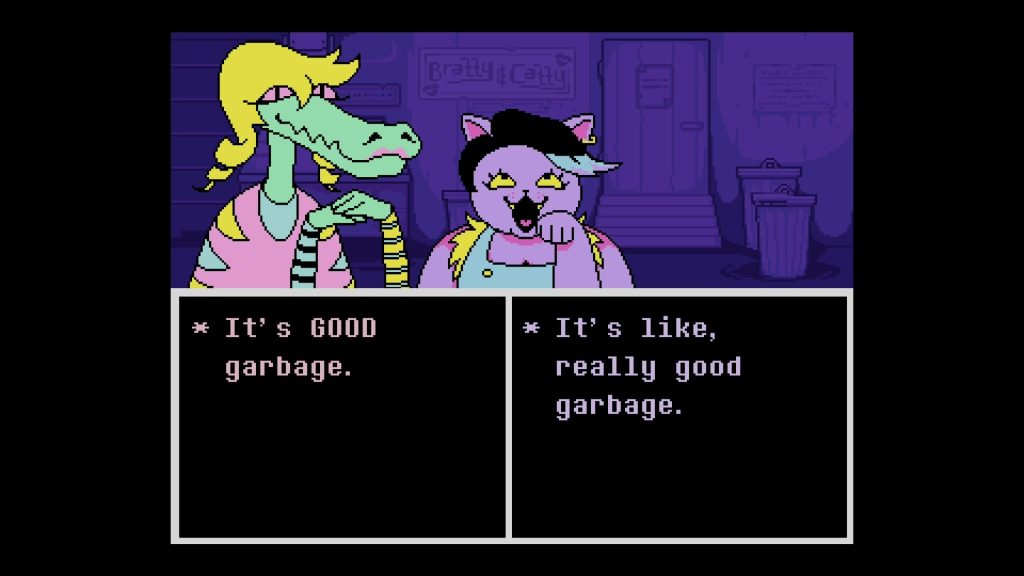
Last week, I got around to something I've been meaning to do for ages: play through Toby Fox's modern classic Undertale, and attempt to understand why it is so well-regarded and popular.
I'd held off for quite some time for a few reasons: first and foremost was simply a matter of making time for it, since as anyone who knows me will be well aware, I have a lot of video games on my shelves. But I was also quite keen to play the game divorced from the context of its somewhat… passionate fanbase.
I have nothing against the Undertale fanbase, I hasten to add — I've never really come into contact with it directly — but for a game like this, I was keen to approach it with as much of a beginner's mind as possible. I wanted to try and understand what, exactly, it was about Undertale that resonated with people so much when it first released. And I think I got there in the end.
Spoilers follow.
Undertale, for the unfamiliar, casts you in the role of a kind-of-sort-of self-insert character. I say kind-of-sort-of because the protagonist is deliberately gender-ambiguous and you can't customise their appearance. You can customise the way they behave, though, and that's something we'll come back to in a moment.
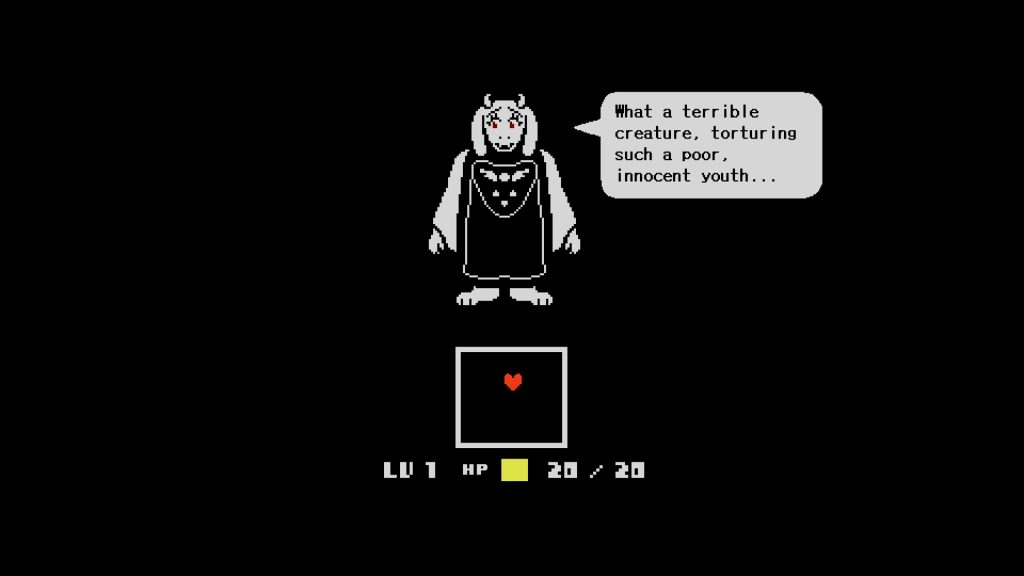
As Undertale begins, you have fallen down a big hole into the land of monsters. Supposedly, many years ago, humankind and monsters lived together on the surface of the world, but a great war eventually led monsters to becoming trapped underground while humans dominated the surface. This is all the context you're really given at the start of the game; in short order, you meet up with a kind-but-a-bit-too-much monster named Toriel, who wants to take you in and look after you.
Toriel is a rather overbearing, motherly type to a borderline sinister degree, and thus it is natural to want to break free of her clutches and explore the greater world in which you find yourself. You can achieve this in a couple of ways, and herein you get to know probably the most important thing about Undertale, and the tagline it's used in various places in more recent years: this is an RPG where no-one has to die.
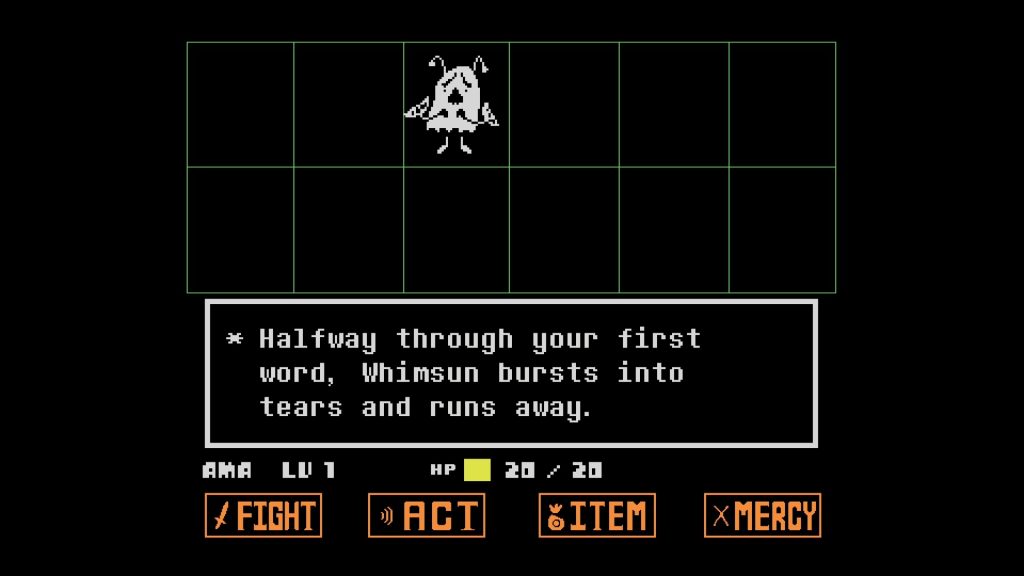
It's true! In every combat encounter you run into throughout Undertale, you have the option of fighting the monsters you come face to face with, or attempting to placate or otherwise peacefully resolve the conflict somehow. The exact way you go about this varies from monster to monster, but it is indeed possible to pass through the entire game without anyone dying by your hand.
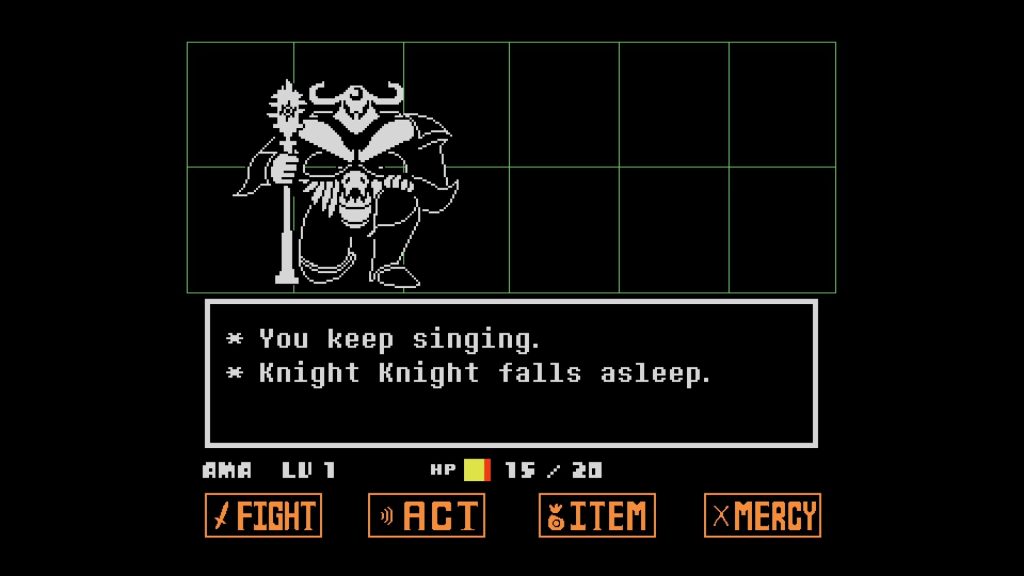
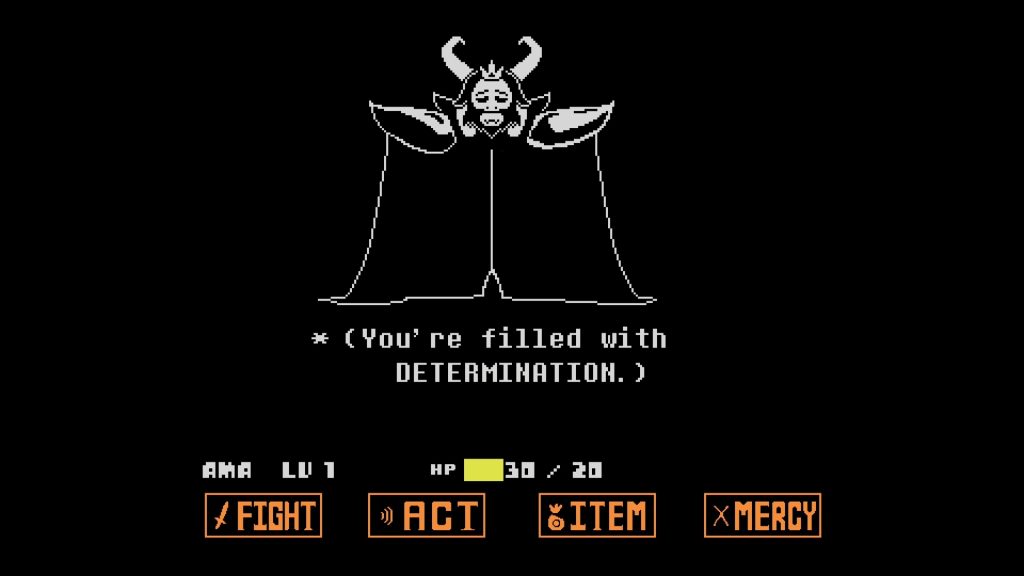
Interestingly, resolving conflicts peacefully does not reward you with "EXP" that allows you to increase your "LV", meaning that if you choose to do a peaceful playthrough, your character will never get any "stronger". Undertale takes great pains to never actually use the full terms "experience points" and "level" for very good reason: in its world, that is not what "EXP" and "LV" mean. Instead, "EXP" stands for "Execution Points", hence you only acquiring them when you kill someone, and "LV" is short for "LOVE", which in turn is short for Level Of ViolencE.
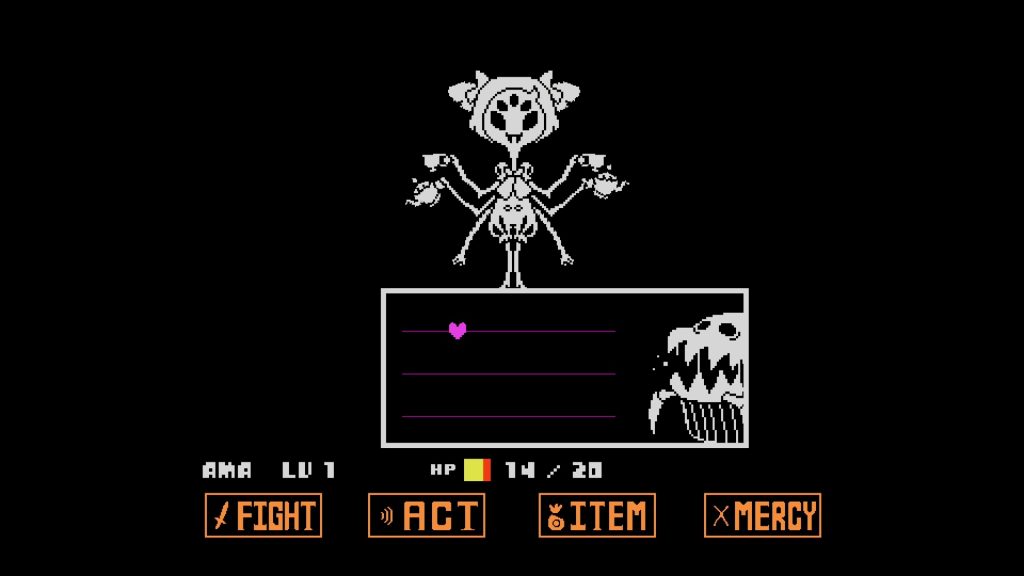
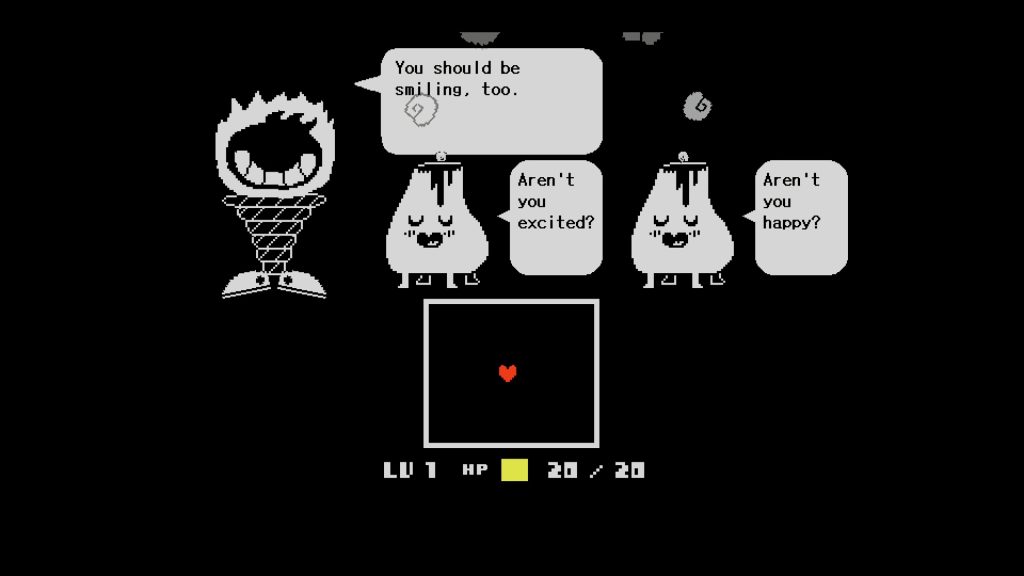
In combat, regardless of whether or not you choose violence, you will have to fend off enemy attacks in short action sequences loosely inspired by shoot 'em up bullet patterns. By controlling the protagonist's SOUL (all caps, but not an abbreviation or acronym to my knowledge), represented as a heart, you can avoid taking damage from enemy attacks. Each enemy type has its own unique attacks, and the further into the game you go, the more varied these become.
One key variation comes with some enemies' ability to change the colour of the protagonist's SOUL. This causes it to behave in various different ways; for example, when it's blue, it's affected by gravity, meaning it has to "jump" over incoming attacks; when it's purple, it can only move between and across set "wires" on the screen. Enemy attacks also have colours, too; blue attacks are harmless if you stay still, orange attacks are harmless if you're moving when they pass through you, and green "attacks" are actually beneficial, providing a small amount of healing and also often triggering special effects. The green attacks most frequently come up when attempting to peacefully resolve conflicts.
But why might you want to spare the monsters of Undertale, when RPG convention has it that you are "supposed" to kill everything in your path? Well, that's because Undertale makes a specific effort to, for want of a better word considering we're talking about "monsters", humanise everyone and everything you come into contact with. Even fodder enemies have personalities and quirks, and it takes the most steely of resolves to look past all that and murder them. But, crucially, the option is there.
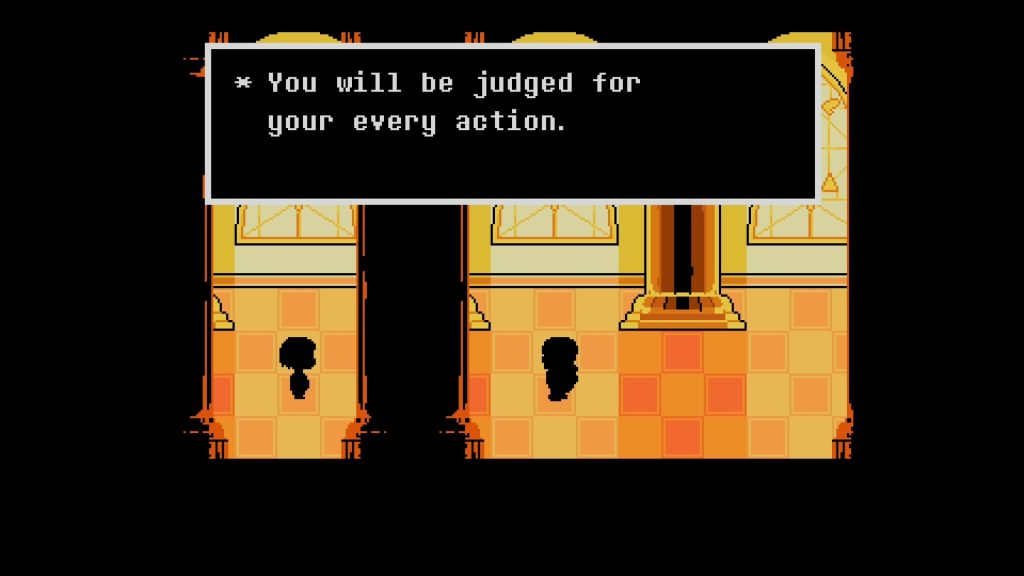
Not only that, but Undertale also keeps track of all manner of other things in the background. If you inadvertently killed someone in a first playthrough and then reset the game without having saved, it will know. On subsequent playthroughs, characters you "haven't met yet" will have recollections of you. And if you went all-out and did a "Genocide" run as your first playthrough, there are some fairly significant differences to how everything concludes.
Undertale is a game that is designed to make you think. Not in the sense that it's especially complicated or difficult to understand, but it really does make you think about the consequences of your actions — and how "game logic" might work were it applied to a "real" situation.
A good example comes if you complete what is known as a "True Pacifist" route. This is only possible after "beating" the game once, and fleshes out the story, resolving in an eventual "true ending" where the monsters finally escape the underground and are able to once again live free on the surface. If you open the game up again after you've reached this ending, the game tells you in no uncertain terms that yes, you absolutely can play again by making use of what it calls a "True Reset", but in doing so you are depriving an entire society — and yourself — of a happy ending. And why are you doing that? Just to see what happens? Is that something you can really justify doing?
A valid response to this is, of course, to say "no, I can't", and to close the game down, never to open it again. You got your happy ending. No need for any "what ifs". No need to satisfy your curiosity as to what might happen if you did the most morally reprehensible thing possible at every opportunity. No need to ruin the lives of a significant number of people.
At the same time, the game absolutely does provide plenty of meaningful changes if you do decide you want to see what might happen if you kill everyone. And then, if you decide to do that "True Pacifist" ending again just to "set everything right", there will be consequences to that, too.
This is the stuff that makes Undertale so clever and noteworthy. The moment-to-moment storytelling and dialogue is charming and memorable — I'd go so far as to say that this is a game with one of the clearest senses of authorial voice I've ever played — but the really interesting stuff comes about once you've been through the whole thing once and you start to contemplate and understand how differently some scenes can unfold depending on your previous actions. Various characters can be seen in rather different lights, and encounters can be resolved in other ways depending on everything from the things you've said to other characters to the objects in your inventory.
Of course, under the hood it's all an illusion based on hidden flags and counters, but in the moment, it absolutely works. Undertale is enormously emotionally engaging from start to finish, and I defy anyone to play through to the conclusion of the True Pacifist route and not at least hesitate before contemplating doing a Genocide run.
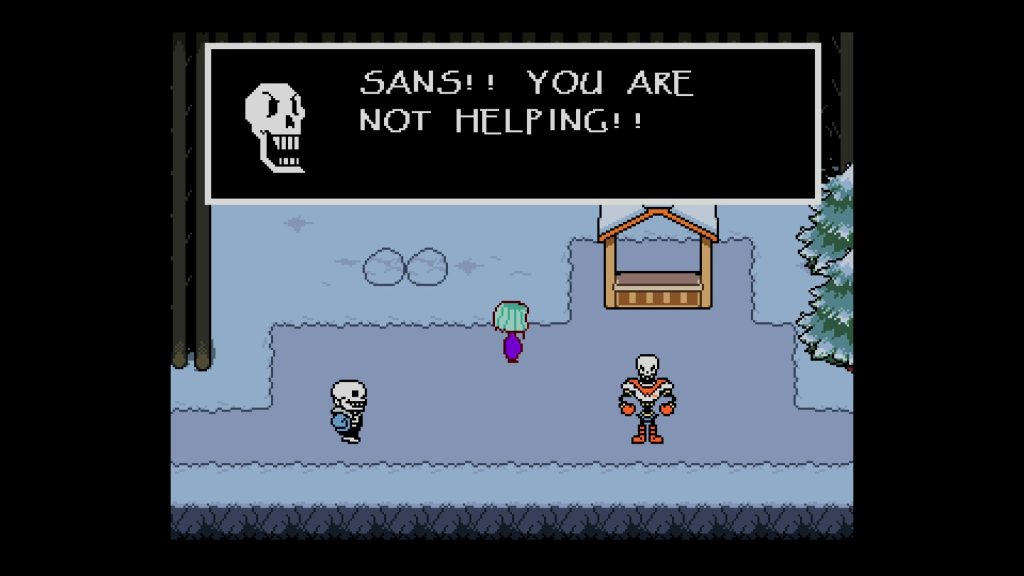
As previously noted, a lot of this is down to author Toby Fox's excellent writing, but Fox doesn't just use well-crafted dialogue to infuse his characters with personality; he uses visual elements such as fonts and the case in which characters' text-only dialogue is presented to help you build up a mental picture of each character. Probably the best example of both of these comes in the case of Papyrus and Sans, two skeletal characters you encounter early in the game after freeing yourself from Toriel's oppressive motherliness.
Papyrus is loud, brash and outspoken — if he had voice acting, he'd absolutely sound like Skeletor — but is this way in order to cover up intense insecurity and loneliness. We can tell this from the combination of his facial expressions, the things he says… and the fact that, as his name suggests, all his dialogue is presented in all-caps Papyrus font, a font that certain types of people tend to use if they want people to like them. Not only that, he's so desperate for validation and friendship that even if you've been on a Genocide run up until this point in the game, your encounter with Papyrus represents a key opportunity to turn back and change your ways.
By contrast, Sans is much more chilled out. Again, we can tell this from the way he looks at us and the things he says, but also the fact his dialogue is all in lower case Comic Sans, a font that everyone knows to be awful, but it serves a function. It's little stylistic things like this that are almost entirely unique to video games; one could get away with the typeface thing in written creative works, but here, it's the way this is combined with other visual and auditory elements that makes it work quite so well.
Expand this to a whole 7-10 hour game, with a variety of other characters who are all equally well-crafted and play very different roles on your overall journey, and you have something that really gets deep into the emotional centres of your brain, and which will stay with you long after the credits roll. This is a game where the characters feel real enough for you to be personally invested in them, and where all but the most hard-hearted will find it very difficult to make the decision to put them to death.
At least, that's how I felt about it, anyway. The nice thing about Undertale is that you can also go in completely the other direction with it, and look at it as an experiment in how video game narratives can manipulate one's emotions so that we believe in things which very much are, by their very nature, unthinking, unfeeling fabrications of someone's imagination. There's no logical reason why you should feel "bad" for "killing" a character in a video game, because you're not actually killing them. After all, think about how many anonymous grunts you've shot in the head in other games; how many slobbering monsters you've hacked and slashed your way through in your average RPG; how many societies you've doomed when you've set a game aside, never to return to it.
Among other things, Undertale makes us think about the context of our actions in video games, and how that might translate to something a bit more real. At its heart, it's not trying in the slightest to be "realistic", hence its deliberately slipshod visual presentation; it behooves us, then, to ask exactly why we end up caring so much more about these characters presented in low-resolution, often monochromatic pixel art than we might do about, say, an anonymous enemy soldier in a Call of Duty, or an enemy knight in a strategy RPG.
The answer, probably, is love. We don't care about grunts in a first-person shooter because we're never given any reason to. We have no opportunity to get to know them; they have a single mechanical function, and that is to stop us achieving our objectives. And, in turn, as Sans points out to us in the late game, "the more you kill, the easier it becomes to distance yourself; the more you distance yourself, the less you will hurt… the more easily you can bring yourself to hurt others."
In Undertale, meanwhile, every potential "enemy" is depicted as someone or something that could also, under different circumstances, be a friend. Even characters like Papyrus, who might initially appear to be set up in such a way to be a "villain", with his fixation on capturing you and seeming inability to actually follow through on this, end up expressing their support and validation for you. And a lot of this happens early on, making those first kills — the ones from before you find it "easy to distance yourself" — hard to perform.
Yes, part of Undertale's effectiveness comes from the fact that it makes you feel good. Because you are playing "you" — despite not being able to customise the player avatar — the game and its characters are effectively able to address you directly. And many of the things both the game and the individual characters have to say are positive, uplifting and supportive. Would you punch someone in the face if they told you that they believed in you, and that they could see you were trying your best?
Some of you might, and Undertale accepts that as a valid response. Some of you, like me, might be a lot more open to what is essentially emotional manipulation (positive), and thus find yourself staring at that post-game screen, unable to click "True Reset" and undo everything you'd done up until this point.
So yeah. I get it. Undertale is excellent. And I'm glad I finally understand why.
Want to read my thoughts on various video games, visual novels and other popular culture things? Stop by MoeGamer.net, my site for all things fun where I am generally a lot more cheerful. And if you fancy watching some vids on classic games, drop by my YouTube channel.
If you want this nonsense in your inbox every day, please feel free to subscribe via email. Your email address won't be used for anything else.
Hello. It's after 1am and I haven't written anything, I need a bath (that can wait until tomorrow) and I'm quite tired. So this will probably be a short one. I did want to acknowledge something, though, which is that I've been playing Clair Obscur: Expedition 33 this evening, and it's real good.
I was a little skeptical about it after feeling a bit burnt by the Blue Prince situation, but this time around it's just flat-out a good game, not "a good game if you have the right kind of brain and 150 hours to plough into it".
I will write more about it on MoeGamer anon, but I did want to acknowledge that my first impressions are very good indeed, and that it has a very distinctive atmosphere about it. I'm getting quite strong Nier vibes from it in terms of its rather melancholy atmosphere — indeed, my wife walked in at one point and asked if it was another Taro Yoko joint. I explained that no, it's French, but I can completely see why she would think that just from overhearing the music.
Oh man, the music. One of the most important things to get right in a dramatic RPG, and boy did they get it bang on in this game. Sweeping orchestral pieces, triumphant choirs, lonely soloists, tinkling pianos, it's all there, and it all hits one right in the Feels.
I was a little concerned about coming to a "J-style" RPG that everyone was saying was the best thing ever when chances are the last "JRPG" they played was Persona 5; I thought it would be an interesting exercise to approach the game from the perspective of someone who has been consistently engaging with this type of game for the last 20 years, while many other folks haven't for various reasons. And I think it's still going to be interesting, but so far my impressions are that no, this isn't just "good if you haven't played an RPG in the last 20 years", it's a good RPG.
There's Nier, there's Final Fantasy, there's even bits of Souls in Expedition 33's DNA, and it all works together in a thoroughly interesting fashion. But, like I say, it's after 1am and I really should probably go to bed. I will write more about this game — much more — over on MoeGamer very soon. But for now, I bid you good night!
Want to read my thoughts on various video games, visual novels and other popular culture things? Stop by MoeGamer.net, my site for all things fun where I am generally a lot more cheerful. And if you fancy watching some vids on classic games, drop by my YouTube channel.
If you want this nonsense in your inbox every day, please feel free to subscribe via email. Your email address won't be used for anything else.