
Back in April of 2010, the first time around on this #oneaday malarkey, I wrote a post responding to the late Roger Ebert's ill-advised argument that "video games can never be art".
Today, on the 5th of December 2025, some 5,710 days later (or "over 15 years" if you want to be a bit more normal about it), we are, apparently, still having this argument. Roger Ebert is, of course, dead, so this time around it has come from someone else: Ian Bogost, a professor at Washington University, St. Louis and hilariously forever doomed to be "most known for the game Cow Clicker" so far as the broader Internet is concerned.
A bit of context if you've not come across this chap before: Cow Clicker was designed as a satirical take on the rise of "social games", as they were known when they first started appearing on Facebook. You know the sort of thing: wait for timer to expire, click on thing, get stuff. Pay up if you want to get stuff more quickly. Marvel at the meaninglessness of existence.
Cow Clicker was good satire! It made some solid points about the way social games abused not only their players, but the broader community surrounding those players. Anyone who lived through Facebook in the 2010s will almost certainly remember being spammed with "invitations" to "help" on someone's "farm" or similar, because although it was patently obvious to anyone who had ever played a video game before that social games were absolute dog eggs, they introduced a lot of people who had never touched video games before to the idea of playing games on their computer or mobile phone. And, as a result, they are indirectly responsible for those tedious shitheads who argue that Candy Crush Saga is relevant to modern gaming rather than yet another abusive, predatory free-to-play game.
Anyway, I hadn't seen Bogost around for a while, but I'd always thought that he had vaguely… sensible ideas. Today he came out with these humdingers — relating to, of course, HORSES, the hot topic du jour (as you will know if you have read my last two posts and my piece on the game over on MoeGamer):
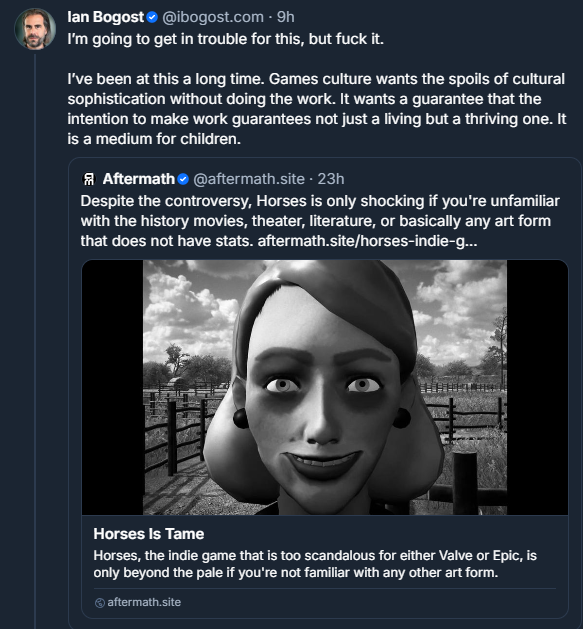
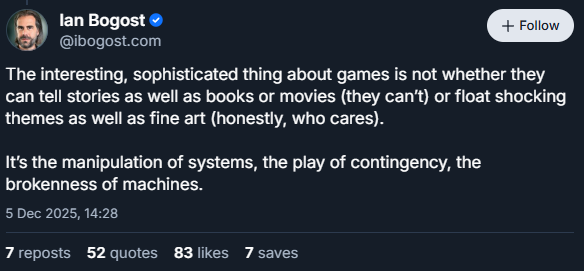

There are some truly amazing bad takes in this mini-thread, but his argument appears to stem from "I am older than you, therefore my opinions are the correct ones." At least he correctly assumed that he would "get in trouble for this".
He falls into the usual traps of assuming that books and movies are inherently superior forms of media because they have been around longer and are thus more refined, but this exceedingly shallow viewpoint fails to accommodate the existence of books and movies that are unashamed to be absolute pulp fodder, trash, blockbuster nonsense or whatever other mild pejoratives you might care to fling at them. Not only that, but gaming is a medium that has grown much quicker than both books and movies, at least partly because it was able to draw on artists' experiences in developing those mediums, and adapting the things that work into the interactive space.
Now, one area where I do kind of sort of align with Bogost is where he notes that games are "the manipulation of systems, the play of contingency, the brokenness of machines". However, where I drift apart from him is his seeming assumption that that is all there is to gaming.
Games can be about the manipulation of systems, the play of contingency and the brokenness of machines. There are some truly compelling games that focus exclusively on those things — and yes, there are plenty of those that I would well and truly describe as exhibiting their own form of artistry. There is an elegance to a well-designed, well-balanced game — it keeps you playing; it keeps you invested; it plays on your mind even when you're not directly engaging with it, in much the same way as a great work of art that you, personally, found particularly impactful "stays with you" long after you were in its physical presence.
This side of things is something that I feel the more "artsy" side of game criticism — and the more artsy side of gaming enthusiasts, for that matter — could do well to study more. As someone with an appreciation for both narrative-centric and mechanics-focused games, it is inordinately frustrating to see those who prefer narrative experiences completely dismiss the artistry of mechanics-centric games. At the same time, it is also frustrating when people who are primarily appreciators of mechanics will completely discount the artistry of a good story.
You see, games aren't one or the other! They can be both, or they can be one of those things — or they can probably be neither of them if you're determined enough. But in most cases these days, there's a little of column A and a little of column B in there — and both of those aspects have been developing rapidly as the medium and technology have evolved, to such a degree that it is an astonishingly galaxy-brained take to say that "games cannot tell stories as well as books and movies" as a blanket statement.
HORSES is an interesting one because it's not a very "good" video game in terms of its mechanical aspect, and there are arguments to be made that its narrative aspects aren't anything particularly out of the ordinary either. I enjoyed my time with it well enough — I found it compelling enough to play through in a single sitting — but I also found myself wondering if anyone would remember it a year from now, particularly if the whole situation with it being "banned" from various platforms hadn't happened. There are plenty of artsy-fartsy walking simulators out there, and some have done their job better than others; it's actually a surprisingly challenging genre of game to get "right", and opinions vary wildly on exactly what getting it "right" really means.
But that's art! Art provokes discussion and debate. It sometimes makes people feel uncomfortable. It sometimes carries deep meaning for people. It resonates with some people more than others, and for different reasons even among those who all found it "meaningful" to a similar degree.
I'm truly astonished that we're still in a situation where games are having to justify their existence as an incredibly creative, artistic medium in 2025. Yes, there's garbage out there — although let's not even get into the casual racism of Bogost's "embarrassing anime RPG trash" statement right now, which is another matter entirely — but there are garbage books, movies and paintings out there, too. To put "established" forms of media on some sort of unassailable pedestal purely because they've been around longer and because the Big Scary Professor At Washington U Says So is just absurd. Because if video games as a medium are not "established" by this point… exactly when is the cutoff point for them to be taken the slightest bit seriously?
There are certain people out there who seem weirdly desperate for video games to forever be regarded as toys for little children — particularly little boys. We are long past that. And I would expect someone like Bogost to know better by this point.
Want to read my thoughts on various video games, visual novels and other popular culture things? Stop by MoeGamer.net, my site for all things fun where I am generally a lot more cheerful. And if you fancy watching some vids on classic games, drop by my YouTube channel.
If you want this nonsense in your inbox every day, please feel free to subscribe via email. Your email address won't be used for anything else.
 Roger Ebert gently and gracefully lowered his gazelle-scented testicles into the lions' den that is the world of video games a