I am presently awaiting two new games consoles with "2s" in their names: the Nintendo Switch 2, and the MiSTer Multisystem 2. And I think I might be more excited about the latter.
I've never used anything FPGA, but I'm led to understand that it's a marvellous thing. And the sheer number of different things that the MiSTer supports is exciting me. With the setup I intend to slot it into, I'm looking forward to being able to use it as a retro computer as well as every games console ever up until the PlayStation, Saturn and N64.
Now, the one difference between the Nintendo Switch 2 and the MiSTer Multisystem 2 is that the latter is going to require a lot more setting up and fiddling around with than the Switch 2 will. But I am hoping that any tinkering will be a one-time process, and that once it is done, the MiSTer will be able to just sit there and do whatever I want it to. Within reason, obviously.
I'm going to hook up a keyboard and mouse to the system as well as a controller, so it can be used for actual computing as well as just playing games. I'll probably get another one of the 8bitdo retro-styled keyboards for this purpose — the C64 one would certainly be thematically appropriate, in the absence of an Atari ST or Atari 800XL one, though the one that looks a bit like an IBM Model M is also quite nice.
I'm also probably going to invest in some nice speakers rather than relying on the single mono speaker of my trusty Trinitron CRT. That built-in speaker is surprisingly decent considering its size and placement, but it would be nice to be able to give console games in particular a bit of oomph.
So all told, I think the setup will probably look something like this, but with less wobbly freehand mouse-drawn lines.
With that, I should be sorted for some retro gaming and computing fun for quite some time. At some point I might consider looking into the various solutions available for using real classic controllers on the Multisystem 2, but I don't think I'll make that a priority to begin with. Let's get it up and running and working — and doing what I want it to do — and then we can talk customisation. Because there's a lot of customising you can do with a MiSTer, I'm led to understand!
It's an exciting new world that I can't wait to get involved in. I have a bit of a wait before that happens — the Multisystem 2 is coming out in August — but I guess I can occupy myself with the Switch 2 and Mario Kart World in the meantime…
Want to read my thoughts on various video games, visual novels and other popular culture things? Stop by MoeGamer.net, my site for all things fun where I am generally a lot more cheerful. And if you fancy watching some vids on classic games, drop by my YouTube channel.
If you want this nonsense in your inbox every day, please feel free to subscribe via email. Your email address won't be used for anything else.

It occurs to me that a while back, I went to visit the Retro Collective museums over in Gloucestershire, and I don't think I actually wrote about the experience. Looking back at my Google Photos, it seems that it was 2023 (wow) when I went, and I hadn't yet kicked off this particular round of #oneaday shenanigans back then. In fact, the only thing I wrote about on this blog in the month that I went was a vitriolic diatribe on how much I detested the TikTokification of comedy, something which, rewatching Friends, the subject of much of that post, I still maintain my position on. But I digress.
So! Anyway, what am I talking about? Well, the Retro Collective is a group of people and organisations that make their home in an old mill in Chalford, Gloucestershire, just outside of Stroud. The main attractions for most visitors are the two hands-on interactive museums: "The Cave" upstairs for retro computers, consoles and general gaming tech, and the "Arcade Archive" downstairs for… well, I think you can probably guess.
The Cave is run by Neil Thomas, a thoroughly lovely gentleman who started a retro tech YouTube channel back in 2012, and gradually became considerably more ambitious with what he was getting up to. Notably, he actually followed through on those ambitions, and the result, in collaboration with the other members of the Retro Collective, is a fantastic day out for anyone with the slightest interest in the history of computing and video games.
Neil still makes YouTube videos along with running The Cave — an operation which has a number of regular staffers and volunteers helping out — and he often does restorations on classic computer hardware. If you're into that sort of thing, his YouTube channel, which is now the home of the whole Retro Collective on YouTube, is well worth a follow. You might even see a familiar face in the video below:
The Cave is designed to be nostalgic and comfortable to explore and experience. The main room is absolutely packed with classic computer and console hardware, and the vast majority of it is hands-on and interactive. If you had a favourite computer or console growing up, chances are it's there, and there are plenty of games available to play on it. But there are also lesser-known devices to fiddle around with too, some of which are on a bit of a rotation thanks to being on loan from other collectors, and others of which are part of the permanent collection.
A particular highlight when I went back in 2023 was the Sharp X68000, which, as any fans of Japanese gaming will know, is a bit of a "holy grail" of home computers. Immensely capable and home to some near-as-dammit arcade-perfect ports, as well as games that were as good as — if not better than — the 16-bit consoles of the era, it was a pleasure to finally have a play with this, even if I inadvertently found the inevitable hentai puzzle game that had snuck into the collection of games installed on the machine's hard drive! (I wasn't looking for it, honest. I was more enamoured with the system's excellent version of Namco's Star Luster, anyway.)
As well as all the classic machines that are set up and ready to play, there's a bunch of less common, more valuable stuff on display, with resources to learn about them. There's a huge library of magazines you can browse through at your leisure. And one of the most impressive parts is a little side room built to resemble the software section of a WHSmiths circa 1990. Not only is this an immensely nostalgic recreation of a long-gone shopping experience, but it's interactive, too; the room is equipped with a MiSTer Multisystem hooked up to a barcode scanner, which allows you to scan the barcode of any game in the "shop" and play it. Very nifty.
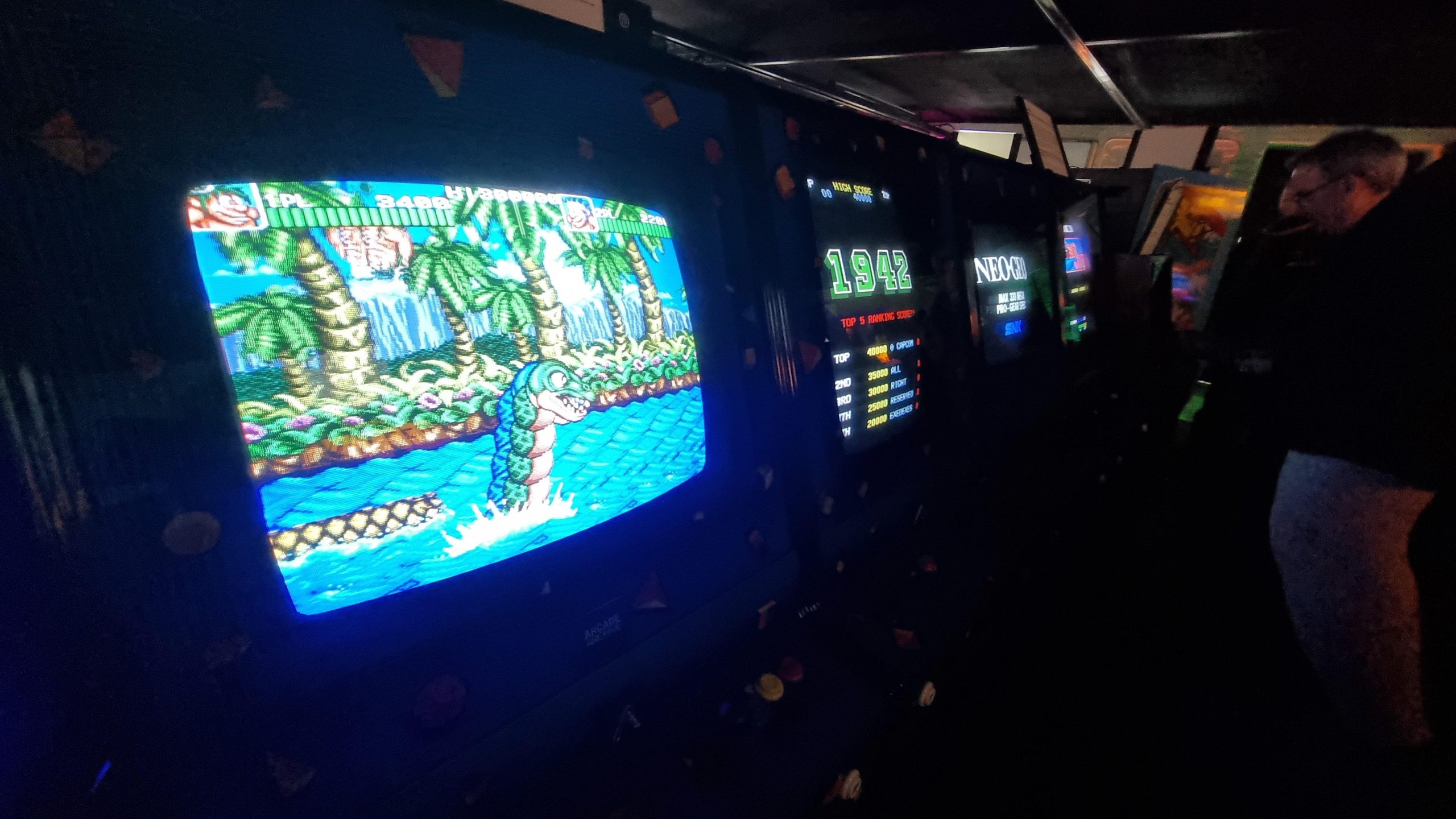
The Arcade Archive, meanwhile, for which tickets are sold separately — though you can buy tickets for both The Cave and the Arcade Archive at the same time, visiting one in the morning and the other in the afternoon — is situated downstairs in the mill, and is… well, it's just a recreation of a classic arcade. It's dark, lit with neon signs, filled with the noise of a variety of machines competing for your attention, and they've all been lovingly restored to full working order (and free play!) for you to explore and play as much as you like.
Like The Cave, the Arcade Archive has both a permanent collection and a rotating selection of guest cabinets on loan from other collectors. At the time I visited, a particularly noteworthy inclusion was a little-known Nintendo arcade machine known as Sky Skipper, which had quite an interesting story behind it.
Elsewhere in the mill is the engineering company Heber, who work on a wide variety of interesting things, many of which have a retro gaming focus. Notably, they're responsible for the design and manufacturing of the aforementioned MiSTer Multisystem and its upcoming follow-up model, but they also make accessories and all manner of other bits and bobs.
I can't recommend The Cave and the Arcade Archive enough if you want a great, highly interactive day out, whether you're a grown-up or a kid… or just a kid at heart. The museums are immaculately kept by people who absolutely love what they do, and you feel the passion for everything the moment you walk in the door. It's a truly special experience that everyone involved with the Retro Collective has created, and I'm looking forward to paying the place another visit sometime soon.
Want to read my thoughts on various video games, visual novels and other popular culture things? Stop by MoeGamer.net, my site for all things fun where I am generally a lot more cheerful. And if you fancy watching some vids on classic games, drop by my YouTube channel.
If you want this nonsense in your inbox every day, please feel free to subscribe via email. Your email address won't be used for anything else.
I put together a new video this weekend. Just the one, because it turned out being quite a beefy one to put together, but hopefully you will appreciate the effort once it's live, which will probably be tomorrow.
Inspired by the recent launch of the Fun Factor Podcast, I thought it was high time I got back to my retrospective look back over the issues of Page 6/New Atari User magazine that I started a while back, but only got around to doing two issues of. The reason I've been putting off doing any more may well already be self-evident: each "episode" of this takes quite a bit of time and effort to put together!
I mean, to my satisfaction, anyway. I could just turn the camera on, rabbit on about what's in the magazine and leave it at that. But one thing I like about doing these videos — and the bit that's particularly time-consuming — is that I can supplement the magazine's contents with actual footage of the things that are being discussed, whether those are programming techniques or the latest games. Getting together all that footage as well as recording the actual run-through of the magazine takes quite a bit of time all together — but the end result is worth it. I like these videos.
If you haven't seen the previous ones, by the way, may I present them below. Here's a look at the very first issue of Page 6, including the back story of where it came from and what it means to me:
And here's a look at the second issue, in which we observe the rise of a mostly forgotten piece of '80s slang: the adjective "keen" to mean "cheap" or "eminently reasonable", which I had never come across before. Well, I mean, I had, because I'd read this issue before, but somehow it had never struck me as odd:
As I note in the videos, these old magazines are of tremendous importance to me, and I'm happy to have the opportunity to be able to share them with everyone through the medium of video. The ability to splice in footage of the stuff being talked about allows you to get some context that you might not have had just reading the magazine back in the day, and this is a part of retro gaming culture that I'm always happy to celebrate in one form or another.
The new episode is uploading and processing right now, so it should be live on YouTube tomorrow as soon as I've done a thumbnail and all the other gubbins for it. Watch out for it then — stop by my channel and subscribe if you haven't already. Go on. You know you want to.
Want to read my thoughts on various video games, visual novels and other popular culture things? Stop by MoeGamer.net, my site for all things fun where I am generally a lot more cheerful. And if you fancy watching some vids on classic games, drop by my YouTube channel.
If you want this nonsense in your inbox every day, please feel free to subscribe via email. Your email address won't be used for anything else.

My Mega Everdrive Pro arrived today. For the unfamiliar, this is a flashcart for the Sega Mega Drive that supports Mega Drive, Master System, and perhaps most intriguingly, Mega CD games. More on that in a moment.
I haven't spent much time with it as yet, as I was working, then I had to make dinner, then eat dinner, then I needed a poo and now here I am, responsibly writing this post before I go off and do something "fun". (Not that this isn't fun, but this is a self-imposed obligation, whereas what I intend to do next is pure recreation.) I loaded up an SD card with everything I wanted to put on it earlier, fired it up briefly and checked it was working, and all seemed in order (aside from a bit of rolling interference on my screen that the Internet tells me is the fault of a crappy aftermarket power supply for the Mega Drive, so I'm replacing that soon). But aside from that, it's up there waiting for me right now.
Obviously a big part of the appeal here is easy access to both Mega Drive and Master System games (for the unfamiliar, the Mega Drive actually contains most of the necessary guts to run Master System games pretty much natively) but one thing I'm particularly intrigued to explore is Mega CD compatibility. Or, more accurately, Mega CD hardware emulation. The Mega Everdrive Pro features some FPGA shenanigans that I don't really understand the workings of, and the upshot of it is that you can make it convince your Mega Drive that you have a Mega CD connected, even if you have nothing of the sort plugged in. (You cannot do the same with the 32X; you still need a real 32X if you want to go down that road.)
I've always been curious about the Mega CD, because it's one of a few consoles from the era that I had absolutely no contact with whatsoever. I had friends with Mega Drives and my brother often brought one home when he came to visit but I didn't know anyone with a Mega CD. I remember reading articles about the games on Mega CD in the magazine my brother was working on at the time (Mega Drive Advanced Gaming, if you were curious) and thinking they sounded really cool, but I have never gotten around to exploring that library at all… yet, anyway.
Of course, retrospectively we all know that the Mega CD wasn't a particularly successful add-on, and there aren't a ton of Mega CD games that are particularly worth playing. But there are a few, and I'm excited to try them. (I'm excited to try some of the "bad" ones too, just to understand the platform a bit better!)
With the addition of this to my collection, I now have Super NES, Mega Drive/Master System (outside of the few incompatible games) and N64 all hooked up and ready to play pretty much anything I would care to throw at them. Just the thing for when I'm in the mood for something short and sweet, like I talked about the other day. And like I'm feeling right now.
So I think I can't put it off any longer. It's time to go get Blast Processed. With Compact Disk power!
Want to read my thoughts on various video games, visual novels and other popular culture things? Stop by MoeGamer.net, my site for all things fun where I am generally a lot more cheerful. And if you fancy watching some vids on classic games, drop by my YouTube channel.
If you want this nonsense in your inbox every day, please feel free to subscribe via email. Your email address won't be used for anything else.
One of the things I've been keen to do with my YouTube channel for a while is branch out into areas that are less familiar to me. I've done a lot of championing Atari stuff, and while I don't see that going away any time soon, the fact it's so easy to play with all manner of different platforms today through emulation and suchlike means that I really don't have an excuse for not educating myself on things like the Spectrum, Commodore 64 and Amiga libraries. (Especially since I have modern recreations of all of them!)
I've already covered a couple of Spectrum games previously on my channel, but the one I published today is one that I had been oddly worried about spending some time with. Here's the video if you fancy following my journey:
Ant Attack is an all-time classic for the Spectrum, frequently appearing in "Best of Spectrum" lists and suchlike. But Lordy is it hard to get started with. Keyboard controls which were clearly designed by a madman. Mechanics that are baffling and unpredictable. An engine that often struggles to keep up with what you're doing. I honestly would not blame anyone for trying it out for five minutes, going "fuck this" and booting up a NES emulator to play Super Mario Bros. 3 for the umpteenth time.
I've never been about that on my channel, though. My philosophy is always to "find the fun" — an idea that, if I remember rightly, I borrowed from Mark "Classic Game Room" Bussler, an influential early gaming YouTuber who, among others, was a big inspiration on me getting into YouTube in the first place.
Finding the fun isn't always easy, but I always make a point of giving a game a bit more of a chance than most people might. I'm aware that in a lot of cases, old games are all well and good if you grew up with them, but if they're brand new to you, they can take a bit of effort before they show their true charms. And, indeed, this is very much the case with Ant Attack.
My first couple of attempts went badly. I didn't know what I was doing wrong, it was frustrating and I was a little tempted to give up. But I didn't; I kept going, I kept exploring, I kept an open mind. And while I won't say I came away from the game loving it, I can at least say with honestly that I appreciate and quite like it now.
Possibly more than any other vaguely popular retro platform, I think the Spectrum library rewards this kind of persistence. If the Spectrum was all you had growing up, doubtless you learned to live with QAOP control schemes and all the other little idiosyncrasies the system had to offer — but I bet even for some folks who were hardcore Speccy fans back in the day, it's difficult to go back to some of these games. It's even harder if you have no nostalgia for these games; you're coming at them blind from a modern perspective, and so there are a lot of things "against" the experience from the outset: garish colours, the notorious "colour clash", screechy beeper music, sluggish controls and game design from an era where people hadn't quite figured out "good" game design yet.
Honestly, though, for me, all that is what makes it so interesting. The early days of computer games were a wild and experimental time, and no, not everything worked. But you have to make mistakes in order to make progress, and the popularity of the Spectrum means that it was absolutely instrumental in shaping modern game development for a significant portion of the world.
That's why I stuck with Ant Attack for nearly an hour. I wanted to "get" it. And, by the end, I think I did. And I'm looking forward to exploring other parts of the system's library over the long term.
Want to read my thoughts on various video games, visual novels and other popular culture things? Stop by MoeGamer.net, my site for all things fun where I am generally a lot more cheerful. And if you fancy watching some vids on classic games, drop by my YouTube channel.
If you want this nonsense in your inbox every day, please feel free to subscribe via email. Your email address won't be used for anything else.
In retrospect, when I had two game cartridges fail in the exact same way as one another, I should have probably considered the possibility that it was, in fact, the game console itself that was at fault rather than the cartridges. But, well, I was going to get an FX Pak Pro anyway, so all that's really happened is I spent £40 more than I thought I was going to, traded in the few loose N64 carts I had lying around (and which were now redundant thanks to the Everdrive 64 X7 I have) and now have two SNESes: one with (presumably) a fried chip that means anything involving "Mode 7" scaling and rotation (and adjacent graphical techniques) is borked, and my new acquisition which, so far, appears to work just fine.
I'm a little sad at the apparent death of my old SNES; that thing had followed me since childhood and has always been a treasured part of my collection, even at the times it wasn't getting much use. I suspect it probably is possible to fix somehow, but that would involve getting stuck into some electronics that I'm not confident enough to explore just yet, and my wife Andie, who is quite happy to get the soldering gun out, is in the middle of numerous other projects, so I don't want to bother her.
So anyway. Yes. CEX did not, in fact, sell me two consecutive faulty copies of Desert Strike, it was my bloody SNES after all. At least that's all resolved now, and with the FX Pak Pro safely in place, I can now just enjoy the thing without worrying about dead batteries, corroded connections and all that other good stuff that we never even thought would be a consideration back when these things were new.
I am looking forward to spending some quality time with the SNES library. As I've alluded to a few times in the past, despite owning that SNES since… probably '92 or so? I didn't have all that many games for it. I had Super Mario World, Super Mario Kart, Super Mario All-Stars, Starwing, SimCity and American copies of Street Fighter II and Chuck Rock. Plus two of those converter thingies that allowed you to play games from another region by plugging a "native" game into the back and the game you wanted to play into the top.
I played a few other SNES games through borrowing them from friends. I borrowed Super Star Wars from my friend Andrew on multiple occasions and liked that a lot; these days people seem to remember that as a ludicrously difficult game, but I don't remember it striking me as being unusually hard back in the day. Definitely one to revisit, and I was always curious to try Super Empire Strikes Back and Super Return of the Jedi, because I never even saw those running.
I'm also going to make some time to play through Soul Blazer, Illusion of Time (better known as Illusion of Gaia) and Terranigma, because I like Quintet's work (and their subsequent work as Shade) but have never settled down to spend a good amount of time with any of these games. I've played the start of all of them multiple times and enjoyed what I saw in all instances, but I definitely want to play them properly.
Then there's just the odd stuff. While loading up a flashcart or emulator with a bunch of ROMs is often a ticket to Analysis Paralysisville, one of the things I like about retro gaming is that you can pick something pretty much at random and probably be able to figure things out without too much difficulty. Sometimes when you do this you make wonderful discoveries of things you never would have thought to try otherwise; at others, you realise why these games aren't better known.
Earlier today, I tried the Infogrames Asterix game. I was a big fan of Asterix as a kid and am still rather fond of it; I still have all my old Asterix books, and the Konami arcade game is, I maintain, one of their best belt-scrollers. I was always frustrated that there was no home version of that arcade game, though, and for one reason or another never came into contact with any of the console games. This particular one isn't anything particularly remarkable, but it does have some of the Asterix wit and charm about it, and Roman soldiers go "PAF!" when you punch them, which is nice.
Another nice thing about the FX Pak Pro is that it functions as a Super Game Boy 2, meaning you can load up Game Boy ROMs as well as SNES ROMs. I found a couple of games that don't seem to work with it — The Smurfs, sadly, which is a shame, as the soundtrack for that game is way better than you would think it would be — but Rod Land does, which is all that really matters.
So mixed feelings today, then. Sadness at the apparent death of my childhood SNES, but joy at the world the FX Pak Pro is about to open up to me. And when the Mega Everdrive Pro gets here in a few days… well, I'll be in 16-bit heaven for quite some time, I feel.
Want to read my thoughts on various video games, visual novels and other popular culture things? Stop by MoeGamer.net, my site for all things fun where I am generally a lot more cheerful. And if you fancy watching some vids on classic games, drop by my YouTube channel.
If you want this nonsense in your inbox every day, please feel free to subscribe via email. Your email address won't be used for anything else.

I can't remember if I mentioned it on here before, but even if I did, I'm going to mention it again anyway: I recently ordered an FXPak Pro for my Super NES, to add to my collection alongside the Everdrive 64 X7 I got a while back for my Nintendo 64, and long-term I intend to also get Everdrives for the Mega Drive, Master System, NES and possibly Game Boy Advance.
For the unfamiliar, an Everdrive is a cartridge for a retro gaming system that allows you to pop in an SD card full of game ROMs, then play them on original hardware. The FXPak Pro is a similar device, but it's distinguished from Everdrives primarily due to its origin, but also because it is capable of emulating the custom chips that many SNES cartridges had in them, such as the famous Super FX chip that powered Starwing.
Most of these devices also have additional benefits such as being able to back up save data and even make use of emulator-style save states in some circumstances — one model of the Mega Drive one can even full-on emulate a Mega CD without having to have an actual Mega CD attached — but their main appeal element is the ability to play any games you want on original hardware without having to use original cartridges. Of course, this generally involves piracy, but at this point, none of the original makers of games on old games consoles are making any money from you buying an original cartridge anyway, which means the often exorbitant prices they go for are pretty much pure profit for the individuals or organisations involved.
A while back, I was all about building a curated collection of games for vintage systems, and there's part of me that would still like to do that. But I have had a few considerations arise over the last couple of years: the first being the available space I have, which is rapidly running out (although I've reclaimed some by banishing some items to the loft and rearranging some of the other shelves) and the second being that I had a run of bad luck with buying second-hand cartridges.
To give specifics, I attempted to buy the game Desert Strike for SNES, a game I never actually owned back in the day, but always enjoyed any time I borrowed it from a friend or played it at their house. I paid £8 for a copy from CEX, and was a little put out to discover when it arrived that it didn't work. Well, it sort of worked; the Electronic Arts logo on startup was garbled, in-game graphics occasionally corrupted and it would just randomly reboot sometimes. This problem persisted even after several sessions with the contact cleaner and cotton buds. The cart was just fucked.
No matter, I thought, it's only £8, I'll buy another copy and return this one if I can be arsed — though I knew from experience that if I attempted to return it to CEX, they'd almost certainly test it, find it didn't appear to work, then refuse me a refund, despite them selling it to me in a faulty state in the first place. So I bought another copy. And the same thing happened.
Couple that with several experiences I've had where I bought games where the save batteries had failed, and, y'know, I just can't be bothered with all the faffing around with aging, failing media when there's a better option just sitting there. Playing on original hardware definitely has its own distinct appeal from playing on emulation or even official rereleases on modern systems, so going the Everdrive or FX Pak Pro route just makes a lot of sense when my priority is not "investing" in a collection, but instead just enjoying the games.
I will add to the above that, if a game I'm particularly fond of or always wanted to play should suddenly become available commercially, I will happily pay up money for it, and have done on numerous occasions, even if I'd already played and beaten the game via "unofficial" means. It's the right thing to do. But there are myriad games out there that are never getting a rerelease for all manner of stupid reasons, and that doesn't mean no-one should be able to play them any more.
So, long-term, I'm intending that all my retro systems will be equipped with Everdrives or equivalents so they can be used and enjoyed without having to roll the dice on whether aged media is still in working order. And once that's all sorted out, I'm looking forward to spending some quality time with some classic games — both ones I loved back in the day, and hopefully some new discoveries, too.
Want to read my thoughts on various video games, visual novels and other popular culture things? Stop by MoeGamer.net, my site for all things fun where I am generally a lot more cheerful. And if you fancy watching some vids on classic games, drop by my YouTube channel.
If you want this nonsense in your inbox every day, please feel free to subscribe via email. Your email address won't be used for anything else.

The rumours were true! Just ahead of the series' 25th anniversary, EA dropped rereleases of The Sims and The Sims 2 on their own storefront and Steam earlier today, for the eminently reasonable price of £34.99 for the both of them. Considering they both come with all the expansions (well, I think The Sims 2 might be missing the IKEA "stuff" pack, but that's about it), I'm perfectly happy to pay up for them both, particularly considering The Sims has never had a digital release, and The Sims 2 has been unavailable for a long time.
"But you can get them both for free!" the entitled corners of the Internet shout. "They're abandonware, and that means you can legally download them for free!" Well, firstly, one, no it doesn't, because abandonware isn't actually a thing, legally speaking, and two, it is important to support official rereleases of stuff like this, because it gives a thumbs up to companies making a commitment to actually preserving their history and making it available to everyone, even those who weren't there for it first time around. It's no good carrying on about "preservation" if you don't support actual attempts to do that. Piracy is all well and good if there is no other way, but official preservation efforts should be supported. Yes, even if they're by EA.
Both rereleases have been updated so that they work just peachy on Windows 10 and 11, and The Sims is able to run in much higher resolutions than it ever has before, and in widescreen. Okay, the game could arguably do with a UI scale option when playing at 1080p or higher, but it's not unplayable by any means, particularly if you're playing on a big TV as I have been.
I've spent a few hours revisiting The Sims this evening by making a rough recreation of my original "Hartley Family" save file, which featured me and the other members of my hall of residence flat at university struggling to survive. I am reminded that the original The Sims is actually surprisingly challenging compared to some of its follow-ups; thus far, keeping on top of six people's needs has been quite difficult, particularly with a lack of substantial income. Things will get easier once some of them start getting promoted and bring in a bit more money each day, but for the moment it's very much in "scraping by" territory.
Also one of them has died already after burning down the kitchen, but I managed to "Plead" with the Grim Reaper quickly enough for him to be able to return as a zombie. I have made a promise to myself that I'm not going to save scum at all, I'm just going to deal with the consequences of everything that goes on as it happens. Emergent narrative and all that.
I'm interested to spend a bit more time with the original The Sims, as back when it was current, I had a lot of the expansion packs, but not all of them. I don't think I had Superstar, Unleashed or Makin' Magic, and those are three that have some substantial additions to the gameplay — the pursuit of fame, pets and the ability to cast spells using appropriate components respectively.
At present, I've got one of the six Hartley family members equipped with a magic wand and (thus far) the ability to turn someone into a toad, and another who keeps slipping off to the "Studio Town" area to go and sing karaoke badly (earning a whopping 5 Simoleons per performance at present) but so far, it's a struggle to keep their mood high enough to be able to truly take advantage of those features. Much as with real life, getting a solid and stable income stream is important if you want to start doing anything out of the ordinary.
So that's that. The Sims and The Sims 2 are both available on Steam and EA's own storefront right now, either separately or in a bundle together. You also get a "free" copy of The Sims 4 with them, but since that went free-to-play a while back anyway it's probably best ignored unless you want to get into DLC hell. The rereleases of both The Sims and The Sims 2 are complete, meanwhile (aside from the aforementioned Ikea pack for The Sims 2) and should keep you busy for a very long time indeed.
I'll probably write more about one or the other or both at some point, but for now, I'm happy. It's been a nice bit of nostalgia to revisit The Sims — and a reminder that as cynical as people got about the series over the years (not without good reason), it's still just a damned fine game at heart, too.
Want to read my thoughts on various video games, visual novels and other popular culture things? Stop by MoeGamer.net, my site for all things fun where I am generally a lot more cheerful. And if you fancy watching some vids on classic games, drop by my YouTube channel.
If you want this nonsense in your inbox every day, please feel free to subscribe via email. Your email address won't be used for anything else.
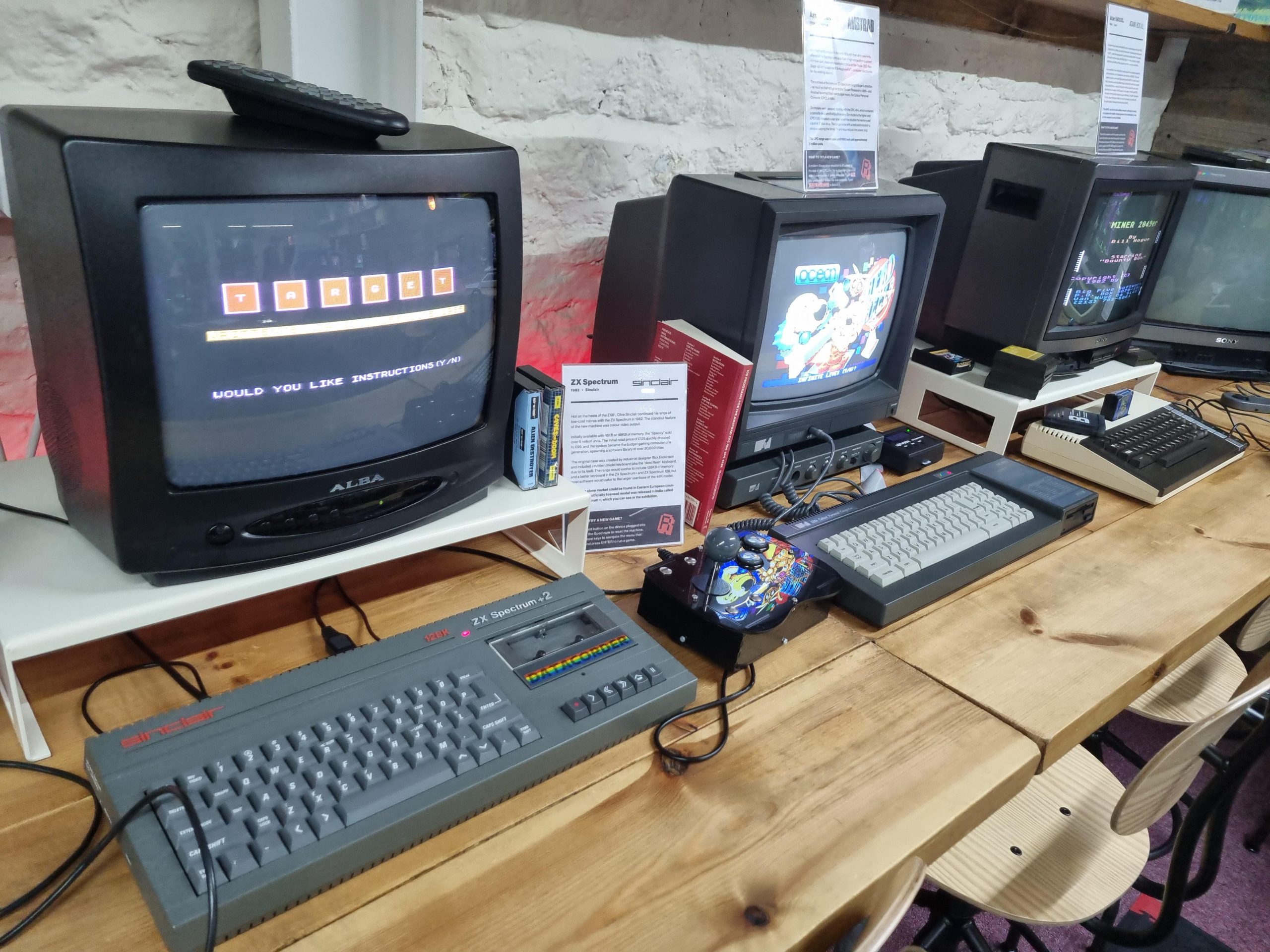
A number of things occurred today that I could potentially talk about: some positive, some not so positive. In the interests of… (gesticulates at all this) everything I'll focus on probably the most positive one, because it's something I'm really excited and happy to see.
Those of you interested in video games as a medium may be aware of the work of the Video Game History Foundation. They've been working as a charitable organisation chronicling the history of the medium for some time now, and they're responsible for the figure you may have seen bandied around that "87% of classic games are not available".
Something they've been working on for a while is providing a means of public access to their library of materials, which includes not only old computer and gaming magazines, but also development and marketing materials as well as some thoroughly fascinating bits of miscellanea, such as a gamer's hand-drawn maps of two early Zelda games that found themselves among a donation of other bits and pieces.
Today, the organisation launched the library for "early access", presumably meaning that there might be some kinks to work out and that it will expand over time, but already it's clear that it's going to be both a valuable resource and something that is just interesting to explore.
There are two main components to the library. First of all is the main catalogue at library.gamehistory.org, which is a catalogue of the materials that the organisation holds. This is interesting to browse through and see what's in their collection, but isn't of that much use when researching things. For most, the real attraction will be the digital archives at archive.gamehistory.org, which include digitally preserved material — scans and other digitised content, in other words.
At present the archives only contain a fraction of what is listed in the main catalogue, and the organisation notes that there is some material that may never be digitised for public access via the Internet for one reason or another. But what's there already is plenty to get stuck into. There's a library of magazines, for example, including 33 publications at the time of writing, including complete or near-complete runs of well-known mags such as Game Informer, Electronic Gaming Monthly and GamePro, plus early attempts at gaming media like Electronic Games, a spinoff of Video magazine's Arcade Alley column.
Right now there is, unsurprisingly, a bit of a US bias to things (and as I type this, the site has crashed under the weight of day-one demand so I can't check what non-American stuff they have, if any!) but there's a significant chunk of gaming media history to explore here; the aforementioned publications all played an important part in shaping video game fandom at one point or another, and the digitally available collection will only continue to expand over time. I'm particularly excited to see the archive of Electronic Games there, as this is an incredible resource to see how early consoles (like the Atari 2600, Intellivision and suchlike) and 8-bit home computers were covered by a fledgling enthusiast press.
I'm really looking forward to exploring this library of stuff and seeing how it expands over time. It's going to be an absolute boon to anyone researching the history of video games and how they were covered by the media of the day, and I can't wait to make use of all this material when composing videos and articles.
Want to read my thoughts on various video games, visual novels and other popular culture things? Stop by MoeGamer.net, my site for all things fun where I am generally a lot more cheerful. And if you fancy watching some vids on classic games, drop by my YouTube channel.
If you want this nonsense in your inbox every day, please feel free to subscribe via email. Your email address won't be used for anything else.
I finally managed to muster up the motivation to make some YouTube videos today. Three of them, in fact; they'll be up on the channel over the course of the next week or so.
To be clear, I wasn't putting off making these videos because I didn't want to make them; I was primarily putting them off because I had a cold in mid-December, and it's left me with a really annoying cough but no other symptoms. (I went to the doctor to see if it was an infection or anything, and it seems there's nothing to be concerned about; I just Have A Cough for a bit, frustratingly.)
I didn't want to start recording videos and collapse into a coughing fit partway through, so I'd been putting it off, particularly as a couple of weekends ago I started trying to record a The Dagger of Amon Ra playthrough and had to stop because my throat wasn't up to it.
My cough is still here — mostly in the evenings, and especially annoyingly when I lie down to go to sleep — but I managed to hold it at bay for the duration of three videos earlier, which is nice. Those three videos are kicking off something I want to be doing throughout this year: exploring a variety of home computer stuff, including Spectrum, Amiga and C64 stuff as well as the Atari 8-bit and ST stuff I've primarily built my channel on.
It felt good to finally get them done. While I have no real "obligations" towards my YouTube channel and could just… stop making videos at any point with no real consequence, it would feel like a great shame to do so. I have somehow made 1,303 videos so far since I created my channel in 2007 (but didn't start Being A Creator until to any vaguely serious degree until 2017) and my channel has shown very slow but steady growth, particularly over the course of the last five years or so. I don't have any grand designs on Being A YouTuber as a career, particularly since the sort of stuff I do isn't exactly algorithm-baiting, but it is nice to be able to sit down, play some games, talk about them to an empty room and feel like at least a few people will, eventually, listen.
In some respects, being able to do that with YouTube has almost been a substitute for being able to spend time with friends talking about this stuff. Pretty much all of my friends who used to be into gaming to any degree have drifted away for one reason or another, and it really sucks to be enthusiastic about things and have no-one to share that with. So by handling my YouTube videos the way I do — as if I'm sitting playing it with the viewer there as a friend beside me — it at least helps a bit with that side of things, if not all of the loneliness I feel at times.
Anyway, like I say, those videos will be coming out over the next week or so. There's one Spectrum one, one C64 one and one Atari 8-bit one; I'm not necessarily going to do all that every week (at least partly because I want to do some ST and Amiga stuff in there too) but it's a nice spread to start the year with. And it's onwards to a whole new year of exploring classic home computers and the myriad weird and wonderful games they played host to!
If you're not yet subscribed, stop by my channel, watch a few vids and hit the dang subscribe button already. Here's a link. Go on, click it.
Want to read my thoughts on various video games, visual novels and other popular culture things? Stop by MoeGamer.net, my site for all things fun where I am generally a lot more cheerful. And if you fancy watching some vids on classic games, drop by my YouTube channel.
If you want this nonsense in your inbox every day, please feel free to subscribe via email. Your email address won't be used for anything else.