#oneaday Day 993: Why You Should Probably Play Quest for Glory

It feels like a good time to explain Why You Should Probably Play Quest for Glory, because 1) the complete series is available on GOG.com for $3.99 for one more day and 2) the Squadron of Shame just released a podcast detailing exactly why it's awesome. You can listen to it in the player below and go leave a comment here.

Quest for Glory remains to this day an aberration in both the point-and-click adventure and RPG genres, in that it is both. For those who have no experience of the series, the basic gist of all games in the series is that you have the mouse-driven "walk, look, use, talk" interface of an adventure game coupled with the stat-based system of an RPG. You wander around, you find out about quests, you get into fights, you save the sleepy Germanic valley/city/African-style savannah region/world.

Sounds simple, right? After all, RPGs and adventure games already have a lot in common — mainly the fact that both often involve a lot of talking — thus it's not much of a stretch to imagine an RPG with a point-and-click adventure game interface (or, in the case of earlier games in the series, text parser).

Except Quest for Glory doesn't stop there, because it makes its games noticeably and significantly different depending on whether you initially choose to play as a fighter, magic user or thief. (It's also worth noting that the "thief" class is a proper thief who breaks into houses and nicks stuff for personal gain, none of that namby-pamby "rogue" nonsense)

That's right — join the quest as a fighter and, for sure, you'll be doing a lot of fighting, but you'll also be using your brawn to solve non-violent problems. Become a thief and you'll be using your agility, climbing ability and stealthiness to sneak around and solve problems from the shadows. Become a mage and over the course of the various games in the series you'll outfit yourself with a diverse array of spells, only a couple of which are of the traditional "throw fiery objects at opponents" variety.

Best of all, if you're the sort of indecisive person who likes to play as a "hybrid" class, you can spend a few extra points on character creation to take a skill that doesn't normally belong to that type of hero. Want to be a wizard that's good at climbing? Go ahead. A thief with a good line in magic tricks? Sure! A fighter who knows what the word "sneak" means? Knock yourself out! All skills that are at higher than zero can be raised through grinding — the Quest for Glory series subscribes to the Final Fantasy II/Elder Scrolls mentality that skills should be raised organically as you use them rather than at arbitrary level boundaries. Crucially for the whole fun factor, though, it's relatively rare that you'll need to grind a skill, unless you're specifically aiming to do and see absolutely everything the game has to offer. (And if you are, you're a masochist.)

Then there's the fact that the Quest for Glory series was one of the first series that allowed you to transfer your save file from one game to the next. Beat one game and you'd be invited to export your character ready to import once the next game released. This was remarkably forward-thinking (and confident) of the developers at the time — and also somewhat symptomatic of the different times back then. Now, sure, we have franchises like Mass Effect and Dragon Age allowing you to import your save file from the previous game, but each game in the series didn't specifically include with a promise of the next one. In other words, whether or not a game gets a sequel these days isn't necessarily preordained — it's often dependent on sales. In Quest for Glory's time, it was built in to the design from the very beginning, even as technology improved over time.

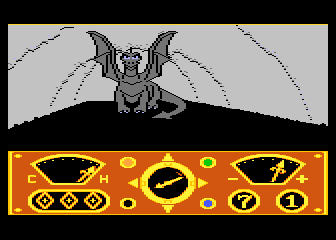
This is one of the other interesting things about playing through any of Sierra's old adventure series. You can see how gaming technology evolved from game to game. Quest for Glory I and II initially used 16-colour 320×200 EGA graphics and a text parser, though Quest for Glory I was subsequently rereleased with 256-colour 320×200 VGA graphics and a mouse-driven interface. Quest for Glory II never got the same treatment officially, but a fan-made free remake (approved, but not funded or assisted by, the original team) brought it into the latter days of the 20th century rather nicely. Quest for Glory III then brought the series officially into the 256-colour VGA age, and Quest for Glory IV was the first CD-ROM based episode, featuring none other than John "Gimli and That Professor Bloke I Can't Remember the Name Of from Sliders" Rhys-Davies on narration duties.

Quest for Glory V marked a bit of a turning point, however, not just for the series, but for Sierra's fortunes and the adventure game genre at large. Being a CD-ROM only multimedia extravaganza with 256-colour 640×480 Super VGA visuals, polygons and a prerendered intro sequence that, while impressive at the time is utterly laughable if you watch it nowQuest for Glory V marked the point where, for many, the franchise lost its way. There are plenty of people who adore the game, of course, but those who grew up with the earlier entries in the series can't help but mourn the direction it took with its fifth instalment and its subsequent demise.

This wasn't the only time Sierra did something weird with one of its established series. In fact, almost all of Sierra's classic, long-running series ended up as something completely different to their original forms — King's Quest became a 3D action RPG with its eighth instalment; Police Quest became the tactical SWAT series after its fourth incarnation (later dropping the Police Quest moniker altogether); and Leisure Suit Larry just went off the rails altogether after its sixth episode (which, naturally, is called Leisure Suit Larry 7). In comparison to these other titles, Quest for Glory V's changes were actually relatively modest — but still enough to put some off.

Perhaps the saddest thing about the demise of the Quest for Glory series is that we really haven't had anything like it since. We've had a resurgence of point-and-click adventures in the last couple of years, sure, but nothing that so deftly blends two genres together with interesting stories, a genuinely amusing sense of humour and satisfying gameplay.

However, there's some good news for fans of Lori and Corey Cole — they're working on something new called Hero U, and will be opening a Kickstarter funding drive some time later this month. More details here. I'm pretty excited — they've said outright that it's not going to be a new Quest for Glory game, but it will incorporate some of the things they learned from making those games. Sounds awesome, right? Of course.

Hope you enjoyed the podcast. We certainly spent long enough recording it — and then I spent even longer editing it. 🙂

#oneaday, Day 82: The Pile of Shame

Hello everyone! Late again. I'm just going to stop writing that at the start of my posts, as it appears that 2am is prime blogging time in my stupid world. Oh well. I could have worse vices at 2am. Or indeed at any time.

Few fun things to report. Well, one really, and one I can't talk about yet until I know a bit more. First up, I'm going to be writing for an upcoming retro-gaming site called B4HD, which specialises in games from the pre-HD era. (B4 HD. Geddit?) It was brought to my attention by the lovely and talented Jennifer Allen, who is also partaking in this One A Day nonsense (one of the few people who are still left) and also happens to be the deputy editor of the site. So thanks, Jen, for pointing it out. It's right up my alley. Now I just need to write something ready for its launch.

I also have several potential freelancing irons in the fire, so we'll have to wait and see if those come to anything. I'm being more proactive about it now, though, and badgering people I haven't heard from for a while. It's not really in my nature to act like that, but I'm learning. Assertiveness and all that. Plus journalism can be pretty cut-throat, so I better toughen up, right?

For the remainder of this post, I think I may just be lazy and list my current Pile of Shame – in this case, games I haven't finished – since it was Jen's post I linked to that inspired this one. So here goes. Starred games indicate games that I have at least started and played a reasonably significant amount of in the past. Non-starred ones have either not been played at all or very little. Some of these I will probably never get around to ever. But they're still there, mocking me.

PS1

  • Final Fantasy V
  • Final Fantasy VI

PS2

  • Final Fantasy XII*
  • ICO
  • Metal Gear Solid 3
  • Resident Evil 4
  • killer7
  • Persona 3 FES*
  • Odin Sphere
  • Project Zero/Fatal Frame*
  • Psi-Ops
  • Shadow of the Colossus*

GameCube

  • Resident Evil Zero*
  • Resident Evil Remake

Xbox 360/XBLA

  • Borderlands*
  • Numerous titles in the Sega Mega Drive Ultimate Collection (particularly the Phantasy Star series, Story of Thor, Shining Force II and Shining in the Darkness)
  • Alien Hominid*
  • Braid*
  • Castle Crashers*
  • Forza 3*
  • Lode Runner*
  • Perfect Dark*
  • Puzzle Quest*
  • Shadow Complex*
  • Splosion Man*

PS3/PSN

  • Matt Hazard: Blood, Bath and Beyond
  • Final Fantasy XIII*
  • Disgaea 3
  • Shatter's last two Trophies
  • Uncharted 2 multiplayer
  • Building a level in LittleBigPlanet

PC – god-damn Steam sale in early January saw to this one.

  • King's Bounty
  • King's Bounty: Armored Princess
  • Mount & Blade
  • Uplink*
  • Jade Empire
  • KOTOR as Dark Side
  • Neverwinter Nights: Hordes of the Underdark
  • Neverwinter Nights 2
  • Baldur's Gate 2*
  • Baldur's Gate 2: Throne of Bhaal
  • Icewind Dale
  • Icewind Dale: Heart of Winter
  • Morrowind* (played EXTENSIVELY, never got anywhere NEAR finishing)
  • Homeworld 2
  • Dungeon Siege 2
  • The entire Myst series
  • Gabriel Knight 3*
  • The Police Quest series
  • King's Quest IV
  • The Witcher*
  • Freelancer*
  • Startopia*
  • Ghost Master
  • Martian Memorandum/Mean Streets
  • Realms of Arkania
  • Relams of Arkania 2
  • No-One Lives Forever 2
  • Unreal Tournament 3

Yeah, that's right. Kicking it old-school with some of those PC games. It's actually quite fortunate I have little-to-no money coming in right now as I clearly have a backlog to last me until the end of time. Couple that with the fact that I'm in a World of Warcraft phase right now (halfway to level 75 with my best character now) and there's clearly plenty to be getting on with. So a big middle finger to all the triple-A games that have come out since Assassin's Creed 2.

Of course, when Blur and Split/Second come out soon, this will all go to pot. Still, never mind.

#oneaday, Day 65: Step into my Game Room

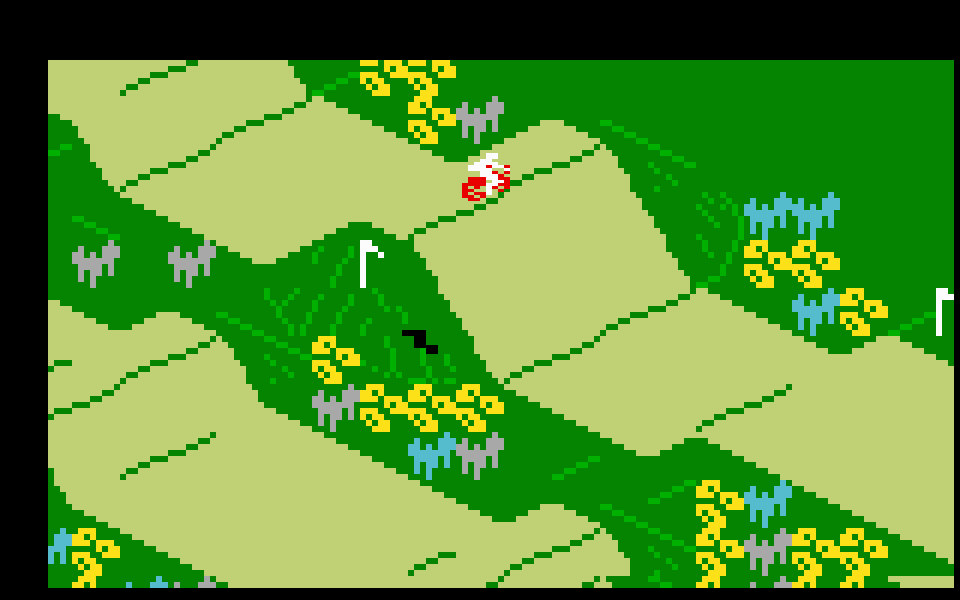
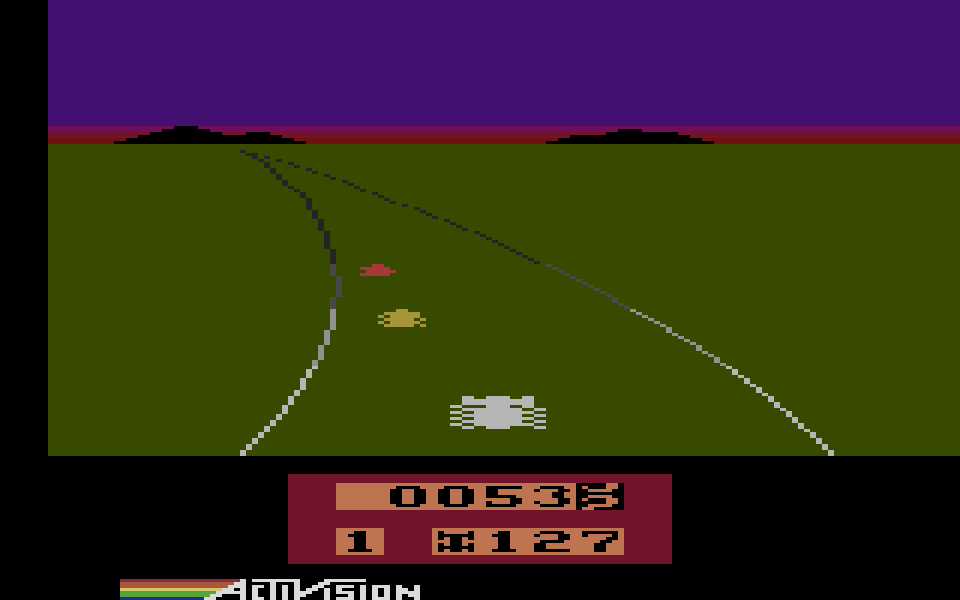
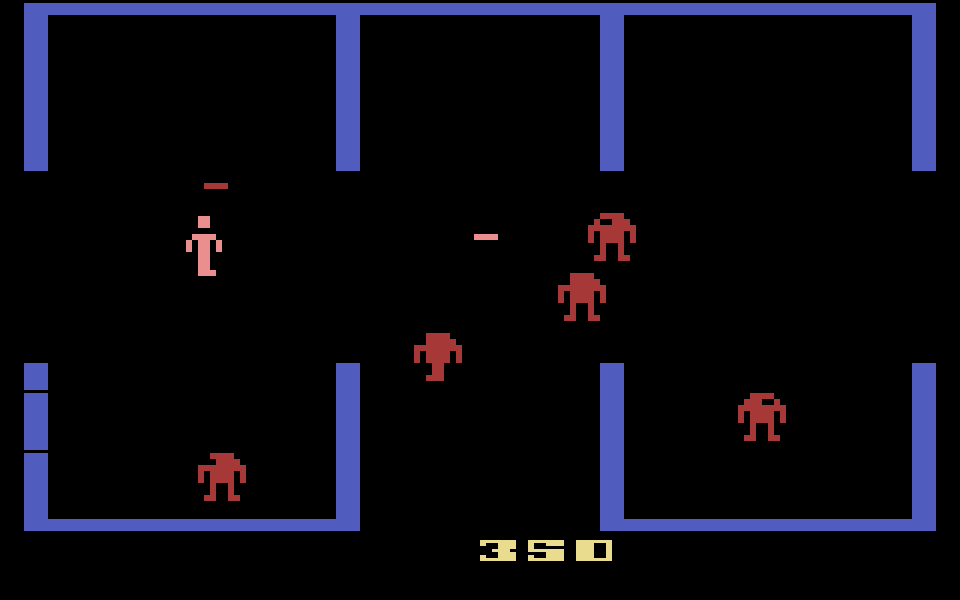
This post makes me sad, because I can't help thinking a lot of people on that thread are missing the point somewhat. I'm hugely excited for Game Room. I wasn't at first, but since hearing that there are not only arcade treasures in there but also Atari 2600 and Intellivision games too, my interest has been steadily growing until now I'm at the stage where it's just after midnight and moments ago, I switched on my Xbox just to see if they released things at midnight, or in the morning. (It's in the morning, for those who were curious.)

The arguments made in the first post are ones that we're hearing a lot – not just in the context of Game Room, but also in the context of digital distribution in general. The biggest concern people have with digital distribution is that one day, your content will be switched off and, despite having paid for it, you'll no longer be able to use it. This is a fair concern, as no-one likes splashing the cash on things that they won't be able to use at some point in the future – but when you think about it, in the world of tech, this is nothing unusual. Products come and go, specifications increase, chipsets change – and at some point it's necessary to leave the old behind. Did people complain that the Amiga wasn't backwards-compatible with the Commodore 64? Do music enthusiasts complain that it's getting harder and harder to find a cassette deck to play those old albums that you only bought on cassette because they were cheaper?

Well, yes, they probably do, but that's beside the point. What I guess I'm trying to say is this: isn't the "built-in obsolescence" of digital distribution the same thing? I have a stack of PC games in a box here, some of which it isn't possible to run any more. Okay, maybe with some tweaking and playing with software like DOSBox it's possible to get it going – but to a (for want of a better word) "casual" user, they're defunct and obsolete. The only difference with potentially-expiring digitally distributed products is that there's no workaround like DOSBox. Once the content's gone, it's gone. And yes, that's not a great thing, but it's not something to be surprised about.

The other objection people have is that Game Room will charge you again to play titles you already own Xbox Live Arcade versions of – titles like Gauntlet, Smash TV and the like. The simple solution to this is, of course, to not buy them again – but there's also the fact that the Arcade and Game Room versions are actually rather different beasts. The Arcade editions of the games are generally enhanced with leaderboards, online play and in some cases, new graphics. The Game Room versions are exactly as they were all those years ago. It may be that some people will be more than happy to buy a game again for the sake of having a completely authentic experience – others should simply avoid those games that they have already purchased.

I think the most exciting thing that a lot of people are missing, though, is that Game Room represents possibly the first fully-legal console-based multiplatform emulator out there. The constantly-rehashed argument from Game Room objectors is that "you can get all those games for free online". Yes, sure you can, but via means of questionable legality. Downloading a ROM for an arcade title is, legally speaking, only allowed if you actually own another copy of the game in question. Of course, people ignore this rule all the time – especially for the sake of hard-to-find games – but I for one think that it will be pretty neat to have these games available legally and without having to do any command-line or front-end faffing like you have to do with emulators like MAME. Again, it's a point in favour of the casual users, many of whom probably haven't even heard of an "emulator". Let's not kid around, either – it's also going to be nice to play some of these from the comfort of the sofa rather than the computer desk.

So I for one am firmly in favour of Game Room, particularly if the rumours of there being over a thousand games set for release in it over the next few years have any truth. Yes, it is a means for Microsoft to make money – but this is just the same as a whole lot of things on Xbox Live already are, much as a lot of things on PSN make money for Sony, and the Wii Shop Channel makes money for Nintendo.

What do you think? Are you going to be downloading Game Room and any games? Or are you going to be leaving the past in the past?

Retro or "Inspired By"?

turtles-in-time-reshelled-screenshot-now-only-10-dollars

Tolkoto's recent Exploding Barrel rant about reviewers' reactions to the recent Turtles in Time remake on Xbox Live got me thinking. What is it that gets people so excited about some "retro" games and not others? I agree with him, in fact – reviewers' reactions to Turtles in Time was somewhat harsh, particularly considering it's only 800 space dollars. Criticising the gameplay of the original by measuring it against modern yardsticks clearly isn't acceptable… or is it? It's difficult to say. After all, this may be some gamers' first encounter with an early-90s brawler (although XBLA has hosted the previous Turtles arcade game along with the magnificent Streets of Rage 2 and the diabolical Double Dragon) – what gives? And how come Castle Crashers – fundamentally the same game in many respects – gets smothered in adoration?

A common criticism of the brawler genre is that it's "too simple". But let's take a look at another genre in the form of the PSN's recent brick-breaker Shatter, which has garnered almost universal praise since its release a couple of weeks ago. Shatter is, let's not kid around here, Arkanoid. Okay, you have a "suck" button. And a "blow" button. (Stop sniggering at the back.) But fundamentally, it's still Arkanoid. You're a bat-shaped spaceship hitting a ball into bricks that are floating in space with some flimsy justification laughably called a "plot" buried somewhere in the Help menus. There are powerups, including one where you can just shoot down the bricks. Pretty much the sole point of the game is to achieve as high a score as possible – and high scores are something the game does well. It's a simple game. Everyone loved it for this fact.

So in terms of gameplay, Shatter adds little to the Arkanoid formula save a few fancy bits of physics, some HD art and a kickass soundtrack that I love and Feenwager hates. So why is this game awesome and Turtles in Time a bit steaming turd to reviewers? God knows.

The important thing is, of course, what the player thinks of all this. Those who enjoy the brawler genre or have fond memories of playing Turtles in Time on the SNES will have an absolute blast with the new XBLA remake. Similarly, those who enjoy bouncing things around and smashing walls will love Shatter. But are people more predisposed to like Shatter as it was designed from the ground-up to be a new game rather than a "re-imagining" of Arkanoid? Arkanoid LIVE on the 360 released to mixed reviews and has, it seems, been mostly forgotten already. Shatter, on the other hand, gives me the impression that people will perhaps be more inclined to give it a go, particularly given its very generous price point ($7.99 in the US store, £4.79 over here) as a result of the few things it does a little bit differently.

This pattern follows us around a great deal. LittleBigPlanet for PS3 is a 2D platformer, and unashamedly so. Yet plonk someone down in front of that, then down in front of, say, Rolo to the Rescue and see which they prefer. Actually, that's perhaps not strictly accurate. Plonk someone down in front of an HD version of Rolo to the Rescue sold for $10 on XBLA or PSN and ask them which they prefer. Would the answer still be LBP? Judging by what has happened with Turtles in Time here, it may well be, though many players, particularly those who have played and loved both, may feel a bit differently.

This has been yet another rant without any real point but do feel free to comment if you have any feelings. I'm planning a new music post very soon – those take a bit more preparation though. 🙂