#oneaday Day 812: Research update

My efforts to catalogue all the noteworthy mentions of Atari home computer games and software (including type-in listings) that I might, one day, want to make a video about are proceeding apace. I have finished reviewing issue 50 of Page 6/New Atari User, and my spreadsheet is up to 1,179 lines. This may have been a mistake.
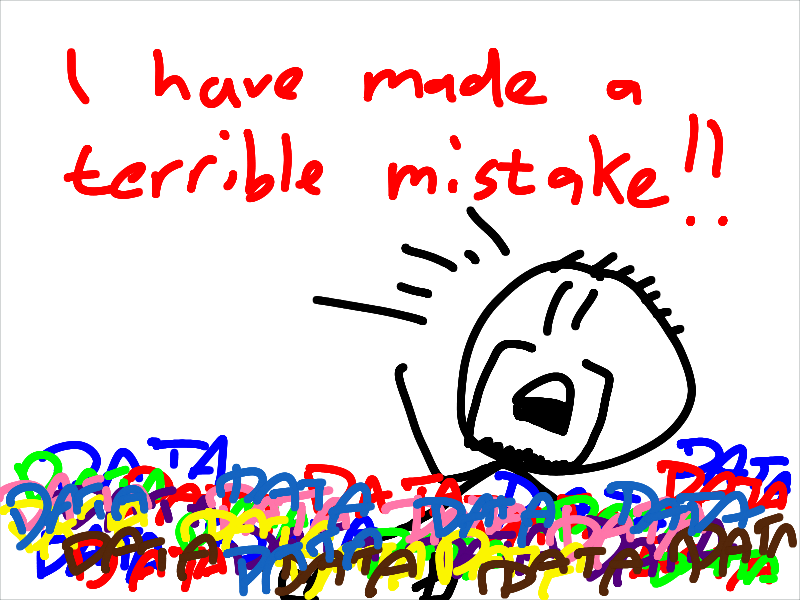
I joke, of course. This is actually proving to be a very valuable, helpful exercise for a variety of reasons: first of all is my originally stated, intended purpose for all this: to be able to easily track down press coverage for games I might want to do videos on for my Atari A to Z and Atari ST A to Z series. But some other benefits are coming to light, too. For example, a number of these games have multiple entries on the list thanks to being featured in various types of articles — besides straight-up individual title reviews, there are also compilation reviews and broader topic roundups — which means I can see how (or if) various titles were responded to differently by different reviewers or in different contexts.

Sometimes a game might be a hard sell at full price, but a decent use of some pocket money if and when it comes to a budget label. Sometimes a game might not have resonated with one reviewer, but really hit home with another — or vice versa. Sometimes a game might be a good inclusion as part of a compilation, but not quite strong enough to stand on its own merits. It's interesting to see all these things, and to have the various issues that relate to the various mentions of all these titles at my fingertips.

The other main benefit is more personal. I originally stopped doing the regular Atari A to Z and Atari ST A to Z series because I was worried I was running out of interesting things to talk about. This nearly 1,200 line spreadsheet — which is set to increase considerably in size as I continue to review Page 6/New Atari User issues up until the final Issue 85 from Autumn 1998 — has shown me that there is a veritable wealth of stuff I haven't even thought about tackling as yet. Whether or not I'll be able to stick to the original "A to Z" formula I haven't yet determined — as you might expect, there are some letters that just aren't all that commonly used to begin titles — but in terms of the sheer number of things, to have this amount just from one magazine's run is kind of incredible.

Once this process is finished, I would like to expand my efforts to other magazines. Initially I will likely cover the other early Atari magazines — Atari User, Antic and ANALOG being the main ones — but may well expand to some slightly later ones such as Atari ST User and ST Action, both of which I used to read back in the day. I'm already seeing with the choice of titles covered just in Page 6/New Atari User that they didn't even attempt to cover absolutely everything that was coming out in time for each issue, so it's very likely indeed that each magazine I look at will cover different things at different times. This, in turn, will make it interesting to compare reactions to titles between a European (Page 6 and New Atari User) and North American (Antic and ANALOG) audience, among other things.

Anyway, this is a substantial project, but it's going well and I'm getting a little bit done each day. I've already got more than enough to make use of when I start up the video production machine again, but it would be great to have enough material to last me a very long time indeed. (Honestly, I probably already have that, but the more the merrier, I say.)

I'm actually getting quite excited about rediscovering this focused approach. Checking the dismal viewing figures on my recent Terranigma video only convinced me further that this is probably the right thing to do for the sake of my own enjoyment. It may not necessarily lead to particularly impressive viewing figures, income, subscribers or anything like that — but honestly, I'm happy with how my channel has gradually grown over the course of the last few years. I have nearly 4,200 subscribers on YouTube now, and I would guess that a significant proportion of them are there for the Atari stuff that was my channel's main focus for quite some time. Switching over to something that I specialise in allows me to say "fuck The Algorithm, this is for me and anyone who happens to want to come along for the ride". And that's much more fun when the whole thing is supposed to be a hobby!


Want to read my thoughts on various video games, visual novels and other popular culture things? Stop by MoeGamer.net, my site for all things fun where I am generally a lot more cheerful. And if you fancy watching some vids on classic games, drop by my YouTube channel.

If you want this nonsense in your inbox every day, please feel free to subscribe via email. Your email address won't be used for anything else.
#oneaday Day 810: Compiling information

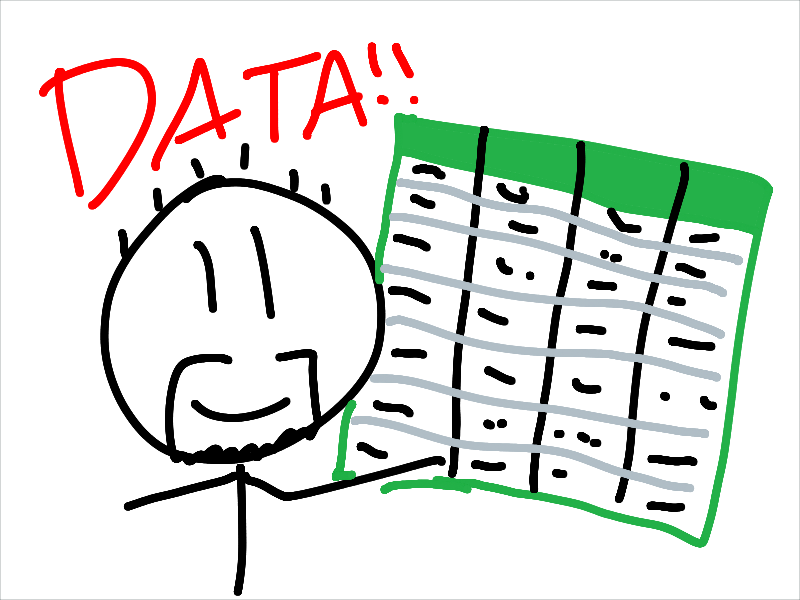
It will probably not surprise you to hear that, as an autistic person, I quite like organising sets of information into a visually pleasing and/or easy-to-refer-to manner. To that end, ahead of my intention to reboot my Atari A to Z and Atari ST A to Z series, I have been doing something I have been meaning to do for a while that will aid with research.

I've been going through old magazines — just Page 6/New Atari User to begin with, but I will expand my efforts at a later time — to determine which issues had reviews (or otherwise substantial articles) of what in them, and recording that information in a big ol' searchable, filterable, sortable table. Or, y'know, a spreadsheet. (I guess this makes me a "spreadsheet person" after years of resisting such things.)

This will (hopefully) make it much easier to track down these articles when researching something — and might also give me some ideas on what to cover, too.

One of the things I find most interesting when either revisiting old favourites or discovering new ones is taking a look at what the "professionals" had to say about them, and seeing if they treated them fairly, or if they were talking nonsense. I don't really mind either way; there is value to both confirming a critical opinion from back in the day, and having the opportunity to look at it from a more detached, modern perspective and perhaps disagreeing with what was said back then.

It's also kind of interesting to, in some cases, give these games a bit more time and attention than they might have perhaps had back in the day, particularly if the reviewer in question clearly didn't have a lot of time to spend with them, or didn't understand them completely. I mean, we're only talking a play session of maybe 20-60 minutes when it comes to most of my videos, but sometimes you do notice properly intriguing things about games after spending a bit of protracted time with them, rather than spending a few minutes on them and then moving on to something else.

Alongside the traditional "reviews", I'm also recording mentions of games in things like topic-based roundups, type-in games (which can be just as interesting and worthwhile as commercial software!) and… basically any mention of something I might want to cover, and which I might want to refer to what was being said about it Back In The Day.

It's going to take a while to compile all this information — particularly if I want to throw other magazines into the mix — but I think it's going to be a worthwhile endeavour that will be helpful for the direction I think I want to take the YouTube channel (back) in. It also gives me a good reason to look back at old computer and video games magazines, and I will always welcome any opportunity to do that. Not that I need a reason. But it is nice to have a reason to do so.

Anyway, my intent is still to hold fire on YouTube until after our holiday, then get back into the swing of things with the rebooted Atari A to Z and Atari ST A to Z series in mid-September, likely with my first recording session being the weekend of the 19th (meaning the first of the new videos will come out the following week). I'm sure I'll have a good chunk of this organising done by then, and I think it will be enormously helpful in adding some additional insight to my videos that will hopefully be as interesting for anyone watching them as it is for me making them.

Right this second, though, after taking care of 28 issues of Page 6 today, I think I've earned a bit of video game time. So it's back to Ys VIII for me!


Want to read my thoughts on various video games, visual novels and other popular culture things? Stop by MoeGamer.net, my site for all things fun where I am generally a lot more cheerful. And if you fancy watching some vids on classic games, drop by my YouTube channel.

If you want this nonsense in your inbox every day, please feel free to subscribe via email. Your email address won't be used for anything else.

#oneaday Day 934: Stop, Check and Check Again

The social Web is an incredibly frustrating place to be at times. I'm aware that I've commented on this subject a number of times before, but it's important: the spread of misinformation is at best irritating and at worst incredibly dangerous.

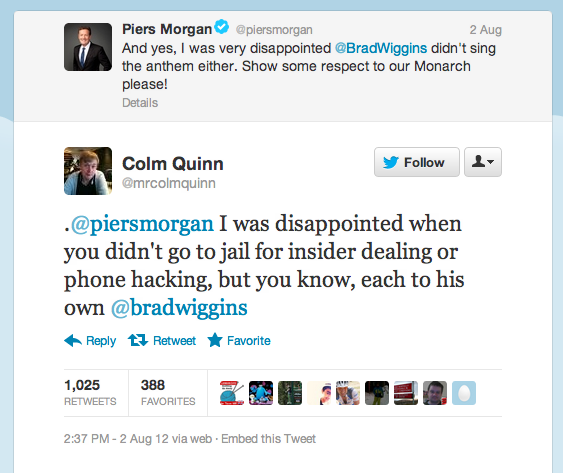
The most recent example was a result of this image:

This image has been doing the rounds recently — first on Twitter, where the supposed exchange took place, and subsequently, as tends to happen, a day later when Facebook's denizens caught up with the rest of the Internet.

It is, of course, bollocks. This exchange took place, oh yes, but it was not between Piers "Cuntface" Morgan and Bradley Wiggins. No, instead, this is what happened:


You have doubtless noticed that the person who replied to Piers Morgan was not, in fact, Bradley Wiggins, and was instead one Colm Quinn, who just happened to mention Wiggins in his tweet, which is where the misunderstanding came from — probably from someone who doesn't quite understand how Twitter works. (Ending the message with "@bradwiggins" could look like a "signature" to someone not familiar with the way a typical Tweet is structured.)

As usual, however, the fact that "BRADLEY WIGGINS GAVE PIERCE MOREGAN AN AWESUM COMEBAK" makes a better story than "SOME DUDE YOU'VE NEVER HEARD OF GAVE PIERS MORGAN AN AWESOME COMEBACK" struck, and it struck hard. The (inaccurate) story spread like wildfire, of course, with no-one bothering to actually check Wiggins' timeline to see if he actually said the things that were attributed to him. And it spread. And spread. And spread.

Over time, some people got wise to the truth of the matter and pointed this fact out. But more and more people continued to post the inaccurate details — and then it spread to Facebook, and the whole thing started all over again, with both sides getting increasingly frustrated with one another.

I know it's a seemingly silly little thing to get riled about, but like I say, consider the potential implications if the "fact" that started spreading was something that could actually put someone in danger, or ruin a person's reputation. When the entire social Web starts acting like Daily Mail reporters by just blindly reposting things without even bothering to see if they're true or not, we have the potential for a real mess. Just look at the reactions of Facebook-bound idiots who don't know what The Onion is for a preview of what might be.

Fact-checking isn't just for journalists. Of course, there are plenty of journalists out there who seem to think it doesn't apply to them, either, but that's another matter entirely. It takes a matter of seconds to check something like a Tweet is the genuine article. You should be immediately skeptical of anything posted as a screen grab of a bit of plain text that looks like it was written in WordPad, or anything described by someone as SO AWESOME/FUNNY/HILARIOUS/LMAOOOOOOO etc. And, most importantly, if something sounds like it was too awesome to be true, it probably was.

Respect to Mr Colm Quinn for his excellent admonishment of Piers Morgan's twattish behaviour. Disrespect to all of you out there (you know who you are) who fall for this crap every time, whether it's "OMG TODAY WAS THE DAY MARTY MCFLY WENT TO IN BACK TO THE FUTURE PART II!" (for the last time, it is October 21, 2015) or "OMG! PIERS MORGAN GOT BURRRRRRRRNED BY BRADLEY WIGGINS".

Simple routine: before you retweet or share something, stop, check, then check again. It's not that hard.


#oneaday Day 729: Stop SOPA, Read Books

So apparently a bunch of the Internet has blacked itself out in protest against the insanity that is SOPA. It's a move that I fully support and endorse, as SOPA is a piece of crap that, while (arguably) well-intentioned, is completely impractical with the digital world we take for granted today.

That's all I'm going to say on the politics of the matter for the moment, since there are plenty of other commentators out there who can doubtless discuss it in much greater detail than me. As a Brit, too, I'm not someone who will be directly affected by the law, but as we all know by now, the proposed measures will have a knock-on effect that could throw the whole online world out of balance.

What I wanted to talk about was how Wikipedia's blackout has affected the stupid people of the world. Not sure what I'm talking about? Give @herpderpedia a follow on Twitter and you'll quickly see what the problem is.

Wikipedia is an excellent and useful resource, of that there can be no doubt. But the level to which people have come to rely on it is perhaps a little worrying. To some people, it's almost as if Wikipedia is the only source of information. (People who think this are probably the same people who believe that Facebook is "the Internet")

There are, however, many more sources of information in the world than Wikipedia. Many more sources of information in the world than the Internet, for that matter. (Engage Old Fart mode) When I was at school, we had no Internet. Imagine that, you teenage morons! No Internet! If I got a bit of homework to "research" something, then I had to pick up an actual book and look through it. I had to know my alphabet well enough to look stuff up, and I had to know how to spell the thing I was looking up. Dark times? Not really, it was the norm; we accepted it. When the Internet came along, it was a source of information in addition to the knowledge we had in books, not a replacement. When I presented that homework to the class, it was written in my own words, showing my understanding. It wasn't a printout from Wikipedia.

And yes, when I worked as a teacher, on more than one occasion (more than ten, in fact) I received homework from students who thought that I wouldn't recognise a printout from Wikipedia. It showed absolutely no understanding on their part besides the most basic of net-savviest — an important skill in today's society, for sure, but not what I was looking for with the assignments in question.

Technology breaks. Open forms of media are unreliable. Every so often someone will come along and want to censor things. I'm not saying books are immune to these issues, but at least you can still read them when the power goes off.

SOPA sucks. Fortunately, it looks like it might not get through — though we're still a long way off victory at this time. Instead of bitching about not being able to cheat at your homework, try opening one of those dusty old books on your shelf and looking up the thing you want to know more about.

Magic, isn't it? Knowledge without electricity. Who would have thought it?

#oneaday, Day 323: A Little Balance On The Gaming Issue, Please

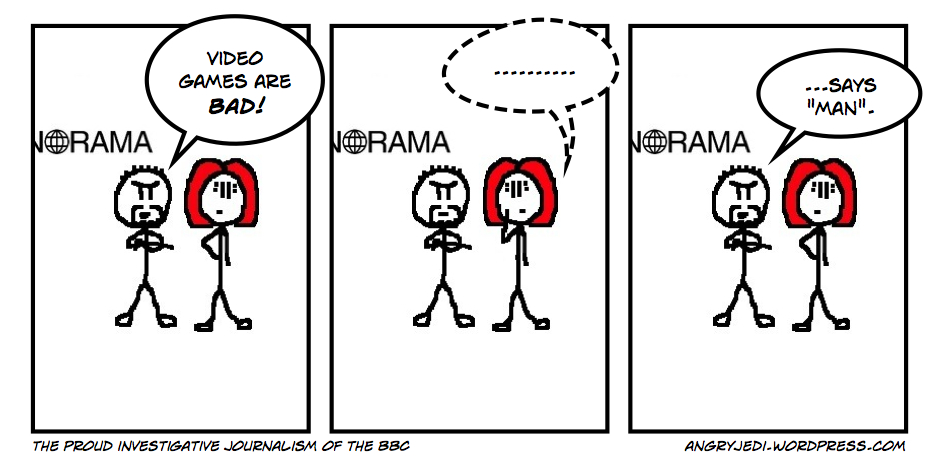
An hour ago, the BBC aired an episode of Panorama, our go-to investigative journalism programme, on the subject of video games. The subject, predictably, was the ever-present "are video games addictive?" question that has been raised and not answered many, many times prior to now.

The programme made a few fair points that are more common sense than anything else. Firstly, those with addictive personalities are prone to becoming addicted to games. Many games have in-built reward mechanics which those who get easily addicted to things will… well, get addicted to. Social games like Farmville, MMOs like World of Warcraft and popular multiplayer titles like Call of Duty all take great pains to ensure a regular stream of rewards and gratification being sent in the player's general direction. Whether it's a "medal", a "completed quest" or simple experience points, there's a constant flow of something that leads the player to believe they're achieving something. Those who become addicted to things easily can use that as a justification.

Secondly, the programme pointed out that parental controls need to be used more effectively. Many children and teenagers are given free reign on their use of video games and as such don't limit themselves on how much to play, to the exclusion of other things. Parents need to get better-informed about the facilities available to them to control their children's playing habits. This is, sadly, something that many parents are very resistant to, despite the fact that the tools are there for use, particularly on the Xbox, which offers some of the most robust family controls that there are—as does the Mac, oddly enough.

There were no concrete conclusions drawn, however. The "conclusion", if you can call it that, was that more research was needed from an independent body.

The thing is, this discussion has been going on for decades now, and no-one has thought to actually do that research in an appropriately investigative and non-biased manner.

I was reading through a few Formspring answers from Leigh Alexander (I think) the other day and she made the very good point that those of us out there who write about games can't be called "journalists" in the same sense as those who write for, say, national newspapers on breaking stories. Our role as members of the games press involves reporting on carefully-disseminated information provided by PR companies, critiquing products on general release (occasionally before general release) and sometimes interviewing a developer from the industry. There's no real "investigation" there, there's no hard-hitting stuff. That's not necessarily a bad thing, but given that mainstream media tends to come down on the more negative side of the fence when investigating gaming, I think there's certainly scope for a counter-argument: someone who does know the industry well investigating the burning issues. And investigating them thoroughly using established journalistic, sociological research techniques.

Who's going to be the first person to step up and do that, though? More to the point, would anyone read it or take it seriously? Gamers, by their very nature, are defensive creatures, having been made out to be "the bad guys" by the mainstream media once too often. And those not "in the know" are often inclined to have their minds made up by sensationalist stories in the aforementioned mainstream media.

What we need is balance. What we need is a hero.

Wait, what?