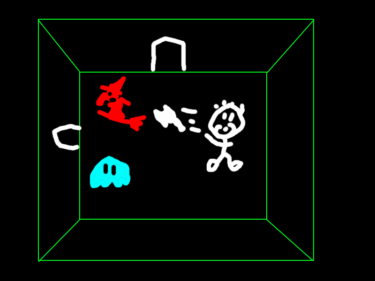
For the last few days, I have not been playing any of the new games I have. I have, instead, been mildly hyperfixating on Atic Atac for Spectrum, which is part of the upcoming Rare Collection 1 cartridge that we're releasing for Evercade. I have ostensibly been doing this so I can better inform the Evercade community about how to get the best out of this game, but honestly I've just been having a lovely time, too.
Atic Atac is a game I have fond memories of, though not because I had it as a child — none of Rare predecessor Ultimate Play the Game's titles were on Atari computers. I don't actually remember where I played it for the first time, and it was only once I ever played it. I believe it was the BBC Micro version I played rather than the Spectrum version, which means I probably played it at my friend Matthew's house, but the details are hazy and unimportant.
What I do remember about Atic Atac is that I thought it was a really cool game for a few reasons: firstly, its top-down perspective, presented with bold, colourful, almost vector-esque lines; and secondly, its unusual health display, which was presented as a roast chicken gradually being stripped down to the bone. When all the "meat" was gone, you lost a life.
For years, I never actually knew what the point of Atic Atac was, though. When I played it as a child, neither I nor whoever it was who was proudly showing it off to me knew what you were supposed to do, so we just had a lovely time wandering back and forth through rooms, throwing axes at monsters. And, indeed, it is possible to enjoy Atic Atac like that if you so desire; there's even a score function based entirely on the enemies you defeat, so you can challenge yourself to get as high a score as possible before succumbing to inevitable death.
Spending some proper, protracted time with it now, though, I'm finding it very much my sort of game, in that it's something of a blend between the Atari 2600 classics Haunted House and Adventure, with a dash of early-format text adventures in there. Not in terms of how you interact with it — Atic Atac is out-and-out an action game — but rather in terms of its core structure of wandering a map, searching for specific "treasures" and your end goal being to return all of said treasures (three pieces of a key, in this case) to a specific location: the starting room.
What I often find with home computer games from this period — particularly those that originated on the Spectrum, for some reason — is that it's easy to assume they're a lot more complicated and confusing than they actually are. And such was the case with Atic Atac; at its core, it's a game about getting to know a map, unlocking doors and hunting for treasure, nothing more. Sure, there's a couple of additional wrinkles — most notably, a few special items counteracting a few "special" monsters that appear at various points — but the basics are simply explore maze, unlock doors, get treasure, escape.
One thing I have really enjoyed doing with Atic Atac is manually making a map, adventure game style. This is mostly fairly straightforward to do, though there are a couple of instances in the game where it defies its own laws of physics to squeeze rooms in where there "shouldn't" be any, which makes mapping those particular portions a little challenging, but for the most part it's easy enough to map. The tricky thing, then, is systematically searching all those rooms to find the keys and treasures that you need!
I haven't quite managed to beat the game just yet, but I've been really enjoying the attempts. And I think I know it well enough to be able to offer some solid advice to newcomers now, too — so watch out for that around the time of Rare Collection 1's release!
Want to read my thoughts on various video games, visual novels and other popular culture things? Stop by MoeGamer.net, my site for all things fun where I am generally a lot more cheerful. And if you fancy watching some vids on classic games, drop by my YouTube channel.
If you want this nonsense in your inbox every day, please feel free to subscribe via email. Your email address won't be used for anything else.


