#oneaday Day 307: Blueprints to my brain

After seeing the glowing praise it's been getting recently, I decided to give the new indie darling Blue Prince a go. I've been suspicious of sudden indie darlings ever since I absolutely detested my time with Jonathan Blow's Braid, but everything I was hearing about this one made it sound thoroughly interesting. As such, I was more than happy to forego my usual suspicion and give it a go.

For the unfamiliar, Blue Prince positions you in the role of an heir to a rather curious mansion. Said mansion supposedly has 45 rooms… except it doesn't, and there's actually a super-secret hidden 46th room somewhere. Your dead uncle has challenged you from beyond the grave to find said 46th room. Succeed, and you inherit all his stuff; fail, and you're doomed to perpetual roguelike hell.

Yes, Blue Prince is a roguelike of sorts in that it's based around repeated runs of the same thing with a heavily randomised element. But it's not a combat-based game, nor a role-playing game; instead, its focus is purely on exploration. While the roguelike descriptor is apt, Blue Prince is perhaps better thought of as being akin to tabletop games such as Betrayal at House on the Hill.

The way it works is like this: each in-game day, you begin a new run with 50 "steps" of stamina available to you. Each time you cross the threshold from one room to another, whether you're making progress or backtracking, you use up a step. Your initial aim is to make it from the entrance hall in "rank 1" of the mansion to the antechamber in "rank 9"; things get a little more complex later, but I haven't got that far yet, so I can't talk about that side of things with any great authority as yet.

Each time you open a door in the mansion, you pull three room "cards" from the deck you have available and can pick one to draft. This room then attaches to the door you just opened, and you gradually build out the mansion map from there. Rooms are automatically oriented based on the direction the door you opened is facing, and in this way you can plan out your route to a certain extent; as time goes on, you'll familiarise yourself with the "deck" of room cards and know which ones work better where. For example, you might want to find a means of safely ditching "dead end" rooms as soon as possible so they don't come up later in your run, but various rooms have special effects (both positive and negative), too, so you'll need to bear those in mind.

As you progress through the mansion, you'll acquire various resources. Keys are used to open locked doors. Gems are used to draft certain particularly powerful or helpful rooms. Coins are used to purchase items in special "shop" rooms. Dice allow you to redraw three room cards if none of the ones you initially drew tickle your fancy. And then there are a variety of items that show up along the way, too; for example, the metal detector makes it easier for you to locate keys and coins, while the shovel allows you to dig in patches of dirt to find additional resources and items.

You'll run into puzzles of various types in the mansion. These appear to take two basic forms: firstly, there are self-contained puzzles that always show up in specific rooms, and these usually reward you with resources or items if you solve them correctly. Secondly, there's the overall meta-progression puzzles, which involve you figuring out the somewhat convoluted means through which you can actually move forward and, once you reach it, get into the Antechamber.

Blue Prince does have a few things that carry over from run to run, but the main thing is knowledge. Information you learn in one run can be used in the next; there's no not being able to do something because your character hasn't seen a particular piece of info in this particular run. As such, it pays to take notes and/or screenshots as you play, because as you discover new pieces of information, you'll eventually find a use for it. It might not be right away, but you'll get there in the end.

The game also isn't completely randomised. As previously noted, you can learn the deck so you can have a good idea of what rooms you should burn early on in order to draw more helpful ones as you get deeper into the mansion. Certain rooms will only show up in certain positions on the map, or display particular scenery elements if positioned in the right place. A "coat check" room allows you to stash an item in one run and pick it up in the next; under normal circumstances, you lose everything at the start of each new day, aside from the knowledge you, the player, have accumulated.

I've played for about three or four hours tonight and I'm starting to get a feel for it. It's a really interesting game. Some folks claim to have spent upwards of a hundred hours playing this and this intrigues me; the central gameplay mechanic is intriguing and enjoyable, but I am very much under the impression that "winning" the central challenge is just the beginning of what makes Blue Prince so interesting. Right now, everyone is being deliberately obtuse about things — partly at the developer's request, and partly just not to spoil it for everyone else — but I am definitely intrigued to see where things go.

My only concern is that I fear I may be too stupid to figure this game out by myself. But that's what talking about it with friends online is for, right?


Want to read my thoughts on various video games, visual novels and other popular culture things? Stop by MoeGamer.net, my site for all things fun where I am generally a lot more cheerful. And if you fancy watching some vids on classic games, drop by my YouTube channel.

If you want this nonsense in your inbox every day, please feel free to subscribe via email. Your email address won't be used for anything else.
#oneaday Day 213: Knotwords is a Mobile Game That Isn't Shit

Mobile games are, to me, mostly absolute bobbins. I have no desire to engage in tap-and-wait non-gameplay, I don't want to play rigged puzzles designed to get me to cough up money for "boosts" and I absolutely want nothing to do with fucking gacha. On top of that, I have zero desire to play "console-quality" experiences on my phone because touchscreens fucking suck for games like that.

As a result of all of the above, there are very few mobile games that I will give any time to whatsoever. One of them is Take It Easy by Ravensburger, an adaptation of a tabletop game that I think works a lot better as a video game because you don't have to do any of the maths or checking for valid moves yourself, but that's not what we're here to talk about. (I talked about it at length here, and I am always pleased to note that it is still supported after originally being released in 2015, which is practically caveman days in smartphone gaming terms.)

No, today I want to talk about Knotwords, a simply presented game by Zach Gage and Jack Schlesinger. This is a game that is, for me, an ideal mobile game. It has short play sessions, it's easy to control using nothing more than the touchscreen, and perhaps most importantly, it's not trying to shake you down for your life savings or make you endure ads every ten minutes. No, in fact the game is ad-free, and simply monetised via either an optional subscription (£4.59 a year) or a one-off purchase (£11.49).

The free version of Knotwords allows you to play the daily "Mini" and "Classic" challenges (the difference simply being the size and complexity of the complete puzzle) as well as a monthly "Puzzlebook" (though I would add that at the time of writing, the Android version of the game has broken this feature, asking for an update that doesn't exist). Paying up allows you to access a mode called "Twist" (which I don't know anything about because I haven't paid) as well as the archived previous Puzzlebooks, plus a couple of extra benefits such as additional hints, if you need them.

So what is Knotwords? It's a word puzzle based on crosswords, but also drawing influences from sudoku (or perhaps more accurately, kenken) and anagram puzzles. You're presented with a blank crossword divided into areas, with each region telling you which letters go in it, but not the order those letters should be in. Your job is to untangle these "knots" and solve the crossword using valid words, ideally as quickly as possible. That's it — at least for the Mini and Classic puzzles; I don't know if Twist is any different.

The pleasant thing about Knotwords is that it's simple to understand, but it gets you thinking. Supposedly the puzzles are easy on Mondays and ramp up in difficulty as each week approaches Sunday, but I haven't been playing the game regularly enough to notice the differences as yet.

I have been playing the game, though, which is more than I can say for pretty much any other mobile game released since… well, 2015, when Take It Easy came out. I appreciate a game that makes good use of the platform it's on, doesn't constantly bug me to pay up, and which is simply a fun little challenge. A Knotwords puzzle is the sort of thing you can do on the toilet or before going to bed; it doesn't demand a lot of commitment, but it does get your brain working in a way that doomscrolling the shitty end of the Internet absolutely does not.

The only thing I don't like about it is its use of "streaks", a la Wordle, because that's a shitty way to engage players and I dislike it intensely. But it's also easily ignored, so I'm not particularly mad about it. I do feel sorry for the people online who seem to have a genuine addiction to anything with a "streak" involved, though, including this. You should be playing things like Knotwords because you want to, not to Make Number Go Up.

Anyway, Knotwords is A Good, and I'm happy to have randomly stumbled across it the other day. If you're burnt out on Wordle (or just feel weird giving the New York Times any of your time and/or attention, regardless of reasons) then I highly recommend giving it a shot.


Want to read my thoughts on various video games, visual novels and other popular culture things? Stop by MoeGamer.net, my site for all things fun where I am generally a lot more cheerful. And if you fancy watching some vids on classic games, drop by my YouTube channel.

If you want this nonsense in your inbox every day, please feel free to subscribe via email. Your email address won't be used for anything else.

2463: You Can't Win Them All

0463_001

"You can't win them all" is one of those platitudes we hear numerous times throughout our lives. In childhood, it's used as a means of attempting to stop the inevitable crying after we lose a game against a sibling or fail to achieve something we really wanted to achieve. And in adulthood, it's used in circumstances ranging from the loss of a job to the end of a relationship.

And yet I feel it's a saying that a lot of people these days seem to have forgotten.

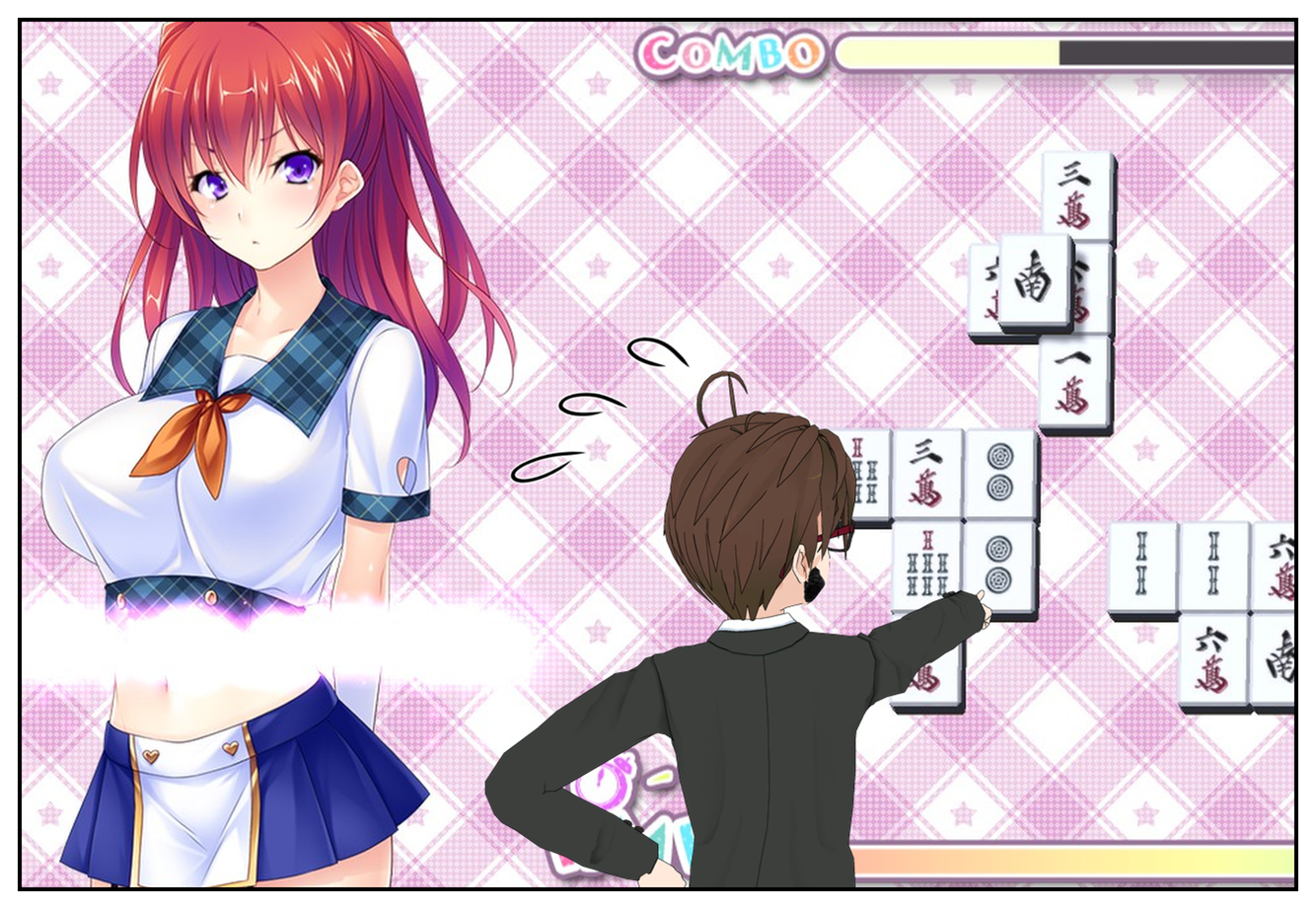
Today I've been playing a game called Delicious! Pretty Girls Mahjong Solitaire which, as I said in my writeup on MoeGamer earlier, is exactly what it sounds like. I've been having a lot of fun with it; mahjong solitaire is one of those simple-but-challenging things that I find enormously addictive, and Delicious! certainly likes to slap you around a bit with its various tile layouts. But that's all part of the fun, as is the case with pretty much any non-free-to-play-garbage puzzle game produced since the dawn of computing: the fact that victory always seems attainable, yet is often just beyond your grasp is what makes these experiences so enjoyable, exciting and addictive.

And yet, glancing at the Steam reviews and discussion pages, the most common complaint people seem to have about the game is that "it's too hard". The timer's too quick. The game gives you too many "unwinnable" layouts. In other words, it doesn't let you win every time. (A similar swathe of criticism was levelled at Frontwing's excellent ecchi puzzler Purino Party.)

"Victory" is something that people the world over seem to think they have become entitled to, with the fact that whenever you're doing anything competitive, the possibility of losing is what makes it competitive in the first place. You see it everywhere: in the Delicious! forums, where players complain that they have to keep trying levels until they get it right; in Final Fantasy XIV, where people vote to abandon a duty after the first party wipe rather than helping newcomers or people who aren't as familiar with the fights; in Overwatch, where someone will rant and rave at their team if they lose, completely ignoring the fact that there's always the possibility that you are, you know, simply outmatched.

It's hard to say exactly where this attitude comes from, but it seems firmly ingrained in society now, and repeatedly reinforced by lots of things that we do, particularly online with the growth of "gamification". "Well done!" everything seems to say, showering you with points, levels and achievements and inevitably begging you to "share" everything on social media. "You used this thing for the thing it was designed to do!"

People often joke about school sports days that don't have winners any more, but I've seen it happen: kids getting "participation trophies" even if they did the bare minimum. I've also seen "Celebration Assemblies", in which children get certificates for everything from getting 100% on a spelling test to — I'm not joking about this — sitting still in their chair for a whole lesson. This continues into adult life, too; at work Christmas parties, there's the inevitable cringeworthy "awards" ceremony, where whatever "lol, so random" douchebag who organised the whole debacle dishes out a series of completely arbitrary awards to ensure that everyone gets recognised for something, even if that thing is "drinking lots of coffee" or "being able to spell".

Failure is what makes experiences like games fun and exciting. If you win every time, you devalue the concept of winning until it is completely meaningless, and nothing feels worthwhile any more, which means you start to crave — or expect — more and more positive reinforcement with every passing day, and get annoyed or upset when your every whim isn't catered to, or things don't go the way you expect them to.

Me, I've had my fair share of failure, but every time I get a TIME'S UP or NO MORE PICK [sic] I just hit the Retry button, give it my best shot and eventually I might actually succeed.

Now, if only it were that easy to pick yourself up and start again after a repeated series of failures in life as well as games.

2372: The Lost Art of Puzzle Games

0372_001.png

I've been playing some old puzzle games recently. By "old" I mean "predating the smartphone", which in the grand scheme of things isn't all that old, but in technology terms is positively ancient. And, while I've known this for a while, the difference between puzzle games now and puzzle games of then makes it abundantly clear, beyond a doubt, that the modern age has done our collective attention spans no favours whatsoever.

The reason I say this is a simple matter of timing and commitment. The age of mobile and social gaming — Bejeweled Blitz in particular had a lot to do with this, I feel — has redefined the puzzle game as an experience that must be over and done with within 30-60 seconds, lest the participant get bored with the experience. This doesn't necessarily mean it has to be easy, mind you — quite the opposite, in fact, in the case of free-to-play games, where "friction" (ugh) is specifically incorporated into the game design at regular intervals for the sole purpose of extracting money from lazy players.

There are some people who are too stubborn to pay up to get past an artificially difficult level in Candy Crush Bullshit, of course, but these people are in the minority, because the 30-second structure of the levels that are easily beatable trains one to expect a bite-size, painless experience rather than having to actually put in any work or practice. And so for many players, the option to pay up to bypass a particular challenge — or at least make it insultingly easy, for the illusion of them having beaten it themselves — becomes an attractive one.

Compare and contrast with a puzzle game designed in the old mould, then. Rather than being designed as rapid-fire timewasters, puzzle games used to fall into two main categories: those which, like the best arcade games, challenged you to see how long you could last against increasingly challenging odds; or those which, like the other best arcade games, challenged you to demonstrate your superiority over either a computer-controlled or human opponent. In both cases, said challenges took a lot longer than 30 seconds to accomplish — in the former instance in particular, a good run could go on for hours or more if you really got "in the zone".

In other words, puzzle games used to be designed with a mind to keeping a player interested and occupied for considerable periods at a time, rather than allowing them to while away a few minutes — that's what simple shoot 'em ups were for. Everything from the classic Tetris to slightly lesser known gems like Klax and oddities like Breakthru were designed in this way; these games weren't just "something to do" — they were a test of endurance, observational skills, strategy and dexterity, both mental and physical. Having a Tetris game that went on for an hour was a badge of honour rather than an inconvenience; you weren't playing the game until something better came along, the game was the better thing that had come along.

This change in focus for puzzle games is a bit sad, as I miss the old days of them offering substantial, lengthy challenges to tackle over time. That's not to say that there's no place for rapid-fire puzzles, too, but it just disappoints me that 30-second "blitz" challenges are all we have these days.

At least the old games still play just as well as they always did — with them being so graphically light in most cases, puzzle games tend to age a whole lot better than many other types of game.

2359: Purupurupurino

0359_001

I took a chance on a peculiar-looking game on Steam the other day. It wasn't a completely blind purchase, since the developer Front Wing were the creators of The Fruit of Grisaia, my favourite visual novel to date, but this looked like an altogether different sort of affair.

Purino Party is a puzzle game with a lightweight visual novel plot, loosely based on Front Wing's Japan-only straightforward visual novels Pure Girl and Innocent Girl. (Indeed, Purino Party reuses a number of event images from both Pure Girl and Innocent Girl, much to the chagrin of those who have read said works, but as someone unfamiliar with them but very much in love with the work of artist Nanaka Mai — who also designed Grisaia's characters — I didn't mind at all.)

The plot is lightweight, stupid fluff straight out of a nukige, which is unsurprising given the source material. You come to a town for a vacation, but are quickly accosted by mysterious local landlord Kei, who decides that your clearly godlike puzzle game skills make you an ideal person to help the girls in her charge realise their potential. (And shag them.) Thus begins a series of eight short stories, each focusing on one of the girls — first the four Pure Girl heroines, then the four Innocent Girl cast members — punctuated with increasingly difficult puzzle game challenges, with your reward being the advancement of the story and a picture to add to your gallery, most of which are lewd. (Most of which are very lewd if you install the optional X-rated patch, which Front Wing have been ballsy enough to link to on their Steam Store page.)

The puzzle gameplay may initially seem to be straightforward Bejeweled-style match three, but it's actually more akin to popular mobile game Puzzle and Dragons in that you can grab a piece and then slide it around the grid as much as you like, displacing other pieces along the way to shift them into advantageous positions, until a 10-second timer expires, at which point you're forced to drop it if you haven't already. Each level gives you a point target that increases with each episode of each girl's story, and a limited number of moves in which to accomplish this score. Later episodes also present you with a time limit, though this isn't normally too much of an issue.

The puzzles are really fun. The way in which you can move pieces around allows you to set up enormous chain-reactions of pieces, and indeed to meet most of the point targets in the game and progress, you'll need to do so. The fact you have ten seconds to move the piece around and displace the rest of the board as you see fit allows you to be strategic and methodical about arranging the pieces to your advantage rather than it simply being a challenge of spotting matches as quickly as possible. There's a touch of randomness that can sometimes screw you over a bit — if you start a round with a bad board layout, there's not a lot you can do — but you can usually mitigate this to a certain extent by taking advantage of the few special mechanics. Firstly, each girl has a "favourite" type of piece that loosely corresponds to their personality or interests, and you get more points for matching or chaining these pieces. Secondly, matching three or more "heart" symbols puts you into Fever mode, accompanied by some thumping cheesy J-pop. During this time, the points you gain are considerably increased; combined with the favourite piece bonus, this is generally the best way to score a lot of points quickly.

Meanwhile, the story is also entertaining. Don't go in expecting an emotional rollercoaster on the level of Grisaia, but each of the characters are endearing and appealing in their own way, and they all have their own personalities and stories to tell. A lot of it tends to descend into sex humour, particularly given that a number of the girls are total perverts, but amid the smuttiness (which, it has to be said, is amusing and curiously charming rather than weird) there are some genuinely funny jokes and some really likeable characters; it's just a shame we don't get to spend much time with them. Though I guess there's always Pure Girl and Innocent Girl to see more of them after the fact — assuming you speak Japanese or can find a suitable translation patch.

Purino Party isn't an amazing game or an amazing visual novel, but it does what it does well. It's lightweight, enjoyable fluff, not meant to be taken seriously in the slightest, and its bright colours, cheery music and immensely endearing characters make it just the sort of thing you can relax with for half an hour when you don't want to do anything too strenuous.

Kanae best girl. And not (just) because she looks a bit like Amane from Grisaia.