#oneaday Day 880: Not Going To Make a "Livin' La Vita Loca" Joke

20120617-012047.jpg

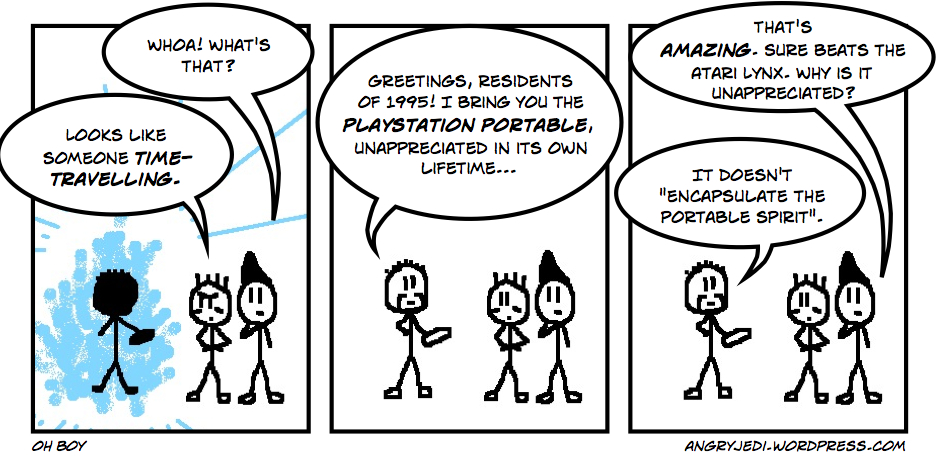
I bought a PlayStation Vita today. I'd had my eye on one for a little while, but having successfully paid off my credit card for the purchase of my new Mac, I decided a little treat was in order, so I did a bit of research as to what the fine folks of the Internet thought was good games-wise, and grabbed one today. I was fortunate enough to be able to snare a preowned but unused model from Game in Southampton today, which cut down the price considerably, allowing me to also grab an (overpriced) 32GB memory card along with a copy of Everybody's Golf to enjoy for about £270 in total.

I've only spent one round with the latter so far (but it's bringing back pleasing memories of Tee Off on the Dreamcast) so I won't comment on that too much, but I did want to talk a little bit about the system itself, as I believe it's worthy of note.

The Vita distinguishes itself from its predecessor the PSP immediately with its touchscreen-friendly interface. Featuring an icon-based homescreen somewhat akin to modern smartphones, the Vita invites you to touch, swipe, flick, peel and all manner of other things. You can reorganise your homescreen icons as you see fit, and even set backgrounds for different pages. You can't organise things into folders, though, which is a bit of a shame, but I can cope with that. PlayStation Network (sorry… Sony Entertainment Network, which still amuses me because its abbreviation is the same as Special Educational Needs) provides plenty of downloadable goodness, ranging from complete games that you could also buy as physical products at retail to smaller, cheaper, download-only titles and even free apps for access to Twitter, Facebook, Skype and Flickr.

The downloadable side of things has, for me, always been a big strength of Sony's systems from the PSP onwards. The PlayStation Store is a veritable treasure trove of underappreciated and overlooked gems as well as some of the most memorable "art games" (for want of a better term) in the business — games like Flower and Journey, for example. PlayStation Minis, too, provide portable-friendly experiences akin to what you might play on a smartphone, only with dedicated controls to enjoy them with, which is a big boon to anyone sick of poorly-implemented touch controls.

Besides the games themselves, though, Vita has a number of interesting and intriguingly noteworthy features. For starters, the system actually does multitasking considerably better than both iOS and Android. A tap of the PlayStation button freezes whatever you're doing and takes you immediately back to the "OS". From here, you can "peel" the app off the screen to close it completely, switch to something else (like, say, the settings app, or Twitter) and then be back into your game without any messing around. This is particularly beneficial when you want to browse the PlayStation Store for addon content, for example — even the PS3 requires a quit out of a running game to access the Store, whereas Vita manages to seamlessly switch to it, let you browse as you see fit, then switch back. This functionality also allows you to effectively do what the Steam Overlay does for PC gamers — while running a game, you can pop open a browser window and, let's face it, look at GameFAQs.

Vita's interface is gorgeous, too. The big, high-resolution LED screen makes things look great anyway, but the design of the OS just begs to be played with, too. On the homescreen, flicking between screens causes the icons to wobble like they're hanging on pegs. Rather than "slide to unlock" if the machine goes into standby, you use the same "peel" motion that is used for closing apps. And the soft keyboard is pretty good, too, with a decent predictive text dictionary built in — though the size of the screen and its position means that "thumb typing" as on a smartphone is next to impossible. Fortunately, as the Vita is primarily a gaming platform, you won't be doing that much typing on it, so it's a design flaw I can forgive.

The built-in apps are interesting, too. Near allows you to see other Vita owners in your nearby vicinity, see what they've been playing and their responses to them. (I was surprised to see quite a few Vita owners living near me — I was expecting it to be a virtual ghost town around here.) Welcome Park introduces the system's little quirks — the multitouch screen, the rear touchpanel, the two cameras and the built-in microphone — through a series of simple but surprisingly engaging minigames, all of which have Trophy support for those who care that much. There's also a pleasing number of free downloads from the PlayStation Store, including a selection of social apps, a simple finger-painting app and even some games, including the hilarious and WarioWare-esque Frobisher Says.

All in all, I'm very pleased with my purchase so far. I've become somewhat disillusioned with iOS gaming recently — perhaps due to the fact I get to see some of the very best and worst titles as part of my day job — so I've been surprised how good it feels to have a dedicated handheld system again, particularly one that doesn't possess an app ecosystem that encourages developers to include "Get More Coins!!" options even where they're not wanted/needed. I shall look forward to many Everybody's Golf sessions on the toilet in the near future as well as a thorough exploration of the myriad joys the PlayStation Store has to offer me.
#oneaday Day 778: Corpse Party: A (Spoiler-Free) Scoreless Review

20120307-023448.jpg

I'm glad this game exists. It's a pleasing piece of evidence to point to when people start talking about subject matter which would "never get greenlit by a publisher". It exists. It was greenlit by someone. It's freely available to download to your PSP or Vita via PSN. It's horrific. And it's brilliant.

Corpse Party tells the story of a hapless group of schoolkids who botch an attempt to commune with the spirit world and find themselves trapped in a long-abandoned elementary school populated with rather unfriendly ghosts. It's then up to the player to help the group (who quickly become separated in true horror movie fashion) to understand the truth behind what's going on and return them to safety. It all gets very Japanese horror very quickly — if you've seen anything like Ju-on: The Grudge or played Fatal Frame you'll know the sort of thing to expect.

Unfolding like a cross between a visual novel and a top-down 16-bit RPG, Corpse Party manages to keep the player feeling involved in the action while keeping the story flowing at a good pace. Oftentimes the player's only contribution between important events will be moving the current player character (for there are several) to a new location, but that simple act, along with the ability to examine items in the environment such as creepy notices on the walls and corpses of previous unwitting visitors to Heavenly Host Elementary School, makes the game feel far more interactive than many visual novel titles, which typically involve tapping the "continue" button lots of times. There's plenty of that, too, sure, but mild exploration and puzzle elements make this feel much more like a "game" to those who care about that sort of thing.

It's worth noting at this point that far from taking the relatively "straight line to the finish" approach that many visual novels take, Corpse Party gets increasingly easy to balls up completely as you proceed. Rather than simply immediately ending with a "Game Over" screen for making a bad choice, however, sometimes the butterfly effect of actions you take doesn't become apparent until an hour or two later. This is a double-edged sword; it turns "making a mistake" into an "alternative ending", even going so far as to credit the player with this ending in the menu screens, but it also means having to replay previous events, figure out what you did wrong and then do something differently. And God help you if you didn't make full use of the five available save slots per chapter. Fortunately, though, each of the game's five chapters is relatively short, with the final one being the longest at around three hours, meaning that replaying a whole chapter is not as much of a chore as it could be — though the game could really do with that mainstay of traditional visual novel interfaces: the "skip" button.

While it's relatively easy to get on to a "bad ending" path, particularly later in the game, this actually isn't something to get too frustrated about, for some of the most intense, morbidly fascinating and emotional scenes come about as a result of these "Wrong Ends", as the game calls them. Sometimes these are subtle changes to events in the supposed "true" ending for each chapter that mean hope turns to tragedy. Sometimes these endings result in horrible deaths for one of more of the main characters. Sometimes they result in revelations about the characters that you wouldn't find out about otherwise. Pretty much all bar a couple of "you were caught by a Bad Thing, you die" incidents are worthwhile and substantial narrative events in their own right, making discovering all of the story's possible endings — good and bad — something of a metagame in itself.

The game's story and the emotional power behind it is helped by a fantastic translation from the Japanese coupled with some truly excellent, emotionally charged Japanese-language voice acting. Even if you don't speak Japanese, you'll want to let the fully-voiced dialogue run its course, as it's packed with convincing expressions of emotion. (Oh, and you'll want to wear headphones while playing. The game features some of the most unsettling use of stereo effects I've ever encountered, along with a kickass soundtrack.) Characters laugh, cry, scream in terror and generally act in an incredibly realistic manner given the situation they find themselves in. Certain incidents which occur also show that being in a horrific, seemingly inescapable situation doesn't make the cast immune to things like your body letting you down at the worst possible moment, or your own feelings towards another person. Despite its supernatural core, Corpse Party's tale is a very human one, examining the relationships between all the members of its main cast and leaving the player feeling like they know most of them very well by the end of the story.

But that doesn't mean that the horror side of things is toned down. Far from it. Despite its retro-style presentation, this is likely one of the most disturbing, unsettling games you'll ever play. It doesn't hold back. This game puts its characters through some of the most unimaginable suffering possible in the name of evoking an emotional response from players, and it's all the better for it. Story is conflict, and through conflict people grow and change — sometimes for the better, sometimes worse. The fact that the characters are children drives home the fact that tragedy can happen to anyone, and the way in which we react to horrific situations can make a big difference to what happens to us next. It's a powerful tale, for sure, and even the most strong-stomached will struggle not to wince at some of the acts described throughout the course of the game's narrative.

Note that I say "described" and not "seen", for Corpse Party understands that most fundamental tenet of horror — the most terrifying things are not the most spectacularly gory things presented to the viewer on a plate, but the things in their imagination. As such, many of the game's strongest, most disturbing scenes are depicted entirely through text, colour flashes and sound effects. The understated manner in which various unpleasant incidents are coolly relayed to the player makes them all the more powerful, for it's at these moments that the imagination comes into play, filling in the blanks about what is not described as much as picturing what is described. It's a potent demonstration of the huge difference that having people who know what they are doing work on a game's script makes.

Corpse Party isn't a long game, and it won't take you long to beat all five chapters. There's plenty of incentive to replay, though, including discovering all the possible endings — good and bad — as well as a series of smaller "extra chapters" that fill in other events which are occurring alongside the main plot. There's also a bunch of student ID tags to collect throughout the course of the game, providing details on previous visitors to Heavenly Host who weren't so lucky, including how they died. It's a diverting little side mission which is integrated nicely into the theme of the game rather than feeling like a gratuitous addition. Since the PSP doesn't have a Trophy system, it's clear that these tags haven't just been added to fill out the Trophy list; they're instead present to provide context and atmosphere to an already creepy and impactful game.

So should you play Corpse Party? If you're a fan of story-based games and Japanese horror, then yes, you most certainly should. There's more than enough content to get your £11.99 worth in this game, and despite a couple of niggling flaws (the lack of a "skip" button when replaying scenes being the most disappointing oversight) it's a memorable, emotional experience that will stay with you long after it's finished.

#oneaday Day 775: Having a Corpse Party

20120304-033323.jpg

Looking for something terrifying? Own a PSP? Then quit whatever you're doing and go download Corpse Party from PSN for a very reasonable £11.99.

I've mentioned this briefly a couple of times over the last few days but it's worthy of some more in-depth enthusing, so here goes.

Corpse Party is a horror adventure game that uses a combination of Chrono Trigger-style top-down visuals and beautifully-drawn anime-style stills to tell its tale. And what a gruesome, horrifying tale it is.

Following a botched attempt to cast a friendship charm as one of a group of friends is set to leave her school, eight Japanese high schoolers and their teacher find themselves trapped in an unpleasant situation: a ruined, abandoned, creepy old school that is not their own, populated by malevolent ghosts and a wide variety of mutilated dead bodies — obviously previous victims of whatever curse brought them there. It's up to the player to get to the bottom of what's going on, and attempt to get the kids home. I haven't finished it yet, so I don't know if they're successful.

Corpse Party initially puts across the impression of being just another light-hearted anime adventure. But things quickly take a turn for the dark as the corpses start piling up and the numerous mysteries surrounding the ruined school start to reveal themselves. Gameplay is limited to wandering around, exploring and making occasional choices, so the game is perhaps best compared to a visual novel rather than an adventure game or survival horror, but it manages to be one of the most affecting, evocative games I've ever played using the bare minimum of tricks and gimmicks.

It achieves this in a variety of ways. First up is the excellent writing and localisation. Not only is the tale told one filled with unexpected twists and turns, but it's also one populated with believable, "human" characters who are far from being "video game heroic". They're kids. They talk like kids, they swear like kids, they make inappropriate comments like kids and they react like kids would in horrific situations like the ones in the game — by screaming, crying and running away.

The game doesn't hold back in its writing, preferring instead to depict its characters' behaviour in a realistic manner rather than the sanitised view of life we get in many other video games. For example, in one flashback scene depicting one of the characters' lives before the events of the game, we see a big sister (one of the main cast) and her little brother in the bathroom together. Both are nude. Big sister, who is somewhat outspoken and borderline brash at times, teases her little brother for being ashamed of his nakedness and hiding his penis from her, tackles him to the ground and tickles him, behaving as siblings do. There's no inappropriate eroticism in the scene despite the characters' nudity, just a believable depiction of two very "human" characters enjoying a mundane moment together.

A lot of the power of Corpse Party's writing comes from this clash between the mundane and the uncanny. Chapters will often open with a flashback of the "good old days" before the botched charm made everything go wrong for these kids, and it makes the anguish and terror they go through all the more profoundly affecting having seen what they're like in situations that they're comfortable with.

The writing is wonderfully descriptive without being overly explicit, either. Some of the most toe-curling, unpleasant scenes in the game come from a blank screen accompanied only by text and minimal sound effects. And yet somehow the manage to be far more horrific than anything I've seen on a next-gen console. The imagination is truly a powerful thing.

Imagination is all very well, but it can be helped along in a few ways. Firstly, there's the visual side of things, which is kept relatively simple for the most part — old-school pixel art RPG-style graphics punctuated with occasional hand-drawn closeups to emphasise particular scenes.

Star of the show is the game's sound design, though. Best experienced on headphones, Corpse Party's soundtrack combines a variety of atmospheric, dramatic and memorable musical themes with subtle use of sound effects and some truly fantastic Japanese-language voice acting. The delivery is packed with emotion, making the kids' screams of terror all the more harrowing as you find yourself really believing what's going on. And the use of stereo makes for an impressively unnerving experience.

While some may object to a game which features quite so much violence against children, I for one have so far found the mature treatment of the player to be refreshing. The game doesn't pull any punches at any point, meaning that you're just as likely to meet an agonising and drawn-out demise when playing as a little girl as you are when playing the "tough" guy. Far from feeling "wrong", however, the knowledge that the game's characters are in very real danger throughout provides a strong emotional impetus for the player to get to the bottom of what's going on and try to save them.

The only criticism of the game I have is the fact that if you find yourself down one of the "bad ending" paths and meeting a sticky end, you can sometimes lose a bit of progress if you haven't been saving fastidiously at the game's sparsely-scattered save points. With no means to quickly skip through scenes you've already seen once, this can be a little frustrating for the impatient (or those who can't work out what they're doing wrong — though it's usually obvious).

This little issue far from ruins the experience, however. In fact, those who want to "100%" the game will actually need to see all of these unpleasant endings as well as the "proper" ends to each of the game's five chapters, meaning that an unpleasant death for one of the cast isn't necessarily wasted play time.

Above all, Corpse Party is a rewarding, affecting, remarkable experience that treats the player as an adult throughout. It's refreshing to play through something which doesn't feel sanitised or dumbed down in the slightest, and I'm both surprised and delighted that a game like this made it on to the Western PSN store.

I'm certainly not complaining, though. In fact, I'd like to see a lot more titles like this in the future.

#oneaday Day 773: Off the Beaten Path

20120301-225122.jpg

The astute among you who follow my gaming posts (which, yes, I'm aware constitute an overwhelming majority of these entries — I am a passionate gaming enthusiast and an occasionally-professional games writer, after all) will be well aware of the fact that over the last few years, I've been drifting further and further away from the "mainstream" in terms of the titles I've been playing. This initially wasn't a particularly conscious decision, but rather a reaction to the fact that I just wasn't enjoying myself with the supposedly "big" titles of the day. I haven't made it through any Halo games except the original and Reach, for example, and my few forays into Call of Duty have left me feeling by turns underwhelmed and insulted. Similarly, I've given up all hope of ever making it through the Assassin's Creed series since it seems as soon as I think about playing through the older titles, Ubisoft goes and announces another one. You know, like they did today. Bastards.

I can't quite pin down exactly when this shift in attitudes happened, but I do know that I've come across some truly remarkable games in the process. One of the most memorable of these is Recettear: An Item Shop's Tale, which I picked up as part of one of Steam's characteristically generous Indie packs during one of the service's many sales, and promptly played all the way through for 40 hours. This was something of a difference from my expectation, which was that the game would be a shallow, social game-style experience with little depth and no long-term appeal. How pleasantly surprised I was when it turned out to be quite the opposite — deep, fun, well-written (kudos to Carpe Fulgur's wonderful translation efforts — we're talking PS1-era Working Designs-quality work here) and immensely satisfying to play. And not an Achievement in sight, either.

The attitude that I've decided to take as a result of discovering brilliant titles like Recettear and numerous others like it a little way off the "beaten path" is to simply say "fuck it" to the mainstream, and explore the things that I'm interested in, rather than the titles which the media makes it seem you're "supposed" to be interested in. It's been a very long time since I consulted a review prior to purchasing a new game, instead relying on a combination of word-of-mouth, intuition and simple, immediate, visceral reactions to screenshots, descriptions and other media.

This philosophy has also been born from the original ideals of the Squadron of Shame way back in the 1up days. Our original remit as a group was as follows, and I quote directly from the original 1up club page, which still stands today:

Games of Shame. You know you have them. They sit in your closet, collecting dust: Little jewels that you always tell yourself you are going to play, but never get around to. Well, that's about to change, soldier. You've been drafted to join the Squadron of Shame. Here we, the elite members of the 1UP Radio boards, paratroop into the bargain bins and rescue the unappreciated games that deserve to be saved. From there we battle through the trenches as a squad. At the end of the day, we take a moment to break down what made the whole experience worth fighting for by sharing war stories, reflections, and cigars. But the fight isn't just on the front of retro games: Any game deemed "fit for duty" by command can be put on the pile. At the end of the day, the reason we fight isn't just to discover new experiences, it's to answer that simple and fundamental question: "Why do we play?" Now suit up. The pile awaits.

I've pretty much stuck by those ideals as the years have gone by, always preferring to check out things that are outside of the mainstream, far from the things that everyone is talking about. I can't help but feel you can have too much of a good thing in terms of game coverage, and this is a problem which is only compounded by the explosive growth social media has enjoyed over the last few years. By the time a big-name game comes out, there are very few surprises left due to the constant PR trickle of new screens, exclusive reveals, teaser trailers, live-action videos, behind-the-scenes developer diary videos, blog posts, interviews, features, podcasts, multiplayer betas and all manner of other things besides. And when the game does come out, everyone is talking about it on Twitter and Facebook, putting you at serious risk of spoilers — or at the very least, of a feeling of "saturation".

So rather than bitch and moan about the state of the mainstream, the iron-fist rule of unscrupulous PR agencies and publishers destroying interesting, outlet-unique coverage and games that I have little interest in playing, I'm simply going to ignore stuff that doesn't interest me and focus on things which sound intriguing. (I'm aware that this post may well constitute bitching and moaning about the state of the &c &c but… but… FUCK YOU, that's what. WAIT I DIDN'T MEAN IT, COME BACK, I STILL LOVE Y—)

And, subsequently, I'll cover them myself, right here. I may be late to the party on some titles, but in many cases, things don't stop being relevant just because of their age, particularly with the number of HD remasters, portable remakes and backward-compatible devices we've seen recently. Providing these games with a little exposure here — "little" being the operative word, since I'm well aware of the relatively miniscule amount of traffic this blog generates, and am perfectly happy with that fact — will make me feel better, because then I then know that there's someone out there (me) appreciating and giving some much-needed attention to titles which maybe don't have a massive marketing budget or an omnipotent PR organisation managing and coordinating all their coverage. And, as small as my audience here is, if I write something, then there will be people reading about these titles, too. And if just a few of those people think "hmm, that does sound interesting" then I can feel like I've done a good job somewhere along the line.

So if I blog about something which sounds interesting and you decide to check it out for yourself, be sure to let me know. I'd love to hear your reactions to titles such as Katawa Shoujo, To The Moon, Recettear, Xenoblade Chronicles, The Last Story and numerous others. Over the course of the next few days/weeks/months, I'm intending to catch up on a variety of PSP titles, starting with Corpse Party and following with the portable Persona remakes. So watch out for those entries soon, and be sure to let me know your thoughts on those games if you've also sampled their charms.

And if you're excited for Mass Effect 3, Assassin's Creed III or, God forbid, the rumoured Call of Duty: Black Ops 2, then don't let me stop you being excited — I'd actually love to hear about those games, from you, too. Just be aware I probably won't be joining you in playing them!

#oneaday, Day 40: Technology is Exciting!

It's been a funny few weeks for the games industry, what with spats between high-profile journalists such as Leigh Alexander and Jim Sterling; the whole Penny Arcade "dickwolves debacle"; and, yesterday, Fox News making the astonishing claim that Bulletstorm directly encourages rape.

This sort of thing is oddly symptomatic of the modern industry, though. We take technology for granted so much these days that new, exciting things are met not with the excitement that they deserve, but with cynicism, caution and, at times, outright hostility. This is arguably wise, given that technology generally isn't cheap, particularly for early adopters. But sometimes I miss the days of wide-eyed wonderment at a new gizmo that does something no-one else has ever done before.

Case in point: Sony and Nintendo's upcoming handhelds, the NGP and 3DS, respectively. Both are pretty impressive pieces of kit—the 3DS for offering glasses-free 3D glasses (which may or may not prove difficult to appreciate for those who actually wear glasses) and the NGP for being a veritable behemoth of pocket-sized power. Both will make a significant dent in your cashflow should you choose to adopt them, but both are incredibly exciting pieces of technology.

So then, why do the industry press feel the need to publish articles like this? This is perhaps a bad example, because PocketGamer did, in fact, also publish a counter-article about why you will buy an NGP. But this is by no means an isolated incident; game sites are filled with list articles like this offering you "reasons to sell your Wii", "reasons not to buy an [x]", "reasons why the [y] is rubbish" (I'm paraphrasing, obviously). It's a curious offshoot of fanboyism that some game sites seem to be voluntarily perpetuating—presumably because it encourages "discussion". Discussion means hits. Hits mean ad revenue. That's what it's all about for many of these sites these days, after all.

Sometimes I think there's a market for a site that treats things with the kind of wild-eyed enthusiasm that we as kids and teens in the 90s used to show for every new and exciting thing. Remember when Starfox/Starwing came out and it looked like games we'd been playing on home computers for years but everyone still loved it because it hadn't been done on a console before? Remember when the Atari Lynx had hardware sprite scaling? Remember when you were gobsmacked about how many layers of parallax scrolling Shadow of the Beast on the Amiga had? Yeah. That. I want that back.

Perhaps it's symptomatic of the fact that technology advances have slowed somewhat since those days. An oft-quoted line with every new generation of gaming technology is "it's difficult to imagine how graphics could possibly get any better than this", or "[x developer] claims they're using 100% of the [y console]'s power". But then someone does something cool. It might not be as huge a leap as that between, say, the SNES and the PS1. But it's still an improvement, and something that I, personally, feel is still worth getting excited about.

For so-called "enthusiast press", sometimes we're not very enthusiastic.

[Thanks to @Alex_Connolly for inspiring today's comic.]