1098: Nepgagaga Complete!

Page_1I finished Hyperdimension Neptunia tonight, thereby proving beyond a doubt that review scores are now completely and utterly useless to me. I kind of suspected this already, but the fact that I devoured and loved a game that Eurogamer gave a 2/10 speaks volumes about how far my tastes have drifted from the mainstream.

With that in mind, some people have been expressing curiosity about this game after hearing me talk about it, so I am going to use this post in an attempt to share some facts about it that may help you reach a decision as to whether or not you would find it an enjoyable experience. Not everyone will like it, and that's fine — I really enjoyed it, but I recognise its flaws.

So here we go then.

It's roughly 50% visual novel. Story scenes in Hyperdimension Neptunia are selected from a menu rather than occurring naturally during exploring a town or something, and are all presented in a head-and-shoulders visual novel style. In a twist on the usual way in which VNs are presented, however, the portraits are animated — they breathe, change expressions, have lipsyncing and move their heads. It's not quite the same as a fully-animated anime scene (or indeed in-engine cutscenes) but it looks very nice and the art is lovely.

The other 50% is old-school JRPG dungeon crawler. You'll spend your non-story time in Hyperdimension Neptunia wandering through a variety of rather samey dungeons. There are a very limited number of environments, and only a set number of layouts to explore. Objectives are generally either "reach the exit" or "kill the boss", with occasional "collect [x] of [y]". Structurally, it's nothing special, and the "collect [x] of [y]" or "kill [x] of [monster]" objectives are largely dependent on luck, which some may find frustrating. The game is non-linear all the way through, however, meaning if you're struggling on one dungeon (or even the final boss!) you can simply shoot off and do something else for a bit.

There are random encounters. A hangover from the old days of JRPGs, random encounters are the bane of some RPG fans' existence. They are present and correct in Hyperdimension Neptunia. Whether or not you get irritated by random encounters will play a big part in determining whether or not you will have an enjoyable time.

This girl is the PlayStation personified. I'm not even joking.The combat system is GREAT. To counter the potential annoyance of random encounters, the combat system is hugely enjoyable. Taking its cues from Xenogears, each character has a set number of Action Points to spend per turn. Three of the PS3 controller's face buttons are assigned to different attacks (each costing a particular number of AP) by default, and as each character levels up they learn new moves. These moves must then be manually assigned to individual button presses in any of the possible combinations of four buttons that make up a combo. Different moves have different "end bonuses" if placed in the fourth slot of the combo — some allow the combo to continue registering after the fourth button press, others allow the party member to "switch" with one in the back row, effectively granting the player a free turn, and some characters have the magical girl-esque ability to transform. It's great fun setting up and naming your own combos, and there's a pleasing almost puzzle-like element to working out which ones will flow nicely into other ones while still leaving you with enough AP to be effective.

You can customize a whole ton of stuff in combat. You can rename button combos and apply your own images to certain special attacks. Other special attacks that you find throughout the course of the game are all based on old Sega games, allowing you to do things like summon the dude from Altered Beast or Alex Kidd to lay the smack down on your enemies.

There's a really weird item system. Rather than a conventional item system, Hyperdimension Neptunia makes use of a strange "crafting" system in combat to handle healing and the like — you can't heal outside battle, except by leaving or completing a dungeon. There are four crafting materials that you collect and/or purchase, and different combinations of these are required to activate each character's unique "item skills", each of which has a time when it occurs, a trigger condition and a target. For example, a basic healing item skill might be "When damaged and HP is 50% or less, heal 30% of HP in exchange for 5 of one item and 5 of another." The twist is that each character only has a limited number of "item skill points" which can be funneled into any of their item skills — one point equates to a 1% chance that when the condition is fulfilled at the appropriate time, the skill will trigger. For example, the character IF has a skill that will resurrect any fallen party members with 50% HP at the end of her turn, but this is only absolutely guaranteed to happen if you put 100 points into that skill. You can shift these points around at will — even during combat, except in the middle of a combo — and it adds an interesting degree of strategy to an otherwise attack-focused combat system, but it's bizarre, only sort-of works as a concept and will almost certainly piss some people off. I quite liked it by the end of the game, but it takes some adjustment to get your head around.

There's a "skip animation" button in combat. If you're starting to find the endless fighting rather dull, you can simply tap the L2 button to skip any animation, whether it's a regular attack by you or the enemies or a lengthy piece of JRPG "final attack" showboating. This means that you can romp through combats super-quickly if you're not too concerned about watching animations.

There's a bunch of grinding later in the game if you want to get the best ending. There are three endings to the game that are dependent on whether or not you recruit three characters in the story — a "bad" one if you don't recruit any of them, a "good" one if you recruit one or two of them and a "true" one if you recruit all three of them. Getting all three of them involves manipulating a mechanic which is never explicitly explained in the game, and requires replaying a lot of dungeons that are, by that point, far too low-level for you and thus almost insultingly easy. Fortunately, you can make use of the aforementioned "skip animation" button to rip through most of these dungeons in a minute or less.

The in-engine graphics aren't great. While the hi-res visual novel scenes look lovely, the in-game graphics look distinctly PS2ish and suffer from a fairly poor frame rate when compared to their mediocre quality. This is, apparently, fairly common practice for the developers Compile Heart and Idea Factory, and doesn't affect the enjoyment at all, but those who appreciate super-pretty graphics will only find functional visuals here. That said, the animations are nice and the characters all have plenty of personality about them.

The music is annoyingly catchy, but limited. There aren't many different music tracks in the game, which means by the end you may well be tiring of some of them. That said, they are catchy, recognisable themes that you may well find yourself humming along with, and there are multiple battle themes rather than the same one all the way through the game.

The game offers both Japanese and English voiceovers. Both have their merits, though some parts haven't been dubbed into English, meaning they're just text. On the whole, the Japanese voice track is superior in terms of acting quality (though beware the high-pitched voices if that sort of thing bugs you), but it's nice to hear the American voice actor who plays Yukari in Persona 3 again on the English track.

The game is genuinely amusing… if you're a fan of Japanese media and video games. The game prides itself on affectionate lampshading of anime and video game tropes, with the characters regularly breaking the fourth wall to talk about their role in the game. There are also plenty of optional scenes with references to various video games and anime, though some feel a little forced. If you don't like things being very obviously referenced, the humour in this game may not be for you. See also:

The game is stuffed full of innuendo and fanservice. The party in Hyperdimension Neptunia is exclusively female, and male characters throughout are very limited, mostly represented as silhouetted portraits alongside the huge, animated head-and-shoulders shots of the girls. There's a lot of boob-related humour, particularly surrounding the discrepancy in size between several party members' breasts, and a number of comic misunderstandings that initially appear to be somewhat sexual in nature but later turn out to be something far more innocuous. There's also a clearly-underage openly-lesbian character (though it's implied that most of the characters have at least a slight inclination in this direction), you'll see a lot of pantsu-flashing and suggestive positions (see below) over the course of the game, most of the girls wear incredibly impractical outfits (see below), and their boobies bounce on the special "event" pictures that normally accompany a character's first appearance (see below!). It's all fairly harmless and there's nothing outright pornographic; it feels cheeky and light-hearted rather than malicious or exploitative and is certainly no worse than anything seen in popular anime, but some may object to it or find it embarrassing.
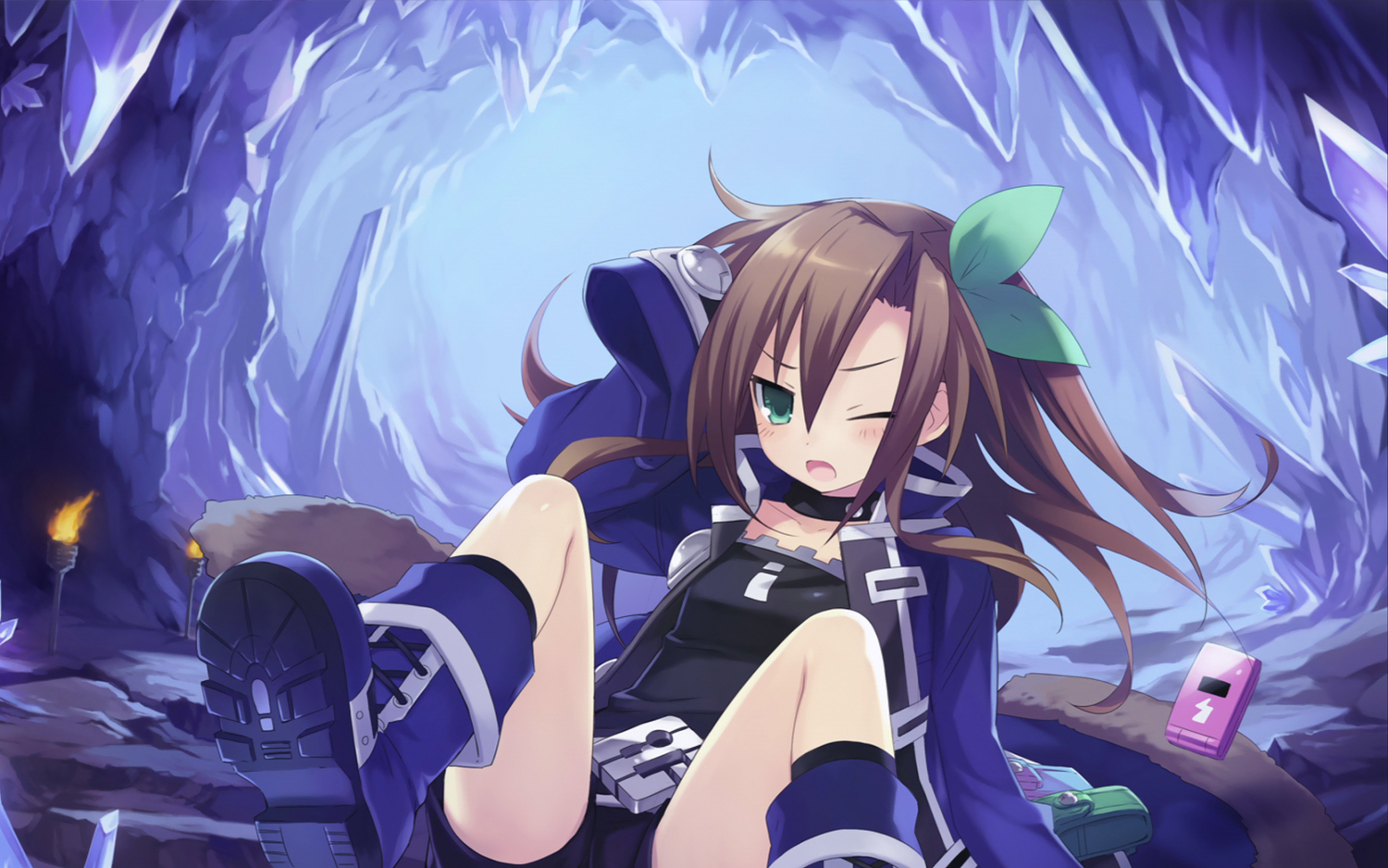
This is how you first encounter IF, Iffy, I-chan.There's a bunch of DLC, 90% of which is completely unnecessary. For the true Hyperdimension Neptunia fan, the game carries a wide selection of downloadable content, most of which takes the form of free additional quests that can be added into the game. Most players who download these will be very surprised to discover that a lot of them have recommended levels well into the hundreds, while the level cap in the game is just 99. You can, however, purchase extensions to the level cap to take it right up to 999, along with "boosters" to increase the various characters' stats if you're really struggling. None of these are essential, and these high-level dungeons provide the exact same experience as the rest of the game, so they're really not worth downloading. (If you do want to grind to 999, it will take you roughly the length of the rest of the game put together doing the same dungeon over and over and over again. Methinks someone was having a laugh with this DLC.)

The other 10% of the DLC should probably have been in the game in the first place. There are four pieces of DLC that are worth buying — two "battle tickets" that allow the use of otherwise non-playable party members in combat, and two additional characters who have their own sequence of event scenes. Again, none of these are essential — the additional characters' plotlines tend to be kept fairly separate to the main core of the party, and you get plenty of characters over the course of the main game to fill up your party — but it's curious that these weren't just included on the game disc. (They're not on-disc DLC, either — each is a 100MB+ download.) Given that you can find a copy of the game for not-very-much-money fairly easily these days, I didn't really object to paying a couple of extra quid to see what I might be missing out on — as it happens, they were a nice addition, but I'm not sure I would have missed them if I chose to forgo the DLC.

The characters are memorable and adorable. For all the game's flaws, the thing that kept me coming back over and over again until the very end was the cast. While most of them are recognisable anime archetypes, the self-aware nature of much of the game's humour means that they're not above calling each other out when they're behaving in a particularly stereotypical fashion. The central cast of the ditzy, airheaded Neptune, the pink and fluffy cries-at-the-slightest-provocation girly-girl Compa and the rational, sensible but somewhat tsundere IF complement each other perfectly, and poor old IF, as the "straight man" (well, woman) of the ensemble usually ends up having to deal with the aftermath of all the other characters' idiosyncracies. She's by far the most sympathetic character by the end of the game, but there's something eminently likeable about all the rest of them, too.

So there you go. A list of facts about Hyperdimension Neptunia. Don't go into it thinking it's going to be the best thing ever because you will almost inevitably be disappointed. If you have a lot of patience for what is essentially a combination of an old-school, combat-heavy JRPG and a visual novel, however, there's a highly enjoyable experience with some very memorable characters and some endearingly self-referential humour to be had here. If that sounds like your sort of thing, give it a shot.

I'll be starting the sequel tomorrow, and I understand that's a superior experience. I'll be interested to see quite how different it is.
1083: Hyperwhatnow Nepperwho?

Page_1I finished Trails in the Sky this morning (not last night — it got to 4am and I still hadn't reached the final boss so I decided to save it for this morning, and it was well worth the wait) so today saw that age-old question, "What to Play Next" rear its head.

I fancied something light-hearted and silly, so I chose Hyperdimension Neptunia. I knew nothing about this prior to starting to play, and just knew that it was rather silly, very Japanese, packed with rather unnecessary fanservice (that I secretly quite enjoy) and not necessarily what you'd call "good" by the traditional definition. However, given that many of the games I've enjoyed most of all over the course of the last year have not been what you'd call "good" by the traditional definition (Nier springs immediately to mind) I was willing to give it a chance.

I think I'm going to like it.

Hyperdimension Neptunia casts you in the role of Neptune, a personification of the cancelled console the Sega Neptune. Cast out of Celestia by her goddess sisters (each of whom represents one of the Xbox, PlayStation and Wii respectively) and forced to fend for herself in the lands of Gamindustri, it's up to her to… well, I don't really know yet, as I haven't got that far and the events in the intro left her with amnesia which she conveniently points out is to help the players understand what is going on. I swear I'm not making any of what I just said up. This is indeed a game that represents the seventh-generation "console wars" as ridiculous anime-style battles between anthropomorphised hardware manufacturers.

Besides the silly premise, which I have a lot of time for, there actually seems to be quite an interesting game under there, too. The game unfolds in several distinct components — visual novel-style storytelling sequences; a "between missions" bit where you can shop, read background information and discover sidequests; and dungeon-crawling. The game isn't really a traditional JRPG in terms of structure — there's no wandering around field screens or towns, for example, and the story scenes all unfold using head-and-shoulders shots of the characters rather than in-engine graphics, like a visual novel rather than a standard JRPG.

Where the interesting gameplay comes in is in the dungeon-crawling component. Structurally, this is very straightforward — you wander around a dungeon finding treasure chests and occasionally getting into random battles. The characters in your party each have "dungeon abilities" that recharge over time that allow them to do different things — Neptune can smash through obstacles, for example, while Compa, a character who appears early on, can trigger tough battles at special summoning zones to temporarily lower the random encounter rate, and IF, another early character, has the ability to lead the way to normally-invisible treasure chests.

The battle system is turn-based, but makes use of an "ability points" system, whereby each character has a certain number of points that they can spend on their turn. Each move they do costs ability points, and up to four moves can be chained together into a combo. Certain moves allow the combo to continue registering with second, third, fourth sets of four button pushes, and the longer a combo goes on for, the better.

It's this combo system that provides some rather daunting complexity to the battle system. You're not limited to the basic skills the game provides for you. Rather, you can redefine pretty much any combination of four buttons to perform any of the character's unlocked skills to create custom combos. Some skills are learned through levelling up, others through acquiring CD-Rs and CD-R/Ws with skill information on. CD-Rs have preset skills; CD-R/Ws have customizable skills that you can rename and visually tweak by importing an image from your PS3's photo library. So yes, you can have a spell that summons, say, Twilight Sparkle to kick some ass. This is, as they say, awesome. And hilarious. It also gives people an actual reason to load some images into their PS3's photo library, which is surely worthy of praise.

So thus far it seems like an interesting game, albeit one with more than a few flaws. On the technical front, the frame rate and graphics aren't all that great (though the visual novel scenes look lovely and feature animated characters); the dungeons look like they might be a bit "samey" over time; and the game doesn't do a great job of explaining its more complicated aspects in detail. But, for me anyway, part of the joy in this sort of thing is in discovering the hidden secrets for oneself and working out just what the fuck is going on.

It's early days yet, but I've enjoyed what I've seen so far. Let's see if it has what it takes to keep me playing in the long run!

#oneaday Day 983: The Mighty Jungle

If you own a PS3 and enjoy games that are just plain odd, do yourself a favour and drop £10 on a copy of Tokyo Jungle right now. While it may not be the deepest, best or most polished game in the world, it's super-interesting, super-weird and super-fun.

If you own a PS3, it's entirely possible that you're already familiar with this strange little game, but in case you aren't, here's the pitch.

The bulk of your time will be spent in Survival mode. Here, you are cast in the role of one of the game's many, many unlockable animals (beginning as either a Pomeranian dog or a deer) and tasked with surviving as long as possible. As soon as you're thrown into the post-apocalyptic Tokyo streets, time starts passing, and you only have 15 years in which to secure your animal's legacy. By hunting for food (other creatures if you're a carnivore, plants if you're a herbivore) to keep your hunger bar at bay, marking territory and finding a suitable mate, you'll ensure your species' survival into the future. By completing various objectives that appear at regular intervals, you'll earn "Survival Points" which act as your score and as a form of currency with which you'll unlock additional content as you play through the game.

As you play through Survival mode, you'll come across scattered data items hinting at the game's backstory — the reason the humans disappeared. Collect enough and you'll unlock a "story mission" in which the game flow is much more directed. Progress through the story to learn the truth while playing Survival to unlock additional content.

To describe Tokyo Jungle in such simple terms is to do it an injustice, though. It's a game about crazy emergent stories. Like that time your army of gazelles successfully took down a gigantic pig by unleashing a kick so devastating it practically launched said pig into orbit. Or the time your lone alley cat, near death by starvation, launched a kamikaze attack on a zebra and won. Or the time your dog bit a cow on the arse and was then trampled to death.

Things only get more bizarre and surreal when you start finding various items of equipment for your animals. Your stories start to become like the rantings of a madman. Remember that time that the beagle in a poker visor and green wellies chased a rabbit back and forth across Shibuya Station for five years before getting eaten by a crocodile? Remember that time the army of hippopotami in bikinis successfully fended off an attack from an army of chickens? What about that time your pig in a straw hat snuck through the bushes while the cats were fighting the chimpanzees and joyfully eviscerated all of them?

In many ways, Tokyo Jungle is a bit like a roguelike. While its levels aren't randomly generated, there is a degree of randomisation to the objectives you're expected to complete, and starting a new game with a new kind of animal tends to put an interesting twist on how your dynasty will unfold. The relentless pursuit of longer and longer survival periods and high scores — that's what the game is all about. Simple. Effective. Addictive. And batshit crazy. It's hard not to love it.

#oneaday Day 835: I Finished Nier

20120503-020725.jpg

As the heading says, I have indeed finished Nier… once, anyway. I'm going to hold off on doing a "review" as such for the moment, however, for several reasons. Firstly, a full understanding of the game is only attained following several playthroughs. And secondly, Nier is a fine example of how the "reviewing" system we use most of the time is, at times, flawed.

Nier enjoyed mediocre review scores on its original release, netting a Metacritic average of 68. As people who care about such things will tell you, 68 is not "bad" if you're taking 50 to be "average", but unfortunately no-one does. The assumption is made by most people that anything under 80 is not really worth bothering with, and anything 90 or higher is an essential purchase.

But in my experience, it's often in these slightly lower areas that you get the most interesting games. They may be rough around the edges, they may not be perfect, but by golly they have soul.

If you were judging Nier purely mechanically, it's easy to see why it attained the mediocre review scores it did. There are a very limited number of environments to explore which you spend a lot of time backtracking through. The environments are pleasant enough, but not that interesting. The enemies are repetitive. Combat can be a bit clunky. Most of the magic spells are fairly useless. The AI partners you pick up over the course of the game are completely useless. Most of the game's quests involve either killing things or fetching things. Choices you make don't matter. And the "real-time" mechanic for growing crops is just ridiculous.

The thing is, though, play Nier and become invested in its story, and absolutely all of these factors cease to matter completely. Nier tells an interesting, mature, emotional tale, and it tells it well with a small cast of well-defined, unique (and bizarre) characters — and a much larger supporting cast who make the bleak, far-future world of the game seem all the more believable. It piles on the darkness but knows how to lighten the mood with a pithy comment or two at just the right moment. It constantly does things you don't expect — with the story, with the characters, with the style of gameplay, even with the camera angles. It encourages the player to get inside the head of this unyielding, determined protagonist and almost "method act" their way through the game as he toils and struggles to save his daughter.

Do Nier's occasionally-clunky mechanics and sometimes-repetitive gameplay make it a "bad" title? Absolutely not. They may, however, put off the less patient players out there — and that's fine. Those who stick with it will find themselves enjoying a surprisingly creative adventure, while those who chose to forgo the game's hidden charms and depths for whatever reason doubtless have plenty of other things they'd like to spend their time playing.

The sad thing, though, is that the mediocre review scores were probably enough to put a lot of people off even trying the game in the first place. Why bother buying and playing a "68" when you could play a "90"? This problem becomes compounded when you take into account the fact that a lot of publishers make strategic decisions about what franchises they want to explore further — and in extreme cases, which development studios get to keep taking home their paycheques — based on Metacritic scores. Do you think we'll ever get another Nier (or at least a game like it)? Probably not. Why? Because it's too risky. Nier has its fans, sure, but they number relatively few, and aren't necessarily going to be enough to let the game make a profit.

I'm glad Nier exists, though. It's evidence that all hope is not lost for creativity, maturity and a desire to do something a little bit different, even in these days of budgets spiralling out of control and a growing desire to create games that are "services" rather than "creative works".

Nier most certainly is a creative work, a labour of love, and it should be applauded for that.

#oneaday, Day 8: Film Illiterate

I am woefully film-illiterate, as becomes painfully apparent the moment anyone uses the tried-and-tested icebreaker "Have you seen [insert movie that everyone has seen here]?"
I just don't watch that many movies. It's as simple as that. When given the option between spending nearly two hours watching a movie passively or interacting actively with a video game, nine times out of ten I'll pick the video game, particularly if I'm by myself. This is inclined to change if I'm with other people, though, since unless you're sitting with another gamer (or at least someone who's invested in the story, characters, gameplay and/or your progress in the game) then sitting watching someone else play a game is no fun. (There are exceptions to this rule, of course; titles like Heavy Rain spring immediately to mind.)

But for the most part, because I live a long way from some of my friends and several thousand miles away from even more of my friends, watching a movie is usually a solitary experience. And if I'm going to be playing solitaire, I'd rather be, you know, playing.

That doesn't stop me thinking that there are certain movies that I "should" see, though. There are a few of the classics that I have seen—unlike Ash, who wrote about this very topic earlier today, I have seen 2001: A Space Odyssey, for example. (And I can't remember a bloody thing about it, leading me to believe it might not have been as good as everyone says it is.) But for the most part, if someone mentions a film that supposedly "everyone" has seen, chances are, I haven't.

Now, in an effort to rectify this, and partly in celebration of its arrival on the PS3, I signed up for a LOVEFiLM trial subscription. My thinking behind it was that I'd finally be able to jump on board with some of these supposed "classics" and catch up with what I've been missing for all these years. The first film I watched was Team America: World Police which, while probably not a "classic" in the same way as certain other films are, it's certainly one which gets quoted and referenced a lot. (And it was pretty hilarious, too. The scene with "Kim Jong-Il's panthers" had me in stitches.)

Last night, though, I jumped in at the deep end and watched one of those films that is supposedly "iconic", a quintessential snapshot of the art form at a particular moment in time. That film was Dirty Harry.

I wasn't sure what to expect, even though I've been seeing Dirty Harry references throughout literature, games and journalism for the last twenty-five years or so. But I was pleasantly surprised to find an enjoyable film that you didn't have to think about too hard, yet which still carried an underlying message that is still relevant today—that of criminals' "rights".

One thing that was particularly striking about the film was how differently it treated its antagonist to today's movies. These days, there is often some lengthy exposition detailing exactly how and why the "villain" of the piece came to be so, well, villainous. This can lead to some interesting moral ambiguity situations when you discover that sometimes a "villain" can just be someone who's doing what they think is right, or that they have underlying problems that explain their actions, however reprehensible.

There's none of that in Dirty Harry. Scorpio is a scumbag, pure and simple. He's a pure personification of "evil"—he rapes, he kills, he manipulates, he tricks, and he sure doesn't like to be brought to justice. His demonisation throughout the course of the film causes the audience to subconsciously and automatically side with Harry, as questionable as some of his methods might be. It's an effective trick, and one which makes the whole movie immensely satisfying right up to its conclusion.

So there's one I can tick off my list. Any other suggestions?

#oneaday, Day 125: 3D Red Split Dot Dead Second Game Redemption Velocity Heroes

No, this isn't another blog post about search terms that will find my blog, though it's entirely possible that the phrase above can now be used to locate me. This is going to be a short post waxing enthusiastic about some of the awesome new releases us gamers have seen recently. And it's not even all of the ones that are available.

Through some judicious trading-in and knowing where to go to get some decent deals, I managed to score copies of 3D Dot Game Heroes, Red Dead Redemption and Split/Second. And you know what? They're all awesome. Here's why:

3D Dot Game Heroes

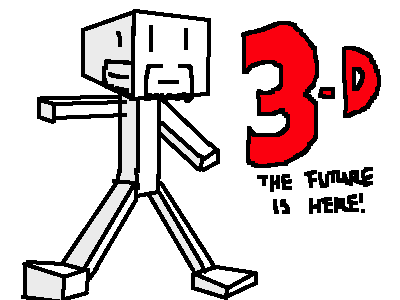
Well you try drawing a fucking 3D stickman, then, smart-arse.This one is incredibly simple to discuss. If you liked The Legend of Zelda: A Link To The Past then you will like this, because it's the same game. Well, actually, that's not quite fair as there are a few extra bits and pieces that the old Zelda games didn't do, such as the ability to customise how your sword upgrades and so forth. But overworld, dungeons, bombs, hookshot, boomerang, bow and arrow, empty bottles and all manner of other distinctly familiar things are present and correct.
The twist is, of course, it's in 3D. Sort of. It still plays like the 2.5D game that LttP was, it's just rendered in a gloriously different "3D pixel" look, where characters are still familiarly 8-bit in appearance and animation, but have some depth to their appearance. There's also a gorgeous tilt-shift effect on the camera as your character moves from the foreground to the background, too, which gives you the impression you're looking down onto a tiny, tiny world made of blocks.

One of the most entertaining things about the game is the character editor. You can build your own character one block at a time and animate them to be your avatar in the game. It's great fun, and enormously satisfying to see your creation wandering around the game world wielding a sword which is about five times their size.

It's a tough game, as the older Zelda titles tended to be, but never overly unfair, at least not in the part I've played thus far. There's plenty to see and do and, in good Zelda tradition, there's a ton of completely optional sidequests too.

Split/Second

Actual in-game footage.

Or Split/Second: Velocity to give it its full name, complete with unnecessary subtitle. How many people have wandered into a shop, seen that and asked if they have "the original Split/Second in stock"? Some people really are that stupid.

Anyway. If you've played the demo you probably know what to expect. Race cars, blow things up. What the demo doesn't quite prepare you for is how utterly involving and terrifying the full game is. The whole thing is tied together with a beautifully-produced "TV show" aesthetic that uses graphic design, special effects and music straight out of an American version of a TV show such as Ramsay's Kitchen Nightmares or the like. Only instead of dealing with an ailing restaurant, there are cars and big explosions. And the explosions are big. Many levels see you gripping on to the controller for dear life as, for example, a cruise liner in drydock comes sliding down towards you as you pray desperately you make it through to the other side.

Then there's the non-race game modes. "Air Strike" sees you attempting to survive as long as possible while a helicopter gunship fires missiles at you, for example. It's an enormous amount of very silly fun, and is a game that features one of the most consistent and stylistically-appropriate aesthetics that I've ever seen in a game. So hats off to Disney's Black Rock Studios for that.

Red Dead Redemption

Ah'm a cowboy. Not the Brokeback Mountain kind.

Aka "that cowboy game" or Grand Theft Horse-o. Red Dead Redemption is a spectacular achievement, with an enormous world to explore and ride around, tons of things to do besides the "story missions" and a real sense that you're part of the twilight years of the Old West. The game is plain fun to play, whether it's in single-player or the peculiar multiplayer mode, and there is enough stuff there to keep you busy for a very long time. Hopefully, though, this won't mean that it falls into the trap Grand Theft Auto has traditionally fallen into, meaning that no-one will ever finish it. That would be a shame, as the writing and voice acting are very good and deserve to be seen.

The one thing I will say about this one, though, is that it's one of those games that almost feels too big. Once you get to the stage where you can ride off freely, a couple of hours into the game, you're confronted with this massive open world and your brain's first reaction is to go "Which way? MAAAAAAAHHH" before dribbling out through your ears. Fortunately though, whichever way you ride off in you'll find something to do, whether it's one of the "challenges" that require you to hunt down particular pieces of wildlife, a "Stranger" who gives you a sidequest that you can complete at your leisure, a random in-world event such as bandits attacking a stagecoach or, indeed, the game's story missions.

EDIT: Also, you can punch a horse in the face. How could I have forgotten to mention that?

EDIT: Also, this.

So these three are certainly plenty to keep me busy for a while. And there's still a growing pile of shame to get through as well. Ye Gods, what have I done?

#oneaday, Day 64: Act Your Age, Fanboys

Why does the phenomenon of fanboyism still exist? And more to the point, why does it exist amongst men (and it pretty much is always men) who are old enough to know better?

The simple and easy answer is, of course, that it's always been around. I remember growing up as an Atari-based family and all of the Atari magazines at the time belittling the competition with stupid names like Spectrash (Spectrum) and Crappydore (Commodore 64). Then came the schoolyard arguments – SEGA vs Nintendo. Sonic vs Mario. "We've got Street Fighter II! Hah! …Oh wait, now you have, too." It got pretty silly.

Once the Dreamcast came out, it was hard to justify fanboyism because, certainly once SEGA's wondermachine came out, it was so far ahead of its competition – the 64-bit Nintendo 64 and the 32-bit PlayStation – that half-hearted attempts to call it things like "Dreampants" always came across as more than a little desperate.

Things then kicked off again with Sony vs Microsoft, with Nintendo kind of relegated to "background observer" by this point. The PS2 and the original Xbox both had fiercely loyal supporters when, in fact, you'd have a far better experience if you bought both systems, played the relevant exclusives on their respective platforms and played multiplatform titles on the Xbox. That's what I did, and I never felt the need to slag off any of the systems.

And it still goes on today, despite each of the consoles arguably offering a more distinct and unique experience from each other than ever before. The Xbox 360 offers its legendary ease of online play, the PS3 is home to a variety of unusual and interesting games (like Flower, flOw, Linger in Shadows, the Pixeljunk games) and the Wii is the family-friendly bundle of fun.

Still the hating goes on, though.

But nowhere is it more apparent than in the world of smartphones, particularly between the owners of iPhones, BlackBerries (let's pluralise it properly, please) and Android-based phones. iPhone owners are either Apple fanboys who bang on about how great Apple is all the time or jailbreakers who bang on about which ludicrously-named hack they're installing this week – and, of course, which apps they could get for free rather than paying for them on the App Store. BlackBerry owners seem to be updating their OS every night. And Android owners seem to be particularly sore about the iPhone for some inexplicable reason.

The question is: why? When it came to the early console wars, slagging off the systems your friends had was just schoolyard banter. You didn't really think that the systems were inferior, otherwise you wouldn't have gone around to their houses and played those games with them. The fact that this juvenile banter has grown up with people who have been using gaming and other consumer electronics for years is utterly baffling. Even people who started gaming at the same time as me – or before – are still bitching and moaning about how much better their handset is that [x]'s handset, and blahblahblah open source, blahblahblah build quality, blahblahblah BlackBerry Messenger, blahblahblah… You get the picture.

Am I alone in thinking that all of this stuff, without exception, is seven degrees of awesome and we should appreciate the brilliant things we have? Yes, some of them have more features. Yes, some of them are objectively "better" in terms of capabilities, power and technical specifications. But is that really any reason to act like 5-year olds telling each other that their respective Mums smell of wee?

No, it's not. So why does it still go on?