#oneaday Day 599: Earth Must Die!

I've been looking forward to a game that released today: Earth Must Die! by Size Five Games, creators of Ben There, Dan That, Lair of the Clockwork God and numerous other excellent games. Today isn't a "review" as such — I'll save some more substantial thoughts on the game for MoeGamer and YouTube once I've finished it — but I did want to pop down some initial thoughts and give a hearty recommend to it. As an indie title, the first few days of sales are critical for visibility on Steam, and this is a game that absolutely deserves to see some success from what I've played so far.

Earth Must Die! casts you in the role of VValak Lizardtongue, third in line to the throne of the planet Tyryth and its empire, the Ascendancy. After tricking his two brothers into murdering one another, VValak ends up in charge, and inadvertently causes the Terranoid forces of Earth to invade. That's as far as I've got, but as the name suggests, one can expect that the remainder of the game will involve VValak finding a way to get revenge on the Terranoids and get his empire back. Or maybe not…?

It's an adventure game, but with a few interesting twists from the usual formula. You have direct control of your character's movement, and interacting with hotspots is done using a cursor that can be popped up. It's clearly designed to be played with a controller and works well like that, but can also be played with WSAD movement controls and a mouse cursor. I think I might have preferred a simple mouse-only interface for its non-controller implementation, but not enough to want to kick off about it or anything.

VValak, as an arrogant (wannabe) tyrant, refuses to touch anything himself because poor people might have touched it before him. Thus you have to solve all the situations in the game without VValak ever getting his own hands dirty. This sometimes involves using his companion robot and former nursemaid, Milky, to perform various actions, and sometimes involves convincing other characters in the scene that they should carry out your orders. It's an interesting mechanic that sidesteps the usual inventory puzzles.

Like I say, I'm not too far in the story as yet so I am hesitant to say too much more in that regard, but one thing I will highlight is the incredible voice cast, which includes numerous big names in British comedy such as Alex Horne, Tamsin Grieg, Matthew Holness, Alasdair Beckett-King, Don Warrington, Mike Wozniak and many more. Plus, of course, Ben Starr is in it, because Ben Starr is the Nolan North of the 2020s (complimentary). That cast might not mean much to anyone who isn't British, but you should know that this is a full-on celebrity cast of comedy royalty, and it's incredible to see them all coming together for a video game.

The net result is that the game sounds like a late-night Channel 4 comedy show (complimentary), and it has some really beautiful animated 2D art to go along with it. It's very much designed along the lines of games like Discworld II, with large, cartoonish sprites and plenty of close-up animations — and much of the humour will be familiar to those who enjoyed Terry Pratchett's work, too.

That's about all I want to say for now. It's an easy recommend if you enjoy silly games that will make you laugh, and is a seriously impressive project from Size Five in terms of scope. I'm looking forward to getting stuck in over the next few days, and, as I say, I will have a full report, likely on MoeGamer and YouTube, once I'm done with it!


Want to read my thoughts on various video games, visual novels and other popular culture things? Stop by MoeGamer.net, my site for all things fun where I am generally a lot more cheerful. And if you fancy watching some vids on classic games, drop by my YouTube channel.

If you want this nonsense in your inbox every day, please feel free to subscribe via email. Your email address won't be used for anything else.
#oneaday Day 594: Point. Click.

I love point-and-click adventures. Back in the '90s, they were probably my favourite type of game. I devoured everything LucasArts came out with and a lot of stuff Sierra did — though I must confess, there are still a few gaps in my knowledge on the latter front.

LucasArts stuff was just better than Sierra stuff, at least in the early days. Early on, LucasArts' developers decided to take the things that annoyed people about Sierra games — chiefly the ability to die and get yourself into unwinnable situations — and throw them out of the window. Far from removing all challenge from the games as a result, this just made them much more fun to play — although it's interesting to note quite how short a lot of those games are by modern standards.

One thing to remember is that when we were playing stuff like Indiana Jones and the Fate of Atlantis, Internet access wasn't particularly widespread. Hell, GameFAQs wouldn't exist for another few years, even if you could get on the Internet; some resourceful folks were writing walkthroughs and posting them on places like CompuServe's GAMERS forum (a frequent online hangout for myself), but for the most part, when it came to solving a tricky game, you had two options: figure it out yourself, or wait for a magazine to print a walkthrough.

This meant that games that are maybe three or four hours long start to finish could actually take days, weeks or even months to complete. We had a lot more patience for that sort of thing back then — although I do recall finding it quite eye opening when I bought a brand new copy of Full Throttle, played it for two hours with my brother and we rolled credits on it.

Today, point and click adventures are still going strong. Press and public alike have enjoyed saying the genre is "dead" for many years, but in reality it's been nothing of the sort. What changed is the part of the market that point-and-click adventures occupied; while once a Sierra or LucasArts game would be considered a "big release" in a similar fashion to today's triple-A titles, after the turn of the millennium they became more niche interest affairs.

I'm not entirely sure why, either; they hadn't fundamentally changed what they were doing, or their core appeal elements. Although thinking about it, that's probably precisely why they became more niche interest affairs. From the late '90s onwards, the "upper" (for want of a better term) end of the market was going 3D, exclusively. And adventure games, up until this point, had been resolutely 2D affairs, tending to be showcases for beautiful rotoscoped or hand-drawn animation, painted backdrops and suchlike. In the age of PlayStation, that suddenly wasn't fashionable any more for a variety of reasons — and the few attempts to bring point-and-click adventures into the 3D realm had been met with a mixed response.

As with most niche interest things, an enthusiast community developed, with many of them rallying around a piece of software called Adventure Game Studio. Initially DOS-based, this was a tool that allowed anyone with a creative mind and the ability to produce basic graphics to put together a point-and-click adventure. It took effort, mind; this wasn't a "game generator", but a fully featured game engine, suitable for creating point-and-click games similar in style to Sierra, LucasArts and any number of other models.

Remarkably, Adventure Game Studio is still going to this day — and the enthusiast community is still using it. Only now, we see a lot more commercial releases from independent developers. And even more remarkably, the stuff being put out today by small outfits is pretty consistently better than anything from the genre's supposed "golden age" of the mid '90s.

There are more point-and-click adventure games that have been released in the last few years than there ever were back in the '90s. And they're really, really good. For just a few recommendations: the Kathy Rain series is an excellent series of investigative adventures; Old Skies by Wadjet Eye Games is an incredibly thoughtful narrative-centric game with a time travel hook; Lamplight City by Grundislav Games is what happens if you take Gabriel Knight and stick it in a steampunk setting; Brok the InvestiGator by CowCat Games is a brilliant, lengthy animated adventure with optional beat 'em up mechanics.

Even better, these games are a lot longer than their mid '90s counterparts. Old Skies took me a good 12 hours. The two Kathy Rain games are about 8 hours each. I'm 7 hours into Lamplight City so far and on the fourth chapter of five. I'm not sure how long Brok was but I have a feeling it was pushing 20 hours.

"Length of play" isn't the sole metric by which you should measure a game's worth, of course. But what a longer game means in the adventure game space is a more detailed, in-depth story to explore and enjoy. The difference between watching a movie and a whole season of a TV show. Both have their place, of course — I'm not averse to a short adventure game, still, and frequently go back to some '90s faves — but it's always nice when one of these modern games really gives you something to get your teeth into properly.

Best of all, though, is that there's loads of them. The ones I've mentioned above are just scratching the surface. As someone who has always loved this type of game, that excites me. And I've really been enjoying playing Lamplight City of late in particular. More on that over on MoeGamer when I've beaten it, though….


Want to read my thoughts on various video games, visual novels and other popular culture things? Stop by MoeGamer.net, my site for all things fun where I am generally a lot more cheerful. And if you fancy watching some vids on classic games, drop by my YouTube channel.

If you want this nonsense in your inbox every day, please feel free to subscribe via email. Your email address won't be used for anything else.

#oneaday Day 409: Beneath the Old Skies

I've talked a bit recently about how the adventure game genre is probably in a better place than it's ever been — in fact, I think I'd even argue that now, it's better off than it was in its supposed heyday of LucasArts and Sierra in the early '90s.

The reason is games like Wadjet Eye's Old Skies, which I've played a good four hours of this evening. This is a masterfully put together adventure game in terms of involvement, emotional engagement and just being a plain compelling interactive narrative. While there are some who have criticised it for not having interesting "mechanics" — by that, what they really mean is that it doesn't have any puzzles they got stuck on — I think there's a strong argument to be made that the genre has moved beyond the necessity for being overtly and deliberately obtuse for the sake of inflating playtime.

Y'see, while Sierra and, to a lesser extent, LucasArts games put in deliberately complicated and sometimes baffling puzzles as a means of hiding the fact that their total runtimes were, in many cases, only one or two hours at most, today's adventure game developers have the resources, budget and ability to put together games that are much longer. As such, there's no real need for these games to artificially inflate their length through obtuse puzzles, because the core of what they offer — their narrative, and the player's involvement in it — is compelling enough to stand on its own merits.

This is definitely the case for Old Skies, which has a thoroughly interesting and enjoyable premise. You take on the role of Fia Quinn, a time-travelling agent who accompanies clients on recreational jaunts to the past in order to ensure that they don't get up to mischief or cause any paradoxes that are too significant. The nature of time travel means that there will always be a certain amount of impact on the future, reflected in the game world by flashes of purple light that signal a "Chrono-Shift", where something notable changes in the "present" due to interference in the past, but the Earth depicted in Old Skies also has sufficient technology to "Chrono-Lock" anything that is particularly important, protecting it from such instances.

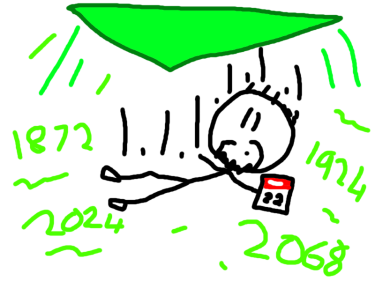
Each main chapter of Old Skies focuses on one of Fia's jaunts to the past with her client. The first is a relatively short trip back to the New York of 2024 as a renowned scientist hopes to resolve some lingering regrets. Things… do not go entirely according to plan, setting what one would anticipate to be a template for the rest of the game. But interestingly, the second immediately subverts that expectation by being much longer, more involved and more complex, both mechanically and narratively. In this chapter, set in the "Gilded Age" of the late 19th Century, something still goes "wrong", but in an entirely different way, forcing both Fia and her client to work through a complex series of events in two closely related time periods (six months apart) in order to set things what is, to their best interpretation, "right".

The whole thing raises some interesting questions about the very ethics of something like time travel. How do you ensure someone's selfish actions don't make a real mess for everyone in the future? How, exactly, do you police such things? Who decides who and what is "important" to the coherence of the overall timeline — and how? Why were they given that opportunity?

I'm looking forward to seeing how the story evolves, and it also appears that this game is going to be pretty substantial by adventure game standards. At four hours to complete the first two chapters, and I believe at least seven in total, this is looking like a fairly beefy adventure, though its chapter-based structure also means that it feels nicely episodic, so you can leave it at a natural break and come back to it another day.

Thus far, I haven't really seen the problem that some reviewers argue is the game's "weak mechanics"; the game doesn't rely much on using inventory items on things in the game world to progress, but instead prompts you to think carefully about the pieces of information you gather, how they relate to one another and, in some cases, how closely related time periods might relate to one another, too. There are some particularly clever sequences in the second chapter, requiring you to jump back and forth to revisit the same locations six months apart and manipulate the information you find in order to secure an advantageous outcome for everyone involved… as much as is possible, given your own interference, anyway.

The game is beautifully presented, with some absolutely stellar voice acting and music, and some really nice animation on the main characters. It's also nice to see an adventure game breaking free from the seeming "obligation" that some developers feel to use '90s-style pixel art; Old Skies instead adopts a true high-definition look that feels like a true successor to the brief period of "Super VGA" adventures during the winding-down of the Sierra and LucasArts "golden age".

Anyway, I'm sure I'll have more to say in the coming days/weeks as I work my way through it on evenings where I feel like something a little more chilled out than Donkey Kong Bananza. In the meantime, if you're a point-and-click type, I can highly and confidently recommend Old Skies; it's another fantastic game from Wadjet Eye (developed by them this time, as opposed to the numerous other titles they've published in recent years) and well worth the £17 it costs. Take that, £75 video games!


Want to read my thoughts on various video games, visual novels and other popular culture things? Stop by MoeGamer.net, my site for all things fun where I am generally a lot more cheerful. And if you fancy watching some vids on classic games, drop by my YouTube channel.

If you want this nonsense in your inbox every day, please feel free to subscribe via email. Your email address won't be used for anything else.

#oneaday Day 355: Soothsayer

I've spent the evening playing Kathy Rain 2: Soothsayer. I played Kathy Rain: Director's Cut a few years back and apparently didn't write about it, but suffice to say I enjoyed it. As such, I was excited to see the sequel show up a few days back — one of several interesting-looking adventure games that have released recently.

I've played about 4 hours of it this evening and I'm not sure how far through I am — most estimates seem to place it around 7 hours in total — so I'm not going to give any conclusive thoughts just yet. I'll save those for MoeGamer and/or YouTube another time. I can give some first impressions, though, and those first impressions are very good indeed.

Like its predecessor, Kathy Rain 2: Soothsayer is a point-and-click adventure presented in deliberately low resolution pixel art, albeit making use of modern widescreen resolutions and colour depth to provide a level of detail that wouldn't quite have been possible back in the classic VGA age. It is, I believe, an Adventure Game Studio affair, which accounts for its interface being rather similar to The Excavation of Hob's Barrow, another excellent modern adventure I played a little while back. That's no bad thing, though; Adventure Game Studio is a well-respected engine, used by a lot of modern adventure developers with good reason.

As with most modern adventure games, interactions in Kathy Rain 2: Soothsayer are kept nicely simple. Click on things to either look at them or do something with them, click on inventory items to examine them, drag inventory items onto items in the scene or other inventory items to use them on things. Conversations unfold using a Gabriel Knight-style keyword system, where Kathy accumulates (and erases) keywords over the course of her investigation and can ask interactive characters about them, along with also being able to ask them about things in the scene or her inventory. It's a simple but effective conversation system that works well, and there are occasional traditional dialogue options that appear when Kathy has multiple things to ask about a situation.

Kathy's case this time around is that of a serial killer known as the Soothsayer. This individual has committed five murders over the course of the last few months, with the most recent being a local celebrity writer. As a rather down-on-her-luck private investigator, Kathy sees the $200,000 reward money and decides she'd like a bit of that action, so she proceeds to go about her investigation in her own mildly anarchic style. I say "mildly" because while she flouts a few rules and laws over the course of her investigation, she does draw the line at doing anything likely to get her thrown in prison — or, indeed, lose the confidence of her contact in the police force, who, as you might expect, is a helpful resource to draw upon, particularly as he very much wants to get into Kathy's pants.

Thus far in the 4 hours of play, I haven't felt like I've got "stuck" at all, which is good — and the game has kept up a decent pace as a result. The puzzles, while not super-easy, won't take long to solve for experienced adventure game veterans, but they are nonetheless satisfying. There's no moon logic on display here; everything makes logical sense, and those who really struggle can check out Kathy's notebook to get some hints on the objectives she needs to accomplish. The presence of the notebook and a list of objectives in the first place is a helpful addition not normally present in this type of game; it helps keep you focused without spoiling the sense of player agency or working things out for yourself.

I remember the original Kathy Rain getting a bit weird towards the end — and I didn't have a problem with that, I hasten to add — and I have a suspicion something similar is probably going to happen in this one, too. The "weird bit" of the first Kathy Rain led to some eye-opening revelations about the character, so I will be very surprised if something similar doesn't occur this time around, too. But we'll have to see, I guess.

Thus far, then, I've been thoroughly absorbed by this new investigation. The game looks great, has a wonderfully atmospheric soundtrack and decent voice acting, and it plays very well, too. Plus at what looks like it will be 7-10 hours in total, it's a decent length for this type of game, too — particularly when you consider most of the "golden age" adventures from Sierra and LucasArts could be beaten within an hour or two (or even less, in some cases) if you knew what you were doing.

I'm looking forward to seeing how things end up. At this rate, it's looking like I might beat it tomorrow. I will definitely pen some more substantial thoughts for MoeGamer and/or my YouTube channel when I've finished the whole thing. For now, though, it's an easy recommend for adventure game enthusiasts.


Want to read my thoughts on various video games, visual novels and other popular culture things? Stop by MoeGamer.net, my site for all things fun where I am generally a lot more cheerful. And if you fancy watching some vids on classic games, drop by my YouTube channel.

If you want this nonsense in your inbox every day, please feel free to subscribe via email. Your email address won't be used for anything else.

#oneaday Day 259: Excavations

I successfully did what I planned yesterday — for two nights in a row, even. Last night I spent some time with Smashing the Battle on Nintendo Switch, which I'll write a bit more about once I've spent some more time with it, and tonight I have seemingly spent nearly six hours playing The Excavation of Hob's Barrow, a point-and-click adventure by Cloak & Dagger Games, published by modern adventure game specialists Wadjet Eye Games.

It always does my soul good to see how not-dead the point-and-click adventure genre has been for quite some time now, because there was definitely a period in the mid 2000s and early 2010s where it felt like there weren't any being made. 3D tech was getting better and everything was suddenly all about cinematic action games — something that certainly hasn't gone away in more recent years — but, looking back, it's clear that adventure games never really went anywhere. And these days, I'd say they're thriving more than they ever have done, even in their supposed golden age. Because not only can we enjoy the established classics from that golden age, there's a host of new ones seemingly being made all the time.

I'll write more specifics about The Excavation of Hob's Barrow when I've fully completed it — I've pressed pause on it for this evening as it's a quarter to one and I should probably sleep. Suffice to say for now that it's very good, though.

In The Excavation of Hob's Barrow, you take on the role of Thomasina Bateman, an antiquarian who has made it her mission to document the various ancient burial mounds scattered around the English countryside. We join the story as she arrives in a remote Northern village, supposedly the home of the titular Hob's Barrow, but she's immediately confronted with mysteries as her contact is nowhere to be seen and no-one seems to want to talk about Hob's Barrow.

That's all I'll say on the plot for now. The interface uses a pretty standard two-button system, with left-clicking "doing" things and right-clicking "looking" at things, but there's plenty of thinking required. Thus far there has been no real "moon logic" to speak of, just a sequence of tasks to complete that provide a sense of relative freedom without overwhelming you with possibilities. In fact, the game is quite cleverly designed in that the "freedom" you feel is not really present at all; there's quite a fixed sequence of things to do with a chain reaction of dependencies, but the fact you discover the beginnings of all these various threads before you start figuring out which order you need to solve them in is what makes this game really work.

It's beautifully presented in low-res pixel art combined with modern graphical techniques and greater colour depth, which gives it a wonderfully distinctive aesthetic. The voice acting is very good, too, seemingly making use of native Northerners in many cases.

I'm intrigued to see where it goes, but not quite enough to pull an all-nighter on it. After all, GOG Galaxy says I've already spent 5 hours and 28 minutes on it this evening and I've only completed two of the in-game "days". I don't know how many there are in total, but it does feel as if the third one is going to be somewhat climactic, so I estimate I'm maybe a little over halfway to two-thirds through? We shall see, I guess.

Anyway, if you're jonesing for a modern point-and-click adventure, I can definitely recommend this one. It's kept me pretty enraptured for the whole evening and I'm looking forward to seeing how it all concludes.

For now, though, sleep. Sleep!


Want to read my thoughts on various video games, visual novels and other popular culture things? Stop by MoeGamer.net, my site for all things fun where I am generally a lot more cheerful. And if you fancy watching some vids on classic games, drop by my YouTube channel.

If you want this nonsense in your inbox every day, please feel free to subscribe via email. Your email address won't be used for anything else.

#oneaday Day 651: Circle of Blood

Having beaten Xenoblade, I was in two minds as to what to play next. Should I go and grab something brand new, or should I delve into the Pile of Shame?

I opted for the latter. Broken Sword, to be specific, and the new(er) Director's Cut version, which features (marginally) updated graphics and some extra Nico-centric scenarios. The new stuff so far is cool — some immensely satisfying codebreaking puzzles are a particular highlight — but the fact that the sound quality is so markedly different to that from the original game is a little jarring.

I have fond memories of Broken Sword. It came out when I was doing work experience down on PC Zone. That particular issue saw me writing a bunch of captions for some material about Quake, and publishing an entire review on Virtua Fighter PC in which I used the then-fashionable terminology on Zone of "turbo nutter ninja bastard" to mean "very powerful". But that's beside the point.

Broken Sword comes from a very different era to the console-centric experiences we have today. This is obvious in a number of ways. Firstly, it's a point and click adventure, and while we do still get some of those nowadays, they're a lot rarer than they used to be — and I can't remember the last time a point and click adventure would have been regarded as a triple-A title. Secondly, none of the characters feel the need to run everywhere. They saunter around at a leisurely pace, mercifully just short of being infuriatingly slow. This relative slowness, however, gives the game a much more "sedate" feeling pace while you're playing — it's almost relaxing to play, despite the fact that you're chasing down a murderer.

Perhaps it's the sensation of using your brain in ways it hasn't been used for a while. The concept of "puzzles" in a lot of adventure-style games these days tends to (still) involve pushing blocks around or finding ways to get to switches. Broken Sword, meanwhile, involves good old fashioned adventure game puzzles. In order to open a door early in the game, you need to pull on a cross on the wall, wedge it open with a shell casing you found earlier, insert a stone tube into a socket that opens up, pull out the shell casing (which hopefully you had remembered to flatten under the door earlier, otherwise you'll have to repeat the above process) and use it to lever open the stuck door that had been partly activated by your insertion of the stone tube. It sounds a little silly, sure, but it makes sense while you're playing — and by golly it's satisfying when you work it out for yourself without the aid of GameFAQs. And it's not as stupid as the rubber ducky puzzle in The Longest Journey, a game I'm finding myself hankering to replay very soon.

Broken Sword is quite impressive in that it has been around for a very long time in computer game terms and still "works" as a game today. Sure, the pace may seem relatively snail-like to console gamers (though the original did come out on PS1 and Game Boy Advance, among others) but there's nothing fundamentally wrong with the puzzle and dialogue-heavy gameplay. In fact, we could stand for a few more games like that these days, and a few less that involve you staring down the barrel of a gun.