2235: Give Flame Over a Go with This Month's PlayStation Plus Games

0235_001

Idiots, as we all know, love complaining. And some of the loudest, most complain-happy idiots are those who whinge about the monthly games on offer via Sony's subscription service PlayStation Plus.

For those unfamiliar, PlayStation Plus is a service you pay a monthly fee to for, among other things, the privilege of playing multiplayer games on the PlayStation 4 platform. Unless you're a die-hard multiplayer gamer, though, the far more attractive things that PlayStation Plus gets you is discounted prices on PlayStation Store digital downloads, and "free" games every month — I put "free" in inverted commas since you only get to keep them for as long as you keep paying the subscription; they deactivate if you stop paying, though you can get them back again by resubscribing.

In recent months, the aforementioned complain-happy idiots have been very keen to point out that the monthly games on offer have tended to err on the side of smaller-scale, independently developed titles rather than triple-A games, the latter of which were originally positioned as a selling point for the service. However, I actually prefer things this way around, since it gives me the opportunity to give games a go that I've perhaps liked the look of, but not enough to want to drop £10-£15 on them at the time.

Enter Flame Over from Laughing Jackal, a firefighting roguelike that I've had my eye on for a while, but somehow never got around to picking up. This month, it's one of the PlayStation Plus games, so now I don't need to agonise over whether or not it will be a worthwhile purchase for me: I just have a copy for as long as I'm a PlayStation Plus member, and since it's a digital download-only game, it's not a game I feel obliged to pick up a physical copy of — I do love my physical copies, as regular readers will know — because a physical copy doesn't exist.

As it turns out, Flame Over is a very good game indeed and I should have picked it up sooner, but oh well; I have it now.

Flame Over casts you in the role of a firefighter with no visible eyes, a big helmet and an impressive moustache. It's your job to enter a 16-floor building with your trusty hose and extinguisher, put out all the fires and rescue as many people and cats as possible before… well, dying. It is a roguelike of sorts, after all, so yes, despite the cartoonish, slapstick visual humour, the overall tone is oddly bleak, if truthful: fire doesn't care who you are, and it will kill you if you don't respect it.

Gameplay is simple and reminiscent of a classic computer or console game from the 8-bit era. You have a ticking clock, you have a maze-like level to negotiate — randomly generated, hence the "roguelike" descriptor — and you have high scores to beat, here represented as money that you can subsequently spend on powerups and permanent improvements to make your future runs a bit easier.

Putting out fires is a simple case of squirting them with your hose or extinguisher. The hose has a longer range and makes things wet so fire is less likely to spread, while the extinguisher covers a wider area and is the only way to put out electrical fires, which are prone to flaring up again after you've put them out once. You can also completely negate electrical fires by finding the fusebox on each floor, but this will inevitably be beyond a room that has come to resemble one of the lower circles of Hell, so you'll need to clear a pathway through first.

The interesting thing about Flame Over is that it makes things deliberately just a little bit awkward for the player to keep things interesting. The camera angle isn't quite top-down, which means that things on the "bottom" wall on-screen can often be hidden, necessitating rotation of the camera in order to make sure you haven't missed anything. This is an additional thing to think about in the heat (no pun intended) of the moment, and with flames flaring up all around you, it contributes considerably to the rather wonderful growing sense of panic that the game creates.

That timer is a distinctly old-school touch, too; you can extend it by rescuing people, and when it runs out it's not immediately the end of the game: rather, in a manner somewhat similar to seriously old-school games like Spelunker and Bubble Bobble, running out of time triggers the appearance of a difficult to avoid (but absolutely avoidable) enemy who will immediately end your game if you come into contact with him. In this case, said unavoidable enemy is Death himself, further driving home the game's point about mortality.

Oh my goodness me is it an addictive little bugger, though. It's simple to play, repetitive, sometimes awkward and regularly frustrating — but it's fun. It's a "pure" game, designed not to tell a meaningful story or make bold, sweeping sociopolitical statements; it's a game designed to test your skills and patience, and as someone who grew up with games when they were nothing but tests of your skills and patience, Flame Over feels like a rather wonderful callback to those good old days; a game that, were it not for its 60fps 1080p polygonal graphics, would probably have been eminently at home on the Atari 8-bit computers or Commodore 64. And that is absolutely a compliment.

So anyway. Next time you're disappointed that PlayStation Plus isn't giving you a free copy of Call of Duty or some other such shit, take a moment to check out the things you might not have heard of: you might just find yourself pleasantly surprised by the charming games on offer, and discover some new favourites in the process.

2233: MegaNep's True Ending: A Love Letter to the Dreamcast, and to the Player

0233_001

I cleared Megadimension Neptunia VII's True Ending path this evening, after a horrible moment where I thought I hadn't triggered it and would have to do the whole thing through again (which is actually not quite as monumental an undertaking as you might think) — and I was very impressed with one of the most satisfying finales I've seen in a story-based game for quite some time.

Mild spoilers ahead.

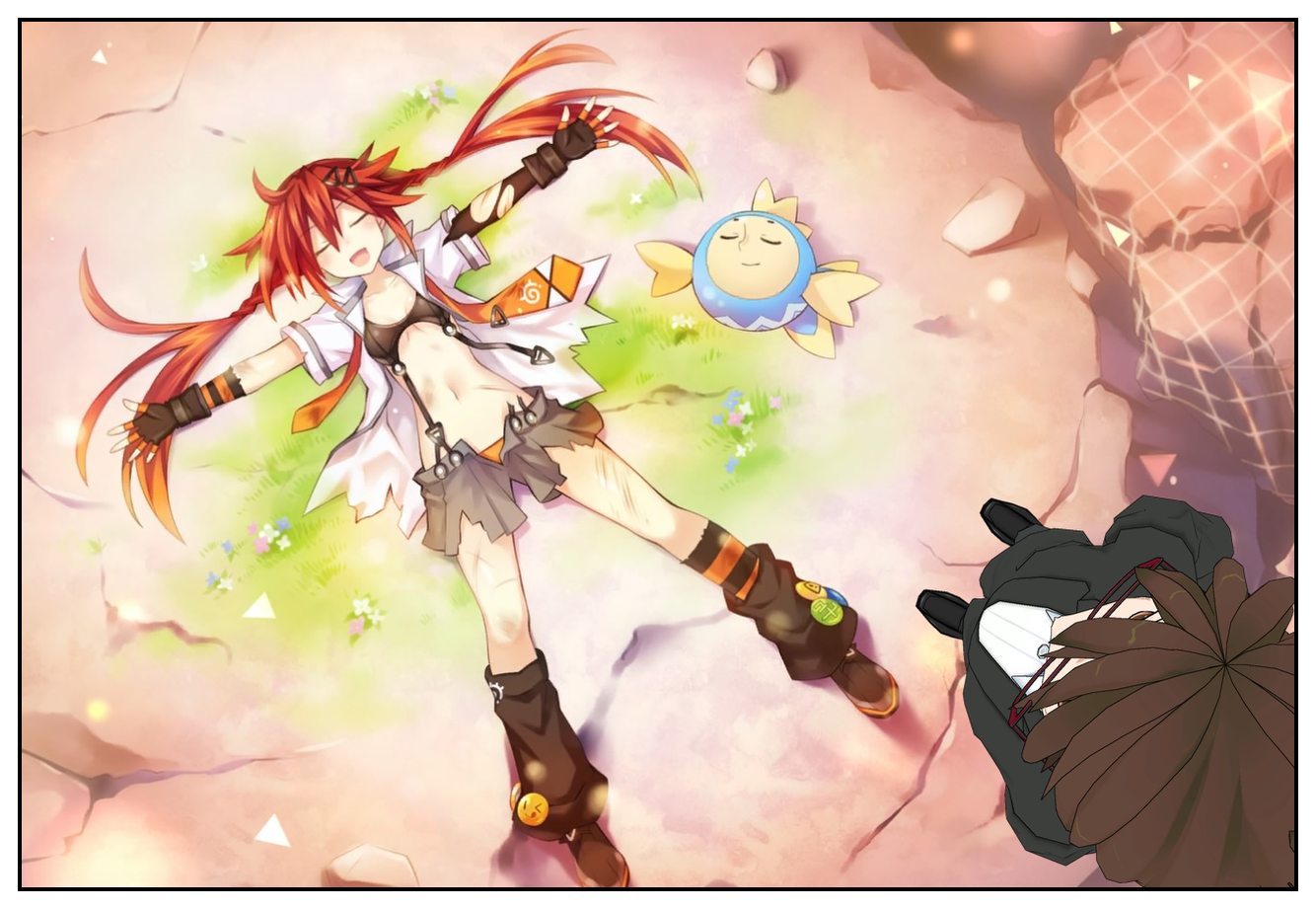
At the core of MegaNep's overarching narrative is the story of Uzume Tennouboshi, a new character to the series who, like the series regulars, embodies a games console — in this case, Sega's ahead-of-its-time Dreamcast. For those unfamiliar with their gaming hardware history, the Dreamcast was a 128-bit console that came out towards the tail end of the console generation that was primarily 32- and 64-bit: that of the original PlayStation and the Nintendo 64. It was astronomically powerful in comparison to its contemporaries and was home to some wonderful games, many of which are still fondly remembered today. But for one reason or another, it was regarded as a commercial failure, and both it and its games dropped out of mainstream distribution after just a couple of years, with the 128-bit era only starting in earnest once the PlayStation 2 shattered all expectations of what console gaming was all about following its launch in 2000.

Uzume's identity and background is initially a mystery to Neptune and company, but over the source of MegaNep's complete story, her past comes to light. Having once been a goddess to what is now Neptune's domain of Planeptune, she was voluntarily sealed away due to the fact that she was unable to control her "illusion" power and largely forgotten about; an allegory for the Dreamcast being released onto the market too early and developers and publishers alike arguably not being sure how to make best use of this new power on offer.

The main villain of the piece is revealed very late in the story to be the darker side of Uzume, representing her irrational hatred and bitterness at feeling abandoned by her people. Through a complicated series of happenings too twisty-turny to describe in detail here, Neptune and her friends eventually manage to help Uzume come to terms with her past and realise that her memories have become tainted by hatred and regret; her people, in fact, loved her and cherished her, and it was with a heavy heart that they saw her sealed away for the protection of everyone.

There are two endings to MegaNep: one in which Uzume sacrifices herself to ensure her dark counterpart is not able to send a horde of monsters from her delusional "Heart Dimension" into Neptune's Hyper Dimension, and another in which Neptune and her friends refuse to leave her to die, and ultimately help her to overcome her darkness. This latter one is the True ending, and it demonstrates beyond a shadow of a doubt that the team at Idea Factory and Compile Heart hold the Dreamcast in considerable esteem; the truth about Uzume's past is described with such a wonderfully warm feeling of fondness that it's hard not to feel extremely nostalgic if you happened to be there when it all happened in our world, and the Neptunia series' biggest strength — characterisation and the feeling of bonds between these characters — really shines through as everyone expresses their love for Uzume and she, likewise, expresses her love for them.

What also made the ending satisfying, aside from this wonderfully genuine-feeling appreciation for the Dreamcast and its games, was the Neptunia series trademark "Thank You Corner", where the cast completely break the fourth wall and address the player directly, thanking them for playing and showering them with praise for beating the game. This is always a lovely moment in every Neptunia game, but in the case of MegaNep it feels particularly heartfelt; it's obvious that the words coming out of the mouths of the characters are actually those of the series' creators, expressing their gratitude for the series having gone from strength to strength over the years, overcoming the adversity of its early installments' poor reviews, widespread ignorance from the press and self-professed RPG "experts" that persists to this day, and ultimately becoming a genuinely rather wonderful franchise that I really don't want to see the back of any time soon.

In many ways, it was like a "curtain call" for the game, and while previous Neptunia games have handled this in much the same way, there was something about this moment in MegaNep that made it more satisfying and touching than it's ever been before. It's a rare and wonderful feeling for a creative work to seem like it's talking directly to you, but the Neptunia series has always felt that way, and never more so than with Megadimension Neptunia VII.

Onwards to the post-game, then; I have trophies to clean up and Colosseum battles to fight! (And in the meantime, I promise I'll find something new to write about soon.)

2231: Initial Impressions on Alexander: Midas

0231_001

Tonight, we cleared the last area of the new raid dungeon in Final Fantasy XIV… in its "normal" incarnation, anyway. Savage is likely to prove a somewhat stiffer challenge, but regular ol' vanilla had plenty of hurdles to overcome, too.

Now that we've been through all four of the new raids, I thought I'd ponder how I felt about them, and about Alexander as a whole compared to The Binding Coil of Bahamut.

The first thing to note about Alexander is that the overall tone of the whole thing is very different to Coil. Coil represented one of the most serious, dramatic parts of Final Fantasy XIV's story, and over its entirety revealed some very significant background lore about the Allagans and the Meracydians, both of whom we'd seen mentioned (and occasionally explored the relics of) but never encountered, mostly due to them both being long dead.

Alexander, meanwhile, largely concerns the goblins, and much like their Final Fantasy XI counterparts, goblins in Final Fantasy XIV are rather silly, afflicted with distinctive speech patterns and, for the most part, there for comic relief. They're not very threatening, in other words, so for them to be introduced as the main villains of the new raid cycle was… interesting, to say the least.

The overall aesthetic of Alexander is very different to Coil, too. Coil began as an expedition into the bowels of the earth and gradually gave way into a combination of fantastic, otherworldly scenery and pure sci-fi, futuristic environments, many of which were absolutely breathtaking in their scale. Alexander, conversely, has a pretty consistent "steampunk" look throughout its entirety, though Midas does a somewhat better job than Gordias in terms of presenting a bit of variety in the way things look.

This difference in aesthetic extends to the main attraction of the raids, too: the bosses. In Coil, you fought a wide variety of foes, ranging from a giant genetically modified snake to a fearsome dragon god via technologically advanced defence systems, a bioengineered lamia, a robot treant and, of course, the reincarnation of Final Fantasy XIV 1.0's main villain, Nael van Darnus, now going by Nael deus Darnus having apparently changed gender and gone a bit, well, dragonish.

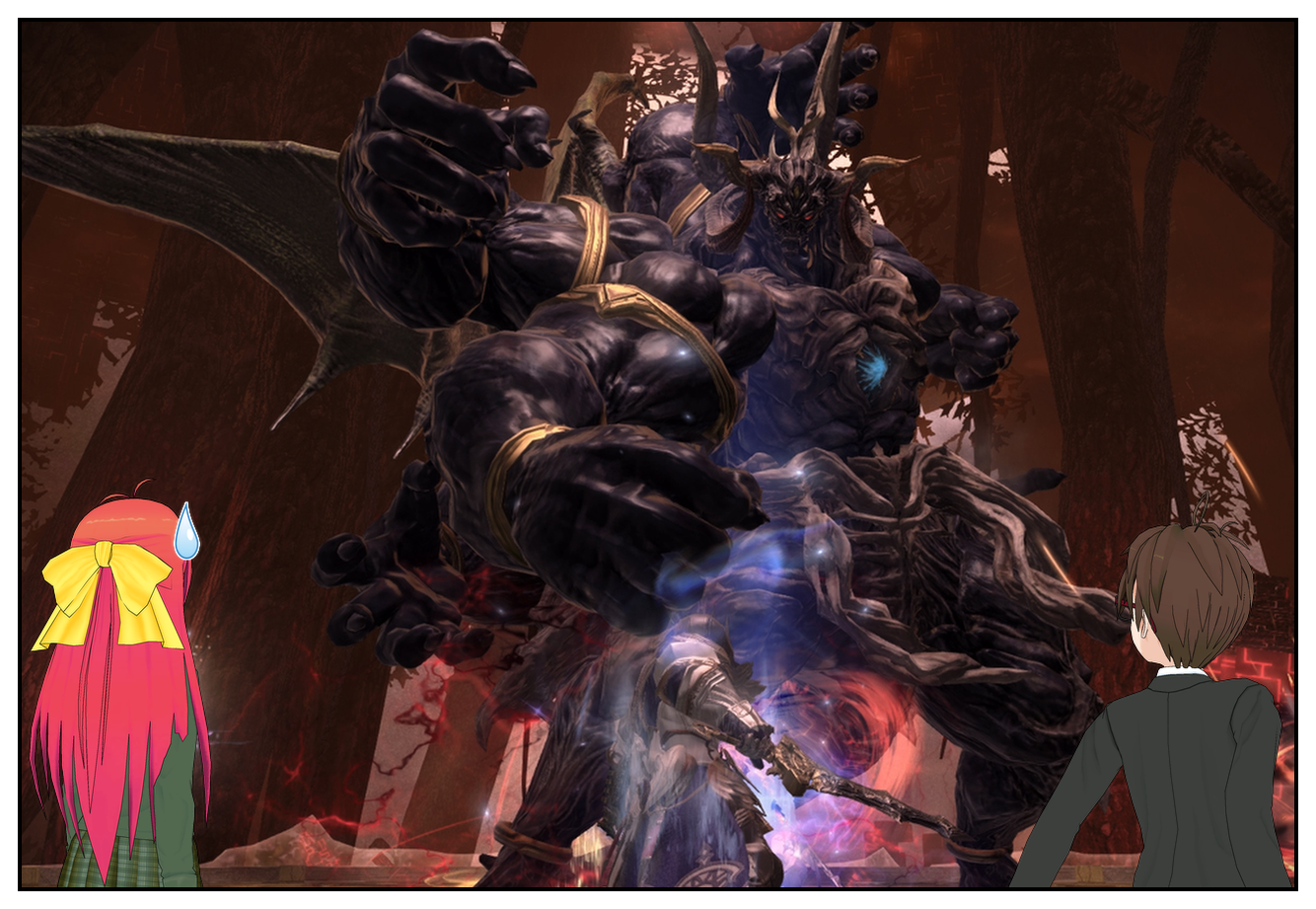
Alexander, conversely, sees you fighting a lot of things in a similar mould: in Gordias, you fight a large steampunk robot thing, followed by a swarm of goblins and large steampunk robot things, followed by a squishy Pepsiman wannabe in what appears to be a sewage outlet, concluding with a battle against The Manipulator, which is a large steampunk robot thing. Midas is a bit better: first you fight a mad scientist goblin who keeps drinking his own concoctions and growing to Hulk-like proportions, then you fight a series of four large steampunk robot things, then you fight the main villain of the plot arc (and his cat), then finally you fight five large steampunk robot things — four of which you fought earlier in the raid — that then combine to make one enormous steampunk robot thing.

While I still like Alexander less than Coil in terms of its aesthetic and enemy designs, Midas is a big step in a better direction. Everything about it is better, from the variety between the four areas to the background plot that is revealed as you progress, which was rather lacking and forgettable in Gordias. It still lacks some of the outright drama that Coil had — the final boss of this particular cycle is an intense fight, but it's more chaotically humorous than terrifying like Twintania, Nael and Bahamut were — but things are improving a lot.

Of particular note is the boss music for the final boss, which I present with some pleasure for you below, in all its '70s anime glory:

Happy with how things have turned out with 3.2. I was getting concerned the game was losing its magic, but it's well and truly back on target.

2229: The Fist of the Son and The Cuff of the Son

0229_001

Been taking my time getting through the new Alexander raid (just the normal version) in Final Fantasy XIV over the last couple of evenings, and thought I'd write down a walkthrough for the first two floors, largely to refresh my own memory and perhaps to provide a convenient service to anyone passing by who wants to know such things.

As with Alexander: Gordias, Alexander: Midas is split into four areas, each of which allows you to get one piece of loot per week. These pieces of loot are tokens that can be exchanged for gear in Idyllshire in the same place you turn in Allagan Tomestones of Esoterics and Lore; like the gear from Gordias, you need varying numbers of tokens for different pieces of gear. Accessories require one bolt, so are the easiest to get, but are also often the smallest upgrade.

The Fist of the Son

Available loot: Bolt (1 needed for accessory), chain (1 needed for belt), pedal (2 needed for boots)

Run through the first area, and use the steam vents to jump up to the top of the room. Pass through the doorway and you'll be confronted with not one but two Fausts. They're much easier to handle than the one in The Fist of the Father, though; one tank take each, keep them together, focus down one at a time.

It's not over, though! After the second Faust drops, a pulsing AoE marker will appear on the floor. Get away from it, as Hummelfaust is going to drop down, dealing more damage the closer you are to its drop spot.

One tank should take Hummelfaust, the other should switch to DPSing and simply batter him down as quickly as possible. Much like OG Faust, this is designed as a DPS check to ensure that your group is going to be up to the job of toppling the subsequent bosses.

Once Hummelfaust is down, hop onto the conveyor belt to reach the boss room.

BOSS: Ratfinx Twinkledinks

This fight initially seems utterly bewildering, but it's actually fairly straightforward. You need to pay close attention to what is happening at all times, though; you might find it helpful to Focus Target Ratfinx to help keep an eye on what he's up to in case you need to target something else.

Before you start, mark the back-left corner of the room as A and the front-right corner as B. You'll be tanking Ratfinx at A, while B is set aside as a no-go area for a later mechanic.

Start the fight. Ratfinx will be reluctant to move as the battle begins, so take the opportunity to establish solid aggro if you're a tank. Once he transforms into his giant form, then you can move him over to A.

Ratfinx will proceed to pummel the main tank about the head, inflicting stacks of Headache, which increases damage taken. When Headache reaches 4 stacks, it becomes Concussion, which stuns you completely. When this happens, you'll see Ratfinx wind up for a big punch much like the one Sephirot does; at this point, the off-tank should immediately use Provoke and hit Ratfinx to take aggro from the original tank, and take the imminent big hit, which is slightly less big if you don't have Headache or Concussion.

Throughout the fight, Ratfinx will cast Bomb's Away, which brings one or more large bombs into the arena. When this happens, someone near the centre of the room should stand in the purple circle to activate the machinery, then at least one person should run to the red pool that forms to the side of the arena. Stepping in this turns you into a gorilla with just two abilities, the first of which allows you to punch bombs away with ease, and the second of which allows you to transform back into your normal form. Punch the bombs to B to keep them safely away from everyone, then change back and return to your normal role.

At various points throughout the battle, Ratfinx will mark a player and cast Glubgloop (or something similar). The marked player should get well out of the way of A, B and where the pools form under the syringes; after the AoE marker appears, a persistent puddle of goop will drop on the floor and stick around for a little while, so keep it out of the way, probably in one of the unmarked corners.

From his second giant transformation onwards, Ratfinx will start casting Boost. When he does this, a player needs to activate the machine in the middle and all players (including the tank) need to rush to the purple puddle to turn into a bird. By flying, you avoid his devastating ground-pound attack; once he's finished doing this, you can use Apothecary to change back into your normal form once again.

Repeat the process, with tanks keeping a careful eye out for Concussion and everyone else watching for Bomb's Away and Boost, and it won't be long before he's down. There are a few additional beasties that show up throughout the fight, but the off-tank can pick these up easily and they don't present much of a threat.

The Cuff of the Son

Available loot: Bolt (1 needed for accessory), pedal (2 needed for boots), lens (2 needed for headpiece)

Run forwards and engage the initial group of enemies. To take a bit of pressure off the main tank, the off-tank may want to take one of the two Gobwalkers. Burn down the enemies as quickly as possible and proceed down the corridor, where you'll be accosted by a number of Goblin Gliders. Tank and spank these, then jump down the passageway on the right of the corridor to be flung into the boss room, where you'll fight four bosses in succession. Don't worry; if you take one down, it stays down.

BOSS: Blaster

Blaster has two main attacks. The first is to drop mines in the arena. These will show AoE markers where they drop, and will continue to pulse afterwards. Do not stand on them, as they deal heavy damage and inflict various status effects in an area.

Blaster's second attack is to mark players; after a moment, he'll drop a Mirage version of himself on them, and after another moment or so, these will charge across the arena in the direction they're facing. Don't be in their way.

DPS down Blaster while avoiding these two mechanics and he'll fall easily.

BOSS: Brawler

Brawler has three attacks that don't have cast bars: you have to rely entirely on visual cues. These cues are related to the fists he holds up when he charges himself with energy; after the blue flash of light around both hands you'll see him have either a red fist, a blue fist or both fists, and you'll have a couple of seconds to handle the mechanic appropriately.

If he raises the red fist, a random player is going to get targeted and damaged. Everyone move away from the boss to minimise this damage; it declines with distance.

If he raises the blue fist, the off-tank should use Provoke to take aggro from the main tank, while the main tank gets behind the boss. Shortly after, the new main tank will take a big hit, but not as massive as the one the original tank would have taken with the Vulnerability debuff Brawler applies!

If he raises both fists, the current tank should turn Brawler around to face the rest of the party; he'll fire a massive dual laser whose damage is split between everyone it hits.

Best way to handle this is to have everyone stacked or lined up directly behind Brawler as the main tank tanks him, then move according to the mechanics. After a mechanic is finished, get back into position and continue.

BOSS: Swindler

This is a weird one that requires you to be observant, but it's not that complicated.

The main mechanic here is Swindlers High and Low Mathematicks debuffs that he applies to various players. High Mathematicks is a purple-coloured debuff icon, while Low Mathematicks is a red-coloured debuff icon. When you receive one of these, stand on a floor tile according to your debuff: if you have Low Mathematicks (red), stand on a red, elevated tile; if you have High Mathematicks, stand on a grey, normal tile. Note that the arrangement of the tiles will shift several times during the battle.

The only other mechanic for this fight sees a player marked with a circle around themselves and a number of orbs above their head. A number of people matching the number of orbs need to be in the circle to prevent horrible messy death.

Dance around according to the debuffs and you'll be good for the final battle.

BOSS: Vortexer

Vortexer will inflict a stacking Vulnerability debuff on whoever is tanking it; the off-tank should use Provoke and take aggro when this reaches two stacks.

Circle AoEs indicate that pools of fiery sludge (similar to Bahamut's attack in Turn 13) will be dropping in these places. Stay out of them, and don't run through them, as they debuff you while you're in them. Also make sure you don't have your back to one.

Super Cyclone is a massive knockback on everyone, centred on the boss. Position yourself so you won't get knocked back into a pool of sludge.

When a player gets marked, they'll drop a waterspout after a few moments. Position this somewhere near-ish and behind the boss.

Several players will get Shiva-style blizzard markers on and around them. At least one person needs to drop this with its circle over the waterspout to freeze it into a block of ice. These will leave a patch of Frostbite-inflicting ice on the ground for a short period, but these will dissipate after a few moments.

When Vortexer starts casting Ultra Flash, everyone (including the tank) needs to hide behind the frozen waterspout and break line-of-sight with Vortexer to avoid being instakilled. After this, the ice block will shatter and the process repeats. Once Vortexer is down, you're done!

2228: MegaNep: Thoughts After a First Playthrough

0228_001

Well, I finally finished Megadimension Neptunia VII for the first time. Took about 62 hours or so in the end; that was taking it fairly leisurely through the game and taking the time to unlock stuff here and there that I perhaps didn't need to do on a first playthrough. Next up for me is a New Game Plus run in which I go for the "true" ending, which leads on to a post-game segment during which you can clean up any bits and pieces you didn't finish off first time around. Or trophy hunt.

For now, though, I want to talk about my experiences with the game after a complete playthrough.

The first thing to say about the game is that, as I've mentioned before, this is Compile Heart's finest work to date. There are no significant technical issues beyond a couple of very minor frame drops in a few places; the script and translation is excellent (although there are a few more typos than there should be); and the gameplay is satisfying, enjoyable and well-balanced.

The first and last points there address two of the biggest criticisms the Neptunia series has had since its inception. From the original PS3 game onwards, the series — and Compile Heart's work in general — had been plagued with technical issues, most notably atrocious framerates that weren't really justifiable given the relative simplicity of the graphics compared to bigger-budget titles that ran a whole lot better. And, again, from the original game onwards, game balance has been an off-and-on problem: the original game (and the total overhaul Re;Birth1) was inconsistent in its difficulty, erring on the side of "suddenly way too hard" without warning; sequel mk2 and its Re;Birth counterpart was much too easy (and rather short, although it does still have the widest variety of endings in the series); Victory and Re;Birth3, meanwhile, got the closest to nailing the formula, but still had a few elements that could be a bit of a pain, most notably the heavily RNG-based Scout system.

So how does MegaNep counter these original problems? Well, in the case of the technical issues, it seems that Compile Heart is significantly more comfortable developing for PS4 than PS3. MegaNep runs at a pretty consistent 60fps pretty much all of the time; the only time it drops is in particularly busy scenes such as the "sakura"-style dungeons with cherry blossoms everywhere. MegaNep is even an improvement over the company's last game Omega Quintet, which ran very nicely in battle scenes, but which juddered a little bit in the (admirably large and sprawling) field areas. It's not going to win any awards for looking amazing, of course, but the graphics are perfectly acceptable and, as is the norm for the series, the character models and animations are very nice indeed.

As for the gameplay balancing, Compile Heart really feel like they've nailed it this time around. At no point did I feel like the game was too easy or too difficult, and progression was paced well. It's not a game that you need to grind to level 99 to be able to beat the last boss, either; my clear party consisted of characters between levels 40-60 (Nepgear being the highest at 60, not that I show her any favouritism, nosirree) and they dispatched the last boss without any difficulty. In other words, it's a game that you can stumble your way through from start to finish without running into too much trouble, but if you go a little off the beaten track from the linear storyline, there are plenty of ways to challenge yourself — and plenty of things to do in New Game Plus, too.

The game systems, having been significantly revamped from the Victory/Re;Birth formula, work extremely well. Skills don't feel over- or under-powered, and the basic combo attacks each character can perform are actually useful for things other than building up the EXE Drive meter now, too. Each character feels unique, too, with a variety of different skills, weapon types, combo arrangements and multi-person formation attacks to play with; there are a clearly number of "optimal" party setups that provide you with the most flexibility in terms of formation and partner moves in particular, but the systems are balanced well enough that you can take pretty much any combination you like into battle and have a good time. Oh, and while there are a few recycled dungeons from past games — it's series tradition by this point — there's also a ton of brand new, original content, including the wonderfully inventive (and infuriating) Neplunker dungeons as well as the mapless Senmuu Labyrinth.

Now, narrative and characterisation has never really been an issue for the Neptunia series, though my one criticism has been that it tends to have slightly weedy finales, particularly the final boss fights, which have previously been quite underwhelming at times. Pleasingly, MegaNep's finale (at least in the ending I got) is spectacular, dramatic and even emotional; it really tugs on the heartstrings as you see what these characters — characters who many players have spent many hours with — are going through to resolve the latest crisis.

The story in general is very good; split into three distinct acts, each with their own focus and expanding scale, it's interesting, enjoyable, varied and clever. It's not a rehash of the previous games' stories at all and it has worthwhile things to say, but it's never forgotten the series' roots in satire and parody. It's laugh-out-loud funny in places, tearjerkingly emotional in others. It's the best script the Neptunia characters have ever had to work with, and, like so much else about this game, feels like such a magnificent step up from the previous games that it's a delight to see. I'll talk more about this after I've seen the "true" ending and how it resolves things in an alternative manner.

In other words, it's not just a great Neptunia game, it's a great RPG, period. The only thing that saddens me is the fact that so many people will write it off without even giving it a shot for themselves; still, I guess that makes it all the more special for those of us in the know who can enjoy and appreciate it, both on its own merits and as, to date, the absolute pinnacle of the series.


Enjoy my games writing? You can now support me on Patreon. If I earn enough, I'll be committing to producing content on my specialist subject of Japanese games on a regular basis. See this page for further details. Thanks for your support!

2226: Sephirot, The Fiend

0226_001

Final Fantasy XIV's new patch came out today, bringing with it some new dungeons and a spectacular new boss fight against Sephirot, The Fiend, one of the Warring Triad previously seen in Final Fantasy VI.

Unlike most of the other Trials that have been in the game so far, the Sephirot battle is separate from the main questline, and having a pop at it earlier revealed why: it's surprisingly tough! Once you know what you're doing, though, it's pretty straightforward. As such, I thought I'd share my observations from a couple of goes today in the hope of helping out anyone struggling with it.

Note that this isn't intended to be a particularly comprehensive guide and I can't remember the exact names of many abilities, but given that the Sephirot fight is largely dependent on observing animations and visual cues rather than cast bars, ability names aren't actually terribly helpful here.

So then. Here's how it works. I think.

Phase 1: That's Not Sephiroth

First phase is pretty straightforward. Main tank should pull Sephirot and turn him away from the rest of the group as normal and proceed to wail on him. Apply DoTs and AoE DoTs as appropriate.

Sephirot has a few different attacks in this phase. He has a conal AoE in front of him called Triple Trial, so this is the main reason the tank faces him away from the group. It doesn't do a lot of damage, but you'll want to keep the MT's HP as high as possible. MT should save cooldowns for the moment though.

Next is a jumping attack away from the MT onto a random player, after which he returns to the MT. Again, the damage isn't horrific, but keep on top of things. Priority after the jump should be topping off and shielding the MT for what comes next.

Sephirot will pull his left arm back ready to deliver a powerful punch. (Note that if you are tanking him, his left arm will be on the right of your screen, as you're facing him.) When this happens, MT should blow a suitable defensive cooldown (Shadow Skin or Rampart is enough) and Convalescence if you want to help out your healers a bit. When the animation completes, the big punch Sephirot was winding up for will deliver a powerful tankbuster in the region of 16-17k or so, though this can be reduced with cooldowns and shields.

Other than this, Sephirot has a large AoE that he blasts out towards a non-tank member of the group, which should be healed through.

At around 60%, Sephirot will become untargetable and spawn a bunch of adds. Both tanks should pick them up and pull them all together for DPS to AoE them. Prioritise the larger adds first, as they hit a bit harder and have more HP. As one set gets close to being killed a second set will spawn, so be ready to pick them up and bring them to the group.

When the adds are down, Sephirot will do his ultimate. You have quite a long time to prepare for this, so make the best use of the time. Sephirot will fall backwards off the platform and nothing will happen for a few seconds. Use the time to heal everyone up, then when you see Sephirot's newly giant hand grab the platform to pull himself up, drop Sacred Soil or other suitable defences ready for the incoming damage.

Phase 2: He Got Big

Tanking Sephirot is less important here, since he stays in one place and fires out mechanics at random players rather than whoever has aggro. Tanks should feel free to switch to DPS stance and wail on him as much as possible.

Note that Sephirot's hitbox is huge and you don't need to be standing anywhere near his model to actually hit him. Target him and stand on the edge of the circle on the ground and you'll hit him no problem; this is important for one of his main abilities in the phase.

At intervals throughout Phase 2, Sephirot will drop blue puddles on the ground. After these have sat there for a moment, he'll slam his fist down on the puddle, knocking everyone backwards. To counter this, stand near (not in) the puddle with your back to the side of the arena furthest away from you — think the final boss of Neverreap. He'll do this three times, so run back into position after being knocked back: first one is always directly in front of himself, then on the left, then on the right.

For Sephirot's other attacks, you once again need to watch his animations rather than cast bars. When he lowers himself down so his head is level with the platform, he's preparing to do a huge raid-wide knockback, so stand in front of him with plenty of space behind you to avoid falling off.

Immediately after the knockback, three adds will spawn: two that you've seen before and one tornadoey whirlwind thing. DPS down the tornadoey whirlwind thing as quickly as possible and it will drop a (harmless) tornado marker on the ground: this will be important in a moment. Then kill the other two adds. Shortly after you've done this, a big flashing arrow marker will appear over the tornado marker, so get in it. Sephirot will probably do a small knockback on you while you're getting into position, so make sure you immediately move back into the tornado: the reason you do this is so that the tornado blows you up in the air to avoid Sephirot's devastating arm-sweep attack, which is an instant KO if you get hit by it.

When Sephirot seems to charge energy into his chest, everyone should spread out because people are about to get hit by energy blasts with splash damage. Simple enough to avoid.

When two players are marked with shining silver markers — the same as in Turn 13 if you've done that — these two players should move to the sides of the arena to bait Sephirot's Earthshaker line AoE move away from the rest of the group. (Yes, this is indeed the exact same Earthshaker that Bahamut Prime does.)

When Sephirot holds two orbs out in front of him… I must confess I'm not entirely 100% on what this mechanic does, but it appears to be something similar to the Angra Mainyu fight in World of Darkness in that the arena is split into two different coloured sections, and you need to stand in the correct one. Perhaps someone can clarify in the comments if you have a better idea.

Shortly before or after the two orbs, Sephirot will summon two towers similar to those seen in later stages of Turn 13. Like those towers, you need to stand in them to minimise raid-wide Bad Stuff happening. Only one person needs to stand in each tower.

After that, these mechanics just repeat, though Sephirot will be flinging small circle AoEs around the place while all this is going on too, but these are easy enough to dodge.

Congratulations, you've toppled The Fiend!

2224: Megadimension Neptunia: 50 Hour Report

0224_001

50 hours deep in Megadimension Neptunia VII and I'm just starting the third and final "episode", Heart Dimension Neptunia H. So far I haven't set foot in the titular Heart Dimension, but the plot has been set up; in the meantime I've been doing a little bit of questing and grinding with the CPU Candidates, who are the focus of the initial part of the arc.

The game continues to be the most enjoyable Neptunia game yet. Everything about it is honed and refined to round off the scrappy edges of the previous installments; while the Re;Birth remakes provided small, incremental improvements on the format set in place by Hyperdimension Neptunia VictoryMegaNep is, as I've previously noted, a complete overhaul of pretty much every system in the game, from the battle mechanics to the way "shares" work.

Perhaps one of the best changes is how unique each character now feels to play in battle. Rather than all essentially working in the same way outside of the SP-powered special skills and super-powerful EXE Drive attacks, now each character very much has their own distinctive feel and circumstances in which they are useful. This is achieved in several ways, largely to do with the weapons and combo attacks they are able to use.

Each weapon in MegaNep not only has the usual stats, but it also has a specific arrangement of combo slots, split into three categories: Rush, Power and Standard. (Break attacks have gone the way of the Guard Points bar that they were used to damage; I can't say I miss the system, since it became largely irrelevant after a certain power level in the old games.) As in previous games, Rush attacks focus on a high hit count, with less power per individual hit, and also have a more significant impact on the EXE Drive meter, which now, incidentally, resets between every battle rather than carrying over as in the previous games. Power attacks, meanwhile, have fewer hits, hit harder and in many cases carry an elemental affinity, allowing you to exploit weaknesses. And Standard attacks are somewhere in between the two.

Where things get interesting is in trying to arrange these combos optimally. Characters learn new combo moves as they level up, but each can only be put in a single slot. Moreover, the first attack a weapon performs is fixed and not tied to the character's unlocked skills; this comes into play when considering the individual combo moves' Combo Traits, which, if fulfilled when you use them in battle, means that the combo move that triggered it will 1) be guaranteed to hit and 2) be guaranteed to crit with every hit, increasing overall damage considerably. Combo Traits vary from "All previous attacks did not use a Combo Trait" to "Haven't used Power attacks" and numerous others besides. The challenge when customising a character is to give them as many workable combos with Traits as possible, enabling them to respond to different situations in an optimal manner. It seems to be impossible to build the "perfect" combo — every move triggering a Combo Trait — at my current level, but I wonder if it will be an option with later weapons and/or combo moves.

Anyway. Given that each character has their own set of combo skills and their own set of weapons (each of which has its own arrangement of combo slots as well as its own area of effect) there's a considerable degree of flexibility in how you set up your party, particularly with the sheer number of playable characters on offer in the game. And you'll want to rotate them around, too; back-line characters no longer gain experience points (with a couple of exceptions) and there are certain circumstances where you're obliged to use one or more specific characters in a fight, so they better be suitably set up when that time comes! The series' Lily Rank system is back, too, only this time Lily Ranks are gained by characters fighting together in the front row, making them somewhat easier to gain — at least it feels that way so far — and in order to max these out you'll need to tweak your party arrangement every so often, particularly if you're Trophy hunting.

Elsewhere in the combat, while there are a lot of disposable popcorn enemies — particularly on the world map, where after a certain point random battles become more of an inconvenience than an actual hazard in getting to your destination — the highlights of the game are the boss fights. The game knows this, too, presenting you with unique interface elements, including one thing that I oddly like very much and can't quite explain why: the boss HP meter with multiple bars. Yes, rather than depleting one bar very slowly while battering down a boss-level enemy, MegaNep takes a Final Fantasy XII-esque approach of having a number of "lights" beneath the main HP bar for a boss, with a light dimming each time you empty the bar. Dim all the lights and you've won. It's essentially a variation on the system that was used in titles like Shining Force and Senran Kagura, where different coloured HP bars represented how many "extra" bars a character or enemy had over the maximum possible to display on screen proportionally.

Outside of my rather specific, peculiar tastes in HP meters, though, back to the boss fights themselves: a lot of them are pretty good, and this is largely thanks to a couple of new mechanics introduced in MegaNep. One is the "Parts Break" system, whereby certain enemies have breakable sections with their own durability counts. In order to damage the part, your character needs to be standing in an appropriate place when they either unleash their combo or a special move. Break the part and you get extra XP, credits and a chance at some extra drops. In many cases, breaking the part also has an effect on the boss, either reducing an aspect of its defences or removing the capability for a particular attack. In one particularly memorable confrontation, a boss is completely immune to all damage except Parts damage until you break the cape on his back — to make matters more challenging, the cape can only be damaged by attacks with an elemental affinity. The fight quickly turns into an entertaining dance as you decide whether to try and break his gauntlets and the horn on his head to cripple his special attacks, or whether to focus on trying to get behind him to destroy his cape and be able to deal some real damage.

The new EXE Drive system works well, too; rather than encouraging you to get into a bunch of random fights in a dungeon just to charge it up before a boss fight, the fact it 1) resets at the start of combat and 2) fills much more quickly than in past games means that you're much more likely to be using the spectacular, entertaining EXE Drive moves, which is good, because there are a lot more of them, including several multi-character ones that necessitate surrounding an enemy in appropriate formations. Transforming the CPUs and their sisters into their HDD (and, later, their Next Form) incarnations also costs a bar of EXE Drive rather than SP, meaning you can pretty much guarantee the ability to transform in every fight if you need it — to discourage spamming this, however, transforming now costs Shares, though getting KO'd costs significantly more Shares, so you'll want to weigh up the pros and cons before doing anything rash. Shares work like their original intention in the first Hyperdimension Neptunia game: the more shares one of the nations has, the stronger their CPU (and her sister) is. They're no longer a zero-sum game, however; increasing one nation's shares no longer means taking them from someone else; it's possible to have all four nations with maxed-out share bars, all enjoying the benefits of being Top Nep.

Anyway. I've waffled on for over 1,300 words on the systems in this game and not even mentioned the story and characters, which are still my favourite bit of the series. I'll save that for another day, though, perhaps when I've finished my first playthrough: there's a lot to talk about, with this being by far the most interesting Neptunia game story-wise as well as in terms of mechanics.

It's pretty good, in other words. Very good, in fact. Buy it. Support it. I want to see more Neps. (At this point, I don't think we have a lot to worry about there.)

2218: Megadimension Neptunia: Report from 21 Hours In

0218_001

Good Lord, this game is good.

As I mentioned the other day, Megadimension Neptunia V-II marks something of a watershed moment for the series in that it's no longer "good, but [insert caveat of your choice here]" and is just plain good. Great, even.

I'm about 21 hours in so far. I've finished the first of the three main stories that make up the complete experience — Zerodimension Neptunia Z — and am now in the second, Hyperdimension Neptunia G. This part — at least the first bit of it; I don't know how long it is in total — is split into four distinct scenarios, each of which focuses on one of the four main goddess characters (and one of the four new "Gold Third" characters, who personify various Japanese game companies from Capcom to Square Enix), and so far I've played through Blanc's route from start to finish.

Like Compile Heart's previous game Omega QuintetMegaNep spreads out its mechanics over the course of quite a few hours. 20 hours in, I'm still getting tutorial messages when I'm afflicted with a status effect I haven't suffered before, though I think that most of the main core mechanics of the game have now been introduced by this point. Unlike Final Fantasy XIII, which often draws the ire of commentators for taking a similar approach to spreading out its new mechanics, MegaNep never feels like it's artificially constraining you, though; the new systems I've seen so far were all introduced at the changeover between Zerodimension Neptunia Z and Hyperdimension Neptunia G, which was an eminently sensible way to do things, since it allows to stand by itself as a complete-feeling experience, then to move on and feel distinctive in its own right thanks to the additional things you have to juggle.

What of those additional things, though? Well, aside from the things that already shook up — the world map is now node-based a la Final Fantasy Tactics, and you can have random encounters while moving from place to place; the battle system has been completely revamped from previous installments — introduces (and, in some cases, reintroduces) a number of new systems.

First is the Scout system originally seen in Hyperdimension Neptunia Victory. Essentially, this is a small army of chibi characters (series veterans will recognise them as the "Chirper" characters who fulfil the role of incidental NPCs) that you can send out to dungeons, and they will then report back with what they find. Whereas Victory's Scout system simply required you to enter and leave locations a certain number of times before the Scouts would return, MegaNep's Scouts head out in real time and then report back with items, money, new dungeon features (boss monsters or clues to hidden treasure) or whole new dungeons. There's still a heavy degree of RNG involved, but it's a fairly painless process, and the real-time element means you can easily leave it running while you're doing other errands in-game. Scouts also provide passive bonuses to you if you're exploring the same dungeon they're deployed to, so they're helpful in ways other than just finding stuff, too.

Next is the Investment system, which allows you to develop towns by spending your hard-earned Credits in three areas: Commercial, Industrial and Public Relations. Upgrading Commercial increases the stock in the shops; upgrading Industrial gives you access to new crafting recipes; upgrading Public Relations triggers events that can reward you with items, new Scouts or simply an entertaining scene. That's pretty straightforward.

Then you have the Route Building system, which is also reasonably straightforward. Discover a new dungeon and you can't just click on it on the map like in the older games; you have to build a node-based pathway to it first, which costs money.

Then you have the Hidden Treasure system for each dungeon, which replaces the old games' spamming the "sonar"-type ability to find invisible items. Here, to find a hidden treasure, first of all you have to have a Scout discover a clue to its location, then fulfil the conditions in the clue, then collect the treasure. Sometimes dungeons have more than one treasure, which means you have to do the process twice, though the conditions are usually different. The conditions make the dungeon-crawling a bit more interesting, because they have a decent amount of variety in them: some require you to collect all the regular treasures in a dungeon (some of which may be in awkward places or behind barriers that require the "Breaker" ability to smash) while others require you to execute 8 "Symbol Attacks" in a row without getting spotted by any enemies, which challenges your stealth and pattern-spotting skills. Others still require you to defeat each and every enemy symbol in the whole dungeon at least once — they don't all have to be dead at the same time, but you do have to keep track of what you've already killed and what you haven't.

In Blanc's route, we get a number of different characters to play with, each of whom handles rather differently, fixing the issue from the older games where most of the characters felt rather interchangeable with the exception of their special skills. Blanc herself has a marked disparity between her physical and magic defense, for example, while her sisters Rom and Ram have half of Blanc's HP but much stronger magic resistance and the ability to attack both at range and over a wider area. The brief time you get to play with Capcom personification C-Sha is a ton of fun, too; her combo skills are all named after fighting game terminology, and it's more fun than it should be triggering Rush attacks called simply "PPPK" then seeing her doing a punch-punch-punch-kick combo on the enemy.

The story is proving to be surprisingly compelling so far, too. The Zerodimension episode had a mixture of lightheartedness and post-apocalyptic bleakness and worked well. Blanc's route of the Hyperdimension story deals with a plausible view of a dystopian society where everything and everyone is controlled by the state, and how revolutionaries fighting against this sort of regime aren't always in it for the right reasons. Neptunia's stories have always been far more clever than most reviewers give them credit for, being heavily allegorical for the most part, but so far MegaNep seems to have taken things to a new level. The writing and localisation is good (aside from a few easily ignored typos here and there) and, crucially, the new characters — of whom there are quite a few — fit right in to the world without breaking a sweat.

It does feel very different to previous Neptunia games, but after the three Re;Births that all had the same basic mechanics, it's refreshing to have a game that feels both comfortingly familiar and fresh at the same time. I'm delighted with the experience so far, and am looking forward to playing it to death over the course of the next few weeks. Expect further reports to follow.

2214: Blue Estate: A Love Letter to Lightguns

0214_001

The lightgun shooter is a genre of gaming that has been pretty much dead for a long time — at least partly because the tech that made lightguns work doesn't work with modern LCD or LED TVs. That said, there have been a few attempts to bring it back using alternative methods, most notably motion controls which, while not quite the same as pointing a gun at the screen and pulling the trigger, at least have the "aim and fire" aspect handled nicely, and arguably in a more accessible manner than traditional light guns.

A while back, I picked up a game on PlayStation 4 called Blue Estate. It was on sale for something ridiculous like £2, so I thought I'd take a chance on it as it sounded interesting. It's based on a comic, I believe, though I hadn't heard of it, and it doesn't appear to be necessary to be familiar with the comic to enjoy the game.

That's because the game is very much an old-school arcade-style lightgun shooter. And it's cracking fun.

In the absence of a next-generation GunCon peripheral, Blue Estate uses the motion sensors in the DualShock 4 controller to move a gunsight around on screen, coupled with the L1 or D-pad up buttons to recentre the crosshairs if they drift off a bit as a result of you moving your hand position. They drift off quite frequently, but the ability to snap them back into position means that this isn't really an issue. (This wouldn't be an issue with the Wii Remote, which recognises its position relative to the television rather than just responding to movements; the DualShock 4, however, doesn't work in the same way, and thus this method is necessary.)

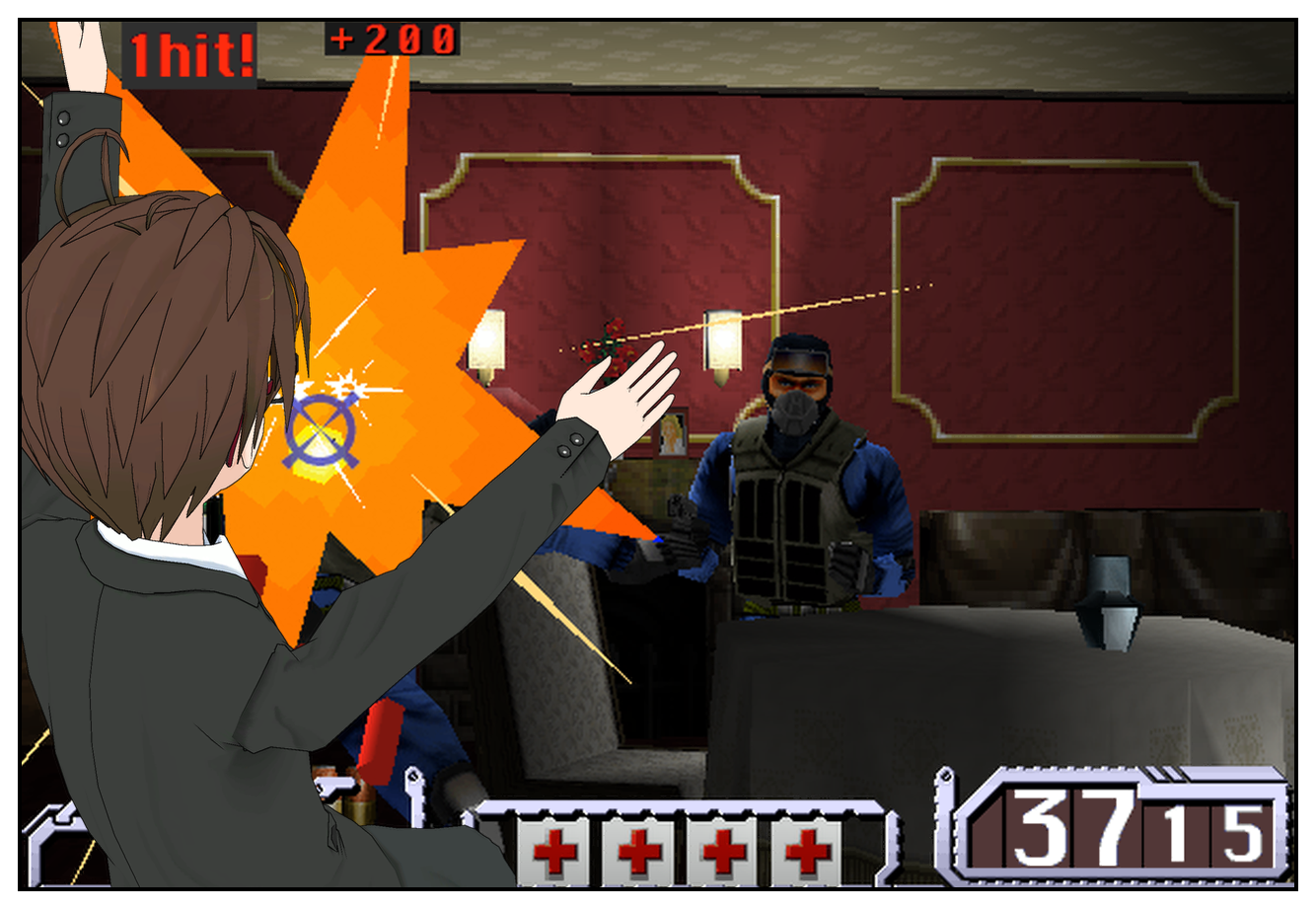
Playing Blue Estate is extremely simple. You point with the motion controls, you shoot with a squeeze of the R2 button. Occasionally you'll be tasked with swiping the DualShock 4 touchpad in a particular direction to perform an action like a melee attack or dodging an incoming projectile, but for the most part this is a game about blasting hordes of goons as quickly, accurately and efficiently as possible in order to rack up 1) a big combo and 2) a big score.

Shooting games of various descriptions were often maligned in the early days of gaming as being the most simplistic, mindless types of games, but this absolutely isn't true; even Space Invaders taught players the importance of performing quick quasi-mathematical calculations in their heads in order to fire their shots at an appropriate position to intersect with the moving aliens as they descended the screen. In Blue Estate's case, the quick thinking required is less mathematical and more observational: it's about prioritising targets and responding to things quickly.

One thing lightgun shooters used to struggle a bit with is how to handle presenting a risk to the player without looking silly. Older lightgun shooters tried several methods — enemies not shooting particularly quickly to give players time to hit them before they got a shot in; enemies focusing on melee attacks; in more advanced games like Time Crisis, a cover system — but it could still sometimes seem a bit convoluted. Blue Estate goes for a hybrid approach of these techniques: as you proceed through each level, sometimes you'll have the opportunity to pop in and out of cover Time Crisis-style, while at others you'll simply have to prioritise your targets appropriately to avoid taking damage. The latter case is handled reasonably elegantly with an on-screen "warning" system showing which enemy is going to score a hit on you next, allowing you to pick a suitable order to blow your foes' heads off.

Blue Estate is, despite its extremely silly story, which I won't go into here, a surprisingly skilful game that has a ton of replay value for score attack enthusiasts. The combo system rewards accurate, skilful shooting, and star ratings in various categories at the end of each level encourage you to try and better yourself in various ways. The basic blasting action is also broken up with several challenge-style objectives in the middle of each level, which task you with everything from quickly shooting enemies that pop up from one of several marked locations to killing a group of enemies in the correct order. There are also some rather wonderful boss fights, which are heavily pattern-based but a ton of fun to fight your way through.

The whole thing has the feel of an old-school arcade game: one that you can "learn" in order to get better at. Learning the position and order of the enemies that show up in each level; learning the bosses' attack patterns; practising your ability to prioritise and quickly respond to targets in order to chain an entire level together — all of these things prove rewarding and fun, even once you've seen the story through to its conclusion. And the story provides good incentive to play through the whole thing at least once, even if you have no intention of score-attacking: it's genuinely amusing but convincingly written with some solid, fun characters and sufficient justification for each of the game's characters to blast their way through scores of henchmen.

If you haven't given it a shot — no pun intended — and you're a fan of the more arcadey side of life, I recommend Blue Estate highly. It may not be a game you've heard of, nor may it be a game that many people are talking about, but it's a whole lot of fun, and worth your time.

2190: Rubble Without a Cause

0190_001

I played through the second episode of the new King's Quest game today. It's a lot shorter than the first one, so I was able to get through it in a single sitting. Despite being fairly short, though, it's an interesting contrast from the previous episode; rather than being a relatively large (for an adventure game) open world with a non-linear series of puzzles for you to tackle at your leisure, Rubble Without a Cause, as the second episode is known, takes place in a much more confined environment, and largely focuses around one big puzzle: how to free everyone from captivity at the hands of the goblins.

Yes, instead of throwing us back into Daventry, Rubble Without a Cause puts us underground in a goblin prison complex. Graham is dismayed to discover that most of the major characters from the town of Daventry appear to have also been abducted, along with the eccentric merchant's "unicorn" Mr. Fancycakes. Thus begins a quest to find a way out of this predicament.

There's a twist, though: unlike most adventure games, you don't have all the time in the world with which to achieve your goals. Unfolding over the course of several days, the adventure sees the health of all of the prison's occupants — with the exception of Graham — decline as the days pass. Thus you're presented with some difficult, mutually exclusive choices throughout as you determine who it is best to give medicine and food to as they require it. And once you start getting closer to escaping, you need to determine which potential companion is going to provide you with the best chance of succeeding, and ensure that they are in good health for when you make your attempt.

The small scale of the episode initially felt a little disappointing, but on reflection after finishing it, I very much liked the concept of it being based around one central problem for you to solve, and felt this was a good use of the episodic format to provide a short-form but complete-feeling experience. You can solve it in a number of different ways, too — it is, I believe, even possible to complete the episode without anyone running out of health and being carried away by the goblins, but I most certainly did not succeed in that particular endeavour today.

In many ways, the King's Quest episodes we've seen so far are a great example of "gaming short stories" — quite literally, since they are presented as stories narrated by the ageing King Graham (whom I'll be very surprised to see survive the fifth episode) to his grandchildren. This presentation of the narrative as a participant narrator looking back on his past actions is an interesting twist on how old Sierra games such as the original King's Quests used to work, with a strong contrast between the omniscient, non-participant narrator and the in-character dialogue between characters. King's Quest, as a series, maintained this style of presentation until its seventh installment, and it's good to see new developers The Odd Gentlemen returning very much to the "feel" of the classic Sierra adventures.

So was Rubble Without a Cause worth playing, given its short length? Well, if it was a standalone game by itself, I'd perhaps feel a little short-changed at its small scale and short length. In the context of the whole series, though, it makes a good, nicely contrasting follow-up to the excellent first episode, and has me once again hungering to know what happens next!