I've been spending some time with Ubisoft's The Crew for the last few days. I actually picked it up shortly after release but didn't play it all that much. With the recent announcement that the base game would be free throughout September (you can still claim a copy here at the time of writing) I thought I'd give it another go.
What is The Crew? Allow me to elaborate in video form, because I can.
I'm left wondering why I didn't play The Crew more when it first released, because it occurs to me that it's what I wanted from a driving game for quite some time: the elusive ideal of the "caRPG", or an RPG with cars if you prefer less clumsy portmanteaus.
The Crew ticks all the boxes that I wanted. For one, it has a plot that is reasonably interesting and features some characters that, while a bit cliched, occasionally have some entertaining things to say — the protagonist offhandedly complaining to his FBI handler that he really wanted a shower because he'd been in his damn car for days was a nice bit of self-reference to the fact that The Crew doesn't have any on-foot missions. The plot itself may be Fast and Furious-level nonsense, but it works in context.
Secondly, it has a levelling system that is actually meaningful. Unlike games such as Forza Motorsport, which largely seem to have a levelling system just to show how long you've been playing, The Crew's levelling system actually works like one in a more conventional RPG — some gear is level-locked, your cars get more powerful as you level up and there's an MMO-style "endgame" once you reach the cap, further improving your abilities by getting better and better loot.
Which brings us on to the third point. The Crew is also a loot-whoring game, which is something I never thought I'd say about a racing game, but it's true. Any activity you complete rewards you with loot, with better results giving you better gear. You get immediate feedback on whether the gear is better or worse than your current setup by means of an "item level"-like system for each of your cars, and events have recommended vehicle levels so you never tackle anything that is going to be way too difficult for you.
In case you're still not quite convinced about The Crew secretly being an RPG, well, there are different classes of cars, too. Fullstock cars are exactly as they came out of the garage. Street cars are modified street-legal cars for road races. Dirt cars are suitable for offroading and stunts. Raid cars are powerhouses that can take a beating and dish one out too. Perf cars are extremely fast. And there's plenty more where that came from — even more with the Wild Run expansion, which adds several "extreme" specs to the list, too.
And then there's the multiplayer, which to be honest I haven't tried all that much yet. There's a sort of passive multiplayer a la Test Drive Unlimited as you zip around the open world, occasionally passing other players by. You can queue up for PvP-specific missions. You can recruit people to help you out with story missions, which then have to be played fully cooperatively — race missions, for example, mean that your teammates just have to make sure that you win by fair means or foul, whereas missions where you have to wreck a fleeing vehicle are likely to be much easier with company.
And on top of all that, The Crew makes driving around its vast open world interesting by 1) having some lovely scenery and 2) scattering Project Gotham-style skill challenges around the roads, tasking you with everything from slaloming around markers to simply getting as far away from your start point as possible. Each of these reward you with loot and experience, making them the equivalent of "trash" enemies in a more conventional RPG.
I'm enjoying the game a lot. Handling is enjoyably slidey and arcadey, just how I like it, and there's a ton of stuff to do, yet enough structure to ensure that you never get overwhelmed with too many options at any one time. And it feels like the best use of Ubisoft's open-world formula to date, with plenty of hidden things to find that reward you with experience, loot and even hidden cars to uncover.
The Crew is free for the rest of the month on PC. Be sure to claim your copy here.
I finished my first playthrough of Fairy Fencer F: Advent Dark Force tonight. I completed my first playthrough, as I'm sure most people do, on the Goddess route, which is (mostly) the same as the PlayStation 3 original. Having never quite gotten around to the PS3 original, it was all new to me, so it was an exciting journey to take.
I found Fairy Fencer F — the Goddess route, anyway — to be an interesting experience because it's by far the most "traditional" RPG that Compile Heart has put out, in that it has a spiky-haired male protagonist who goes on an Oprah-worthy journey of personal growth over the course of the entire story, a band of plucky companions that he attracts to his cause through his own charisma and personal magnetism, a plot that involves aspects of faith and religion, and a suitably climactic battle against a supernatural being at the end.
This is in stark contrast to, say, the Neptunia series, where the overall plot is often the least important aspect of the game (though MegaDimension Neptunia V-II placed greater emphasis on the overall plot and was one of the best Neptunia games I've played as a result) and instead the main attraction is the developing relationship between the recurring cast members.
Fairy Fencer F is ample proof that Compile Heart has what it takes to butt heads with the masters of the genre, though, at least in terms of characterisation and storytelling. Their method of interacting with the game world affords it fewer opportunities for demonstrating the sheer level of detail Falcom puts into works such as the Legend of Heroes series — Compile Heart RPGs typically flow like visual novels punctuated by dungeon crawling rather than the more free-flowing experience that is a Falcom RPG — but the game nonetheless manages to paint a convincing picture of the world in which the story takes place, and the people who make the story happen. It achieves this by taking an approach Compile Heart also adopts in many of its other games: keeping the scale of things relatively small. Fairy Fencer F features only one town and a few dungeons in its immediate (rather geographically diverse) vicinity, and consequently you get to know the area and the people in it pretty well, both through the main story and the optional interactions with incidental characters around the town and its various locations.
Of particular note in the story as a whole is the protagonist Fang and his relationship with the two leading ladies of the piece: his fairy Eryn, with whom he constantly bickers but obviously trusts absolutely, and Tiara, whose first encounter with Fang and Eryn comes when she tricks them into drinking paralytic tea so she can steal the Fury the duo were in pursuit of. Tiara in particular demonstrates herself to be a complex character over the course of the complete narrative, and while the big "revelation" about her identity may not be a big surprise to those who have played a lot of RPGs, the story takes some very surprising twists and turns, particularly immediately leading up to the "split point" where the new version diverges into three different narrative paths.
Also noteworthy is the game's tendency to demonstrate that people aren't necessarily always as "good" or "evil" as they might immediately appear. Indeed, one of the most squeaky-clean characters in the game turns out to be a bit of a bastard, while overtly playing for Team Evil is a noble swordsman whom Fang can eventually recruit to his cause (fail to do so and he kills himself, a shot of darkness I'm not entirely used to seeing in Compile Heart games!), a young woman who spends her free time caring for orphans using the Obligatory Big Bad Corporation's funds, and a salaryman who is only perpetrating less-than-noble deeds to care for his wife and child, whom it is clear he genuinely loves a great deal.
This "people aren't exactly what they seem" theme is also seen to a lesser extent through Tiara, who acts like a "proper lady" — her Japanese speech is riddled with watakushi and desu wa, both of which are verbal signals that we're dealing with someone who either is "noble" or at least wants to put across the impression that they are — but is actually, as Fang puts it, "nasty" underneath. And the trope is explicitly lampshaded in the form of the character Pippin, who appears to be a strange green cat-like creature, and who constantly extols the virtues of not judging a book by its cover. Indeed, Pippin remains something of an oddball enigma right up until the very end of the game, but after a while you just start thinking of him as an odd person, not an odd green cat-like creature.
All in all, my 50-hour first playthrough of Advent Dark Force leaves me feeling like it's Compile Heart's strongest game to date — yes, even better than the already excellent MegaDimension Neptunia V-II — and hungry for more. Fortunately, there is more — I have two more narrative routes to play through, plus a Platinum trophy to chase. I'm particularly interested to see how the two other narrative routes differ from the Goddess route — whether it's a few changed events or a complete restructuring of the story. I'm kind of expecting the latter based on what I've seen people discussing, but either way, I'm looking forward to spending more time with this great cast of characters.
Serious talk: if you're still rejecting Compile Heart games just because they're Compile Heart games, you're missing out on some truly great RPGs. Including this one.
With it being Final Fantasy XIV's third anniversary it's only fitting that I take a look back at the reason I've been playing it since its closed beta — and why, even though on several occasions I've felt like I might be "done" with the game, I keep on coming back, time after time.
These memories are presented in no particular order, but it makes the most sense to start with this one.
Knowing FFXIV was going to be something special
I jumped into Final Fantasy XIV's closed beta after a casual discussion with a Twitter friend about Final Fantasy XI and how much I liked it despite never really getting all that far with it. Eventually I found myself with an invite to the testing period of the game, and I was immediately smitten with it. Everything about it felt Final Fantasy. The look, the feel, the music, the controls, the battles, the monsters — and yet, it had enough of its own unique identity to make it feel like far more than just series fanservice.
Specifically, Final Fantasy XIV adopts a somewhat "dark fantasy" tone throughout, clearly heavily inspired by works such as Game of Thrones and The Witcher in places. Sure, there are still moogles and chocobos, but there are also complicated political machinations, betrayal, murder and, technically, just prior to the start of 2.0's story, apocalyptic catastrophes.
I was immediately drawn into the world in a way that World of Warcraft never quite managed to enrapture me. NPC dialogue, although localised with more than a few liberties taken from the original Japanese, much to the chagrin of people who play with Japanese voiceovers, was beautifully written with an almost Shakespearean tone in places, blending old- and middle-English words and phrases with modern spellings to make it actually comprehensible.
The fact that Final Fantasy XIV placed any emphasis on its main story at all — let alone to the degree that it has ended up doing so — was a unique feeling for me. Even its predecessor Final Fantasy XI's main story had felt like a side activity you did when you had done enough level grinding to be able to take on the next mission; here, the main story was tightly tied in with your character's progression: you advanced through the levels and became more powerful both in terms of mechanics and narrative, until you eventually reached level 50 and took on your most terrifying challenges yet.
During the closed beta, I only played up to about level 20 or so, but that was enough to know that I wanted to keep playing — and to know that I wouldn't mind when the servers were wiped post-beta to prepare for the start of live service.
Making some great friends
My friend who had urged me to try out FFXIV was all set to assemble a Free Company — FFXIV's take on guilds — as soon as the facility became available, and many members of that free company, centred around the Giant Bomb video games website, became great friends. I even took a trip to PAX East to hang out with a bunch of them and had an absolute blast. And while I recently left said Free Company in favour of a smaller group who are more local to where my wife and I are, FFXIV's various ways of keeping in touch — as well as extra-game means of communication like Discord — mean that I'll never be far away from this band of loveable rogues.
Castrum and Prae keeping me up until 5am
When I reached level 50, I was proud. The only other MMO I'd ever reached the level cap in prior to that day was World of Warcraft, and I'd stopped playing shortly afterwards, as my lack of friends playing had made that game a rather lonely experience at high level — this was the days before its current Dungeon Finder system, itself inspired by FFXIV's Duty Finder.
I'd heard the final two story dungeons, intended to be done pretty much as soon as you hit 50, were quite an experience, and so I asked the Free Company very nicely to accompany me on my first run through them. This was — and still is — the best way to run these dungeons, since they're both full of cutscenes, and running with a completely preformed party means no risk of other people running ahead and starting boss fights while you're still watching dramatic scenes.
The experience of running Castrum Meridianum and Praetorium left such an impact on me that I immediately wrote about it on USgamer. It remains one of my fondest gaming memories to date, and it makes me a bit sad that people coming to it now will more than likely be partied up with a group of people who outgear it to such a degree that every boss fight is a complete steamrollering. Pro-tip, then — if you're just hitting 50 for the first time and you have 7 friends handy, queue up for Castrium then Prae and check the "minimum item level" option in Duty Finder in order to experience these two dungeons at their original difficulty level from shortly after launch.
Entering the Coil
I happened to be up and about one night when some Free Company-mates were heading into the endgame raid dungeon The Binding Coil of Bahamut. At this point, the raid had been "unlocked" because better gear than it offered was already available, and so it was there for people to run just for the experience of the unique story it offered, as well as unlocking subsequent chapters.
Coil was a whole other level of the game for me. The encounters were much more complex, they demanded much more coordination and awareness of what was going on, and the unique story, music and enemies you fought in there made it feel like a truly "special" experience.
Forming LoCoBomb and tackling Coil proper
Loose Cannons, or LoCo, were Giant Bomb's neighbours in the Limsa Lominsa housing district of Mist, and they're now my new Free Company. LoCo is a tiny little group compared to the hundreds of members of Giant Bomb (many of whom are inactive players, but still) but we struck up a mutual friendship with one another, even going so far as to put together a rather casual, slapdash static for tackling The Binding Coil of Bahamut, a little later than much of the rest of the player base, but tackling it nonetheless.
Raiding together was a great way for us to get to know one another better, and we had a lot of fun times working out way through the first four Turns until we hit our first real barrier: Turn 5.
Toppling Twintania
Turn 5 of Coil was originally the hardest fight in the entire game, facing a party of 8 players off against the rather angry dragon Twintania. Accompanied by the fantastic piece of music Thunderer, this was a genuinely terrifying confrontation in which you really felt like you were battling against insurmountable odds.
Twintania was our first real encounter with having to properly coordinate raid tactics thanks to now-notorious mechanics such as Divebombs and Twisters. Taking her down for the first time was an incredible feeling, only to be matched by the time we finally bested the final boss of the Second Coil of Bahamut.
Nailing Nael
Turn 9 of Coil — or Turn 4 of Second Coil, if you prefer — quickly took over from Turn 5 as being the hardest fight in the game, mostly due to how unforgiving it was. The fight featured a wide variety of tasty instant death mechanics and even a few sections where careless play could wipe the rest of the raid without too much difficulty.
After a long slog through Second Coil — Turn 6 gave us a lot of grief, though the subsequent two went a little smoother — LoCoBomb persevered and were eventually victorious, however, and we still weren't sick of the two incredible boss themes Tempest and Rise of the White Raven.
This encounter remains, to date, my favourite boss fight of all time in any game ever. Ten character levels, over a hundred item levels and one expansion later and it's still not particularly easy to clear.
Phoenix from the Flames
A lot of people will note that Turn 12 — Turn 3 of Final Coil — is as memorable an encounter as the grand finale Turn 13, and I'd certainly agree with that. Resolving a large number of questions surrounding what really happened at the end of Final Fantasy XIV 1.0, Turn 12 sees the party facing off against the iconic Phoenix, accompanied by this magnificent arrangement of the game's main theme Answers. I still get shivers every time I hear it. And the recent The Rising event in the game now brought it out at the perfect moment to genuinely give me goosebumps all over my body.
The Final Witness
The final battle in Final Coil is appropriately spectacular. It wasn't horrendously difficult by the time we got to it — each subsequent patch had increased the amount of bonus HP and damage you'd be blessed with when you went in, theoretically allowing more and more people of lesser skill and/or gear to enjoy all of Coil's story — but it was still an immensely worthy absolutely, positively, definitely final boss. And it made incredible use of Answers.
An in-game marriage and a real-life proposal
(if the embed doesn't work, go here to embarrass me)
January 3, 2015: Amarysse Jerhynsson married W'khebica Qimi (now Wuckle Bunny, because no-one can spell authentic Mi'qote names properly). During this process, the player behind Amarysse Jerhynsson — yours truly — made a rather lengthy virtual speech that culminated in him proposing to the player behind W'khebica Qimi, who was sitting in her study upstairs from him at the time.
We married in June 2015. And who says computer games are antisocial?
Heavensward and beyond
The first full expansion for Final Fantasy XIV was an exciting moment, as it would take us to brand new areas, see us tackling brand new dungeons and battling fierce new foes. It was everything most people hoped for, with an excellent story — to some, better even than A Realm Reborn's at times meandering narrative — and one hell of a final boss fight.
While the long lull between Heavensward's release and the first major content patch finally arrived with us was, I feel, largely responsible for the fact that my former Free Company are no longer quite as obviously "active" (at least in public channels) as they used to be, Heavensward has, on the whole, been a great evolution of A Realm Reborn's base, even introducing a number of brand new types of content to the mix, with my favourite being the new randomly generated Deep Dungeon.
Heavensward's raid scene hasn't appealed that much — I'm not really a fan of steampunk in general, and the narrative set up around Alexander was feeble and unmemorable compared to the majesty of Coil — but there's still been plenty of stuff to do, and as we saw with the Live Letter yesterday, there will continue to be more and more stuff to do as we start the buildup to the second full expansion, set to be revealed for the first time in October.
It's not many games you can play almost continually for three years and still look upon fondly, but I guess anything you spend that much time in the company of eventually becomes something you really, truly can't ever let go of.
It's hard to get this across to people who haven't been on the journey I've been on, and it probably won't be quite the same for someone who starts right now, but I stand by my nomination of Final Fantasy XIV as my Game of the Year for 2013 over on USgamer, and given the number of hours I've played, it's probably my GotY for 2014, 2015 and 2016 too.
Back in the '90s, MicroProse, a software company that already produced a number of the most complex computer games on the market thanks to their near-exclusive focus on military simulators, launched a spin-off label called "MicroStyle". MicroStyle's "thing" was that they produced "games for adults". This did not mean "adult" as in "porn"; rather, it meant games about things that — supposedly, anyway — older gamers would be interested in. No cutesy platformers with rainbow colours here; MicroStyle was all about motorbikes, fast cars and, err, Rick Dangerous, the latter of which perhaps erred a little more towards the side of cutesy platformers than its stablemates.
The reason this largely pointless piece of gaming history trivia is at the forefront of my mind right now is due to the recently released No Man's Sky, and the bafflingly negative reaction it has received from many online commentators. I had been asking myself why there was so very much whining going on about this game, when it occurred to me, partly after a bit of reflection on my own part and partly after a discussion with my friend Chris.
No Man's Sky is a game for grown-ups. And some people don't know how to deal with that.
The reason I say this is that there's a very obvious dichotomy when it comes to this game between those who have sat down and spent time with it — and then, crucially, reflected on the experience — and those who take it at face value, judge it against the frankly unreasonable expectations they set for it in their head and consequently respond rather negatively towards it.
There are two particularly good pieces on the subject of No Man's Sky that I invite you to read right now before we go any further.
The first, from The Guardian's Keith Stuart, explores the game from the perspective of someone who grew up playing the original Elite on 8-bit computers. Stuart describes how invested he was in the virtual galaxy that Elite allowed him to explore; how he went so far as to buy a particular joystick to play it with because it looked suitably futuristic, and to make copious notes about profitable trading routes and sectors to avoid. His prose reminded me of my own youth with computer games, when I'd actually go so far as to dress up in a bomber jacket, home-made "oxygen mask" (made from a bit of cardboard and an old vacuum cleaner hose) and balaclava (the closest I could get to an actual crash helmet at the time) when playing games like F-15 Strike Eagle II and F-19 Stealth Fighter on the Atari ST. The use of imagination was key; these games were thrilling not because they presented the most impressive visual spectacles on screen, but because they truly allowed you to become someone else for a short time. The idea that you could sit down in front of your computer monitor and become a space traveller or fighter pilot was intoxicating, and even though at the time I was far too young to really understand those games properly, those experiences still stuck with me.
Stuart describes No Man's Sky as an Elite for the modern age. He also notes that we already have an Elite for the modern age in the form of Elite: Dangerous, but makes the crucial distinction that Elite: Dangerous has gone heavily down the path of complex simulation, while No Man's Sky eschews some of the more "unnecessary" aspects of realism in favour of providing an experience that stokes the fires of the imagination.
Stuart's piece is complemented nicely by this piece in Rolling Stone/Glixelfrom Star Wars novel author Chuck Wendig. Wendig describes No Man's Sky as "boring", but notes that this isn't actually a bad thing.
"We often play games for the destination," says Wendig, "but I don't think that's why we play No Man's Sky. We play it for the journey. There is an eerie calm to this game. A utopian serenity. A pleasant, alluring boredom that draws you along the journey – but not too fast. This is sci-fi that doesn't ask you to kill, kill, kill. It asks you only to wander. To discover. To catalog your findings and sell your wares and move onto the next moon, the next space station, the next world, the next star system. All in pursuit of whatever it is you wish to pursue."
He's absolutely right. While there is combat in No Man's Sky, it's a rare occurrence — rare enough to make every time you switch your multi-tool from mining laser to boltcaster mode feel significant. The emphasis instead is on exploration, discovery and, above all, imagination. You're given very little context or explanation for the things you are seeing in No Man's Sky, and I have a strange feeling that even if you "finish" it by reaching the end of one of the narrative paths and/or the centre of the galaxy, it still won't answer all the questions you might have.
My friend Chris also describes it as "a game for people who like books: you have to have a bit of imagination, and have your sense of wonder still intact, and understand that there are breeds of sci-fi that aren't about action." I can't help but feel that the fact the whole game looks like an Asimov cover is entirely intentional.
The trouble is that this style of play is the exact opposite of what a lot of younger gamers expect from their games these days. They don't expect their space sims to be quiet, contemplative, artistic affairs that minimise action in the name of cataloguing flora and fauna on diverse alien worlds. They expect their space sims to be more along the lines of the Call of Duty: Infinite Warfare trailer we saw at E3: all action, all explosions, all bodies floating off into space. And No Man's Sky isn't about that.
I can't help but feel that the loudest complaint of all — the fact that the game isn't the synchronous massively multiplayer title that a lot of people had come to assume it would be — also ties in with this. Fundamentally, No Man's Sky is a game about being alone in a vast galaxy, and occasionally coming across traces of evidence that other people have been there before you — whether it's long-forgotten ruins, from which you can learn snippets of the various alien languages in the game, or star systems, planets and species of flora and fauna named by other players. The fact that you can't see other players flying around is entirely intentional; the game hasn't been designed in that way at all, and "true" multiplayer would add absolutely nothing to the experience other than the opportunity to be griefed by players who fancied a career in virtual space piracy.
No Man's Sky is a game for grown-ups. Specifically, it's a game for grown-ups who grew up with games in the '80s and '90s; it realises the dream of being able to freely fly a spaceship around a vast universe, land on planets and explore them at our leisure; it gives us enough fuel to stoke the fires of our imagination, and withholds enough to allow us to let those flames flare up as much as we want; it's a game that is the exact opposite of something like Mass Effect's grand space opera, in which nothing is left to the imagination. (This isn't to put Mass Effect down, mind you; there's a place for both the quiet contemplation of No Man's Sky and the dramatic bombast of Mass Effect in this world.)
Perhaps most tellingly, all the most interesting, thoughtful and sensible commentary on No Man's Sky has been by people over the age of 30. And the negative comments very much come across as being written by much younger people. (I obviously can't say for certain how old many of the naysayers are, but their words certainly come across as being less… seasoned, shall we say.)
If all you can do is rant and rave about how Hello Games' Sean Murray "lied" to you about the game being multiplayer… well, then you're missing the point. Spectacularly. And you should probably go and play something else. Something with more guns in it.
Final Fantasy XV was originally due to come out at the end of next month. Today, director Tabata officially confirmed the rumours that have been swirling around the Internet for the last couple of days: the game has been delayed until November 29.
Tabata announced the delay in a video on the game's official YouTube channel.
His reasoning behind the delay was that, although the team had finally completed the "master version" of the game, meaning a version that was feature-complete and that they would be happy releasing to consumers on disc, they had already started work on some additional content and adjustments that would normally be distributed as a "day one patch" to be applied automatically when a Final Fantasy XV player had their console connected to the Internet.
The trouble with day one patches, though, is that they're not part of that master game experience. They're not on the disc; they're reliant on an Internet connection. And while the "not everyone has an Internet connection" argument is rapidly losing steam as broadband becomes more and more affordable and ubiquitous, there's still a fundamental problem with them from an archiving perspective. In other words, if someone interested in the history of gaming were to become interested in checking out Final Fantasy XV some twenty or thirty years down the line, it's doubtful the PS4's PSN servers would still be up and running to allow them to download the patch, and as such they'd be left with an inferior — although, in this case, still complete — version to explore.
In some cases, day one patches contain essential bug fixes that actually get the game working, meaning the game is unplayable straight from the disc. And in others, they fundamentally shake up the structure of the game — the day one patch for No Man's Sky is a good example of this latter instance. There are very few cases where they are desirable, although sometimes developers are left with no choice — if a game is rushed out of the door to meet a deadline, for example, or if in last-minute testing after the game has been duplicated several million times, a major problem is found.
With Final Fantasy XV being such a big project, though, it seems that Tabata and his team have been given the flexibility to hold the game's release back until it meets with their high standards, however, and Tabata himself notes that he is uncomfortable with releasing a disc-based version of a game that isn't the very best version it can possibly be. He's not ruling out future patches and DLC — and the existence of a "Season Pass" for the game confirms that there are going to be a number of substantial add-ons for Final Fantasy XV — but he wants that initial day one experience to be as smooth as possible for all players around the world, regardless of whether or not they have an Internet connection or are able to download the day one patch.
This, ladies and gents, is how you make a video game. It's what we used to expect from previous, non Internet-connected consoles, and it's something that we have lost sight of in the modern age, where attention-deficient mobile game-playing audiences bray and whine if games don't receive "updates" every two weeks, even where none are necessary. While it's disappointing that this no longer means I'll be playing Final Fantasy XV next month, I respect Tabata and his team enormously for wanting to make their game the very best it can be before it gets into the players' grubby little hands.
I guess that means I have time to play through Fairy Fencer F: Advent Dark Force before Final Fantasy XV after all, then…
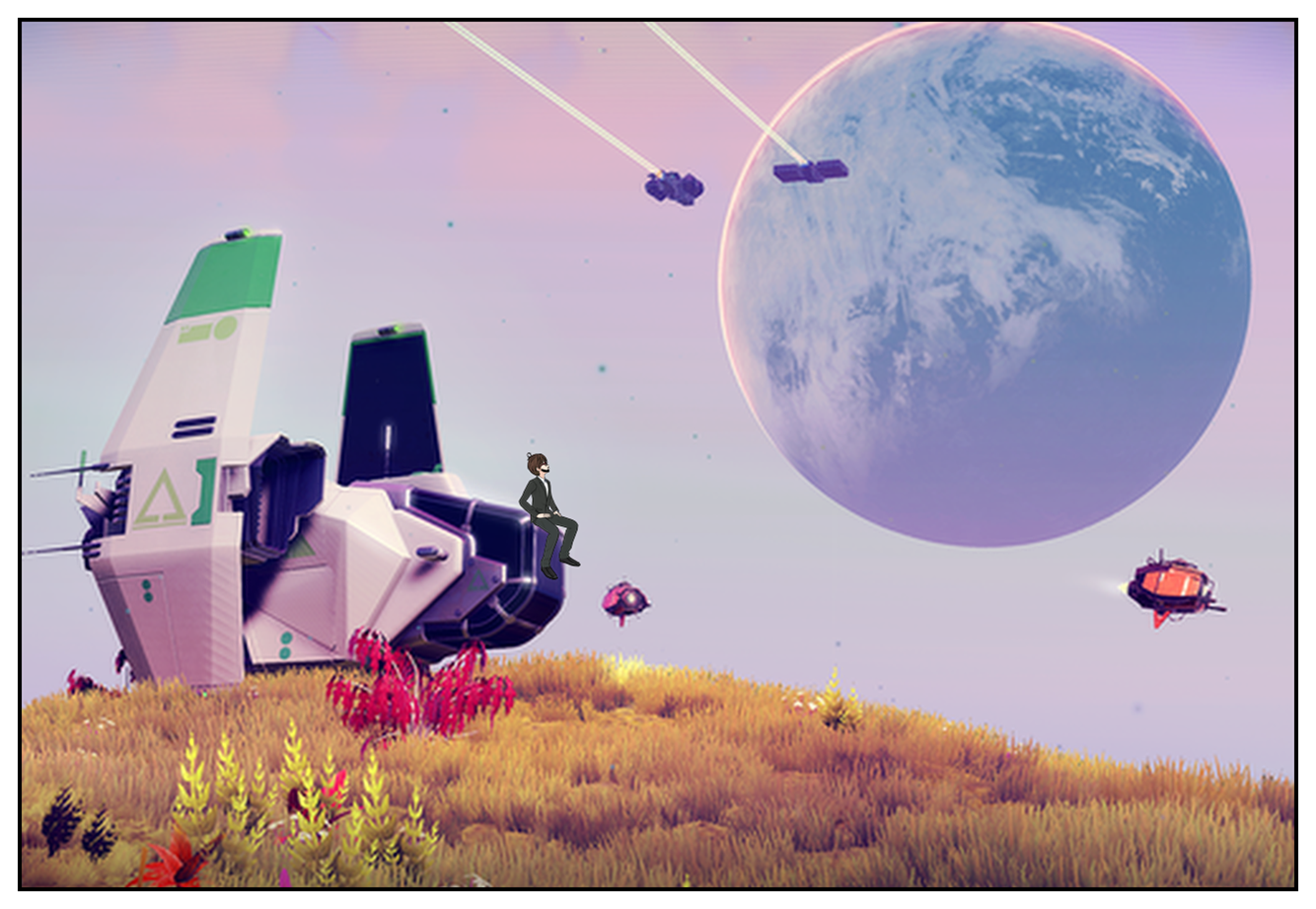
After feeling somewhat lukewarm to the idea of it for a while — the relentless hype train hasn't helped — I've come around to the idea of No Man's Sky, so much so that I'm now actually looking forward to it releasing on PC on Friday so I can get started on some grand space adventures.
I'm very interested to see how it's turned out, though I am tempering my expectations accordingly as well as intending on paying attention to the evolution of the game over its lifespan; this is a game that, several months down the line, may be very different to what it is on launch day, and that prospect is both exciting and a bit of a reflection on the modern games biz.
The reason why I'm interested to see how No Man's Sky ends up is that the concept reminds me of some of my favourite underrated games of yesteryear, and a genre which we don't really "do" any more, and that is the Star Trek-style space sim. Star Wars-style (i.e. combat-heavy) space sims have been enjoying a bit of a resurgence in the indie space in recent years, but the more sedate pace of Star Trek-style (i.e. exploration-heavy) sims is something still largely consigned to the past, with the exception of a few 2D affairs like Starbound and Interstellaria, neither of which, I feel, particularly capture the real feeling of space travel and exploration.
The specific games I'm thinking of when I ponder Star Trek-style space sims are the two Starflight games by Electronic Arts back in the 16-bit era. These were games where you were given a starship and pretty much told to just get on with it at the outset; there was an overarching plot to follow, but the main attraction of Starflight was the ability to just pootle around known (and unknown) space exploring solar systems and planets, then bringing goodies of various types back to home base for analysis and filthy lucre.
No Man's Sky isn't quite the same thing as Starflight in that you appear to be piloting a single-seater ship rather than a big-ass starship, but the philosophy behind the game seems to be similar in that the emphasis is on discovery, and the main means through which you profit, progress and flourish is through exploring and finding exciting things rather than blasting anything that dares to pass through your crosshairs into a smooth pâté.
To continue the comparison, both Starflight and No Man's Sky had/have significant planetside components in which you explore, find useful things and perhaps uncover a few mysteries along the way. I can't speak for No Man's Sky yet, but I have some fond memories of landing on planets in Starflight, then sending my all-terrain vehicle out into the wasteland to track down valuable minerals, artifacts and, if I was lucky, some specimens of life, too. Starflight's primitive graphics were enriched by some enjoyable descriptive text whenever your ground crew ran into trouble, and naturally it would be up to the crewmember you'd assigned as your medical officer to patch people up when they got back onto your ship.
Starflight was interesting, exciting and compelling even when you weren't in mortal peril, though, and indeed a lot of the time you weren't. There was a simple joy in entering a new system for the first time only to discover that it had an abundance of planets and moons, each of which could be landed on, explored and stripped of as many valuable minerals as you could fit in your ship's cargo holds. It sounds as if this is the sort of experience No Man's Sky offers, too, and if that's the case then I'm pretty excited for it.
Like Starflight, No Man's Sky appears to have an overarching narrative pushing you towards a "conclusion" of some sort at the centre of the galaxy, but also like its distant predecessor, you're free to just do your own thing as you see fit for the most part.
I'll be particularly interested to see how things like encounters with alien NPCs and suchlike go in No Man's Sky, as some of these interactions were a real highlight of Starflight. Judging by this screenshot, though, it looks like I don't have much to worry about.
Anyway. Just a couple of days to go until I can find out for sure whether No Man's Sky is actually the space sim I've been wanting to play since I didn't have a spare floppy disk to hand to save my game in Starflight on the Atari ST, so had to start again each and every time I played. No such woes await with No Man's Sky — hopefully, anyway, though doubtless day-one server issues will be A Thing — and so I'm looking forward to jumping into my Roger Dean/Asimov-inspired space odyssey and, frankly, seeing if Hello Games have managed to make an interesting game out of 18 quintillion planets or however many are supposed to be in the damn thing.
Doubtless I'll be writing about this in more detail at some point in the near future over on MoeGamer, but while it's still new and fresh I thought I'd give some initial impressions on Fairy Fencer F: Advent Dark Force, Compile Heart's latest PS4 release.
FFF:ADF, as I will refer to it hereafter, is a Neptunia Re;Birth-style reimagining of the PlayStation 3 game Fairy Fencer F. It includes the whole story of the original game, updated and expanded with all-new mechanics, plus a whole bunch of brand new content as well, making for what looks to be an absolutely sprawling mammoth of a JRPG that I'm very much looking forward to sinking my teeth into.
For the uninitiated, FFF:ADF casts you in the role of Fang, a lazy asshole who we're introduced to as he's been locked in prison for stealing bread. Three days earlier, it transpires, Fang pulled a legendary sword known as a Fury out of the ground, and thus found his fate inextricably intertwined with the adorably cute but rather headstrong fairy Eryn. Fang, wanting nothing more than a good meal and a warm bed, finds himself rather hastily recruited into a quest to find all 100 other Furies scattered around the world and use the power of the Fairies within to wake up the Goddess and prevent some sort of horrible catastrophe from occurring.
FFF:ADF follows Compile Heart's usual RPG formula fairly closely. Town scenes are menu-based and allow you to visit a number of different locations to purchase and sell items or just chat with NPCs. As you progress through the game, more facilities become available in town.
When you leave town, you'll likely be entering one of the game's dungeons, which are filled with enemies you can see wandering around the map, and perhaps an event and/or a boss fight to complete.
Striking an enemy with your weapon while you're in the field — a challenge made significantly easier than in the Neptunia series by the simple addition of a visual and auditory cue when you're in range to connect a hit — allows you to get the jump on an enemy; mistiming it or letting an enemy run into your back, conversely, lets them ambush you.
Combat initially appears similar to the Neptunia series but there's a few twists on the basic formula. For starters, characters only begin with a basic attack rather than a multi-hit combo. Multi-hit combos can be unlocked later — and they include fighting game-style techniques such as launching and juggling enemies — but initially the bulk of your damage will probably come from your special skills, which are further subdivided into weapon skills and magic spells.
The thing that's looking most interesting about FFF:ADF at this early stage is its progression system. Whereas Neptunia's character progression was completely linear — though once you unlocked abilities you could customise your characters to a minor degree, and Megadimension Neptunia made more of this by making different weapons capable of different combos — in FFF:ADF you earn WP ("Weapon Points") through combat, which can then be spent on unlocking abilities, buffing stats and activating passive skills. In practice, there's probably a "right" order to unlock things in — and if previous Compile Heart RPGs are anything to go by, you'll probably unlock everything by the time you're through — but it's nice to at least feel like you have some options.
Other cool features include a battle system that allows up to six party members at a time, which will hopefully make for some interesting encounters later in the game — I only have two characters at present! Neptunia's Challenge system is back, too, providing you with useful stat boosts in exchange for completing various tasks.
It's early days yet, but FFF:ADF looks like Compile Heart's most polished title to date; there's none of the weird screen tearing from Omega Quintet and, so far, none of the frame drops of Megadimension Neptunia, and the 2D art (courtesy of Neptunia artist Tsunako) is as gorgeous as ever.
I'm looking forward to seeing what this game has to offer; everything I've heard from people who have already played it makes me feel like it's going to be a really solid JRPG, and I'm excited to see what other gameplay features I'll be fiddling around with as I progress further.
Lightgun and rail shooters generally aren't regarded as particularly deep and meaningful experiences for the most part, and this is fine; after all, sometimes all you want to do is hold a plastic gun in your hand (or aim a crosshair) and blow seven shades of shit out of everything walking your way.
Sometimes, though, these games go the extra mile and provide a surprising amount of depth beneath the facade of mindless blasting. Nintendo's Star Fox series has been a good example of this in the rail shooter genre since Star Fox 64, with its complex scoring and medals system, and Gal*Gun: Double Peace does something similar for the (lightgun-less) lightgun shooter genre. Which may surprise you.
Gal*Gun's wrapper mechanics are that of a dating sim — a proper, full-on, stats-based one like True Love rather than the games that get called "dating sims" but are actually just visual novels with romantic themes. The protagonist has statistics determining his intelligence, athleticism, fashion style and lewdness, and these can be adjusted over the course of a playthrough either by taking girls into the "Doki Doki Field" and poking them until they emit some extremely suggestive moans, or by purchasing items between stages. The difference between the two approaches is that while purchasing items allows you to choose the stats you raise (or lower, if you need to) so long as you have the ability to pay for it, taking girls into the Doki Doki Field generally affects more than one stat at a time to a more significant degree, and each and every one of the girls in the game has a different impact on your stats. In other words, if you're trying to form a particular "build" — something that becomes particularly important in the more "freeform" mode that unlocks after you've beaten the main story-based routes — you'd better learn which girls are most useful for your purposes.
The stats are relevant in a couple of instances. Firstly, in the story-based routes, your stats need to be at a particular level in order to choose certain dialogue options. For example, if your lewdness level is too low, you are unable to make lecherous comments towards the heroines, which is probably for the best. Secondly, in the freeform mode, in order to pursue a particular girl, you'll need your stats to be in specific regions in order to be the type of guy they want you to be. I haven't got far enough to try out this mode yet, but it presents an interesting twist on the formula; in the story-based routes, you can pretty much get away with just raising all your stats as high as possible in order to have the maximum available options in dialogue.
As for the story-based routes' structure, they have a Good End and a True End, with the latter being dependent on a combination of your overall score for the playthrough being high enough and your affection rating with the heroine being high enough by the time you reach the final chapter. The latter is mostly a case of saying the right things in dialogue sequences, but it's also affected by the "event" levels where you're doing something other than just blasting incoming girls.
The scoring system, meanwhile, has a certain degree of depth to it, too. Most of your points come from fending off the girls who relentlessly charge towards the protagonist, but just blindly blasting away won't get you the best scores. No, in order to score highly, you need to achieve "Ecstasy Shots", which allow you to one-hit eliminate a girl by hitting her in a weak point. These are helpfully indicated when you move your crosshair over the girl by a piece of Japanese onomatopoeia appearing, though you can also learn where each girl's weak point is over time, too. There are four main weak areas: red popups indicate you should hit them in the head, orange means the neck, yellow means the torso and pink means the legs.
Each time you get an Ecstasy Shot, your combo counter increases by one. Your combo is broken if you take damage or eliminate a girl "normally" without performing an Ecstasy Shot. There's also an additional Quick Bonus for eliminating girls in rapid succession.
The Ecstasy Shot system makes the shooting a lot slower and methodical than the typical franticness of regular lightgun shooters, and there are a couple of other techniques you can use to tip the scales in your advantage, too. Firstly, shooting a girl anywhere but her weak spot without eliminating her stuns her for a moment, preventing her from doing her attack animation briefly. Secondly, holding down the fire button allows you to do a "Charged Shot", which covers a wider area and can likewise stun enemies briefly. Thirdly, taking one or more girls into the Doki Doki Field and poking them until not-an-orgasm-honest causes a smart bomb effect to go off, taking out all girls in the vicinity as if you'd Ecstasy Shotted them. These techniques are particularly helpful — even essential — during the sequences where enemies come at you from all sides and you have to manually turn to face several different directions to fend them off as they approach.
As well as the points earned through eliminating enemies in each level — not all of whom charge at you, so some need to be quickly taken out as they wander past during transitions between "shooting gallery" areas — there are also three bonuses at the end of each level for clear time (the quicker the better), amount of damage taken and accuracy, ranked between one and five stars, with five stars providing significantly more points than anything below. Clear Time is a particularly variable one, as many of the levels offer branching routes, with some being significantly quicker than others, but perhaps counterbalancing this with fewer enemies to chain Ecstasy Shots off.
As well as clearing the various story routes and attaining high scores, there are loads of hidden collectibles to uncover throughout the game. Some of these are hinted at by the "requests" you receive on your phone between levels, and largely involve finding either hidden objects or characters and shooting or staring at them, depending on what the request was. Others are simply hidden objects and provide anything from point bonuses to new costumes — the game's Dressing Room mode allows you to customise each and every character in the entire game to your own personal preferences (including undies), though disappointingly, the PS4's Share facility is blocked while you are using this, meaning you can't take pictures of your own personal take on the cast.
Alongside the hidden objects are student and teacher handbooks hidden in plain sight around the levels; shooting these unlocks parts of each character's profile, and you can complete said profile by taking each character's bust, waist and hips measurements by using the "zoom" function (also used to locate hidden objects by seeing through otherwise opaque scenery such as locker doors) and staring at them in the appropriate region before you blast them into euphoria.
On top of all that, there's at least one hidden ending that you can achieve by fulfilling a particular set of conditions (they're fairly obvious, but I wasn't expecting them to actually lead to a full-on ending) and a Score Attack mode that allows you to play either a whole story route or an individual stage and record your best score and highest combo.
So yes. There's a lot to this game. It's no Time Crisis, in other words, which, while it was great, pretty much played all its cards within twenty minutes if you were the slightest bit skilled with a lightgun. Gal*Gun, meanwhile, looks set to keep me busy for a very long time indeed.
I am sad about this. Really, genuinely sad. The game has been an important part of my life for quite some time now, and will always be special to me — hell, it's where I proposed to my wife.
But I think I'm gone for good this time. I've just had enough.
Not of the game, mind you; the game itself remains one of my favourites, with an enjoyably rhythmic combat system, plenty of distinction between classes and some truly memorable encounters — not to mention an incredible soundtrack and a great story.
No, I've had enough of the people who infest it.
The community's slide into unpleasantness has been a gradual but noticeable process. Whereas I described FFXIV's player base in my USgamer review (circa 2.0-era A Realm Reborn) as one of the most helpful, supportive and friendly communities in gaming, these days I regrettably can't say the same — though I find myself pondering whether or not it's because at the time I wrote that review, I'd only been playing endgame content for a short period.
Let me talk a bit about the incident that drove me over the edge today, then I'll talk a bit in more general terms about what I feel has gone wrong.
A short while back — like, earlier this week — FFXIV introduced a new type of content called Deep Dungeon. This was a completely new way to play the game, and involved descending into a 50-floor dungeon with up to three companions and clearing it out, one randomly generated floor at a time. The rewards on offer include tokens called "potsherds", which can be exchanged for various valuable items, and if you fully upgrade the weapon and armour you use in the Deep Dungeon — these are separate from those which you use in the main game — you get a high-level weapon for a level 60 character that is not quite the very best in the game, but certainly very respectable and suitable for all levels of content.
Upgrading the weapon and armour requires that you find silver treasure chests in the Deep Dungeon. Opening one of these will do one of three things: upgrade your weapon, upgrade your armour or explode, dealing damage to you and anyone unfortunate enough to be standing nearby. The deeper you go into the dungeon, the more likely it seems you are to come across trapped chests, and your weapon's upgrade level is also capped by your character's level within the deep dungeon — also measured independently of progress in the main game. To put it another way: your weapon and armour can go up to level +30, and in order to upgrade them to this level your character must reach level 60 in the Deep Dungeon, though thankfully levelling up is considerably quicker than in the main game.
After completing all 50 floors once, it's likely that your weapon and armour will be around the +10 to +15 mark, depending on how lucky you've been. This means you then have to challenge the dungeon again from floor 1 but with your upgraded gear, hoping you'll get luckier on the deeper floors this time. As incentive to run it again, however, every 10 floors gives you a generous shot of gil as well as Allagan Tomestones of Poetics, Esoterics and Lore, all of which are used to purchase the best level 50 or 60 gear available, so it's not as if running the upper floors again is a useless waste of time. Alternatively, if you enter the Deep Dungeon on a class you don't yet have to level 60 in the main game, completing 10 floors awards you with a large chunk of XP for your character's level in the main game, so it's also a good means of levelling alternative classes.
You may have surmised from that description that this structure puts a lot of pressure on Floors 41-50 to get players up to the magical +30/+30 needed to take away a shiny new weapon into the main game. And indeed, this is where the problems arise, with players doing everything from skipping fights with monsters that they don't feel the party "needs" to fight (despite some players not having reached level 60 at this point, and some enemies dropping treasure chests) to outright Vote Abandon-ing the whole dungeon if they don't feel they got "enough" silver chests in the first couple of floors.
I ran into one of these people today: a white mage, which is to say, a healer, and so an important, useful part of any group. Deep Dungeon, unlike everything else in the game, doesn't matchmake you into a party made up of one tank, one healer and two DPS, so it's entirely possible you'll find yourself running in a group with no healer at times, and as such having a healer in your group is something to be celebrated.
Unless it was this guy. Right from the very start of Floor 41, he ran off in completely the opposite direction to the rest of the party, leaving the remaining three of us to fight off monsters and get afflicted with various status effects that could have easily been cleansed if he had been there. But no; he had places to be, apparently, and finding those silver chests was more important than actually helping the other three people in there.
"Will you PLEASE stop running off?" piped up one of my companions halfway through Floor 42, obviously getting as impatient as I was with this git's shenanigans.
"I'm skipping mobs," replied our friend.
I then pointed out that not everyone in our party was level 60 yet — one was 56, one was 58 — and thus it would be in everyone's interest to kill as many monsters as possible, particularly as it's also necessary to kill a certain number to open the exit to the next floor anyway. He then complained about us being "slow" and "inefficient", and took great umbrage at several of us accusing him of "speedrunning".
Speedrunning is a bit of an issue in Final Fantasy XIV as a whole, particularly in dungeons, most of which are tuned more to the "casual" end of the difficulty spectrum, but nonetheless remain a good source of income for those valuable Tomestones. With a well-geared, confident party that knows what it is doing, most dungeons can be cleared in about 10 minutes or so, but this relies on everyone being both well-geared and confident in the speedrunning process, which usually involves the tank pulling as many enemies as possible at the same time, the healer working overtime to keep their HP topped up and the DPS doing area-effect attacks as much as possible.
It's quick, sure. It's also boring, because more often than not fighting like this means that you use maybe two or three of your complete suite of abilities, and fighting the monsters just becomes a case of standing in place hitting the same buttons over and over for ten minutes. Not interesting, and certainly not doing justice to the impressive encounters the Final Fantasy XIV team have created throughout the game. But no, at some point between 2.0 and 3.35, where we are now, someone somewhere decided that the de facto way to run dungeons was as quickly — sorry, "efficiently" — as possible, and woe betide anyone who slows it down for any reason, even if, say, the tank or healer say they don't feel confident or geared enough to do it.
Now, the thing with Deep Dungeon is that speedrunning is largely pointless, because monsters respawn, everyone needs to level up, you need to kill a certain number of monsters to open the exit to the next floor and, as with any good role-playing game, if you split the party you're probably asking for a bad time. With the levels being randomly generated, too, there's no set route through each floor, either, so you can't even work out a route that lets you avoid certain encounters as in certain fixed dungeons in the game, so it's really more trouble than it's worth.
That didn't stop this obnoxious White Mage from arguing his case increasingly aggressively though, eventually descending to insults about his perception of the rest of the party's skill levels. Hilariously, he even had a go at me on the grounds that I "wouldn't last five minutes in Expert Roulette" (the current two highest difficulty level 60 dungeons, neither of which are very tough) — I chose not to engage with him by explaining that actually, I had been playing the game since its open beta and as such knew it pretty fucking well by this point. Instead, I just voted to dismiss him from the party; my companions silently agreed, and thankfully he was booted shortly afterwards, to be replaced by a much friendlier person who unfortunately wasn't a healer.
This White Mage's attitude is representative of a considerable proportion of Final Fantasy XIV's player base as it stands today: the game, for these people, is about the relentless pursuit of "efficiency" so that they can acquire all the best gear, get all the achievements — achieve whatever they want to achieve, in other words — as quickly as possible then, in all likelihood, go on the official forums and Reddit to complain that three months is too long between content patches and that there's "nothing to do", despite smaller patches with additional features (such as Deep Dungeon, which was a significant addition) being added on a monthly basis.
I also saw this among a number of active Final Fantasy XIV players I used to follow on Twitter. There was a marked shift in their attitude over time; one person in particular that I started following as a result of attending an in-game "funeral" for a player who had sadly passed away in real life began as a very pleasant person to talk about the game with. But gradually over time he started caring more and more about parser figures — a parser being an external program you can run to see how much damage per second (DPS) everyone in the party is doing, a common means of harassing other players for "not pulling their weight" and technically against the game's Terms of Service, though I don't know of anyone who has been punished for it. He'd complain about parties he'd come across in Duty Finder; he'd post images of the parser figures; he'd shame people for not playing "well enough" or being "lazy". That relentless pursuit of "efficiency"; your DPS must be this high to ride.
I just can't stand it any more. It's ruined the game for me. Dungeons that I used to love running, like A Realm Reborn's final storyline dungeons Castrum Meridianum and The Praetorium, lose all their drama by people skipping all cutscenes — and yelling at people who don't — and speedrunning their way through as quickly as possible, even if someone in the group hasn't seen this part of the story before. (Not coincidentally, those two dungeons were also the last to have lengthy cutscenes in the middle of the dungeon run.) If I decide I want a leisurely run through a dungeon rather than a stressful but boring speedrun, I get yelled at. If someone in the party makes a mistake and there's a single death, everyone gets yelled at. And apparently not going fast enough in Deep Dungeon is now a cardinal sin, too.
Fuck all that. Fuck everyone who has ruined one of my favourite games of the last few years. And fuck this shitty behaviour being considered "normal" in all games, not just Final Fantasy XIV — indeed, I'm under no illusions, and am well aware that this sort of thing is a problem in all MMOs.
I just thought Final Fantasy XIV's communitywas better than that. It certainly was once — at least, I think it was. But no longer. The buildup of this crappy behaviour and how not-fun this makes the game for me has led me to both cancel my subscription and uninstall the game completely for the first time ever since open beta. And I doubt I'm the only one who feels this way.
Gal*Gun: Double Peace came out today, and my preorder from a while back arrived right on time. The limited edition comes in an absolutely enormous box thanks to the nice quality wallscroll in there.
But let's talk about the game!
Gal*Gun, as I shall refer to it from hereon, is a peculiar affair that is part dating sim and part lightgun-style shooter. The story concerns our protagonist inadvertently being hit with a fully charged angel's bullet that is 32 times the normal strength of a Cupid's arrow, which means that for the next 24 hours, he will be completely and utterly irresistible to women. There's a catch, however: if he fails to find his true love during this period of unprecedented popularity, he will remain alone for the rest of his life. Thus begins a rather peculiar adventure.
Gal*Gun is split into a number of different components when playing through its Story mode. Firstly, there are straightforward visual novel-style sections with occasional choices, some of which are locked off if your stats are too low or too high. Secondly, there's an "intermission" between the action stages where you can visit the school shop to purchase items that either buff up your character's base stats and personality traits or provide protection against various types of attacks. Thirdly, there are the rail shooter segments, which also incorporate "Doki Doki Mode". And finally, there are minigames corresponding with various events.
The visual novel sections see you pursuing one of several different love interests, with the aim being to get their affection rating as high as possible by the end of the game. You're given auditory cues when you make a choice as to whether or not you picked the correct choice to increase their affection rating, allowing you to make better choices on a subsequent playthrough. The presentation uses a combination of polygonal animated characters for most of the dialogue, and hand-drawn event pictures for noteworthy things happening. The 2D art is quite a lot more detailed than the 3D models, but the 3D models are animated nicely and presented in an attractive cel-shaded style.
During the intermission sequences, as well as purchasing various items from the shop, you can also read a virtual message board, on which the various characters in the game post about problems they've been having or things they've lost. These exchanges contain cryptic clues for hidden items you need to look out for in the coming action stage, as well as whether these hidden things are something you need to actually shoot or just stare at until they register. Sometimes you get a choice of stages to proceed onward to, and certain requests only apply to certain locations, so if you're interested in pursuing a particular girl, you need to pay careful attention to her messages.
The action stages unfold in fairly standard lightgun fashion, with a few twists. Firstly, you're not actually killing anyone; you're fending them off with a "Pheromone Shot" until they collapse from "euphoria". Different girls have different weak spots that allow you to one-shot eliminate them, and doing so is called an "Ecstasy Shot". You can also zoom in while playing the action sequences, and this has several uses: firstly, it allows for more accurate (albeit slower) aiming; secondly, it allows you to see hidden things; thirdly, it allows you to see through things, including tree leaves, items of furniture and, of course, clothing. Ogling a girl for long enough also allows you to determine what her measurements are, which are subsequently recorded in the in-game database.
As you progress, the challenge escalates somewhat. Initially, the girls run towards you and "attack" you with love letters, hugs and kisses, but later in the game as the plot gets underway, you start coming across sadistic girls who have been afflicted by a demon's curse; these rather aggressive young ladies like to slap, punch and step on you, and the only way to snap them out of it is to find the hidden "mini-demon" floating around them, then shoot it before eliminating them in the usual manner.
Success in the action phases increases a meter in the upper corner of the screen; when this is at 1 or higher, you can enter Doki Doki Mode and bring as many girls as the meter indicates. In Doki Doki Mode, the girl(s) are presented posing provocatively, and you're tasked with finding where they like to be poked and rubbed to increase an affection meter at the side of the screen. The main use of this mode is to affect your stats, since each and every girl affects one or more stats in different ways. There's a secondary benefit, though: successfully completing a Doki Doki sequence unleashes a "bomb" when you return to the action phase, making it a good way to clear a particularly stubborn crowd.
Finally, the event sequences occur when the protagonist and a girl find themselves in a somewhat awkward situation; for example, early in one of the routes, the hero's love interest finds herself stuck in a window as she tried to escape being locked in the PE equipment closet. In order to free her, you have to find and shoot various hidden targets over her body, and in some cases do motions on the touchpad, to increase her "Satisfaction" level. Once this phase is completed, you then have a particular action to complete as many times as possible in a short time limit, then you repeat the process twice.
At the end of each section of the game, your score is tallied up and you are graded on your total progress. You're also awarded Angel Feathers to purchase items from the store in the intermission menu.
There are several story routes, an absolute shit-ton of collectibles and a customisation system for all the characters in the game. There's also a score attack mode that can be played independently of the main story mode.
Gal*Gun is gloriously, deliciously stupid. It knows exactly what it is, and isn't trying to be intelligent or clever about it whatsoever. It's colourful, high-energy, joyful fun with a filthy sense of humour, and yet it somehow manages to come across as charming rather than sleazy. The story is surprisingly enjoyable and the characters are fun; I'm looking forward to seeing what hidden depths this game offers! Failing that, just a bit of looking at pantsu will do me nicely.