Yesterday's post was out of frustration, so it's only fair that I make today's post one of genuine enthusiasm. Today marks the release of Nighthawks, a new game from The Curiosity Engine and Wadjet Eye Games, and I think you should buy it because it is good. Positive enough for you?
I should probably add at this point that I have not yet played the full version of Nighthawks — it is presently sitting on my PC ready to be started for the first time. But I did play a demo several months back (EDIT: nearly a year ago!) that looked like it would be pretty representative of the full experience, and I came away from that demo thinking "cor blimey, that game was a bit of all right and no mistake, onto the wishlist it goes". I have no reason to believe that things have taken a devastatingly shit turn between that time and now, particularly because Nighthawks has been in development for so long.
Eight years, to be exact; the project began its public-facing life on Kickstarter in 2018. I must confess I only became aware of it a little more recently — I think the aforementioned demo was the first time I'd really stumbled across it in any meaningful way — but like I say, that initial contact was enough for me to get thoroughly interested in the project and want to pick it up immediately on release day. Well, release day is here, and I have made good on my promise: I have bought it, and intend to spend the evening playing it, even though I haven't quite yet finished Ys VIII as I hoped I would have by this point. But no matter. I'm sure I can find a way of juggling these two games without agonising over the decision of which to play each evening. I'm good at that.
(beat)
Anyway, some of you may still be wondering what the fuck this Nighthawks thing actually is. Well, it's a vampire RPG, based around a similar concept to White Wolf's Vampire: The Masquerade franchise, only in this instance there is no Masquerade; the existence of vampires is no longer a secret. Still, the fact that you play a vampire, with all the interesting powers that comes with both your new undeath and your overall background, is a common factor — and with the disappointment that Bloodlines 2 apparently ended up being, there is definitely scope for a good vampire RPG in 2026.
Don't come into this expecting something along the lines of Bloodlines, though; this is primarily a text and dialogue-based game rather than a game where you have a little vampire man that runs around a city, bites people and occasionally indulges in some of the worst first- and/or third-person action ever committed to a gold master. That means it's a very character-centric game, with interactions between your character and the various inhabitants of the city playing a crucial role in how things unfold. To put it another way, its overall approach has a fair amount in common with games like Disco Elysium and Esoteric Ebb, where you are effectively working with the game, which acts as a virtual "game master", to build your story.
The game is written by Richard Cobbett of PC Gamer fame, whose other work actually on games includes titles such as Beyond a Steel Sky and Sunless Sea/Skies. It also features art by Ben Chandler, who has worked on some excellent adventure games in the last few years, and Dave Gilbert of Wadjet Eye Games has acted as producer. There are also some excellent voice actors in the game, including, among others, the inimitable Sally Beaumont (of Old Skiesfame) in a "minor but memorable" role, apparently.
As I say, I'm yet to jump into the full game and see how things have turned out, as well as establish factors like how long the game is, but the demo version from a while back made me very excited about this game indeed. As such, I'm really looking forward to sinking my fangs into it after dinner, and I'm sure I'll have much more to say about it in the near future.
Right now, though, it's 7.30pm, I've had dinner, I've emptied and reloaded the dishwasher: it's time. The lights are down low. It's time to enter the nocturnal world of Nighthawks. Maybe you should, too.
Want to read my thoughts on various video games, visual novels and other popular culture things? Stop by MoeGamer.net, my site for all things fun where I am generally a lot more cheerful. And if you fancy watching some vids on classic games, drop by my YouTube channel.
If you want this nonsense in your inbox every day, please feel free to subscribe via email. Your email address won't be used for anything else.
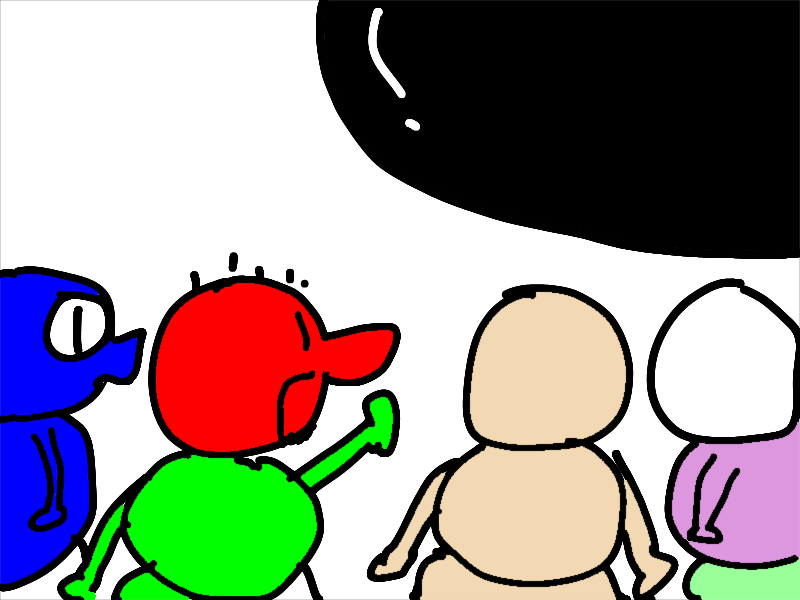
We finished Big Walk this evening. It was excellent! I am going to share some spoilers after the image, so consider yourself warned. If you would like to read something not spoileriffic about Big Walk, may I direct you to the article I wrote about it here? Thank you.
One of the things Big Walk continually impresses on you is the importance of communication, whether that's communicating over short to moderate distances in order to collaborate on puzzles, taking the time to just have a chat, or finding a means to get one another's attention from a long distance apart if you happen to find yourself separated.
I suspect every group will find their own ways of dealing with this particular challenge — and every group will have its own members that, for one reason or another, present additional challenges to everyone, including themselves — but it's something you will likely settle into fairly quickly in collaboration with your walking partners. I'd be interested to try it with other people and see how different the dynamic is between group members and group sizes — though I'm also conscious that once you've solved a lot of these puzzles once, it's a lot easier to play through the game, so I don't know how inherently replayable the whole thing is.
Anyway, the reason I mention this is because towards the end of the game, Big Walk takes away two very important things that you have likely been using for your communication up until this point: your visual identity — in other words, the colours you have chosen to represent your character, which you can "paint" onto each other in the introductory stage of the game — and your voice.
Yes, the finale sequence of Big Walk completely takes away the ability to voice chat with one another, meaning you will have to find ways of communicating not only each participant's part in a puzzle solution, but also determine between you what on Earth you are supposed to do in each puzzle.
Thankfully, Big Walk does have a fairly robust gesturing system that allows you a surprising amount of flexibility in terms of waggling your noodle arms around, but you still have to find a way to agree what each gesture means, having likely not had an opportunity to do so verbally beforehand — unless, of course, you had the foresight to do so "just in case" you were not able to communicate through voice. But why would you need to do that? Taking players' voices away in a game built around cooperative play and communication would just be mean, wouldn't it?
Well, yes, it would, but it also makes Big Walk's finale sequence incredibly memorable. There are, I think, seven puzzles you have to complete in the run up to the actual ending, and each challenges your group to think on their feet and find a way to get various messages across to one another without using words and without being able to visually identify who is whom. It really works extraordinarily well — I won't spoil the actual solutions for the puzzles here, for the sake of anyone who didn't heed my spoiler warning but is still intending to actually play Big Walk, but I'll just say that the "kettle puzzle" was my favourite for how gleefully silly it was.
Anyway, once you finish Big Walk, there is a "postgame" to play, too, which we're probably going to tackle in a subsequent session. There are a lot of puzzles on the map that we didn't solve in our various explorations, and we found a place where you have to put a whopping fifteen of the collectible thingies (we call them "Kongs" after their resemblance to a classic dog toy) in order to do… something? We don't know what yet ,though I have a suspicion. That's a job for another day though.
I'm impressed how substantial the game actually is. It took us three very long sessions to get through the entirety of the "main" game, and there's still a fair bit more for us to do. This is one of numerous reasons why I don't think it fits into the ill-defined "friendslop" category; to me, "friendslop" says games that you play with your friends that are over and done with in one session, and which "don't matter". Not in the sense that they're worthless, but in the sense that they don't have a long-term overarching goal; each session is self-contained, like an individual play of a board game, rather than part of a broader "campaign" in which you're working together to achieve something.
Anyway. I had fun! And aside from one of those finale puzzles, which I found very difficult to get my head around for some reason (as did everyone else, I think) I am relieved that Big Walk, despite whipping much of games media into a similar frenzy as we saw for Blue Prince last year, is a very different sort of experience. And for me, it's nice to actually be able to enjoy an indie darling for once, because on a significant number of past occasions, they have left me cold. This led me to doubt that Big Walk would actually be any good, but I'm glad I decided to give it a try. It was very much worth it.
Now it's nearly 1am and I need to sleep. But that was, indeed, a Big Walk.
Want to read my thoughts on various video games, visual novels and other popular culture things? Stop by MoeGamer.net, my site for all things fun where I am generally a lot more cheerful. And if you fancy watching some vids on classic games, drop by my YouTube channel.
If you want this nonsense in your inbox every day, please feel free to subscribe via email. Your email address won't be used for anything else.
While out on a walk this evening, I was listening to the soundtrack of a game that I really love, played a lot some years ago… and haven't really touched since. That game is A Valley Without Wind.
As my thoughts wandered during my little 2km circuit of the Common, I started to think about why I haven't really played it much since (checks dates on Achievements) 2020? No, I definitely played it well before that. Mid-2010s. They probably added Achievements later after some entitled little prick on Steam got pissy that they couldn't have their meaningless shinies. (checks blog) Ah. 2012. Fuck me.
Anyway, before I got distracted, what was my point? Oh, right, the reason why I haven't played this all that much since 2012… and a brief return in 2020, apparently. I think it's because A Valley Without Wind is one of those games that there is no real "end" to. You have a long-term objective to complete, yes — defeating an Overlord — but once you do that, the game continues. There is a never-ending stream of Overlords to defeat, of gradually increasing difficulty, but, as far as I am aware, no way to "win"; no way to "beat" the game completely.
As time has gone on, for one reason or another, I have drifted away from games like this, and I'm not entirely sure why, because it's certainly not because I don't enjoy them. Over the years, I've had a lot of fun with various types of "freeform" experience, ranging from Starflight on Atari ST through SimCity on SNES, SimCity 2000, SimCopter, The Sims, The Sims 2, The Sims 3 on PC, and, yes, A Valley Without Wind. In fact, I'd go so far as to say I absolutely adored A Valley Without Wind when I first started playing it.
There was just something about it that… resonated with me. It was probably a combination of things: the janky but creative gameplay; the sense of emergent narrative; the chiptune-esque music; the baffling aesthetic which looked like half the team wanted to make an Amiga game and the other half knew what "Super VGA" meant. I played that game a lot when I first got it, although Steam claims I've only played it for 10 hours. I'm pretty sure the bulk of my playtime was before Steam started recording how long you'd played something.
But yeah. I haven't gone back. And I think the reason is that knowledge that it doesn't end. There's no way to "finish" the game, and thus it feels like there's never a good time to start it. This is a silly way to think about it, of course; there are lots of really good games that never end, and if I thought this about all of them, I'd never play any of them!
Weeeelll… I kind of don't. Y'see, I find finishing games enormously satisfying, and I love seeing the variety of different ways that games handle a narrative and/or mechanical finale sequence. Given that my tastes tend to skew towards the narrative-centric RPG end of things, you can see how I might find it tricky to figure out how to fit in a game like A Valley Without Wind. It's easy to fall into a trap of feeling that these games have no "point"; that it's not worth starting them if you can't finish them.
And yet I'm conscious that I'm deliberately depriving myself of things that I know I enjoy. Focusing on one or two "Big Games" at a time is certainly a good way to get through your library and, over the long-term, have a range of experiences that are both broad and deep. But it certainly doesn't hurt to punctuate those Big Games that have a definitive beginning, middle and end with something that just… doesn't end.
I mean, I have no problem spending an evening playing arcade games. Some of those never end. Even the ones that do are built to be replayed. And so why am I holding myself back from playing games that I know I like?
Perhaps I just need to make more time for experiences like this, and stop worrying about whether or not it's ever the "right" time to play something in particular. If I'm in the mood to play something, just play the damn thing!
Aren't brains fun? We're talking about something that is supposed to be relaxing entertainment here, and here I am, agonising and stressing over it. I need to stop doing that and just do what feels right, fun and just plain nice in the moment.
I need to go and have a bath as I'm stinky and sweaty after walking 2km in what turned out to be an incredibly humid evening. But after that, y'know what? I might just fire up A Valley Without Wind for the first time in six years. And realise that I have almost certainly completely forgotten how to play it.
(Aside: you can finish A Valley Without Wind 2, and in many ways it's a better game, with a belter of a theme song. But there's something I've always just really, really liked about the first one.)
Want to read my thoughts on various video games, visual novels and other popular culture things? Stop by MoeGamer.net, my site for all things fun where I am generally a lot more cheerful. And if you fancy watching some vids on classic games, drop by my YouTube channel.
If you want this nonsense in your inbox every day, please feel free to subscribe via email. Your email address won't be used for anything else.
I've been looking forward to a game that released today: Earth Must Die! by Size Five Games, creators of Ben There, Dan That, Lair of the Clockwork God and numerous other excellent games. Today isn't a "review" as such — I'll save some more substantial thoughts on the game for MoeGamer and YouTube once I've finished it — but I did want to pop down some initial thoughts and give a hearty recommend to it. As an indie title, the first few days of sales are critical for visibility on Steam, and this is a game that absolutely deserves to see some success from what I've played so far.
Earth Must Die! casts you in the role of VValak Lizardtongue, third in line to the throne of the planet Tyryth and its empire, the Ascendancy. After tricking his two brothers into murdering one another, VValak ends up in charge, and inadvertently causes the Terranoid forces of Earth to invade. That's as far as I've got, but as the name suggests, one can expect that the remainder of the game will involve VValak finding a way to get revenge on the Terranoids and get his empire back. Or maybe not…?
It's an adventure game, but with a few interesting twists from the usual formula. You have direct control of your character's movement, and interacting with hotspots is done using a cursor that can be popped up. It's clearly designed to be played with a controller and works well like that, but can also be played with WSAD movement controls and a mouse cursor. I think I might have preferred a simple mouse-only interface for its non-controller implementation, but not enough to want to kick off about it or anything.
VValak, as an arrogant (wannabe) tyrant, refuses to touch anything himself because poor people might have touched it before him. Thus you have to solve all the situations in the game without VValak ever getting his own hands dirty. This sometimes involves using his companion robot and former nursemaid, Milky, to perform various actions, and sometimes involves convincing other characters in the scene that they should carry out your orders. It's an interesting mechanic that sidesteps the usual inventory puzzles.
Like I say, I'm not too far in the story as yet so I am hesitant to say too much more in that regard, but one thing I will highlight is the incredible voice cast, which includes numerous big names in British comedy such as Alex Horne, Tamsin Grieg, Matthew Holness, Alasdair Beckett-King, Don Warrington, Mike Wozniak and many more. Plus, of course, Ben Starr is in it, because Ben Starr is the Nolan North of the 2020s (complimentary). That cast might not mean much to anyone who isn't British, but you should know that this is a full-on celebrity cast of comedy royalty, and it's incredible to see them all coming together for a video game.
The net result is that the game sounds like a late-night Channel 4 comedy show (complimentary), and it has some really beautiful animated 2D art to go along with it. It's very much designed along the lines of games like Discworld II, with large, cartoonish sprites and plenty of close-up animations — and much of the humour will be familiar to those who enjoyed Terry Pratchett's work, too.
That's about all I want to say for now. It's an easy recommend if you enjoy silly games that will make you laugh, and is a seriously impressive project from Size Five in terms of scope. I'm looking forward to getting stuck in over the next few days, and, as I say, I will have a full report, likely on MoeGamer and YouTube, once I'm done with it!
Want to read my thoughts on various video games, visual novels and other popular culture things? Stop by MoeGamer.net, my site for all things fun where I am generally a lot more cheerful. And if you fancy watching some vids on classic games, drop by my YouTube channel.
If you want this nonsense in your inbox every day, please feel free to subscribe via email. Your email address won't be used for anything else.
I love point-and-click adventures. Back in the '90s, they were probably my favourite type of game. I devoured everything LucasArts came out with and a lot of stuff Sierra did — though I must confess, there are still a few gaps in my knowledge on the latter front.
LucasArts stuff was just better than Sierra stuff, at least in the early days. Early on, LucasArts' developers decided to take the things that annoyed people about Sierra games — chiefly the ability to die and get yourself into unwinnable situations — and throw them out of the window. Far from removing all challenge from the games as a result, this just made them much more fun to play — although it's interesting to note quite how short a lot of those games are by modern standards.
One thing to remember is that when we were playing stuff like Indiana Jones and the Fate of Atlantis, Internet access wasn't particularly widespread. Hell, GameFAQs wouldn't exist for another few years, even if you could get on the Internet; some resourceful folks were writing walkthroughs and posting them on places like CompuServe's GAMERS forum (a frequent online hangout for myself), but for the most part, when it came to solving a tricky game, you had two options: figure it out yourself, or wait for a magazine to print a walkthrough.
This meant that games that are maybe three or four hours long start to finish could actually take days, weeks or even months to complete. We had a lot more patience for that sort of thing back then — although I do recall finding it quite eye opening when I bought a brand new copy of Full Throttle, played it for two hours with my brother and we rolled credits on it.
Today, point and click adventures are still going strong. Press and public alike have enjoyed saying the genre is "dead" for many years, but in reality it's been nothing of the sort. What changed is the part of the market that point-and-click adventures occupied; while once a Sierra or LucasArts game would be considered a "big release" in a similar fashion to today's triple-A titles, after the turn of the millennium they became more niche interest affairs.
I'm not entirely sure why, either; they hadn't fundamentally changed what they were doing, or their core appeal elements. Although thinking about it, that's probably precisely why they became more niche interest affairs. From the late '90s onwards, the "upper" (for want of a better term) end of the market was going 3D, exclusively. And adventure games, up until this point, had been resolutely 2D affairs, tending to be showcases for beautiful rotoscoped or hand-drawn animation, painted backdrops and suchlike. In the age of PlayStation, that suddenly wasn't fashionable any more for a variety of reasons — and the few attempts to bring point-and-click adventures into the 3D realm had been met with a mixed response.
As with most niche interest things, an enthusiast community developed, with many of them rallying around a piece of software called Adventure Game Studio. Initially DOS-based, this was a tool that allowed anyone with a creative mind and the ability to produce basic graphics to put together a point-and-click adventure. It took effort, mind; this wasn't a "game generator", but a fully featured game engine, suitable for creating point-and-click games similar in style to Sierra, LucasArts and any number of other models.
Remarkably, Adventure Game Studio is still going to this day — and the enthusiast community is still using it. Only now, we see a lot more commercial releases from independent developers. And even more remarkably, the stuff being put out today by small outfits is pretty consistently better than anything from the genre's supposed "golden age" of the mid '90s.
There are more point-and-click adventure games that have been released in the last few years than there ever were back in the '90s. And they're really, really good. For just a few recommendations: the Kathy Rain series is an excellent series of investigative adventures; Old Skies by Wadjet Eye Games is an incredibly thoughtful narrative-centric game with a time travel hook; Lamplight City by Grundislav Games is what happens if you take Gabriel Knight and stick it in a steampunk setting; Brok the InvestiGator by CowCat Games is a brilliant, lengthy animated adventure with optional beat 'em up mechanics.
Even better, these games are a lot longer than their mid '90s counterparts. Old Skies took me a good 12 hours. The two Kathy Rain games are about 8 hours each. I'm 7 hours into Lamplight City so far and on the fourth chapter of five. I'm not sure how long Brok was but I have a feeling it was pushing 20 hours.
"Length of play" isn't the sole metric by which you should measure a game's worth, of course. But what a longer game means in the adventure game space is a more detailed, in-depth story to explore and enjoy. The difference between watching a movie and a whole season of a TV show. Both have their place, of course — I'm not averse to a short adventure game, still, and frequently go back to some '90s faves — but it's always nice when one of these modern games really gives you something to get your teeth into properly.
Best of all, though, is that there's loads of them. The ones I've mentioned above are just scratching the surface. As someone who has always loved this type of game, that excites me. And I've really been enjoying playing Lamplight City of late in particular. More on that over on MoeGamer when I've beaten it, though….
Want to read my thoughts on various video games, visual novels and other popular culture things? Stop by MoeGamer.net, my site for all things fun where I am generally a lot more cheerful. And if you fancy watching some vids on classic games, drop by my YouTube channel.
If you want this nonsense in your inbox every day, please feel free to subscribe via email. Your email address won't be used for anything else.
So Steam announced a bunch of new hardware, and some of it looks quite nice — though the fact that no prices have been mentioned as yet is a bit of a concern.
Of the items that have been announced, I find the "Steam Frame" probably the most interesting. This is a standalone VR headset that can either stream games from another computer, or run games installed on its own storage. It doesn't have to be VR games, either; you can play standard 2D games on a big "virtual screen" in VR.
There are a number of attractive things about this. Firstly is the fact that it looks like being a relatively lightweight, comfortable headset — certainly a far cry from the units of even just a few years ago. Secondly is, of course, the Steam compatibility; by running things from your Steam library just like a Steam Deck (or the newly announced Steam Machine), it has an immediate ready-made library of thousands of games to choose from without having to worry about whether the platform will be supported over the long term. Thirdly is the fact that it's a standalone headset that has nothing to do with Meta — since up until now, your only real option in that regard has been a Quest.
Now, of course, being tied to Valve and Steam has its own concerns. Steam's community features remain a rancid cesspit of the very worst examples of humanity, for example, as discussion forum after discussion forum is overrun by right-wing fuckheads crying about "DEI" and "woke" at the slightest hint of a female character in a leading role. That is something that the company probably should address, but it also feels like it's probably much too late for them to be able to do anything about at this point. We are very much in "lunatics running the asylum" territory at this point, since it's extremely rare anyone from Valve actually steps in to deal with a situation; mostly it's up to developer and publisher community managers to stem the tide of absolute sludge from the dickheads of the Internet — and I absolutely do not blame any of them who simply refuse to engage with a Steam discussion forum on principle.
Then, of course, there's the matter of several of Valve's games encouraging a form of gambling with their lootboxes and tradable items and whatnot. Add the exploitative (and easily exploited) trading card system to the mix and you have a whole mess of ethically questionable stuff going on, because this stuff probably makes Valve a lot of money.
And finally, of course, there's the fact that Steam is the one example of online-centric DRM that everyone has been sort of fine with for a long time. Sure, there are many games that can run without Steam being open, but it can be a bit of a pain to find out which games this applies to, and which require you to have a stable Internet connection. There's no good way to take your games "out" of Steam in the same way that GOG.com provides, either; no making your own physical copies or backups of Steam games.
There's also the fact that Steam was pretty much single-handedly responsible for completely destroying the collectible physical market for PC games — although I will be fair here: if you're going to be gaming on a standalone VR headset you probably don't want to be inserting discs into it while you're trying to get your game on.
I'll be interested to see what people think of these new machines once they're out in the wild. I have no particular need for a Steam Machine, as I have a perfectly competent "living room PC" that can run most games I'm interested in playing on PC rather than console — but, as I say, the Steam Frame is of at least moderate interest to me for gaming purposes. If I do end up getting one, I will almost certainly keep my living room PC up and running as it is, as I don't just game on it; it's also an entertainment centre, my video editing system and where I do just… general computery things. I'm not entirely ready to make the switch to Linux (which SteamOS is a flavour of) as yet, but I suspect that time will come at some point.
Anyway, I'm reserving judgement until I've seen prices and I've heard what people I trust think of these things. But there's definite potential for Valve to have something special here. I certainly think they're well-placed to fill the growing Xbox-shaped hole in the games industry with Microsoft's continual missteps in that regard.
We shall see!
Want to read my thoughts on various video games, visual novels and other popular culture things? Stop by MoeGamer.net, my site for all things fun where I am generally a lot more cheerful. And if you fancy watching some vids on classic games, drop by my YouTube channel.
If you want this nonsense in your inbox every day, please feel free to subscribe via email. Your email address won't be used for anything else.
I've talked a bit recently about how the adventure game genre is probably in a better place than it's ever been — in fact, I think I'd even argue that now, it's better off than it was in its supposed heyday of LucasArts and Sierra in the early '90s.
The reason is games like Wadjet Eye's Old Skies, which I've played a good four hours of this evening. This is a masterfully put together adventure game in terms of involvement, emotional engagement and just being a plain compelling interactive narrative. While there are some who have criticised it for not having interesting "mechanics" — by that, what they really mean is that it doesn't have any puzzles they got stuck on — I think there's a strong argument to be made that the genre has moved beyond the necessity for being overtly and deliberately obtuse for the sake of inflating playtime.
Y'see, while Sierra and, to a lesser extent, LucasArts games put in deliberately complicated and sometimes baffling puzzles as a means of hiding the fact that their total runtimes were, in many cases, only one or two hours at most, today's adventure game developers have the resources, budget and ability to put together games that are much longer. As such, there's no real need for these games to artificially inflate their length through obtuse puzzles, because the core of what they offer — their narrative, and the player's involvement in it — is compelling enough to stand on its own merits.
This is definitely the case for Old Skies, which has a thoroughly interesting and enjoyable premise. You take on the role of Fia Quinn, a time-travelling agent who accompanies clients on recreational jaunts to the past in order to ensure that they don't get up to mischief or cause any paradoxes that are too significant. The nature of time travel means that there will always be a certain amount of impact on the future, reflected in the game world by flashes of purple light that signal a "Chrono-Shift", where something notable changes in the "present" due to interference in the past, but the Earth depicted in Old Skies also has sufficient technology to "Chrono-Lock" anything that is particularly important, protecting it from such instances.
Each main chapter of Old Skies focuses on one of Fia's jaunts to the past with her client. The first is a relatively short trip back to the New York of 2024 as a renowned scientist hopes to resolve some lingering regrets. Things… do not go entirely according to plan, setting what one would anticipate to be a template for the rest of the game. But interestingly, the second immediately subverts that expectation by being much longer, more involved and more complex, both mechanically and narratively. In this chapter, set in the "Gilded Age" of the late 19th Century, something still goes "wrong", but in an entirely different way, forcing both Fia and her client to work through a complex series of events in two closely related time periods (six months apart) in order to set things what is, to their best interpretation, "right".
The whole thing raises some interesting questions about the very ethics of something like time travel. How do you ensure someone's selfish actions don't make a real mess for everyone in the future? How, exactly, do you police such things? Who decides who and what is "important" to the coherence of the overall timeline — and how? Why were they given that opportunity?
I'm looking forward to seeing how the story evolves, and it also appears that this game is going to be pretty substantial by adventure game standards. At four hours to complete the first two chapters, and I believe at least seven in total, this is looking like a fairly beefy adventure, though its chapter-based structure also means that it feels nicely episodic, so you can leave it at a natural break and come back to it another day.
Thus far, I haven't really seen the problem that some reviewers argue is the game's "weak mechanics"; the game doesn't rely much on using inventory items on things in the game world to progress, but instead prompts you to think carefully about the pieces of information you gather, how they relate to one another and, in some cases, how closely related time periods might relate to one another, too. There are some particularly clever sequences in the second chapter, requiring you to jump back and forth to revisit the same locations six months apart and manipulate the information you find in order to secure an advantageous outcome for everyone involved… as much as is possible, given your own interference, anyway.
The game is beautifully presented, with some absolutely stellar voice acting and music, and some really nice animation on the main characters. It's also nice to see an adventure game breaking free from the seeming "obligation" that some developers feel to use '90s-style pixel art; Old Skies instead adopts a true high-definition look that feels like a true successor to the brief period of "Super VGA" adventures during the winding-down of the Sierra and LucasArts "golden age".
Anyway, I'm sure I'll have more to say in the coming days/weeks as I work my way through it on evenings where I feel like something a little more chilled out than Donkey Kong Bananza. In the meantime, if you're a point-and-click type, I can highly and confidently recommend Old Skies; it's another fantastic game from Wadjet Eye (developed by them this time, as opposed to the numerous other titles they've published in recent years) and well worth the £17 it costs. Take that, £75 video games!
Want to read my thoughts on various video games, visual novels and other popular culture things? Stop by MoeGamer.net, my site for all things fun where I am generally a lot more cheerful. And if you fancy watching some vids on classic games, drop by my YouTube channel.
If you want this nonsense in your inbox every day, please feel free to subscribe via email. Your email address won't be used for anything else.
I've spent the evening playing Kathy Rain 2: Soothsayer. I played Kathy Rain: Director's Cut a few years back and apparently didn't write about it, but suffice to say I enjoyed it. As such, I was excited to see the sequel show up a few days back — one of several interesting-looking adventure games that have released recently.
I've played about 4 hours of it this evening and I'm not sure how far through I am — most estimates seem to place it around 7 hours in total — so I'm not going to give any conclusive thoughts just yet. I'll save those for MoeGamer and/or YouTube another time. I can give some first impressions, though, and those first impressions are very good indeed.
Like its predecessor, Kathy Rain 2: Soothsayer is a point-and-click adventure presented in deliberately low resolution pixel art, albeit making use of modern widescreen resolutions and colour depth to provide a level of detail that wouldn't quite have been possible back in the classic VGA age. It is, I believe, an Adventure Game Studio affair, which accounts for its interface being rather similar to The Excavation of Hob's Barrow, another excellent modern adventure I played a little while back. That's no bad thing, though; Adventure Game Studio is a well-respected engine, used by a lot of modern adventure developers with good reason.
As with most modern adventure games, interactions in Kathy Rain 2: Soothsayer are kept nicely simple. Click on things to either look at them or do something with them, click on inventory items to examine them, drag inventory items onto items in the scene or other inventory items to use them on things. Conversations unfold using a Gabriel Knight-style keyword system, where Kathy accumulates (and erases) keywords over the course of her investigation and can ask interactive characters about them, along with also being able to ask them about things in the scene or her inventory. It's a simple but effective conversation system that works well, and there are occasional traditional dialogue options that appear when Kathy has multiple things to ask about a situation.
Kathy's case this time around is that of a serial killer known as the Soothsayer. This individual has committed five murders over the course of the last few months, with the most recent being a local celebrity writer. As a rather down-on-her-luck private investigator, Kathy sees the $200,000 reward money and decides she'd like a bit of that action, so she proceeds to go about her investigation in her own mildly anarchic style. I say "mildly" because while she flouts a few rules and laws over the course of her investigation, she does draw the line at doing anything likely to get her thrown in prison — or, indeed, lose the confidence of her contact in the police force, who, as you might expect, is a helpful resource to draw upon, particularly as he very much wants to get into Kathy's pants.
Thus far in the 4 hours of play, I haven't felt like I've got "stuck" at all, which is good — and the game has kept up a decent pace as a result. The puzzles, while not super-easy, won't take long to solve for experienced adventure game veterans, but they are nonetheless satisfying. There's no moon logic on display here; everything makes logical sense, and those who really struggle can check out Kathy's notebook to get some hints on the objectives she needs to accomplish. The presence of the notebook and a list of objectives in the first place is a helpful addition not normally present in this type of game; it helps keep you focused without spoiling the sense of player agency or working things out for yourself.
I remember the original Kathy Rain getting a bit weird towards the end — and I didn't have a problem with that, I hasten to add — and I have a suspicion something similar is probably going to happen in this one, too. The "weird bit" of the first Kathy Rain led to some eye-opening revelations about the character, so I will be very surprised if something similar doesn't occur this time around, too. But we'll have to see, I guess.
Thus far, then, I've been thoroughly absorbed by this new investigation. The game looks great, has a wonderfully atmospheric soundtrack and decent voice acting, and it plays very well, too. Plus at what looks like it will be 7-10 hours in total, it's a decent length for this type of game, too — particularly when you consider most of the "golden age" adventures from Sierra and LucasArts could be beaten within an hour or two (or even less, in some cases) if you knew what you were doing.
I'm looking forward to seeing how things end up. At this rate, it's looking like I might beat it tomorrow. I will definitely pen some more substantial thoughts for MoeGamer and/or my YouTube channel when I've finished the whole thing. For now, though, it's an easy recommend for adventure game enthusiasts.
Want to read my thoughts on various video games, visual novels and other popular culture things? Stop by MoeGamer.net, my site for all things fun where I am generally a lot more cheerful. And if you fancy watching some vids on classic games, drop by my YouTube channel.
If you want this nonsense in your inbox every day, please feel free to subscribe via email. Your email address won't be used for anything else.
After seeing the glowing praise it's been getting recently, I decided to give the new indie darling Blue Prince a go. I've been suspicious of sudden indie darlings ever since I absolutely detested my time with Jonathan Blow's Braid, but everything I was hearing about this one made it sound thoroughly interesting. As such, I was more than happy to forego my usual suspicion and give it a go.
For the unfamiliar, Blue Prince positions you in the role of an heir to a rather curious mansion. Said mansion supposedly has 45 rooms… except it doesn't, and there's actually a super-secret hidden 46th room somewhere. Your dead uncle has challenged you from beyond the grave to find said 46th room. Succeed, and you inherit all his stuff; fail, and you're doomed to perpetual roguelike hell.
Yes, Blue Prince is a roguelike of sorts in that it's based around repeated runs of the same thing with a heavily randomised element. But it's not a combat-based game, nor a role-playing game; instead, its focus is purely on exploration. While the roguelike descriptor is apt, Blue Prince is perhaps better thought of as being akin to tabletop games such as Betrayal at House on the Hill.
The way it works is like this: each in-game day, you begin a new run with 50 "steps" of stamina available to you. Each time you cross the threshold from one room to another, whether you're making progress or backtracking, you use up a step. Your initial aim is to make it from the entrance hall in "rank 1" of the mansion to the antechamber in "rank 9"; things get a little more complex later, but I haven't got that far yet, so I can't talk about that side of things with any great authority as yet.
Each time you open a door in the mansion, you pull three room "cards" from the deck you have available and can pick one to draft. This room then attaches to the door you just opened, and you gradually build out the mansion map from there. Rooms are automatically oriented based on the direction the door you opened is facing, and in this way you can plan out your route to a certain extent; as time goes on, you'll familiarise yourself with the "deck" of room cards and know which ones work better where. For example, you might want to find a means of safely ditching "dead end" rooms as soon as possible so they don't come up later in your run, but various rooms have special effects (both positive and negative), too, so you'll need to bear those in mind.
As you progress through the mansion, you'll acquire various resources. Keys are used to open locked doors. Gems are used to draft certain particularly powerful or helpful rooms. Coins are used to purchase items in special "shop" rooms. Dice allow you to redraw three room cards if none of the ones you initially drew tickle your fancy. And then there are a variety of items that show up along the way, too; for example, the metal detector makes it easier for you to locate keys and coins, while the shovel allows you to dig in patches of dirt to find additional resources and items.
You'll run into puzzles of various types in the mansion. These appear to take two basic forms: firstly, there are self-contained puzzles that always show up in specific rooms, and these usually reward you with resources or items if you solve them correctly. Secondly, there's the overall meta-progression puzzles, which involve you figuring out the somewhat convoluted means through which you can actually move forward and, once you reach it, get into the Antechamber.
Blue Prince does have a few things that carry over from run to run, but the main thing is knowledge. Information you learn in one run can be used in the next; there's no not being able to do something because your character hasn't seen a particular piece of info in this particular run. As such, it pays to take notes and/or screenshots as you play, because as you discover new pieces of information, you'll eventually find a use for it. It might not be right away, but you'll get there in the end.
The game also isn't completely randomised. As previously noted, you can learn the deck so you can have a good idea of what rooms you should burn early on in order to draw more helpful ones as you get deeper into the mansion. Certain rooms will only show up in certain positions on the map, or display particular scenery elements if positioned in the right place. A "coat check" room allows you to stash an item in one run and pick it up in the next; under normal circumstances, you lose everything at the start of each new day, aside from the knowledge you, the player, have accumulated.
I've played for about three or four hours tonight and I'm starting to get a feel for it. It's a really interesting game. Some folks claim to have spent upwards of a hundred hours playing this and this intrigues me; the central gameplay mechanic is intriguing and enjoyable, but I am very much under the impression that "winning" the central challenge is just the beginning of what makes Blue Prince so interesting. Right now, everyone is being deliberately obtuse about things — partly at the developer's request, and partly just not to spoil it for everyone else — but I am definitely intrigued to see where things go.
My only concern is that I fear I may be too stupid to figure this game out by myself. But that's what talking about it with friends online is for, right?
Want to read my thoughts on various video games, visual novels and other popular culture things? Stop by MoeGamer.net, my site for all things fun where I am generally a lot more cheerful. And if you fancy watching some vids on classic games, drop by my YouTube channel.
If you want this nonsense in your inbox every day, please feel free to subscribe via email. Your email address won't be used for anything else.
I saw an interesting bit of discussion over on Bluesky earlier, and thought it might make for a blog post worth pondering, so here we are. The subject is video game modding, a matter for which I have feelings that are probably best described as "complicated" and "somewhat nuanced". I appreciate that these descriptors are generally best avoided on the Internet at large, but this is my blog, so I do what I want with it.
Anyway, the discussion stemmed from this post by John Linneman of Digital Foundry, quoting another user with whom he had been having a discussion about the raytraced modified version of Half-Life 2 which has been doing the rounds recently.
I was a little surprised and intrigued by this response amounting to insinuating that mods are bad, basically. It’s basically the foundation of PC gaming. What do ya’ll think? Do they have a point or do you disagree?
"Fumseck"'s argument was that RTX-ifying Half-Life 2 was compromising the creators' original artistic vision for the game by adding technology to it that wasn't possible on its original release, and adding in things like lighting effects that weren't present in the game's original incarnation.
Half-Life 2 is actually a rather complicated situation to ponder with regard to mods, because the game (or at least the Source engine) was built very much with modding in mind, and Half-Life 2 developer Valve have themselves gone back multiple times over the years to completely rebuild Half-Life 2 with more up-to-date features and tech. So surely RTX-ifying it is just a natural progression from this?
Thing is, I see Fumseck's argument. Not necessarily for Half-Life 2, which was already a game whose visuals were taking aim for something approaching "realism", and thus raytracing is a natural inclusion. But definitely for other games.
For example, a little while back, this video did the rounds:
It's about a modified version of Doom II which has raytracing. Now this, I'd argue, is a step too far for my personal tastes, because while the raytraced version of Doom II does indeed look very lovely and atmospheric and all that… it doesn't look like Doom II any more. It looks like a modern game that is inspired by Doom II and deliberately using features such as sprite-based enemies and items as a means of paying homage to Doom II. But it doesn't look or feel like Doom II.
In adding the raytracing, the modders have made it look nicer, but I feel they've compromised the distinctive look and feel of Doom II. Doom II was built with the technological limitations of the era in mind, and as such, everything it does, it does for a valid artistic reason. If you eliminate some of those limitations, you fundamentally change the way the game's aesthetic is designed, and that's when you're stepping into "compromising the artistic vision" territory, so far as I'm concerned. Half-Life 2, meanwhile, already had dynamic lighting and HDR; adding raytracing atop that is a natural fit because it doesn't fundamentally change the way Half-Life 2 looks.
Same with Minecraft. I actually rather like the way raytraced Minecraft looks, but I also feel playing it like that is compromising the artistic style of the game. Minecraft was very deliberately designed to look like an old game, but combine those aged aesthetics with things that wouldn't have been possible on older tech, such as its vast world, its completely destructible landscape and the player's ability to build anything, anywhere.
So I think when it comes to visual mods, my attitude is "if visual mods are enhancing what the game is already clearly trying to do, they're maybe fine, so long as they don't overdo it; if visual mods are fundamentally altering the core aesthetic and stylistic choices of the game, I don't like them."
So that's one aspect of modding covered. But modding is much more complicated than that. And, as a result, so are my feelings towards it.
As I've already noted, I'm fine with games that are built with modding in mind from the outset. My earliest contact with these was way back in the Atari 8-bit era, when numerous games shipped with a "Construction Set" or similar on disk, or sometimes available as a separate purchase. Mr Robot and His Robot Factory. Dandy. Boulder Dash. All these games, and numerous others, were designed in a way that they could be modular: the artistry was mostly in the combination of the game's aesthetics and the way its mechanics worked — though of course, some praise should be given to the built-in level designs, too. Just because you have access to the Boulder Dash Construction Set doesn't mean you can immediately make a good Boulder Dash level, after all.
A game that is built in this way can, in theory, be enjoyed indefinitely, because once you've mastered the built-in levels, you can make some new ones, or you can swap your creations with friends. With games like this, I do find myself thinking "well, I don't really want to be playing this game forever", but that's entirely a "me" problem; the way I play games is that I like to focus on one "big project" at a time, and if that "big project" turns out to be something that just has no end, I often end up not even starting it in the first place.
Looking further forward, games with modding support have always been a thing. It was easy to replace the map and graphics files in Wolfenstein 3-D, for example, though I don't think id Software themselves necessarily expected the modding scene to take off for that as much as they did. Hell, even I made two hundred dollars by making Wolfenstein levels!
They paid attention, though, and both Doom and Quake (and their numerous spinoffs and sequels) were very much built with modding in mind. Quake even gave direct access to the game's core mechanics and logic through its "Quake C" programming language, allowing you to completely change the fundamental way the game worked — see mods like Quake Rally, Quess and AirQuake.
The explicit, developer-approved "Construction Set" being a thing is somewhat rarer these days, but it still exists. Bethesda games often ship with creator tools of some description, for example, and the Neverwinter Nights series set the benchmark for role-playing games with user-generated material, so far as I'm concerned. Then of course there's games where "creation" is a core part of the overall package right from the outset, like the TrackMania series.
Of course, all these things are very much a PC thing for the most part; while I'm not sure I'd go as far as Linneman's point that they are a foundational aspect of gaming on PC, it's rare to see console players have the opportunity to tinker with their favourite games. Modding does happen, of course, but it's a much more niche interest thing when it comes to console games. And I don't think that's necessarily a bad thing.
Because here's what I think my fundamental feelings about modding are: Not every game needs to have mod support. Not every game needs to be modded. And if a game "needs" mods to be worth playing, it probably wasn't very good in the first place.
I'm fine with folks making new levels for Doom, Quake and their successors (and rereleases!). I'm fine with folks making new quests, characters, monsters, dungeons and whatnot for Bethesda games. I'm definitely fine with people making TrackMania tracks, Neverwinter Nights campaigns and Mr. Robot and His Robot Factory levels. (Although my digital Atari 8-bit library wishes some groups would maybe cool it a bit on the Boulder Dash levels.)
What I'm not fine with is people booting up something like UFO 50 and immediately thinking "wow, this needs mods", which I saw in the discussion pages around its launch. No. Absolutely not. That is an example of a game that has a very specific reason for existence, and that is as an interactive, creative work of art. Not only does modding it show the height of ungrateful entitlement — it implies it "doesn't have enough content", when it has 50 full games in it — it also completely compromises the whole reason for its existence. Modding something like UFO 50 is defacing it, vandalising it, so far as I'm concerned, and not something I'm okay with, regardless of what platform it's on.
Likewise, I'm not really OK with things like character mods for games. Sure, it can sometimes be funny to see a different character running around in a game they're not supposed to be in, or see a character running around with no clothes on or whatever, but for me, again, that's compromising the artistic vision of the work, defacing and vandalising it, for no real good reason other than "because I can" and "this is mine now, I can do what I want with it".
And sure, you can do whatever you want with the games you have. There are bajillions of excellent custom levels for Doom and Quake out there, amazing new cars and circuits for BeamNG.drive, wonderful new aircraft for Microsoft Flight Simulator, lots of amazing things. And if you want to make all the characters in a game you like naked, there's nothing I can do to stop you.
There's plenty of really interesting things being done in the fan translation and ROM hacking communities, too. But those are a bit different, I think. Fan translation in particular isn't about defacing someone else's work; it's about making it more accessible. ROM hacking is not an area I'm particularly interested in, but in most cases those projects are presented as their own self-contained things — whole new games built on the core of something that exists, rather than "hehe, I modded Super Mario World so his willy is out all the time". They're creative projects perhaps best looked on as something akin to using an off-the-shelf engine to build your game.
But I'm pretty steadfast in the beliefs I outlined above: not every game needs to have mod support, not every game needs to be modded, and if you recommend I install 300 mods before even starting to play a certain game, I'm probably… not going to play that game.
While PC is the platform on which modding is easiest and most widespread, I don't think modding is (or should be) a fundamental aspect of PC gaming for everyone.
For some, it is, and that's great; for many, a passion for modding has led to a career in game design and development.
But there are plenty of us with bulging Steam libraries that we have no intention of fucking with the contents of, and I think that's also a perfectly valid, acceptable viewpoint to have. I also think that certain games are sacrosanct, for which modding is simply defacement and vandalism; that's the part I suspect to get the most pushback on, but it's the core of my beliefs on this subject.
It's a topic for which you have to take things on a case-by-case basis, and for which I suspect most people will have their own nuanced viewpoints. To be clear, if you're someone who enjoys nude mods and breaking things like UFO 50, I'm not saying you shouldn't do that; I'm simply saying I don't like it personally, and I won't get involved with it. Ultimately I don't give a shit what you are doing with the games you've purchased, so long as you're not fucking with the games I've purchased, or telling me that I'm "wrong" or "missing out" for enjoying them as the creators originally designed them.
Want to read my thoughts on various video games, visual novels and other popular culture things? Stop by MoeGamer.net, my site for all things fun where I am generally a lot more cheerful. And if you fancy watching some vids on classic games, drop by my YouTube channel.
If you want this nonsense in your inbox every day, please feel free to subscribe via email. Your email address won't be used for anything else.