#oneaday Day 470: Time travel

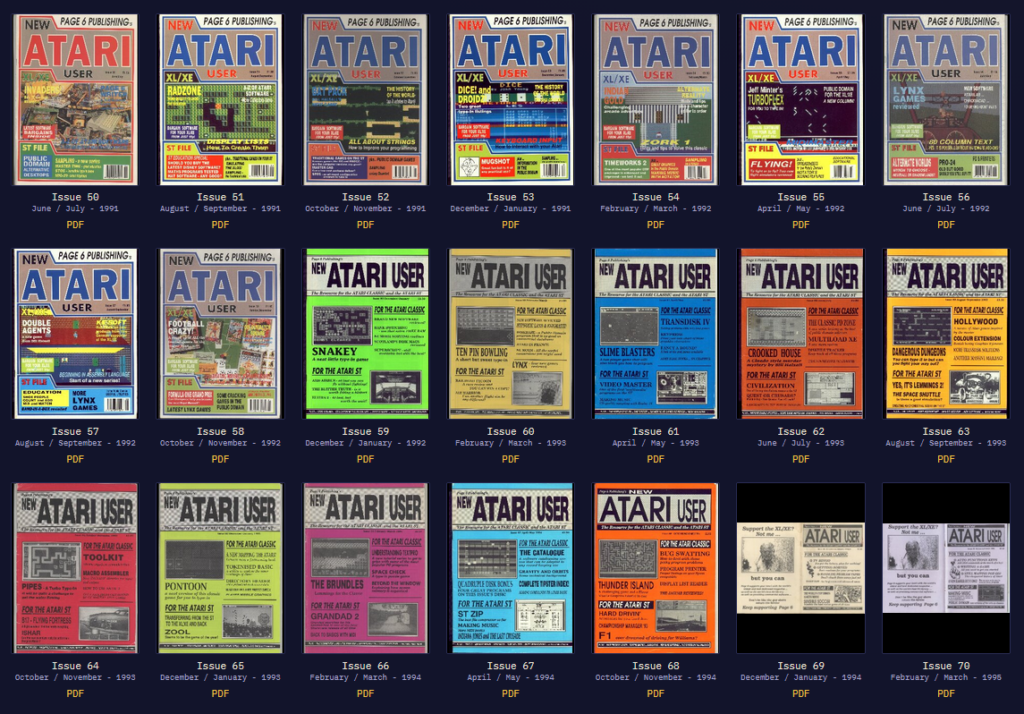
I like reading old magazines. I always have done, ever since I was a child — and in fact, the "old magazines" I read today are pretty much the same old magazines I read when I was a child: that is to say, old issues of Page 6 and Atari User, with an occasional PC Zone or Official Nintendo Magazine from the mid to late '90s.

Part of this is down to the family connection: my Dad, my brother and I all contributed to Page 6, so it will always be important to me. None of us wrote for Atari User, but as the only other magazine devoted to Atari 8-bits around at the time, we bought pretty much every issue. Likewise, my brother worked on PC Zone for quite some time in the mid to late '90s — I even went and did my Year 10 work experience with him — and I did a few freelance gigs for the Official Nintendo Magazine during my latter days of Sixth Form and early days of university.

I don't just re-read these magazines because I'm proud of the people involved, mind. I read them because while I'm reading them, for a brief moment, I have escaped 2025, and I have travelled back in time to when they were current. I've caught myself numerous times genuinely thinking that I wanted to order something from one of the companies advertising in the magazines, before remembering that they almost certainly do not exist any more, particularly in the case of those supporting the Atari 8-bit computers.

But it's nice. While I was a bit young to be involved in things like user groups, computer clubs and (let's be honest here) piracy exchanges back when these magazines were current, reading them, even now, makes me almost feel like I'm there. It almost makes me feel like I can reach out and touch the past — and find great happiness there.

This is the root of nostalgia, of course, and some would argue it's not necessarily a healthy thing to fall into the habit of. But to that I say pish, pfaugh and all manner of other Victorian expectorations, because 2025 sucks balls, and any escape from it is welcome — particularly if it can be achieved through a means as simple as opening an old magazine and reading Garry Francis ranting about Scott Adams adventures, or Patrick McCarthy writing an entire preview in "Franglais", or even the odious "street talk" house style that was used at the Official Nintendo Magazine at the time I was doing occasional freelance work for them.

Many of the people involved in these things have moved on to better things in later years. In the case of the early Atari magazines, some of them may not even be with us any more. I wonder how many of them, penning their lines for the latest print deadline, would know that their words would carry great comfort and meaning for someone — even if it's just me, and no-one else gives a shit any more — so many years later?

A few articles in some magazines might seem like a small legacy to leave, but it is a legacy nonetheless. I wonder if, many years from now, someone might find something I've written and draw some comfort from it? If that's you, I pre-emptively appreciate your time and attention, and I hope the future doesn't suck quite as bad as our current present.


Want to read my thoughts on various video games, visual novels and other popular culture things? Stop by MoeGamer.net, my site for all things fun where I am generally a lot more cheerful. And if you fancy watching some vids on classic games, drop by my YouTube channel.

If you want this nonsense in your inbox every day, please feel free to subscribe via email. Your email address won't be used for anything else.
#oneaday Day 296: Hefty project

I put together a new video this weekend. Just the one, because it turned out being quite a beefy one to put together, but hopefully you will appreciate the effort once it's live, which will probably be tomorrow.

Inspired by the recent launch of the Fun Factor Podcast, I thought it was high time I got back to my retrospective look back over the issues of Page 6/New Atari User magazine that I started a while back, but only got around to doing two issues of. The reason I've been putting off doing any more may well already be self-evident: each "episode" of this takes quite a bit of time and effort to put together!

I mean, to my satisfaction, anyway. I could just turn the camera on, rabbit on about what's in the magazine and leave it at that. But one thing I like about doing these videos — and the bit that's particularly time-consuming — is that I can supplement the magazine's contents with actual footage of the things that are being discussed, whether those are programming techniques or the latest games. Getting together all that footage as well as recording the actual run-through of the magazine takes quite a bit of time all together — but the end result is worth it. I like these videos.

If you haven't seen the previous ones, by the way, may I present them below. Here's a look at the very first issue of Page 6, including the back story of where it came from and what it means to me:

And here's a look at the second issue, in which we observe the rise of a mostly forgotten piece of '80s slang: the adjective "keen" to mean "cheap" or "eminently reasonable", which I had never come across before. Well, I mean, I had, because I'd read this issue before, but somehow it had never struck me as odd:

As I note in the videos, these old magazines are of tremendous importance to me, and I'm happy to have the opportunity to be able to share them with everyone through the medium of video. The ability to splice in footage of the stuff being talked about allows you to get some context that you might not have had just reading the magazine back in the day, and this is a part of retro gaming culture that I'm always happy to celebrate in one form or another.

The new episode is uploading and processing right now, so it should be live on YouTube tomorrow as soon as I've done a thumbnail and all the other gubbins for it. Watch out for it then — stop by my channel and subscribe if you haven't already. Go on. You know you want to.


Want to read my thoughts on various video games, visual novels and other popular culture things? Stop by MoeGamer.net, my site for all things fun where I am generally a lot more cheerful. And if you fancy watching some vids on classic games, drop by my YouTube channel.

If you want this nonsense in your inbox every day, please feel free to subscribe via email. Your email address won't be used for anything else.

#oneaday Day 289: Some games magazines I used to like

I love old games magazines, and will frequently re-read them years after they were relevant. In fact, I'm currently in the process of assembling a collection to bung on an SD card and pop in my otherwise unused Kindle Fire 7 to use as a portable retro magazine library. I've also got a vague plan to make some more videos on classic magazines, as I really enjoyed making the first two on Page 6 magazine — you can watch those here (issue 1) and here (issue 2).

In the absence of anything else to write about — I've been playing Xenoblade Chronicles X for most of the weekend, and I already wrote about that earlier — I thought I'd give a rundown of some magazines I used to like, and which I may well take some time to cover on YouTube at some point.

Note: I say "magazines I used to like"; most of them are magazines I knew someone who worked on, usually my brother. I make no apologies for this.

Page 6/New Atari User

This is the one I bring up most commonly on my channel, and for good reason: three members of my family (my Dad, my brother and me) were involved in it at various points, and it's the magazine that launched the career of my brother — a career that, with him being a big bossman at IGN now, he's still in.

Page 6, as it was initially known, started life as a user group newsletter. Within one issue, the editor Les Ellingham had decided that he wanted to fulfil a grander ambition: to publish the UK's first Atari-specific magazine. And he only went and did it. For an astronomical amount of time, considering the subject matter, too; Page 6 ran in one form or another from December of 1982 until the autumn of 1998, and it was still covering the Atari 8-bit in its very last issue.

Page 6 was an enthusiasts' magazine. It wasn't a games magazine; Les in particular was keen to stress from the outset that while computers were excellent games machines, there was also a ton more you could do with them. And part of the point of the magazine was to educate people on the possibilities their computers offered. It achieved that through articles about software releases (including both games and "serious" software), interviews, tutorials, type-in listings and plenty more.

It was always a pleasure to read. One gets the impression that it was a real labour of love for Les in particular, and there are plenty of occasions where his editorial page came across as very frustrated that other people didn't seem to care quite as much as he did — but I cared. I still do care. Page 6 was a formative part of my youth, and revisiting old issues today, I still feel a lot of the same magic I felt in the early days of computing.

Read them all at Atarimania.

Atari User

Showing up a little later, Atari User from Database Publications (later Europress) launched in 1985 and ran until November 1988, at which point Page 6 acquired the rights to the Atari User name and rebranded as New Atari User. Page 6 was still on the newsstands at that point, and it was thought that the Atari User name would attract more casual interest, since "Page 6" is a nerdy reference to an area of the Atari 8-bit's memory that only people already well-versed in the system's "culture" would understand.

At heart, Atari User was a similar sort of magazine to Page 6, covering both games and "serious" applications, perhaps with a slightly greater focus on things that, if not games, were at least entertainment of a sort. Like Page 6, there were a variety of features each issue, including type-in listings, and often some interesting-looking "Gadgets" sections for electronics projects you could do with your Atari. I never tried any of them — I was a bit young — but they always looked interesting.

I enjoyed reading both Page 6 and New Atari User because they each had a very different style to them. Page 6 always felt like it took itself very seriously, with a fairly no-nonsense, stern, professional-looking layout in each issue — not to say that individual articles lacked personality and humour, mind; I'm talking purely aesthetically — while Atari User made use of the bigger budget it had thanks to being part of a larger corporation by producing colourful issues with large, attractive pieces of artwork and photography throughout. I was sad when Atari User went under, as it was one of those magazines that it was just fun to look at thanks to its colourful cover art.

Read them all at Atarimania.

Antic and ANALOG

Antic, subtitled The Atari Resource, was one of two Atari-specific magazines from the States, with ANALOG (short for Atari Newsletter And Lots of Games) being the other. You could get them both relatively easily in this country via specialist importers. Antic and ANALOG were both, like Page 6 and Atari User, magazines that revelled in the joy of home computer ownership. Part of that was gaming, yes, but it was also about programming, productivity and creativity.

I actually haven't revisited Antic and ANALOG for many years and I think I'm long overdue to, as I remember enjoying them both. I do remember Antic having noticeably thicker issues, while ANALOG became renowned for its excellent machine language type-in listings. So they're both going on my portable magazine library, assuming it works as I hope it does.

Read Antic and ANALOG at Atarimania.

Games-X

Page 6 was where my brother got started writing about games, but it was Games-X that truly launched his career properly; he left home to work on it, and it ended up being the beginning of a whole life in the games press.

Games-X was unusual: it was a weekly games magazine (a decision which founder Hugh Gollner later described as "a big mistake" financially), and most other magazines at the time were monthly. Page 6 was bi-monthly (as in, every two months, not twice a month). This naturally allowed it to be a lot more "up to date" with gaming news than many other magazines, but it was also fun to be able to buy a new games magazine every week, initially for just 60p an issue.

Games-X covered that strange period late in the ST and Amiga's lifespan when consoles were just starting to really get a foothold in the UK. The majority of the focus in each issue was on home computer games, but there was a dedicated console section — and the next magazine my brother worked on after Games-X was Mega Drive Advanced Gaming.

Games-X had a fun, irreverent attitude to it and, in many ways, was very "'90s", with everything that entails. I still really like it, though, and think it stands out as a magazine that deserves to be remembered a bit more than it is.

Read them all at RetroCDN.

Advanced Computer Entertainment (ACE)

I don't think I actually had many issues of this, but I enjoyed every one of them a great deal. Advanced Computer Entertainment, or more commonly just ACE, was a multi-format magazine that one gets the impression liked to think it was a cut above the other games magazines around at the time. It was still about video games, sure, but it lacked some of the '90s abrasiveness of other publications, and took things a bit more "seriously", for want of a better word. One might call it the Edge of its day, only marginally less pretentious. (And yes, I checked; Edge launched in 1993, while ACE folded in 1992.)

That is, after they got over an initial rocky patch where there were more errors in the early issues of ACE than I think I've ever seen in any other magazine. Typos, mistakes, outright blank sections of pages — they had it all. But once it settled down, it was a very high quality magazine that I always enjoyed. The magazine was noteworthy for its "Pink Pages" section in the rear, a no-nonsense "reference" guide to new releases, charts and review summaries, plus a bizarre "Stock Market" section that never really made much sense, but I believe it was an early attempt to try and aggregate review scores for various developers and publishers, if I remember rightly.

I rather liked that ACE took things seriously. The silly humour of other magazines could be entertaining, to be sure, but it was nice to be able to read a magazine about games that was just… about games, rather than about its writers trying to launch a comedy career. As with Page 6, that's not to say that individual articles and writers lacked personality or a sense of humour; it's just that humour wasn't the main point, whereas with some other magazines around at the time, particularly once we moved into the 1990s, it felt like they were trying to be a funny magazine first, about video games second.

Read them all at Atarimania.

PC Zone

Now, this may make me sound a bit like a hypocrite after what I literally just said, but I always enjoyed PC Zone, even before my brother's time there as editor and publisher. PC Zone in its prime always felt like it struck a good balance between humour and information, and I loved it for that. It acknowledged that games were fun, silly and often stupid, but also recognised that people were passionate about them — sometimes to a fault.

PC Zone is also noteworthy in retrospect for being an early outlet for Charlie Brooker, and his articles were always a highlight, as were his eminently silly The Cybertwats cartoon strips, which got the magazine a bunch of complaints on multiple occasions, particularly after he depicted Lara Croft machine-gunning someone's cat to a particularly violent and bloody demise.

When people talk about old magazines being fun, I think of PC Zone. While in retrospect some of it may have been a bit "lads mag"-ish (see: front cover depicted above), it never really felt particularly exclusionary. Plus I spent two weeks doing work experience in their offices and, although I didn't really do much other than make a lot of cups of coffee and tea (and write a review of Virtua Fighter PC) that fortnight remains one of the happiest of my life.

Read them all at Pix's Origin Adventures.


And there's more I could be going on with, but I think that's probably plenty for now. If you're a retro computer and gaming enthusiast, you could do far worse than familiarise yourself with the above publications. And the links I've provided will let you do just that.

Note: I will not be held responsible for anyone complaining at you suddenly taking a lot longer in the toilet.


Want to read my thoughts on various video games, visual novels and other popular culture things? Stop by MoeGamer.net, my site for all things fun where I am generally a lot more cheerful. And if you fancy watching some vids on classic games, drop by my YouTube channel.

If you want this nonsense in your inbox every day, please feel free to subscribe via email. Your email address won't be used for anything else.

2424: This Month in Old Gaming Magazines, 1988 Edition

0424_001

Since I've spent the last two days downloading approximately 40GB of old magazine scans comprising near-complete collections of ACE, Atari User, Page 6, Antic and Analog, I thought I'd look back at a few of them to see what was going on this month in the dim and distant past.

Chosen entirely arbitrarily by seeing which issue of ACE had "September" on it first, I thought we'd have a look at 1988 today.

"Games Without Frontiers", ACE issue 12

"Once upon a time it was just you against the Galaxians," writes Andy Wilton in issue 12 of ACE. "But revolutions in communications technology are going to bring about tremendous changes in the way we play — and who we play against."

This should be interesting.

The article begins with a discussion of PBM (Play-By-Mail) games — as in, games you played through the postal service — which, as ridiculous as it sounds today, was once a viable means of playing multiplayer games. Obviously this style of multiplayer lends itself primarily to turn-based strategy experiences, and indeed the first example Wilton mentions is legendarily cynical backstab-o-rama Diplomacy.

Wilton's designs for PBM are somewhat grander, though; he goes on to conjecture that "if the Royal Mail lets you run a game that's inconveniently large for a living room, why not set up a game you couldn't possibly fit in a house?" Why indeed.

Wilton then goes on to discuss play-by-email games; indeed, this remained a viable way to play games as modern as Civilization IV until relatively recently, since the format of the email messages could be made in such a way that the computer program could decode it without any external input required. Clever, but largely irrelevant to today's constantly connected world.

"Far more exciting things are afoot than postal or pseudo-postal games," continues Wilton. "For some time now there's been the technology to get a whole load of people playing the same computer game by means of networking." He then goes on to describe what we now know as server-based play, or taken to its natural extension, massively multiplayer online games. He does not, however, predict that one day we will have network setups specifically for games, or indeed the Internet: "for a networked game to really catch on," he writes, "the network it runs on must already be in use for other purposes. Hardware's the important factor here: setting up several machines, close together, connected with special cables, is a lot more effort than most people will go to for a game."

Interestingly, Wilton then goes on to discuss distributed processing — the kind of thing Microsoft promised with its "Xbox Cloud" nonsense and has never quite managed to show any real evidence of. While there are noteworthy examples of distributed processing being successful — Folding@Home is a well-known example — it's yet to be leveraged for gaming.

The article then concludes with the conjecture that the new frontier in multiplayer gaming will be using satellites. Well, plausible — a number of Japanese companies in particular experimented with satellite distribution of games — but again, it never really caught on, because the Internet became a thing.

An interesting article through modern eyes.

"Very Clever System", Atari User Vol. 4 No. 5

Two issues before it was consumed by its longtime rival Page 6Atari User took the bizarre step of kicking off a series of deep-dive articles exploring not the Atari 8-Bit, nor the Atari ST… but the by then 9-year old VCS/2600 console.

Actually, it's not quite as unusual as you might think; the 2600 actually enjoyed a lifespan that the PS3 and Xbox 360 would be proud of; indeed, article author Neil Fawcett notes that an estimated one million 2600 systems were sold in 1987, with more than a hundred thousand of those in the UK.

Fawcett kicks off his article with an examination of how the 2600 differs from the Atari 8-Bit range of home computers. In other words, he defines what a games console is.

"It's basically a dedicated box of electronics to be attached to your television to play games plugged into it," he writes. "You can't attach a disc drive or tape deck, nor can you type in the listings which appear in Atari User."

On that latter point, one interesting thing about the computer magazines of the time was that in lieu of the downloadable demos or cover-mounted discs we take for granted these days, many magazines simply filled their paged with program listings that you could copy into your computer, save to floppy disk or tape and then run at your leisure. Free software — if you were willing to put the time in to type them in, of course. (Side note: I attribute my speed and accuracy of typing today to the sheer number of these listings I typed in as a kid.)

A little disappointingly, Fawcett's article doesn't delve deep into how the 2600 itself works, though he does include an annotated diagram of its guts, for all the good that does to someone who doesn't know how electronics work. Instead, he reviews both old and then-new 2600 titles, in this case California Games from Epyx ("nice graphics and neat sound effects add a wonderful feeling of reality to each game"), Ghostbusters from Activision ("considering the 2600 is only a games system, the standard of Ghostbusters is superb"), Kung Fu Master from Activision ("The 2600 version may not be as graphically good as the arcade version, but it has the atmosphere and playability of the original") and H.E.R.O. from, again, Activision ("the best conversion of a home computer game I have seen for the VCS").

"Adventure!", Page 6 issue 34

Page 6 often had themed issues or at the very least cover features, and this edition was very much focused on adventure games — the kind we now tend to describe as "interactive fiction" rather than the more recognisable point and click adventures we see more of today.

There were several type-in listings of adventure games in the issue, but the real attraction for adventure game fans was the in-depth interview with Level 9, a British software company that specialised in these games.

When I say in-depth, I mean it; the interview goes on for seven full pages with very few images; a far cry from the obnoxious "too long; didn't read" mentality of many modern readers.

Level 9's Pete Austin described his company's formation as being born from a love of Dungeons & Dragons. "The form of D&D that we played is very unlike that played elsewhere," he admits. "We played political D&D where, frankly, if you had to fight your way out of a situation then you had done something wrong. The basic idea was to bluff and blackmail people in the game and use political intrigue and spy techniques, that sort of thing." It's clear to see how this approach to tabletop gaming would naturally transplant itself to creating narrative-centric, text-heavy experiences that were entirely turn-based.

The interview goes on to describe how the team at Level 9 went on to produce their own programming language called A-Code to create their games, in effect creating one of the earliest examples of a game engine, albeit a text-based one. It also describes how Level 9 had people asking for clue sheets for their games even before they were released, showing that even back in 1988, some people still wanted to get through games by fair means or foul. This is perhaps more understandable for narrative-based games such as text adventures, however.

CES '88, Analog no. 64

In his editorial introducing the September 1988 issue of American Atari magazine Analog, Lee Pappas notes that his 14th Consumer Electronics Show (CES — a show that still goes on today) was one of mixed emotions, in that he had "nothing to report on the 8-bit news front".

Instead, what he discovered was a world where "the big names in software now read Nintendo or Nintendo compatible. Even Apple Mac and PC supporters were missing."

The trouble Atari was having at the time was that its peculiar computer-console hybrid the XE Game System didn't really know what it wanted to be, and being based on already dated technology — the 16-bit computers such as the Amiga and the ST were already available by this time — it struggled to secure releases that were 1) technically impressive and 2) good.

"Most of the games are starving for state-of-the-art graphics and just don't have the imagination that is clearly evident in the Nintendo and newer Sega products," writes Pappas. "Face it, the Nintendo and Sega don't have keyboards. In the Nintendo's case the unit is plain and boring in appearance and the controls are simple. What those have, however, are spectacular, well-thought-out programs, many of which go far beyond the shoot 'em up concept."

True indeed. And while the Atari 8-Bit computers certainly weren't short of imaginative titles in their heyday, by this point we were well into the age of consoles — an age that we would never look back from, with one exception; PC games eventually found a way to thrive alongside their console brethren. But the dedicated, proprietary-format computer was well on the way out.

2422: A Different Time

0422_001

I've been doing some retro gaming stuff recently which involved trawling the AtariAge and AtariMania forums for information, and as it happened, one game I was looking for information about — the rather peculiar Pondering About Max's [sic] — linked to a scan of an old edition of New Atari User magazine, the very publication that I, my brother and my father all used to contribute to.

I spent quite a while distracted by the format of the magazine, because it's a relic of a very different time indeed. New Atari User — or its former incarnation Page 6 — wasn't a games magazine per se, though coverage of the latest video game releases on Atari 8-Bit and ST formed a core part of each issue. What I found much more interesting was the inclusion of other features. I was well familiar with the Making Music with Your Atari column that my Dad used to write, as I think our whole family remembers numerous MIDI incarnations of various '60s and '70s classics blaring out from the studio at all hours of the day — but I was surprised to see quite how… specialist some of the other articles were.

Take the issue I was looking at earlier, for example. There's a three-page feature in this issue about maths. Just maths, and how to make use of it in Atari BASIC. The article begins with an exploration of the use of the RND function in BASIC, which generates a random number between 0 and 1, expands on this by describing how using multiplication allows you to generate random numbers between 0 and much higher upper limits, and concludes by using the INT function to generate only whole numbers. This is stuff that most bedroom programmers were already familiar with, but the article then goes on to look at powers and roots, signs and absolute values, logarithms and exponentials and finally probabilities — each of which was punctuated with a short BASIC listing for you to type in on your own computer to see how the functions worked in practice. I've never seen anything quite like it.

Elsewhere in the same issue there's four pages devoted to making the Atari 8-bit display an 80-column text screen — this was deemed exciting enough to get a mention on the front cover of the magazine, which is unthinkable these days — an in-depth exploration of the AtariLab computer-aided scientific experimentation kits, and plenty of other things besides. It really is a fascinating relic of a period in computer media that I thought I remembered pretty well, but evidently have forgotten more than a few things about over the years. Looking back on it now… I miss those times a lot.

If you want to enjoy a bit of nostalgia — or are just curious what computer and games mags used to look like back in the early days — then AtariMania has a substantial collection of scans that you can enjoy right here.