#oneaday Day 813: That sure was a big walk

We finished Big Walk this evening. It was excellent! I am going to share some spoilers after the image, so consider yourself warned. If you would like to read something not spoileriffic about Big Walk, may I direct you to the article I wrote about it here? Thank you.
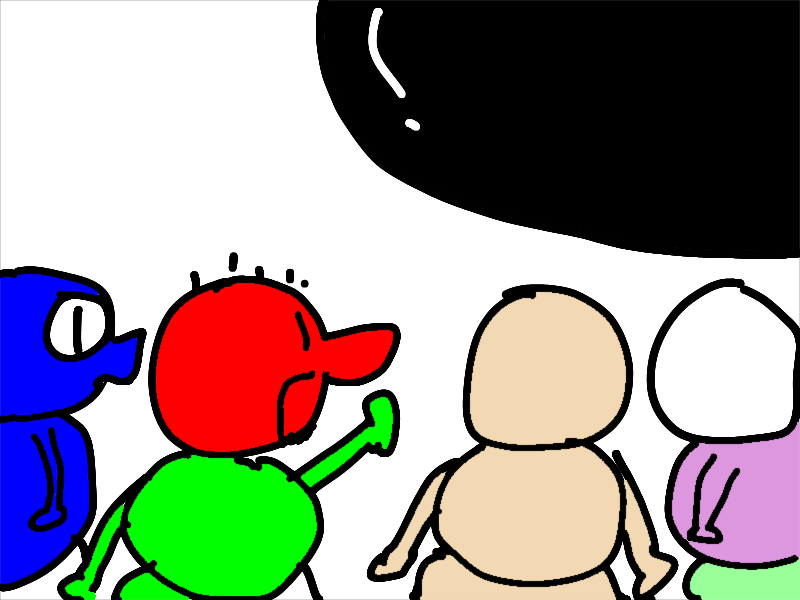
One of the things Big Walk continually impresses on you is the importance of communication, whether that's communicating over short to moderate distances in order to collaborate on puzzles, taking the time to just have a chat, or finding a means to get one another's attention from a long distance apart if you happen to find yourself separated.

I suspect every group will find their own ways of dealing with this particular challenge — and every group will have its own members that, for one reason or another, present additional challenges to everyone, including themselves — but it's something you will likely settle into fairly quickly in collaboration with your walking partners. I'd be interested to try it with other people and see how different the dynamic is between group members and group sizes — though I'm also conscious that once you've solved a lot of these puzzles once, it's a lot easier to play through the game, so I don't know how inherently replayable the whole thing is.

Anyway, the reason I mention this is because towards the end of the game, Big Walk takes away two very important things that you have likely been using for your communication up until this point: your visual identity — in other words, the colours you have chosen to represent your character, which you can "paint" onto each other in the introductory stage of the game — and your voice.

Yes, the finale sequence of Big Walk completely takes away the ability to voice chat with one another, meaning you will have to find ways of communicating not only each participant's part in a puzzle solution, but also determine between you what on Earth you are supposed to do in each puzzle.

Thankfully, Big Walk does have a fairly robust gesturing system that allows you a surprising amount of flexibility in terms of waggling your noodle arms around, but you still have to find a way to agree what each gesture means, having likely not had an opportunity to do so verbally beforehand — unless, of course, you had the foresight to do so "just in case" you were not able to communicate through voice. But why would you need to do that? Taking players' voices away in a game built around cooperative play and communication would just be mean, wouldn't it?

Well, yes, it would, but it also makes Big Walk's finale sequence incredibly memorable. There are, I think, seven puzzles you have to complete in the run up to the actual ending, and each challenges your group to think on their feet and find a way to get various messages across to one another without using words and without being able to visually identify who is whom. It really works extraordinarily well — I won't spoil the actual solutions for the puzzles here, for the sake of anyone who didn't heed my spoiler warning but is still intending to actually play Big Walk, but I'll just say that the "kettle puzzle" was my favourite for how gleefully silly it was.

Anyway, once you finish Big Walk, there is a "postgame" to play, too, which we're probably going to tackle in a subsequent session. There are a lot of puzzles on the map that we didn't solve in our various explorations, and we found a place where you have to put a whopping fifteen of the collectible thingies (we call them "Kongs" after their resemblance to a classic dog toy) in order to do… something? We don't know what yet ,though I have a suspicion. That's a job for another day though.

I'm impressed how substantial the game actually is. It took us three very long sessions to get through the entirety of the "main" game, and there's still a fair bit more for us to do. This is one of numerous reasons why I don't think it fits into the ill-defined "friendslop" category; to me, "friendslop" says games that you play with your friends that are over and done with in one session, and which "don't matter". Not in the sense that they're worthless, but in the sense that they don't have a long-term overarching goal; each session is self-contained, like an individual play of a board game, rather than part of a broader "campaign" in which you're working together to achieve something.

Anyway. I had fun! And aside from one of those finale puzzles, which I found very difficult to get my head around for some reason (as did everyone else, I think) I am relieved that Big Walk, despite whipping much of games media into a similar frenzy as we saw for Blue Prince last year, is a very different sort of experience. And for me, it's nice to actually be able to enjoy an indie darling for once, because on a significant number of past occasions, they have left me cold. This led me to doubt that Big Walk would actually be any good, but I'm glad I decided to give it a try. It was very much worth it.

Now it's nearly 1am and I need to sleep. But that was, indeed, a Big Walk.


Want to read my thoughts on various video games, visual novels and other popular culture things? Stop by MoeGamer.net, my site for all things fun where I am generally a lot more cheerful. And if you fancy watching some vids on classic games, drop by my YouTube channel.

If you want this nonsense in your inbox every day, please feel free to subscribe via email. Your email address won't be used for anything else.
1606: A Little Pleasantness Goes a Long Way

I partied up with, I think, the absolute worst party I have ever played with in Final Fantasy XIV earlier — skills-wise, I mean; there wasn't much in the way of ego on display, thankfully — but despite this, it was actually pretty fun.

I was running Haukke Manor's normal mode as part of the daily "Low-Level Roulette" system, whereby you're randomly thrown into one of the pre-level 50 dungeons with three random strangers and, depending on whether you're still earning experience points or at endgame, earn big bonuses that are of benefit to you regardless of what level you actually are. There's also an "Adventurer in Need" bonus for classes there are a shortage of at any given time — given that there's about 4,500 gil on offer for jumping in to the requested class, it's worth doing if you have the classes available.

Anyway, jump in as a healer (the Adventurer in Need) I did, and Haukke Manor began. It quickly became apparent that the tank, a level 28 Gladiator who hadn't yet upgraded to the advanced job Paladin, hadn't been there before, as there were enemies that he didn't know to watch out for. He was also being very cautious, taking great care to mark enemies with thoroughness — an admirable enough trait, but he didn't need to be quite so thorough — and taking his time working his way through.

I snuck a peek at his gear and some of his equipment was a little low-level for the dungeon we were challenging — a fact further emphasised by the fact that I, the healer in the party (typically the "weakest" player in terms of attack and defense power) had more hit points than him. Still, we pressed on, and as the healer I made sure he didn't die as much as I possibly could.

I noticed after a little while that he didn't appear to be using the skill Shield Lob, a useful trick in the Gladiator/Paladin's arsenal and the typical way most battles begin. The Gladiator/Paladin flings their shield at an enemy, which attracts their attention onto the Gladiator/Paladin, and starts the fight off right, with the enemy in question attacking the tank. This is then, usually, followed up by a couple of Flashes, which attract the attention of nearby enemies. Once this is done, the enemies' attention is usually pretty firmly on the tank, which then allows everyone else to go hog wild killing them.

Our tank in this group wasn't using Shield Lob because he didn't have it. He was level 28; you get Shield Lob at level 15 by completing the appropriate Gladiator class quest at that point, meaning he hadn't done that. To be fair to him, the first time I tried tanking in a dungeon I forgot to pick up Shield Lob first, but that was a little different in that I was still level 15 at the time. Tanky boy here was nearly double that level, and still didn't have it. Whoops.

When you spot something like this happening in an MMO, you're always faced with a choice. Do you press on and hope the rest of the group is strong enough to make up for the weak link's shortcomings? Or do you quietly slip away, leaving them to fend for themselves? Being an altogether decent sort of person, I chose to stick around and offer the struggling tank some helpful, non-aggressive advice. (One of my partymates was less understanding, his only utterances throughout the whole dungeon being "lol", "omfg" and "wtf". Great communication there, chap.) As a result, we eventually — very carefully — managed to make it through the entire dungeon intact. I was genuinely pleased to see the tank make it through in one piece and pick up some good new equipment along the way, and I hope he felt the same way.

I can't entirely blame the "lol omfg wtf" guy for his attitude, because it's easy to get into that mindset when you've been playing for a while. It's easy to assume that everyone is as skilled at the game as you are, and that everyone has the same knowledge of the game's mechanics and systems as you are. This is what leads to feelings of anxiety about living up to people's expectations — feelings that even people like me, who have been playing for hundreds of hours by now, still feel regularly.

The reality is, in fact, somewhat different. People make mistakes. Some people don't know the game well. Some people might not even really know what "tanking" actually is, thinking the "dude with sword and shield" character class is more of a hack-and-slash affair rather than the important defensive role they play. Some people might not know that you have to do your class quests every 5 levels to get all your abilities — though to be fair, the game is pretty explicit about this at the outset.

In a game like Final Fantasy XIV, it's everyone's responsibility to help make the game a pleasant, friendly place for everyone to enjoy. It's everyone's responsibility to help out those who are struggling, or who don't understand. It's easy to laugh and point fingers at "noobs" or "bads", but it's much more beneficial in the long run to help educate them so they know how to play the game better.

After all, what's better: people leaving the game in droves because of elitist attitudes, or the gradual growth of the available base of players who understand the game mechanics and are able to take on its toughest challenges? It's not a stumper, really, is it?

#oneaday, Day 140: Being An Asshole

Every time there is a "new advance" in AI for video games, the first question a lot of people ask is "how human is it?" How does it compare to playing against a real, actual, human person? A gaming-related Turing Test, if you will. And the answer is always "it's not very human". There's one reason for this – computers can't be assholes.

I was playing Blur multiplayer tonight and the one thing that struck me is how much of an asshole players online can be. That's not a criticism, by the way. In fact, the sheer assholeness of a lot of online Blur players makes multiplayer races a pretty thrilling experience. And the AI players in the single-player, while frustrating, aren't assholes. They never drop a mine directly behind a powerup so you grab the powerup and then explode. They never use a Barge to knock you off a cliff. They never swerve into you at the start line and bash you into a wall. They never wait until the home straight to launch a mine right up your arse and sail past in the last half-a-second of the race. They never park sideways across a narrow bit of track just to get in the way.

This sort of creative sadism which online Blur players have developed is what makes the multiplayer so much more appealing than the single-player mode. It's really interesting to see the tactics that people have obviously developed independently without any prompting from the game. The "trapping a powerup" thing, for example. The AI players never do that. It's never suggested you do it in the loading-screen tips. But it's, when you think about it, a smart idea. Everyone is clamouring for powerups throughout every race. So why not make the more desirable ones rather more difficult to get?

This is a different sort of assholeness to the kind of 13-year-olds who scream racist, homophobic abuse down their headsets during games of Modern Warfare 2 (which they shouldn't be playing anyway, but of course, that's another conversation) – this is a stubborn, passionate desire to win at any cost bar cheating, rather than a stubborn, passionate desire to be a dick. And it's fun. You can't help getting involved. Watch other people playing Blur and all you want to do is out-asshole them. Get someone with a carefully-placed mine, or accurately slam a backward-fired Shunt into their face while they're slipstreaming you and it's immensely satisfying.

In fact, Blur as a whole is set up for being an asshole. Take the social gaming features I discussed the other day. What possible reason could there be for posting information about how well you're doing other than to make other people think "I need to take that asshole down a peg or two"?

The reason, of course, that AI in single-player games being a perfectly accurate representation of a human is not necessarily a desirable thing is this: sometimes we like to win. And if you're playing against 19 other assholes, most of whom are more of an asshole than you, very often you don't win. That's all very well, and competitive and so on… but if you're playing by yourself, you want to win, don't you? So that's why I can say with some confidence that I really, really hope AI doesn't ever improve to a level where it's indistinguishable from a human. Because I like to beat it sometimes. And I've played over 60 online races in Blur now… and won two of them!