I read a good thread on Bluesky earlier. It ties in with something I've talked about before, but it bears repeating. It concerns matters of community management, and how a proactive approach that might, in the short-term, be perceived as "negative" is actually for the best in the long run. If you want to read the thread in question, here's the link.
The poster, "The Wyzard", posits a "10-1 rule", which is to say "every (1) shithead you don't ban costs you ten (10) other customers". They admit that the maths is not exact by the very nature of it being an abstract concept that one cannot truly represent mathematically, but I can see figures along those lines being very plausible.
The theory runs that if you have one person stinking up the joint — whether literally through their personal hygiene, or metaphorically through their behaviour — then while they might be a loyal customer, they will actively repulse other customers. And the number of customers they will repulse is more than the one, single person that they are, making them a net negative for your community.
Back when I was running Rice Digital, I ran into an issue with a persistent commenter who, during the site's time without much moderation going on in the comments section, had come to think of it as his own personal place to spew hatred and bigotry. Because I had taken over the site and the login details to be able to moderate the comments had gone astray several editor-in-chiefs ago, I took the executive decision to nuke the entire comments section from orbit and start afresh.
The commenter in question was not happy, because he believed he had ownership of this vitriol he had continually spewed on the site (including, among other things, stating that a particular TV show had "ruined lesbians for him" because the lesbians in question were not what he considered to be attractive), and it had not occurred to him that a website that does not belong to him, and which he doesn't pay anything for, does not owe him a damned thing.
The metaphor I used at the time was that of a clubhouse. When you run any sort of community, be it online or offline, whatever form it takes, you are effectively carving out a space that is for the use and enjoyment of that community, but which is ultimately the responsibility of someone. Picture, for example, a gaming club, where people come along to meet friends and play games together in a space specially designed for that. Sounds great, right?
Now imagine that every week you show up to that gaming club, there's some asshole whose table talk consists entirely of how much he hates trans people, what he's wanked over this week and why he thinks anyone trying to stop him talking about these things in spaces that might be occupied by people who do not want to hear those things is engaging in "censorship".
After a while, you wouldn't want to go along to that club any more, right? You'd come to dread the experience of this jackass stinking up the joint with his rancid opinions, so you'd find an alternative place to see your friends — or, worst case, just stop seeing them altogether. A net loss for you, your friends and the club in general.
Now imagine that this jackass is kicked out of the club after just one session of him spewing his odious rhetoric. While the initial reaction, particularly if the kicking-out is public, might be shock and even fear from certain members — "what if we get turned on next?" and all that — the long-term effect is that normal, well-adjusted people will feel safer and more comfortable coming along to that clubhouse and doing the things they enjoy. They will not need to abandon something they enjoy doing for the sake of one asshole.
It's the same with online communities. The longer you tolerate someone acting like a shithead as part of a community like that, the more annoyed other people will become, to such a degree that they will eventually leave your community, even if they otherwise like what you are doing. That's counter-productive, because all you will be left with is a single shithead who hates trans people (it's always trans people) and no actual community. And at that point you might as well give up, because I'm sure we've all had the experience where you've ended up being the last person in a room with the one individual no-one wants to be left alone with.
Anyway, I know I've talked about this stuff not long ago, but the thread linked above made me want to talk about it again. If you're someone who finds yourself in a position of responsibility for maintaining a community — whether it's something as small and simple as a comments section for your own stuff, or as large as the social media presence for a Brand™ — I would encourage you to bear that "10-1 rule" in mind. The 10 will thank you, even if the 1 doesn't.
Want to read my thoughts on various video games, visual novels and other popular culture things? Stop by MoeGamer.net, my site for all things fun where I am generally a lot more cheerful. And if you fancy watching some vids on classic games, drop by my YouTube channel.
If you want this nonsense in your inbox every day, please feel free to subscribe via email. Your email address won't be used for anything else.
I missed yesterday, but in my defence I also wrote over 2,000 words about EXPELLED!, so it's not as if I didn't write anything. I just forgot to write anything here before I went to bed. Oh well, not the first time it's happened and it almost certainly won't be the last time, either.
Anyway, today I thought I'd write something about a blog post I read yesterday from Norm of My Bad Take Space. The thrust of Norm's piece is that blogs played an important role in the development of the Internet, and their apparent decline is a significant loss for self-expression, because social media just isn't the same. Blogs are useful not only for connecting to other people, but also for connecting with oneself. I, as is probably abundantly clear already if you've spent any time over here whatsoever, agree heartily with this assessment.
One of the things that pisses me off about supposed modern "best practice" on the Internet is the assumption that people won't read anything too long, won't watch anything too long and don't have the attention span to devote to one thing for more than about 30 seconds at most. It pisses me off not because it's true, which it, regrettably, is, but because this is a problem entirely of our own creation. We spent so long assuming that this is how people behave that we normalised it. And now we're stuck in a rut where the only (supposedly) palatable content for people to consume is short, snappy videos of someone yelling at the camera.
Except… no. I cannot be the only person out there who detests attention-deficit content culture. I really like it when I discover something interesting and thoughtful to read online — like Norm's blog, for example — and I find myself getting annoyed when I read a piece from a news site and it just sort of seems to fizzle out before it gets to any sort of point, which seems to be an increasingly common occurrence these days.
There is a place for this sort of thing, and the apparent popularity of things like Ed Zitron's Where's Your Ed At?newsletter/blog on the shittiness of modern tech and the "rot economy" gives me a certain amount of hope, but it's still not quite where we were. We're not quite back to a point where someone can just start a blog, use it to post their long-form thoughts about life, the universe and everything, and people will read it. If you start a "newsletter" these days, it needs to be about something.
Now, I've said numerous times before that this blog isn't here for any reason other than because I like writing on it; it's certainly not here as an engagement farm or a means of earning ad revenue. (You will, hopefully, notice that there are no ads.) But I still find it a little strange to consider that a few years back (probably closer to a decade at this point, upsettingly) I was getting maybe three figures' worth of visitors a day here, while today I'm lucky to break 10.
While I don't really care about the figures, what that lack of views means is that this blog doesn't act very well as a means of starting conversations any more. When I was getting a couple of hundred people a day visiting, chances are that at least one of those viewers (many of whom were regulars) would read what I'd written and have something to say about it, and from there we could have a nice little chat in the comments.
Alternatively, someone I know enough to have on an instant messaging service might pop up and say "hey man, I read your blog, let's talk about that". That doesn't really happen any more, outside of a few notable occasions. And even in the case of that link, that really only got people talking because I made a specific effort to get it in front of certain people that I actually wanted to read it.
To put it another way, while this blog remains great for connecting with myself, the connecting with others part has become significantly more challenging.
I don't really know what can be done about this, if anything. One of the things I used to like about writing this blog… well, no. One of the things I still do like writing about this blog is expressing things that I find difficult or outright impossible to say "out loud" to someone's face. The "expressing myself" part hasn't changed, but with the lack of readers, those things that I confess or express simply aren't getting to the eyes of the people I might actually want to confess or express those things to, thereby making the whole thing a little less useful as a means of communication than it used to be.
But times change, I guess, and I just haven't kept up with them. And I don't really have any desire to. I find TikTok and YouTube Shorts distasteful, distracting and uncomfortable to watch, and feel actively repulsed any time I see a vertical video thumbnail that is just someone with their nose pressed up against their phone camera yelling something. That's not how I want to express myself, and I don't feel that we should abandon an entire medium such as long-form writing just because something else is popular.
When I trained to be a teacher, one of the things that was impressed on us repeatedly was the fact that different people learn in different ways. Some folks learn visually, by looking at things. Some folks learn aurally, by having things told to them. Some folks learn kinaesthetically, by doing things. And some folks learn best when given a book and told to study it themselves. The same is completely true for communication and self-expression. While some folks doubtless think the short-form video revolution is the best thing ever for their personal preferred form of self-expression, those of us who, like me, have always preferred writing our thoughts down in long form are left a bit out in the cold. The two (along with any other forms of communication and self-expression) should be able to coexist and thrive, and it's frustrating that they don't.
I don't know what else I can really do at this point, honestly, other than continuing to write here because I still find it valuable to do so, and perhaps sharing what I've written on the one form of social media I actually use a little bit: Bluesky.
Anyway, that's that for today. I'm off to go have a nice relaxing weekend, and hopefully remember to write something for "today" a little later! Have a pleasant Saturday.
Want to read my thoughts on various video games, visual novels and other popular culture things? Stop by MoeGamer.net, my site for all things fun where I am generally a lot more cheerful. And if you fancy watching some vids on classic games, drop by my YouTube channel.
If you want this nonsense in your inbox every day, please feel free to subscribe via email. Your email address won't be used for anything else.
Likely to be a long one today, and I'm not entirely sure exactly what I want to say, nor exactly how to say it, but I ask you to indulge me, whether you're a regular reader, someone who stumbled across this page, or someone I specifically pointed in the direction of this post.
I'm just going to start typing and see where things go from there.
This is something I've been meaning to write for some time, but have never really known exactly how to write it. It's probably going to be difficult to write, it's probably going to be difficult contemplating the possible reactions to it, and I honestly don't know if it's a good idea to even write it at all in the first place. But having had… Feelings festering inside me for probably the best part of a decade and some change at this point, I think it's time I got at least some of them down on paper.
I was inspired to write this by Chris "Papapishu" Person's excellent post over on Aftermath, I'm Only Here Because I Was A Forum Poster, in which he contemplates how, in the mid 2000s, he found a community of like-minded folks on the forums for 1up.com, and that, via a somewhat roundabout route, resulted in him being a professional games journalist, initially for Kotaku and subsequently for Aftermath.
Pishu isn't the only person for whom this is true. I can probably attribute my current position indirectly to those days back on the 1up.com forums, and Jeff Grubb and Mike "Tolkoto" Minotti of Giant Bomb, both specifically namechecked in Pishu's piece, almost certainly have their own similar stories. Those heady pre-social media days on 1up.com were, it's fair to say, a real high point for online socialisation for me and for many others, and I feel like things have only gotten worse since the collapse of that site and its consequences: the community scattering to the four winds, never really settling down and calling one place "home" ever again.
I first came to 1up.com because of the family connection. My brother, John Davison, helped to launch the site, and was also working on Electronic Gaming Monthly and the Official U.S. PlayStation Magazine at the time. 1up.com was a bold new experiment in online video game-related media: its social features were, at the time, pretty revolutionary, allowing any of its users to start a blog, create a club with its own private message board, and post on the forums. The site still had professional staff, of course, and for many folks the various 1up.com podcasts by that staff were a real highlight of the site. But for me, the thing that made me happier more than anything was the sense of community it had at its peak.
As someone who is what I now understand to be autistic, finding a community of like-minded nerds online was an absolute lifeline. Finally, I had a place where I could well and truly be myself, among "my people". And it didn't take long for me to find a niche within a niche: nerds who enjoyed video games, and who enjoyed talking about them at great length, in great detail, and with a mind to proper in-depth critical analysis rather than just flame wars or quickly writing things off because they didn't score over 80% in a review.
If you look back over the past entries of this blog, you'll see frequent references to "The Squadron of Shame". This was a loose conglomerate of 1up.com members who came together after a discussion on the 1up Yours podcast about "The Pile of Shame": what today tends to be referred to as "the backlog". The pile of games that you've bought, but haven't gotten around to. The games you always meant to play, but haven't. The games that don't get the time of day in reviews, but which you always thought looked interesting.
Fun fact: the first video I ever posted on YouTube was a hacked-together "trailer" for the games we'd covered up until that point.
1up Yours was initially intending to pick a game from the hosts' respective Piles of Shame, play it as a group, then discuss it the following episode, book club style. They didn't really manage to do that — and this isn't a criticism or admonishment of them, as they were all busy people — but a group of us on the forums thought that it was a really good idea… so we did it instead, beginning with the game the 1up Yours crew intended to cover: Psychonauts.
Squad "Missions", as they were known, took the form of a forum thread, in which the person proposing the "mission" would outline the reasons they thought the game in question was noteworthy and why they thought it could do with some in-depth discussion. These initial posts were often long and in-depth in their own right, and they set a good tone for the subsequent discussion: Squad threads became notorious as being wordy, but no-one gave us grief for it, and we often got a shout-out on 1up Yours for successfully picking up and running with the otherwise aborted concept.
One day, something terrible happened on those forums, and I'm not entirely sure why. Where there once had been a selection of subforums specific to particular types of discussion — including individual platforms, plus a special forum for the "1up Radio" podcasts, which is where the Squad threads resided — there were now just two forums: "Games" and "Not Games". Presumably this was done in an attempt to make moderation easier, but it was the beginning of the end for 1up.com's community.
The first Squad thread we posted under this new layout (in "Games") was immediately trolled by someone, clearly unfamiliar with how we had done things on the 1up Radio boards, complaining about a "massive fucking wall of text", and things derailed quickly from there. It was abundantly clear, both from this forum upheaval and various other behind-the-scenes happenings at 1up.com, that the writing was on the wall for this community, and so we started looking into alternative approaches. (1up.com actually hobbled along until 2013, but most of the community and staff left long before that.)
Many of us settled on the fledgling Twitter as a means of interacting with one another, but one of the most important things we did was organise a podcast. This would take the place of our megathreads on the 1up.com boards, and allow a rotating group of us — with several regulars — to discuss the games in-depth, in person, for as long as we wanted. Although severely lacking in confidence to speak up when surrounded by people I always felt were probably a lot more clever and articulate than I was, I quickly developed a reputation among the group as The Guy Who Was Good At Editing The Podcast, so my seat in pretty much every episode was all but assured, and I made a (now-defunct, and apparently non-archived) website that left a written record of all the podcast episodes and the things we discussed. (The episodes themselves, thankfully, survived — you can find them all on my Soundcloud.)
For a while, things went well, and friendships solidified. I even made the trip across the pond to visit various other members of the Squad (who were mostly North America-based) on multiple occasions, and we played host to some Squaddies on at least one occasion that I recall.
We changed the format in which we discussed things several times over the podcast's complete run, shifting from the "book club" format to focusing on a particular topic and bringing our own examples to the table. Things were good, for a while. Then we stumbled across Katawa Shoujo, a visual novel about a boy with a heart condition and how he came to love a group of girls with disabilities that he came into contact with when they all attended the same special school.
Katawa Shoujo was — is — a thoroughly interesting cultural artifact, if you're unfamiliar. It stems from the work of an independent Japanese artist named RAITA (if I remember correctly), who sketched some girls who had various forms of physical disabilities. Various members of the notorious imageboard 4chan found these images somewhat striking, and so, seven years after the original images' publication, they took the unusual step of forming a development collective of individuals from all across the world in order to bring these characters to life. The result was an absolutely fascinating visual novel that handled the subject matter infinitely more sensitively than anyone would have ever expected, given the origins of the development team being a website commonly referred to by many (not without cause) as a "cesspit".
In keeping with the visual novels that tended to come west at the time of its release, Katawa Shoujo was a sexually explicit game, featuring erotic scenes between the protagonist and each of the various heroines. Unsurprisingly, this made some people uncomfortable, particularly given the high school setting of the game and the way it (like many other localised Japanese works) left the cast members' ages somewhat ambiguous. And, although we had a great podcast discussion about the game itself — during which several of us opened up emotionally more than we'd ever done in public before — some damage had been done to our group. I don't blame the folks who splintered off or their reasons for it, but I am still sad that it happened, because it marked the beginning of the end.
We managed a few more episodes post-Katawa Shoujo, but eventually things petered out. We'd had plans for a Squadron of Shame website with its own forum to host discussions just like in the Good Old Days, but it took a long time for those to come to fruition, and it never quite built up the same momentum as in the 1up.com era. Eventually, it fizzled out completely, and after many years of reflection I probably can't say with any confidence that I was completely blameless in this.
Around the time of our Katawa Shoujo discussions, I'd started getting to know one of our members known as "Shingro" a bit better, and he was particularly interested in anime, manga and Japanese games. He, along with a couple of other people I knew in other places online (including Google+, remember that?) had given me some recommendations for some localised Japanese games to try — games that never got much attention from the press, weren't received particularly positively when they did, but which were likely to appeal to anyone who "got" what Katawa Shoujo was going for. Among those games were the early entries in the Hyperdimension Neptunia series, the Atelier Arland series and the Ar Tonelico series.
I played and absolutely adored all of those games, and, along with Katawa Shoujo, found that I was experiencing something unusual and interesting: I was enjoying games that felt like they had been tailor-made to suit me and the way what I would later come to recognise as my neurodivergent brain worked. I recognised that they likely wouldn't appeal to everyone for a wide variety of reasons — and not just the sexually provocative element. They were unabashedly cheerful, they were colourful, they were often gleefully experimental (and not always successfully so) with their game mechanics, and their voice acting had a lot of screeching and shouting, particularly if you played in Japanese.
But I liked them for that; they knew their audience, and they unashamedly catered to that audience and no-one else with a laser-like focus. I started to discover hidden depths in these games; even the most silly-seeming ecchi titles, like Senran Kagura Burst, had something interesting to say, and they often had a lot less shame about it than many mainstream titles, many of which were still in their "dark and edgy equals mature" phase. In stark contrast to my growing disillusionment with triple-A games — Gears of War was my absolute last straw in this regard, as I hated that game and pretty much swore off "big games" after that — I felt like I was discovering gaming afresh for the first time.
And, naturally, I wanted to share the way these games made me feel. So I did. And for a while, things were okay, until I saw a few messages that made me feel a bit uncomfortable. Messages that, while it almost certainly wasn't the intent, given the sources, made me feel like I was being judged for the type of entertainment I was enjoying — entertainment that, let's not forget, I had recently come to feel was "speaking" to me like pretty much never before in my gaming career. Words like "creepy" and "perverted" were bandied about a bit too readily, and I… did not like that.
For a bit of context, I was struggling in my personal life around this time. (So what else is new?) Shortly after I took one of the aforementioned trips across the pond to meet some Squad members at PAX East in Boston, I split up with my first wife. And I… did not handle it very well. I felt betrayed, broken, utterly destroyed, and the things that I could cling onto for some degree of comfort in those trying times were of increasing importance to me. By the time Katawa Shoujo and the aforementioned other games came along, I was several years deep into A Difficult Time and, although I had met Andie, the wonderful person who is now my wife, I was still struggling and in great need of comfort.
I started to get frustrated when I saw the things I enjoyed come under what I perceived to be "attack". In the early to mid 2010s, this really started to come to a head, as the modern progressive movement started to really raise its head online — and was being more than a little abrasive about it, with public shaming often being the weapon of choice. In retrospect, I recognise how effective this can be — and how flaccid groups like the USA's Democratic party appear when they're not willing to step up and confidently declare their opponents to be Bad People — but at the time, I did not like it, particularly as I saw people I knew and cared about caught in the crossfire on multiple occasions.
At this point I should clarify that I have always had beliefs that are broadly in line with what one would call "progressiveness". I believe that straight white men have indeed been in a position of power and privilege for many years, and that marginalised groups, including women, have had an uphill struggle to stand on the same level — and that it is the responsibility of those who are in positions of power and privilege to help others up, so we can all benefit. I believe trans rights are human rights, I believe everyone has the right to love whoever they want to love, regardless of gender, and I believe racism is something we should have left behind long ago, and that it doesn't go challenged nearly often enough these days.
At the same time, part of my frustration stemmed from those mid-2010s feeling like I was being demonised for my gender and my sexuality in particular. I am sure at least part of this was down to my vulnerability at the time, but when I saw articles literally branding people who liked certain games as "creepy", "paedophiles" and "sex pests", I didn't like it. At all. Striving for equality, I felt, shouldn't mean dragging people down — particularly when there's a lot more nuance to the situation than just "white straight man = privileged". As someone having difficulty with my own personal situation — and what I later learned was neurodivergence — I certainly didn't feel like I was in the same position as the hypothetical straight white bogeyman, sitting in his suit with his perfect white teeth, counting his money and posting slurs on the Internet.
So I lashed out. There are numerous posts on both this blog and on MoeGamer where I did just that: I attempted to express how I was feeling about this. I attempted to express how these things that were important to me made me feel — and how it made me feel when I was called all manner of horrible names simply for what I liked, including by former colleagues. When I left USgamer, I was subject to some absolutely horrible abuse from an individual who joined the organisation as I was on the way out, and I received absolutely no support from anyone when that happened.
All this, as you might expect, eventually attracted the attention of the Gamergate crowd, who also counted among their number people who liked sexually provocative (or explicit) games, just like I did, and seemed to be forming a community of like-minded folks. I recognised even in the early days that Gamergate — and particularly its subreddit, KotakuInAction — was a scarlet letter, so I always took care not to publicly associate myself with the movement or even express support for it, particularly as things escalated and it became clear that no, for some of those people, it really wasn't about ethics in games journalism.
I maintain to this day, however, that among the early Gamergate crowd were some genuinely good people who wanted change for the better — and in a few cases actually achieved meaningful change that didn't involve any sort of bigotry — but with the inherently disorganised nature of the whole thing, it was, in retrospect, very easy for it to become an alt-right pipeline, and for bad actors to take control of things. And, as silly as it may sound for a dispute supposedly over video games to have such power, I firmly believe that at least part of the reason the world (particularly the online world) is in such a mess today is down to Gamergate.
Although I continued not to associate myself with Gamergate or its supposed beliefs, I found supporters from among its members for what little overlap we had. And I won't lie, it was nice to feel like there was someone who supported the way I felt, regardless of where they'd chosen to plant their flag. I found people who seemed to understand me, many of whom were on the periphery of the whole "culture war" by choice, much like I was, but who often got dragged into things whether they wanted to or not.
I continued to feel frustrated and vulnerable, though, like I was being pushed aside by people I had once called friends and a community I had once felt part of, all for the things I enjoyed. I continued to lash out, including towards people who had once been good to me, close friends, all because I felt like they had "sided" with people who didn't value my opinion, who wanted to brand me some of the worst names you can call people. And all because I liked anime-style games that occasionally crossed a line into sexual provocativeness or explicit scenes.
I said some things that I regret on multiple occasions, and I am deeply sorry about that. I recognise today that, in retrospect, I was standing at the very mouth of the alt-right pipeline and, if I had made some very different choices, I would be in a far worse situation than I am in today. Thankfully, I eventually recognised the danger I was in, and successfully changed my ways in such a way that I could continue to enjoy the things I loved without putting myself at risk of becoming one of those "everything I don't like is WOKE" idiots who infest online discourse today. And one of many positive results from that was a very enjoyable period in charge of Rice Digital, which subsequently led to my current position with Evercade — a job that, were it not for the necessity to check in on social media every day when I have otherwise mostly abandoned it for my personal life, would be 100% a dream assignment.
That doesn't change the regrets I have, though, and I wish I had come to the above realisation sooner than I did. There was still a period where I was in a bad place, and doing bad things, whether or not I really intended to. I deeply regret lashing out and pushing people away, and I wish I could make up for what I did, regardless of my reasons for it.
The reasons don't even matter any more; all that remains is the result, that being that I am growing older, I am mostly alone (except, thankfully, for the blessings that are my wife, cats and family) and in complete and utter despair at the mess I've made of my interpersonal relationships over the course of the last decade and a half.
I have many regrets. I am sorry to those I hurt. And I want to make things right. I just don't know how.
So this post is, hopefully, a start.
If you're reading this and you used to know me before… all this, I would like to know you again. I'm sure both our lives are very different to how they once were, hopefully for the better. On the whole, my life is much better than it was 10-15 years ago.
But I wish I hadn't lost those 10-15 years, and all the people I lost with them.
I am sorry to those of you I pushed away, either consciously or unconsciously. I am sorry to those of you I hurt. It doesn't matter if it was deliberate or not; if I hurt you, I hurt you, and I am sorry.
I just want things to go back to how they were during that one brief time in my life when I can say I was happy, when I felt I was accepted, when I felt I was among "my people". I know it can never be exactly the same as it once was. But I'm willing to put in the work needed to rebuild, reconnect and rekindle lost friendships.
Whatever it takes.
Thanks for reading.
Want to read my thoughts on various video games, visual novels and other popular culture things? Stop by MoeGamer.net, my site for all things fun where I am generally a lot more cheerful. And if you fancy watching some vids on classic games, drop by my YouTube channel.
If you want this nonsense in your inbox every day, please feel free to subscribe via email. Your email address won't be used for anything else.
Yesterday, we updated the rules on a Discord server I help run. The rules did not change from what they were before; they were simply expanded and clarified in a way that allows any of us on the moderation team to easily step in if things look like getting out of hand.
And you know, people absolutely lost their shit over it to a frankly baffling degree. We had people claiming that the server had been "destroyed", that they were no longer able to express themselves fully, that mods were "power hungry"… if you've been on the Internet any length of time all this will be familiar, I'm sure, particularly if you were ever part of forum culture.
I have found the whole experience baffling and extremely frustrating. The new rules amount to "don't be a hateful bigot", "don't be mean to other people" and "please use the channels as they are designed to be used". Bizarrely, it's that last one that got people most upset, because apparently asking people to keep off-topic discussions to the off-topic channel is something approaching a fascist dictatorship.
All this gave me exceedingly unpleasant flashbacks of "behaviour management" when I was working as a teacher. A classroom full of screaming children and a Discord server full of crying adults who are very much old enough to know better are remarkably similar. And it all comes down to people, regardless of age, having a great amount of difficulty with someone who isn't them laying down boundaries.
In both cases, kids and adults, they feel they're not able to behave as they please. In both cases, the rules are in place to help keep things somewhat more orderly: so that lessons can be taught in the classroom, and so that people who came to the Discord server to get specific information can find that information in the latter case.
No-one has quite gone as far as throwing out the "but my free speech!" card as yet but some people came remarkably close earlier. And I suspect we will continue to have some unrest for a few days.
I don't get it. I've always been quite happy to follow the rules when I've been invited into someone's house, be it real or virtual. I'm still mortified about one time, aged 12, when I used the word "bog" to refer to the toilet at a friend's house, only to be admonished that "we don't use that word in this house" (or at least not in front of his mother anyway). If someone asks me to behave myself online, I behave myself. It's really not all that difficult.
I suspect much of it stems from the people in question never having had those boundaries set in the past, and not knowing what to do when they are set — even if they were already following the rules anyway. I suppose it's easy to feel a weird sort of guilt when you're involved in a community and that community feels the need to lay down the law, even if you know you had nothing to do with it.
But honestly, come on now. If you have difficulty with rules that amount to "don't be a dick" and "use this server for its stated purpose", that's an issue with you, not the rules.
Want to read my thoughts on various video games, visual novels and other popular culture things? Stop by MoeGamer.net, my site for all things fun where I am generally a lot more cheerful. And if you fancy watching some vids on classic games, drop by my YouTube channel.
If you want this nonsense in your inbox every day, please feel free to subscribe via email. Your email address won't be used for anything else.
I don't know if any of you reading this have ever been properly trolled by someone who really knows what they're doing, but I have. Twice.
The first was during my GamePro days, and I believe I've mentioned it on this blog before. Basically there was this dude who frequented the GamePro Facebook page and was a bit of a nutcase, to put it mildly. He'd often come along and comment on updates, talking about how debit cards were somehow evil and various other ravings. He seemed mostly harmless, however, so he was tolerated, left alone and largely ignored by other members of the community.
That is, until I posted a news story about Singapore-MIT Gambit Game Lab's interactive JRPG-style exploration of queer issues, A Closed World. Suddenly, nutjob went on the offensive, posting raving comment after raving comment and directly attacking me, accusing me of being a paedophile and all manner of other slurs. Apparently he was a big fat homophobe as well as a crazy person, it seems, so he got summarily blocked from the GamePro Facebook page, reported to Facebook and also blocked from the main GamePro site despite his best efforts to continue harassing me. This rapid response (largely from me, I might add, without engaging with him) meant that he went away pretty quickly, thankfully, but it was still a somewhat unpleasant experience to go through, even though I knew that none of the things he was saying were true.
Something very similar happened today. Yesterday, I received a bizarre tweet from a complete stranger that wasn't a reply to anything which I had said, but which simply called me a "sick, sick man." I took a brief look at this person's profile and they appeared to be… not the sort of person you'd really want to associate yourselves with, let's say, so I immediately blocked them and thought nothing more of it.
Today I received an email from Rob, the owner of Games Are Evil, informing me that he'd received a voicemail from someone — someone who neither he or I knew, I might add. Apparently they'd made some rather unpleasant allegations about me and had supposedly contacted the authorities. Much like the previous time I was attacked without provocation, my heart almost stopped, even though I knew there was absolutely no truth to these allegations whatsoever. It took me quite some time to calm myself down.
Calm myself down I did, though, and I did a little digging, as I was suspicious about a few things. So firstly I went back and looked at the Twitter account that had sent me the strange message last night. The location on it matched the location the caller was supposedly from, and the first name on the account also matched the Twitter account. Things were starting to fall into place.
I checked the WHOIS records for Games Are Evil and discovered that, as I suspected, Rob's phone number and contact details were recorded alongside the site's other information, which explained how this person was able to contact him by phone when the only information on the site itself is a selection of email addresses. The only question left was why someone would do all this.
And the best answer I can come up with is "because they had nothing better to do." My attacker is, according to his Twitter profile, a member of an anti-blogger group with a spectacularly offensive name whom I'd never heard of prior to today, and it seems they have something of a habit of attacking people in this manner for reasons best known unto themselves. It seems that today, I was just unlucky enough to be the one in the firing line. I'm now not all that worried about this ridiculous turn of events, because frankly I don't really see the "authorities" — if they were contacted at all, which I seriously doubt — trusting the word of someone who voluntarily chooses to associate themselves with a group called… well, this. (Wikipedia link, offensive name. You have been warned.)
Still, it sucks that there are people out there malicious enough to pull shit like this against complete strangers. May they all fall off a cliff and land arse-first on a sharp spike. Cunts.
Quite a few people I know have quit Twitter in the last year or so. A few of them have also come back again, and some have gone through this process more than once, but a few have gone, never to return, either. Fortunately, in the cases of people I'm actually interested in staying in touch with, I have alternative means of contacting them, and Twitter was only ever a way of easily sending short messages to them — a global texting service, if you will.
I use Twitter a lot, for engaging in conversations, posting links to my work and just generally being part of the global community. But over the past few weeks, I'm starting to understand why increasing numbers of people are jumping ship.
The experience is, of course, as with so much else on the Internet, exactly what you make of it, and I've taken fairly ruthless control of my experience by simply blocking people I find objectionable and/or annoying. Not necessarily people who are being abusive — I appear to be a relatively inoffensive tweeter that doesn't attract trolls compared to some — but people whom I just don't want to hear from. (If only real life were that simple.)
Even with doing this, though, it's still increasingly frustrating when the entirety of my timeline is taken up by some sort of snark on one subject or another. Today, there were several subjects — a report by Edge about the next-generation Microsoft console which framed a bunch of rumours as if they were confirmed facts; the ECA announcing that HipHopGamer was going to be their new ambassador; and something about J. J. Abrams and Valve. I've only really dipped in and out of Twitter today, and the snark in relation to all of these things was unbearable then, so I can't imagine how irritating it would have been had I had a client open all day.
This is the thing, though. There's nothing really fundamentally wrong with having strong opinions on matters such as those mentioned above — which will, of course, mean nothing to people who don't follow the games industry — but Twitter is not a particularly good place in which to have discussions about those opinions. It's fine for raising awareness of something — perhaps posting a link to a relevant story — but when people start trying to have "debates" about these things, it all sort of starts to fall apart a bit, really. Any pretext of rational discussion is inclined to quickly go out of the window in favour of short, snappy arguments, and the ease with which a tweet can be posted means that things are often spoken in haste without any real thought. To me, the very benefit of arguing a point using the written word is that you can take your time over it and consider it carefully; not so if you're in a Twitter argument.
I haven't been involved in any of these discussions/debates/arguments as I know how they inevitably go. I also know the people to avoid engaging with by now — those who seem to take offense at everything it's even slightly possible to take offense to. Even though I don't engage with them, though — and in many cases, as mentioned above, have blocked them — it's still exhausting to feel that there are certain subjects which just can't be broached; certain turns of phrase which can't be used; certain words which are off-limits. (And I'm not talking about anything explicitly offensive like racial epithets or anything like that; I'm talking about words which these people specifically choose to interpret using the worst possible meaning rather than the tone and context in which they were intended.)
I'm rambling a bit, I know, but the gist of the matter is that this week I've come closer to quitting Twitter altogether than I have ever done. Twitter has been an important part of my life for a long time, a key way in which I stay in touch with a lot of my international friends and the means through which I first met Andie, but I'm beginning to feel that "honeymoon" period is over. It doesn't feel like the warm, welcoming, positive community it used to be. Perhaps that's just the people I follow, and I'm long overdue for a ruthless unfollow-and-block session — or perhaps people really are being more snarky than they were. Either way, the negativity is starting to get to me a bit.
It's doubtful that I will quit Twitter at any point in the near future — I still have too many friends who use it as their primary means of communication, and it's still the best way to quickly and easily share things that probably don't really need to be shared with the world — but I just found it mildly interesting that this is the closest I've ever come to actually ditching it.
Another day, another day of snark on the Internet. This time the sources were twofold: firstly, the Pope joined Twitter (and, apparently, his first tweet will be on December 12, begging the question why the account has been set up and announced now) and secondly, it emerged that Kate Middleton (or whatever we're supposed to call her now) is pregnant and suffering from "acute morning sickness", apparently.
Neither of these things are of particularly earth-shattering importance, and both of them can be easily ignored. I have spent most of the day ignoring them both completely, and am only mentioning them now out of frustration — not at the things themselves, of course, but rather at the reaction to them.
The Pope's presence on Twitter was, of course, greeted by numerous sarcastic replies and fake retweets; the news of the "royal baby" (as it is now known) was greeted by general disdain and constant repetition of "THIS ISN'T NEWS". Well, whether or not it is is a matter of opinion, of course, but if you don't think it's news and have no wish to contribute to making it news, you could always, you know, stop talking about it.
I don't know if my weariness with this sort of thing is just a symptom of getting older or general fatigue at having seen so much snark over the past couple of years in particular, but either way… yes, I am tired of it. Because it doesn't let up, either. You can unfollow and block the people who are being a pain, but they'll get retweeted and quoted; you can close your social media windows altogether, but then you can't talk to your friends. (And when you are, at least for the next couple of weeks, a long way away from your nearest friends, yes this is a big deal.)
It is probably related to my general fatigue with the Internet-based slacktivists (previously discussed here) who rant and rave about a particular issue (usually, at the time of writing, sexism) until they're blue in the face but then don't appear to actually do anything beyond declare certain blog posts and articles "mandatory reading" and then ignore any attempts to actually engage in discussion or education.
The ironic thing with this behaviour is that it drowns out the actual message they're trying to convey. In the case of the fervent anti-sexism brigade, who are quick to splatter anyone who disagrees with them with the "privileged white male" brush — perhaps fairly in some cases, perhaps not in others — it means that the underlying message of tolerance, acceptance and equality gets lost in all the noise of people shouting and screaming and demanding that everyone unfollow a particular person on Twitter because they said something they don't agree with. (It wasn't me.)
Not only does it drown out the message they're trying to convey, it makes me care less, which is the complete opposite of what they're trying to do, surely. I don't know if anyone else feels this way, but I certainly do. The more these people froth at the mouth and shout and bellow and point fingers and demand that people read this article by their friend, the less of a shit I give — because I don't want to be associated with them. Not because I disagree with their ideals — as I've mentioned a number of times previously, I agree with what they're arguing for in most cases! — but because the confrontational, aggressive way in which they try to get their points across is just so completely loathsome to me that I don't want anything to do with it.
So I block them. I literally silence them. Which is exactly one of the things that they complain about, usually without any sense of irony that their own furious, righteous anger is itself intimidating and silencing people who genuinely want to discuss, engage and understand these complex, non-binary issues in greater depth.
I didn't take the decision to block a bunch of these people lightly, and I occasionally feel guilty that I have done so. Many of them are supposedly "respected" figures, and some are friends with people that I consider to be friends. But I haven't unblocked them.
Why? Because I have tried to engage them in discussion. I have tried to see these complex issues from a variety of different perspectives and talk about them accordingly. I have tried to have a rational, reasoned debate. And yet the last time I attempted to do this — I forget the exact topic now, as I unfollowed the Facebook comment thread shortly afterwards feeling genuinely upset — I was shouted down with the words "get a grip". No attempt to engage. No attempt to discuss or debate. No attempt to help me understand their points of view. A simple shutdown.
I gave up at that point. That is when I wrote this post. That is when I simply decided to avoid confrontation altogether and "stay out of trouble", as it were.
This isn't how it should be, surely. People should be aware of these issues and feel able to discuss them openly without fear. Fighting hate with hate is counter-productive and achieves nothing except alienating people like me while causing both "sides" of the debate to dig their heels in and argue ever-more aggressively.
I've been playing a bunch more of The Secret World today and I stand by my initial impressions that it's a significant step, nay, leap forward for the MMORPG genre. My only slight criticism would be that so far I've had very little incentive to actually play alongside other people, but 1) this is nothing unusual for modern MMOs and 2) I haven't tried any "dungeon" missions yet.
It's in the Investigation missions that I mentioned yesterday where the game truly distinguishes itself. I shall try and resist spoiling specifics at this point, but completing one today involved searching for something in the game world, finding a laptop (password-protected, natch) and then having to break into it. The clue on the computer was vague at best, and there was nothing in the immediate vicinity to help. A little exploration was required, and then some actual honest-to-goodness deduction and lateral thinking on the part of the player. It was a true case of "I wonder if this works… holy crap, it does." As I say, spoiler-free, but it involved the sort of shenanigans normally reserved for "alternate reality games". Which is impressive stuff.
What all this clever puzzle-solving leads to, though, is something of a dilemma for the community. In other MMOs, the General chat channel is the home for people asking how to do things — when it's not the home of teenage boys soliciting sex from hot female Night Elf avatars, of course. It's sort of expected that if you ask a question such as "where is quest objective x?" that you'll get a straight answer. And that's fine — a lot of MMOs are still a bit clunky on the whole "user-friendliness" part and thus often forget to point the player in the right direction, necessitating either a lot of tedious searching the game world or simply asking other players.
In The Secret World, however, the confusion inherent in these Investigation missions is part of the appeal. The sense of satisfaction when you unravel one of the game's cryptic clues is unprecedented in the usually rather predictable MMO genre. Assuming you worked it out yourself, of course — and herein lies the problem.
Players coming to The Secret World straight from titles like World of Warcraft and Star Wars: The Old Republic will come to General chat or the dedicated Help channel and pose the usual sorts of questions. One of two things then almost inevitably happens — 1) someone posts the answer and everyone then yells at them for spoilers. 2) someone posts a vague clue and the new player then gets annoyed at not being able to get a straight answer.
Actually, this is an exaggeration — so far, from what I've seen, the vast majority of the community is on the side of "give hints, not answers" and only a few people ruin that. The trouble is, if you happen to glance at General chat when one of these people is spoiling a quest solution — perhaps unintentionally — then you can't unsee it. You'll know forever that Dr Bannerman's computer password is — wait, hang on, you won't get it out of me that easily!
Funcom's GMs are apparently being pretty strict about those they catch posting spoilers in the chat channels, so hopefully the community will be "trained" out of that particular practice sooner rather than later. The trouble is, tempers often run unchecked online, meaning that some people will fly off the handle to a disproportionate degree at these spoiling types — who, in many cases, simply hadn't yet got a handle on the game etiquette. Sure, it's common sense that in a game with a heavy puzzle-solving component that people might not want to just hear the answers blurted out, but it's entirely possible for the reasons I mentioned above that people may not have considered this. Getting yelled at and verbally abused by people isn't going to help them change their behaviour — it's simply going to make them defensive and often lash out back at their "aggressors", thereby perpetuating a cycle of people bitching and complaining at each other unnecessarily.
In many ways, it's the same as in teaching. In the classroom, if you spot someone misbehaving — or if another child comes up and "tells on" the miscreant, the worst possible thing you can do is yell, shout, scream and otherwise draw attention to their inappropriate behaviour. In many cases, the child was simply seeking attention, so to succeed so completely — even if it's with negative attention — will not train them to behave more appropriately in the future. Instead, a more assertive approach is the way to play it — take the child aside and discuss quietly and discreetly with them why what they did was wrong rather than encouraging them to get upset and strike back.
Now, obviously most of the players of The Secret World are a little older than primary school children (hopefully), but this approach is still a sound one. If someone behaves inappropriately — such as by posting spoilers — it may be easy to simply publicly shame them in General chat with an "FFS" and a few choice expletives, but all that will do is make them call you a "moron" (or worse) and ensure that you both end up on each other's Ignore lists. Instead, a simple, polite private message explaining why what they did was inappropriate or unacceptable is the way forward. No malice, a simple — but assertive — desire to help them out and make the experience more pleasant for everyone involved. Easy, right? Well, it should be. In practice it doesn't always work that way, but people will settle down over time as the "norms" of the game community are established.
The way online communities interact with one another is something that's always been fascinating to me, and the fact that The Secret World is even running into this issue at all shows what a big shift away from conventional, predictable MMO thinking it really is. The community is going to have tom come up with established conventions and ground rules — perhaps policed by GMs in the early stages — and those used to a different set of norms will have to adjust and adapt appropriately.
Anyhow. That's that. If you haven't figured it out already, The Secret World is most definitely worth your time and money, particularly if you have the slightest interest in Lovecraftian horror, or if you enjoyed Funcom's adventure titles The Longest Journey and Dreamfall. While it has its flaws and its bugs, it's certainly a far more interesting experience than the vast majority of other online titles out there, and I recommend you give it a shot — even if you're not normally into MMOs.
I didn't understand it back in the MySpace days, and I still don't understand it now.
Friend collecting. Why? Just… why?
I am, of course, referring to the phenomenon seen in the comments thread of this Facebook post here:
(with apologies to Kalam, who is nothing to do with this.)
"Who wants 2,000+ friend requests?" asks Ahmed Hamoui, only with poorer use of punctuation and a seeming inability to use the number keys on his keyboard.
To his question, I answer "Not me. Fuck off."
Facebook is noisy enough at the best of times. Can you imagine how chaotic and useless it would be if you 1) got 2,000 friend requests and 2) accepted all of them? It would completely negate the core concept of Facebook (or what it used to be, at least) which is to be a "social tool" that helps you to connect with family and friends. The very nature of the way Facebook works pretty much encourages you to limit the friends you add to being people you actually know, otherwise there's that horrid risk of people seeing photos they shouldn't. Because despite the fact that everyone knows you shouldn't post embarrassing photos online, everyone still does. (Not to mention the fact that you have no control over what other people post.)
This sort of thing happens on Twitter, too, with the whole "#TeamFollowBack" thing, whereby certain tweeters promise to follow back if you follow them. At heart, this sounds like a relatively admirable thing to do, promoting mutual, equal discussions and– oh wait, most of them are just collecting followers for no apparent reason then filling their entire timeline alternating between bragging about how many followers they have and bleating about how close to the next "milestone" they are. (Please RT.)
I trimmed my Twitter list massively a month or two back because it was just getting too much to deal with. I flip-flopped between two equally annoying problems: things moving too fast for me to be able to keep up with, and everyone posting the exact same thing at the exact same time either due to press embargoes or the death of a celebrity. So rather than complain about it, I cut the people who were irritating me or whom I hadn't "spoken" to for a while, and now enjoy a much more pleasurable life online. Sure, my timeline still gets flooded every time a celebrity (usually one I've never heard of) dies, but at least I can keep up with the conversations for the most part.
Which makes me wonder why on Earth you would want to put yourself in a position on Facebook or Twitter where it is literally impossible to follow and engage with that many people. Surely at that point social media ceases being at all "social" and simply becomes white noise?
Or perhaps I'm just getting old. It seems to be mostly young kids (particularly Justin Bieber fans for some reason) engaging in this behaviour. Perhaps they have a much greater tolerance for being bombarded with crap than I do. Perhaps they're numb to it. Perhaps they don't really want to "socialise" at all online, simply grow a bigger e-peen than their friends and/or strangers they don't know.
Whatever. I don't really care. I have cultivated a relatively small but close-knit circle of friends online, much as in "real life", and I'm happy with it that way. It's nice to have occasional new people trickle into the mix through, say, this blog or Twitter or what have you, but I certainly don't feel any need to bellow at the top of my lungs about how close I am to 1,500 Twitter followers, and I have no idea how many friends I have on Facebook — nor do I care.
If you'd like 2,000 friend requests on Facebook, simply "Like" this post then go fuck yourself.
Second only to the patented "Everyone Is So Entitled These Days And Should Just Shut Up" argument-defuser is the ever-faithful "Everyone Should Realise That There Are Bigger Problems In The World And Should Just Shut Up" conversation-closer.
I shan't get into the former here — everyone has talked it to death and should just shut up — but I feel I should address the latter, since I saw it come up on Twitter earlier today. (And, if you're reading this and you know that you used it, fear not — this isn't a personal attack on you by any means, just my own thoughts on that particular argument.)
The trouble with the "Everyone Should Realise That There Are Bigger Problems In The World And Should Just Shut Up" argument (hereafter referred to as ESRTTABPITWASJSU) is that it assumes that people who are commenting on or complaining about something are equating their personal reaction to something that is "close" or "important" to them with something that is unquestionably a Big Problem For The World.
This is not the case at all. Recent examples where the ESRTTABPITWASJSU argument has been applied include independent game developer Phil Fish's ill-advised admonishment of the entire Japanese game development community in a very public place (and subsequent beratement of those who criticised him on Twitter, culminating with him leaving the social network altogether); and public reaction to the Mass Effect 3 ending. I have no desire to beat those particular drums in any great detail for now, so let's put the specifics aside for a moment.
Yes. There are bigger problems in the world than both of those things. There are people losing their homes and livelihoods to the economic crisis. There are people in the world with not enough food or water. There are places in the world where diseases go unchecked. There are countries that are ruled by people with only their own interests at heart, not those of their people. There are wars being fought in the name of… what? And there are people who get so passionate about their religious beliefs that they blow themselves up in the name of their god, usually killing many other people in the process.
These are big problems. They are fucked up, massive, humongous problems that we, as individuals, can do very little about. Sure, we can throw our money at charities and, if we're feeling particularly activist-y, attempt to take some sort of action against. But realistically (or pessimistically, if you prefer) there is very little that Josephine McAveragepants can do about these things since she does not run a government and/or army and/or bank. The problems become so massive that they take on an unreal quality — they often feel like they take place in a parallel reality distant from our own.
This is why people prefer to turn their attentions to problems they feel they can solve, or that they feel they can at least have an impact on. They have every right to do that. They may often have selfish interests at heart, but recent examples of organised action aimed at these relatively minor issues have proven that it's far from being isolated individuals shouting and screaming about Games for Windows Live in Dark Souls or whether the Mass Effect 3 ending constituted false advertising (apparently, according to one Better Business Bureau blogger anyway, it does, believe it or not) — these are groups of people who are prepared to stand up and be counted in order to tackle problems they feel like they can face.
It's an idealistic, utopian vision to believe that people (read: the Internet) will rise up together and do something about the bigger problems in the world than the ones they have successfully tackled to date. Maybe it will happen one day. Maybe these small "victories" will give some people the confidence to try something bigger, a little piece at a time. Protesting, say, a war is a bigger deal than signing a petition against the ending for a video game. Some people may be scared to jump in at the deep end, particularly with the apparent risk to life and limb frequently presented by the media, so they take the "safe option". They feel like their voice is being heard, but relating to an issue which is smaller, closer, more relatable.
The key thing, though, is that none of these people who are sweating the small stuff are saying that the issues they feel strongly about are more important than the Bad Shit Happening Everywhere Else In The World.
No-one is equating those things except, ironically, in many cases, those people making use of the ESRTTABPITWASJSU argument.
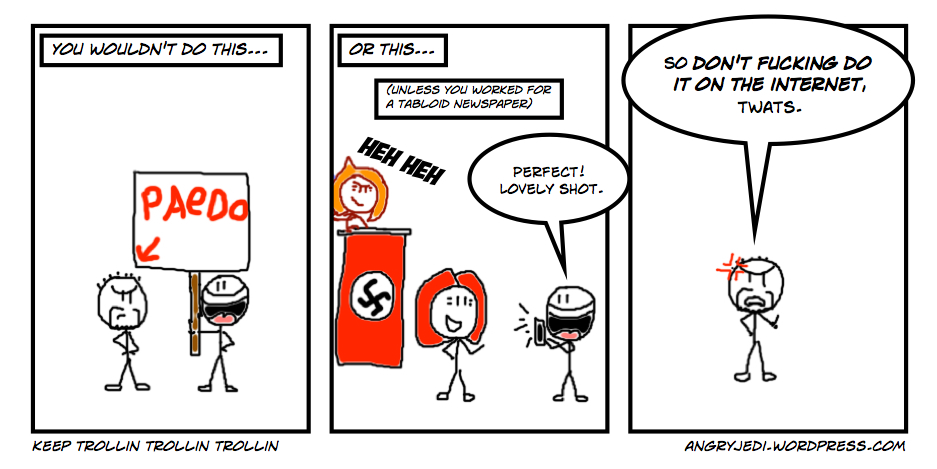

 Another day, another day of snark on the Internet. This time the sources were twofold: firstly, the Pope joined Twitter (and, apparently, his first tweet will be on December 12, begging the question why the account has been set up and announced now) and secondly, it emerged that Kate Middleton (or whatever we're supposed to call her now) is pregnant and suffering from "acute morning sickness", apparently.