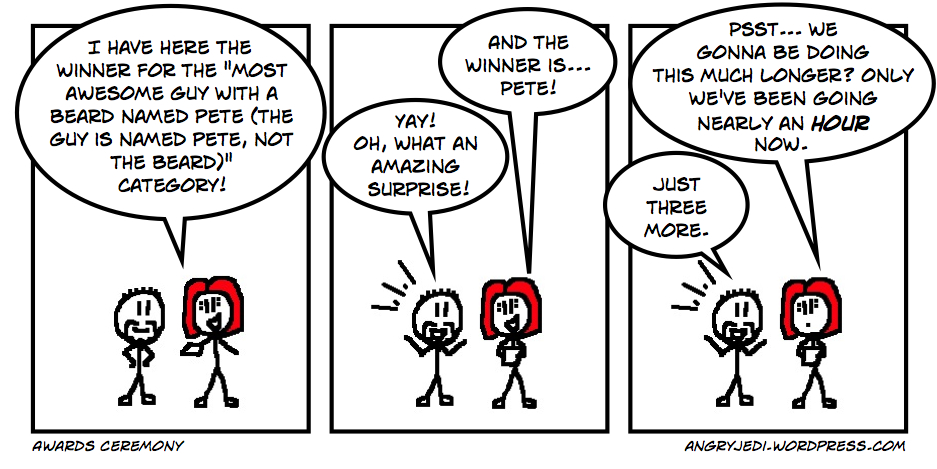
#oneaday Day 76: The Alternative Video Game BAFTAs

So the BAFTA Video Games Awards happened. Last night, in fact. And while the nominations were fairly predictable, there was a relatively pleasing spread of different titles that actually won. In fact, I did a lovely writeup over at GamePro that you should probably go read.

But enough of that. Those awards are all very conventional. So I thought I'd come up with some of my own. Without further ado, I present the Alternative Video Game BAFTAs.

Most Opportunities To Go To The Toilet In A Video Game

Winner: Heavy Rain, where despite the fact there is no logical reason for you to make your characters go to the toilet, you find yourself doing so anyway.

Honourable mention: The Sims 3, which only didn't win because it didn't come out in 2010, unless you count the console version, which I don't, except when putting it in as an Honourable Mention.

Game No-One Had Heard Of When I Played But Now Most People Have Heard Of

Winner: Recettear: An Item Shop's Tale, one of the most charming games I played last year, promptly got very excited about and some months later everyone else seemed to discover.

Game That Has Been On My Shelf The Longest, Unopened

Winner: Resident Evil 4 on PlayStation 2, which I'm not sure counts any more because I started playing it last night.

Former Winner: Final Fantasy XII.

The "MMO That Isn't Boring" Award

Winner: DC Universe Online, which I am aware came out in January of this year, not last year, but these are my awards, so my rules.

Game Most Likely To Make You Feel Uncomfortable If Someone Walks In On You Playing It

Winner: Deathsmiles, for reasons that are well-documented.

Runner-Up: Recettear: An Item Shop's Tale. "That looks shit and cheesy and their voices are really annoying and my God that music!" "No, but it's really funny! Seriously!" "Shut up. I'm going to go and play Starcraft."

Honourable Mention: Dead or Alive Xtreme 2, the most summery game in the Universe. I know it didn't come out last year, but I still play it in the summertime because it's like being on holiday with improbably-proportioned women who like jetskiing. I have an Achievement and everything.

Sadomasochism Award

Winner: Castlevania: Harmony of Dissonance, a game which enjoys kicking you in the balls so much that it's enough to put most people off within a matter of minutes. I, on the other hand, have sunk over 20 hours into it and have just started playing it again.

The "I Love You But You Make Me Angry" Award

Winner: Mass Effect 2, for being a magnificent game that I finished before all the DLC came out and considered going back to just to play the extra stuff but then decided to wait for the "definitive" PS3 version, which then has some extra DLC announced for it, too. STOP IT. STOP MAKING THAT GAME. YOU FINISHED IT. MAKE THE SEQUEL. AND DON'T FUCK IT UP OR RUSH IT OR POST REVIEWS FOR IT ON METACRITIC.

The Game I Keep Forgetting Exists But Is Actually Really Good

Winner: Frozen Synapse, a wonderfully inventive take on the competitive shooter that is turn-based and play-by-email. And awesome.

The Game I Got Best At While I Was Really Totally Off My Face On Expensive Cider

Winner: Joe Danger, a game which my friend Sam and I started playing early in the evening, got drunk and accidentally played for over 3 hours. Highlight of the night was when I discovered how to get massive scores while Sam was in the toilet, meaning that when he came back my average score was roughly 1,000 times more than when he left.

Best Game

Winner: Deadly Premonition. No further explanation required.

Best Video Game Podcast

Winner: The Squadron of Shame SquadCast. Of course.

The Alternative BAFTA Fellowship

Winner: @SpaceDrakeCF from Carpe Fulgur for the magnificent localisation job on Recettear. We're talking a translation of Phoenix Wright quality here. Not only that, but he was consistently entertaining to follow during GDC and provided some excellent "liveblogs" of the sessions he attended.

#oneaday Day 75: Yar-Har Fiddle-De-Dee

Piracy is a crime. Most people are aware of this by now, but it still goes on. And as much as I'm not a fan of piracy per se, it's becoming increasingly understandable why people resort to less-than-legal means to get hold of digital content. Sometimes it's because said content isn't available where they live without paying exorbitant amounts of money to import things. Sometimes it's to get a different version of some content they enjoy. And sometimes it's because the legal versions of the content don't work in the first place.
Let's take YouTube as an example here. YouTube launched a service in the UK last year called YouTube Shows, which carries content from Channel 4, Channel 5 and various other sources, allowing viewers to catch up on programmes they've missed, rather like iPlayer. This is a great service, particularly considering it's available for free, thanks to the fact it's supported by advertising.

At least, it's great in theory. Until the advertising service breaks, rendering the content completely inaccessible. Because there's no failsafe to skip a broken ad, no means of reloading with different ads if they cause the video to fail and no means to report broken content, if YouTube decides that you're not going to watch something, you're not going to watch it.

This is obviously a Bad Thing, but of course it's not YouTube's fault directly. Computers fuck up, that's part of What They Do. But when the fact that Computers Fuck Up That's What They Do means that a service becomes unusable, that's when alternative means start to get 1) sought and 2) provided.

Take the various means of digital rights management that many PC games come bundled with these days, too. Several of Ubisoft's games won't run at all if you're not connected to the Internet constantly while you're playing, so if you have a dodgy wireless signal in your home, good luck playing Assassin's Creed on the PC, since it'll kick you from the game every time your connection drops. And now some console games are starting to take the same approach, too, with Bionic Commando Rearmed 2 on PSN being one of the first. Modern consoles are very much geared towards "always-on" connections these days, of course, but with the number of times my PS3 logs itself out of PSN with no warning every day, playing a game that depended on Internet connectivity would quickly become very frustrating.

It ends up as a vicious cycle, however. The pirates determine more and more inventive ways to circumvent the more and more inventive protective systems that publishers put in place to deter the pirates from circumventing their protective systems. And it never ends. At the moment, particularly when it comes to PC gaming, cracked versions often offer a more convenient, "better" experience than legitimate copies. And when it comes to DVDs, not having to sit through several minutes of unskippable bullshit every time you want to watch a 20-minute episode of How I Met Your Mother is always going to be a mark in favour of downloading the episodes rather than buying the DVDs.

Piracy is a crime. But buying a product isn't, and nor is tolerating advertising to make use of a free service. So how about the legitimate consumers stop getting treated like dirt, huh?

#oneaday Day 74: Fanfic

It was late, and dark, and cold. The air was thick with desire, and there was only one thing on his mind as he quietly descended the stairs in pursuit of the one thing he wanted. His bare feet made no noise as he descended the stairs towards the home of his heart's desire.
He reached out and opened the door to the land of forbidden pleasures and shielded his eyes against the light. He gently took his love from her prison and laid her down softly, tenderly, waiting for him patiently.

Two sheets of white, laid flat on a porcelain bed. He softly greased them up until they were slick, and smooth. Then, he picked up his love and slowly undressed her, removing her clothing a little at a time until she stood naked, unashamed, in his hand, waiting to please him, to make him happy.

He took out his weapon of choice and plunged it deep into his love, sliding through her easily, then back out again. He tenderly peeled off the edge, then plunged deep into it again, harder this time, jerking back a little more suddenly than he intended. He pulled off another, thicker piece, and thrust in for one final time. Now, he knew, it was almost time to enjoy the fruits of his labours, to savour the pleasures that his love had been saving for him. His mouth began to water at the prospect.

He laid one of the sheets over the pieces of his love, and split her down the middle with his tool. Satisfied, he stood back for a moment to gaze at that which he had wrought. His mouth was full of saliva now, and he longed to take that which he desired firmly in his hand and feel her rich, pungent bounty enter his mouth and fill his senses with the pleasure he so longed for.

He could wait no longer. Grasping her firmly, he slowly raised her to his mouth and parted his lips just enough to allow his love to enter. He felt the familiar pleasurable sensations as he let just the tip slip into his mouth, and his tongue tasted his love's familiar flavour. Desire overcame him quickly, and he bit down hard, sinking his teeth into his love, feeling her yield to his strength. He closed his eyes and breathed deeply, enjoying every moment.

"Damn," he thought, "I really love cheese sandwiches."

#oneaday Day 73: The Late Review - Final Fantasy XIII

[This post contains spoilers.]

Final Fantasy XIII is a game about control in its many forms. What happens if the State or Church has complete control over the populace? What happens if beings beyond our understanding control the resources that determine humanity's survival? How do you challenge a fate which seems to be set in stone?

This theme permeates the entire game, from its visual design through its progression structure to the oft-criticised linearity. The game starts with the Sanctum-endorsed "Purge" sending hundreds of citizens to their death. Lightning and her soon-to-be companions are the ones who step up to challenge this seemingly-inevitable fate, but they don't really have a choice. It's fight or die, and to our heroes, death is not an option. This sets them on their path, and once they're on this path, there's no escaping their destiny: they are going to become Pulse l'Cie and receive their Focus: to destroy Cocoon as Ragnarok.

This inescapable destiny is reflected by the fact that there's no deviation from the path on which you, the player, can move. The first part of the game is completely linear for some time, and this is entirely appropriate for the theme. It reflects several things: the tightly-ordered society that is the Sanctum-dominated Cocoon, and the inevitability of preordained destiny. It's not until much, much later in the game that our heroes come across the verdant green hills of Pulse, a land devoid of human life and thus free of the "control" and corruption which the Sanctum and, by extension, the fal'Cie hold over the heads of the population of Cocoon.

But there's subtler things, too. As our heroes progress along their path, they grow in power. At the start of the game, they don't learn from their experiences. Shortly after they become l'Cie, they have the opportunity to develop themselves in the disciplines in which they're good at. Shortly before they arrive at Pulse, when they make the decision to challenge the unjust fate which appears to lie before them, their options open up. The player is able to develop them down pathways which were formerly closed to them. It's harder work for seemingly relatively little benefit, at least to begin with, but the option is there. The path of least resistance still allows the greatest benefits, but those who are willing to make the effort and invest the time will find it pays off later. And as their l'Cie brands advance, bringing them ever-closer to their inescapable destiny—destroy Cocoon or endure an existence worse than death—ironically, their options open up and their potential for advancement becomes ever stronger.

It transpires throughout the course of the story that the party has, in fact, been manipulated for nefarious ends. The interesting thing about the end section of the game is that it jumps firmly back onto rails, but this time it's rails that the party (and/or the player) has chosen to jump onto and follow to their conclusion. There's nothing stopping the player keeping the party down on Pulse, indulging in sidequests, trying to hunt down elusive treasure and wondering if they'll ever be tough enough to take down one of those enormous Adamantoise creatures. The player makes the choice to return to Cocoon and see the story through to its eventual conclusion. And when the final confrontation ends up causing that which the party had struggled so hard to avoid, it's through strength of will that Fang and Vanille manage to use Ragnarok's power to make a choice. A choice not to destroy Cocoon, but to save it instead. The two worlds are changed forever by their actions. The choices that they made put into motion a chain of events that inextricably tie Pulse and Cocoon together—literally, physically.

Ironically, of course, the ultimate control of Final Fantasy XIII's world is that which the creators hold over the player. The characters make choices for themselves and the player is powerless to do anything about it. The player is just along for the ride. But the lengthy setup, the introduction of the characters and the resolution of all their personal stories by the time the party reaches the relative "freedom" of Pulse—if the player has let themselves become invested in the fates of these diverse characters, if they can let themselves look past these characters' first impressions: that Lightning is an aloof, arrogant arse; that Snow is an idiot; that Hope is a whiny brat; that Vanille is an irritatingly girly girl; that Sazh has a stupid name and never quite seems to understand what's going on; that Fang is all too quick to jump off a metaphorical cliff at the slightest provocation—then they'll be right there with them, rooting for them as they decide the fate of the world.

Final Fantasy XIII isn't for everyone. The mixed critical reception the game got on its initial release is more than enough to make that abundantly apparent. Is it the large tracts of linearity, the characters, the fact it's not Final Fantasy (insert number here) that puts people off? I don't know. But I absolutely loved it. It was a spectacular thrill-ride with characters that despite occasional pretensions of obnoxiousness that they display at the outset, end up being a good, memorable ensemble cast—and seriously, what JRPG cast doesn't have occasional pretensions of obnoxiousness? I found it fun to play and beat it with a sense of satisfaction and closure, not least because of the fact that I know that it's over (until the full-on sequel of course) and won't feel obliged to return because of some piecemeal DLC.

I am half-tempted to go Trophy-hunting and/or finish off the last 24% of sidequests on Pulse that I didn't complete—but if I don't, I still feel like I've had a satisfyingly "complete" experience. And that, in this day and age of games that keep getting extended, extended, extended and thus losing the impact of their original "ending"… that's something to be celebrated.

#oneaday Day 72: Jam on Toast

The tail-lights of the cars in front of you brighten as they apply the brakes. Your collective speed drops. There seem to be an awful lot more cars around than there were a moment ago, and a few trucks, too. Your heart sinks.
Yes, you're entering a traffic jam.

At this point, you will do one (or more) of several things. You may suddenly wonder if you have enough music to cover the entire period this eventuality may cover. You may consider phoning someone at your destination to let them know you're likely to be late. You may decide that no, this jam couldn't possibly last for very long because it appeared out of nowhere, so there's no need to phone ahead, because you left the house with plenty of time to spare just in case this happened. You may emit a string of incredibly loud and offensive swearwords—this is considerably more likely if you're in the car by yourself and/or are an extrovert/sufferer of Tourette's.

Then you see the electronic signs warning you of the "recommended" speeds (or, if you're on the M25, the actual variable speed limit which you can be pulled over and/or caught on speed camera for.) You see it and you figure that hey, 40 mph may not be quick, but at least it's moving, right?

Wrong. What they don't tell you is that the "recommended" speeds are actually a cunningly disguised secret code. Fortunately, I have cracked it.

  • 20mph – You ain't going anywhere for at least an hour and probably more like three hours, plus.
  • 40mph – You will move, but very slowly. You will be lucky to break 20mph.
  • 60mph – You will move at a relatively comfortable speed but will be lucky to break 40mph and will often have to brake suddenly for no apparent reason.
  • End of speed limit – Theoretically, you are allowed to drive at full speed now, but the volume of traffic coming out of the jam means that this will be very difficult to achieve for at least another half an hour.

People have developed various coping mechanisms in order to deal with the stress and frustration of traffic jams. You could shout and swear some more. You could turn your music up. If you're a Mercedes driver, you could weave in and out of lanes in an attempt to get as far forward as possible. And if you're an asshole, you could use the hard shoulder and/or filter lanes for junctions to "jump the queue" and get as far forward as possible by barging in. But if you do this, you deserve to be scooped up by a gigantic super-powerful electromagnet (which picks your car up, obviously, not you, unless you're a robot) and fed to an ant-eater which has been inflated to unnatural proportions via the ethically questionable misuse of SCIENCE! and which has developed a taste for cars—so much so that the giant form of the ant-eater has in fact been re-dubbed the car-eater.

So yeah. Don't do that. Sit and wait patiently. Because ultimately, no amount of screaming, shouting, swearing, lane-weaving or driving like a dick is going to affect the fact that there are hundreds of cars stuck in place, just like you. And until the day when all cars have a button that allows them to take off and fly away like the DeLorean in Back to the Future (when, if you think about it, we won't really need roads at all any more) there's nothing you can do about it.

So sit. Wait. Suffer with the rest of us.

#oneaday Day 71: Want Not

I haven't bought anything "new" for some time now, be it a book, CD, DVD, Blu-Ray or game. (Actually, that's a lie, I picked up Deathsmiles recently but only because if I didn't grab a copy now I doubt I'd ever see it on store shelves ever again, but that's beside the point. I probably shouldn't have started on this aside as it is taking away from my original point somewhat. Forget I said anything and let's start again.)

I haven't bought anything "new" for some time now, be it a book, CD, DVD, Blu-Ray or game. (Actually… (No! Stop it!) What? (You know what.) Oh all right.) And you know what? I don't miss it. (I'm going to focus on games here.) I don't feel like I've missed out on Assassin's Creed Brotherhood and I don't feel like I'm missing out on Dragon Age II. There are many other things I could list but I won't because it would be terribly boring.

There are many reasons I haven't missed buying these things. Firstly and most obviously, it's saving money, something I'm woefully short of at the minute. Secondly, though, there's really no need to constantly have the latest and greatest the second it comes out. What does it achieve, really? You pay full price, have to enter six bajillion redemption codes to download all the DLC that should be on the game disc (don't get me started!) and know that there's going to be more of it in the future. Wait a few months and you could likely have a better edition for less money and more Stuff. You also get to avoid all the "pre-order bonus" bullshit that big publishers are starting to pull these days, because the content in question is often then included in that newer edition.

The third and probably most important reason, though, is that not rushing out to buy something awesome the second it comes out is the fact that you can then just enjoy what you've already got. I'm currently playing through Final Fantasy XIII, a game which I picked up months ago, played approximately 20 hours of, stopped due to something else coming out, and never went back to until recently. Now, those who dislike FFXIII will undoubtedly say that I shouldn't have bothered, but I'm having a blast, and the fact I'm not feeling "pressured" to beat it as quickly as possible means that I can savour the beautiful world that makes up that game, take my time to explore and enjoy the extra content it has on offer, and move on to beat it when I'm good and ready. When I've beaten that, I have Demon's Souls, Disgaea 3, Darksiders, Resident Evil 4, killer7 and a whole host of other things to play through—a backlog of games that literally covers years. Eventually I'll get through them all—hopefully in time for a Dragon Age II game of the year edition or even Mass Effect 3.

Of course, this will all go out the window once Catherine comes out in the States and I immediately import it but hey. That's another one that might end up being hard to find, so it's an investment, hey?

#oneaday Day 70: Waste Not

[The comics for the next few days are a little disjointed as I'm going away for the weekend. Fans of Rogue, if there are any, will be pleased to see he has his own utterly pointless mini-series.]

I'm sitting in my "study" (for want of a better word—it's the room I have with my desk and computer in) and despite staring at the screen enjoying the wonders of the electronic, digital age (such as this delightful blog) I am literally surrounded by pieces of paper. I don't dare throw any of these pieces of paper away because one day, one of them might be important for something I can't possibly predict. I have discovered this to my cost a number of times in the past.

This is annoying, though. I have one of those expandy box file things that has burst its seams because of the amount of shitty useless paperwork crammed inside it. Some of this paperwork is from houses I haven't lived in for five years. Some is from, I don't know, last week? All of it is completely useless, until you really need it, when it becomes the most important thing in the world and consequently is nowhere to be found even though you know you put it in that section of the file and can remember looking at it and thinking "I know this will be important some day".

Conversely, I know that if I have all these shitty annoying stupid bits of paper everywhere and close to hand that I will never ever need them ever again. And then I will throw them out to tidy up. And then I'll suddenly need them again.

Why? Why do we surround ourselves with such crap? The world is full of so many wonders and yet it seems that in order to just survive and go about our daily business we have to sign this, keep this safe, keep this secret, remember this handy 300-digit number that also includes letters just to be awkward, keep every single piece of paper that includes numbers and currency symbols just in case you need to show people that you understand what money is or something, and read 15-page long letters that make no sense but basically amount to saying "if you break something or have it nicked, you can have some money but only if we feel like it and by GOD we will investigate thoroughly for the best part of fifteen years before we even think of paying out".

And relax.

I should probably add at this point that I've never had to claim through an insurance company so haven't encountered the above situation before, but I did do some temping for a firm of "loss adjusters"—a profession I didn't know existed before I did that job briefly—and was alarmed to discover some claims had indeed been going on for a healthy number of years. I was also shocked to see quite how many pointless companies exist in the world. In one instance, an insurance company contacted the loss adjusters who contacted some surveyors (odd, since the loss adjusters had their own in-house surveyors, but never mind) who contacted some builders who contacted some architects who contacted some draftsmen… and then they all contacted each other back in the other direction again. This isn't an exaggeration for comic effect, there legitimately were that many people involved. No wonder we're drowning in fucking paperwork.

Please consider the environment before you print this blog post. And please consider the environment before you post me a metric shit-ton of paper I will never read.

#oneaday Day 69: PAX Bostona

PAX East is happening tomorrow, and I'm not there. This makes me inordinately sad for a number of reasons. Firstly, PAX East last year was the last time I could legitimately say that I was 100% completely, totally and utterly happy. For those few days, I had left all my growing troubles behind in the UK and was able to immerse myself in the culture that I loved so much. I was able to be an unabashed nerd and surround myself with thousands of other people like myself.
Secondly, PAX East represented the last time I had the chance to see some of the people I consider to be my best friends in the world. It sounds sappy, I'm sure, but the relationships I've cultivated online over the last few years are some of the strongest friendships I've ever had—and in some cases, I've met these people once or twice… and in many cases, not at all.

Thirdly, PAX East last year pretty much marked the start of the career path that I'd very much like to follow full-time, given the opportunity: being part of the games press. At the time I was writing for Kombo.com and between meeting up with people and seeing cool panel discussions (some of which didn't feature my brother) I was hunting down interesting stories and reporting on them. I'd been writing the news for a little while by then, but attending an event and spotting the new hotness was a lot of fun, and something I want to do more of in the future.

The best thing about PAX East, though, I've already touched on, and I blogged about at length last year. It's a place to call home. A place where people who enjoy video games can come together and nerd out to their hearts' content without fear of judgement, without feeling like they have to "hide" their hobby or play it down. No, this is a place where girls could dress as Bayonetta without (much) shame, where people could experience new aspects to their hobby, where people could meet some of their idols and where people could get together and meet each other.

In short, it was awesome. And that's why right now I am very much wishing I was there in Boston, scoping out the nearest coffee shops and Dunkin' Donuts to the convention centre, arguing about which places to go for food and playing "spot the influential industry figure".

So to all of you over there in Boston right now, I hope you have the best time of your lives over the next few days. Because if you don't have the best time of your lives, I could clearly have had your tickets and had the best time of my life instead. (Assuming I could have actually flown over to Boston, of course. Planes are expensive. But that's beside the point.)

Yeah. I JELLY. Deal with it.

Have an awesome time, PAX East. Wish I was there.

#oneaday Day 68: What Now?

It's coming up on a year since my departure from the obnoxiously-named "world of work", when I left my employment at a primary school, went to PAX East and had what was to this day the happiest week of my life, then came home only for my life to completely fall to pieces two short months later.

Now, here I am, and some things have changed, and some things aren't any further along than they were even back then. I have some awesome new people of various descriptions in my life, for one thing, and while most of them are some distance away, none of them are so far away as to make it completely impractical to go and see them. This is a Good Thing.

I also have a sweet writing gig that I'm absolutely loving. I enjoy doing the news posts every day and I've had great fun at the events I've had the opportunity to attend so far. This is also a Good Thing.

But I get the impression that some Decisions are going to have to be Made at some point. How much do I want to be a writer in the games industry? Quite a lot, as it happens. Despite having been technically "unemployed" for the last year, I've been doing a lot of writing and I haven't reached that "jaded" stage that some writers have got to—the stage where they've forgotten to have fun with what was once their hobby. I don't see myself getting to that point any time soon because I'm a fan of games, the games industry and everything it involves, and hopefully that comes across in my writing. I believe that I'm a good writer and a valuable addition to any of the teams I've been part of over the years, and friends and colleagues would (hopefully) back me up on that front. I certainly have a heap of LinkedIn recommendations that would attest to this.

So what's the problem? Well, as much as I love it, it's not a full-time gig… at the moment, anyway. Making it into a full-time gig would likely, at this time anyway, involve having to whore myself around to a number of outlets on a freelance basis, without any particular guarantee of a particular amount of money coming in each month. I wouldn't have a problem with this were it not for the fact that the events of the last year have left me in a terrible state financially. The thing I find myself constantly coming back to is whether I should leave behind "the dream" and get a full-time job instead. Practically speaking, it's the thing that would probably make most financial sense, and anyway, there's nothing to say I can't continue contributing to sites on a freelance basis while I hold down another job.

So I have been applying for jobs. And applying. And applying. And tweaking my CV and cover letter and trying new templates and writing in different styles. And nothing. This is immensely frustrating as I know that I am Good At Stuff. But on paper I am qualified for just two things: writing and teaching. Teaching I have no desire to go back to as it's nearly killed me on two separate occasions, but I have a lingering fear that it's the only career path I can all but guarantee I'll be able to find myself a position in. I've held three teaching jobs in the past, all of which were in schools that could politely be described as "challenging" and as such my perception of the profession may have been coloured in a slightly negative light. But I'm not sure I want to risk my sanity and happiness (well, potential happiness, anyway) diving back in "just to see" if I was just imagining it was as awful as I thought it was.

In summary, I'm not sure what I "should" do. A job's a job, after all, and anything that gets some money coming in is surely better than doing nothing and having no money coming in whatsoever. My quandary is this, then: after this long out of full-time work, should I continue looking for that elusive something that's going to make me happy? Or after this long, should I just take whatever the hell I can get?

And are you hiring?

#oneaday Day 67: Cultural Differences

Games are a fairly unique medium in that they allow pretty much anyone easy access to material from other cultures without the language barrier necessarily getting in the way. A book in a language you don't understand, for example, is pretty much useless. A film can be appreciated for its direction and cinematography if not understood. Music can be enjoyed on a certain level. But a foreign game, assuming its not too story-heavy, can be enjoyed by anyone.

It's here that we run into the East-West divide. Both parts of the world enjoy producing games with stories, though Western stories often tend to err on the side of "gritty" while Japanese tales tend for the most part to be more on the colourful, melodramatic side, often derided by people who don't enjoy them as being "emo". Let's leave narrative-heavy games aside for a moment, though, and look at games that are "gameplay experiences" first and foremost.

For comparison purposes, I'm going to take dear departed Bizarre Creations' Geometry Wars 2 for the Western front, and CAVE's Deathsmiles for the Eastern front. Both are Xbox 360 titles, both released at a low price point, though Deathsmiles saw a retail release as opposed to Geometry Wars 2's Xbox LIVE Arcade-only release. This, in itself, is somewhat telling.

Let's consider the games' respective aesthetics first. Geometry Wars 2 is, as you may expect from the title, abstract in nature. There are no "characters", there's no "story", it's just a bunch of neon shapes against one little white abstract "ship", and everything explodes into a shower of beautiful fireworks. It's spectacular to behold (assuming the person playing is any good) and recognisably "next-gen" (or "current-gen" if you prefer, since it's technically more accurate).

Deathsmiles, on the other hand, looks like a SNES game, albeit one with enough things on screen to make the little Nintendo box explode. It's all sprite-based, it has chunky pixel-art backgrounds that have been upscaled to HD but not quite by enough, it has animations done by hand rather than generated procedurally and suffers from occasional slowdown due to the sheer amount of shit happening on screen at once.

Not only that, though, but Deathsmiles has "character". Rather than the abstract appearance of Geometry Wars 2, the player "ship" in Deathsmiles is a person. Specifically, it's one of four underage Gothic Lolita angels dressed in borderline-inappropriate costumes accompanied by a familiar. Similarly, all the enemies are recognisable as "monsters", be they humanoid, dragons, flying eye things with bat wings, spiders or indeed the wonderfully named final boss, Tyrannosatan.

The key thing about the two games' respective aesthetics, though, is that Geometry Wars 2 is consciously trying to look shiny and new, while Deathsmiles is more than happy to look like an arcade game from at least 10 years ago—the "if it ain't broke, don't fix it" approach. Neither approach is necessarily more or less valid than the other, but it's an interesting contrast.

Then we come to how the two games play. Geometry Wars 2 has a variety of modes, all of which can be explained very easily. They all involve killing things before they touch your ship, with only a couple of modes (King, in which you may only fire while sitting in certain temporary "zones"; and Pacifism, in which you can't fire at all and can only destroy things by detonating "gates" by passing through them) varying even slightly from this formula.

Deathsmiles, on the other hand, should be a simple matter to explain. It's a shoot 'em up, after all—how complicated can it be? But I attempted to explain it to a friend earlier and ended up confusing both myself and him. The game's tutorial makes it sound rather straightforward—fire in either direction, use a smart bomb, charge up shots or use a lock-on attack—but in fact there's a surprising amount of hidden depth.

Firstly, since it, like Geometry Wars 2, is a game about getting high scores, there's a somewhat intricate method to attaining the highest scores that involves destroying the correct enemies with the correct type of shots. The game mentions this in passing, but it's up to the player to determine what it actually means. Geometry Wars 2, on the other hand, is about shooting shit and using a bomb if you're in an inescapable situation.

Secondly, there's the key element of the "bullet hell" shooter—the hitbox. Graze any enemy in Geometry Wars 2 and your ship explodes. But the same isn't true in Deathsmiles—mercifully, since the player sprite is relatively large. No, instead there's a pulsing "heart" symbol in the middle of your characters chest and that—and only that—is the thing that can be damaged. Because this is so small, it means you can navigate your player character through intricate arrangements of bullets that initially seem impossible to avoid. Much of the game becomes about less about shooting things and more about learning how and when these patterns appear, and finding an appropriate path through them. The patterns are the same each time, too, so you certainly can "learn" the game, as opposed to Geometry Wars 2's more random chaos.

Then there's the matter of replay value. Both games are designed to be replayed in a "score attack" style. But Geometry Wars 2's sessions tend to be rather short for the most part—a few minutes at most. In most modes, the game ends when you're dead. More skilled players get to play for longer in most cases.

Deathsmiles, on the other hand, takes you through at least 6 levels, the order of which you can select to a certain degree, and offers you unlimited continues. The whole game takes about 20-30 minutes from start to finish. This means that "beating" the game is within the reach of absolutely anyone, even on the hardest difficulty settings. Sure, you'll get crap scores, since your score resets to zero every time you continue, but you can at least reach the end and whore for Achievements if that's your bag. The sign of a skilled Deathsmiles player, then, is not how long they play for, but how long they can survive without their score resetting. This doesn't necessarily have to be from the beginning of the game, as tackling the levels in different orders can provide optimum bonus-point scoring potential, but then we get into a whole other order of depth.

It's interesting to see two wildly different approaches to what is essentially the same genre—the shmup—and contrast them. I like both games very much, but I feel that most people will probably find themselves favouring one or the other, much like game design philosophy in general.

I'll leave you with one of the most interesting things to ponder: whether Deathsmiles' character designs would have ever been green-lit by a Western developer, even knowing the fact that the arguably "sexualised" nature of them doesn't factor into the game itself at all? I somehow doubt it. Don't believe me? Take a look:

Cute, right? Bit of a stockings and thighs and boobs theme going on. We've seen self-consciously sexy Western female characters before, so surely nothing new there. How about if I tell you how old they're all supposed to be?

Yeah. Pervert.