#oneaday Day 849: Jud's Handy Guide to Video Game Terminology [UPDATED!]

20120516-234409.jpg

This post is aimed at anyone who doesn't know what all that crazy terminology we game geeks fling about actually means. Like any hobby, there's a ton of specialist words, abbreviations and acronyms in there, and some are a little ambiguous, just to confuse matters.

So, then, here are some definitions, some of which you may know, some of which you may not.

2D — Usually used to refer to games in which the screen has no "depth". Players can move up, down, left and right on screen, but not "in" and "out". Also used to refer to visuals that are constructed using pixels (q.v.) rather than polygons (q.v.)

3D — Usually used to refer to games in which the player may move in a full three dimensions — up, down, left, right, in and out. Typically used to refer to games whose visuals are constructed using polygons. Nowadays also used to refer to games that use 3D technology to give visuals genuine, proper depth using either 3D glasses or glasses-free technology such as that seen on the Nintendo 3DS handheld (q.v.).

8-bit — Term usually used incorrectly to refer to pixel-art graphics designed to resemble those seen on older computers and consoles (q.v.), particularly from the "8-bit" era (NES, Master System, Commodore 64 etc.) Actually refers to either 256-colour graphics ("8-bit colour depth") or a computer processor which can access 8 bits of data in a single instruction.

Achievement — An arbitrary objective set outside of the main structure of the game (in most cases) that rewards players with a virtual "award" saying they accomplished said arbitrary objective. Seen in Xbox 360, PC, mobile and social games. See also: Trophy (capital T), Achievement whore.

Achievement whore — A person who plays games specifically to get Achievements (or Trophies) rather than focusing on the game's own inherent reward mechanisms.

Adventure game — A story-focused style of game in which the main barrier to progress is usually some form of puzzle integrated into the game world. These vary from "use x on y" object manipulation puzzles to more elaborate chains of events. Examples include the King's Quest series, Indiana Jones and the Fate of Atlantis and Time Gentlemen, Please! Hidden Object games (q.v.) are a modern offshoot of the adventure genre.

Brawler — A game in which between one and four players cooperate to battle enemies. Often takes place in "urban" environments, and is usually presented from a 2 dimensional side-on perspective. Examples include Double Dragon, Streets of Rage and The Simpsons Arcade.

Bullet hell — (also: danmaku) A subgenre of shmup (q.v.) that involves avoiding intricate patterns of enemy fire as much as it does spraying the screen with hot laser death. In bullet hell games, the player's hitbox (q.v.) is usually very tiny, meaning they can navigate through incredibly tight-looking bullet formations. Examples include DoDonPachi Resurrection, Jamestown and Deathsmiles.

Character action game — Any game in which the player controls a single, often visually distinctive character and battles their way through hordes of enemies and gigantic, physically improbable bosses. Has much in common with the brawler genre (q.v.). Examples include Devil May Cry, Bayonetta and God of War.

Computer — An electronic device onto which you can install software, connect peripherals, customise your experience and play games. The most common computers these days are Windows-based PCs and Apple's Mac series, though you find the odd geek using Linux just to be different. Games that are specifically designed for computer alone tend to be referred to as "PC games" or "computer games".

Console — An electronic entertainment device that is not a computer and is specifically designed for playing games (and, increasingly, consuming other digital media such as music and movies). Current-generation consoles include the Xbox 360, PlayStation 3 and Wii. Games specifically designed for consoles tend to be referred to as "video games".

Developer — Collective term for whoever actually creates the game. May be an individual person or a gigantic company.

Digital distribution — Term used to describe when you pay for something online and download it straight to your computer, console, mobile phone or other device without involving a physical product at any point in the process.

DLC — DownLoadable Content. Additional content which may be added to a game, usually for a fee. "Day-One DLC" is DLC which is available the same day the game is released. "On-Disc DLC" is DLC for which the actual content is stored on the game disc, with the only thing that gets downloaded being an "unlock code" to allow access to it. Neither are popular approaches, and often seen as a means of publishers trying to squeeze more money out of consumers. Good DLC does exist, however — good examples include the expansion packs for Borderlands and The Elder Scrolls IV: Oblivion, both of which added significant amounts of content to the game for reasonable prices. See also: Game of the Year Edition.

Driving game — A subdivision of the racing game (q.v.) genre that involves driving realistic vehicles. Examples include Gran Turismo, Forza Motorsport and Project Gotham Racing.

DRM — Digital Rights Management. An anti-piracy technology intended to ensure that customers are using legitimate copies of their entertainment. Often very intrusive and usually easily circumvented by pirates, leading many to claim that games sporting DRM are punishing legitimate consumers more than pirates. Developers, publishers and digital distribution (q.v.) outlets who release titles that are "DRM-free" are often very popular.

Fighting game — A competitive game genre that usually involves one-on-one combat between two characters attacking each other with a variety of unlikely and/or physically improbable "special moves" until one or the other's life bar is depleted. Known for its fiercely competitive community, gorgeous female characters and high barrier of entry. Not to be confused with the brawler genre (q.v.). Examples include the Street Fighter series, Marvel vs. Capcom and Soul Calibur. Sorry, Soulcalibur.

First-person perspective — Any game which unfolds from the perspective of the main character(s) viewpoints.

fps (lower case) — Frames Per Second. The number of times the screen updates every second. Higher numbers make movement look smoother. Film typically runs about 24fps. Anything higher than 60fps can't really be distinguished, so 60fps is often seen as the "gold standard" — anything consistently running at 60fps moves incredibly smoothly. A higher fps is often the result of either more powerful hardware or more efficient programming. PC gamers get rather obsessive about this figure, particularly when buying a new system.

FPS (upper case) — First-person shooter. A game where the player's perspective is from inside the head of the main character(s) and their main means of interacting with the world is by shooting seven shades of crap out of it with a variety of weaponry.

Free-to-play — A game which is free to download and play, but which requires the player to pay real money in order to access certain items. (This is known as "microtransactions".) This may be additional game content, visual customisation options for the player's character or timesaving "boost" items. Free-to-play games are often either MMOs (q.v.) or social games (q.v.). Contrast: freeware.

Freeware — A game that is completely free and features no microtransactions.

Friend-gating — A technique used in social games (q.v.) to encourage players to invite their friends to play. Progress is halted until the player convinces a certain number of friends to start playing the game, or pays money to bypass the restriction. A form of viral marketing (q.v.).

GameFAQs — The website gamefaqs.com, which includes an enormous repository of guides to almost every game you can possibly imagine. Used by people who can't be bothered to figure things out for themselves, or those who simply want more information about a game. The "FAQs" part of the name comes from Internet slang acronym "FAQ", meaning "Frequently Asked Questions".

Games industry — Collective term used to refer to specialist press (online or print) about games, game developers and game publishers.

Game of the Year Edition — (also GotY Edition) A rerelease of a game that includes all (or most) of its DLC (q.v.). Usually has different packaging to the original release. No-one is quite sure where the "Game of the Year" bit comes from, but it's usually something that only happens for popular games with a lot of DLC.

Gen4 — A term coined by Electronic Arts on its 2012 earnings call to refer to the upcoming new generation of consoles (q.v.) including Nintendo's Wii U system and new, unannounced offerings from Sony and Microsoft. An inaccurate term, since we are actually currently on the seventh generation of hardware, not the third.

Handheld — A portable console (q.v.) that plays games. Current examples include the Nintendo 3DS and Sony PlayStation Vita. Some people get snobby if you throw smartphones (q.v.) into this category.

HD — High Definition. Used to describe televisions that run at a resolution (q.v.) of either 1024×720 pixels (aka 720p) or 1920×1080 (aka 1080i/1080p, but we won't get into that now). HD displays provide clearer, crisper images than their SD (q.v.) cousins. Also used incorrectly by almost everyone in the world, particularly iPad developers.

Hitbox — The area of a player which detects collisions with other objects, usually bullets. In bullet hell (q.v.) games, the hitbox is considerably smaller than the player's ship/character, meaning it's possible to navigate through seemingly-impossible hails of incoming enemy fire.

HOG — Hidden Object Game. Used to refer to an offshoot of the adventure game genre (q.v.) that is usually story-focused, and in which the main barrier to progress is being confronted with an unnaturally untidy room and a laundry list of things to find as quickly as possible. A popular genre of social game (q.v.). Examples include Hidden Chronicles, Gardens of Time and anything on Facebook with the words "Hidden", "Mysteries" or "Adventures" in its title.

Indie — Short for "independent", and the opposite of "triple-A" (q.v.). Usually used to describe small developers that make more niche games and often aren't attached to a particular publisher. There is some disagreement over the exact definition of the term among the community. Is Minecraft, an independently-developed game that has been a runaway, multi-million seller, truly still "indie"?

MMO — Massively Multiplayer Online. Catch-all term to describe games that hundreds, thousands or even millions of players can play online at the same time. The most common variant is the MMORPG, an RPG (q.v.) in which it's possible to meet other players wandering around the same world and team up with or compete against them. Examples include World of Warcraft, Star Trek Online and Rusty Hearts.

Multiplayer — A game or mode you play with other people. Subdivided into local and online multiplayer, with the former being a game you play in the same room as other people (usually using multiple controllers) and the latter being a game you play via the Internet. Further subdivided into cooperative and competitive variants, which are hopefully self-explanatory.

Origin — A digital distribution (q.v.) platform run by Electronic Arts, notorious for not being very good yet still being forced upon PC and mobile gamers by EA.

Patch — A downloadable update to a game that adds features, fixes problems or sometimes both.

Pay to win — Pejorative term used in reference to free-to-play (q.v.) titles that include the option for players to pay real money for a significant in-game advantage.

Pixel — A tiny, single-coloured square that makes up the image you see on a monitor or TV.

Polygon — A closed, flat shape consisting of straight lines. Hundreds, thousands, millions of these may be connected together to construct three-dimensional models.

Premium currency — A virtual currency used in a game (usually a free-to-play (q.v.) title) that may not usually be earned through normal play, and usually requires the expenditure of real money to acquire. Used as a means of masking the true cost of microtransactions.

Publisher — The company who gets the game onto store shelves or digital distribution (q.v.) sites. The people who handle the money. Not necessarily the same company as the developer (q.v.).

Racing game — A genre of games that involves participating in vehicle races. Often used interchangeably with "driving game" (q.v.) but tends to refer to non-realistic games such as Mario Kart, or futuristic titles such as WipeOut and F-Zero.

Resolution — The number of pixels (q.v.) that make up the complete image on a screen, expressed as the number of pixels across by the number of pixels down, with the origin in the top left corner.

RPG — Role-Playing Game. A genre in which players control one or more characters who grow in strength over the course of the game. Variants include "action RPG", in which players spend most of their time killing things, "open world RPG", in which players have a large world to explore however they please, and "JRPG", which is an RPG produced by or in the style of Far East-Asian developers. Often story-heavy. Examples include Xenoblade Chronicles, the Final Fantasy series and Diablo III.

RTS — Real-Time Strategy game. A genre of game in which players take on the role of an omniscient commander who commands their troops to (usually) wage war. The "real time" part comes from the fact that the game does not stop while the player makes their decisions — they must effectively prioritise and respond to situations in order to be successful. Examples include the Command & Conquer series and StarCraft.

SD — Standard Definition. A display technology for televisions in which the image is displayed at a resolution (q.v.) of (usually) 640×480 for NTSC-based televisions (seen in America and Japan) and 720×576 for PAL-based televisions (seen in Europe and Australia).

Share — A social networking term used to refer to making a post on a social network. In the case of games, this is usually some form of "brag" post boasting of a new high score. In actuality, it is usually a form of viral marketing (q.v.).

Shmup — Short for "shoot 'em up", a term usually used to describe 2-dimensional games that involve shooting things. Most commonly used today to refer to the "bullet hell" genre (q.v.). FPS (q.v.) games are not shmups.

Single player — A game you play by yourself while you are not connected to the Internet.

Smartphone — A mobile phone (cellphone) which is more like a miniature computer. Usually has a touchscreen, the ability to connect to the Internet and the facility to install "apps" to extend its functionality, including games. Several types are available, including the iPhone series, Android phones, Windows Phones and BlackBerrys [sic]. The iPhone and Android ranges are the most popular and consequently have the most apps available.

Social game — A game designed to be played on a social network such as Facebook. Usually free-to-play (q.v.) and monetized through sales of premium currency (q.v.). Often accused of being "pay to win" (q.v.), using "friend gating" (q.v.) excessively or constantly bugging players to "share" (q.v.) everything.

Special move — A combination of button and directional presses that causes something awesome to happen, most commonly seen in fighting games (q.v.).

Steam — Arguably the most popular digital distribution (q.v.) store for PC and Mac games there is, run by Valve Corporation, developers of the popular Half-Life, Left 4 Dead and Portal series.

TBS — Turn-Based Strategy. A strategy game in which players can spend as long as they like thinking about the commands they would like to give their units under their control. Often compared to board games, and typically less combat-centric than RTS (q.v.) titles — though military conflict often plays a part. Examples include the Civilization series and Endless Space.

Third-person perspective — Any game where you can see the character that you are controlling. Most commonly used to specifically refer to games where the "camera" floats behind the character or is positioned just behind one of their shoulders.

Third-person shooter — A game that unfolds from a third-person perspective (q.v.) in which the player's main means of interacting with the world is by shooting seven shades of crap out of it with a variety of weaponry. Examples include Gears of War and Binary Domain.

Triple-A — A big budget game, usually published by Electronic Arts, Ubisoft or Activision. Tends to have excellent graphics, famous voice actors and a marketing plan that will make you sick of it months before it's even released. Just being published by one of these companies doesn't necessarily make a game "triple-A" — rather, it is to do with the overall budget and marketing spend. Gaming's equivalent of the "summer blockbuster".

Trophy — The PlayStation 3's equivalent of Achievements (q.v.). Trophies come in Bronze, Silver, Gold or Platinum variants to reflect their difficulty. Platinum Trophies are usually awarded simply for accomplishing all of the other Trophy requirements.

Viral marketing — A means of subtly promoting something by using people's inherently social nature. In video games, this is usually achieved by allowing players to post things on their Facebook Timeline from within the game, thereby allowing the player to boast of their achievements and conveniently promote the game in the process.

At over 2,000 words, I think that's enough for now. Feel free to post in the comments if I missed any "q.v."s or if there are any things you still don't know.
#oneaday Day 848: I Can't Get Angry About Diablo III

20120515-224443.jpg

I know I have a track record of Getting Angry About Shit, particularly when it comes to things like DLC, DRM and other three-letter acronyms. But I'm finding it rather difficult to get riled up over the issues surrounding Diablo III.

For the uninitiated, Diablo III is the latest game from World of Warcraft creators Blizzard, who are part of Activision. Activision used to be gaming's resident Empire Of Evil, but that mantle has since passed to EA, and Activision are now simply Those Guys Who Killed Bizarre Creations, Pump Out Call Of Duty Every Year And Have Something To Do With Blizzard. But that's beside the point.

The point is that Diablo III was always going to be a massive seller and an immensely popular title. It's the long-anticipated third entry in a series with a long history, and one which a lot of players have been looking forward to for a long time.

It's also one which a lot of people are getting extremely angry about, largely due to what they describe as its "always-on Internet DRM". Said "DRM" has had difficulties today due to overloading, leaving many players unable to log in and play the game.

Here's how the system works. To play Diablo III, you have to log in to Blizzard's online service Battle.net. Once logged in, you can then play the game. You have to stay connected in order to play, even if you're playing solo. The benefits of playing in this kind of "always on" environment include the fact you can always see when your Diablo-playing friends are online, that you can jump in and out of each other's cooperative multiplayer games, and that you can make use of the game's auction house facility to trade items.

Some people are getting very upset about this — particularly the fact that you can't play single player offline. And while that may seem a bit silly, I can't help but thinking a lot of people are looking at this from the wrong angle — the "gamers are getting screwed" angle. This is perhaps understandable, given the amount of time gamers spend getting screwed nowadays, but I really find it difficult to agree with the people getting riled about this.

Here's the thing, though: Diablo has pretty much always been designed as an online game to play with either friends or random strangers online. The classes are designed in such a way that it's both desirable and fun to group up with other people and tackle the game's challenges cooperatively. You can play solo, sure, but the game has always been designed with online in mind. With this latest iteration, including the auction house and other mechanics, Diablo is now closer in execution to a massively-multiplayer online title than a single-player dungeon crawler like Torchlight. Sure, it doesn't charge a subscription fee or feature a truly massively-multiplayer open world to explore, but the game has been designed specifically to be an online title. People don't complain about World of Warcraft, Guild Wars or the like having to be always online — what, really, is different here?

I think the issue is that Blizzard hasn't appropriately set people's expectations for the game being an online-only title. We have no problem with games like the aforementioned requiring us to stay online in order to play, despite the fact you can play them solo. (In the case of Guild Wars, you can even team up with computer-controlled partner characters if you really can't stomach playing with real people.) So what, really, is different about Diablo III? Is it simply that the previous games had a discrete "Single Player" option that didn't require you to be online? (I haven't finished installing the new game yet so at the time of writing don't know if this is still the case.)

The other issue is that people believe Blizzard, being the company who runs the world's biggest massively-multiplayer online game, World of Warcraft, should have anticipated demand and made sure their servers were up to the job of dealing with the thousands (millions?) of people who were likely to be wanting to log in at the same time. This I sort of agree with, though there is no genuinely reliable way of predicting quite how much demand there is going to be for any given title. Blizzard underestimated demand, and it's caused problems — much like has happened with the launch of many other online-only games. That doesn't make this a "disaster" or a "debacle" or anything like that; it makes it an occurrence that we've seen before. An occurrence we should have figured out a solution for by now, yes, but one we shouldn't really be surprised about any more.

Within a matter of days, the whole issue will be completely forgotten about as everyone starts playing and enjoying the game, which kind of makes the whole RAGE!!! thing seem rather pointless, really.

But I guess you could say the same thing about any sort of "controversy" — including the Mass Effect 3 issues I wrote about a while back.

The fact is, though, this is an issue I find it very difficult to get riled up and upset about. So far as I'm concerned, Diablo III is an online game, almost an MMO, therefore I accept the fact that an unavoidable part of its existence is downtime, during which you cannot play. It's not as if I'm short of other stuff to try when that happens — and getting angry really won't solve anything. I accept that others' views may differ on this subject if Twitter today is anything to go by, but that's how I feel personally.

If you're getting upset, go play something else. Or, in the words of my good friend Jeff, GO OUTSIDE.

#oneaday Day 847: You Must be This Skinny to Ride

20120514-215133.jpg

I've been going back and forth in my mind as to whether or not I should write about this, but given subjects I've happily covered in the past on this blog I figured what the hell. In for a penny, in for a pound, or something. Hopefully writing about this will prove cathartic, as I've been feeling fairly shitty for a fair chunk of the day.

Today, as you'll know if you have read recent posts, Andie and I went to Alton Towers. I was looking forward to this a great deal, as it's been a long time since I'd been and I was very curious about the new rides — as well as going on some old favourites.

All was going well. We'd been on the Runaway Mine Train, the Rapids, the Flume and an awesomely fun rollercoaster called Air that suspends you in a "lying down" position as if you're flying like Superman, and we were having a great time.

Then I tried to go on Ripsaw. I had a feeling there might be trouble when the seats felt a bit small. I wasn't expecting it to be quite so mortifying, however.

To cut a long story short, I had to get off the ride because I was too fat. The attendant didn't use those words, obviously (if he had, I would have probably yelled more than a few obscenities at him and/or punched him) but there it was. Apparently the (already very tight on most people) safety harness thingies couldn't be lowered enough on to me, so I had to get off. They gave me a "Priority Pass" to get on something else immediately, but guess what? All of the rides it covered also had very similar issues. I tried one and didn't dare get on any others after that, as I was so upset.

I don't think I've ever felt so humiliated as when I was getting off Ripsaw and walking across the front of the ride area towards the exit. I didn't hear anyone laughing at me, but it didn't matter. I was mortified. I was The Guy Who Was Too Fat To Ride. I won't lie, it upset me enough to make me cry. I have issues with my body shape as it is, and to have it "confirmed" by strangers was just the worst feeling.

I am totally insecure in my body shape. I'm not what you'd call "massive" by any means. But I have quite a "solid" upper body. I hate it. I feel revulsion when I look at myself in the mirror. I wish I could just be happy in who I was, but when a day out is spoiled by your own fatness, it's hard not to take it personally, particularly when you're already made to feel like a social pariah by the way the world is set up.

Every time I see statistics about the number of obese people in the country, I feel bad. Every time someone on Twitter makes some judgemental comment about obese people, I get upset. I gave up on Wii Fit in the end because I was getting so demoralised every time I did the Body Test and it made my Mii swell up like a balloon. I've even been insulted by complete strangers in the past because of my weight. The world is set up to make me feel like Being Fat Is Bad and that I should Do Something About It.

Here's the thing, though: I am doing something about it. I am going to the gym regularly, doing at least an hour of cardio every time (plus some weights work) and burning anywhere between 600 and 800 calories in a session. I am watching what I eat, counting calories and trying to make sure I have a deficit of a decent size, but not so much I'm starving myself. And still I feel like a societal reject because the weight is hard to get off. I wasn't expecting it to be easy, but I would have expected to have at least a little impact by now. Perhaps it has and I just haven't realised or noticed. But it's incredibly demoralising when you discover that despite your best efforts, you're Too Fat To Do That Thing You Like.

I'm really not sure what I can do beyond what I'm already doing — perhaps trying to up the intensity further on my workouts, and making sure I'm being as consistent and disciplined as possible. But my experience today made me feel like absolute shit about myself, through no-one's fault in particular. Besides my own, I guess.

I've known people who were pretty large who successfully managed to lose a buttload of weight and completely change their body type. I feel jealous when I see those people, and I wonder if I'll ever succeed. On days like today, it feels like it won't ever happen.

I have calmed down a bit since earlier. Shit happens, and the rest of the day was fun. I am thirty-one years old, and Alton Towers probably wasn't built with thirty-one year old men in mind. Perhaps I just need to let go of the past and do things that are more friendly to thirty-one year old men instead of stuff I was doing around half my lifetime ago. Going to the gym. Sitting in the jacuzzi at our hotel (so relaxing — just the thing after a stressful day). Hanging out with friends and playing board games. Playing Diablo III. Being at peace with oneself.

I'm not sure I'll ever manage the last bit unless I successfully manage to shed a whole buttload of weight. I certainly intend to keep on trying, but you'll forgive me if I have occasional lapses in hope for my long-term success.

Thank you for indulging me with this post. We're off to the Alton Towers Water Park tomorrow, so hopefully that will be a much more fun day.

#oneaday Day 846: Holiday Time

20120514-005734.jpg

We've gone away for a few days as a late birthday treat for me. Since I took Andie to Legoland for her birthday last year, she's taking me to Alton Towers since I'd dropped a few hints that I'd like to go sometime.

I haven't been to Alton Towers for a very long time. I think the last time I went, I was still at school. I'm not sure how much has changed since that time, but I'm excited to find out.

I used to hate rollercoasters. I have vague memories of going on rides like Big Thunder Mountain at Disney when I went there back in 1985. I found them terrifying, but give me a break; I was about five years old at the time.

I can't remember exactly when I managed to make myself start liking them, but I have a feeling it was as a result of a school trip to Alton Towers. We enjoyed several of these trips during our school career, despite the fact that there were at least two theme parks that were considerably closer to us. Alton Towers was always the prime choice, however, and we'd normally find ourselves heading there for the impressive fireworks displays shortly before the park closed for the winter.

The Corkscrew — sadly no longer with us — was the first "big boy" rollercoaster I ever went on, I think. (Big Thunder Mountain aside, obviously.) By comparison to some of the other impressive rollercoasters we have today, this was a relatively tame affair that took you up high, raced you around a few corners and then twizzled you through the titular corkscrew before landing back at the station again. The whole thing was over relatively quickly, but in the process I discovered that I was actually enjoying myself.

I was bitten by the thrillseeker bug after that. Nemesis and Oblivion were our next targets — for the uninitiated, the former is a rollercoaster where the riders' chairs hang from the track rather than being a more conventional "train cart" style one, while Oblivion, at one point, featured one of the biggest drops in either the world or the country. I forget, but it was fucking terrifying, partly because it takes you up high then suspends you over aforementioned (vertical) drop for a good few seconds, lurches you forwards slightly and then sends you plummeting to the earth.

I know next to nothing about what Alton Towers offers today, but I'm looking forward to finding out tomorrow. I'm also quite looking forward to seeing whether or not Andie will be brave enough to join me on some of these ridiculous rides!

It's a strange thing to do, when you think about it, isn't it? "I know what I'll do… I'll get in a rickety old mine cart and fling myself around corners and down hills at ridiculous velocities. Why, you ask? 'S a laugh, innit?"

#oneaday Day 845: Endless SPAAAAAACE

20120513-022002.jpg

As I believe has been well-documented on this very site a number of times, I am not very good at strategy games, be they of the board- or computer-based varieties. I have trouble prioritising what I want to do, and as soon as I do decide upon a course of action, some asshole other player comes along and beats the shit out of me before I have a chance to follow through on my master plan.

So it was with some trepidation that I decided I would give Endless Space a go. I've been playing a bit of Starbase Orion on iOS recently and, having recently won my first game (against one Easy-level opponent) I felt I wanted to investigate the space-based 4X genre a little further.

Aside: If you, like me, constantly forget what "4X" stands for, it means "explore, expand, exploit and exterminate" and is used to describe strategy games that involve a combination of building, expansion, collecting resources and military conflict. They're typically (though not always) turn-based in execution due to the amount of micromanagement necessary to keep an empire running smoothly, and depending on the game, victory can generally be attained in several ways. Sid Meier's popular Civilization series is one of the best-known examples.

With me? Good. Endless Space is an upcoming space-based 4X game from French indie developer Amplitude. You can preorder the game right now and jump into an impressively-complete alpha build and, in an interesting twist on the usual development cycle, participate in the decision-making process as the game gets closer to release. I shan't go into detail on that side of things right now (though I may in the future as it's a very cool idea to get the community involved in development) but I will talk a little about the game itself and how I've found it after a few hours of taking it for a spin earlier.

Endless Space, like many other games of its type, takes place in a randomly-generated galaxy. You're given a starting colony and a meagre supply of ships to get yourself up and running, and from there it's all about the empire-building. Scout out new systems, send colony ships to the richest-looking planets, then build, expand and conquer until you are the undisputed ruler of the Universe. Easy enough, right?

Unlike some similar titles, Endless Space's map is based around specific routes between star systems. (In Starbase Orion, for example, ships can move between any systems that are in range via the most direct route.) Because of this, it's much more straightforward to figure out how to defend yourself because attacks will only be coming from certain angles. Blockade your systems that are on the front line, then figure out a pathway through your opponent's defences that will whittle them down piece by piece. In some ways it reminded me of the excellent board-game adaptation of Blizzard's StarCraft, which is well worth a punt if you have a few hours (and a very big table) to spare.

The basic mechanics are similar to the classic Civilization titles. Each colony under the player's control produces food, industry, science and "dust", which is the currency used in the Endless Space universe. Food leads to population growth. Industry is used to build things — the more industry, the quicker things are built. Science is used to research new technologies. And dust is used for all sorts of purposes — hurrying production, upgrading ships and all manner of other things. Each colony in a star system adds to that system's pool of food, industry, dust and science (referred to in-game as "FIDS"), and each system may then use said pools to upgrade its population, contribute to the empire's overall research progress, build ships or build improvements to that specific system. It's simple to understand in practice, particularly if you've played Civilization before.

An interesting twist on the usual formula comes in the form of "hero" units, who are generated every few turns and may be hired for a fee of dust up front, then paid a salary each turn. Heroes come in two main forms: system governors and admirals. The former provide various bonuses to FIDS and morale in the system they're assigned to, while the latter may be used to take command of a fleet of ships and make them more powerful. As they do their jobs, they level up and may be customised with various abilities to specialise them or make them better generalists. They can be shuffled around the player's empire at will, too.

Combat, too, takes an intriguingly unconventional approach. Rather than going outright real-time such as in Sins of a Solar Empire, or almost completely hands-off as in Starbase Orion, Endless Space's combat takes a curious "cinematic" approach. A combat encounter unfolds over a set period of real time which is divided into several phases. There are a few seconds at the beginning of combat while both fleets approach each other, then the battle progresses between long, medium and short-range phases. The player may play a "card" on each of these three phases which provides numerous special effects. Cards have categories, too, and certain categories cancel out the other player's abilities. This gives an element of uncertainty to the combat, though the "combat preview" window, which estimates the player's chances of victory prior to the combat unfolding, is a pleasing addition, as are the Battlestar Galactica-style cinematic combat sequences (complete with ethnic instruments) and ability to completely skip the combat scene altogether if it looks like being a complete whitewash.

I haven't played a game through to completion yet, but I've been enjoying what I've tried so far. I don't feel overwhelmed with things to worry about and I don't feel I'm being "left behind" by the computer players. (I may feel differently if I get stomped on by one of them — my closest neighbour declared war on me just because I forcibly removed one of his scout ships from my border system with a fleet of destroyers.) The "hero" mechanic adds a cool sense of progression and the way the game is presented is simple, clear and easy to understand while remaining aesthetically impressive, with smoothly-animated, attractive UI elements, excellent background music and atmospheric sound effects.

If this is an alpha version, I very much look forward to seeing how the game evolves over the coming months. If you have the slightest interest in the turn-based strategy genre, I'd strongly suggest you give it a shot — and thanks to my good buddy Alex for the recommendation.

Check out the game here and preorder on Steam to get access to the alpha build.

#oneaday Day 843: This World Ain't Big Enough...

20120510-234746.jpg

Ever get the feeling that the world just isn't quite built for you?

It's a feeling I've been getting quite a bit as I've got older. I suspect such a feeling is largely age-related, as it centres around the fact that certain things quite simply don't appeal, because they're not aimed at me.

It just seems a little odd that "popular culture" is often taken to mean "people under the age of 25 who aren't that bright".

Let's take Britain's Got Talent, for example, which Andie's been watching recently — primarily to get annoyed at, lest you judge her harshly for it. Any time I've watched Britain's Got Talent, I've got annoyed too, but I don't find the experience of getting annoyed at it particularly fulfilling or fun. If anything, I just get inordinately frustrated about… well, everything about it. Simon Cowell is a douche, the judges' comments are vapid nonsense that don't mean anything, the acts are cringeworthy and the audience is made up of the very worst kind of braying moron who thinks that constructive criticism is a personal attack and thus must be booed.

Take gaming, too. I have zilcho, zippo, nada interest in the upcoming "big" games that are bearing down on us like multi-million dollar juggernauts. I don't want to play Call of Duty, Assassin's Creed III, Halo 4 or anything like that. (I did recently play Binary Domain, which certainly was a an impressive experience, but one destined for obscurity)

Or the Internet at large. Everything must be social these days, it seems. And long-time experience has taught me that if you make something social, you will generally attract illiterate, ill-informed, angry morons. Just look at the comments section of any website ever. (I often find myself wondering why the most notorious cesspits don't just close comments forever. It's rare that any meaningful discussion takes place on them. Obviously I'm excluding my own blog from this because I have a small group of intelligent people who sporadically comment here and are willing to engage in actual conversation, as opposed to a vast community of pillocks.)

Fortunately, any time I start to get frustrated by any of the experiences I describe above, a moment's reflection simply reminds me that they are not the only experiences out there — just the most visible. And while that can in itself be frustrating in that you have to look a little harder to find people with whom you have things in common, we're certainly not beyond hope just yet.

On TV, I don't have to watch Britain's Got Talent. I can watch Community. My Little Pony. And a whole host of other stuff thanks to the magic of streaming video, giving me access to a whole ton of quality entertainment that doesn't make me want to throw bricks at my TV. I haven't seriously watched live TV for ages, a couple of episodes of The Apprentice aside. Instead, I can binge on Star Trek thanks to Netflix, or dig up obscure Channel 4 shows on YouTube.

In the gaming world, I can play everything from Binary Domain to Pandora's Tower and A Valley Without Wind to escape from the blockbuster insanity. Gaming is now so big that you literally can't play everything that comes out.

On the Internet, there are mature communities. I have the Squadron of Shame. You lovely people who comment on this blog. Twitter (at least the people I've trimmed my "following" list to, anyway). Gamers With Jobs. Fitocracy.

While the world may not be built with me in mind any more, I certainly don't have a problem living in it for the moment.

Unless you make me watch Britain's Got Talent. Then we might have a problem.

#oneaday Day 842: The Captain's Chair

20120510-013852.jpg

I've started playing Star Trek Online again. It's been a good couple of years since I last tried this game, as I played in the beta and subsequently for about 40-50 hours or so immediately after launch. I liked it a great deal back then, but wasn't playing it enough to justify the monthly subscription fee so, like many other MMOs I've left in my wake, I set it aside, saying to myself that I might check it out again were it ever to go free-to-play.

The astute among you will be aware that Star Trek Online has, in fact, been free-to-play for some time now. I, too, am aware of this and have had the thing installed for quite a while but never got around to picking it up again. Until now.

It's been so long since I last played I ditched my old character and recreated it to play from the start again. I was originally doing pretty well, but I can't remember what the hell I was doing, so I figured it better to start again and re-learn the game mechanics — along with discovering what's been added since I last played. (Quite a lot, as it happens.)

For those groaning at the prospect of yet another MMO with a hotbar, hold it right there. Star Trek Online is worthy of note for several reasons. Yes, it has a hotbar, but no it most certainly isn't World of Warcraft in space. I remember thinking on its original release that, slightly rough edges aside, it's the Star Trek game that I always wanted to play. And my opinion stands today — arguably even more so.

For the uninitiated, Star Trek Online starts with a bang. The Borg are attacking, and the player, a new Ensign serving aboard a fairly pathetic little ship, is tasked with helping out. This process conveniently introduces all the basics of play, including running around inside places, shooting things, talking to things and interacting with things. The player subsequently gets to join a bunch of other Federation vessels in taking down a crippled Borg ship and eventually, thanks to the rest of the crew ending up dead, gets a promotion to Lieutenant and the chance to take command of aforementioned pathetic little ship. Thus begins their grand adventure in the stars.

Once the player is out of the introductory tutorial series of missions, they're able to explore the galaxy and take on a wide variety of missions, ranging from story-heavy "episodes" to exploration missions where uncharted sectors have to be, well, charted. Along the way, they'll engage in space combat, beam down to places and investigate mysterious goings-on, reconfigure the tachyon pulse emitters to scramble the grub-nuts frequencies and generally do all the things that Star Trek people do.

It's a deep game that has only grown and changed for the better since launch. There is always something for the player to do, be that pursuing a mission, participating in a multiplayer "Fleet Action" cooperative event, taking on the Klingon Empire in PvP combat, taking part in any of the nightly special events, exploring the stars looking for research material which may be used to develop better equipment or simply chilling out in some recognisable Trek locales like Deep Space Nine or Starfleet Academy.

The space combat is worthy of special note. It's often said that the space combat genre is all but dead, but it's most certainly alive and well in Star Trek Online, though X-Wing this ain't. Since pretty much all the ships in Star Trek are what other games would refer to as "capital ships", combat unfolds rather more like a naval skirmish than a fast-paced dogfight. It's all about manoeuvring around your opponent, flying alongside them, then letting rip with a broadside of phaser fire from both arrays, punching a hole in their shields and filling them with hot torpedo death.

If it were just a basic space shooter, it would be quite fun, but there's plenty of depth there, too. You can tweak the power systems to prioritise attack, defense, speed or whatever, rebalance the shields to provide more protection in a particular direction, use your three bridge officers' special abilities to aid yourself or hamper the enemy, and use your character's own personal specialisms to turn the tide of the battle in your favour. At times it's like being in the middle of a battle from something like Homeworld, particularly when taking part in the cooperative "Fleet Action" events or flying with some companions.

As you progress through the game, you get new ships and equipment with which to customise them, including some recognisable models from the Trek series. Yes, you can essentially fly Voyager, Defiant or the Enterprise if you want to. A bunch of alternative ships are available for real-money purchases, including some absolutely hulking behemoths that look very impressive — particularly when you're still in the pathetic little starting ship.

And this isn't even getting into the flourishing user-generated content community. Star Trek Online features the ability for players to create their own missions using a tool called The Foundry (that will also be seen in Cryptic's upcoming D&D MMO Neverwinter) and then publish them for the community to play at any time. I haven't yet delved into this side of things, but it's a big part of what drew me back in. The Architect facility in City of Heroes was a source of considerable entertainment for me, so I'm looking forward to something similar here.

Above all, Star Trek Online is a great example of how to get a free-to-play MMO right — and a truly excellent sci-fi game to boot. You can have a completely satisfying experience right up to the level cap without paying a single cent if you want to, or you can pick and choose how you want to customise your experience. So far as I can tell, none of it unbalances the game — always a big concern in titles like this — and is primarily there for bragging rights or visual customisation.

Check it out on Steam. No, there's no Mac version. (Boo!)

#oneaday Day 841: Badass Teacher

20120509-000455.jpg

I know I've said many, many times on this blog that I'd never go back to teaching (and for the sake of my own mental health it's probably for the best that I don't) but I still, at times, find myself idly wondering how I'd manage The Perfect Classroom. By that I mean at a school that wasn't struggling to keep its head above water, that was adequately staffed, that was populated by children of a decent range of ability levels but whom weren't misbehaving little shitbags. A non-existent school, then, but a good starting point for a dream nonetheless.

Let's assume for the sake of argument this Perfect Classroom is at a primary school, because that generally means sticking with the same class the whole time and building up a good relationship with them. On balance, I think I slightly preferred that to the constant coming and going of secondary education in which it was very difficult to learn names even after several months of teaching the same children.

Organisation is the key to a successful classroom, so I'd have some sort of technological solution — ideally portable — in place to keep things organise. I'm thinking an iPad, tooled up with a specialised app such as TeacherPal or a more generalised database like Bento. Within said technological solution I'd keep detailed, ongoing records on my students and also include a photograph to help prevent forgotten names. Using said technological solution I'd be able to quickly call up information on a particular student's work and progress when required, be that for report-writing season or a parents' evening.

Said portable device would also, ideally, be hooked up to the interactive whiteboards that are present in most classrooms (essentially giant touchscreens with a projector) in order to allow presentation of material on the screen while remaining "mobile". (The inspectors love it when you don't stay at the front of the room all the time.)

Technology can also play a good role in home-school communication, and certainly none of the schools I worked at in the past took advantage of this. Statistically speaking, it's highly likely that a good proportion of the parents of the children in the class would have social media accounts, so why not take advantage of that? My class would have a Twitter and Facebook presence maintained (and carefully moderated) by me. The pages would provide regular updates on what the class has been up to and, crucially, publicly note any and all homework that had been set. Homework is a thorny issue, particularly in primary education, but having it spelled out in black and white on an "official" social media page would certainly allow me and the parents of my students to keep on top of things.

The social media page wouldn't just be a glorified homework diary, of course. It would also be a great place for celebrating achievements, which is something that pretty much every school is big on. This could range from sharing the names of who won things like attendance certificates to pictures of good work. (Obviously care would have to be taken with photos, names and other details that end up in the public domain lest the Thought Police swoop in and decry you as some sort of kiddie porn-peddling pervert.)

In the classroom's day-to-day life, I'd make an effort to use gamification theories to encourage students to progress. I'd allow them to earn rewards of some description — perhaps some form of "experience points" system, with tangible rewards given on every "level up", or perhaps some sort of "achievement" system, again with tangible rewards on offer for significant achievements. These wouldn't have to be big things — a congratulatory letter home, a sticker, some crappy pound shop toy — but they'd help motivate the kids to do their best. (I know, you shouldn't have to "bribe" children to do good work, but it certainly doesn't hurt to make them feel good about their achievements.)

It's a nice dream, isn't it? Pity it will probably never happen.

#oneaday Day 840: Adventures on Environ

20120508-011145.jpg

[Explanatory note: One of my favourite things about procedurally-generated games like roguelikes, Minecraft and indeed A Valley Without Wind is the sense of emergent narrative they generate. While light on explicit narrative, the story of the player's own journey through the game becomes compelling in its own right. It's a big part of what makes story-light titles such as Demon's Souls so entertaining, too, if you're willing to invest in them.

What follows is the story of my first forays into the world of Environ via A Valley Without Wind. Some artistic license has been taken for brevity's sake but this is more or less how my early play sessions have unfolded.

Additional note: All names in this piece are exactly as they appeared in the game thanks to its glorious random name generator.]

Yan Sadovski awoke with a start in a snowfield. Spitting out the wet slush as it melted on his face, he unsteadily pulled himself to his feet and surveyed his surroundings.

Snow and ice as far as the eye could see.

This was nothing unusual, of course, for the world had been enveloped in a new ice age certainly for as long as he could remember. But something didn't seem quite right. He couldn't quite put his finger on what it was, but something was very much amiss, and he had a strange feeling that something terrible had happened. If only he could remember what.

Flexing his fingers within his snowsuit which had been keeping him warm for however long he had been unconscious outdoors, he experimentally cast the "fire touch" spell that momentarily set his hand ablaze — one of the first spells his people learned, but a useful one.

Good, he thought. That's still fine.

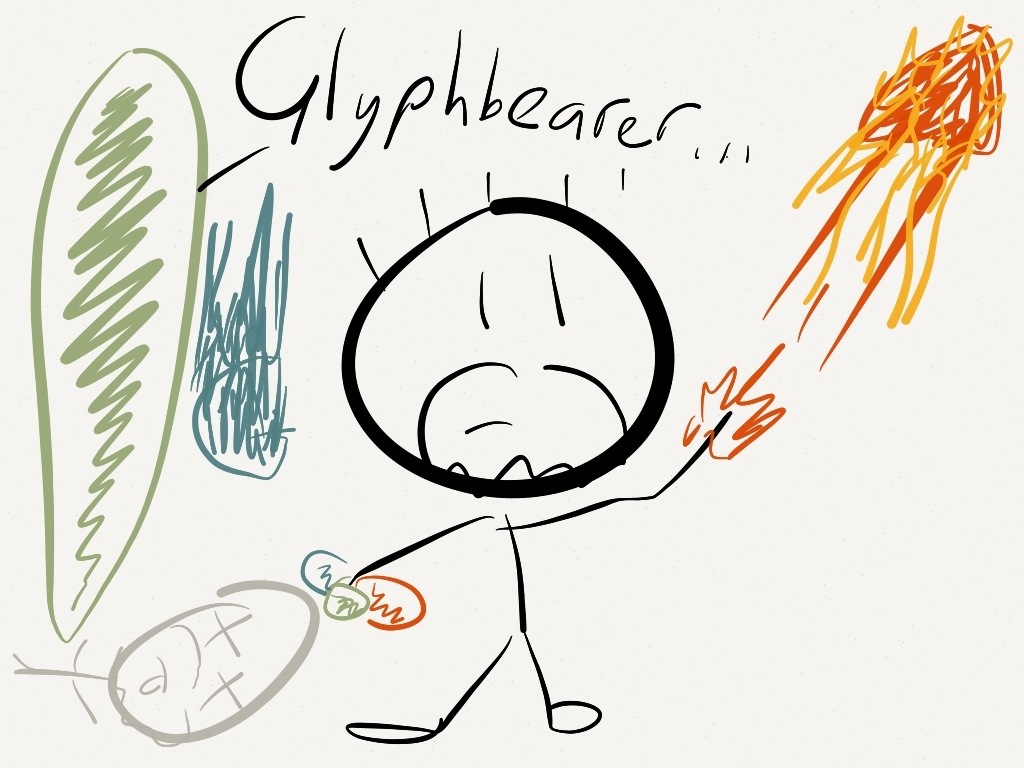
It was then he felt the strange presence behind him — a floating, glowing object depicting strange symbols.

Glyphbearer, said a resonant voice inside his head.

"What?" said Yan aloud, feeling immediately foolish, for there was no-one to speak to.

Wherever he turned, the glyph seemed to float behind him, meaning he couldn't get a good look at it. He shrugged and started trudging onwards through the snow in what he hoped was the right direction to get back to civilisation.

Gravestones littered the path here and there, marking the spots where previous Glyphbearers had fallen. Inscribed upon them were warnings and advice — "don't forget your wooden platforms", "don't jump into big holes unaware of what lies ahead", "don't forget a light source". He didn't know who had left the gravestones, but he felt it wise to follow their instructions, particularly as they always seemed peculiarly relevant to the situations in which he found himself.

Before long, he came upon the mouth of a cave. Curiosity getting the better of him, he walked inside and began to investigate.

The cavern was filled with strange mushrooms, lumps of rock and solid veins of purest gemstone. Greedily running his hands over the veins and letting the energy of elemental fire flow through his fingers, he gathered up the gemstones only to discover the strange glyph sucking them inside itself. He had no idea where the tiny, strange, floating object was putting them, but he had little doubt that they were safe.

Making a note of where the entrance was in his mind, Yan proceeded deeper into the caverns. Before long, he came upon what looked like a long-abandoned spellgem workbench — and it still held a selection of gems. He picked them up, the glyph "pocketing" them once again, and felt a rush of mystical energy flowing through him. Concentrating intently, he summoned forth a boulder of solid rock, flinging it into the air. Then a fireball, scorching the chill air as it passed. Then a ball of lightning, electricity cracking and fizzling around him as he chuckled to himself.

Satisfied with his haul, he picked his way through the caverns, back in the direction of the entrance. But he was no longer alone; the robots had come. The endless mechanical hordes had been blighting humanity throughout this new ice age, and now they were here, too. Grimacing, Yan fired off a bolt of lightning at the approaching mech, watching satisfied as it exploded into pieces. But still they came, in greater numbers.

Before long, he was surrounded. White metal robots jabbed him with their spears, while their red brethren — superiors? he thought — assaulted him with flaming masses.

He could feel his life slipping away as the machines continued their relentless assault. He was in pain, and he knew at that instant that he was never going to find out what disaster had befallen the lands.

Blackness.

Nothingness.

Anger.

Taquesha Garrett opened her eyes and found herself standing in a snowfield. She had no idea how she had got here, and no idea what the strange floating object behind her was. She sensed great power emanating from it, however, and sensed it wanted to accompany her.

She started walking through the snowfield in what she hoped was the right direction. Passing a small cave entrance, she hesitated for a moment, feeling an inexplicable sense of dread and rage emanating from within, before picking up the pace and moving on a little faster.

Before long, she came to an open area. A loud "thumping" noise was disturbing the peace, and it wasn't hard to see the source — a giant robot roaming the landscape. Figuring it was too strong to challenge by herself, she carefully and stealthily found a route past it without attracting its attention, and shortly afterwards found herself in a sorry-looking village.

A long-haired man staggered up to her. "What have we done?" he cried. "We must put our trust in the Ilari!"

Taquesha frowned, and followed the man's frantic gesturing to what passed for the village square, where three enormous crystals stood, glowing softly in the moonlight. She walked up to them and immediately felt a sense of warmth, concern and trust emanating from them.

Glyphbearer, they said in her mind. You have come.

She said nothing — she had no idea what she might be able to converse with these mysterious entities about — but in a flash, she understood her mission, if not the circumstances which had led to it.

The Overlord would fall. And these shattered lands would know peace.

She didn't know what the words that had burned themselves into her brain knew until she left the village for the first time, only to discover a strange sight. In one direction, lush green unspoiled forest. Behind her, the glacial fields she had grown up with. To the north, barren desert. And to the south, what looked like a junkyard.

Her studies of magic had given her a good working knowledge of how to craft her own spellgems, so she resolved to equip herself with some stronger magics before taking on this mysterious "Overlord", wherever he might be.

For the next few days, she explored the local area, poking her head into long-abandoned buildings and looting them of any valuables within. There was no sign of any human life anywhere save for the sole survivor she had seen back at the village. What had happened here?

In the distance, violent wind and rainstorms buffeted the landscape. She knew that if only she were able to push the winds further away from the settlement, she'd be able to better judge her surroundings and her eventual goal.

The Ilari, she thought. Maybe they can help.

She returned to the village and rested, then asked the strange crystal ones if they could help her with the wind.

Seek the wisdom of an Aquaurgist, they replied. Taquesha frowned in response. The other survivor in the village didn't seem to be much for working with water — he was more of a wood specialist, judging by the number of logs he'd chopped since she'd been there. But where to find an honest-to-goodness Aquaurgist in this strange, shattered land?

It took time, but she eventually discovered a survivor holed up in an abandoned town. Promising to protect the frightened, bearded man from the monsters that terrified him so, she led him back to the village, where he began work with the Ilari immediately on summoning the materials needed for the construction of a wind shelter.

A short time later, Taquesha had braved the howling winds and acidic rain and successfully constructed the shelter. Its vast blades span majestically through the air, and the storm, as if frightened, backed away from it, far towards the horizon.

For a time, life was good. Taquesha spent her days gathering materials for the good of the village and to assist her with her spellgem research, but one day cruel Fate decided that her time was up.

She'd snuck into a run-down warehouse, feeling confident that she'd be able to find a stash of unspoiled supplies within. Inside, it was dark, and the air was thick with tension. She knew that she'd have to be very careful here, or the strange creatures lurking in the darkness would surely destroy her.

She tensely picked her way through the first few rooms of the building safely, but before long she'd attracted the attention of a strange, fiery beast. Its roaring, in turn, brought others like it running, and as her body was wracked with pain from the burning embers striking her skin, she found herself melancholy.

It wasn't supposed to end this way, she thought. I was supposed to defeat the Overlord and save these lands. I've done so much for them already, and this is how–

Darkness.

Silence.

Rage.

Phlegethon Gogola suddenly awoke in an unfamiliar village, his long, unkempt beard and hair blowing in the chill wind of the disconcerting icy surroundings. Behind him floated a strange, unfamiliar object that unnerved him somewhat. But at the same time, he suddenly found himself with a sense of purpose.

Glyphbearer, came a voice in his head. It is time for you to begin your adventure.

Phlegethon grunted to himself. Adventure was all very well and good, but he was damned cold. He wouldn't be going far unless he could find some way to protect himself from the elements…

#oneaday Day 839: So Binary Domain is Kind of Awesome

20120507-015626.jpg

I got a few games for my birthday this year from generous people taking pity on my advancing years. I've waxed lyrical about A Valley Without Wind for quite some time now and I haven't yet got to Legend of Grimrock (oh, but I most certainly will) so that leaves Binary Domain to talk about.

Binary Domain is a third-person shooter from Sega. Created by Toshihiro Nagoshi, the producer of the excellent Yakuza series, it spins an interesting sci-fi tale about "Hollow Children" — robots designed to look like humans and programmed to believe they are human. Taking on the role of one Dan Marshall (not, sadly, the British developer of point-and-click adventure funfests Ben There, Dan That and Time Gentlemen, Please!), it's up to the player to kick lots of robot bottom on the way to tracking down the supposed creator of these illegal, ethically questionable droids.

Binary Domain could so easily have been shit. It's a game about futuristic soldiers shooting robots — you can't get much more cliched than that, after all. And yet it has a huge amount of charm coupled with an addictive quality that keeps you playing just to see what happens next.

Technically speaking, Binary Domain is a squad-and-cover-based third-person shooter, which probably makes it sound very much like Gears of War, a series which I loathe and detest. (Well, to be fair to it, I only loathe and detest the first one, but that put me off ever playing the other two.) But in execution it manages to be so much more than the thick necks and testosterone of Epic's title, and in the process it highlights the differences between Japanese and Western development. It's also helping further cement the feeling I've been having recently that Japanese games are, for the most part at least, preferable to Western — for me, anyway.

But what sets it apart from Marcus Fenix's opus of "eat shit and die"? Quite simply, characterisation. Dan begins the game as a bit of a dick, but in an endearing way rather than as an unlikeable, bland macho asshole. He's accompanied through the introductory mission by "Big Bo", a walking tank of a man who has a bit of an attitude himself. When the two are together, they crack jokes and make irreverent comments just like they're a pair of best friends in a bar together. They have a relationship beyond "Cover me!", in short, and that makes them interesting to hang out with, even if they're both quite sexist, a bit racist and generally loutish in their attitudes.

A short way into the game, Dan and Bo meet up with the rest of their team, which includes the businesslike ex-MI6 dude Charlie (who doesn't know who James Bond is); the strong, silent Brit woman Rachael; and the sexy Chinese girl Faye. These disparate characters' personalities all clash a little with one another, which again makes their interactions extremely entertaining to witness.

"Hmm, she reminds me of someone," says Bo to Dan upon meeting Faye for the first time. "A movie star or something."

"C'mon, Bo, you and I both know the only movies you watch are porn," chuckles Dan, who promptly receives a sharp dig in the ribs from his friend. "Oh… OH. Right."

Once the team is assembled, Dan is regularly invited to take two of them with him, and each have their own unique conversations with each other and our hero. Again, these exchanges are a real highlight of the experience, and show what a massive difference it makes when you bother to spend some time on your characters. If you're going to be battling giant spider robots with people, it's better they be people that you actually like, right?

There's an interesting twist, too — when characters speak, Dan can respond to them either by using a simple multiple-choice system or by actually speaking his response into a gimmicky voice-recognition system which I switched off almost immediately. (When your voice-recognition system picks up gunfire from the game and thinks you're saying the word "fuck", you have a problem, as entertaining as that might sound.) Dan's responses will affect the other characters' "trust level" with him, with them being more likely to successfully follow his orders if they trust him more. I'm guessing there will be some sort of story payoff for high trust levels, too, though I'm not far enough into the game to say with certainty yet.

As the different characters all clash somewhat, though, certain responses might piss one off while pleasing another. Crack a joke with Bo about getting crabs from a hooker and Faye might get sniffy. Tell Charlie to go fuck himself with his overly-serious military-speak and he'll get annoyed, but Bo will laugh. Your performance in combat affects these trust ratings, too — clip your teammate with a bullet and they'll get angry, but save them from certain death or pull off a particularly impressive feat and they'll give you the credit you deserve.

In this sense, Binary Domain sometimes feels like it's a role-playing game very vaguely following the Mass Effect mould. This feeling is further compounded by the ability to equip characters with stat-boosting nanomachines and upgrade weapons as well as the inclusion of "social" areas that are just about walking around talking to people, but when it comes down to it, the game is unashamedly a linear, Japanese, third-person shooter. While not quite as insanely frenetic as Sega's previous shooter title Vanquish, Binary Domain has its fair share of ridiculousness, usually in the form of giant robots which must be defeated by dropping heavy things on them, blowing bits off them, leaping onto their back Shadow of the Colossus-style or all manner of other shenanigans. It's a spectacle, as thrilling to watch as it is to play, and I'm having a blast with it so far.

Binary Domain received middling reviews on its original release, with the PC version (which I'm playing) catching particular flak for including most of the PC-specific visual and control options in a separate program rather than in the game itself. I feel that this has been focused on rather too much, frankly, as it's an issue players will encounter precisely once, before they even start playing. Once the game is set up to your liking, it looks great, sounds great and runs smoothly, which is all I ask for.

These middling reviews, however, are likely to see the game relegated to obscurity before very long. Already people are saying that they'll wait for it to become a "bargain bin title" before picking it up, purely based on reviewers' comments. And herein lies the problem: people criticise the increasing "blockbuster culture" of video games, pointing to titles like Call of Duty and Halo as symptomatic of everything that is wrong with the industry, but as soon as something that provides a different take on an established formula comes along, like Binary Domain does, no-one is willing to buy it new and take a chance on it. Thus these great games get pushed to the back of the community's consciousness, while those with the biggest marketing budgets continue to dominate year after year.

From my couple of hours' experience with it this evening, I can happily say that Binary Domain is well worth picking up now, since it's a fun, entertaining, spectacular and satisfying game that, sadly, looks set to join Vanquish and Alpha Protocol in the box marked "Sega Games That Were Actually Brilliant That No-One Played".

Make a difference. Vote with your wallet. Support awesome new games that aren't "blockbusters". Please?