#oneaday Day 919: Friendship Is Magic

I've been delving a little into the Brony community recently. As an open and "out" fan of My Little Pony: Friendship is Magic, I felt it behooved me (no pun intended… all right, maybe a little) to actually try and engage with the wider community of fans. As such, I Googled for Brony communities and came across the Friendship Is Magic forum, which I promptly signed up for.

I haven't been an active member of a forum since, ooh, about 2006 or so, I guess, when I was a relatively well-known member of the Times Educational Supplement forums. They were a good place to blow off steam about educational and general life issues as well as just chatting to like-minded people from a pretty wide variety of backgrounds — albeit usually with an interest or involvement in the teaching profession. I haven't logged in there for a very long time now for a multitude of reasons, just one of which is the fact that social media has mostly taken over the functions that dedicated online communities once had.

But I was determined to make a go of it on Friendship is Magic. I introduced myself in the relevant section and started replying to a few threads. While I don't think I've made a "name" for myself as yet, I like to think that my relatively few contributions so far have been noticed — and meanwhile, it's given me a good opportunity to observe the Brony community from within.

You see, I had no idea what a "Brony" really was. Who are these people? Are they actually anything like me, or is the only thing we have in common a love of a show that is ostensibly for little girls? I was hoping to find out through joining the forum — and, as an aside, keeping an eye on the results of the intriguing Brony Study research project, which has been aiming to clarify attitudes both towards the community from without, and towards various pertinent issues surrounding the fanbase from within.

Thus far my (purely anecdotal) observations have been interesting. Bronies cover a wide and diverse array of human beings — young and old, male and female, and varying degrees removed from what society would deem "normality". Some Bronies use 4chanesque dialect ("newfags", "copypasta" et al), others use a clear, straightforward and polite means of communication. Some Bronies like to act "in character" and roleplay their original pony creations on the forum as a means of escapism; others are simply themselves; others still take the middle road and incorporate Ponyville dialect ("everypony", "fillies and colts" et al) into their posts. Some Bronies love the show and actively participate in the huge creative community that has sprung up around it; some simply appreciate the content that others have created; others have no interest in it whatsoever.

In short, there's not really a single unifying characteristic that it's possible to point to and say "that's a Brony" — besides an appreciation for My Little Pony: Friendship is Magic, of course, and a seemingly-genuine sense of tolerance, acceptance and understanding, regardless of a person's background and regardless of the depth of their affection for the show and its surrounding subculture.

Then, of course, there's Rule 34, the aspect of the fandom that tends to get the most attention from outside. (If you don't know what Rule 34 is, you need to brush up on your Rules of the Internet. Borderline NSFW and will probably offend everyone. No porn, though.) Indeed, when radio personality Howard Stern set out to explore the fandom in a recent show, an undue level of attention was given to certain parts of the community who generally prefer their activities to be kept behind a closed stable door, shall we say. This naturally and understandably upset those Bronies who don't participate in that particular aspect of the fandom, and even prompted voice actor Tara Strong (who voices series protagonist Twilight Sparkle) to defend the entire community (and particularly the "Rule 34" crowd) on Twitter.

While the "Rule 34" stuff isn't to my taste, I'm not about to denounce anyone for either enjoying or being involved in making it. It's easy enough to avoid if you don't want anything to do with it, and it's there if you do. If it's not hurting anyone, then knock yourself out, I say. Live and let live. Stern's logic was based on a flawed assumption: the idea that if one fan likes something that is seen as "deviant" in some way, then clearly they all do! This is clearly, as I've seen even in my limited dealings with the community at large, absolute nonsense. Bronies, just like any community, come from a wide variety of backgrounds and each indulges in their passions to a varying degree. No-one's approach to their fandom is "wrong" — assuming it's not causing anyone (including the person themself) any distress — and if it's a good outlet or means of getting away from the stresses of the day then, well, keep on cloppin'.

…wait, clopping means what?

#oneaday Day 918: We Dig, Dig, Dig, Dig...

Yes, I've been playing Minecraft again, thanks largely to several members of the Squadron of Shame finally biting the bullet and jumping on the bandwagon. And, once again, I am rediscovering the sheer joy of that game.

The first time I played Minecraft I wasn't overly enamoured with it. Not because of the deliberately lo-fi graphics — on the contrary, I found them highly endearing — but because I had literally no idea what I was supposed to do, and at the time I started playing, it was largely up to the player to either work things out for themselves or refer to a wiki. Nowadays, of course, there are achievements to guide your early days in the game and basic techniques are practically common knowledge — the Xbox version also removes the need to remember the specific "patterns" to craft tools altogether, making it even more accessible and a great jumping-on point for those who have no idea what Minecraft is all about.

After spending a hefty proportion of time in Minecraft's many pixelated, blocky worlds, however, that sense of "what on Earth do I do now?" is, as it turns out, precisely what appeals to me about the game. I have no goals aside from the ones I set for myself. There is no "end" to the game aside from the time when I wish to stop playing. (Well, technically that's not quite true — you can "finish" Minecraft through a long and convoluted process culminating in a difficult boss battle against a giant evil dragon thing. But you can carry on playing after that.) The world is different each time I start a new game. And therein lies Minecraft's biggest joy.

Minecraft is like being a kid again, assuming you were a kid who never had to get home in time for dinner, and a kid who was trusted with various sharp implements. Minecraft taps into that youthful desire to explore, to discover, to see what's over that next hill, around that corner, on the other side of that sheer rock face. It taps into that youthful fear of being lost in the middle of nowhere and having no idea of how you're going to get back home. And, like those youthful expeditions into forests and caves, it's much more fun with friends.

Minecraft is what you make of it. I currently play on two multiplayer servers — one with a small group of "real-life" friends and the other with a group of people I primarily know online — the aforementioned Squadron of Shame. The differing approaches we take on each server are very interesting, and represent two very different social dynamics.

On my "real-life friends" server, everyone quickly staked their claim to their "territory" and built something big and impressive there to mark it. Tim built a huge castle; James built a wizard's tower and network of connected walkways with giant mushrooms (plus a huge tree made of trees); Andie built some quaint (and practical) little houses; and I built a large, experimental pyramid-like structure and enormous, intricately-carved bridge.

On the Squadron of Shame server, meanwhile, things were a lot more cooperative from the get-go. I was one of the first people on the server, so I took the time to establish a basic base camp — wooden hut with crafting table and furnace, sufficient to last the night. Over time, and with the assistance of others, this hut expanded with an extra room containing beds, and a large mine beneath it. Other structures sprang up nearby until our improvised "base camp" started to look like a small village. I built roads in every direction as I explored, and others followed suit to help us find our way to various impressive landmarks. When we found a cool piece of randomly-generated scenery, we talked about it as if it was a real place. Other "citadels" sprang up around the map, and we as a group went further and further afield. I constructed some kick-ass bridges.

In both cases, the world feels alive — because it is alive. It's constantly growing and changing according to how far people have explored and what they have built. It's an immensely satisfying experience to know that you've played a part in the shaping of a virtual world, whatever your contribution and whatever your particular skill sets might be. In many ways, it's similar to the satisfaction of playing an active role in something like Second Life, which I've been known to spend time in in the past, and which I once referred to as "taking a walk through other peoples' imaginations". The key difference here, though, is that Minecraft has a great deal more immediacy than Second Life — and considerably fewer prostitutes.

So if you've been holding off on playing Minecraft, I suggest you give it a shot — preferably with friends. If you have no idea what you're letting yourself in for, fire up the Xbox version and play online or in split-screen. When you're ready, grab a copy of the full experience on PC and prepare yourself for the most immersive game world you'll ever experience — the one you helped create.

#oneaday Day 917: Select an Ability to Learn

I like learning stuff. It's a fun process to start from "nothing" and gradually equip yourself with Knowledge. I've done it a number of times over the years, though I will admit that I've not taken any of these things really far enough to, say, get a qualification. But I do have a working knowledge of HTML, CSS and several specific software applications that I didn't know before, all thanks to my ability to self-study.

The trouble with self-study, though, is that it requires time — time that you don't always have — or time that you might not have the inclination to spend "working" when there are nicer things you could be doing.

It's when I think about this sort of thing that I wonder what it would be like to go back to university. I'm pretty sure there are a lot of people I know who look back very fondly on their university days, but that — assuming they went at 18-19 — the actual "studying" part of things isn't the main reason for the rose-tinted spectacles. I know it's certainly not true in my case — while it was a lot of fun to, say, get up on stage in a nice concert hall and perform music, or sit in a small room and argue semantics with a group of fellow English students, the things I remember most fondly are the extracurricular and social activities I did. Theatre Group and their various productions. Trips to the Edinburgh Fringe. Drinking in Chamberlain Bar. That time my friend Plummer came down and we got wasted on the Union's £1 triple vodka and oranges then consumed roughly a pound of cheese between us at about three in the morning. That time a shopping trolley showed up in our flat so we mounted a huge clandestine operation to get rid of it without being identified.

Now I'm a little older, I can't help but think that going back and, you know, doing it "properly" might be fun. That said, the possibility of shenanigans is also appealing. Andie and I were discussing this the other day — university is one of the only times in your life when you have pretty much all of your friends together in one place, making it an absolute snap to arrange impromptu social events. Nowadays, I don't see my friends anywhere near as often as I like, and it's sad. But I digress.

Yes. Doing it "properly" might actually be fun. Picking a topic, studying it, doing assignments, getting graded, improving. Learning something. Coming away from the experience with both practical experience of applying subject knowledge and an actual qualification to prove you've done it. Sounds pretty good to me. If I had the opportunity, I'd study something practical that I know very little about — probably something computer-related, since I've always been IT literate and willing to tinker about, but my actual specific technical knowledge of things like, say, programming is rather limited.

Unfortunately, it's pretty unlikely to happen any time soon. Going to university is very expensive, and I don't see myself surviving on the relative pittance that is the student loan any more.

That said, I do have a work-from-home job with flexible hours and good pay.

Hmmm.

Hmmm.

No. No, I can't do that. Not just to satisfy some sort of whim or early-30s crisis or whatever it is that's going through my mind right now.

What I can do, though, is take some steps to learn something new on my own time. Self-study. Perhaps signing up for some sort of evening class. I'd like to do it, certainly, it's just a case of finding — or perhaps making — the time.

Now, what to learn…?

#oneaday Day 916: You Have Earned a Trophy

I go back and forth on whether or not I like Achievements/Trophies/equivalents. Sometimes I like them. In Diablo III, for example, they became an addictive metagame once you'd ploughed your way through the main (rather predictable and marginally disappointing) story. In World of Warcraft, they provide a wide variety of things to do that reward you with tangible things with which to outfit your character. In The Secret World, they're a handy way of tracking what you have and haven't done.

But in other cases — typically in story-heavy games — they just make the sense of ludonarrative dissonance even more pronounced than it needs to be. The most egregious example I can think of was Oblivion, in which I raced through the various Guild questlines in order to get all the achievements, then the Shivering Isles expansion, then the main quest. By the end, I had all Oblivion's achievements, but had completely lost all sense of that thing that made The Elder Scrolls series special — that sense of you being a character and forging your own path in the world as if you "lived" there. Instead, all I had done was follow a checklist. It ruined it. And it soured me on Skyrim somewhat. (Well, that and the realisation that Bethesda RPGs have great worlds but some of the worst characters and storytelling in all of gaming. But that's another matter altogether.)

At the moment, I'm playing Yakuza 3. The joy of the Yakuza series is, like its spiritual predecessor Shenmue, exploration and discovery giving you a sense of immersion in the game world. What's down this side alley? Oh, it's an arcade! I wonder if I can play the arcade machine? Oh, I can! That's kinda cool. I wonder if the crane game works? Yes it does! Awesome! Oh, hey, there's an irritable-looking lady, I wonder what's wrong with her? Oh, she's had her bag snatched… etc. etc.

Since Yakuza 2, the series has had a "completion" menu that taunts players with how many sidequests they've completed, how many cabaret girls they've romanced and what foods they've eaten in restaurants. After 40 hours of Yakuza 2, I had beaten the main plot but apparently only "beaten" 33% of the game. I didn't feel short-changed, as a lot of the stuff I'd missed was simply eating as much food as possible and playing some minigames that, while fun, weren't the reason I was playing Yakuza.

Yakuza 3 compounds this problem with a Trophy list. Not only do you have a "completion" menu now, but you also have an actual checklist of Things to Do. I wouldn't mind so much if these trophies simply tracked your progress through the game, but when they demand that you spend time playing indecipherable Japanese board, dice and card games in order to score some sort of virtual trophy, that pulls me right out of the experience. It puts me in a quandary while I'm playing — "should I go and do this stuff I don't really enjoy just to get a trophy?"

The answer, of course, is "no". There is no sense in playing a game if it's not enjoyable — unless, of course, it's something like Pathologic, in which case its sole reason for being is to be less than enjoyable — but I continually see people who insist on "Platinuming" or "1000Ging" their games and feeling like they've short-changed themselves if they don't. That's fair enough, and of course it's their call if they choose to do that, but the fact is that in most cases, it becomes abundantly clear that these people are not having any fun. By following these arbitrary checklists, they are voluntarily sucking the fun out of a game that might have been a favourite.

"Oh, but chasing the trophy list is fun in itself," you might say. And for some people it might be. But for the trophy whores I follow online — who, for all I know, could be in the minority, I'll admit — pretty much every single one refers to their relentless pursuit of Platinum/1000G as "work", a "slog", a "grind", and they express relief rather than joy when it's done. That, to me, is just bizarre. Why continue doing something long after it has ceased to be fun in the pursuit of something intangible that, in most cases, doesn't benefit your in-game experience at all? Are we so vain that we need to brag about the fact that we started ten fights in first-person mode (an actual achievement in Yakuza 3) or that we spent three hours mastering an ultimately-irrelevant darts minigame just so that we could get a "hat trick" (another actual Yakuza 3 achievement)?

Apparently we are. I'm not judging you if you're one of those people who likes (if that's the right word) chasing Platinum trophies. I'm saying that I find it completely unfathomable. I have no desire to grind my way through abject tedium purely so I can get a differently-coloured virtual trophy that no-one will look at or care about. I don't beat a game, look at that trophy list and feel I've not had my money's worth if I haven't got 100% of the game's trophies. I beat a game, roll the credits and then, in most cases, move on to any one of the bajillion other titles waiting on my Pile of Shame — which, I have to admit, has only got bigger during the recent Steam summer sale.

It's easy enough to ignore Achievements and Trophies, I guess, and they certainly don't hurt anyone. But I kind of resent the "torn" feeling they give me when playing a title like Yakuza 3. I'd much rather they not be there at all than pull me out of the experience by making me wonder whether or not I should be seeking out locker keys, cabaret girls, karaoke bars, dartboards… you get the idea.

My favourite implementation of achievements in a narrative-based game? Deadly Premonition, which rewarded you with one achievement per completed chapter, one for completing 100% of its sidequests and one for completing it on each difficulty level. That's how it's done. I don't need any more incentive than that. Build your reward structure into the game and build the achievements around that — don't give me a list of arbitrary objectives that don't actually improve my game experience at all.

Achievement whores, I salute you. I'm a patient sort of guy in most cases, but you guys must be like saints.

#oneaday Day 915: No, I Haven't Seen [Insert Movie Name Here]

I haven't seen The Dark Knight Rises yet. I'm probably not going to. I also didn't see that new Spider-Man movie, The Avengers or any of the other films that people have been going apeshit over in recent months. (And, it has to be said, being extremely tiresome about. So you enjoyed The Avengers? Great. I don't need to be kept up to date on how many times you've seen it. Also, quit retweeting your friends' Foursquare checkins of when they go to see it. No-one cares.) (Sorry. Apparently I am grumpy tonight. Disregard all of that. A bit.)

I just can't "do" movies. It's not through a lack of attention span — I can happily sit and play a game, read a book or dick around on the Internet for hours and hours and hours — but I just find it impossible to sit down and watch a movie any more. There's always a lingering sensation at the back of my mind that I'd rather spend two hours doing something — anything — else.

Actually, that's true of watching movies at home. I sold most of my DVDs to Music Magpie a while back and I haven't missed them since. I have a Netflix account on which I haven't watched any movies (though I have more than got my money's worth from all the TV shows on there). The idea of watching a movie at home is just… no. I don't want to do it.

Going to the cinema is a marginally more appealing prospect because of all the associated "other stuff" that goes with it. Comfy seats, a nice dark room with a big screen and impressive sound system, a bucket of popcorn which looks like it will last forever (but inevitably only lasts until the end of the trailers) and an opportunity to Do Something With Your Friends. (Of course, that Something is sitting in a darkened room, in silence, in a straight line so it is impossible to talk to each other, so you might as well be there by yourself.)

But then at the cinema you have to deal with shite you don't have to put up with at home. The scrotes who sit behind you and jiggle your seat with their feet. People who can't eat quietly. People who won't shut up. People who won't put their bastard mobile phone away for five seconds. (I hate these people on planes, too.) People who think everything that isn't funny is absolutely, massively, hilariously funny and turn a serious scene into some sort of farce with a laugh track.

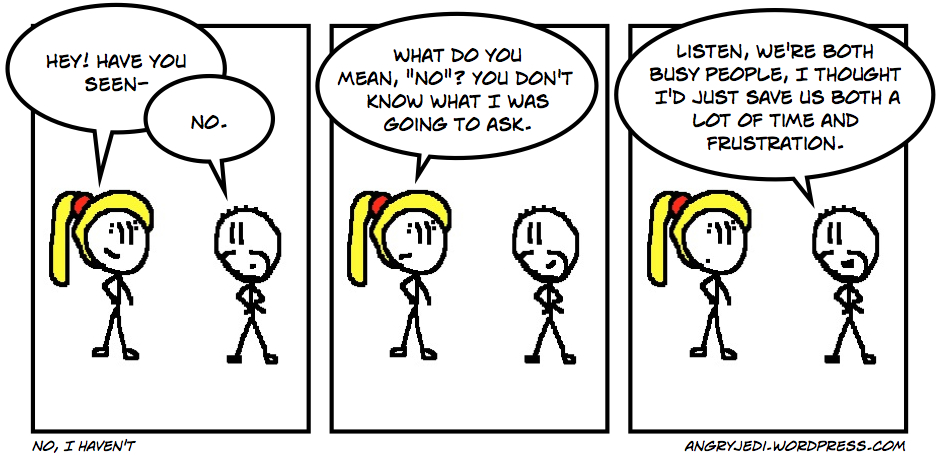
None of these things represent specific reasons that I don't want to watch movies. I simply… don't want to watch them. I am fine with this. As such, if you ask me "have you seen [insert movie name here] yet?" the answer will almost definitely be "no." You can also drop the "yet" because I'm probably not going to see it at all. So there.

I am grumpy. Now I am going to bed.

BALLS.

#oneaday Day 914: Chinese Whispers

Twitter was angry today. There was some degree of justification — the horrific shooting in Aurora at the screening of the new Batman movie had emotions running high, and I certainly don't begrudge anyone that. But it demonstrated, once again, some of the dangers inherent in social media — a force which should, by all accounts, be a positive thing.

Misinformation spreads like wildfire on the Internet thanks to services like Twitter. People post things without thinking, without bothering to back things up with research and evidence. Journalists encourage this, with TV news being a particular offender, inviting people to contribute their own thoughts on a particularly pertinent story using hashtags. It thus becomes something of a challenge to determine exactly what the facts are, and what is simple hyperbole dreamed up by the increasingly-hysterical mass of people who suddenly all think that They Know Best.

I shan't talk too much about the Aurora shooting specifically here because I haven't read up on all the gory details myself as yet. I will refer to a couple of other recent incidents where this phenomenon became particularly apparent, however.

Most recently was the "Arctic Ready" campaign, in which Shell apparently made the amateurish misstep of opening up a slogan competition on a controversial subject — drilling in the Arctic — to the public. The "Let's Go! Social" gallery page promptly became filled with anti-drilling, environmentalist slogans and it looked, by all accounts, to be one of the most colossal fuck-ups in social marketing history.

Except that it wasn't. It was actually a genius piece of social marketing, but not by Shell. No; the whole thing was, in fact, a clever ruse by Greenpeace, who then went on to troll Shell even further by picking a "winner" from the supposed competition and putting it on a billboard right outside Shell's Houston headquarters.

It should have been pretty obvious to anyone who stopped to think about the whole thing for a moment that this clearly wasn't Shell's doing. The kind of people who handle social media marketing are generally fairly savvy sorts (though there are exceptions) and would have stepped in to deal with the mass trolling of the supposed competition. In fact, they would have probably removed it altogether fairly sharpish. They certainly wouldn't have left it up for several weeks, opened up a new Twitter account just to repeatedly request that people don't retweet "offensive" adverts and generally keep poking the fire.

Unfortunately, it wasn't obvious to a lot of people. It caught people out not once, but twice — first, when the "Arctic Ready" site first appeared, and again a few weeks later when the Twitter account appeared. People posted, retweeted and commented without stopping to think about whether or not it was real. Others who were wise to it posted, retweeted and commented about how it was clearly fake. But amid all the noise from both sides it became impossible to differentiate who was talking sense and who was simply repeating the digital equivalent of what they had heard down the pub while drunk.

The Shell incident isn't the only one either. The "Today Is The Day They Went To In Back To The Future Part II" hoax has been around twice, too. Both times it caught people out. Why? Because, again, no-one bothered to check. No-one took a moment to fire up the movie and take a look. If they had, they would have seen that the claims made by whoever started that ridiculous rumour on each occasion were patent nonsense.

It happens in journalism too, and particularly in games journalism. One site posts a "Rumour:" or "Report:" story, and others pick up on it. The content spreads and becomes somewhat distorted over time. It happened today with a story from MCV which, as it turned out, apparently misreported the facts in the first place (or rather, more accurately, posted a story with a misleading headline) and was then sourced by Destructoid and a ton of other sites. This then inspired Ben Kuchera, official unelected and self-styled arbiter of How To Do Games Journalism On The Internet, to pen this piece bemoaning the whole situation, and by God I hate agreeing with Ben Kuchera — but he had a point. With a bit of research (or indeed just carefully reading the quotes that MCV included in its own piece) it's clear that the "story" (or, more specifically, the headline) that was going around simply wasn't true.

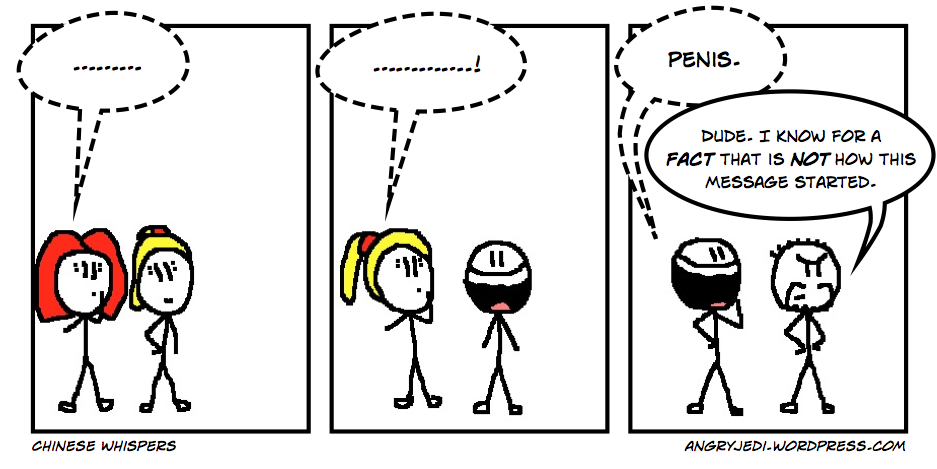
It's exhausting at times to keep up with all this stuff, and while it's great to be able to tap the pulse of everyone at the same time on a hot topic, it's less great to find yourself in the world's biggest game of Chinese Whispers. So do me a favour. Before you blindly retweet something that seems a little "off", take a minute and check to see whether or not it's actually genuine.

#oneaday Day 913: Funny Bone

Nothing highlights the passage of time more than switching on a comedy show and see who is standing on stage, clutching a microphone in their hand and talking bollocks to an audience.

Also, nothing makes you sound more like you're getting old than bemoaning the fact that "modern comedians" aren't a patch on the standups you used to enjoy.

I've never been a particularly hardcore follower of comedy, but I do enjoy a good standup show, and over the years I've appreciated the work of a wide variety of comics. I've never quite got the reason that comics rise and fall in popularity like fashion trends — surely if something's funny, it's timeless and funny forever?

Well, actually, no. That's not quite true. I recall vividly seeing a show about Tommy Cooper a while back and finding it utterly cringeworthy from start to finish. I couldn't quite put my finger on why, but it simply wasn't funny. Perhaps it's because I wasn't "of that time" that I couldn't appreciate it — but then I look back at some of the stuff that Kenny Everett and Les Dawson did, and that's still hilarious despite being a little out of what I'd describe as "my time".

The earliest real standup I was aware of was a Lenny Henry video my parents had and which I decided to watch one day when they were out. (It was "15" rated and I was not 15 at the time.) While I didn't understand everything that he was talking about — some of the stuff about marijuana went right over my head — I found it very entertaining. It's not fashionable to admit that nowadays, of course, because Lenny Henry is now the guy who did Chef! and the man who advertises Travelodges, but I still find him pretty watchable when he appears on Comic Relief and the like.

The two standups I have the fondest memories of, however, are Eddie Izzard and Bill Bailey. I could watch these guys' shows repeatedly forever. (Perhaps not forever.) Their comedy is distinctive, clever and rewarding — both in different ways. Izzard's work rewards paying close attention to how he weaves the various chaotic threads of the things he is talking about together, while Bailey's alternation between slightly-surreal standup and genuinely excellent musical numbers is just a pure delight to watch.

Going to Edinburgh a couple of times with the university theatre group was an eye-opening experience, as we got the opportunity to see a whole swathe of comedy acts — some great, some not so great. Some of the highlights included Daniel Kitson — aka the terrible DJ from Phoenix Nights — and Marcus Brigstocke, who now makes semi-regular appearances on various TV and radio panel shows. I can't remember the names of any of the lowlights because in most cases it was just embarrassing to watch them fall apart in front of an increasingly-restless audience.

I will always have a soft-spot for improvisation. At university, we played improvisation games as warm-ups for rehearsals, had a weekly "Improv Night" and hosted an occasional  "showcase" event known as Count Rompula, which tended to be largely improvised. (The Web of Dan still leaves me with shivers.) At Edinburgh, one of my favourite memories is seeing improv troupe Boom Chicago (or Boom Shit Cock, as one of our number who was constantly forgetting their name kept calling them) and marvelling at how quickly they picked up on suggestions from the audience and ran with them.

One of the things I like about Eddie Izzard's comedy, in fact, is that it has an air of improvisation about it — though it becomes clear when he successfully weaves all his threads together that there actually is a significant degree of planning that goes into one of his shows.

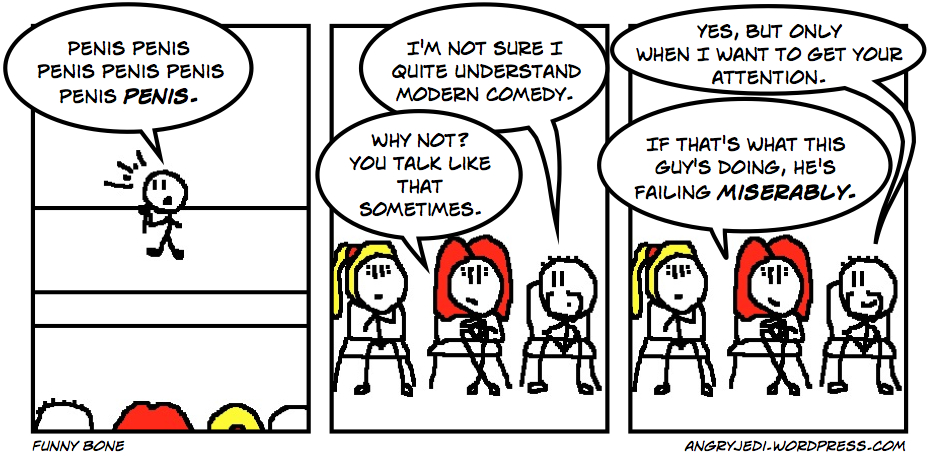
I did have a point to all this somewhere. And that is that — yes, I'm an old man now — modern comics seem to be a bit rubbish, although I am using BBC Three as my yardstick here, which may not be particularly wise. (BBC Three, for those outside the UK or simply unfamiliar with the channel, is the dustbin of television, incorporating some of the most asinine documentaries you'll ever see, a show called Snog Marry Avoid — which is exactly what you think it is — and what they call "experimental comedy". I call it "shite".) In recent weeks, I've seen a guy whose entire shtick seems to be just shouting at the audience (to be fair, Rhod Gilbert does this too and I find him hilarious — the difference being that Gilbert shouts with passion and righteous fury, while this other guy whose name I can't remember simply seems to blurt out obscenities), a sketch in rather bad taste regarding death, and a guy who sang a song about a fridge. (All right, that last one actually was quite funny.)

Perhaps I'm just looking in the wrong place for my comedy kicks these days. As I noted, BBC 3 is a big steaming pile of poo at the best of times, so I should probably start by not using that as a means of judging modern comedy. Suggestions for fun and entertaining stand-up shows to catch would be most welcome, then, so please feel free to share!

#oneaday Day 912: Blood from a Stone

I'm pleased to confirm that, after several days of wrangling, arguing and repeating myself over and over and over again, CeX finally relented and gave me a full refund. (Context.)

hate complaining. I feel like an asshole. Normally because in order to complain effectively, you have to be a bit of an asshole. I hate it because I've been on the other side of things, receiving those complaints. It's frustrating for both parties in the whole situation, because in many cases the person receiving the complaint really does want to help but their hands are tied, and the person complaining just wants things to be resolved as quickly as possible.

Such was the case with this whole debacle. It took two days of talking to someone on CeX's Twitter account and subsequently emailing their customer service team, then going in to the store where I bought the item in the first place to actually claim the refund. It would have been easy to just give up, but that would have left me £70 down and, while I don't like complaining, it was the whole principle of the thing here.

The thing that infuriated me most about the whole experience was the blindingly obvious things CeX could have done along the way to help me out. As I said in the original post, it would have cost them literally nothing to help me out and just issue me a refund. The item was already second-hand and open, so it was in the same condition as when it was sold when I returned it. It was also returned within about an hour of me having purchased it, so it's not as if I could have been using the shop as a quasi-rental service, which is — presumably, anyway — what this policy is designed to discourage.

I grant that, since there was nothing technically wrong with the item, I wasn't entitled to a refund under the various laws and regulations that govern this sort of thing. But when making an honest mistake — as I did — I don't expect to be punished for it to the tune of nearly a hundred quid.

So I complained. And I persisted. I remained polite — though clearly frustrated — throughout the entire experience. I didn't swear, I didn't insult anyone, I didn't cast aspersions on the sexual preferences of anyone's mother. I simply repeated the things that were upsetting and frustrating me in the hope that it would sink in. And I kept a close eye on the people around me on Twitter who were taking an interest in the case. There was the potential for some serious damage to CeX's brand here, and while I had no particular desire to cause trouble in that manner, the longer it went on the more it looked like being a potential PR disaster for the company — which is why I was so confused that CeX appeared to be in no hurry whatsoever to help me.

Customer service is actually relatively simple. Follow your business' policies as appropriate, but when a customer complains, review the situation carefully and determine how you can help them. If bending the "rules" slightly doesn't impact your company and does help the customer, then doing so builds considerable goodwill because it makes it look as if you've gone out of your way to help them. Apple stores are really good at this. Very often a customer will enter the store frustrated and angry that something or other isn't working, and leave with a smile on their face because they've been pleasantly surprised by an employee apparently going out of their way to do something nice. (In actual fact, said employee more likely than not knows exactly the situations in which is is appropriate to bend the rules and simply set the customer's expectations accordingly.)

This is what CeX wasn't willing to do for me. I was repeatedly quoted store policy and made to feel like an idiot for not knowing it before purchasing the item. But how was I to know? It wasn't explained to me at purchase, I've never returned anything to them before and the only place in the entire shop their return policy is mentioned is in a single sentence of roughly 10-point text on a small mat near their cash till — a mat which, I might add, is more often than not covered up by items that are being bought and sold at the time. The fact is, I wasn't aware of the policy, otherwise I wouldn't have taken the risk on the item in the first place. Repeatedly quoting it at me after the fact was just making me more and more angry, and the people who were doing so just didn't appear to notice this — or care. It became something of a battle of attrition — me repeating how annoyed I was and what I wanted out of the whole situation, them repeating their policies over and over. Something had to give.

It was them. I certainly wasn't going to back down, and the situation was looking worse and worse for them as they continually refused to acknowledge my concerns and upset. I can imagine I was probably called some fairly unpleasant names behind the scenes. But I prevailed in the end. For fairness' sake, I should say thank you to Raj on CeX's email support team and Jackie, the store manager of the Chippenham store, for making it happen.

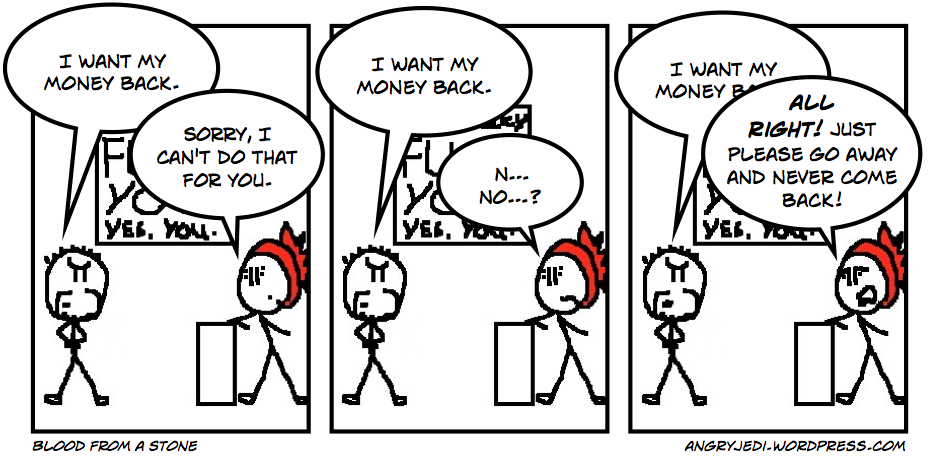
Complaining works. It's not a pleasant thing to do, and it often takes time, but it works. We've seen plenty of examples of it Getting Things Done recently — whether or not they're "important" is neither here nor there — and people should know when it's appropriate to step up and say "wait, hang on a minute, that's not right." It's all too easy to just allow yourself to get screwed over and then feel completely powerless. So don't be afraid to complain, and remember it's different from whining.

If you can't remember the difference, perhaps this will help you out:

#oneaday Day 911: Drizzt's Big Adventure

As promised at some point in the near past, we got to play The Legend of Drizzt as a larger group tonight, and it was fun.

The thing with a lot of dungeon-crawlers is that they often take a long time to set up, a long time to play and only tend to become especially rewarding if you have a group of players who can commit to a long-term campaign with player characters gradually increasing in strength through acquired treasures and levelling up.

The thing with The Legend of Drizzt is that it ignores all that, creating an experience very friendly to a board game group more normally accustomed to self-contained experiences. Each adventure in the Legend of Drizzt book is playable within an hour or two (less if you mess up particularly badly!) and is constantly moving forward thanks to mechanics that minimise "downtime" and help prevent the age-old Advanced Heroquest problem of a randomly-generated dungeon becoming so sprawling it covers the entire table.

Play is much more strategic than I was expecting, too. With multiple players, positioning and turn order becomes much more important as you carefully consider how to tackle the situations you face. Do you kill every monster you come across? Do you spread out and push "forward" in as many directions as possible or focus your efforts? When victory is in sight, do you race for the goal or play it safe?

The high level of difficulty in the game helps matters enormously. Because it's highly likely you'll get to each scenario's "endgame" with a sliver of health and a selection of depleted abilities, securing victory becomes a matter of making some very difficult choices as a team and determining whether or not taking big risks is going to pay off. In the case of the adventure we played this evening, we scraped victory by the narrowest of margins — one of our number was down for the count, and if the turns had come around to him one more time, we would have lost with the finish line in sight. Fortunately, we prevailed.

I'm very pleased with how the play session went this evening and look forward to playing it again in the near future. It's a great game that I can highly recommend to anyone who enjoys the dungeon-crawling experience but who doesn't have the time (or inclination) to commit to a lengthy campaign. I'm curious to try the other two games in the series — Castle Ravenloft and Wrath of Ashardalon — and see how it's possible to link the games' various components together, as the core system seems very much designed to be expanded and experimented with.

For now, though, bed, and dreams of being able to play games with friends on a more regular basis in the near future…

#oneaday Day 910: Continued Adventures in The Secret World

I'm still playing The Secret World and still enjoying it. Generally a pretty good sign for an MMO is if it can maintain my attention through the first month and convince me to continue paying the subscription fee (if applicable) past that point. The Secret World is certainly keeping me occupied and entertained, and I'm enjoying it a great deal.

I've progressed somewhat since the last time I discussed the game. I'm in the second of the game's main "adventure" areas, which is another part of the Innsmouth-style Lovecraft town. Rather than the more "towny" area that you start in, the second part is more like a forested outskirts area. There are fewer houses, streets tend to wend their way into the depths of the woods, and there are creepy Twin Peaks-style lakes with mist rolling off them (and monsters lurking in the fog, of course).

The missions continue to display an excellent amount of variety. There are a few more "kill [x] of [y]" action missions than I'd perhaps prefer there to be, but they generally have more of a narrative incentive to progress than in other MMOs. For example, in one mission I completed tonight, I was tasked with killing a bunch of draugr and then burning their bodies. This attracted some more powerful draugr, which I then had to kill and impale on some spikes. This attracted a draugr queen, which I then had to kill and splay out on a pointy rock. This attracted a draugr berserker, which I… you get the idea. This process continued through several steps, with increasingly more difficult fights along the way. At the end of the quest, my "handler" and I reached the conclusion that the draugr had an organised hierarchy and chain of command that could potentially be exploited in the future. Much cooler than simply returning to a questgiver and them going "thanks for killing all those wolves". (Praise should also be given to the fact that, this being the modern world, you turn in quests simply by phoning your handler rather than having to return to whoever gave you your quest.)

The fact that most missions incorporate something a little more than just plain killing is the best thing, though. In another one I completed today, I had to gather mushrooms from various areas around the map (guarded by horrible slobbering things from the depths of the ocean, natch) and then mix them together according to a recipe on a scrap of paper I had to remember I'd been handed at the start of the quest. The Secret World assumes a certain degree of intelligence on the part of the player, and doesn't remind you that, say, the instructions you need to complete a quest are safely in your journal — or, indeed, that sometimes you have to use the crafting interface to complete an objective.

Speaking of the crafting interface, it's a surprisingly cool approach somewhat reminiscent of Minecraft, of all things. Disassembling equipment you don't need rewards you with raw materials, which can then be combined together to make various objects. The twist is, you have to arrange them into the correct formations to produce the things you're after. You can then add things like glyphs to give them special abilities and bonuses and customize them.

I even tried a bit of PvP the other night. I normally hate PvP in MMOs because in most cases it's a horribly unbalanced afterthought that simply isn't any fun whatsoever. It is terrible in Star Wars: The Old Republic, for example, and I've never really been a fan of it in World of Warcraft, either. The Secret World has some interesting ideas, though, that make PvP well worth engaging in.

There are currently (I think) three PvP areas in the game. Two of these are instanced battlegrounds in which players take part in timed team-based matches according to whichever faction they're on. The other, though, is a large map which has persistent PvP going on at all times. A number of facilities cover this map, and it's up to each faction to capture (and, ideally, hold) each of these locations. There's a strong incentive to do so, because all players of a given faction receive ongoing buffs according to how many facilities their secret society is in control of.

And people are playing it well. The chat channels in the PvP areas are full of people actually bothering to talk to each other, strategise and coordinate their efforts. The Templars appear to have a bit of a numbers advantage, but that certainly hasn't stopped my faction, the Illuminati, from having a bit of fun — especially during quiet periods. Which is nice.

All in all, then, Funcom have done an excellent job in shaking up the very stale MMO space and creating something that it distinctive, entertaining and downright compelling. Its writing is good, its world is beautifully crafted and the whole experience is wrapped together with some unconventional but very effective game mechanics that successfully distinguish it from the million and one World of Warcraft clones out there. I strongly suggest you give it a try if you get the chance.