#oneaday Day 941: Scrivenings

I've been spending a bit more time with Scrivener, a writing tool that I picked up a while back and then didn't do much with for a little while. Having paid actual money for it, though, I figured it was high time I delved into it and actually started using it for a project rather than it being one of those things that just gathers (virtual) dust as a symbol of past good intentions.

I decided that the project I was going to use it for was a visual novel. Regular readers will know that I find this simple but effective form of interactive storytelling to be a fascinating medium, and I have been toying with the idea of writing one for quite some time, usually falling at the first hurdle when I remember I have little-to-no graphical talent, which somewhat precludes me from incorporating the "visual" bit.

But, I figured, no sense worrying about graphics if there's nothing for them to visualise. So I decided to actually start writing it, and to use Scrivener to plan it out in advance.

Now, when I write, I must confess that I rarely go through a formal "planning" process. This is probably fairly evident in these daily blog posts, which tend to spew forth directly from my brain and out of my fingers in some sort of hideously unorganised stream of consciousness. But it's the way I've generally worked on more formal pieces over time, too. During A-Levels and university, I never "planned" an essay on a piece of paper beforehand. I never used the "outline" function of Word, I never scrawled things on Post-Its and then moved them around. I just wrote, then tweaked, fiddled and moved things around once I'd written a first draft. It worked for me.

Mostly.

That approach doesn't work so well with long-form fiction, whether you're attempting to create a linear narrative for a novel or a non-linear branching narrative for a game or visual novel. I have a number of stalled novel projects on the go simply because I'm not entirely sure where they're going. In some cases, I have an idea of what the end might be, but it's the stuff in the middle I haven't figured out. How to get from the beginning to the end, as it were.

So, as I decided to start work on this visual novel project (which, like an irritating PR agency for a company making an iOS game you don't give a shit about I'm "not ready to talk about yet") I also figured that I would give this whole "planning" thing a shot. I recalled seeing the spectacularly comprehensive flowchart for Katawa Shoujo (mild spoilers within), and knew that if I was going to put together even a relatively simple VN project, I would have to figure out some sort of way to keep it organised.

Fortunately, Scrivener has delivered just that brilliantly. In order to plan out the basic sequence of events, I've used the "corkboard" facility and its special mode where you can drag around virtual index cards as you please. I've written short synopses of each scene on each index card and laid them out in a logical fashion to depict the various routes the player might be able to take through the story. Each index card then corresponds to a separate "subdocument" in the whole Scrivener project, allowing scenes to easily be split up and composed a little bit at a time rather than simply being confronted with a daunting blank page and no idea where to start.

Then there's pleasing little touches that help with the actual writing process, too. When writing in "Script" mode (which I'm using to compose the VN), simple keyboard shortcuts allow you to easily switch from writing actions to character names to dialog and back again. You can create links to other subdocuments or your research (which you can also store within your Scrivener project). You can split the editor window so you can refer to a piece of source material as you write. And when it's all done you can "compile" your project ready for publishing as a physical product, ebook or other format.

I've barely scratched the surface of the features it offers, but already I can see it becoming an essential part of the writing process. Progress on the VN project is going well so far — I've synopsised (huh… according to spellcheck that IS a word) the whole of the first "act" of the game and am now starting on in-depth scripting for each scene. Following this, I'll work on the various diverging paths through the narrative and hopefully end up with a suitably comprehensive document ready to plug into Ren'Py and then flutter my eyelashes at someone who can draw. Following that, who knows? Perhaps I'll have a finished game one day.

#oneaday Day 940: Insert Coin

When I was young, I loved arcades. There was something magical about going to one of those dingy rooms, inserting your pocket change into a slot and playing games that were far beyond anything home computers and consoles offered. The arcade experience was all the more "special" here in the UK, as traditional game arcades tended to only be found at the seaside. As a resident of a landlocked county growing up, a trip to the seaside was typically a sign that it was "holiday time" — and, consequently, "arcade time."

I liked the arcade experience so much I regularly tried to recreate it at home. I liked playing games that specifically called the feeling of playing an arcade game to mind — I recall Stratos on the Atari 8-bit being one of the earliest examples, later followed by the (rather poor) Atari ST ports of titles like Turbo OutRun and After Burner. I also loved the original Starfox/Starwing for how much it felt like it could have been an arcade machine — everything about its presentation called to mind a "50p a go" sit-down machine that was actually hooked up to my television. Especially the noise it made when you pressed Start on the title screen. (Seriously. I loved that game almost entirely for how arcadey that noise was.)

For some reason, though, I've never owned an arcade stick — the ultimate accessory in making your home gaming systems feel authentically arcadey. I think it's been partly due to the fact that I've never been particularly good at fighting games — the primary reason most people get such a peripheral. But with Persona 4 Arena and Dead or Alive 5 coming soon, I figured it was time to take the plunge and give one a try, particularly as it would also likely prove to be a fun addition to the "bullet hell" shmups I like playing, too.

The stick I eventually settled on — after the whole CeX/PS3 Street Fighter IV stick debacle, now thankfully resolved — was the catchily-named Qanba Q4RAF. I can pretend to know what I'm talking about when I say that this stick has Sanwa components and is dual-modded out of the box to allow compatibility with PS3, Xbox 360 and PC. The latter feature is the primary reason I chose this stick — it's not the cheapest, but given that I wouldn't have to buy additional sticks for the other systems if I found myself enjoying the more authentic "arcade" experience, it seemed like a sensible option. I have it on the good authority of the Internet that Sanwa components in an arcade stick are A Good Thing, too, so there's that.

I spent a bit of time trying it out today. In Street Fighter IV on the PC, it performed admirably, and allowed me to reliably perform a Shoryuken motion without any difficulty whatsoever — something I have always had trouble doing on a pad, and particularly on the Xbox 360's dreadful D-pad. Just the positioning of the buttons made a lot of moves significantly more comfortable to perform, too. So while I am no expert at virtual fisticuffs as yet, I feel that using the stick will certainly help me to get better.

I also tried it out with Deathsmiles on the 360, one of my favourite shmups. Here, the stick really came into its own, allowing easy shooting in both directions as well as access to the game's other functions. The digital stick proved a lot more sensitive and accurate than I expected, too, allowing for very precise movement amid the hails of bullets. I'm looking forward to trying it out with titles like DoDonPachi Resurrection, Akai Katana and Gundemonium Recollection.

Finally, I tried it with Scott Pilgrim on the PS3. Again, it worked well, with the chunky controls and clicky stick feeling very much like the way this game was intended to be played. A successful test all round, then — and absolutely no issues in switching between the three different platforms.

I'm a total convert, then — and now very much looking forward to the experience of playing Persona 4 Arena properly arcade-style. Hell, just looking forward to playing Persona 4 Arena. Damn, I miss those characters.

#oneaday Day 939: Deeper Into the Dark

Last night, I had the good fortune of being able to spend some more time with my friends playing Descent: Journeys in the Dark Second Edition (hereafter, once again, referred to as Descent 2). The game has been a big hit so far, which is pleasing, as there's a hell of a lot to it and a significant amount of replay value even once your group plays through the 20+ hour campaign once.

This time we had a full complement of five players — me as the Overlord and four hero characters, two of whom we "boosted" up to an equivalent level to the two who played the first quests in our first session. We took on a new quest and played it through to completion. It took significantly longer with five people as this (1) meant that there were four people to argue about the best way through which to eviscerate my monster minions and (2) I had more monster minions with which to attempt to eviscerate my four opponents. Overall, I found it a much more satisfying experience with five players total, which perhaps explains why the game's BoardGameGeek page rates it as "best with 5 players".

The game has so far appeared to be weighted quite heavily in favour of the heroes in that they have won every quest so far. I'm not complaining about this, mind — it's quite fun to struggle against these difficult odds, and I'm assuming (hoping, really) that the odds will even or perhaps tip in my favour as the campaign progresses to more difficult challenges. Or, of course, I could just be rubbish at being the Overlord. (I know for a fact on more than one occasion I screwed myself out of a potentially significant advantage by forgetting to play Overlord cards such as "pit trap" and "tripwire" that could have stopped players from moving and thus blocking me off from completing objectives — but this is entirely my fault, so I didn't ask for a "do-over" as that wouldn't really be in the spirit of things. I have learned my lesson.)

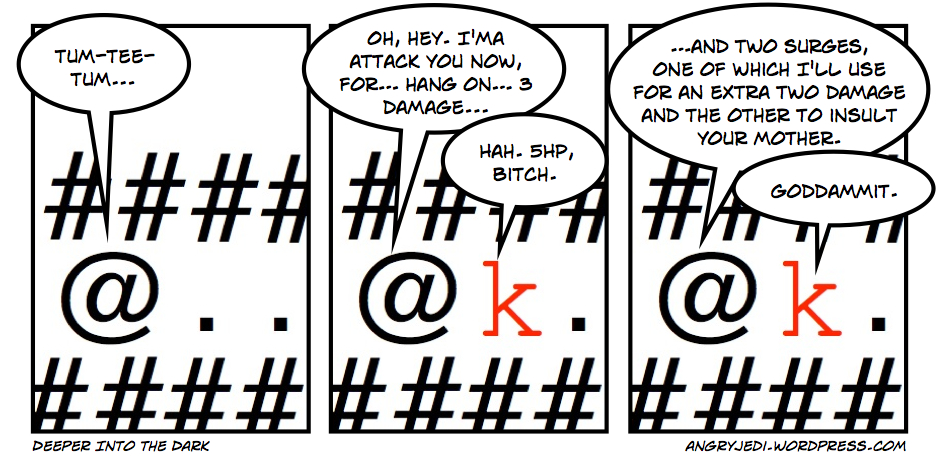
There are a ton of things to like about the game, though. Unlike many "dungeon crawlers" (which, as I've previously said, Descent 2 really isn't) the rules are relatively lightweight, but pretty flexible, and the custom dice used for combat allow for a large amount of variety. For the unfamiliar, every attack roll uses a blue "attack" die, which has a 1 in 6 chance of missing and does varying degrees of damage on its other faces. Each weapon or special attack then uses one or more of the red and yellow dice — red ones offer the potential for more damage, while yellow ones offer more in the way of "surges" — little lightning-bolt symbols that can be spent to perform a weapon's special actions — some might be able to "pierce" the enemy's defensive dice, for example, while others might do additional damage, apply an effect or knock the unfortunate victim backwards. Combine the various weapon, skill and item cards with the pool of dice available and you have a wide variety of possibilities that keeps combat constantly interesting.

And that's just within a single encounter. Pulling back to look at the bigger picture, the entire campaign can play out completely differently according to how the heroes and Overlord perform, and the quest choices that the hero players make. Rather smartly, the game only requires players to complete three out of five possible "Act I" quests before an "interlude", followed by three out a possible ten "Act II" quests, each of which is presented as part of a pair according to whether the heroes or Overlord won the corresponding act I quest. I didn't explain that very well. Basically, Act II's available quests change according to who won various quests in Act I. There, that's better.

On top of that, the Descent 2 Conversion Kit allows content from the original Descent: Journeys in the Dark to be used with Descent 2, opening up a whole swathe of possibilities. And then you can guarantee that Descent 2 will also have its own expansions ready to roll before long, meaning that this is a game with a potentially very long lifespan — which is why I'm so very pleased that my group has taken to it so well. Anything that puts off yet another humiliating, crushing (and bewildering) defeat in Agricola is just fine with me.

#oneaday Day 938: Stop Shouting, Start Talking

As I have said before on a number of occasions, I do not enjoy conflict, disputes, arguments or anything that gets a bit "heated". My own social anxiety tends to make me overthink it and repeatedly go over it in my mind and worry that it's "personal", even if it isn't. And the sort of passive-aggressive comments that inevitably come up when one of these situations arises inevitably make me paranoid that they're talking about me, even if they aren't.

But that's a little off the point of what I wanted to talk about, though it does involve conflict.

For those who weren't following the debacle on Twitter earlier, Gearbox Software, developers of Borderlands 2, chatted with Eurogamer about an addon character that would be following the game's launch. The developer in question (Hemingway? I'm writing this on my phone so can't be arsed to multitask) commented that this character had a skill tree called "Best Friends Forever" that provided a number of significant boosts to a less skilled player, allowing them to play alongside someone very familiar with first-person shooters and still have a good time. Things like being able to ricochet bullets into enemies if you aimed vaguely near them rather than having to be properly accurate — real noob-friendly stuff, and actually a really good idea to make the game accessible to less skilled players, or two co-op partners of uneven skill.

The trouble arose when the developer referred to this particular set of abilities as "for want of a better term, the girlfriend skill tree". This was misquoted by Eurogamer in its own article as "girlfriend mode" and the whole thing then spiralled out of control through the usual game of Chinese Whispers, making significant proportions of the Internet very angry indeed and effectively tainting what was actually a very good idea with the distinct whiff of sexism.

The dude's words were ill-considered and stupid and Gearbox should have apologised for them rather than poncing around trying to do "damage control" like they instead chose to. The fact they were said at all is symptomatic of a large sexism problem within the video games industry, and this is an issue that should be addressed.

Addressed calmly and rationally.

Unfortunately, that latter part is what is escaping commentators on both "sides" of this debate. One side starts yelling about how awful this is, making increasingly over-the-top arguments, then the other strikes back in exactly the same way, leaving everyone looking rather foolish. I of course understand that this is something that people are passionate about — particularly feminists who work hard to promote a much-needed female equality agenda — but "passionate" should not mean the same as "angry" or, at times, "disrespectful". Any time either side descended into all-caps sarcasm (and BOTH sides were guilty of this several times throughout the day) it just ruined the point of what they were trying to say and ended up looking rather childish, really.

I'll reiterate: I believe sexism is a problem in society, particularly in the video games industry. But spitting feathers, swearing, making false comparisons, wilfully misquoting things and taking a "who can shout loudest" approach is just counterproductive, surely. I accept that it is frustrating every time something this stupid happens, and I agree that it should be talked about — there were plenty of people out today just wishing everyone would shut up, which isn't a helpful attitude to take — but yelling isn't the right way to go about it because it just leads to a downward spiral of both sides becoming more and more defensive.

Instead, what is needed is rational, sensible, calm and honest discussion. Those upset by the comments should be able to point out that they were upset — and why — without fear of reprisal. Those who didn't see why there was a problem should open their minds and see the other side's viewpoint rather than immediately going on the defensive. And the hidden third faction who just wanted everyone to shut up should calmly accept that different people hold different views, and just because they don't want to hear about something doesn't mean that no-one should talk about it.

Unfortunately, the very nature of the Internet means that immediate, passionate knee-jerk reactions are the way most people go — and once someone gets up on their high horse it's very hard to get them down again, regardless of what viewpoint they hold. It becomes exhausting for everyone involved and everyone observing, and just ends up leaving a distinctly bitter taste in the mouth — one that could have easily been avoided had the issue been addressed promptly, calmly and rationally by everyone involved.

Instead, we get what we had today, which was a bit of an embarrassment for everyone involved. I sincerely hope that one day we can sit down and talk about these things without all of the RIGHTEOUS FURY, because then we're much more likely to get something productive done about it.

Because seriously, people, it's 2012 and we're still discussing gender issues. Surely the human race should have moved past this sort of discrimination by now?

At least there are certain corners of the Internet where sexism is tackled effectively, calmly and rationally — just as it should be. Check out this great story to see How It's Done.

#oneaday Day 937: The Olympics Are Closed

The Olympic closing ceremony finished not long ago, a little late, and now it's back to normal for Britain until the Paralympics start, at which point everyone will suddenly get interested in sport that isn't premier league football again for two weeks and then forget all about it when that is finished. (Incidentally, people, you can stop saying "don't forget about the Paralympics" any time you want. They're still quite a way off. I doubt anyone is going to forget they're happening — and more to the point, I doubt the media will let anyone forget they're happening, either.)

The closing ceremony was… well… uh… a bit poo, really. After the genuinely impressive spectacle that was Danny Boyle's opening ceremony — noteworthy for its greatest achievement, which was stopping British people from being snarky for two whole weeks — the closing ceremony just couldn't match up, and seemingly made no effort to.

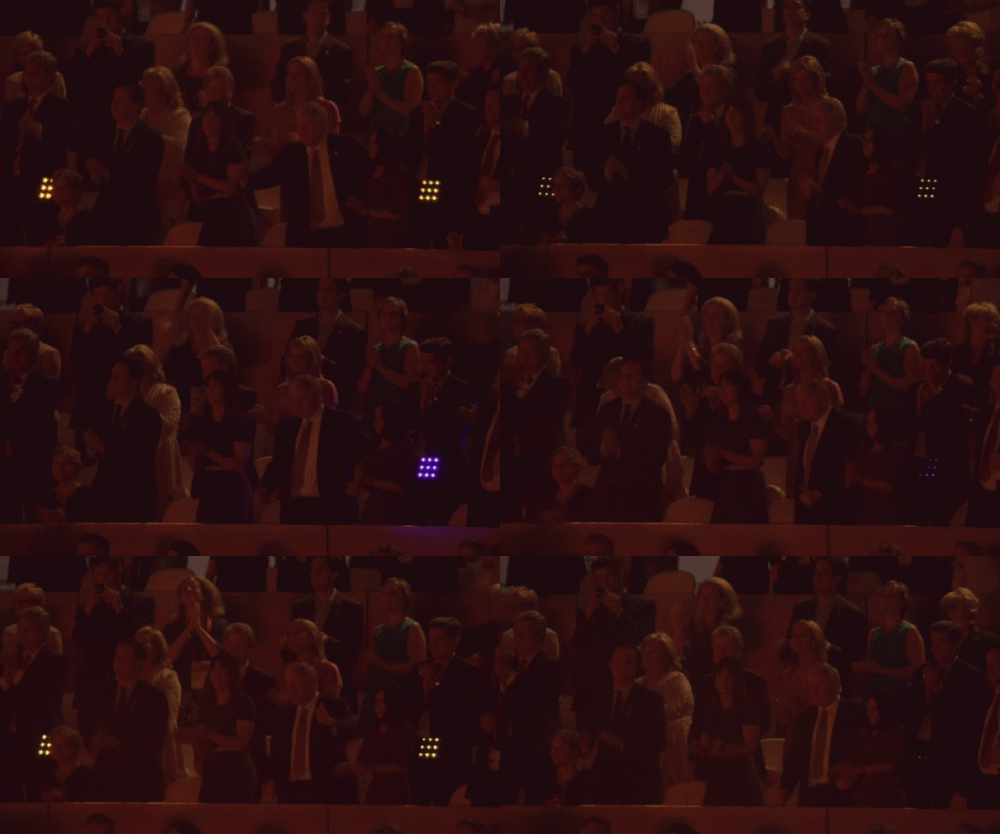
This is nothing new for Olympic closing ceremonies, of course, which always tend to be a bit poo, particularly when compared to the opening counterparts. But this was just… bizarre, really. And not especially good. There was a lot of celebration of British music that wasn't that good — Jessie J, Tinie Tempah, Taio Cruz (no, I didn't know he was British, either) were particular lowlights — and some utterly sacriligeous bollocks in the form of Jessie J butchering Queen with her characteristic out-of-tune caterwauling. Apparently the Spice Girls were involved at some point, but since I had left the room to go for a dump as soon as a video of John Lennon came on whining his way through "Imagine" showed its face, I missed them. And I'm not sorry. The Spice Girls never were good live. They were, however, responsible for this .gif of David Cameron clapping on "1" and "3" (twat!) and Boris Johnson dancing like your embarrassing uncle at a wedding:

Perhaps the most noteworthy thing about the closing ceremony was the palpable sense of relief as 60 million British people all unlocked their underpants and let rip with one of the biggest waves of snark I've ever seen. Everyone was obviously backed up from two weeks of genuine pride in the country, the achievements of our athletes and the fact that holy shit you guys, we did an Olympics and it didn't suck! It was obvious that everyone felt a lot better after ripping the shit out of the closing ceremonies, so it is, of course, entirely possible that the whole event was designed with precisely this in mind. In which case the whole thing was a wonderfully-crafted work of art that managed to get two weeks' worth of clogged-up snark well and truly ejaculated from the British public just in time for us to go back to the humdrum mundanity of everyday life tomorrow.

Or perhaps it was just a bit poo, really.

Still, regardless of how it ended, the Olympics have been an impressive spectacle and it's been nice to see people taking pride in athletes who obviously do what they do for the love rather than the money. There have been many comments over the last two weeks concerning the obvious differences in attitude between the (mostly) very sportsmanlike Olympians and the whiny, overpaid, spoiled little crybabies that are premier league footballers, and it's true. I hate football precisely for the attitudes that are typically on display from the oafs who are at the top of their game, and there was not a trace of that throughout the Olympics… well, for the most part, anyway. Winners often appeared to be genuinely humble and proud of their victories, while those who missed out on gold didn't tend to blame the referee, the other team, the other manager, the fans or anyone — they simply remained gracious in defeat and, in many cases, promised to come back fighting even harder at the next opportunity.

That's the true thing that should be celebrated from these Olympics. The opening ceremony was cool, sure, and the closing ceremony was entertainingly bad, but neither of those two things are what the whole experience is about. It's about taking pride in the sporting achievements of one's country, and if it can even crack the jaded, cynical old heart of a curmudgeon like me then it's truly something to be applauded.

#oneaday Day 936: Biggest != Best

No, I'm not talking about penises.

Let's talk about Facebook.

Facebook is massive. Facebook has taken over most people's daily existence on the Web to such a degree that there are plenty of people out there who genuinely believe that it is the Web. Like, all of it.

It's not. But then you probably knew that already.

But the fact stands that it is a massive global phenomenon, and something that has happily grown and evolved over time from its humble beginnings up to the multi-bajillion dollar business it is today.

Thing is, though, as it's grown, it's sort of lost sight of what it's for.

"Facebook is a social tool that connects you with people around you," the login screen used to say. When adding a friend, you used to have to indicate how you knew them, and the recipient of that friend request had to verify your story. It was actually quite a good idea that got around the MySpace "friend collecting" issue, whereby people would just add and add and add each other and then not talk to any of their 40,000 friends. Facebook's systems ensured that you 1) were actually friends with the people you marked as friends and 2) didn't fall into the "popularity contest" trap.

Whizz forward to today, and the Facebook of 2012 is a very different place. Now we get people promising "2,000+ friend requests" if you Like one of their pictures. I don't want two thousand friends. I want my online friends to reflect people I actually know, and occasionally give me the opportunity to meet someone new who is relevant to my interests and/or knows people that I know. Give me two thousand newcomers from all over the world, all of whom are vying for my attention simply to make some arbitrary number higher than everyone else, and you sort of lose that.

Part of the reason for this change is the different in what Facebook thinks we should use it for these days. I first joined the site quite a while after many of my friends had — at the time, I assumed it was going to be one of those passing fads like MySpace, and would quickly disappear into obscurity. But I found its value while on a trip to the States to visit my brother — while abroad, I could share the photographs I'd taken and easily stay in touch with my friends as a large group rather than emailing them individually. It was nice.

Over time, things started to shift. Facebook's big change to something a bit closer to its current layout upset a lot of people, and the addition of "applications" marked the beginning of how the social network looks now. At the time, I was of the attitude that the people complaining about it were bleating on about nothing, but in retrospect they may have had a point. As everyone's news feed started filling up with FarmVille brag posts, the signal to noise ratio started getting worse.

Then came the brands. Facebook undoubtedly thought they were doing everyone a favour when they opened up the previously "personal" social network to companies and businesses who wanted to grow their social presence. And in some cases, it worked well, with companies able to engage with their customers and post important information as and when needed.

Unfortunately, this too lost the plot somewhere. Now, pretty much every brand page uses the same obnoxious "engagement strategies" to keep people commenting, talking and Liking — the worst of which by far is the fucking awful "fill in the blank" status update that invites commenters to give their own meaningless opinion on something utterly asinine and irrelevant to the company's product. ("My favorite color is ____________!" proclaimed the Facebook Page for The Sims 3 on one memorable occasion. Over four thousand people replied.)

You see, people seem to absolutely love posting things that have absolutely no value. People love thinking their opinion is important, that they are being listened to, that the things they say are somehow valuable to someone.

The things you say are valuable to someone. The people they are important to are called your family and friends. Not the PR representative for The Sims 3. They don't care what your favourite colour is. They just want you to keep giving them page impressions and comments and Likes.

Likes. Fuck Likes. The Like button is Facebook's most enduring legacy, and one of the biggest blows to actual communication in today's connected world. Why comment any more when you can just click "Like"? It means nothing, particularly when it's connected to a sentence for which the verb "like" is completely inappropriate. ("My grandad died. So sad right now." "Insensitive Twat likes this.") It's a meaningless metric designed to measure how many people have seen something you have posted and want to interact with it, but are slightly too lazy to actually write anything.

The diminishing sense of Facebook's usefulness for actual communication is perhaps best exemplified by the current way someone's profile looks. Known as "Timeline", the theory behind it is that it is an easy to navigate history charting everything interesting that has happened in someone's life.

It's a sound plan. Unfortunately its implementation is just terrible.

The problem is that there's no consistency in how posts show up, and seemingly no understanding of how people read content. Leaving aside the fact that one's profile cover image and fairly pointless basic information takes up over 500 lines — or nearly half of a 1920×1080 display — there's seemingly no rhyme or reason as to what gets posted at the "top" of one's profile.

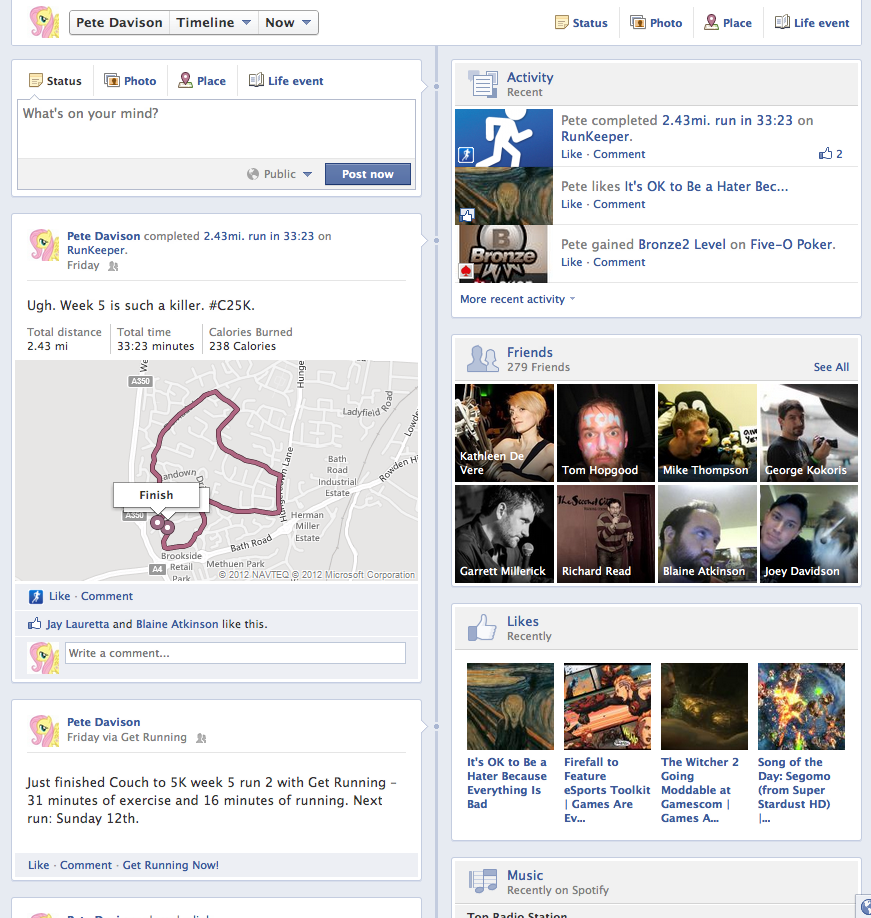
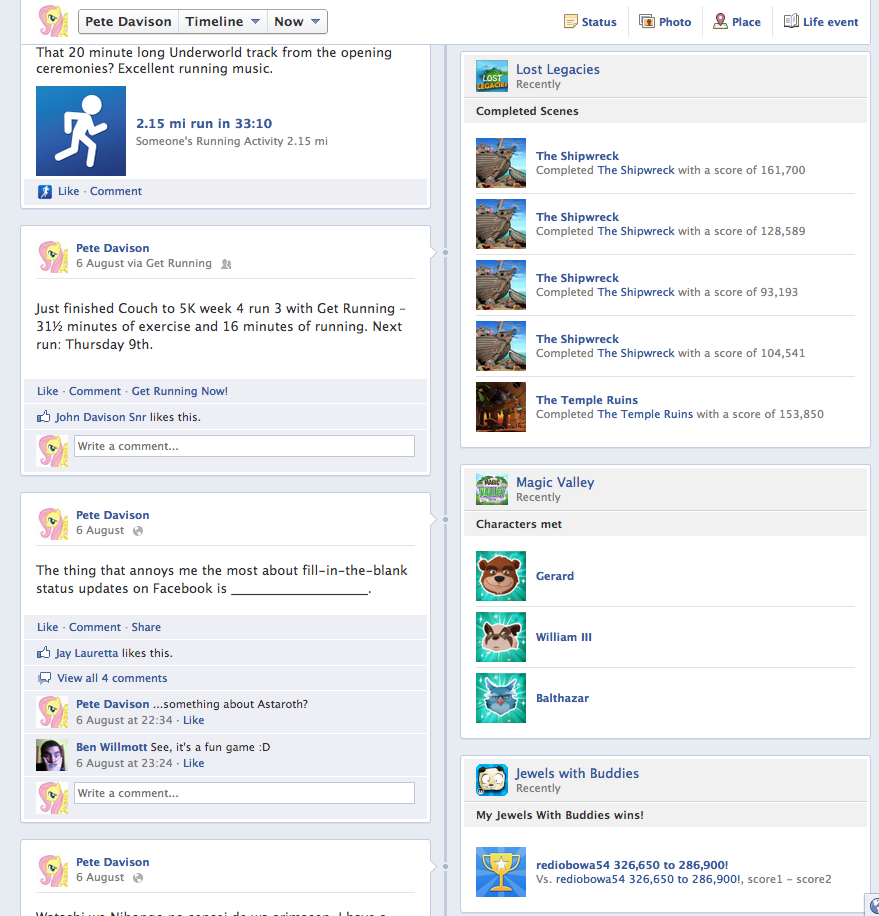
The conventions established by blogs and earlier social networks dictate that the most recent things go at the top, so anyone checking in on someone's page doesn't have to scroll around or search to find something new. Yet with all the sources from which Facebook can pull information these days — games, external sites, apps, Spotify, Netflix —  there is no consistency in what goes where. For example, at the time of writing, this is what the top of my Timeline looks like:

What a mess, and very little of it is stuff that I 1) actively shared and 2) feel people really need to know. I deliberately shared the RunKeeper stuff because I like sharing my fitness achievements because it helps keep me honest, but I have no need to show people who eight of my friends are, nor do people need to know that I achieved Bronze Level 2 in Five-O Poker, a game I reviewed earlier in the week and specifically told not to share shit on my timeline. At the other end of the spectrum, pages that I have "Liked" elsewhere on the Internet — and thus wanted to share with others, perhaps because I wrote them or just found them interesting — have been unhelpfully collected into a single box that shows just four of them. This behaviour changes seemingly daily, with Liked pages sometimes showing up as individual posts on one's Timeline (useful) and sometimes being collected into that box (not useful). At the time of writing, Facebook appears to have decided that "not useful" is the way to go on this one.

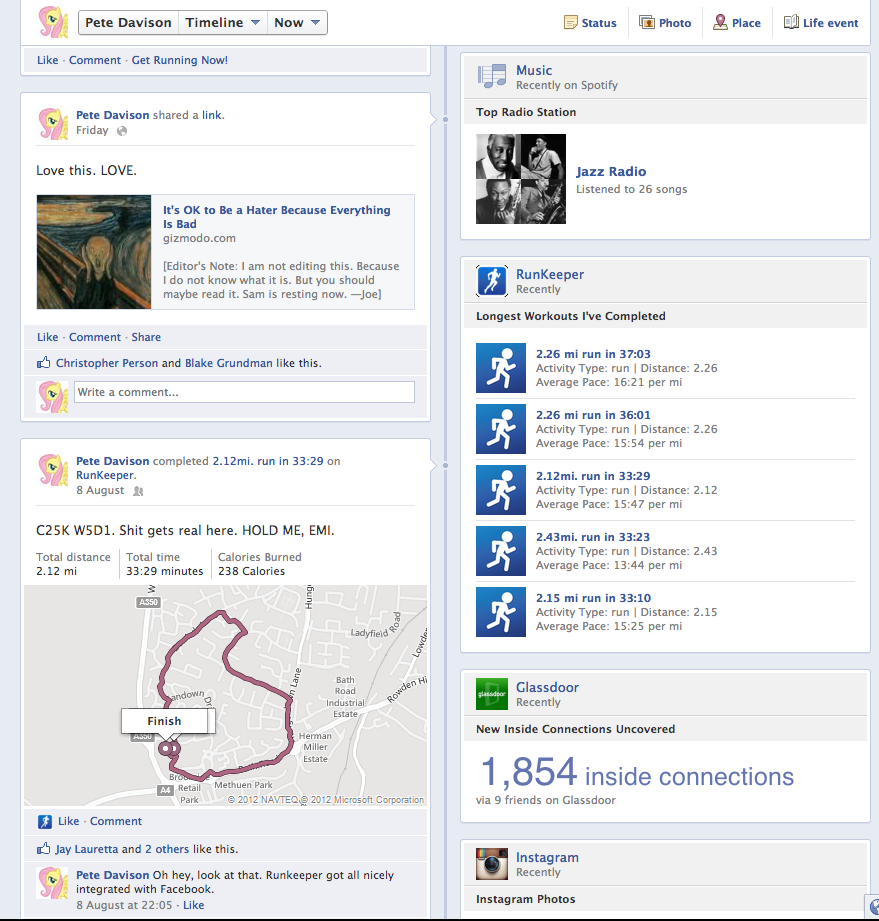
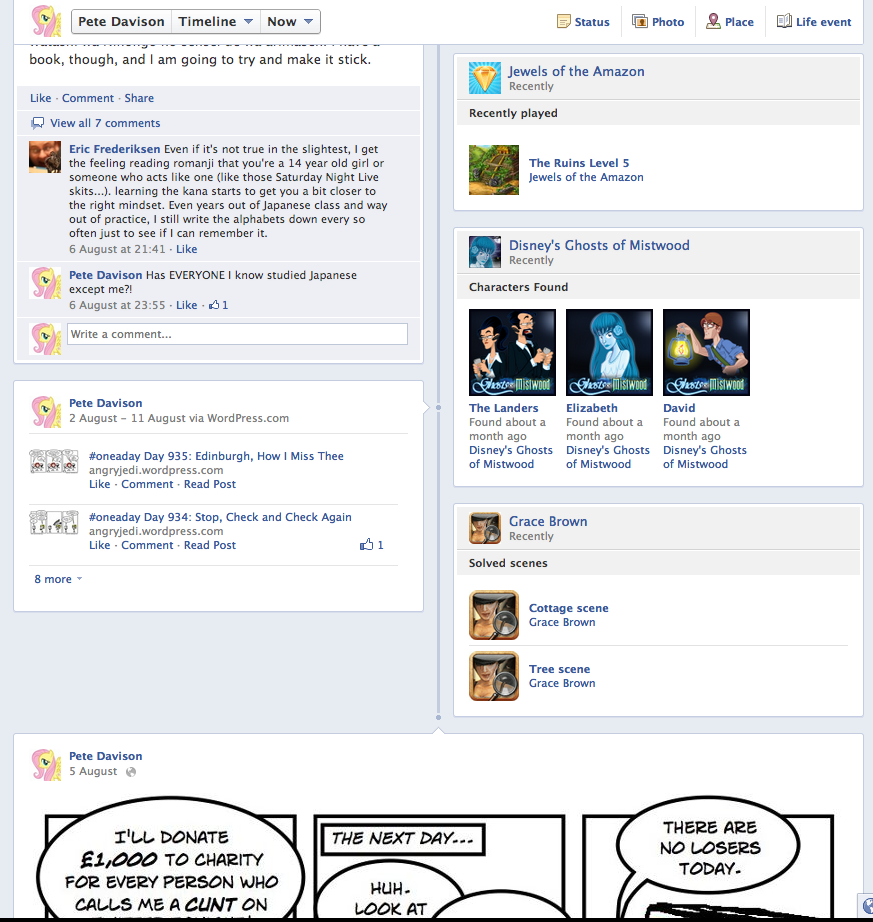
Let's scroll down a few "page heights" and see what else we have:

The left column? Sort of all right. The right column, though?

SO MUCH IRRELEVANT CRAP.

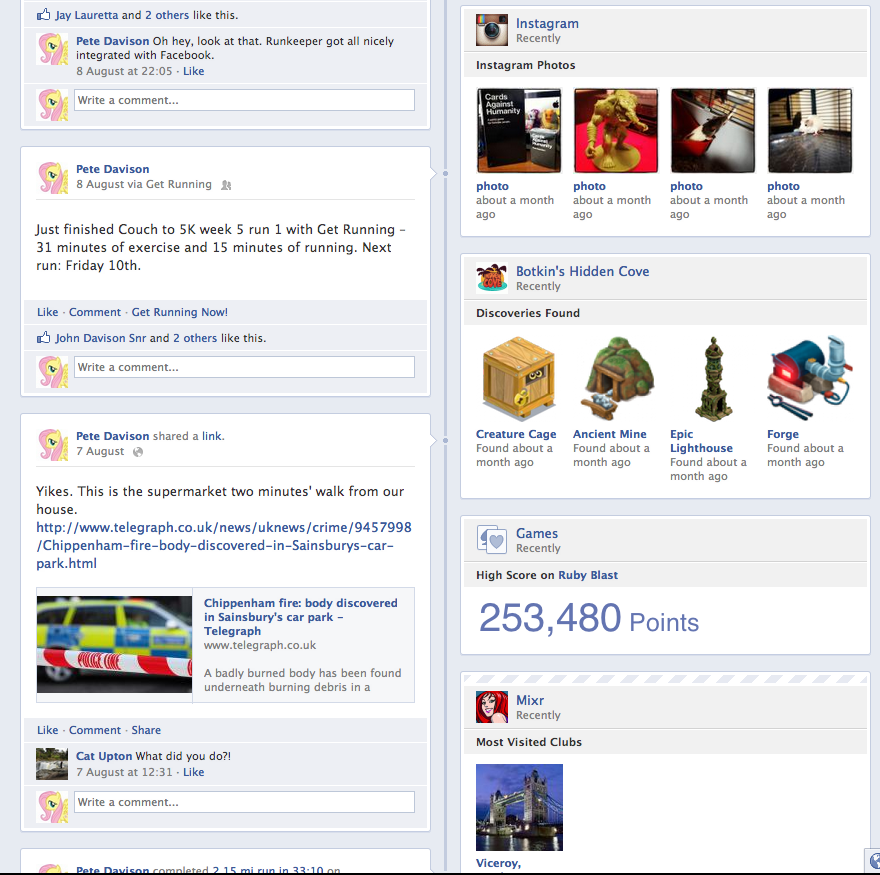
Including posts from games that I 1) didn't press a "Share" button in once and 2) have since removed from my Facebook account.

There. After five screen-heights worth of scrolling, I finally get to one thing that I actually want to share with people — my recent WordPress posts, aka a feed from this blog to my Facebook Timeline. Again, though, like the Likes, they have been collected together into a box that displays very little relevant information and, in this case, is put in a stupid, stupid place. Why stupid? Because the most recent post in that little WordPress.com box came considerably after the RunKeeper post at the top of my Timeline — and certainly considerably after all the spammy crap those games have plastered all over that infuriatingly useless right column.

"Facebook is a social tool that connects you with people around you" my arse. "Facebook is a digital scrapbook maintained by a five-year old with ADHD," more like.

I'll see you on Twitter.


#oneaday Day 935: Edinburgh, How I Miss Thee

A brief Twitter conversation with the always-awesome Mitu Khandaker got me all nostalgic this evening. Y'see, Mitu has just come back from the Edinburgh Interactive Festival, where she was speaking about exciting and clever things to do with love, sex, relationships and obsession in games — a topic which I find particularly fascinating, as my extensive series of posts on Katawa Shoujo will attest.

But that's not what I want to talk about today, as I'm sure video and/or slides from Mitu's presentation will be available online at some point soon, and they will probably say things rather more coherently than I can. (I LOVE YOU EMIIIIIII)

No, instead I just want to look back on why Edinburgh is awesome. Because it is awesome, and if you've never been I strongly suggest you take the opportunity to do so.

My memories of Edinburgh stem entirely from my several trips to the Fringe festival with the Southampton University theatre group, known on various different occasions as SUSU Theatre Group, "Blow Up" and "RATTLESNAKE!", for reasons that I have, sadly, since forgotten.

My first trip there came during my first year at university. I'd joined the theatre group and had already had a small part in our overly-elaborate and rather pretentious production of MacbethThe Matrix was still fashionable, you see, so it was seemingly obligatory for every student theatre company in the country to do a Matrix-inspired Shakespeare production, and we were no exception. (It actually ended up being quite good, though vastly over budget.)

Anyway, Wachowski-Shakespeare crossovers aside, my association with the theatre group eventually led to me auditioning for the Edinburgh production and successfully securing a part. The play we'd decided to take up was Ivan Turgenev's A Month In The Country, which is a good play with interesting characters (I played Afanasy Bolshintsov, a character for whom I was legitimately able to leverage my legendary Harold Bishop impersonation), but quite heavy going. Our bright idea was to perform it outdoors in the Edinburgh Botanical Gardens, which sounded like a great idea on paper.

Actually, it was a pretty great idea that added some lovely atmosphere to the play, the only flaws in the plan being 1) the amount of rain that Scotland gets and 2) the fact that the Botanical Gardens were rather off the beaten track. As a direct result of 2), we had rather disappointing viewing figures, but soldiered on regardless, despite having no more than one or two people watching most days.

Performing the play was just a relatively small part of the whole experience, though.

In the mornings, we'd be flyering on the Royal Mile, one of the main streets in Edinburgh that attracts entertainers and promoters come Fringe time. Flyering was always fun, even if it was rather difficult to sell the idea of a tragic Russian love story performed outdoors in a venue no-one really knew the location of to passing tourists. We managed to get a few people coming along, though — and not just all our respective parents.

In the evenings, we'd take in some shows (all right, lots of shows) and then go drinking. Lots of drinking. You see, at the time, Scotland's licensing laws were significantly different to England's — in England, you could only drink until 11pm in a pub and 2am in a club; in Scotland you could drink until… actually, I can't remember what time you could drink until in a Scottish pub (I want to say 2am) but I certainly remember that the clubs were open until 4am.

Our two regular haunts for drinking purposes were the "Frankenstein" pub, a rather tacky (but awesome) theme bar that sold overpriced (but awesome… and deadly) cocktails; and a club just around the corner called Espionage, which had five floors, each of which was themed after a far-flung locale that James Bond had visited in one of his movies. (Incidentally, I am very pleased to note that both of those venues are still there. That makes me feel warm and fuzzy.) Following drinking until some ungodly hour in the morning, we'd often decide that The Thing To Do at that point was to get a pizza from the conveniently-located all-night pizza place that was near Frankenstein — an all-night pizza place which provided you with said pizza at an astonishingly high speed.

It wasn't all roses, though. On this first trip, I was enjoying the experience but found myself suffering considerably from the social anxiety that has wracked my personal life for as long as I can remember. I found it difficult to start up conversations with the people I was living with at times — despite the fact I was acting with them every day — and I found myself worrying that people would think the things I said would be stupid. I recall one evening getting very depressed, breaking down in tears and being very embarrassed about the whole situation despite the fact I was sitting by myself in the hallway when it happened.

Two of the guys I was staying with came to my rescue: Chris and Des (no relation to Des). I was very grateful to them, because they proved to me that the things rattling around in my head were completely wrong. They took me in to their room, talked to me, got to know me and let me stay the night in there with them. (To sleep. This was not a period of "experimentation" for me.) We had some laughs, particularly at Chris' expense when he fell asleep in mid-sentence, and I got up the following morning feeling considerably more positive about myself, my situation and my ability to make friends.

That night was a real turning point for me. Remembering that night gave me the confidence to go back to Edinburgh on two other occasions with the theatre group — once without a show, once with a double-bill of The Importance of Being Earnest and Alan Ayckbourn's Round and Round the Garden. Both visits were amazing, and neither were tainted by feelings of anxiety. In fact, the experiences I had on those two visits were remarkably akin to the way I felt when I visited PAX East a couple of years ago before my life went to shit — I felt like I was "home", "among friends", and completely comfortable. I would have given anything for it to have lasted forever.

But these things don't last forever, sadly. What will stay with me forever, however, is the memories — Des getting told off for trying to dry-hump a guy dressed as a dinosaur on the Royal Mile; recording our drunken conversations on a Dictaphone in the kitchen of the hostel we were staying at; climbing Arthur's Seat after a solid night of drinking, reaching the summit in time for sunrise, drinking sake in silence as we witnessed dawn breaking, then sliding down the muddy hillside on our arses.

Thinking about it, my positive memories largely revolve around what I did while I was there than the city itself. I've never been there when it wasn't Fringe time, see — and at Fringe time it's a magical place, infused with a wonderful atmosphere all day and all night for the entire duration of the festival. But from what I saw beneath the glitz and slightly grotty glamour of Fringe time, it's a beautiful city, too, and one that you really should visit if you've never had the opportunity. One day I'll make it back there, though whether or not it'll be at Fringe time I don't yet know!

#oneaday Day 934: Stop, Check and Check Again

The social Web is an incredibly frustrating place to be at times. I'm aware that I've commented on this subject a number of times before, but it's important: the spread of misinformation is at best irritating and at worst incredibly dangerous.

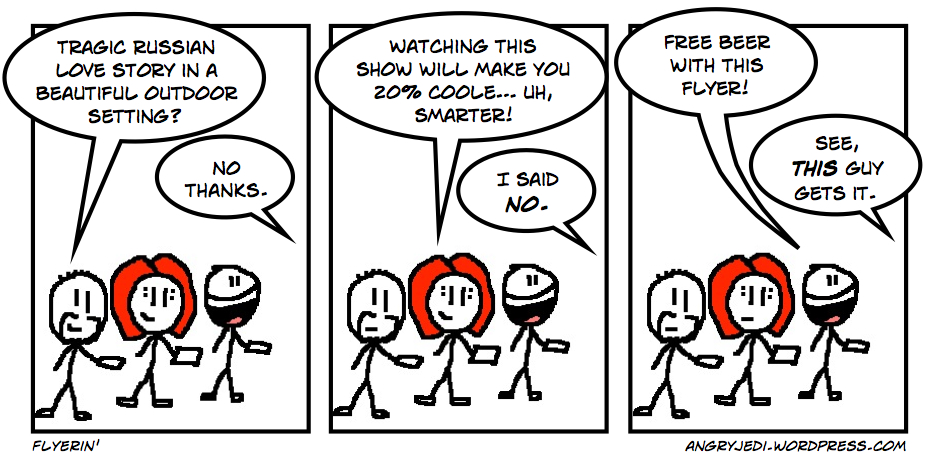
The most recent example was a result of this image:

This image has been doing the rounds recently — first on Twitter, where the supposed exchange took place, and subsequently, as tends to happen, a day later when Facebook's denizens caught up with the rest of the Internet.

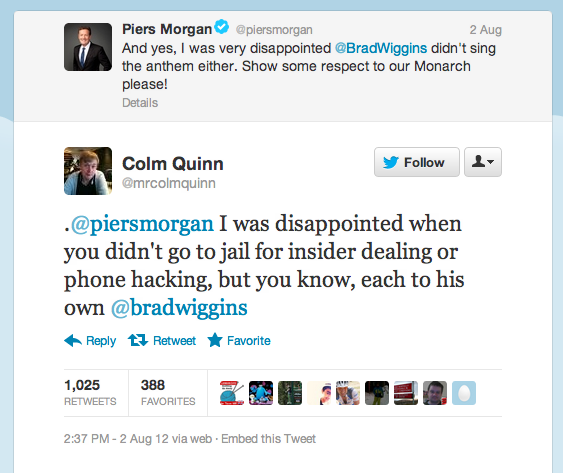
It is, of course, bollocks. This exchange took place, oh yes, but it was not between Piers "Cuntface" Morgan and Bradley Wiggins. No, instead, this is what happened:


You have doubtless noticed that the person who replied to Piers Morgan was not, in fact, Bradley Wiggins, and was instead one Colm Quinn, who just happened to mention Wiggins in his tweet, which is where the misunderstanding came from — probably from someone who doesn't quite understand how Twitter works. (Ending the message with "@bradwiggins" could look like a "signature" to someone not familiar with the way a typical Tweet is structured.)

As usual, however, the fact that "BRADLEY WIGGINS GAVE PIERCE MOREGAN AN AWESUM COMEBAK" makes a better story than "SOME DUDE YOU'VE NEVER HEARD OF GAVE PIERS MORGAN AN AWESOME COMEBACK" struck, and it struck hard. The (inaccurate) story spread like wildfire, of course, with no-one bothering to actually check Wiggins' timeline to see if he actually said the things that were attributed to him. And it spread. And spread. And spread.

Over time, some people got wise to the truth of the matter and pointed this fact out. But more and more people continued to post the inaccurate details — and then it spread to Facebook, and the whole thing started all over again, with both sides getting increasingly frustrated with one another.

I know it's a seemingly silly little thing to get riled about, but like I say, consider the potential implications if the "fact" that started spreading was something that could actually put someone in danger, or ruin a person's reputation. When the entire social Web starts acting like Daily Mail reporters by just blindly reposting things without even bothering to see if they're true or not, we have the potential for a real mess. Just look at the reactions of Facebook-bound idiots who don't know what The Onion is for a preview of what might be.

Fact-checking isn't just for journalists. Of course, there are plenty of journalists out there who seem to think it doesn't apply to them, either, but that's another matter entirely. It takes a matter of seconds to check something like a Tweet is the genuine article. You should be immediately skeptical of anything posted as a screen grab of a bit of plain text that looks like it was written in WordPad, or anything described by someone as SO AWESOME/FUNNY/HILARIOUS/LMAOOOOOOO etc. And, most importantly, if something sounds like it was too awesome to be true, it probably was.

Respect to Mr Colm Quinn for his excellent admonishment of Piers Morgan's twattish behaviour. Disrespect to all of you out there (you know who you are) who fall for this crap every time, whether it's "OMG TODAY WAS THE DAY MARTY MCFLY WENT TO IN BACK TO THE FUTURE PART II!" (for the last time, it is October 21, 2015) or "OMG! PIERS MORGAN GOT BURRRRRRRRNED BY BRADLEY WIGGINS".

Simple routine: before you retweet or share something, stop, check, then check again. It's not that hard.


#oneaday Day 932: Take Control

I'm generally a pretty disciplined sort of person. I'm good at prioritising, and if I have something that I have to do I'll make sure that I complete it before I do things that I want to do.

It's when it comes to prioritising the things that I want to do that things go a bit pear-shaped.

It's easy to stumble through your days as normal and just let things happen. But if you do that it's easy to fall into routines and patterns and then wonder where the minutes, hours, days go. Those things that you want to do sometimes get forgotten amid your default activities, your comfort zone, the things that you do without thinking.

In order to fit in all the things that you want to do, sometimes you have to take drastic steps. Steps like scheduling your time.

This approach doesn't work for everyone. Some people are terrible at sticking to schedules, others simply don't like the lack of flexibility. But I've discovered (and rediscovered) several times over the years that I actually seem to work better and be rather more efficient if I plan out my time carefully rather than simply taking things as they come. It's a hangover from quite enjoying the sense of "structure" from school and university (even if — ssshhhh… I didn't always show up to my university lectures and seminars) and it's something that I should really start doing more of in my daily life if I want to fit everything in. Because even with scheduling, it's sometimes tricky to squeeze all your desired activities in, and that's when you have to decide how to make compromises and sacrifices. Thankfully, with the things that I want to do at the moment, I haven't had to make too many of the latter.

The ironic thing about people not wanting to organise themselves these days is it's so easy to do so now thanks to technology. You can make your phone remind you to do things, set email-based nags to pop up in your inbox, create task lists that synchronise between devices, take snapshots of things and store them "in the cloud" (urgh) for future reference. You can even get social and be public about the things that you want to do, making use of your friends as a means of browbeating… sorry, "encouraging" you to actually get on and do stuff.

I use a few simple tools to sort myself out. Firstly and most simply is Google Calendar. I use this in favour of iCal on my Mac because it's easier to sync between devices, is stored online rather than tied to a single device and works with iCal and iOS anyway. Google Calendar is a decent tool with enough features for what I need to do — multiple colour-coded calendars, email reminders, the ability to invite people, time zone support — and it proves valuable when I have taken on lots of things and only have a limited time in which to do them. It was especially valuable this time last year when I was going to Gamescom in Germany and every developer and publisher in the world suddenly wanted a bit of my time. (Apart from EA. They ballsed up my appointment — their fault, not mine — and wouldn't let me in to their stupid high-security compound. Fuck them. I went to go and see Larian Studios instead, which was much more fun.)

Alongside Google Calendar, I've tried several other tools over the years. Evernote is pretty neat, for example. Epic Win was a cool idea that gamified your own productivity, but development seemed to stop quite a while back and it's still lacking a few features that many other task manager apps offer. Most recently, I've been playing with Springpad, which I like a lot, despite a few rough edges.

Springpad is quite a bit like Evernote, but with a few interesting twists. It's based around the concept of "notebooks", which are ways of grouping related content together. Within a notebook, you can create a wide variety of different notes, ranging from simple text notes to checklists (mini to-do lists, essentially) via tasks, recipes, books, product information (scannable via the RedLaser barcode-scanning interface on the mobile apps) and all manner of other stuff. A webclipper bookmark allows you to easily clip things into your notebooks, and the interface generally does a pretty good job of figuring out what kind of content you're trying to store — I tried it with a recipe from BBC Good Food earlier and it successfully recognised it as a recipe, though failed to import the ingredients list correctly.

Springpad also features a "social" component which allows its users to make its notebooks public, too. While I'm not entirely sure that this has been particularly well thought out, it does provide an interesting alternative use for the service, effectively turning it into a kind of blogging platform. Notes can be used as entries, the more specific types of notes used to provide specific information, and the site's in-built commenting facility allows users to build up a community. It's a neat idea. I'm not entirely sure how useful it is, of course, but it's a nice idea.

So anyway. Armed with these simple (and free) tools, I'm attempting to organise myself a bit better. After two days, I've already managed to do a bit more than I would have done otherwise, which is pleasing. I shall continue with this system for a little while and see if it's something that I want to make stick. It will be an interesting experiment if nothing else, and it might actually spur me on to get some things done that I've been meaning to get done for a while.

Further updates on exactly what when I have something to share.

#oneaday Day 931: Pure Profit

The more doublespeak I hear from industry analysts and company executives on earnings calls, the more and more glad I am that companies such as Atlus, Carpe Fulgur, Xseed et al exist. (Though Atlus should really pull their finger out and open a European office. I'll happily run it. Single-handedly. Gladly. Just bring fucking Trauma Team out over here and we'll be cool, Atlus. Why you gotta be that way?)

Why? Because these are companies whose primary motivation is not profit, it's pleasing their customers. They accept that they are catering to niche interests and accept that they are not going to create games that sell millions of copies.

Here's an actual quote from Aram Jabbari of Index Digital Media, Atlus USA's parent company:

"With the launch of the strategy RPG Growlanser: Wayfarer of Time, an iteration in the popular franchise never before released in North America, Atlus demonstrates the continuation of its proud heritage of supporting niche titles aimed at the core gamer. We are not intimidated by the challenges of servicing a smaller audience or pursuing more modest success with a given project. Our fans are excited for a new Growlanser title and we are excited to be able to bring one to them."

What a great attitude to take. A bold, proud statement that Atlus specifically isn't going after the quick buck, but is instead aiming to build long-term loyalty with its customers by giving them the things that they have been asking for.

Note: this is not the same as pandering to the whims of crybabies. It is a case of listening to your customers and providing them with things that they will appreciate, which in turn builds up a strong and significant base of loyalty which can be drawn upon in the future. I know plenty of people who will happily pick up anything that has the Atlus stamp on it purely because of the goodwill the company has built up over the years (goodwill which they're at risk of losing with the whole Persona 4 Arena region-lock business, but that's another matter entirely).

It's the same with Carpe Fulgur, whose dedication to their craft shines through in every one of their three releases so far. While RecettearChantelise and Fortune Summoners may not be the most technologically-stunning or even best games in the world, they feature a top-quality localisation job the likes of which we haven't seen since the days of Victor Ireland and Working Designs on the PS1. They work on niche titles that players might not have heard of, but built up a solid foundation of brand loyalty with Recettear and have continued to provide memorable experiences since.

Then there's Xseed Games, whom I have to admit I'm not as familiar with, but who are noteworthy for bringing excellent PSP action-RPGs Ys Origin and Ys: The Oath in Felghana to PC, and are also handling the North American release of the fantastic The Last Story(C'mon, guys, pick up Pandora's Tower, too — your fans will thank you.)

And then there's the even smaller niche developers and publishers like Mojang, Gaslamp Games, Zeboyd Games — too many to mention. Not one of these companies is responsible to shareholders and investors, which means they can take a much more "human" approach to business. Their team members can speak as individuals and freely give their opinions rather than stock, robotic "we do not comment on rumours and speculation" responses that frustrate journalists and public alike so. They can enthuse about their products in human terms rather than spouting bollocks like this actual quote from Ryotaro Shima, senior vice president the EML business department at GREE Inc and CEO of GREE UK Limited:

"The formation of a UK studio is strategically significant on many levels. Primarily it will allow us to focus on Western content, keyed to local social trends, as well as tailoring content for global propositions. It also reinforces GREE's commitment to growth within European markets."

Besides the fact that these smaller companies tend to have job titles that are less of a mouthful, there's a clear disparity in the language used. Let's take a look at another quote that is more roughly equivalent to the one from Jabbari I posted at the beginning of this piece — this one's from Paul Nicholls, sales and marketing director at Koch Media, annoucing Andrew Lloyd Webber Musicals: Sing & Dance (yes, that is a game that is actually coming out, and you bet it's a game being made primarily as something that will sell rather than a great creative work):

"This is a fabulous signing for us. Andrew Lloyd Webber and his creations are a British institution that have been enjoyed by generations across the world. The chance to bring this product to market for the Nintendo Wii is both an honour and hugely exciting."

Note the difference in the language used. Jabbari refers to "our fans"; Nicholls talks of "bringing this product to market". Jabbari speaks of "servicing a smaller audience", "pursuing more modest success" and emphasises what Atlus is doing for its fans; Nicholls speaks of what a "fabulous signing for us" the Andrew Lloyd Webber license is — no mention of customers at all.

Obviously those two aren't exact equivalents — one is a rather niche PSP release while the other is a Wii game based on the music of Andrew Lloyd Webber. But the point stands — personally speaking, I'm much more inclined to respect companies that have a "human" face; companies who make it clear that their first priority is not shifting as many copies as possible, but pleasing, surprising and delighting their fans.

Obviously it would be nice if the niche titles were multimillion-sellers, but that would somewhat diminish their "niche" status. What the continued existence of smaller outfits like Atlus, Xseed and the like proves, however, is that you don't have to be focused on big business and the bottom line to be successful — it is possible to please your customers and have a company that performs well.

It's also, I'd argue, a sign that going public is a terrible, terrible idea for a company supposedly based around creative ideas. As soon as "what would be cool?" becomes "what would sell?" or "what will make the investors happy?" I, for one, am no longer interested, because I'm being treated as a bag of money rather than a human being. For all I know, Atlus et al may be laughing all the way to the bank, but because they put such a human, consumer-friendly face on the way they do business, I'm more than happy for them to take all of my monies while I consistently give companies like EA, THQ and Activision the finger until they start speaking English.