#oneaday Day 973: Some Words on Social Anxiety

I've recently been chatting with a friend (who, for obvious reasons, shall remain nameless) who is coming to terms with their own feelings of social anxiety and wishes to make a difference to improve their life. I have spoken on the subject at length on this blog on a number of occasions in the past, but sometimes it's helpful to just talk about these things or read about them. I'm sure writing about this will be cathartic for me, and for my friend it might help to know how other people experience this problem and how they deal with it — or not, as the case might be.

Deeply personal "TMI" post follows. Feel free to skip if you Don't Want To Know. Follow the link if you do.

Continue reading "#oneaday Day 973: Some Words on Social Anxiety"

#oneaday Day 972: H, and Not the One from Steps

For one to become a fan of the visual novel genre, one has to be willing to deal with one of gaming's great taboos: the sex scene. You have to be willing to play games specifically marked as "adults only" and warning of explicit sexual content on the box; you have to be willing to explain that no, you're not actually playing a "porn game" (in most cases, anyway) — you're playing a game that just happens to have sex scenes in it, because there's a difference. You also have to be able to say that latter bit without coming across as defensive, which is very difficult.

A good few years back, I played several of what I then knew as "H-games" — specifically, True LoveRing OutParadise Heights and Three Sisters' Story.

Of these games, two were pretty much out-and-out porn — Ring Out centred around a young girl who had been sold into effective slavery to repay her parents' debts and who was forced to compete in an all-lesbian sex-wrestling tournament for the entertainment of pervy, disgusting men; Paradise Heights centred around a guy who both lived and worked at the titular apartment complex and seemed to spend most of his time either spying on or having sex with the residents. Interestingly, though, despite the clear focus of these titles being the sex scenes, they still bothered to put clearly-defined characters and an actual sense of narrative in there — Ring Out in particular, despite its eminently silly premise, was clearly designed to be an uncomfortable experience as much as an arousing one.

Three Sisters' Story, meanwhile, was a title I actually can't remember a great deal about, save that it was a character-heavy visual novel in which you automatically attained a bad ending at the conclusion if you gave in to base desires and slept with everyone who proffered themselves to you.

True Love was perhaps the most interesting, though, being an actual dating sim rather than a straight visual novel. You had a limited number of in-game days to find your "true love" (from among the wide variety of potential lovers at school, of course) and had to choose how you spent your time each day — studying, training, doing art, going shopping, that sort of thing. How you chose to spend your time affected various statistics, and the levels of these statistics affected your relationships with the girls. It was actually a surprisingly complex game that had a surprising amount in common with Persona 3 and 4. I really enjoyed it — and my past enjoyment of True Love is perhaps a big part of the reason why I enjoy the Persona games so much now.

Here's the thing, though — at the time, I didn't really feel comfortable talking about the fact I'd played these games to anyone. The popularity of the Internet was still in its relative infancy at the time, thanks partly to the fact that broadband hadn't taken hold in this country yet, and I didn't really feel that comfortable discussing them with my real-life friends at the time. (True Love was an exception — several of us ended up playing this through concurrently while we were at university.)

The sex was the reason. There was an air of "shame" about playing these games, and not in a Squadron of Shame sense. Because there was sex in all of them to varying degrees, I felt uneasy about revealing my association with them lest I end up thought of as some sort of weird pervert. (In the case of Ring Out, I probably would be thought of as some sort of weird pervert — there was some messed-up kinky shit in that game. Except now I've revealed the fact I've played it to all of you. Yay! I'm a weird pervert! AND PROUD.)

Yet now I feel perfectly comfortable talking about these games, and even promoting them through a regular column over on Games Are Evil. So what's changed?

Several factors, I think. First up, my own attitudes towards sex have, naturally, changed over the years. Secondly, the rise of the Internet means that it's much easier to find like-minded people to discuss these things with, even if they're outside of your normal friendship groups. Thirdly, societal attitudes towards sex in gaming are changing.

We're not living in a completely sexually liberated age, of course — there's still a fuss any time a high-profile game such as Mass Effect or Dragon Age features bonking, and said games tend to skimp on the titillation by having characters writhing around in their underwear — but we're in a place now where people are at least a little more willing to consider the possibility that games might have some sex in them.

Part of this is the fact that the general demographic of "gamers" has grown up somewhat and is demanding more "mature" experiences for their money. Mostly, "mature" tends to be interpreted as "more violent, more swear words and more women in suggestive outfits". Sex is still seemingly considered somewhat taboo, so we end up with the underwear-writhing just described.

In 18+, adults-only visual novels, there's none of that. In these titles, sex scenes are explicit, sometimes quite protracted and, in the words of their manuals, "not always exhibiting the level of sensitivity required for a healthy relationship". They're often highly erotic and titillating, and more often than not obviously aimed at a male audience — or at least presented from the perspective of a male protagonist.

Are they necessary? Probably not. Having played through two paths of My Girlfriend is the President now, I feel that game's stories could probably have been told just as effectively without the flurry of shagging that occurs in the game's third act of four. Some visual novels even allow players to turn off H-scenes altogether, and console or smartphone ports remove said content altogether, thereby proving that no, it's probably not necessary.

They may not be necessary, but they're actually pretty effective in many cases — at least from my perspective. Staying with My Girlfriend is the President, I found the erotic scenes to be incredibly powerful — largely because the writers had taken such great pains to build up a massive amount of sexual tension between the characters before anything truly perverted started happening. As the erotic scenes unfolded, a very "private" side of these characters revealed themselves. What were their attitudes towards sex and physical intimacy in general? How did they define their relationship with each other? Did they see sex as an important part of a relationship, or just something fun to do?

There's also the fact that visual novels tend to take place with the player "riding along" inside the protagonist's brain. The player is privy to the protagonist's innermost thoughts, feelings and desires, however shameful they might be, It's a uniquely intimate relationship between player and visual novel protagonist — not the same as playing a game where you feel completely "in control" of the characters, but one where the player feels "trusted" to find out things that, in some cases, other characters in the game world don't know. Next to that, seeing Our Hero putting his penis into someone is a relatively small matter.

And with all that, there's the fact that being turned on by something erotic is really just another form of emotional engagement. I'll stay with My Girlfriend is the President for now, but it applies to many other VN titles, too — if feeling happy, sad, amused, upset or angry is a valid emotional response to the things you're seeing unfolding on screen, why not feeling aroused or excited — or even just pleased for the characters?

There's a distinction between these incredibly explicit sex scenes and straight-up porn, I've found. Seeing, say, Yukino and protagonist Jun getting it on is hot, sure, and the amount of panting, groaning and screaming on the game's voice track (coupled with some truly stunning subtitles) makes it clear that these are scenes that are supposed to be hot. But they're not hot in the way that makes me want to, well, not to put too fine a point on it, fap.

They're part of a story; they're something that is happening with these characters. Sure, they're generally not saying anything meaningful to one another ("Mmmm… tch… slurp… aaaaaah") but they are demonstrating part of their relationship to one another. The meaning of that outweighs any desire to flop it out and go to town — and the fact that I'm not treated as an idiot or a prude is also actually quite refreshing. Let's also not forget that many VNs feature sex scenes that are not designed to be titillating at all — Hanako and Rin's scenes in Katawa Shoujo spring immediately to mind — and instead are there to provoke some sort of emotional reaction, or afford a deeper understanding of the characters. Sex is, after all, part of life, like it or not.

Doubtless there are people out there who fap to sex scenes, and the fact that many VNs offer the option to replay just the sex scenes would certainly back this theory up. But, y'know, you want cheap thrills, there are certainly easier ways to go about getting them.

I am, of course, coming at all this from a male perspective and I do not apologise for this in the slightest. I find these experiences engaging, compelling and, on occasion, erotic. And anyway, if we're being practical about this, what difference is there really between someone playing an eroge and the millions of people around the world who have read the Fifty Shades of Grey series? Think about that.

I'm off for a cold shower.
#oneaday Day 971: Y'All Should Probably Play This FTL Thing

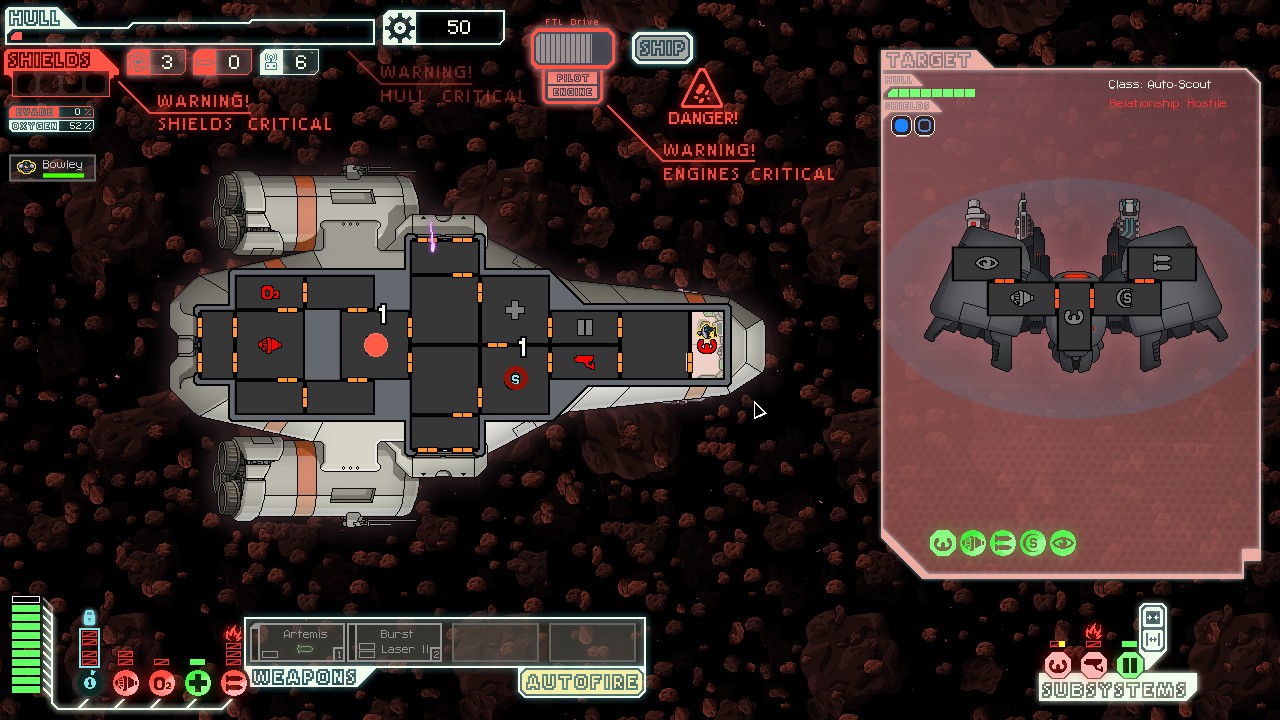
Things weren't going well. The rebel fleet were closing in, and the last jump had put the UNS Scruttocks perilously close to a rather active star that was currently enjoying a period of intense flares. Pete, best pilot in the remnants of the Federation (which wasn't saying much) frantically struggled to power up the Scruttocks' FTL engines as the ship was rocked  by the explosions of the overly-joyful sun.

It turned out that wasn't the only problem, though. A pirate ship, seemingly undeterred by the solar activity, stood staunchly in the path of the Scruttocks, matching its every move and doing its best to ensure that this would be the end of the intrepid crew's journey.

Andie ran from the bridge to her station at the weapons console at the rear of the ship. Lara followed her, splitting off at a rear bulkhead to head for the engine room. The undermanned Scruttocks was going to need every ounce of power she could give them if they were going to get out of this alive.

"Fire! Go for the shields!"

Andie didn't need to be told twice. She diverted power from non-essential systems, powered up the ship's missile launcher and laser cannon and took aim for the pirate ship's shield systems. The first missile sailed harmlessly past, while the first volley of laser fire was absorbed by their assailant's shields; the second struck true, the missile penetrating the shields and knocking out the shield generators, the cannon fire now free to inflict damage directly on to the enemy's hull.

The pirates weren't going down without a fight, though.

"Fire!"

"I am!"

"No, seriously, FIRE! Get out of there!"

Lara came running through the aft section, severe burns over one side of her body. Andie watched in astonishment as her determined crewmate headed for the medical bay. She smelled smoke, and knew that trouble was ahead. But if she could just hang on a little longer…

The air started to become thin; it became harder to breathe. Andie knew that Pete was trying to put the fire out by venting the oxygen out of the affected sections, but it seemed like the ship's oxygen distribution system had been damaged by the fire, as even though the weapons room was firmly enclosed, she was definitely starting to feel light-headed.

Lara came charging back through. "Come on!" she cried. "Help!"

Andie left the weapons controls on automatic and followed her companion through the aft sections of the ship. Sure enough, the fire had gutted the ship's oxygen distribution room, but the damage wasn't so severe it couldn't be repaired. The pair set about their important work, doing their best as the ship was continually rocked by impact after impact.

Finally, through the window they saw the debris of the destroyed pirate ship drifting sliently past. They had done it. The Scruttocks had survived another day, for now — all they had to do was get this oxygen tank back up and running before–

A loud bleep confirmed to the rapidly-weakening Andie and Lara that their efforts to repair the oxygen tanks had been successful. As they heard the air distribution system start up again, they breathed in heavily, gulping down the precious, life-giving air.

"Preparing for jump to lightspeed," came Pete's voice over the comm system. "Ready in 3… 2…"

At that moment, a solar flare erupted. The Scruttocks' hull, weakened from the protracted battle, tore apart like a snail shell beneath a wellington boot. Its crew's last thoughts as they were suddenly cast into the silent vacuum of space?

"Bollocks."

That's a typical day in the life of the crew of FTL: Faster Than Lighta new independently-developed game that officially came out today. In it, players oversee the crew of a starship frantically running from the mysterious "Rebels" as they attempt to deliver important secrets to the remains of the "Federation". Little more context than this is given, and little more is needed, because FTL is a game about the struggle that is the journey rather than its beginning or its conclusion.

The most apt descriptions of FTL would draw comparisons to the board games Space Alert and Battlestar Galactica. Like those games, FTL gives its players a small number of crew members and a sprawling ship in which to deploy them, then continually bombards them with increasingly-unreasonable challenges until they explode, die, asphyxiate or reach one of a variety of other sticky ends. It is possible to "finish" the game by beating a final boss, but for your first few playthroughs at the very least, you'll be dead within half an hour.

FTL strikes a great balance between simple mechanics and depth, and presents its unfolding emergent narrative in a manner that is abstract enough to allow the player to use their imagination, yet explicit enough to make it clear to understand exactly what is going on at any given moment. Players can route power to different parts of their ship, fire weapons on specific systems of enemy ships, move crew members around to man stations, deal with intruders and put out fires, and even faff around with doors. Doors are very important. You might not think that they are, but the moment your remote door control systems get blown out and you're unable to vent your engine section that is currently on fire, you'll come to appreciate the power of being able to sit in the driver's seat and open the back doors without running the risk of asphyxiation.

FTL describes itself as a form of roguelike and there's certainly plenty of resemblance there — a randomly-generated challenge at the start of each new game, permadeath and a wonderful sense of unfolding, unscripted narrative — but it has a unique identity that is all its own. It's not trying to be Star Control or Master of Orion or anything like that, nor is it trying to be Angband in space — it's the personal story of a few brave men, women and slugs who want to make a difference in a turbulent galaxy. Whether they do so, or whether they end up suffocating as they run around panicking at the fact that half the ship is on fire and the pilot is in the process of being eaten by a praying mantis? That's entirely up to the player's skill and/or sense of sadism.

Either way, you should buy FTL because it's fucking great.

#oneaday Day 970: Shouldn't This Tell You Something...?

A new game-related Kickstarter is not really news any more, but when one gets halfway to a $1.1 million target just a few hours after launching, that's a clear signal that the public is very much interested in the proposed project.

The project in question this time around is Obsidian Entertainment's Project Eternity, a new title that promises to resurrect the isometric-perspective, real-time-with-pause combat, incredibly well-written RPG genre as exemplified by the Infinity Engine games of the late '90s and early '00s. Many of the key team members behind the quite astonishingly good Planescape: Torment now work at Obsidian, so the prospect of a new game from these creative minds is a very exciting one.

Very few details on the new game are available right now, but what I feel is interesting is the fact that such a huge amount of support has already been pledged to this project. Obsidian's justification for starting the Kickstarter in the first place was that it was difficult to get funding from major publishers for what they wanted to do — the Men In Suits believe that late '90s-style isometric-perspective RPGs won't sell, so the developers don't get to make them.

Except… "won't sell". Is that really true? As I write this, Project Eternity's Kickstarter page has pledges of $560,885. A few hours ago when I posted a news story on Games Are Evil on the subject, the figure was $238,296. According to Kicktraq, the project, assuming it continues at the current rate (which it probably won't), will finish at over 1,500% of its original target. Naturally the initial flurry of people will die down and the final total will probably be a little more modest than the currently-predicted $17.1 million, but it's certainly going to beat its $1.1 million goal comfortably.

This makes me ponder whether the big publishers, constantly chasing the megabucks, are really going about things the right way. Sure, the blockbuster titles most certainly are selling and making astonishing amounts of money, but they also cost a huge amount of money and time to make. Perhaps more importantly, the increasing "annualisation" trend that publishers are inflicting on popular franchises is starting to make longtime gamers resentful of these series. The regular appearance of Call of Duty has become a running joke, regardless of whether or not the latest entry in the series is any good or not. People still buy it, yes, and the games are unquestionably highly-polished experiences with well thought-out user retention and monetisation strategies but, well, is what you really want from a game something that has a well thought-out user retention and monetisation strategy? Or do you want something that is a memorable experience?

The two aren't mutually exclusive, of course. But practically speaking, at some point during the development cycle, an important decision has to be made. What is going to be the priority: business, or creativity? Do you make something that will sell, or do something risky that has never been done before? Do you make a shit-ton of people feel satisfied, or do you make a smaller number of people ecstatically happy?

There's no easy answer, of course. But whatever you may feel about the sudden rise to prominence that Kickstarter has seen over the last year or so, I'm certainly grateful that it gives developers who want to prioritise the risky, creative side of development the opportunity to make something that they want to make — and that their fans want them to make — rather than what a marketing plan put together by someone who quite possibly has never played a game before says they should make.

So yeah. You should go back Project Eternity. (It's up to $585,632 now, incidentally.)

#oneaday Day 969: Hate Speech

The Wii U is too much money for last-gen technology. The iPhone 5 doesn't offer anything new. Kamiya-san should just die if he doesn't bring Bayonetta 2 to Xbox 360 and PS3. Terraria coming to consoles is a slap in the face for PC owners.

These are all genuine opinions I have heard voiced in the last few days by people of varying degrees of intelligence and coherence. Every time I hear something along these lines, it just makes me a bit sad. In general, despite regularly ranting and raving about all and sundry on these very pages, I try to remain as positive a person as I can when it comes to technology, games and the like. I find new things interesting and exciting rather than something to be cynically derided; I also take the firm belief that if something doesn't appeal to you, that's fine, but there might be other people for whom it does hold an appeal and you have no right whatsoever to piss on their bonfire.

There are obvious exceptions to the rule above — if something is a shitty experience for everyone, then yes, it should be derided. But none of the things I mentioned above are shitty experiences, and certainly don't deserve the negative responses they have received from some quarters. In some cases we don't even know enough about the experience in order to declare it shitty or not.

The Wii U in particular is an interesting case. The console isn't even out yet and people are already quick to predict its failure for various reasons; quick to criticise features that may change, or that no-one has seen as yet. It's almost as if people want it to fail after the astronomical success that the Wii enjoyed early in its lifespan. Bewildering.

The iPhone 5 has a similar problem. Nothing Apple could have announced would have made everyone happy. And sure, Apple have a real arrogance problem, getting people whipped up into a frenzy over cable connectors. But the fact is, the iPhone is still a fucking amazing piece of technology that we take for granted every day. There are plenty of people out there who haven't got one yet. Wouldn't it be nice if they could have the best possible version of this awesome gizmo if they do decide to take the plunge? Well hey, look at that, they can.

And then there's the anger about Bayonetta 2 being a Wii U exclusive. (Yes, someone actually did tweet a death threat at Kamiya-san earlier.) Bayonetta was an awesome game that not enough people played. Meanwhile, absolutely fucking everyone bitched about the Wii not having enough third-party support. So a prominent (if underappreciated) third party pledges support to its successor and everyone complains. (Well, apart from open-minded Bayonetta fans, most of whom seem to be more than happy to consider purchasing a Wii U purely to punch more angels in the face. Actual tweet from someone who is not me: "So Bayonetta 2 is going to cost me around £300. Let's face it, for the sequel to the best action game ever made it's probably worth it." I concur.)

Finally, there's the Terraria issue. This is perhaps some of the most obnoxious behaviour I've ever seen from the gamer community. Take a look. Essentially, the "problem" was that the Terraria developer, who abandoned work on the (already feature-complete) game in February of this year to spend some time with his new child (what a bastard!), had been teasing "something big" to the Terraria community. Said "big thing" turned out to be an impending console release of Terraria for Xbox Live Arcade and PlayStation Network (pleasecometoVitapleasecometoVitapleasecometoVita) — great news, right? A much bigger audience gets to play an awesome and underappreciated game!

NO! say the PC players of Terraria. YOU BETRAYED US WITH YOUR BASTARDISH DESIRE TO MAKE MONEY AND NOT GIVE US MORE FREE STUFF. What the f—

I… blargh. Seriously. Shut the fuck up and just enjoy life more. And get off my lawn while you're at it.

#oneaday Day 968: Silence to 1K

As I draw ever closer to that elusive "1,000 daily posts" combo it becomes more and more difficult to think of things to write about each day. I'm very conscious of the fact that I have already repeated myself on several occasions as well as spent several posts on a number of topics where one would have perhaps sufficed (hello, Katawa Shoujo) but I have no regrets as to how things have gone so far.

I'm not saying there aren't 968 different things in the world to write about, obviously, it's whether or not I can say anything coherent about them — and whether or not I can actually think of any of them when it comes to time to write this blog, since I almost inevitably end up doing it as one of the last things I do each day. (Today is an exception — I've specifically decided to write this before I settle down to a bit of pre-bedtime My Girlfriend is the President). Sometimes when you have to write something, your mind just goes blank and the absolute last thing you want to do is write. I get it sometimes during my day job, when I play a game so unbearably tedious or awful that the mere prospect of writing about how tedious and awful it is fills me with a sense of deep melancholy. (Other times, however, it's fun to rip something that has clearly been crafted with no care or attention whatsoever a new one — or indeed to praise something that is worthy of praise.)

And yet despite occasional dalliances with writer's block, here I am, day after day, posting my inane ramblings to anyone who will listen. To my surprise, I have built up something of a small but apparently dedicated audience over the last few years I've been writing this. My distaste for the Facebook "Like" button is well-documented, but the WordPress "Like" button is another matter — it gives me the opportunity to see when new (or familiar) visitors have stopped by and felt the need to show their presence, which is genuinely nice to see. (WordPress' overly-positive emails make out that someone clicking the Like button is an absolutely massive deal on a par with being whisked away on a romantic getaway and proposed to in front of a sunset, but we both know you're just clicking a button.)

Believe it or not, as self-indulgent as this blog is more often than not, I'm very grateful to those of you who stop by and read/like/comment. I've said on numerous occasions that this blog isn't "for" anyone — the original remit of the #oneaday project was simply to get all the participants writing every day for the sake of writing, not for the sake of building an audience — but it is pretty awesome to see that, on occasion, something I post resonates with someone else somewhere else in the world. Ships in the night and all that.

Speaking of the #oneaday project, I have to toot my own horn a bit here — I'm pretty proud of myself for sticking with this for so long. Granted, with the number of words I've written across the last 968 posts I could probably have penned at least two or three novels, but that's not quite the same as having an "outlet". On more than one occasion I've been grateful for this blog as a means to share things I'm thinking or feeling with anyone who will listen — it's not always easy to do that face-to-face or over the phone, but bizarrely, announcing it to the entire world via the Internet is absolutely no problem whatsoever, largely because in that case you can simply express yourself and walk away without having to have any of those difficult "conversation" things.

But I digress. To my knowledge, the only other original participant of #oneaday's first year who is still going is the inimitable Mr Ian Dransfield of Play Magazine fame. Meanwhile, it looks entirely possible that the most pleasant Gemma Critchley is also about to start blogging again, which is nice to see. It's been a bumpy ride for daily bloggers, though — in the first year, a huge number of participants (including the "founder") dropped out within a week or two of starting; in the second year, I made a bold attempt to try and organise everyone via this "hub" site, relaxing the "rules" a little in order to (successfully) attract more people, and inviting readers to sponsor our efforts for charity. (In the process, I apparently pissed off one of the original participants who had not taken part since January of the previous year, who promptly posted an incoherent ranty post about how he was going to do things their own way, only going to prove my suspicions about said person. No, I am not saying who it was or what my suspicions were.)

This is now my third year of daily blogging and while the "community" feeling of blogging together with others is all but gone (for now, at least) it's still satisfying to know that I can look back on the last 968 days and know that at least some of this waffle is worth reading again. It may be narcissistic to do so, but I do sometimes enjoy just hitting the "Random Post" button and seeing what comes up. More than enjoying rereading my past posts, it's sometimes fun, sometimes sad, always interesting to think back on where I was in my life at that point — and where I might be another 968 days from now.

I guess I should start planning my 1,000 post party. Who can make a good cake?

#oneaday Day 967: I Love You, Irina

I have already said a few positive things about batshit crazy visual novel My Girlfriend is the President on here and done a writeup over at Games Are Evil, but I feel it's worthy of another post as I'm still playing it. My initial writeups were based on a single playthrough, you see, and like any good visual novel worth its salt, there are several possible "routes" through the narrative. (Interestingly, once on a route, there only appears to be one ending and minimal decision-making along the way — something which I thought would bother me a lot more than it does, which is not at all.)

(Author's note: it is nearly 2am and I am tired, so I apologise in advance for incoherent rambling.)

Mild to moderate spoilers follow.

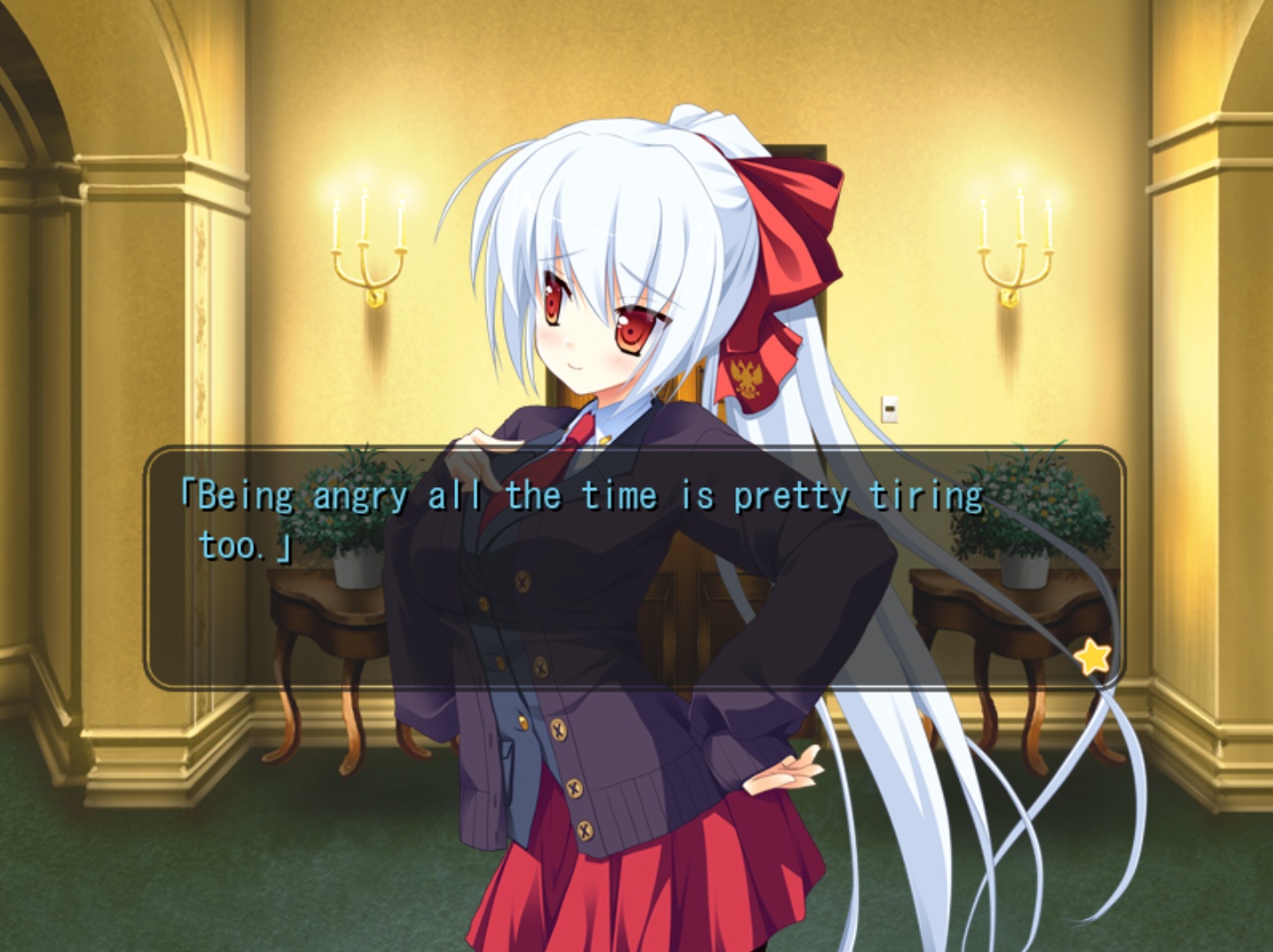
Currently I am about halfway through Irina's route. Irina Putina is the Rusian (sic) president who shows up early in the game's (fixed) first act and then sticks around for varying amounts of time in the remaining three, depending on which route you chose. She's a textbook tsundere in almost every respect, seeming abrasive, grumpy and quick to anger on the surface but regularly demonstrating that she has a soft centre beneath all the slapping. And to be fair to her, protagonist Jun deserves every single slap he gets from her.

Playing Irina's route directly after Yukino (the titular "girlfriend" — actually better translated as "childhood friend") is interesting. On Yukino's route, a huge deal was made out of her history with Jun, particularly a key event in their past which made them the close friends (and, later, lovers) that they are in the game's story. On Irina's route, the pair are still very close to one another, but Jun's attitude towards Yukino is markedly different, at least so far as I have progressed. The pair still play with one another — Yukino's "puppy" impression is particularly adorable ("Wan! Wan!") — but over time as Jun becomes increasingly aware of Irina, he becomes self-conscious about his relationship with Yukino and about how he is stringing her along and making her jealous.

Jun, just in case you haven't read my other entries on the subject, is a bit of a dick at the start of the game. Specifically, he's a wannabe sex pest, constantly making inappropriate comments and lusting after his female friends, most of whom know exactly how to put him in his place. It's worth bearing in mind that he is a teenage boy, however, and consequently is wracked with perpetual horniness and no outlet into which to channel this energy. Moreover, his "harassment," as he calls it, doesn't escalate beyond ill-chosen words and an occasional bit of peeping at things he shouldn't. His actions are regularly completely inappropriate, of course, but he could also be much, much worse.

It's this thoroughly objectionable nature that Jun has at the start of the story that allows him to take such a bold personal journey over the course of the narrative, even as utter insanity is unfolding around him and his friends. By beginning as a heavily flawed character, a pervert, he has the potential to grow and change into something better, and the girls of the story provide the catalyst for him to change. In the case of Yukino, he learns to respect and respond to the feelings of others; in the case of Irina, he learns restraint and gentleness. (I can't speak for Ell or Ran as I haven't played their paths at all yet.)

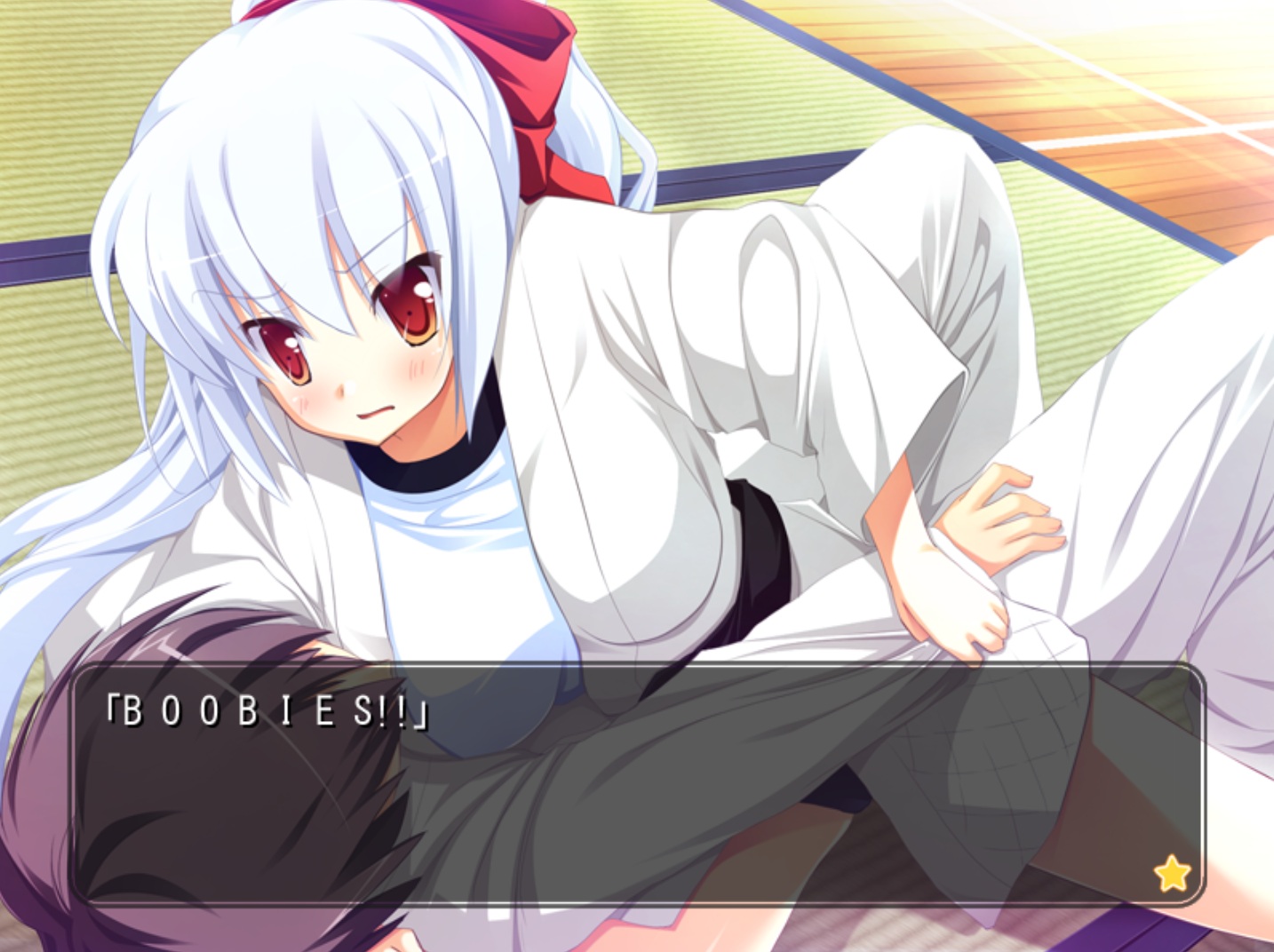
It's actually quite touching to see. We first witness Jun going through some changes on Irina's path when she comes with him to a judo class and shows him her passion for the sport. When he ends up pinned beneath her and starts teasing her about her breasts, she gets absolutely furious at him and storms out. Normally, Old Jun would have just shrugged this off, but he actually feels bad that he has hurt her feelings by mocking something she loves so much. He goes out of his way to try and make things right — even more remarkable given that he knows she's going to leave in a couple of weeks and thus he could just as easily stay out of her way. His feelings grow, and he realises that he wants to make her happy, to give her the opportunity to be a "normal" girl for those two short weeks rather than the "girl president" position she's been lumbered with.

It's an interesting twist on what happens with Yukino's path. When Jun and Yukino become lovers, Jun stands by her, swears to support her and goes out of his way to help her complete her mountains of work — without her knowledge in some cases. As he grows to love Irina, however, he seemingly wants to provide her with an "escape" from reality for a short period, to let her be "herself" rather than the "Rusian Fairy" facade she normally has to keep up.

I really love that a game with such an utterly nonsensical overarching plot as My Girlfriend is the President still has such wonderfully-defined characters and a genuine sense of emotional engagement in its narrative. The game is absolutely masterful at building up sexual tension in particular, meaning the player is right there with Jun throughout, feeling the electricity of every stolen glance, flushed cheek and hesitant word of affection.

That sense of involvement, of being inside the heads of the characters? That's why I love VNs. There are few other places in gaming where you can have such profound experiences.

#oneaday Day 966: Rest in Peace, Willow

This is Willow. She was lovely and cute and adorable and liked to bite people a little bit too much. She was a scaredy-rat but was slowly starting to come out of her shell. The first day we got her, she just sat in her box, too petrified to move, but over time she became more and more confident and started to assert herself more. Her cagemate (and possibly sister) Lara was very much the dominant one in their relationship, but Willow very occasionally managed to come out on top — more so as she grew older, larger and more confident in herself.

Willow died this morning. I feel like we had barely had time to get to know her — we'd only had her about two months or so — before she was snatched away from us far too soon. She'd been ill for around a week — she'd been out of sorts and dirty — but we'd been told that rats were prone to this sort of thing at times, and she'd probably get over it.

Unfortunately, she didn't. Last night, she was very shaky on her feet, but was at least walking around, unsteadily getting food and drinking water. When I came down this morning, she was lying on the floor of the cage, unable to support her own weight. I put food and water in front of her and she couldn't summon the strength to take it. Her sister was fussing around her, trying to clean her, obviously trying to liven her up. It was heartbreaking to see. Rats can't talk, but all I could hear in my imagination was Lara whispering "please don't die, please don't die." I was saying it to myself, too.

Half an hour later, she was gone, lying peacefully on the floor of the cage in silence. I don't know if rats feel emotions or not, but her sister looked sad, and was sitting in her little house, keeping away from the body. She looked at me with sparkling eyes and I just broke down in tears. Little Willow was gone, and poor Lara was left all alone.

I buried Willow in the garden and left Roger the squirrel, a garden ornament who had taken up temporary residence in our living room, guarding her. She's at peace now. I hope she didn't suffer too much.

I've often found the subject of death to be an interesting one to write about creatively — if you follow my "Creative Writing" category you'll find plenty in there — but I find it a terrifying prospect to deal with in real life. Not the prospect of dying myself, mind — that doesn't occur to me — but the prospect of having to deal with bereavement. Today was a potent reminder that I have had to deal with relatively little tragedy in my life compared to some people — but at the same time, a lack of experience in dealing with death makes it all the more difficult to know how to respond when it does happen.

You may feel that a little rat is not worth mourning or grieving over — particularly when we had so little time together in the grand scheme of things — but I get very attached to pets, regardless of size and species. It is perfectly normal and healthy to mourn the loss of someone or something that has been a "fixture" in your life, something you came to expect to see every day, which is why I feel great sorrow at Willow's passing.

Rest in piece, little rat. We loved you dearly and hope you're in a better, more peaceful place now. If you see Kitty wherever you are, I hope you'll be friends.

#oneaday Day 965: Geometry Makes the Best Games

Being "in the zone" is a curious experience. On the one hand, it's enjoyable and satisfying, whatever the context — sports, games, music, writing — but on the other, it can be terrifying. The second you become aware of your own "in the zoneness", panic strikes. Your pulse races and you worry that you will fall out of said zone any moment. You struggle to maintain your "in the zoneness" but as you become more and more stressed, you get more and more likely to make some sort of critical mistake until, eventually, you give up and go and do something else.

This is the feeling you are constantly battling against while playing Super Hexagon, a new iOS game from Terry "VVVVVV" Cavanagh.

In Super Hexagon, you play the role of a teeny-tiny triangle attempting to not meet a sticky end against the various walls that are being inexplicably flung at it from outside the screen. Or perhaps it's attempting to escape a maze without crashing into any walls. Or… well, it doesn't really matter what it actually is. It's an abstract, "pure gameplay" game in which the aim is simply to survive as long as possible. In essence, it's similar to those "endless running" games that are so popular on mobile platforms right now, with the difference being that you're rotating a shape around a point rather than jumping, ducking and sliding.

In your first couple of games of Super Hexagon, you're likely to last a matter of seconds — five at most. This brutal level of difficulty will likely be enough to put many people off immediately, and that's fine. Stick with it, though, and you'll find yourself increasingly slipping into "the zone" as you survive just a tiny bit longer each time, your skills consistently improving as you learn to spot the various patterns that come your way — and how to deal with them.

Then, of course, you make the mistake of thinking "gosh, I'm doing quite well this time" and plough straight into a wall while 0.05 seconds away from beating your high score. Then, you will immediately tap the screen to try again and be unable to break this cycle for at least half an hour. (Consequently, I do not recommend playing Super Hexagon on the toilet.)

The simple, addictive, abstract nature of the game brings my love affair with Geometry Wars 2 to mind. Both are completely different types of game, of course, but both also have a lot in common. Both tend to have relatively short play sessions, both have an aesthetic so abstract that it stirs the imagination to a surprising degree, and both have a relatively low "penalty" for failure. Mess up and you're back in the game within a second or two to try again.

This latter quality is one of the most important factors in making a game "addictive". Super Meat Boy is another game that understands this — fail a level in that and simply by pressing a button, you're trying again, with no loading breaks, no obtrusive "You Failed" screens or statistical breakdowns, just a tap of the "Retry" button and an immediate response. Geometry Wars 2 did this; Super Hexagon does this. Because it's so simple and habit-forming to just tap the screen to retry after a failed attempt, you get locked into a compulsive cycle, determined that this time is the one, that this time you'll be able to progress just a little bit further and hear Jenn Frank's voice whispering the name of a shape with even more sides at you.

Super Hexagon is out now for just 69p. Grab it from the App Store.

#oneaday Day 964: Where Everybody Knows Your Name

As someone who suffers from social anxiety, I've never really been one to just "go out" unless I had a very good reason, usually in the form of some friends asking me to join them. (I have, of course, tried going out by myself a few times in the past, but as chronicled in this post, it rarely ended well.)

As such, I've never really had somewhere that I could call "my local" with any confidence, there's nowhere that I could accurately describe myself as a "regular" of. I'm not really bemoaning this fact — I have plenty of better things to do than sit in the pub — but it's an aspect of life that I feel may have passed me by somewhat.

It was a little different back when I was at university, of course. We regularly frequented a wide variety of places that could quite politely be described as "dives", but all of them had their own unique charms.

In the first year, there was Chamberlain Bar, which was the "local" for a group of several university halls of residence in the area. It wasn't a particularly exciting bar, bearing a closer resemblance to the sort of half-hearted establishment that exists to make a few extra pennies for a community recreation centre than a jumpin' nightspot, but it was "home" for a while. It was where most of us discovered the "Juicy Lucy" (pint glass, vodka, blue curaçao or however you spell it, double shot of Taboo, topped up with equal amounts orange juice and lemonade) and the "Passion Wagon", officially the laziest cocktail of all time (shot of Passoa with a bottle of Reef emptied into it). It also had a tendency to throw crap events — our flat were the only attendees to dress up for "Seventies Night" and a Hawaiian-themed evening consisted of them turning the heating up full and serving nothing but the aforementioned Passion Wagons all night.

Southampton had one big club at the time when I was studying at the university. I'm not sure what it's called now, but it used to be called Ikon and Diva, as it was one of those weird places that was split into two separate mini-clubs inside. It was shit. It was the sort of place that you went after you got really drunk and consequently barely remember anything from. Consequently, I barely remember anything about this place save for the fact I was clearly so impressed by it that I never went there ever again after my first visit.

There were plenty of smaller clubs, though. One that springs immediately to mind was New York's, which has been closed and derelict for several years now. It was also shit, and like Ikon and Diva, it was the sort of place you only went to when absolutely off your tits. I only have random flashes of memories of the one (I think) time I went to New York's, but I vividly recall looking down from a balcony to a stage-like area below, where a bunch of drunk men and women were stripping because the DJ had asked them to. Sure, I got to see tits, but even in my horrendously intoxicated state, I found the complete lack of human dignity on display to be more obnoxious than titillating. Consequently, I never went back there, either.

Then there was Lennon's, which I think is probably home to most of my best "going out" memories, perhaps largely because it's the place that several of us tended to frequent most often. I'm not entirely sure why this was, as Lennon's was a fairly bare-bones club, being essentially a moderately-sized wooden room with a bar on one side and a DJ on the other, occasionally accompanied by a nice man named Vince who sold chips. They played good music, though, and often played host to live bands. I even performed there myself on a couple of occasions, with our university band the Coconut Scratch Orchestra discovering the folly of leaving drumbeats up to a backing track rather than a live drummer. (We all swore after that to never, ever play Mission: Impossible again.) It was also nice in that it was not frequented by the sort of waxed-chest, greasy-haired chav that frequented places like Ikon and Diva.

Would I describe myself as a "regular" at any of those places, though? No, probably not. I see a "regular" as someone who knows the bar staff by name and is recognised by bouncers; someone who meets friends there without having to make prior arrangements; someone who sees it as a "home away from home" — a place to socialise, hang out and just relax. I never quite saw it that way — it was always fun to go to Lennon's, sure, particularly if my friend had enough to drink to get to the stage where he thought kebabs made him literally invincible, but it was never a place that I felt like I was a "part of".

I'm not really sure if I've "missed out" on something by not having that kind of experience. I guess I have another chance when I hit, what, 50 years of age and start liking real ales or something?