#oneaday Day 993: Why You Should Probably Play Quest for Glory

It feels like a good time to explain Why You Should Probably Play Quest for Glory, because 1) the complete series is available on GOG.com for $3.99 for one more day and 2) the Squadron of Shame just released a podcast detailing exactly why it's awesome. You can listen to it in the player below and go leave a comment here.

Quest for Glory remains to this day an aberration in both the point-and-click adventure and RPG genres, in that it is both. For those who have no experience of the series, the basic gist of all games in the series is that you have the mouse-driven "walk, look, use, talk" interface of an adventure game coupled with the stat-based system of an RPG. You wander around, you find out about quests, you get into fights, you save the sleepy Germanic valley/city/African-style savannah region/world.

Sounds simple, right? After all, RPGs and adventure games already have a lot in common — mainly the fact that both often involve a lot of talking — thus it's not much of a stretch to imagine an RPG with a point-and-click adventure game interface (or, in the case of earlier games in the series, text parser).

Except Quest for Glory doesn't stop there, because it makes its games noticeably and significantly different depending on whether you initially choose to play as a fighter, magic user or thief. (It's also worth noting that the "thief" class is a proper thief who breaks into houses and nicks stuff for personal gain, none of that namby-pamby "rogue" nonsense)

That's right — join the quest as a fighter and, for sure, you'll be doing a lot of fighting, but you'll also be using your brawn to solve non-violent problems. Become a thief and you'll be using your agility, climbing ability and stealthiness to sneak around and solve problems from the shadows. Become a mage and over the course of the various games in the series you'll outfit yourself with a diverse array of spells, only a couple of which are of the traditional "throw fiery objects at opponents" variety.

Best of all, if you're the sort of indecisive person who likes to play as a "hybrid" class, you can spend a few extra points on character creation to take a skill that doesn't normally belong to that type of hero. Want to be a wizard that's good at climbing? Go ahead. A thief with a good line in magic tricks? Sure! A fighter who knows what the word "sneak" means? Knock yourself out! All skills that are at higher than zero can be raised through grinding — the Quest for Glory series subscribes to the Final Fantasy II/Elder Scrolls mentality that skills should be raised organically as you use them rather than at arbitrary level boundaries. Crucially for the whole fun factor, though, it's relatively rare that you'll need to grind a skill, unless you're specifically aiming to do and see absolutely everything the game has to offer. (And if you are, you're a masochist.)

Then there's the fact that the Quest for Glory series was one of the first series that allowed you to transfer your save file from one game to the next. Beat one game and you'd be invited to export your character ready to import once the next game released. This was remarkably forward-thinking (and confident) of the developers at the time — and also somewhat symptomatic of the different times back then. Now, sure, we have franchises like Mass Effect and Dragon Age allowing you to import your save file from the previous game, but each game in the series didn't specifically include with a promise of the next one. In other words, whether or not a game gets a sequel these days isn't necessarily preordained — it's often dependent on sales. In Quest for Glory's time, it was built in to the design from the very beginning, even as technology improved over time.

This is one of the other interesting things about playing through any of Sierra's old adventure series. You can see how gaming technology evolved from game to game. Quest for Glory I and II initially used 16-colour 320×200 EGA graphics and a text parser, though Quest for Glory I was subsequently rereleased with 256-colour 320×200 VGA graphics and a mouse-driven interface. Quest for Glory II never got the same treatment officially, but a fan-made free remake (approved, but not funded or assisted by, the original team) brought it into the latter days of the 20th century rather nicely. Quest for Glory III then brought the series officially into the 256-colour VGA age, and Quest for Glory IV was the first CD-ROM based episode, featuring none other than John "Gimli and That Professor Bloke I Can't Remember the Name Of from Sliders" Rhys-Davies on narration duties.

Quest for Glory V marked a bit of a turning point, however, not just for the series, but for Sierra's fortunes and the adventure game genre at large. Being a CD-ROM only multimedia extravaganza with 256-colour 640×480 Super VGA visuals, polygons and a prerendered intro sequence that, while impressive at the time is utterly laughable if you watch it nowQuest for Glory V marked the point where, for many, the franchise lost its way. There are plenty of people who adore the game, of course, but those who grew up with the earlier entries in the series can't help but mourn the direction it took with its fifth instalment and its subsequent demise.

This wasn't the only time Sierra did something weird with one of its established series. In fact, almost all of Sierra's classic, long-running series ended up as something completely different to their original forms — King's Quest became a 3D action RPG with its eighth instalment; Police Quest became the tactical SWAT series after its fourth incarnation (later dropping the Police Quest moniker altogether); and Leisure Suit Larry just went off the rails altogether after its sixth episode (which, naturally, is called Leisure Suit Larry 7). In comparison to these other titles, Quest for Glory V's changes were actually relatively modest — but still enough to put some off.

Perhaps the saddest thing about the demise of the Quest for Glory series is that we really haven't had anything like it since. We've had a resurgence of point-and-click adventures in the last couple of years, sure, but nothing that so deftly blends two genres together with interesting stories, a genuinely amusing sense of humour and satisfying gameplay.

However, there's some good news for fans of Lori and Corey Cole — they're working on something new called Hero U, and will be opening a Kickstarter funding drive some time later this month. More details here. I'm pretty excited — they've said outright that it's not going to be a new Quest for Glory game, but it will incorporate some of the things they learned from making those games. Sounds awesome, right? Of course.

Hope you enjoyed the podcast. We certainly spent long enough recording it — and then I spent even longer editing it. 🙂
#oneaday Day 992: Making Excuses

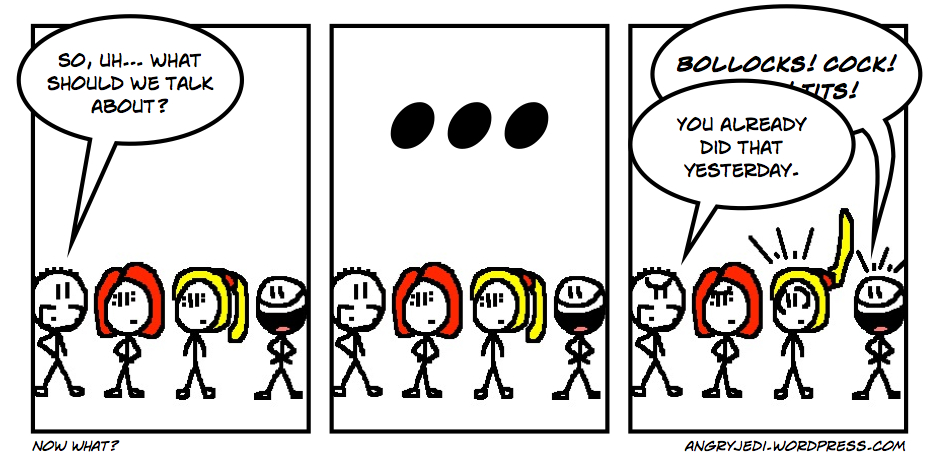
It came to my attention last night that some people were missing the stickmen cartoons. This was nice to know, as I'd always wondered if anyone actually found them entertaining or not and occasionally found myself suffering from a bit of a "crisis of confidence", thinking they were crap, not funny or whatever. I'm usually fairly confident in my creative work, but I think at the back of my mind was the knowledge that bad webcomics often get ridiculed, and I really don't like being ridiculed. Call me irrational like that.

Of course, the pretty limited audience this blog has probably means that the vast majority of the Internet had no idea of the existence of that cartoons, so there's that.

I have a bit of a love-hate relationship with the cartoons, if I'm honest. I genuinely love the characters I've created, even if they're silly, stereotypical and don't have any really meaningful depth. It's also nice to occasionally drop in a guest character based on someone I know — that has never been received negatively, even though I spend much too long worrying about whether their stickmen representation actually looks anything like them. (note to self: they're stickmen. If you think you're going to make them realistic, you are Doing It Wrong.)

At the same time, it adds a bunch of extra work to my daily blog posts (you'd be surprised how much I agonise over getting those crap drawings just right) and also means that if I'm away from my Mac — which has the software I use to make the comic layouts — I can't do them easily. It irks me somewhat if I've started doing them daily again and then suddenly have to leave a gap. Sometimes I end up not starting again after said gap, which I think is probably what happened last time. Or possibly just laziness and/or starting to write when I just really wanted to go to bed.

I also get a bit hung up on trying to tie the strip and the blog post together, and sometimes there's nothing funny in the post I can spin out into a comic. In particular if I'm writing about something personal or upsetting, cracking a joke about it can feel a little flippant or insensitive. (Can you be insensitive towards yourself? I guess so.) The solution to this is, of course, simply to not be too attached to the concept of the strip and the post having anything to do with one another, and dealing with situations where penis jokes might not be appropriate as they arise.

So there you are. Those are the things that go through my head regarding the stickmen, and the reasons why sometimes I stop for a little while. Since they apparently have a small but dedicated following, however, I will certainly do my best from this point on to keep them coming! (hurr hurr, you said "coming" — Phillipe)

#oneaday Day 991: Last Man Standing

So, having hit one thousand daily posts before me (he did start first), Mr Ian Dransfield has officially bowed out of the daily blogging business. I don't blame him at all — he notes that the prospect of continuing even on a weekly basis feels like "giving myself work I don't want to do" so has chosen instead to jack it in altogether. A hearty congratulations to him for having put up with it for so long, though — a thousand daily posts is a massive amount of stuff to evacuate from your head on to the page. Believe me, I know.

Since I'm coming up behind Ian and closing in on that elusive post number 1,000 as the last man standing, this has naturally got me thinking about the whole business, too. Specifically, it has me thinking to myself "is it worth still doing this? Am I actually enjoying it?"

And, I have to conclude once again — this isn't the first time I've asked myself this question — that "yes" is the answer to both of those questions. In the last 991 days, I don't think there's been a single time that I've resented my self-imposed obligation to write this blog. There have been days where it's been difficult to think of something to write, sure, and there have been days where other distractions have meant I haven't written it until a ridiculous hour in the morning (I think 4am was the latest after having watched several episodes of Firefly while in conversation with someone over the Internet) but I've certainly never felt like it was an unwelcome obligation. Quite the opposite, in fact — although it usually ends up being the last thing I do each day, it's something I often find myself thinking about over the course of the day's activities and looking forward to actually sitting down and writing. It is, as I've said many times before, a cathartic means of self-expression for me, with the happy bonus that I've got to know a number of thoroughly pleasant people in the process. Moreover, a number of people who already knew me have got to know things about me that they might not have done otherwise.

Like Ian, my life has changed immeasurably since I started writing this blog. I have changed jobs several times — going from primary school teacher to unemployed bum to part-time, low-paid games journalist to legitimate, properly-paid games journalist. My relationship status has changed several times — my wife and I split, signalling the start of the darkest period I've ever been through in my life; I met someone, that didn't work out; I met Andie, that did work out (right? Hopefully. OH GOD WHAT IF— [*slap* — the Rational Part of Pete's Brain]). I went to America several times for various reasons (PAX East, family time). I've moved several times — from Southampton back to my childhood home in Cambridgeshire, then onward to my current situation in Wiltshire (and hopefully back to Southampton at some point in the near future). I've re-established contact with some friends; lost touch with others. And I've discovered anime.

Alongside all these various upheavals, the one constant in my life has been this silly little corner of the Internet that I call my own, with the tens of thousands of words I've tapped onto it at ungodly hours in the morning, usually from my own computer, but sometimes from my phone, sometimes my tablet, sometimes my netbook. This blog has been someone I can always "talk to", to offload thoughts and memories both pleasant and painful, and to share those things with anyone who will listen. It's been an immeasurably valuable experience for me, and thus I have absolutely no intention of stopping right now.

I realise that by saying all these things now I am effectively sabotaging my own "YAY 1,000 POSTS" post, but eh, whatever. With Ian's departure from the journey, it felt timely to say them now. Doubtless inspiration will hit me at about 2am on Day 1,000 and I'll have something amazing to share with you.

Until then, though, it's business as usual, I'm afraid. Thanks for continuing to read, like and comment, and I'll see you again tomorrow!

#oneaday Day 990: Aselia the Eternal, Early Impressions

For an upcoming READ.ME column over on Games Are Evil, I'm going to be covering a game called Aselia the Eternal. Depending on how much progress I make before Sunday, said column will either be this week or, more realistically, next week. But I thought I'd take a bit of time to share some less formal initial impressions on the game for those who are interested, or simply curious.

Aselia the Eternal is a visual novel for PC (and PSP in Japan, I believe). There are actually two versions available — an 18+ edition with H-scenes and a 15+ version without. Only the 15+ version has officially made it to Western-speaking territories due to some of said H-scenes supposedly being in questionable taste — and also because of Western publisher/localiser JAST USA's desire to start putting out a few "all ages" titles as well as their myriad 18+ shag-happy offerings.

The basic premise of Aselia the Eternal is thus: Protagonist Yuuto lives alone with his little sister Kaori. Their parents died a while back in an accident, but Kaori was spared thanks to Yuuto imploring anyone who would listen to give him a miracle and save his sister. It turns out someone was listening — the spirit of the sword "Desire," which, as these things tend to do, claims ownership over Yuuto's soul in exchange for his sister's life and, at an unexpected point after several hours of fairly typical high school drama, sucks Yuuto into another world where All Is Not Well. War is brewing, and Yuuto is about to become embroiled in it as part of a force of "spirits" — seemingly human creatures with strong bonds to their swords who are treated as nothing but weapons by the actual humans. Since humans make spirits (and "Etrangers" from another world such as Yuuto) do all their fighting, most places have little hesitation in going to war because there's actually very little risk to the "real" people, and as such Yuuto arrives just as It Is All Kicking Off, as it were.

The interesting thing about Aselia the Eternal is that rather than representing the conflicts and battles that Yuuto and his spirit companions get into purely through narrative text, there's actually a very competent strategy game built in alongside all the visual novel stuff. When it's time for Yuuto and his allies to saddle up and hit the road to complete a mission, gameplay switches from the usual "read, read, read, read, read, make a choice" to a tactical map view, at which point you need to put your strategic hat well and truly on if you're going to survive.

The world map of Aselia the Eternal's battles is node-based in nature. Player units, each of which may contain up to three members, may move one space per turn, as may the enemy. If a unit enters a contested space occupied by an enemy unit, a battle begins, at which point the makeup of the teams becomes important.

Each unit has an attacker, a defender and a supporter. The attacker makes use of direct-damage skills. The defender tends to mitigate damage. The supporter either casts damage spells or adds useful effects. Each individual character has their own set of skills that changes according to what slot they're in — the eponymous Aselia, for example, may attack with her sword twice in a battle if she is in the attacking position, whereas if she is in the supporter position she is able to block enemy spells and prevent them from causing damage. The "colour" of each unit also has an impact on their effectiveness — green spirits are best in defensive positions, blue spirits are best in attacking and red ones are best in support, though according to the enemy's abilities (which can be previewed before battle is resolved) you may wish to switch them around a bit. Each character only has a set number of uses of each of their skills before they either need to switch them around or go back to a friendly-occupied town or base to refresh themselves.

It's an unusual, original, simple and elegant system that works extremely well, offering a degree of tactical flexibility while rewarding those who think carefully about the best way to approach a particular situation. The node-based nature of the world map means that it's relatively accessible to strategic newcomers, but still offers the potential for pulling off clever tactics, particularly later in the game when you get access to additional characters and, by extension, units. It's surprisingly tough and unforgiving, too — lose a main character in battle and it's an immediate game over. No Phoenix Downs here. (Also, SAVE!)

What's surprising about the inclusion of this aspect of gameplay is not that it's in there at all — there are a number of visual novels that incorporate minigames — it's that despite it being there, the game is still a storytelling vehicle first and foremost. It's not a strategy game/RPG with lengthy story sequences, it's a visual novel with occasional strategic battles. This might not sound like a big difference, but it's the difference between playing something like, say, Final Fantasy Tactics, where the story sequences sometimes feel like they're just rushing you through towards the next battle as soon as possible, and what we have here, which is an unfolding story in which you occasionally have to fight. The "pace", for want of a better word, is a lot slower — though that's not necessarily a bad thing, as it gives you plenty of time to get to know and become attached to these characters before walking into battle with them.

In fact, what the experience really feels like is the developers sitting down and thinking "this is the story we want to tell. There are battles at this point, this point and this point because they serve the story." rather than "we are making a strategy RPG. We need gameplay to be 75% strategic battles, 25% story." It feels very much like something that has been designed primarily as a narrative, in short, rather than a game — and that's rather interesting, because I can't imagine any Western publisher greenlighting a game with such a seemingly skewed ratio of traditional gameplay to sitting back and just reading. (Of course, I can't imagine any Western publisher greenlighting a visual novel full stop, but that's beside the point.)

I like what I've seen so far. The story is quite slow to get going but it already has some interesting characters involved, and I'm intrigued to see where it goes next. Watch out for further thoughts when I've played a little further.

#oneaday Day 989: Blackout

I was all set to write something profound tonight, then the Internet died and I'm relegated to blogging from my phone.

All right, I didn't have anything hugely profound to say and even if I did I could clearly still say it from my phone, but the Internet has gone down, which is, as everyone thoroughly immersed in 21st century living knows, incredibly annoying.

Given its prevalence in our everyday lives, it's very easy to forget what life without the Internet was like. Something as simple as checking the news or finding out what time something was on TV relied on you having… oh, it's back. I'll return when I finish watching this episode of The World God Only Knows. Ja ne!

… … … …

20 minutes later…

There we are, that's better.

Shit, now there's pressure on me to write something meaningful. Umm…

Nope, I got nothing. And fuck all that Internet talk. I've written that exact same post at least five or six times already in the last 989 days.

I finished watching Welcome to the NHK today. The last few episodes were major-league Feels territory. It was a fascinating show, all-told, that I may write about in more detail at some point in the near future. What I particularly liked was that it wasn't particularly easy to pigeon-hole into a specific category of genre. It had elements of comedy, drama, romance, surrealism and all manner of other stuff too. On the whole it was quite an emotional experience for me — I'm not sure how much it would resonate with someone who couldn't relate to some of the issues therein, but I certainly found it to be an excellent, worthwhile, enjoyable and moving watch.

Tonight, as I mentioned earlier, I've started watching The World God Only Knows after recommendations from several people. I'll blog in more detail about this when I've watched more than two episodes, but it seems to be highly entertaining so far.

The premise, for the unfamiliar, is that dating sim addict Keima inadvertently enters into a contract with the unfeasibly cute and broom-wielding demon Elsie to help round up "Loose Souls", runaway spirits that hide themselves inside the hearts of girls. Keima is thus tasked with making said girls fall in love with him, thus releasing the Loose Soul for Elsie to catch. Keima, sadly, is more than a little socially awkward, having spent all his time dating 2D girls rather than interacting with real people. However, since reneging on the contract means that both he and Elsie will be decapitated by the magical collars placed upon them, he has no choice but to go along with the outlandish plan. Consequently, he attempts to use his knowledge of dating sim tropes to figure out girls in the real world and, of course, Hilarity Ensues.

I've watched two episodes so far and already I want my own Elsie to hug. Certain characters just nail the whole adorableness factor, and she has this particular characteristic in spades. The show as a whole is rather endearing, too, though, regularly lapsing into heavily-stylized and chibi sequences rather than trying to remain too grounded in reality. The concept is, after all, ridiculous, so rather than trying to take itself too seriously the show appears to very much embrace its silliness. I'm fine with that, and am looking forward to exploring the rest of the episodes.

Anyway, on that note I think it's probably time I hit the sack. Hopefully tomorrow will see a more coherent entry and less in the way of Internet outages.

#oneaday Day 988: Love and Tolerate

The world is full of social issues that really, thinking about it, we should probably have gotten over by now. As a general rule, hating anyone for arbitrary reasons such as their gender, race, sexuality or haircut is something that the human race of the 21st century should have moved past now, but it's sad to see that this sort of thing still goes on. And yes, people probably should speak out against sexism, misogyny, racism and all manner of other issues when they crop up. If they don't, then these issues just continue to fester and get worse. If you don't get any sort of feedback on the things you say, you never learn that they aren't acceptable, after all.

At the same time, I can't help feeling discomfort at the tone in which some of these criticisms are presented. I read an article over on Boing Boing today about "why the fedora grosses out geekdom". Perhaps I'm not clever enough to "get" Leigh Alexander's writing, but I came out of that article having absolutely no idea of what she was getting at. Supposedly she was exploring why the fedora had such negative associations, even among members of geek culture — this is the first I've heard of it, I have to say — but it actually came across to me as yet another rant against the phenomenon of "Nice Guys". I've written about this topic in the past and it really does bother me — even more so since learning that a very good friend of mine (and a genuine nice guy (no caps) to boot) abandoned his previous (excellent) blog due to its name — "Nice Guy Gamer" — having negative connotations. While I don't argue that there are guys out there who do fulfil the "Nice Guy" (with caps) stereotype, as someone who believes himself to be nice (no caps) it irks me enormously any time this discussion comes up.

In short, Alexander's piece just came across as rather judgemental, even if that wasn't the intention. In providing links to the various "shaming" Tumblrs that focus on men wearing fedoras and these supposed negative connotations, she has fuelled the fire and made people aware of another avenue of bullying people based on their fashion choices. Not only that, she has also drawn attention to a supposed connection between the people who choose to dress this way and undesirable character traits. Statistically speaking, there probably are some men who wear fedoras and who are manipulative jerkwads, but equally, there are probably also plenty of men who choose to wear them purely as a means to express themselves. We geeks aren't particularly known for dressing well at the best of times, so perhaps we should cut those who make an effort to give themselves a distinctive appearance a bit of slack. (NB: I do not own a fedora. I do have a straw trilby that was purchased entirely to stop me giving myself sunstroke when sitting outside, and not as a fashion statement.)

I guess my point is that while there are plenty of issues that really do need resolving — the way that many women are treated on a daily basis is unacceptable; racial epithets just need to go away; medieval attitudes towards sexuality need to be thrown through the window — there are clearly better ways of going about it than attacking (or at least drawing unnecessary attention to) subcultures or trends that may or may not have anything to do with undesirable character traits. Attack sexism, misogyny, racism, homophobia and all that other bullshit the world can do without when it comes up, yes. Speak out against injustices. Make a difference.

But seriously. Dudes in hats? Let them enjoy their quirks. Love and tolerate. Not everything is bad. At this rate there will be very little left in the world for people to enjoy without feeling guilty or self-conscious. And that sounds like a pretty miserable existence to me — especially as a geek who feels perpetually uneasy and self-conscious.

#oneaday Day 987: Welcome to the NHK

Continuing my jaunt into the world of anime, I started watching Welcome to the NHK on the recommendation of my good friend Mark, who knows about these things. And if ever there were a show to ably demonstrate the massive possibilities of anime as a medium it's this one. Watch it and then tell me that animation is in any way childish or silly.

I've only watched about half of the complete run so far, but I am very much appreciating what it does so far. It's wonderfully put together, blending just the right amount of comedy, surrealism and pathos together to produce something extremely memorable and affecting.

For the uninitiated or curious, Welcome to the NHK revolves around the protagonist Tatsuhiro Sato, who is a hikikomori. (A hikikomori is a "shut-in" — someone who is not in employment, education or training (NEET) and who rarely leaves their home or interacts with other people except when absolutely necessary.) The story unfolds as Sato explores his condition and learns a great deal about himself through his developing relationships with several other characters — his neighbour and former schoolmate Yamazaki, his old school senpai (and crush) Hitomi and the mysterious young girl Misaki, who shows up offering to counsel him out of his hikikomori status for reasons that have not become completely clear at the point in the series I have reached thus far.

Perhaps the most interesting thing about Welcome to the NHK is that it doesn't pull any punches about how these characters are represented. Sato is wracked with all manner of neuroses and social phobias; Yamazaki is a hardcore otakueven Misaki, who initially appears to be sweet and innocent, clearly has some fairly serious issues of her own that she's dealing with. Every one of the characters is dealing with some sort of "damage" and it makes every one of them interesting and unique by themselves. When they get together, as you might expect, the sparks frequently fly. But at no point are their conditions and issues really played for laughs — they are what they are, and if you find their circumstances amusing, that's your decision, but they're not specifically portrayed as being worthy of ridicule (or not, as the case may be).

In particular, I've found a lot of the show very relatable for a number of reasons. I recognise many of the things Sato in particular goes through — specifically with regard to his social phobias and discomfort at the prospect of dealing with other people. There's also the fact that I was practically a hikikomori myself in the weeks/months following my split from my wife — I was a NEET, I was emotionally unstable, I had no idea what to do with myself and the prospect of going back home to live with my parents filled me with unspeakable dread, like an admission that I was a complete and total failure as a human being. Having survived all that intact — well, mostly — I know in retrospect that it wasn't as bad as I thought, but when you're there actually in that situation, it's all too easy to let the negative thoughts, fear and anger run away with themselves. And with no-one around to keep you in check, it can be very difficult to deal with.

Aside from the personal perspective on the show, the other thing that I've been very impressed with is the soundtrack. It features some excellent tunes in a variety of different styles, ranging from some mournful Silent Hill-style jangly guitar melodies to more upbeat and "dramatic" numbers. They fit the on-screen action well and are reused enough to be recognisable but not so much to be tiresome or predictable. They're also tweaked, changed and remixed every so often to either have different lyrics, or additional layers of lyrics, or different instrumentation. It gives the show a great feeling of consistency.

And speaking of consistency, there's Pururin.

Pururin is a fictional anime show that Sato's neighbour Yamazaki is obsessed with. It has such importance to the "world" in which Welcome to the NHK takes place that creators GONZO went to the effort to create a completely fake opening credits sequence for the show, seen above. The Purupurupururin theme that you probably already have stuck in your head if you were foolish enough to click "Play" on that video is a regular fixture in the background sound of the show — Sato meets Yamazaki as a result of hearing the song through his wall 24 hours a day (if you want 10 hours of it non-stop for a similar experience, go here), it's several characters' ringtones, it plays in the background of several shops and the Pururin character frequently appears on billboards and posters around the place. We never really find out a lot about who or what Pururin actually isbut from the opening sequence we can deduce that she's some sort of magical girl with cat ears who appears to ride around on a vacuum cleaner.

All this isn't even getting into the other awesome aspects of the show — the tenuous friendship between Sato and Yamazaki as they attempt to make an eroge together; the way in which Sato has a stronger impact on the people around him than he thinks; the unassuming, understated but utterly enrapturing cuteness of Misaki (plus the things she's clearly hiding) — but suffice to say that the DVD blurb's assertion that Welcome to the NHK is a "modern-day classic" is not without a certain degree of plausibility, and it's well worth your time if you're interested in character-driven, relationship-based stories featuring realistically-flawed characters with relatable issues.

#oneaday Day 986: A Very Big House in the Country

One of the appealing things about this weekend away was getting the opportunity to spend some time at my friend Tim's childhood home, which is an impressively large mansion in the middle of nowhere in the British countryside. It's up for sale, so it's also quite possibly something of a farewell for Tim, but for most of us it's the chance to spend some time in the sort of place you normally only get to visit if you're attending someone's wedding.

It brings up an interesting consideration though. Most people, when confronted with the possibility of winning the Lottery or something will claim that one of their first priorities would be to purchase a gigantic house. And while a gigantic house is certainly a fine status symbol, a lot of people clearly don't think of some of the issues that only come about in big country houses.

For one, when was the last time you looked behind the TV and found a dead bird? That's exactly what happened to us last night when attempting to set up the TV in order to chill out with some DVDs.

Spiders, too. Everyone gets spiders in their houses but it's nothing compared to the behemoths you get lurking between the beams in an old wooden-framed house. And mosquitoes. And all manner of other little creepy crawly bastards.

And low doorways. I've lost count of the number of times I've banged my head on a low doorway this weekend, even when I'm well aware of where the danger zones are. It still hurts.

And yet despite all this there's still something kind of wonderful about being in a house with multiple staircases, about fifteen bathrooms and a bizarre layout. Even if its just enjoying a few Resident Evil fantasies.

#oneaday Day 985: BANG

As I mentioned yesterday, this weekend was set to see us shooting each other with Airsoft weaponry. And indeed that is how we spent a healthy proportion of the day.

I haven't done Airsoft before today, but it's a lot of fun. A big part of the appeal is the fact that the weaponry involved is very realistic — most of the guns available are based on real-life guns to varying degrees and thus must be painted bright orange so as to not get the participants arrested. The gun I got was modelled closely on a Beretta and made entirely of metal, so had a pleasing amount of heft to it and a satisfying degree of kickback when fired. It made a great noise too.

I haven't fired guns on many occasions in my life but it's an oddly thrilling experience. I recall in the first week of university several of us decided to try going along to a trial session of the Rifle Club. It was a lot of fun but also had an element of danger — the instructors repeatedly reminded us that firing the gun at the floor would probably kill us. Scary.

More recently, I've done paintballing a few times. Paintball is good fun, but the weaponry isn't particularly realistic. It really, really fucking hurts when you get hit, though. And you get a lot of the satisfaction of crawling around in the undergrowth and shooting at far-off enemies.

Games such as paintball and Airsoft give you a good insight into what soldiers must go through on a regular basis. It makes me feel like I most certainly couldn't be in the army. I'm sort of fine with that — although it's fun to fire these fake guns, I imagine it would be absolutely terrifying to fire a real one that could actually kill someone.

Anyway. It is late so I am feeling the call of bed.

#oneaday Day 984: Stagging

I'm away for the weekend. Specifically, I'm in the middle of nowhere in Worcestershire for my friend Tim's stag weekend (or "bachelor party" as you Americans prefer to call it). We're having a weekend of drinking, board games and shooting each other (but mostly Tim) with Airsoft guns. Sounds like fun.

Of my friends who have got married whose stag dos I've been to, none of them have done the stereotypical "get hammered in Amsterdam, hire hookers then leave Stag Boy in an embarrassing position to be discovered by the police/his parents after several hours of considerable discomfort". And I'm actually quite grateful for that. Although everyone jokes about that being the way that stag dos are "supposed" to go it never struck me as particularly fun — especially not for the Stag, who will probably be left rethinking his friendships in the hours between being chained to the lamppost and having to explain to the nice police officer why he is naked and covered in margarine.

My own stag do was relatively stereotypical — paintballing in the daytime followed by drinks in the evening — but I chose to invite my female friends also, and nothing embarrassing happened. Not that I remember, anyway. I remember it being a rather fun night — there are certainly a bunch of photos suggesting it was lurking around somewhere — but I didn't leave it thinking "wow, my friends are a bunch of bellends." Which, again, I'm quite grateful for.

A stag do should be an opportunity for the groom-to-be to have some time with his closest friends — regardless of gender if he so desires — and have a memorable "send off" before married life. That looks like exactly what this weekend is going to be, so I'm going to take the time to relax and enjoy it hopefully as much as Tim will.

Bed now. The drinks have been flowing freely and we've been playing Cards Against Humanity for the past few hours. Hilarity, as usual, ensued, but I'm more than ready for sleep now!