2419: Happy Anniversary, Titan Quest

0419_001

Titan Quest Anniversary Edition is currently just £5 on Steam, and it's completely free if you own any other Titan Quest products already. You should go buy it and play it, because I have spent most of the evening doing so and I like it a whole lot.

Titan Quest Anniversary Edition combines the original Titan Quest and its expansion Immortal Throne into one package, cleans the whole shebang up for modern computers — the original came out in 2006, hence the "anniversary" thing — and unleashes it on the world for existing fans and newcomers alike to enjoy.

Having never played Titan Quest, I fell into the latter category. It had just never quite appealed to me for some reason, despite it being the sort of hack and slash loot-whoring game I enjoy coupled with Greek mythology, which I was in love with as a child — and despite the game often being discussed in hushed, reverential whispers any time anyone brought it up.

£5 for a remastered version of the game and its expansion in one complete edition was too good an offer to turn down, though, so I took the plunge and gave it a go, partly to sate my own curiosity and partly to have something to play online with my friend Chris, who had also been going back and forth about whether or not he wanted it.

If you, like me, have never played Titan Quest, here's the deal. You play a male or female Greek person who initially has no character class. You save a farmer's horse from being eaten by satyrs, then you embark on a journey to cleanse the land of evil seemingly for no other reason than "because why not". Your character is given precisely no backstory and no real motivation to do their thing, but in this sort of game that's probably a good thing. While the lore in the Diablo games is substantial and interesting, its execution in-game leaves a lot to be desired, and in latest installment Diablo III in particular, by far the most enjoyable way to play the game is in "Adventure Mode", which dispenses with the narrative and linear structure altogether in favour of giving you freedom to go anywhere at any time to chase down various objectives.

Titan Quest doesn't quite go that far in abandoning the traditional narrative structure — you still progress from "unknown Greek person" to "hero of legend" over the course of the game — but the plot is very much de-emphasised in favour of the excellent mechanics.

At level 2, you unlock a "specialism" — essentially a character class with its own skill tree plus a mastery meter you need to pump skill points into in order to unlock the next "tiers" of skills. (Said meter isn't entirely useless; each point you put into it gives you a substantial increase to your base stats.) Then at level 8, you unlock another specialism and can start pumping skill points into that as well, allowing you to effectively mix and match skills from two entirely different classes to create your own custom build.

And these classes aren't your usual warrior-thief-mage trinity, either — they're all interesting, and all present interesting combinations when combined together. All together, there is a caster type that specialises in cold and electricity; another caster that specialises in fire and earth; a close-range physical attacking type person; a highly defensive physical attacker (who can apparently do some tremendous things with shields later in the game); a tree-hugging hippy that can summon wolves, heal things and infect enemies with plague; a hunter type that is good with bows and spears; and a backstabby thiefy rogue type deal that is good at inflicting pain but not so good at taking it.

The great thing about this system is that you can make a variety of different character types — all together, there are 36 different combinations, each of which has its own unique name. You can combine the Defense and Warfare masteries to create Conqueror, for example, which is a tank that also hits incredibly hard. Or you could combine the Earth and Nature masteries to create Summoner, a character that is able to summon a variety of different minions to do their bidding, including an earth golem, some wolves and a nymph, and be able to sit back, pelt the enemies from a distance and heal their minions as needed.

The combat itself is fundamentally satisfying. Humanoid enemies are thrown around with satisfying ragdoll animation; birds explode in a shower of feathers; skeletons shatter into pieces. The variety of skills mean that there are a lot of different ways you can protect yourself or go on the offensive, too, and so far I haven't felt like there's a "bad" combination; with two different masteries, you can either cover the weaknesses of the first with the second, or enhance the first's strong points with the second.

Then, of course, there's just something wonderfully enjoyable about hacking and slashing through recognisable creatures from mythology. The game appears to act as pretty much an Ancient Greece's Greatest Hits, promising confrontations with Medusa, the Hydra and numerous others over the course of the adventure — and I believe you also take a trip to ancient Egypt and China later, too, which opens up possibilities for all manner of interesting confrontations.

I hadn't expected to like the game quite as much as I did when I booted it up for the first time. But, well, the 5 hours of playtime Steam has already recorded for me — I bought it earlier this evening — probably speaks for itself.

2418: The Bonds of True Friendship

0418_001

As someone who, for the most part, tends to put narrative concerns front and centre when considering what to entertain himself with, it probably won't surprise you to hear that the main thing that draws me to my favourite genre of video game — RPGs — is not the stat-crunching mechanical goodness that goes on behind the scenes (though good mechanics can make a game I'm already emotionally invested in even more satisfying) but the almost overwhelming sense of camaraderie and "all being in it together" that a good ensemble cast brings to the table.

When considering narrative tropes, this sense of comradeship is regarded as "true companions" or sometimes nakama, from a Japanese word that translates to "friend" or "comrade". Indeed, if you turn the Japanese voices on in many JRPGs, you'll hear the word nakama used pretty liberally when characters are talking about their friends and travelling companions in the party; it's a contrast to another Japanese term referring to friendship, tomodachi, which is typically used when talking about friends in a more social, casual manner. To put it crudely, your nakama friends are the ones who travel with you, who will go to the ends of the earth with you, the ones who are closer than family; your tomodachi friends are the ones you go down the pub with once or twice a month and talk about girls or football.

This sense of true companionship is, for me, what defines a great RPG story, and it's a big part of why I find solitary experiences like Skyrim and Fallout — which, mechanically at least, ought to be right up my alley — so fundamentally unsatisfying: you don't get that sense of being part of a group of people with complex and interesting relationships.

So with that in mind, I thought I'd share some of my favourite ensemble casts from the past few years. You can probably guess at least one of them.

Neptune and the gang

Yup, you were right! The biggest thing that keeps me coming back to the Neptunia series time after time — and the thing that kept me persevering with the shaky first game in the series — is the wonderful sense of camaraderie between the characters.

Interestingly, Neptunia's cast can be split into a few different elements, each of which overlap a little and which all have Neptune as their common element.

First up, you have IF and Compa, who will always have an important place in any Neptunia fan's heart due to them being pretty much the first characters you have a meaningful conversation with in the series. IF and Compa are friends, but also a study in contrasts; IF is somewhat sullen and tsundere (with a secret otaku side) while Compa is feminine, ditzy and honest. They're good foils for one another, and with the chaotic personality of Neptune in the middle, just these three make for a good cast by themselves, and indeed a significant portion of the original Hyperdimension Neptunia consisted of just these three core cast members fighting alongside one another.

Then you have the more well-known faces of the series, the CPUs Blanc, Noire and Vert. These were introduced in the original Hyperdimension Neptunia almost as antagonistic characters, but over time their personalities have softened somewhat, and the four of them (including Neptune) have become very close friends with one another. Once again, they work as a group because of how they contrast with one another. Noire is determined and driven to a fault, but secretly wishes for close friendships; Vert likes to play the older sister but in many ways is one of the most immature of the group, often disappearing for days at a time to indulge in her hobbies rather than doing her job; Blanc, meanwhile, despite her youthful appearance, seems calm and mature until something — it doesn't take much — attracts her ire, at which point she becomes a devastating force of fury.

mk2 onwards introduced the sisters of the CPUs to the series, and again, they made heavy use of contrast to make them stand out from one another. Neptune's sister Nepgear, for example, is the opposite of Neptune in almost every way: she's smart where Neptune is dim; she's articulate where Neptune tends to let her mouth run away with herself; yet she's timid where Neptune is (over)confident. Blanc's twin sisters Rom and Rom contrast both with each other and with Blanc, with Rom being quiet and shy, while Ram is loud and rambunctious. And Noire's sister Uni, in her own way, contrasts with the rest of the group altogether by actually being similar to her sister — a little too similar at times, so closely does she follow in her sister's footsteps.

All together, you have a substantial ensemble cast with a variety of contrasting character types. They often clash with one another, as contrasting personalities tend to do, but their shared hardships and common goals bring them together time after time. The particularly dark mk2/Re;Birth2 story is arguably the catalyst for their closeness, thanks to the especially unpleasant events that occur therein, but by now their relationship has grown so close that each new Neptunia game feels like being reunited with a group of old friends. It's a delight.

The Witcher

The Witcher series is an unusual case in that they're not party-based RPGs, but they nonetheless carry a strong sense of camaraderie, friendship and even romance between their major characters. This is helped along in part by the fact that the games are based on some already extensive pre-existing lore from the original novels, but even if you're unfamiliar with the source material, The Witcher's relationships are a real highlight of the whole experience.

For starters, despite protagonist Geralt usually working alone for each of the games, there's a strong sense of comradeship between him and his fellow School of the Wolf witchers, some of the last remaining witchers in the world. Months or even years can pass between them seeing one another in some instances, but when they do meet up with one another, it's like no time has passed. The Witcher 3 in particular plays with this delightfully in a scene where Geralt and his witcher buddies get absolutely hammered before going to try on the fancy outfits of sorceress Yennefer, Geralt's significant other (or onetime squeeze, depending on how you've chosen to play that particular subplot out) and play with her megascope. In game terms, it's utterly irrelevant to the main plot and doesn't give you any mechanical benefits, but it's a beautifully captured moment that emphasises the fact that despite the work of witchers typically being solitary, they, too, still have need of the ties of friendship.

Then there are the recurring characters like Dandelion the bard and Zoltan Chivay the, um, dwarf. These characters show up throughout the novels and all three games, and their relationship with Geralt is likewise one of close friendship and trust. Indeed, the bond between Dandelion and Geralt is so seemingly close that all the in-game journal entries tracking your quests are written not from Geralt's perspective or even that of an omniscient third-person non-participant narrator, but as if Dandelion is narrating Geralt's tale in the past tense to an eager audience. It's a nice touch.

The Witcher prides itself on shades of grey, though, and this is true for Geralt's relationships, too. In The Witcher 3 in particular, Geralt will come into contact with a number of people with whom he's had dealings in the past, many of whom will seem like unquestionable friends if you're unfamiliar with their history. Yet depending on the choices you make and Geralt's subsequent actions, their relationships can take some very surprising — sometimes tragic — turns. The arc with former spymaster Dijkstra in The Witcher 3 is particularly interesting to see play out.

The Witcher, then, definitely has an ensemble cast of the kind I find particularly appealing, even if they're not all there obediently running along behind Geralt for the whole game. In the case of The Witcher 3 in particular, it's proof positive that it's more than possible for the Western open-world RPG to pull off this sense of "true companionship" — even without a persistent party — and that Bethesda should consider trying a bit harder in this regard with future Elder Scrolls and Fallout games.

Tales of Xillia

Two of my favourite RPGs in recent years were Tales of Xillia and its sequel, and the strong ties between the party members in those games are what made those games special for me.

The first Xillia had two overlapping storylines that were mostly identical apart from their very beginning and a significant chunk in the middle. The two protagonists were Jude, a somewhat idealistic young medical student who gets swept up in a series of rather peculiar events, and Milla, a mysterious young woman who claims to be the earthly incarnation of the deity Maxwell.

The journey through the two Xillias is very long, but its epic nature works to its benefit, because it allows us to get to know the two protagonists and the party members they gather around them very well indeed. There's Jude's childhood friend Leia, who is clumsy but charming; there's butler Rowen, who turns out to be a highly regarded former general; there's the cynical mercenary Alvin who seems like a pleasant enough "big brother" type but is clearly hiding something; and there's young girl Elize, who captures the feeling of a young girl being alone in the world and finally finding people who understand her perfectly.

Xillia's cast works because of the game's frequent use of "skits", where action stops for a moment and the party members have a quick chat about something. This might be important to the plot, or it might be seemingly irrelevant information, but all of it is essential to the characterisation of the group as a whole. In the first game in particular, Milla is the centrepiece of the group, and we come to understand the world of Rieze Maxia through her eyes, with her party members explaining and supporting her along the way. That said, Milla isn't a helpless waif by any means; on the contrary, on more than one occasion her companions have to hold her back from getting a little too inappropriate with her explorations of life among the humans.

Xillia 2 takes an unusual step in this day and age by actually being a direct sequel to the first game. All the characters from the original make a reappearance, along with a couple of new ones — just enough to keep it feeling a bit different from the original, while still familiar and recognisable as a continuation of the same story. Interestingly, Xillia 2 introduces a new protagonist named Ludger, and for your first playthrough he's an almost entirely silent protagonist, his contributions mostly being limited to grunts and gasps. (Calm down.) There is a narrative-related reason for this that I shan't spoil for you here, but the use of a silent protagonist is also often a way of making the player feel like "they" are in the world rather than just controlling a character who isn't them.

Regardless of the reasons for his silence, Ludger forms a suitable nucleus for the party in much the same way as Milla did in the first Xillia game, and once again we're treated to a variety of enjoyable skits on a variety of subjects, both plot-relevant and inconsequential. By the end of the two games, you really feel like you've been on a lengthy journey with a group of people who have come to be close friends.

Persona 3 and 4

Shin Megami Tensei purists may thumb their nose at the later installments in the Persona series, but for me the thing that made them special to me is their strong emphasis on the bonds between people.

In both Persona 3 and 4, these bonds take many forms. They might be the bond between the protagonist and a member of an extracurricular club he attends, who gradually grows comfortable enough to open up a bit about their own concerns. Or they might be the bond between party members who come to understand one another as events start spiralling out of control around them.

In Persona 4 this latter case is particularly true, given that the majority of the dungeons are themed around one of the characters confronting their "true self" and admitting something that they would previously rather keep quiet about for one reason or another. The game goes to some surprisingly daring places in terms of subject matter, though it also leaves a few bits and pieces just ambiguous enough for you to come to your own interpretation of what you just witnessed.

Like Xillia, one of the biggest strengths of both Persona 3 and Persona 4 is the sheer amount of time their respective quests take — and the fact that, in both games, you can actually see how much virtual time you've spent in the world thanks to the ever-present readout of the in-game date, which also acts as a reminder that each month, you are on a tight deadline to ensure things don't go horribly wrong for someone you know.

The sheer amount of time you spend with the characters in both Persona 3 and coupled with the game's setting in a school and its surroundings means that you really come to think of these characters as friends by the end of the game. This makes a relatively minor aspect of Persona 4's ending, where you leave on a train and see all the people whose lives you touched standing on the platform to see you off, incredibly touching and borderline heartbreaking. It is likely no coincidence that one of the most frequently heard pieces of music on the soundtrack is called Heartbeat, Heartbreak.

The Witch and the Hundred Knight

This is an unusual one in that it's an action RPG in which you play a distinctly non-human silent protagonist and don't actually have a party gathered around you at all times, but nonetheless it manages to have that strong sense of "true companions", with numerous characters who go through significant developmental arcs over the course of the complete narrative.

In The Witch and the Hundred Knight, you play the Hundred Knight, a mythological creature that turned out to be a bit disappointing in the flesh. You were summoned by the witch Metallia, who lives by herself in a swamp and is pretty much a psychopath. Your stated aim at the outset of the game is to spread Metallia's swamp across the land so she is able to move freely and dominate the world — she can't go far from her swamp — but over time things become much, much more complex.

The Hundred Knight, despite being the playable protagonist, is in many ways the least important part of the plot, though his actions do serve as the catalyst for most of the major plot beats throughout the narrative. Instead, the story is about Metallia: why she is so angry, why she is so violent — and why she is so sad. The tale itself features some gut-wrenchingly horrible moments to depict Metallia's seemingly "beyond redemption" status, but her growth as a character across the entire narrative — a process witnessed and helped along by a young cursed noblewoman called Visco, who eventually becomes very important to Metallia — and the three possible finales, none of which can be called particularly "happy", makes for a game that takes the unusual step of being an outright tragedy in terms of its narrative.

The story works, once again, because of the close bonds between the characters. We see how horrible Metallia is at the beginning of the game, and we see how poorly she treats Visco. But we see how Visco keeps coming back for more, obviously seeing something in Metallia that others don't, and we see how Metallia, despite continuing to be foul-mouthed and aggressive, softens a little as she realises that she is developing feelings of friendship — arguably more — for this young woman cursed with the face of a dog. I shan't spoil the "bad" ending (which is actually the most significant ending, despite the game's terminology) but suffice to say the Metallia at the end of the game is a completely different person from the one at the beginning, and as the Hundred Knight, we've been there to see that whole process.

Fairy Fencer F

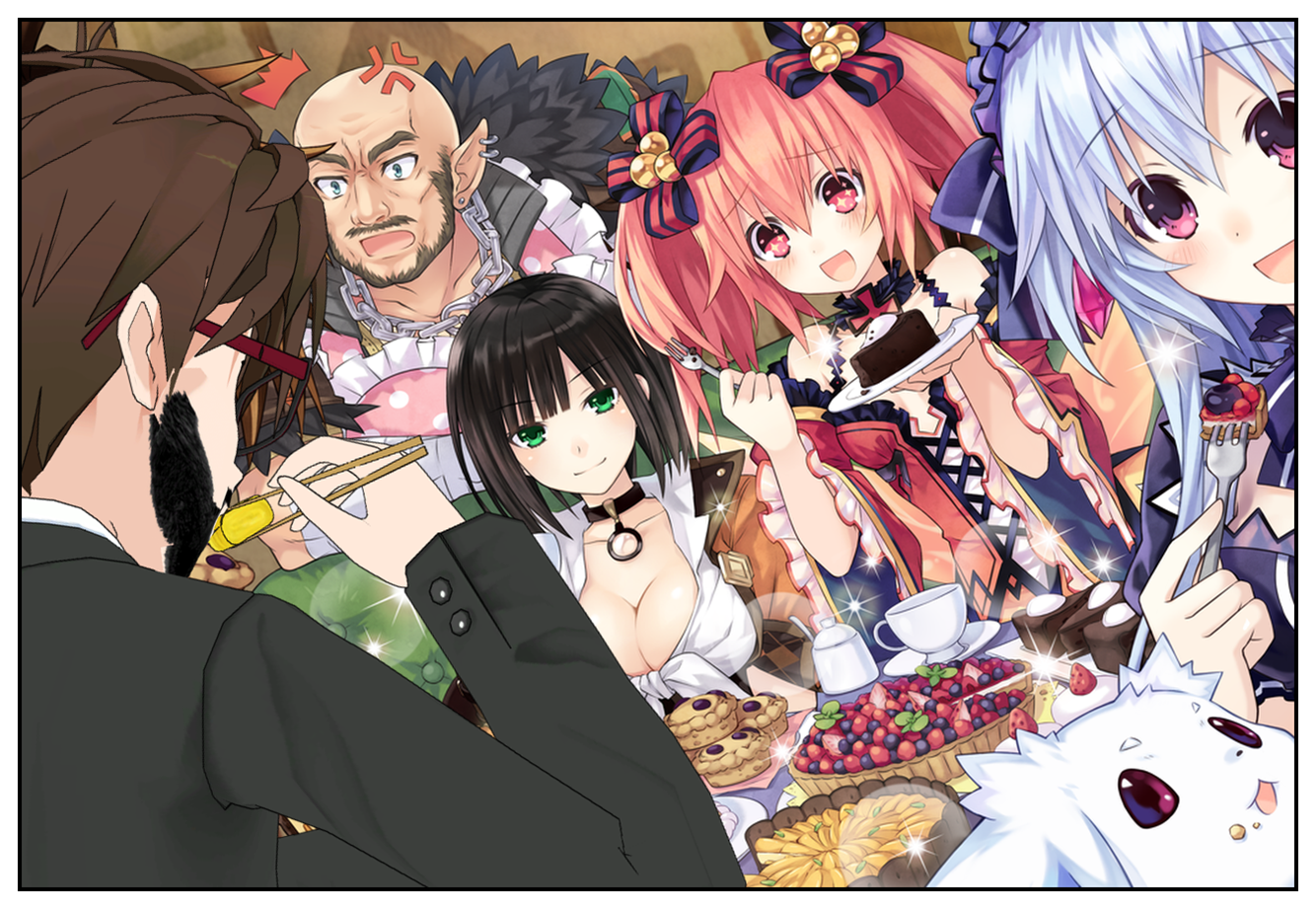
And perhaps most relevantly, given that I'm still playing through it at the moment, I was delighted to discover that Fairy Fencer F has a wonderful ensemble cast, too — and despite its aesthetic similarities to the Neptunia series thanks to artist Tsunako on character design duty, it has an overall darker tone to its stablemate, allowing for its characters to share hardships and sadness as well as good times with one another.

Like Neptunia, FFF's cast can be split into a number of components. There's the core cast of playable characters who centre around protagonist Fang, who is initially lazy and cynical, but later turns out to be far more responsible and caring than he would care to admit. Then each of these characters has a companion fairy, who form a sub-cast of their own who are usually with their human partners, but sometimes get the chance to do things by themselves. Then there's a cast of villains, too, but without spoiling too much, let's just say that on the Goddess route, at least — the narrative path that comprised the original Fairy Fencer F, rather than one of the two new ones introduced for the PlayStation 4 version — the lines between "good" and "evil" are frequently blurred to quite a significant degree.

An crucial moment at the midpoint of Fairy Fencer F carries more emotional weight than I've ever seen from a Compile Heart game, eschewing the company's usually breezy comedy and satire — both of which are present in Fairy Fencer F when appropriate, make no mistake — in the name of something truly awful happening as a catalyst for one of the three subsequent divergent narrative paths that follow. This moment only works because of the first half of the game, in which we get to know Fang and his ragtag group of companions very well indeed, and because of its sharp, surprising contrast with what we, the player, had been led to expect would happen at that point in the story.

I haven't yet seen how things turn out. I can guess, but given that this game has already surprised me more than once with the direction its narrative takes — mostly with regard to how dark it gets at times — I'm not going to believe it until I actually see it. It's been an enjoyable journey so far, though, so I'm looking forward to seeing how it ends. And then seeing the other two ways in which it ends after that.
2417: The Steam Shmup Sale

0417_001

There's a sale running on Steam right now, centred around shoot 'em ups in the classic mould. You can see the full list here, but here are a few selections that I can personally recommend:

ESCHATOS

ss_fd0689c7133c105e308cd609dcac133311de6457

The follow-up to Judgement Silversword (which is also worth a go, and available in a bundle with ESCHATOS) is a Raiden-style shoot 'em up (i.e. non-bullet hell) that unfolds over the course of several stages, taking you from an Earth-like planet, into space and finally into the bowels of an alien world. It's a spectacular, thrilling journey, presented in uncomplicated but nonetheless impressive 3D polygonal visuals but playing from a top-down perspective.

ESCHATOS has a couple of ways to play depending on how complex you like your shmups. For my money, the simpler mode is actually a more enjoyable way to play — this doesn't involve any powering up of your weapons and simply requires that you defeat complete waves of enemies without missing any to build up your score multiplier. The higher the difficulty you play on, the higher the multiplier can go (and the faster it rises), so for the highest scores you need to take on the toughest challenges the game offers.

ESCHATOS has a fantastic soundtrack, fluid graphics with some wonderful setpieces, and gameplay to die for. If you're a shmup fan, this should without question be a part of your collection.

Deathsmiles

ss_fd8137dfb622672834fb6bae3dda6b75c92afcc9

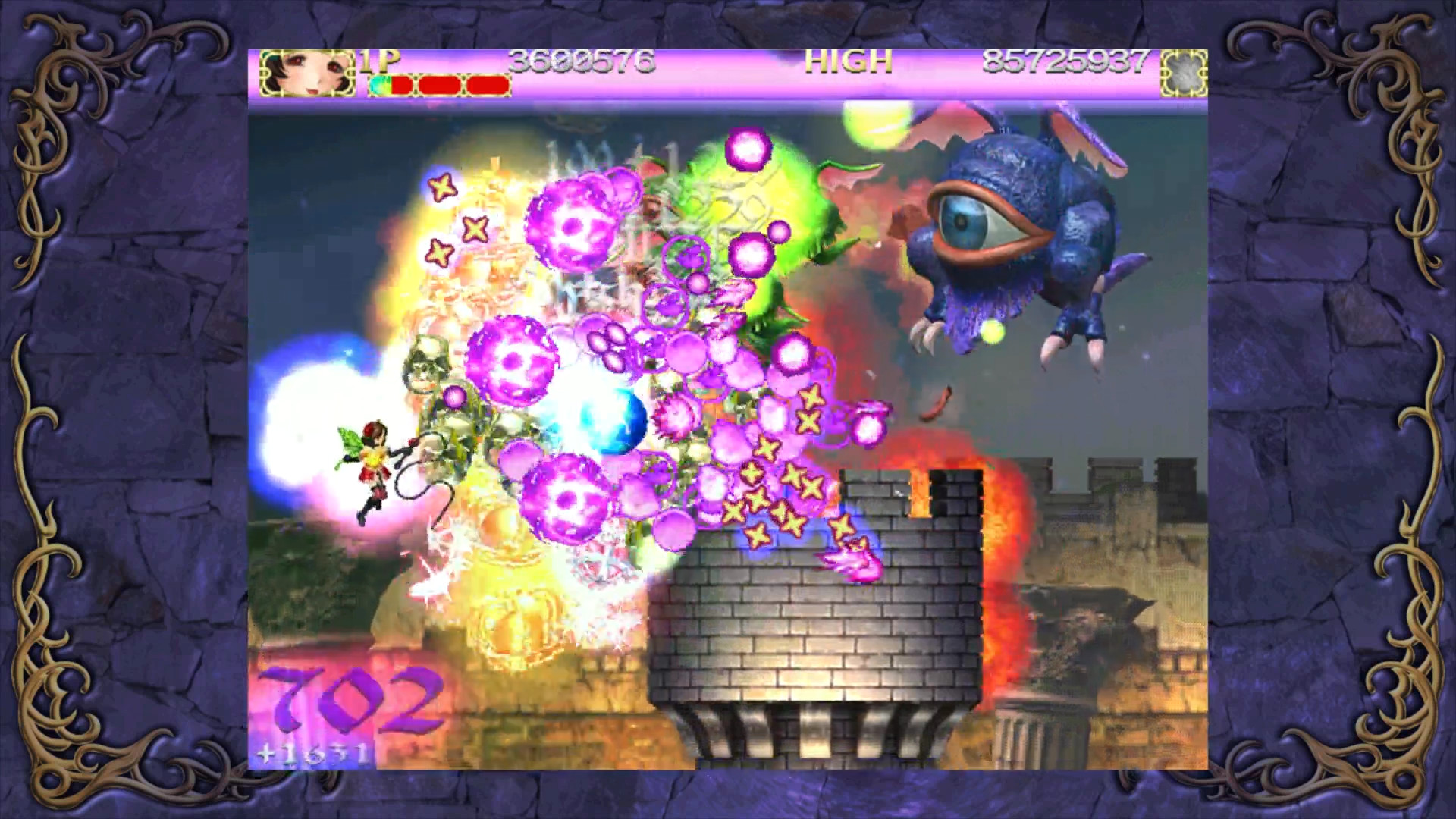
Regarded as one of Cave's more accessible bullet-hell shooters, Deathsmiles is a horizontally scrolling affair for one or two players where you take on the role of one (or two) of several different goth loli chicks, each of whom handle slightly differently. You can shoot in both directions using either a rapid-fire shot, a charged beam or a lock-on laser, and advanced players will need to learn which attack should be used for which enemy, since the scores and collectible items they yield vary according to how they were dispatched. If you're a shmup beginner, mind, you can ignore this aspect of the game completely and just try to get through the game, because that's challenging enough in itself.

Deathsmiles has a gorgeous Gothic rock soundtrack a la Castlevania, some varied levels and some brilliant boss fights, culminating in a battle against the spectacularly named "Tyrannosatan" accompanied by Bach's famous Toccata and Fugue. There's a lot of hidden depth to the scoring system once you get your head around the bullet patterns, and variable difficulty settings that you can change on the fly between levels help give it some longevity. It's one of Cave's finest games, and well worth a look.

Savant Ascent

ss_c8d6467aadfc43ef96125113f6b7b7ed4ae43ef2

Based around the music of electronica artist Savant, Savant Ascent casts you in the role of a masked alchemist who has to make his way up a tower to defeat the weird… thing that has manifested at the top. It's a twin-stick shooter with a twist — in each of the game's battlefields, the character can only stand in preset places, with pushing directions on the stick moving him from one to the other either by rolling or jumping between them.

The "Story" mode in the game lasts about five minutes and is easily beaten, but the meat of the game comes in the modes that unlock afterwards. Time Attack throws you into a horde of enemies and challenges you to 1) survive and 2) complete the game as quickly as possible. Endless, meanwhile, simply tasks you with surviving for as long as possible.

Longevity in the game comes through score attack and collectible CDs of Savant tracks, each of which unlocks a new gameplay element. What initially appears to be a very simple twin-stick shooter gradually unlocks new depths as you collect more of the CDs and progress further. It's a beautifully presented game, too, with lovely graphics and a thumping soundtrack courtesy of Savant, obviously.

Horizon Shift

ss_b52c05f23149943b9486ff8f606d165fe32c53e1

An interesting twist on the genre, Horizon Shift is presented in a minimalist Geometry Wars fashion, with simple controls and visuals, a thumping soundtrack and immensely challenging gameplay.

Your job in Horizon Shift is to protect your "horizon", a line dividing the screen into two halves. Your ship can face either up or down, and you can use this ability to dodge bullets, since only bullets on the same side as your ship can destroy you. Your ship can also jump and double-jump, providing another means for avoiding projectiles on the occasions when the "horizon" disappears and requires you to face in one direction only.

Enemies in Horizon Shift are a combination of kamikaze types that destroy part of your horizon when they hit it — meaning you'll have to jump the gaps or die — and enemies that spew bullets at you. Blasting any type of enemy builds up a chain bonus, and unleashing a smart bomb (which must also be charged by killing enemies) allows you to "bank" this chain bonus; conversely, dying loses the chain bonus altogether.

Horizon Shift has a cool aesthetic, with simplistic visuals in the foreground and a busy but low-brightness backgrounds that evolves as you play through the game. Particularly cool (and cheesy) is the giant laughing "skull" face that dominates the background any time you're fighting a boss.

Shmups Skill Test

ss_75fc9dffefda8eca3d142ecbdc6864d4bfb6258f

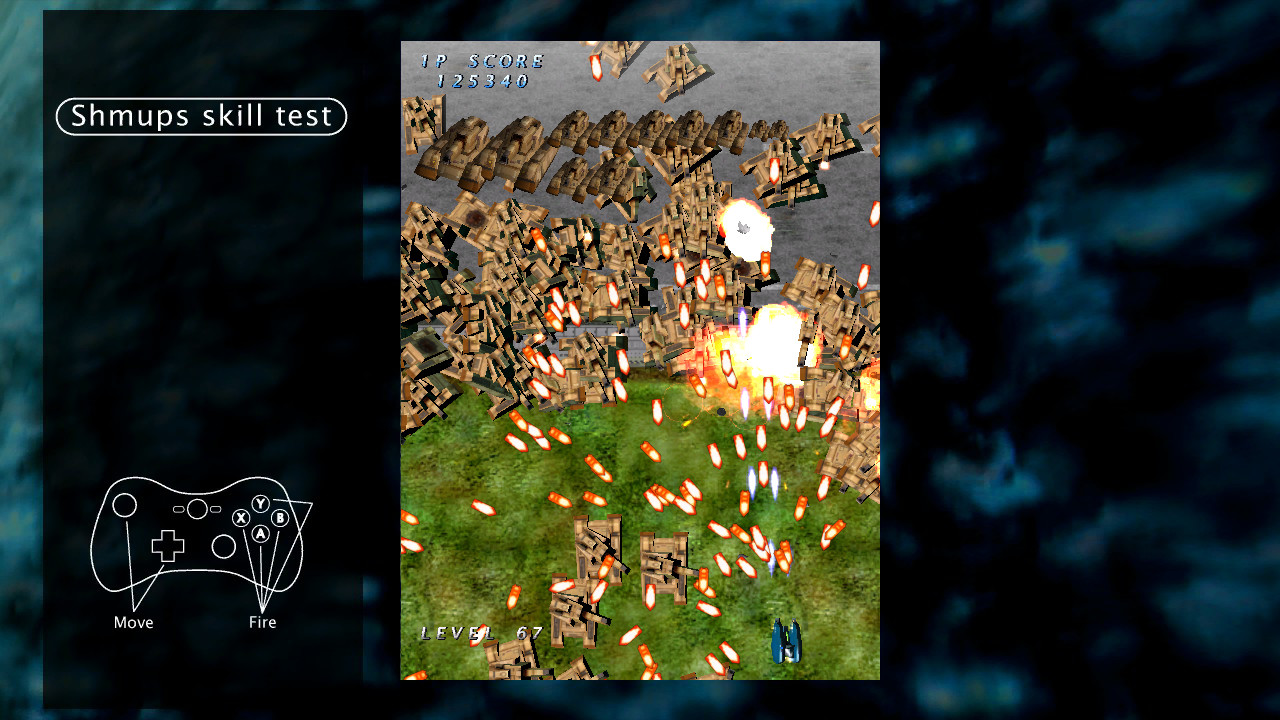
Blend WarioWare with a shoot 'em up and you have Shmups Skill Test, a short, quick-fire game that challenges you to complete several minigames in succession, then humiliates you about your lack of skill afterwards.

Minigames vary from the delightfully named "TANK TANK TANK TANK TANK" — in which there are lots of tanks to shoot — to one where you have to precisely shoot timebombs off the side of a rocket without blowing the rocket up, and all of them are very challenging indeed, with the possible exception of the one where you have to shoot tin cans (in space) into a giant waste-paper basket (in space) to "save the earth".

After you're finished, you're given a breakdown of your skills, a comparison to the online average rating and your "gamer age" is calculated a la Brain Age on the Nintendo DS — the lower the better.

This game is hard, but it has a lot of staying power thanks to a variety of minigames, online leaderboards and support for up to four-player competitive play. Plus, as its name suggests, it's actually good training for the various skills modern shmups demand of you.

2415: The World Doesn't Need Any More Stock Images of Businessmen Pressing Things from Behind

0415_001

I mean, come on. Seriously. Look at this.

stock-photo-business-technology-internet-and-networking-concept-businessman-pressing-make-money-button-on-278211434.jpg

And this.

stock-photo-businessman-presenting-work-safety-concept-hazards-protections-health-and-regulations-388868647.jpg

You want more? I got more. This one's fancy.

stock-photo-businessman-press-on-digital-screen-digital-layer-effect-business-strategy-concept-302638517.jpg

Make your own button with this one! I suggest a big red one that says "CUNT".

stock-photo-businessman-pressing-an-imaginary-button-on-bokeh-over-dark-background-155244101.jpg

Maybe start with "TRANSLATE"-ing the weird backwards text you're apparently reading through your Minority Report-style touchscreen.

stock-photo-businessman-pressing-button-on-touch-screen-interface-and-select-translate-business-internet-334793183.jpg

Had enough yet? No no no.

stock-photo-businessman-pressing-messaging-type-of-modern-icons-with-virtual-background-246689782.jpg

Icons!

stock-photo-businessman-pressing-multimedia-type-of-modern-buttons-with-virtual-background-119639965.jpg

And just to be multicultural, here's one in Arabian flavour.

stock-photo-arabian-man-pointing-with-finger-218977159.jpg

I'm unsure if these are more or less irritating than the ones that feature a businessman writing on something from behind.

What's that? You want to see some? Well…

stock-photo-yes-you-can-and-hand-holding-blue-marker-124097521.jpg

I'm not sure that I'm taking this one's advice.

stock-vector-doctor-writing-reduce-stress-words-in-the-air-260973932.jpg

This one's just weird.

stock-photo-hand-drawing-a-stairs-in-a-conceptual-image-393506284.jpg

NO-ONE WRITES LIKE THIS.

stock-photo-hand-writing-with-a-blue-mark-on-a-transparent-board-feedback-146554451.jpg

Fill it up with meaningless, unrelated words, that'll make it better!

stock-photo-hand-writing-words-on-transparent-board-116228686.jpg

Or perhaps emphasise the point by circling it!

stock-photo-man-hand-writing-practice-with-marker-on-transparent-wipe-board-business-internet-technology-436318330.jpg

And let's not forget we live in the Age of Social Media when everything must be shared. SHARE NOW, PUNY HUMANS, OR WE WILL ASSIMILATE YOU. RESISTANCE IS FUTILE. OBEY THE HAND.

stock-photo-share-your-story-hand-writing-with-black-marker-on-transparent-wipe-board-168383129.jpg

2414: Stranger Things

0414_001

I watched the first episode of a new Netflix show people have been raving about recently: Stranger Things. I came away very impressed with the whole thing.

Stranger Things is set in 1980s small-town America and appears to have been shot to bear more than a passing resemblance to a 1980s movie. Coming off the back of Turbo Kid, this is something that appealed a great deal to me, and it was interesting to compare how the two works approached it. While Turbo Kid took the extremely graphic approach of violent action movies of the era, Stranger Things' first episode felt a little more like a somewhat more family-friendly movie — perhaps a PG or a 12 at most. Any violent aspects were de-emphasised in favour of depictions of close friendships between children, the adventurous souls that many '80s kids had (partly as a result of the awesome movies we had to enjoy) and the dysfunctional nature of many nuclear families.

Stranger Things' first episode centred around the disappearance of a young boy who had… something happen to him on his way home from a game of Dungeons and Dragons with his friends. His sudden disappearance allows us the opportunity to meet his single mother and older brother as well as the more traditional (albeit extremely dysfunctional) family of one of his friends as they struggle to determine what happened to him. The local police force also gets involved, and in true small-town '80s America movie tradition, they're all seemingly lazy and incompetent, but buck their ideas up sharpish when something genuinely serious finally happens in this sleepy little town.

There's also a touch of high school drama through the older sister of one of the central kids, who has just begun a relationship with a boy who appears to be one of the "cool" kids. In true '80s movie tradition, their relationship revolves a lot around seeing one another in secret, even though many people — including her younger brother — know exactly what they're up to. And there's a strong sense that the boyfriend is very much the sexual "aggressor" in their relationship, for want of a better word, while the sister Nancy herself is keen not to get distracted from her studies; again, this is typical of '80s movies, which often had not-so-well-hidden messages of abstinence buried in them.

And on top of all that, there's a mysterious organisation of scientists, because there was always a mysterious organisation of scientists in '80s movies, and some sort of weird, possibly otherworldly biological horror. And a girl with apparent telekinetic powers who escaped from their clutches.

It felt like Stranger Things was trying to cram as many '80s movie tropes as possible into its 50-minute first episode — almost too many — but it managed to do so without buckling under its own weight, and without being too self-conscious or self-referential about it. What it ended up being was a remarkably authentic-feeling slice of '80s nostalgia that offered enough intriguing little plot threads to make me very keen to see what happened next. It never felt over the top or overt with its '80s references; it was just when it was set, and everything about it supported that setting, right down to the fact it looks like it was shot on film rather than video.

I'm looking forward to seeing where the show develops from its strong first episode. I'm expecting great things. Strange things, even.

2413: Dropping in on Vana'Diel

0413_001

The first MMO I really got into was Final Fantasy XI. This was after a few previous aborted attempts including EverQuest and Ultima Online (over dial-up — not recommended, particularly EverQuest, which crashed every time I zoned) as well as slightly lesser-known titles like Dark Age of Camelot.

I never stuck with the earlier games because they never quite resonated with me for one reason or another — perhaps it was their clunky interfaces or their painfully slow progression. All I know is that Final Fantasy XI, despite also having a clunky interface and painfully slow progression, managed to capture my attention for a decent period of time before I finally moved on to something else — Final Fantasy X-2, as I recall — and never went back.

Just recently, some Final Fantasy XIV friends and I have been getting nostalgic for XI, so I thought I'd go check it out, given that it's been a number of years and several expansion packs since I last tried it. And while the game is still recognisable as what it once was — a steadfastly traditional MMO more in the EverQuest mould than the now more fashionable WoW mould — it's been considerably streamlined to make the experience much more friendly to new players and solo players. On top of that, players now have a hefty amount of options to choose from when they log in and want to decide what to do next. This is not something Final Fantasy XI was ever lacking in, but the additions and refinements that have been added to the formula over the years benefit both new players and grizzled veterans.

Take the Fields of Valour and Records of Eminence systems, for example.

The former sees you examining "field manuals" in each zone and taking on a training regime of your choice. Completing said regime rewards you with experience, gil and a currency called tabs that can be traded in for various benefits ranging from teleporting back to your home city — a godsend if you've been grinding several zones away, since fast travel isn't anywhere near as accessible as it is in XIV — to having temporary buffs cast on yourself.

The latter, meanwhile, is accessed through your Quests menu and allows you to assign yourself up to 30 objectives at a time from an extremely comprehensive list of possible challenges that range from "defeat 100 enemies" to "deal 100,000 points of damage in total" via "loot 10 wind crystals from enemies". Most of these objectives are repeatable, and all reward you with experience points upon completion.

Just the addition of these two systems, which support the existing style of play FFXI veterans will be used to, makes levelling a considerably less painful, time-consuming process. What once took weeks of grinding can now be done in a few hours — to put it in context, I played for about 2 or 3 hours earlier and made it to level 16. First time I played this took me several weeks to achieve; in several months of play I never got any further than level 30.

It's a bit of an adjustment to go back to XI after the tightly structured gameplay of XIV. XI, by contrast, is much more freeform; there is a main storyline to follow, but it's of considerable benefit to players to go out and level up a bit first before even thinking about tackling these missions. The story can even be ignored completely if you'd rather just go out hacking and slashing monsters, unlike in XIV, where it was an integral part of overall progression by gradually unlocking game features and challenges as you went through.

One of the best additions to XI in recent years is the Trust system, which allows you to recruit "alter-ego" versions of various NPCs from around the game world after meeting the requirements to unlock them. Once unlocked, these "alter-egos" can be summoned at any time in the field for you to party up with, effectively allowing you the ability to take on considerably stronger monsters than you would otherwise be able to tackle solo, and all but eliminating the need for standing in Valkurm Dunes for hours at a time shouting "RDM LFG" in the hope that someone would pick you up to go and kill lots of crabs with.

One might say that the Trust system takes away from one of the key defining aspects of FFXI as a massively multiplayer online game, but in practice it's simply more convenient for many players. You still have the option to party up with other people, of course — and chances are they'll play their roles much better than the relatively limited AI of the Trust companions — but for those who prefer to play solo, Trust NPCs can form a formidable party with you once you've unlocked a few of them.

The other interesting contrast between FFXI and FFXIV is how it handles combat. XI's combat is relatively simple in the early levels, relying mostly on your auto-attack and occasional use of Weaponskills when your TP bar hits 1000 or greater. XIV, meanwhile, is much more active, demanding that you both dodge enemy attacks with telegraphed areas of effect and keep performing your class's combo or rotations as efficiently as possible, preferably without stopping. Both are considerably slower paced than true real-time combat, striking a good balance between a turn-based feel and actually allowing the player to feel like they are in full control of their character, but XI is even slower than XIV, providing you with plenty of time to pick abilities in advance from its traditional FF-style menu system rather than XIV's hotbars.

I've enjoyed returning to Vana'Diel so far; the experience contrasts well enough from XIV that the two games can sit quite comfortably beside one another in a gamer's collection, and the state they're both in in 2016 means that you can sit down for either a long or a short session with either and feel like you've achieved something.

Mostly I'm wanting to play through Final Fantasy XI to see its main story content, which is supposed to be good, but the sheer amount of stuff to do in the game — it's got over ten years on A Realm Reborn, after all — is more than likely to prove a bit distracting!

2412: Looking Back on Three Years, Off and (Mostly) On, in Eorzea

0412_001

With it being Final Fantasy XIV's third anniversary it's only fitting that I take a look back at the reason I've been playing it since its closed beta — and why, even though on several occasions I've felt like I might be "done" with the game, I keep on coming back, time after time.

These memories are presented in no particular order, but it makes the most sense to start with this one.

Knowing FFXIV was going to be something special

I jumped into Final Fantasy XIV's closed beta after a casual discussion with a Twitter friend about Final Fantasy XI and how much I liked it despite never really getting all that far with it. Eventually I found myself with an invite to the testing period of the game, and I was immediately smitten with it. Everything about it felt Final Fantasy. The look, the feel, the music, the controls, the battles, the monsters — and yet, it had enough of its own unique identity to make it feel like far more than just series fanservice.

Specifically, Final Fantasy XIV adopts a somewhat "dark fantasy" tone throughout, clearly heavily inspired by works such as Game of Thrones and The Witcher in places. Sure, there are still moogles and chocobos, but there are also complicated political machinations, betrayal, murder and, technically, just prior to the start of 2.0's story, apocalyptic catastrophes.

I was immediately drawn into the world in a way that World of Warcraft never quite managed to enrapture me. NPC dialogue, although localised with more than a few liberties taken from the original Japanese, much to the chagrin of people who play with Japanese voiceovers, was beautifully written with an almost Shakespearean tone in places, blending old- and middle-English words and phrases with modern spellings to make it actually comprehensible.

The fact that Final Fantasy XIV placed any emphasis on its main story at all — let alone to the degree that it has ended up doing so — was a unique feeling for me. Even its predecessor Final Fantasy XI's main story had felt like a side activity you did when you had done enough level grinding to be able to take on the next mission; here, the main story was tightly tied in with your character's progression: you advanced through the levels and became more powerful both in terms of mechanics and narrative, until you eventually reached level 50 and took on your most terrifying challenges yet.

During the closed beta, I only played up to about level 20 or so, but that was enough to know that I wanted to keep playing — and to know that I wouldn't mind when the servers were wiped post-beta to prepare for the start of live service.

Making some great friends

My friend who had urged me to try out FFXIV was all set to assemble a Free Company — FFXIV's take on guilds — as soon as the facility became available, and many members of that free company, centred around the Giant Bomb video games website, became great friends. I even took a trip to PAX East to hang out with a bunch of them and had an absolute blast. And while I recently left said Free Company in favour of a smaller group who are more local to where my wife and I are, FFXIV's various ways of keeping in touch — as well as extra-game means of communication like Discord — mean that I'll never be far away from this band of loveable rogues.

Castrum and Prae keeping me up until 5am

When I reached level 50, I was proud. The only other MMO I'd ever reached the level cap in prior to that day was World of Warcraft, and I'd stopped playing shortly afterwards, as my lack of friends playing had made that game a rather lonely experience at high level — this was the days before its current Dungeon Finder system, itself inspired by FFXIV's Duty Finder.

I'd heard the final two story dungeons, intended to be done pretty much as soon as you hit 50, were quite an experience, and so I asked the Free Company very nicely to accompany me on my first run through them. This was — and still is — the best way to run these dungeons, since they're both full of cutscenes, and running with a completely preformed party means no risk of other people running ahead and starting boss fights while you're still watching dramatic scenes.

The experience of running Castrum Meridianum and Praetorium left such an impact on me that I immediately wrote about it on USgamer. It remains one of my fondest gaming memories to date, and it makes me a bit sad that people coming to it now will more than likely be partied up with a group of people who outgear it to such a degree that every boss fight is a complete steamrollering. Pro-tip, then — if you're just hitting 50 for the first time and you have 7 friends handy, queue up for Castrium then Prae and check the "minimum item level" option in Duty Finder in order to experience these two dungeons at their original difficulty level from shortly after launch.

Entering the Coil

I happened to be up and about one night when some Free Company-mates were heading into the endgame raid dungeon The Binding Coil of Bahamut. At this point, the raid had been "unlocked" because better gear than it offered was already available, and so it was there for people to run just for the experience of the unique story it offered, as well as unlocking subsequent chapters.

Coil was a whole other level of the game for me. The encounters were much more complex, they demanded much more coordination and awareness of what was going on, and the unique story, music and enemies you fought in there made it feel like a truly "special" experience.

Forming LoCoBomb and tackling Coil proper

Loose Cannons, or LoCo, were Giant Bomb's neighbours in the Limsa Lominsa housing district of Mist, and they're now my new Free Company. LoCo is a tiny little group compared to the hundreds of members of Giant Bomb (many of whom are inactive players, but still) but we struck up a mutual friendship with one another, even going so far as to put together a rather casual, slapdash static for tackling The Binding Coil of Bahamut, a little later than much of the rest of the player base, but tackling it nonetheless.

Raiding together was a great way for us to get to know one another better, and we had a lot of fun times working out way through the first four Turns until we hit our first real barrier: Turn 5.

Toppling Twintania

Turn 5 of Coil was originally the hardest fight in the entire game, facing a party of 8 players off against the rather angry dragon Twintania. Accompanied by the fantastic piece of music Thundererthis was a genuinely terrifying confrontation in which you really felt like you were battling against insurmountable odds.

Twintania was our first real encounter with having to properly coordinate raid tactics thanks to now-notorious mechanics such as Divebombs and Twisters. Taking her down for the first time was an incredible feeling, only to be matched by the time we finally bested the final boss of the Second Coil of Bahamut.

Nailing Nael

Turn 9 of Coil — or Turn 4 of Second Coil, if you prefer — quickly took over from Turn 5 as being the hardest fight in the game, mostly due to how unforgiving it was. The fight featured a wide variety of tasty instant death mechanics and even a few sections where careless play could wipe the rest of the raid without too much difficulty.

After a long slog through Second Coil — Turn 6 gave us a lot of grief, though the subsequent two went a little smoother — LoCoBomb persevered and were eventually victorious, however, and we still weren't sick of the two incredible boss themes Tempest and Rise of the White Raven.

This encounter remains, to date, my favourite boss fight of all time in any game ever. Ten character levels, over a hundred item levels and one expansion later and it's still not particularly easy to clear.

Phoenix from the Flames

A lot of people will note that Turn 12 — Turn 3 of Final Coil — is as memorable an encounter as the grand finale Turn 13, and I'd certainly agree with that. Resolving a large number of questions surrounding what really happened at the end of Final Fantasy XIV 1.0, Turn 12 sees the party facing off against the iconic Phoenix, accompanied by this magnificent arrangement of the game's main theme Answers. I still get shivers every time I hear it. And the recent The Rising event in the game now brought it out at the perfect moment to genuinely give me goosebumps all over my body.

The Final Witness

The final battle in Final Coil is appropriately spectacular. It wasn't horrendously difficult by the time we got to it — each subsequent patch had increased the amount of bonus HP and damage you'd be blessed with when you went in, theoretically allowing more and more people of lesser skill and/or gear to enjoy all of Coil's story — but it was still an immensely worthy absolutely, positively, definitely final boss. And it made incredible use of Answers.

An in-game marriage and a real-life proposal

(if the embed doesn't work, go here to embarrass me)

January 3, 2015: Amarysse Jerhynsson married W'khebica Qimi (now Wuckle Bunny, because no-one can spell authentic Mi'qote names properly). During this process, the player behind Amarysse Jerhynsson — yours truly — made a rather lengthy virtual speech that culminated in him proposing to the player behind W'khebica Qimi, who was sitting in her study upstairs from him at the time.

We married in June 2015. And who says computer games are antisocial?

Heavensward and beyond

The first full expansion for Final Fantasy XIV was an exciting moment, as it would take us to brand new areas, see us tackling brand new dungeons and battling fierce new foes. It was everything most people hoped for, with an excellent story — to some, better even than A Realm Reborn's at times meandering narrative — and one hell of a final boss fight.

While the long lull between Heavensward's release and the first major content patch finally arrived with us was, I feel, largely responsible for the fact that my former Free Company are no longer quite as obviously "active" (at least in public channels) as they used to be, Heavensward has, on the whole, been a great evolution of A Realm Reborn's base, even introducing a number of brand new types of content to the mix, with my favourite being the new randomly generated Deep Dungeon.

Heavensward's raid scene hasn't appealed that much — I'm not really a fan of steampunk in general, and the narrative set up around Alexander was feeble and unmemorable compared to the majesty of Coil — but there's still been plenty of stuff to do, and as we saw with the Live Letter yesterday, there will continue to be more and more stuff to do as we start the buildup to the second full expansion, set to be revealed for the first time in October.


It's not many games you can play almost continually for three years and still look upon fondly, but I guess anything you spend that much time in the company of eventually becomes something you really, truly can't ever let go of.

It's hard to get this across to people who haven't been on the journey I've been on, and it probably won't be quite the same for someone who starts right now, but I stand by my nomination of Final Fantasy XIV as my Game of the Year for 2013 over on USgamer, and given the number of hours I've played, it's probably my GotY for 2014, 2015 and 2016 too.

2411: Happy 3rd Birthday, FFXIV

soulsurrender

It's 5am and I'm still up because I decided it would be a really smart thing to do to stay up and watch the beginning of the 14-hour livestream to celebrate Final Fantasy XIV's third anniversary. It's not as if I have to get up for anything in the morning, though, so it's fine.

The reason why I wanted to watch at least the start of the livestream is because of the Live Letter from the development team, featuring a preview of the upcoming patch 3.4. These are always interesting and exciting, because they often reveal new game features and content, some of which ends up being a surprise to everyone.

I'm interested to see where 3.4 goes because the story begun in Heavensward is now essentially over — patch 3.3 saw adventurers defeating the dread wyrm Nidhogg and saving Ishgard from another thousand years of war with the dragons.

Previous patches did, however, tease the existence of dark counterparts to the player's Warrior of Light, and it looks as if 3.4 and 3.5 will concern these individuals in the run-up to whatever the next full expansion will be. (We find that out in October.)

I'm watching a livestream with a concurrent live fan translation, so I'll just write some thoughts as I watch, then post the whole shebang in one go when it's done.

3.4 will be called Soul Surrender and concern the aforementioned Warriors of Darkness. It will also apparently feature a great deal of lore about the planet of Hydaelyn itself, where the game takes place. It will be out on Tuesday, September 27.

As usual, there will be new main scenario quests advancing the main storyline. It looks as if Alphinaud and Alisaie will finally be reunited after being apart for pretty much all of A Realm Reborn and Heavensward. Alisaie was the main NPC for the excellent Binding Coil of Bahamut raids in A Realm Reborn, and apparently this patch's story will make reference to Coil, even going so far as to change dialogue if you previously completed Coil. (Cue a rush on unsync'd Coil runs!)

There will also be new Scholasticate quests. These started a couple of patches ago and sort of tailed off without any resolution, but they had potential to be interesting.

And Hildibrand will be back. His content has been a little weak in Heavensward, lacking the custom boss fights of A Realm Reborn, but his quests have nonetheless remained amusing and well written.

There will be some tweaks to the battle system, including recast timers being reset when restarting battles — a godsend for raiders or people trying to clear new content for the first time. The changes will also include some changes to auto-attack — Yoshi-P mentioned he wanted to make some changes here in a recent interview with Famitsu, and it looks like we're going to get the first stage of that with 3.4 — you'll no longer have to worry about character facing, just be in range of your foe. In other words, this means you can keep moving around a target without worrying about losing auto-attack damage for those periods when you're not directly facing it. Good news for bards and machinists in particular, who are perhaps more reliant on auto-attack damage than most.

Some Extreme Primal fights will be added to the recently added Raid Finder. These Trials aren't quite full-on raids, but still have quite a lot of complexity, so it will be good to have a means to organise learning or clear parties other than Party Finder.

The UI will have a Countdown feature added. Exactly what this does remains to be seen, but it's apparently intended to be a replacement for macros that some players used, perhaps to announce when certain abilities come off cooldowns.

The final chapter of the Alexander raid cycle is coming this time around: Alexander, The Creator and a Savage counterpart. Last chance for them to get this right after a somewhat lukewarm reception from much of the player base.

There's a new trial that sounds as if it will be a second member of the Warring Triad, since it's called Containment Bay P1T6, much like the previous Sephirot fight. Apparently the foe this time will be Sophia, the Goddess.

New dungeons include Xelphatol, the Ixali homeland, and a Hard mode variant of The Great Gubal Library. Still just two rather than the three ARR got with each patch, though this isn't surprising any more.

PvP is getting a duel mode that can be done in the Wolves' Den in a new part of the map. You'll be able to queue for dungeons while dueling, which is nice, and there will be no time limit; matches only end when someone wins or leaves the duel area.

PvP will also get a Custom Match feature allowing two light parties to set up a clash against each other, and a Spectator mode. FFXIV's PvP is actually pretty good, so it's good to see it getting some love.

The roguelike-esque dungeon Palace of the Dead will get an update in patch 3.45, bringing it to 200 floors total. There will be a job-specific ranking system based on a score you build up as you play. Floors 51-100 will be about the same difficulty as the current floors and bring the dungeon's story to a close. Above floor 100, things get much harder but they'll be worth many more ranking points.

Grand Companies are getting an update after being dormant pretty much since 2.0. A new Grand Company rank will finally be available, Platoons will become available and have some sort of missions attached to them, and new gear will be available, presumably this time geared to level 60 characters.

The Platoon system looks to have something to do with raising NPCs, and you'll be able to go into content with these NPCs from the sound of things — you can make a team of one player and three NPCs.

A new game feature is Wondrous Tails, which involves helping a young Mi'qote girl create something by completing objectives in a book. No other details were given.

Gold Saucer is getting an instanced Triple Triad battle hall for each data centre, allowing you to find opponents from other servers and thus expanding the minigame's scope considerably.

RTS minigame Lord of Verminion will also be added to the Duty Finder, allowing you to queue up and find opponents that way.

Housing updates will include the introduction of the Apartment system, presumably functioning something along the lines of Final Fantasy XI's Mog House system. It looks as if there will be a public lobby in each building as well as instanced rooms for players, and there will be 1536 apartments per server, assuming 3 buildings (one for each of the Eorzean cities) with 512 rooms each. They will cost 500,000 Gil, so much cheaper than current housing. Hopefully they won't all get bought up to be resold!

A system called the Double Cross Hotbar will be introduced for controller players. It's intended for people who don't feel they have enough available buttons when playing with a controller and want to be quicker to get at certain abilities. You'll be able to double-tap a trigger to access the extra buttons, and it can be used in conjunction with the existing Expanded Cross-Hotbar for even more available buttons. Essentially it adds an extra 16 button slots, and you'll have the option to keep these visible on screen at all times, and adjust the transparency of the hotbar you're not using at the time to make it clear what actions you have available.

The Double Cross Hotbar stuff looks like a great quality of life improvement for the game. Is it wrong that this is one of the things I'm most excited about? It will certainly make more complex jobs more straightforward to play with controller. Apparently Yoshi-P and his team are pretty excited about it too, as I think they spent more time showing it off than anything else in the Live Letter!

The exploratory missions to The Diadem are getting some minor updates, including the ability to queue as a gatherer rather than having to change once you get there. It will also start dropping item level 235 gear, making it potentially worthwhile again. A brand new exploratory mission — hopefully with lessons learned from the Diadem — will come in patch 3.5.

The new Allagan Tomestone endgame currency will be Tomestones of Scripture, and the gear they purchase is rather Sharlayan in its look, particularly the Dragoon's rather fetching robe and hat combo.

An online status for role-players will be added. FFXIV doesn't seem to have that many RPers in my experience, but that doesn't mean they're not thete, so having a means for them to find each other will be good. You'll also be able to use hyphens in character names at last — no more errant apostrophes!

Finally, The Rising event starts today. Last year this was an awesomely meta event in the game where you could warp out of Eorzea and visit the writers' room to meet the development staff. It was an extremely cool moment, and gave the feeling that the FFXIV team love and are grateful for their players.

Exciting times ahead for the game, then, and I'm well and truly back on board after my short break from it. Events like this remind me why I can never quite quit it.

2410: Sounds of Vana'Diel

0410_001

Talking to some of my Final Fantasy XIV friends today, I realised quite what an impact XIV's predecessor Final Fantasy XI had on me, even though I never really got that far with it in the long term.

As with many other things throughout my life, the thing that has stayed with me for the longest ever since I played it for the first time is the music. (Incidentally, the music is, more than anything, the reason why I find I can't stay away from Final Fantasy XIV for long, even when, as I did recently, I think I'm "over it".)

Final Fantasy XI's music is not as well known as many of the other soundtracks in the series, primarily because XI itself is not as well known as the other Final Fantasy games that have been released over the years. It's not as technically accomplished as XIV's diverse soundtrack, and it's not the work of series veteran Nobuo Uematsu (who hasn't been quite as involved with the series in more recent years) but it is nonetheless made up of a selection of rather lovely pieces of music.

Here are a few that make me feel suitably nostalgic every time I hear them.

This music, simply called Ronfaure after the area in which it plays, is one of my favourite pieces from Final Fantasy XIV, because it pretty much sums up the overall atmosphere of the game: vaguely melancholic and rather traditional.

Final Fantasy XI is — at least, from what I remember — one of the more traditionally-set Final Fantasy games, with an emphasis on good old swords, shields, magic, orcs and goblins. Its soundtrack reflects this, and is a contrast to XIV's diverse track listing, which reflects the diversity of XIV's world itself.

The first character I played in Final Fantasy XI — and the only one that ever got anywhere to date — hailed from the Federation of Windurst, and thus his starting area was Sarutabaruta, which featured this wonderfully calming piece of music to accompany your exploration.

Sarutabaruta was a land of grassy meadows and sunshine; a thoroughly pleasant place to have a stroll, were it not for the monsters wandering here and there, of course.

One of the things I liked most about Final Fantasy XI, even after I played World of Warcraft for the first time, was the fact that it had a battle theme. Well, actually it had several according to your progress and whether or not you were in a party, but this one was likely to be the first one you heard as you stepped out of the gates of your starting city for the first time and prepared to have the shit kicked out of you by a small bumblebee. (FFXI was an MMO designed in the EverQuest mould, in comparison to FFXIV's rough adherence to the World of Warcraft formula, and consequently was brutally difficult, particularly at low levels.)

I always particularly liked that the battle theme for FFXI actually sounded like a Final Fantasy battle theme.

Final Fantasy XI's character creator was simple compared to those that came in later years, but one of the things I always liked about it was that each of the several races you could play as in the game had their own "theme tune" and even had their own signature animations to show you what they were all about while you were deciding. The Mithra, FFXI's take on the catgirl, were exactly how you would expect them to be from a game designed by Japanese people, and their music reflected that nicely.

Final Fantasy XI's group content was structured rather differently to XIV. It wouldn't be until about level 25 or so that you'd encounter your first real "boss", marked by a "Burning Circle" that you had to enter with a party of companions you'd previously gathered — no Duty Finder for you here.

Confronting said boss was A Big Deal, in other words, which is why I can remember it vividly: battling a dragon and his Ahriman companion, accompanied by this stirring soundtrack.

I never got far enough into the story to get properly into the expansion packs for FFXI, but I did visit some of the areas, because they were good for level-grinding.

I think, for once, YouTube comments sum up what I feel on hearing this piece of music better than anything I could say here:

"And here I am, 8 or 9 years later laying in bed listening to this music, wondering what ever happened to the people I considered my closest friends. Time is cruel, and one by one we each took a break from the game and never returned. If youre in a guild/ls/free company now, these will be the days that you someday look back on 😀 Dont let your friendships disappear, get on Facebook/Discord/Guildwork and keep in touch with them."

"Makes me tear up… I miss my old ls. r.i.p. Saints"

"comments like these make me wanna cry ;-; chemistry like this is so hard to find now. social life is so fast now"

Quite. For all their faults, for all the assholes who play them and all the whining that inevitably goes on around them, MMOs are, at heart, about people finding and connecting with one another, then sharing unforgettable experiences together.

2409: Changing Perspective

0409_001

I don't feel quite so bad today.

This isn't to say I don't still feel fairly bad about everything in general, but I don't feel quite so bad today. I even found myself applying for some other jobs in a slightly different field to that which I've not been having much luck in so far, and the simple act of doing that — of finding a job listing that, while not offering particularly good wages, certainly seemed to say "hey, you could do that" — helped me feel marginally more positive.

Dealing with negativity is all a matter of perspective. The easiest thing to do when you're feeling negative is to look straight up and see everything falling down on your head as you're buried by it. And once you're buried by it, it's very difficult to get yourself out again; the cycle becomes self-perpetuating.

Once in a while, though, you have a moment where you have the opportunity to step back and look at things from somewhere other than directly underneath them as you bear down on them. I'm speaking purely metaphorically here, of course, but looking at something from the outside — perhaps floating high above it, or from the perspective of a being that is much bigger than you are — can make things seem not quite so daunting. That huge inky blackness that was closing in threatening to bury me can become just a pile of papers on a desk — papers that can be shuffled, dealt with one at a time, even thrown away.

I wouldn't say I'm through the worst of this particular bout of depression — these feelings of general uselessness and worthlessness aren't going to go away until I find some way I can meaningfully contribute to the world (and by that, I mean do a job I get paid a reasonable amount for on a regular basis) — but today… didn't feel quite so bad.

I can only hope these feelings improve. I'm going to try and get some sleep now. May tomorrow be a brighter day still.