1449: From the Game Shelf: Ascension: Storm of Souls

Ascension: Storm of Souls

Publisher: Gary Games
Designer: Justin Gary, John Fiorillo
Released: 2011
Players: 1-4 (1-6 with expansions)
Recommended Ages: 14+
Play Time: 30-60 minutes

Theme: Fantasy
Mechanics: Deckbuilding
Randomness: Moderate to high
Luck factor: Moderate
Strategy: Moderate
Interaction: Low

IMG_2721

Ascension: Storm of Souls is one of several games in the Ascension series of fantasy-themed "deckbuilding" card games. In contrast to "customisable card games" (CCGs) such as Magic: The Gathering, Ascension: Storm of Souls comes with everything you need to play in a single box without the necessity of purchasing booster packs, and you build your deck naturally through the course of gameplay rather than prior to beginning play. This means that each time you play, things will likely proceed noticeably differently to previous encounters.

The rules of Ascension are also considerably simpler than games such as Magic and its ilk, making this an easy game to pick up and play, and a potential gateway into more complex card games.

How it Plays

In Ascension, you deal with two main resources: runes and combat power. Most of the cards you play will provide you with either or both of these resources, which may be spent on your turn but not stockpiled. Runes are generally used to purchase cards to add to your deck that will be of benefit to you in the future; combat power is used to defeat monsters, which are immediately worth "honour points", and in some cases may be kept as trophies to be cashed in for an additional benefit later. There's a set stock of honour points available at the start of the game according to the number of people playing, and when this is depleted, the game ends.

The cards that you either purchase or defeat are placed in the centre row on the game board, meaning that six are available at any one time. Purchasing or defeating a card immediately replaces it with another one, and there are several cards that are always available regardless of what is in the middle row. These are generally less effective than the more specialised cards from the middle row, but acquiring some of these is often a sound early-game strategy.

IMG_2725

Since there are only two real mechanics to learn — how to buy things and how to kill things — and the remainder of the game involves reading the cards themselves to make use of special abilities, Ascension is a very quick and easy game to learn. The Storm of Souls version adds a couple of additional elements to the basic Ascension game that began with Chronicle of the Godslayer — specifically, the addition of "Event" cards, which stay in play until replaced by another one and have a constant effect on gameplay in some way, and the aforementioned "monster trophies" rule. These additions aren't hard to learn, though it's easy to forget the effect an Event card has, so be sure to check it each time your turn comes around.

At the end of the game, players add up the honour points they have earned through killing monsters and add the number of points they have on the cards they have purchased, and whoever has the most is the winner.

Bits and Pieces

Ascension's main component is, of course, its deck of cards, which are made of good quality material, stand up to repeated shuffling and are of a standard size, so may be sleeved if you wish to protect them. The cards are designed in a similar way to standard customisable card game cards such as those seen in Magic and its ilk, with artwork at the top and descriptive text explaining special actions at the bottom. Iconography used is clear, simple and easy to learn, so most players will be able to pick up and play fairly quickly.

IMG_2723

Aside from the cards, many new players' eyes are drawn to the plastic gemstones that represent the pool of available "honour points". These look nice, and it's satisfying to acquire your own little collection of them — plus they provide a clear and simple means of determining how many points each player has earned through combat, though of course it's important to try and remember how many points each player has on their cards, too — something which can only be determined by keeping an eye on which cards they buy and play.

Ascension also includes a pleasantly chunky gameboard with appropriately labelled spaces for the middle row of cards, the always-available cards, the draw deck, the event cards and the "void" (discard pile). This isn't really necessary, but it provides a nice centrepiece to the game, makes setup easier and is also helpful when teaching the rules.

Is it Fun?

The deckbuilding nature of Ascension leads to a strong degree of randomisation, which makes the game very replayable. As with many other deckbuilding games, however, it's more difficult to come up with a long-term strategy if you're not sure exactly which cards are going to come up when — it's not like Magic where you know what cards are going to definitely come into your hand at some point regardless of what you do.

This may frustrate players who like to come up with strategies in advance, but it does help level the playing field somewhat: everyone has an equal chance of getting their hands on the "best" cards, and it's still possible to focus on purchasing specific cards with a particular strategy in mind rather than simply grabbing the first ones that become available: the various different categories of cards each have their own specialisms, so the most effective decks will take advantage of this.
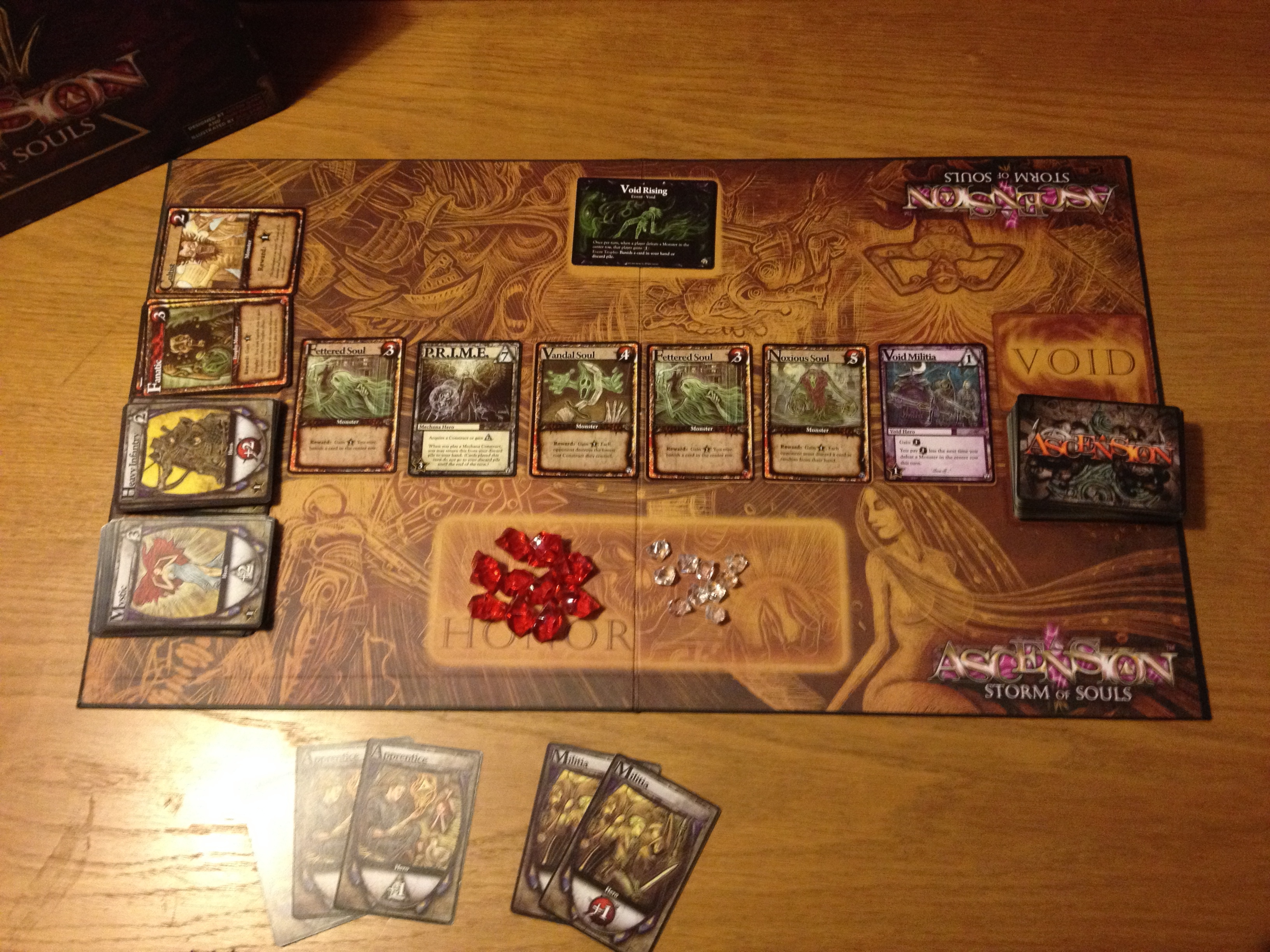
IMG_2722

Ascension is a satisfying game to play. There's a wide variety of different cards that will come up over the course of the game, and playing a particularly devastating combo of cards that allows you to score a huge number of points in a single turn is very enjoyable. For those who find the base game getting a little stale, however, it's possible to combine any of the Ascension games together for a wider selection of cards and some potential rules tweaks — later expansions and standalone sets add additional rules, while earlier sets simply add more cards and consequently more variety. Adding more cards to the mix also allows the game to support more players — up to six maximum — though it does significantly slow down with more players, and with interaction practically non-existent this can lead to some downtime.

Ascension actually plays best with just two players, because the more players you add, the more the centre row changes before it comes around to your turn again, making it harder to devise long-term strategies and turning the game into one where you're more responding reactively to the situation you're currently in rather than trying to think a few turns ahead. Playing this way isn't necessarily a bad thing, but it is worth noting that it's a very different experience to duelling it out with just two participants.

Overall, Ascension is a fun, lightweight card game that's easy to learn, quick to pick up and speedy to play, making it ideal either as a filler game or an option for impromptu multi-game tournaments.

1448: New Term

2014Taking a break from the board game posts for today, largely because I've left it a bit late to start faffing around with taking photographs and whatnot. I'm quite tired and it's back to work properly tomorrow; I'd like to try and be up and about at a reasonable time in the morning so I have time to do "stuff" of an indeterminate nature before I have to actually start working, but we both know that's statistically quite unlikely to happen.
This is one of the many problems with working from home. I mean, sure, it's great to not have to commute anywhere. And, theoretically, being able to stay in bed until pretty much whatever time you want so long as you actually get the work done before the end of the day is pretty great.

But it's not, really. The temptation when provided with potentially limitless time to lie in bed in the morning is to… well, lie in bed for a limitless amount of time until you really can't justify lying there any more. To be fair to myself, I have never actually overslept to such a degree that I haven't started working by the semi-arbitrary 11am start time I set myself to knuckle down and start writing, but I've cut it fine a few times.

Getting up is hard, though. I find it quite difficult to get to sleep quickly at night-time — much to my chagrin, Andie can fall asleep in a matter of seconds — and thus I like to enjoy as much restful sleep as I possibly can. Then there's the matter of "morning dreams" — the incredibly vivid workings of my imaginative subconscious that I can usually recall rather well for a few moments after I wake up, and indeed have documented a number of times on these very pages. (Obligatory link to "the poo dream" post for the benefit of my good friend who occasionally comments here.) These are often so compelling that it's difficult to tear myself away from them, even though I know even as they're happening that they're nothing but dreams, and they almost certainly won't conclude in a satisfying manner.

At least I am able to get up, however. When I was going through what I shall euphemistically refer to as my "rough patch" a few years back, I completely fucked up my sleep patterns to such a degree that I actually found it impossible to even wake up before 5pm in the afternoon. I was unemployed, alone and shortly to be without a place to call my own, so there really wasn't very much to get up — or even wake up — for. It was embarrassing to walk into the shop across the road from my flat and be greeted by the guy with the smelly armpits behind the counter with a polite request as to how my day had been when I knew that my day had only started ten minutes ago, despite his working day being almost over. It was frustrating, too, as I felt I should be doing something more productive with my time than sleeping, but, well, I was not exactly of sound mind at the time, and I'm not sure getting up in the morning would have helped all that much at that point.

Thinking back to that time, I should count myself lucky that I'm enjoying a period of stability right now, then. There aren't all that many things I really need to "worry" about right now — though as anyone who's ever suffered with anxiety and depression will know, you don't necessarily need "something" to stress about to feel stressed out. Life at the start of 2014 is pretty good, by all accounts, and hopefully it will only continue to get better as time goes on.

Now, before I pontificate further on matters of the mind, I believe it's probably time to bid you all farewell. I'll see you at the start of the new working week. Don't be late!

1447: From the Game Shelf: Guildhall

Guildhall

Publisher: AEG
Designer: Hope S. Hwang
Released: 2012
Players: 2-4
Recommended Ages: 12+
Play Time: 30 minutes

Theme: Medieval/Dark Ages
Mechanics: Set collection, hand management
Randomness: High
Luck factor: Moderate
Strategy: Moderate
Interaction: High

IMG_2717Guildhall is a card game themed around the concept of you opening… well, a guildhall. Your guildhall will play host to a variety of different professions, ranging from dancers to assassins; farmers to traders. The aim of the game is to score 20 Victory Points through a combination of point cards and individual points, and in order to do so you'll need to collect sets of professions. There's six different professions and five colours of each.
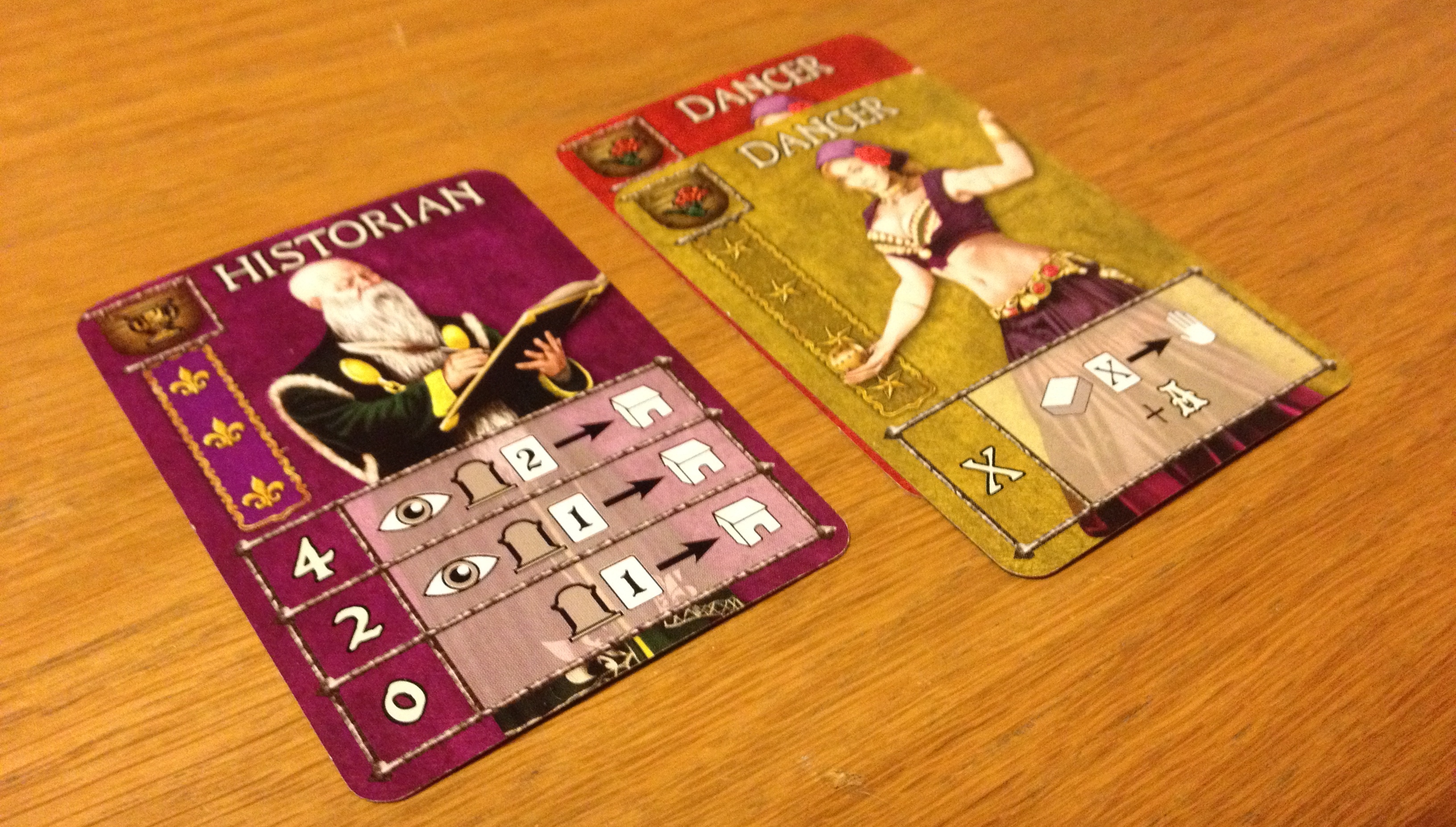
The rules of Guildhall are simple, straightforward and easy to follow and all the special mechanics are depicted through simple icons rather than text. Once you have your head around what all these icons mean, play is quick and snappy, making this an ideal filler game.

How it Plays

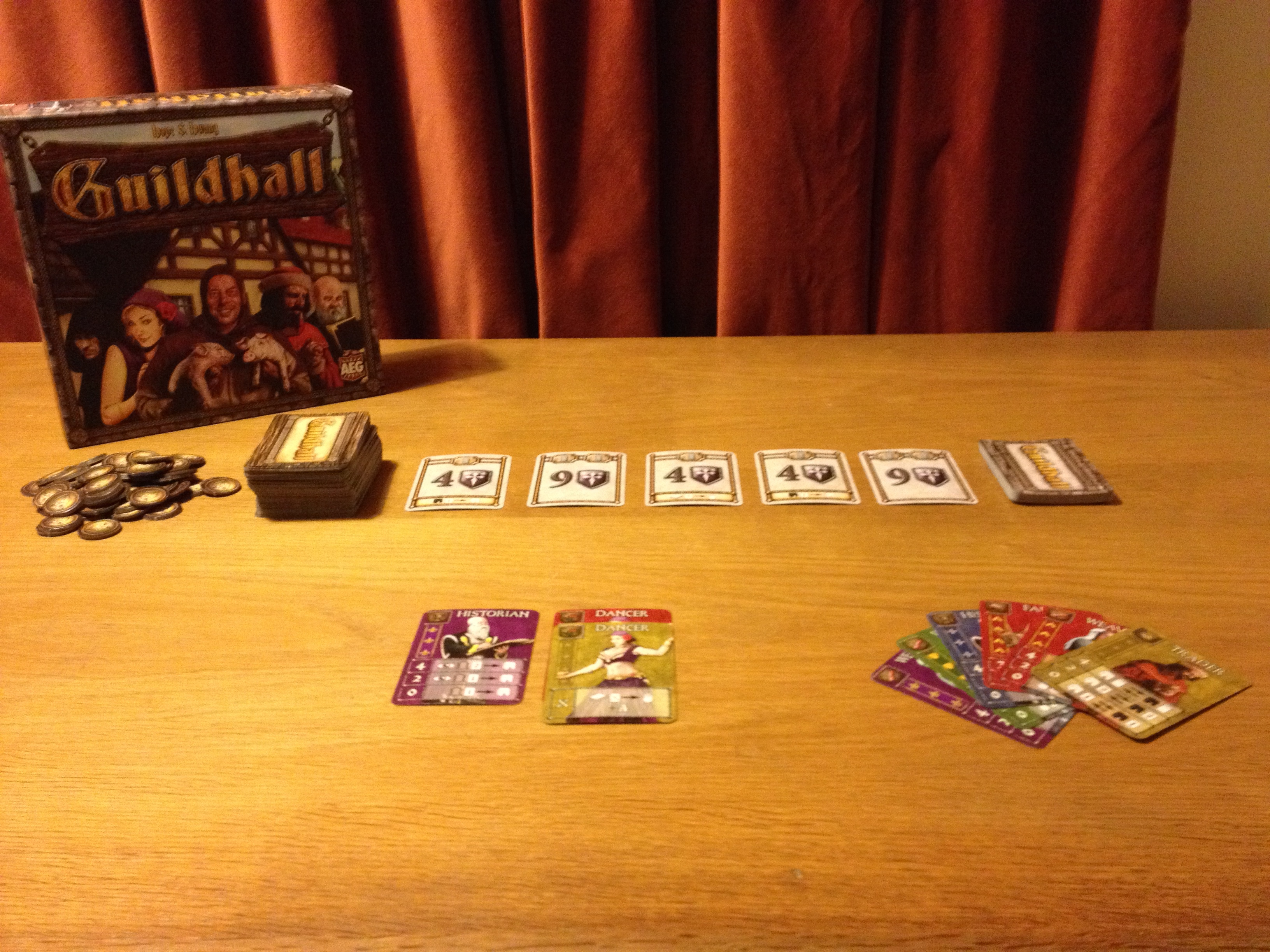
On your turn in Guildhall, you can take two actions. Your options from each action are to play a card to the table, which may trigger its special ability; to draw cards into your hand; or to use a completed "chapter" of your guildhall (all five colours of a single profession) to purchase one of the victory point cards, five of which are on offer at any one time. You are not allowed to play a card that is identical to one already down on the table — if you already have a red Dancer down, for example, you are not allowed to play another red Dancer, but you may play a blue Dancer instead if you have one.

Each of the profession cards in Guildhall has a different effect when you play it to the table, and each becomes more effective — or at least different — when you have more copies of that card in your guildhall already. For example, playing your first Dancer simply allows you to take an extra action; playing a Dancer when you have three Dancers in your guildhall already allows you to draw three extra cards and take an extra action.

IMG_2718

Many of the profession cards allow you to mess with the other players to some degree. The Assassin card, for example, allows you to destroy cards that are in other players' guildhalls, while the Trader forces another player to swap one (or more) of their guildhall's cards with one (or more) of yours. Collecting sets is often a matter of manipulating what other players have available without annoying them too much — piss off an opponent and it's very possible for them to exact amusing revenge on you with some well-chosen cards. If you want a quiet life, the Historian, Farmer and Weaver cards are handy — Historian lets you go through the discard pile, Farmer simply allows you to collect victory points at a slow rate, and Weaver allows you to play extra cards from your hand, perhaps in exchange for picking something up from your guildhall.

Take care with one rule when playing: cards played from your hand to the table do not go into your guildhall until the end of your turn — until that time, they are considered to be in the "action area" and as such chapters are not completed until your turn has ended. This means that you can't play a card to finish a chapter and then immediately spend that chapter on a victory point card of sufficient value to win the game, for example. (You can, however, use special abilities of cards such as Weaver to complete a chapter before the end of your turn.)

Bits and Pieces

Being a card game, Guildhall's box is largely taken up by, you guessed it, cards. There are two decks — a large one of all the profession cards and a smaller one of victory point cards — differentiated from one another by different backs, and separated into two distinct areas of the box insert, which leaves space for expansions. The only other components are a stack of victory point chips, used when playing the Farmer to acquire small quantities of victory points without buying cards.

IMG_2719

The cards are good quality, of a satisfying thickness and pleasingly glossy. They're standard-sized, too, which means they may be sleeved if you so desire. Artwork on the cards is distinctive, attractive and in keeping with the box art, while the lower half of the card is devoted to iconic descriptions of the various special abilities. It takes a little time to learn what all these mean, but there's a handy guide in the instruction leaflet, plus all the card special abilities are helpfully summarised on a single page, too.

Cards can also be quickly differentiated by the icons in their top-left along with their large, prominent title text, and colour-blind players are catered to with the pennant down the left edge of the card, which displays a different piece of heraldry for each of the five colours.

Is it Fun?

Guildhall's theme is mostly irrelevant to its mechanics, but the "collecting professions" concept helps put what you're doing in the game into context, and the professions themselves mostly have thematically relevant special abilities: Assassins "kill" cards; Historians look back at what's come before (i.e. the discard pile); Traders trade cards. Dancers, Farmers and Weavers have a somewhat more tenuous link to the theme of the game, but at least each of their purposes is clear and distinct from one another — every card feels like it has a use, and there's little in the way of underpowered, "dead weight" cards to clutter up your hand — unless, of course, you just can't get your hands on the right colour.

It's a fun game that maybe takes a play or two to get your head around, but once you do it's an enjoyable, quick and surprisingly cut-throat competitive filler game that's well worth having in your collection — it's just a bit of a shame it doesn't support more than four players.


1446: From the Game Shelf: Dixit

Dixit

Publisher: Libellud
Designer: Jean-Louis Roubira
Released: 2008
Players: 3-6
Recommended ages: 8+
Play Time: 30 minutes

Theme: Abstract
Mechanics: Bluffing, communication, description, educated guessing
Randomness: Moderate to high
Luck factor: Depends on who you play it with!
Strategy: Light
Interaction: High

IMG_2713

Dixit is a card-based party game that revolves around the idea of creatively describing images. (Do not confuse it with the 1983 crossword-building game of the same name, as the two are very different!) The aim of the game is to score points — this can be achieved by, depending on what your role is that turn, describing cards in just enough detail that one or two people around the table successfully guess what you were describing, by successfully identifying what that turn's "storyteller" was describing, or by convincing other people that the card you played was the one the storyteller was describing.

It's a quick, easy to learn game that's high on communication and creativity, making it ideal for social gatherings. There are numerous expansions available too, as well as standalone variants that bump up the maximum player count to 8 rather than the original's 6.

How it Plays

The role of "storyteller" is passed around the table one player at a time. On your turn as the storyteller, you must select one of the cards from your hand and play it face-down onto the table, then describe it in any way you please — a word, a phrase, a little song and dance routine.

Once this is done, all of the other players select a card from their hand that they believe would also fit the storyteller's description and play them face-down. The storyteller then shuffles the played cards and reveals them to the table.

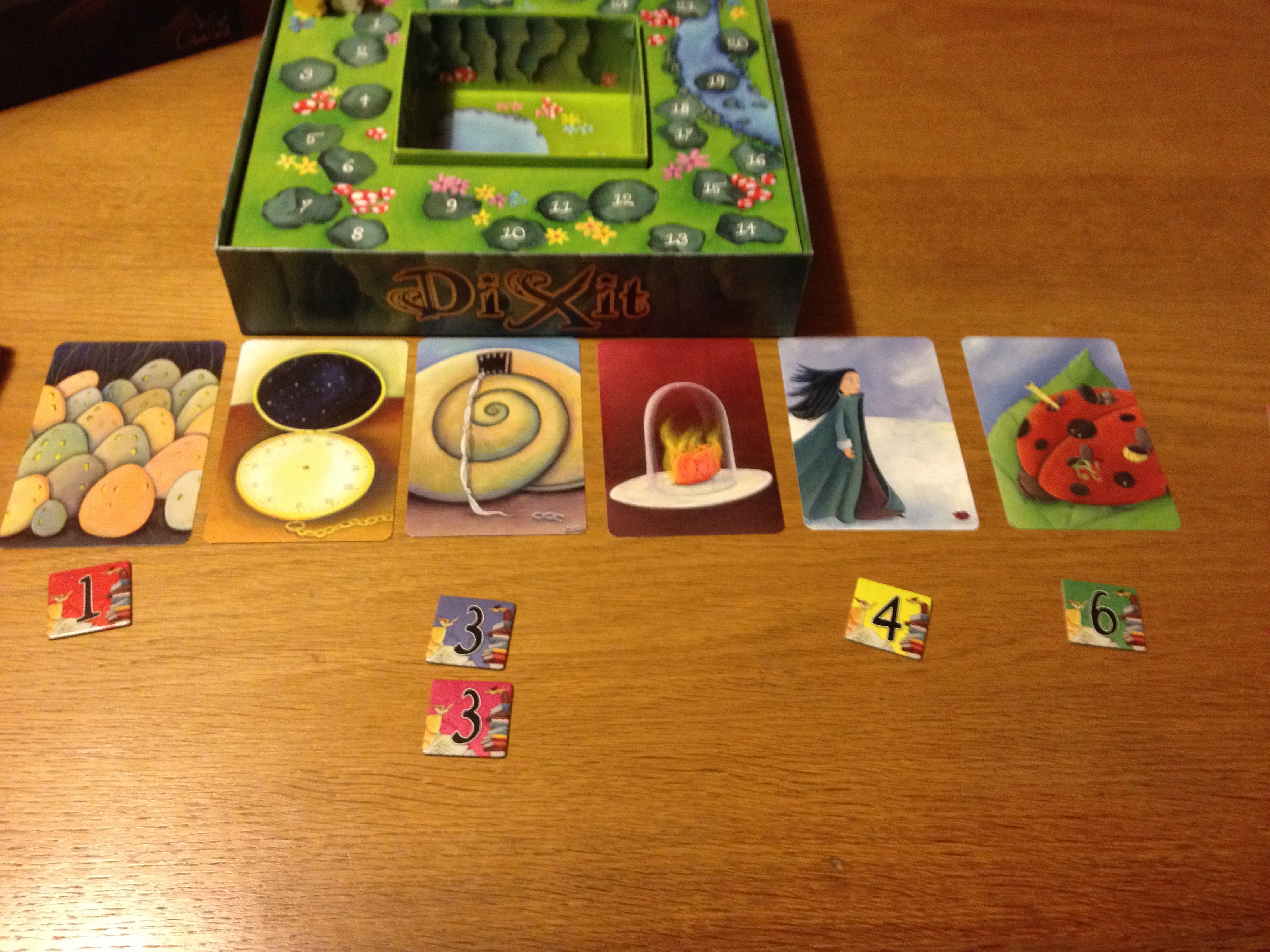
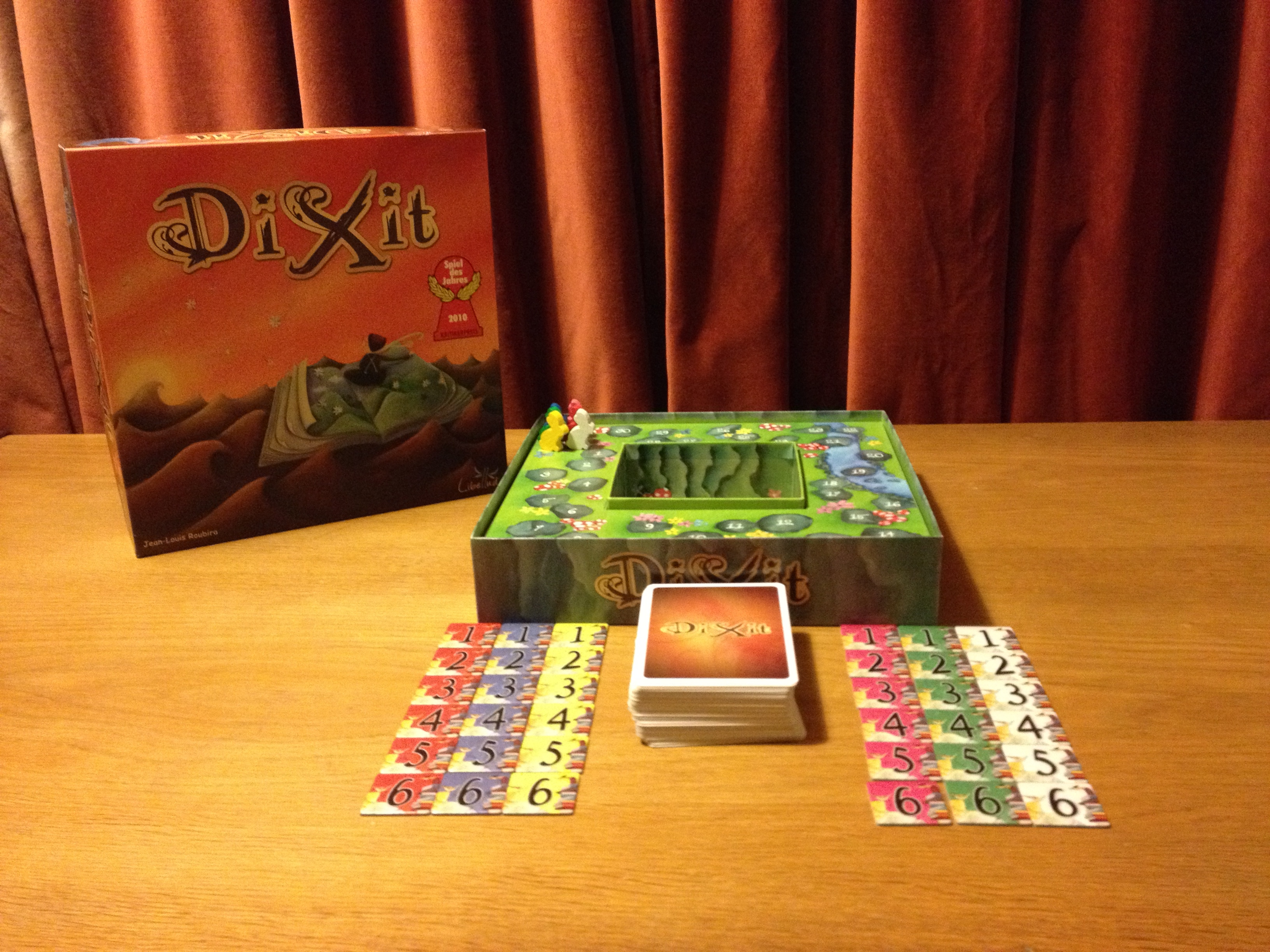
At this point, players secretly vote which one they think was the storyteller's card using cardboard chips with numbers on them. The storyteller does not vote. All votes are revealed simultaneously, and the storyteller then reveals which card was theirs.

IMG_2715

If all players correctly voted for the storyteller's card or if no-one correctly identified it, all players except the storyteller receive two points. In all other cases, the storyteller and any players who successfully identified their card receive three points. Bonus points are awarded for each vote a player received for the card they played when they were not the storyteller. In other words, it's in the storyteller's interest to be slightly obtuse about their clues, but not so obtuse no-one will recognise what they're talking about. Savvy storytellers will make use of references and descriptions they know only certain players around the table will catch.

Players then draw up to a hand of 6 cards, and the role of storyteller passes around the table. Play continues until the deck of cards is exhausted, and the player with the most points at the end is the winner.

Bits and Pieces

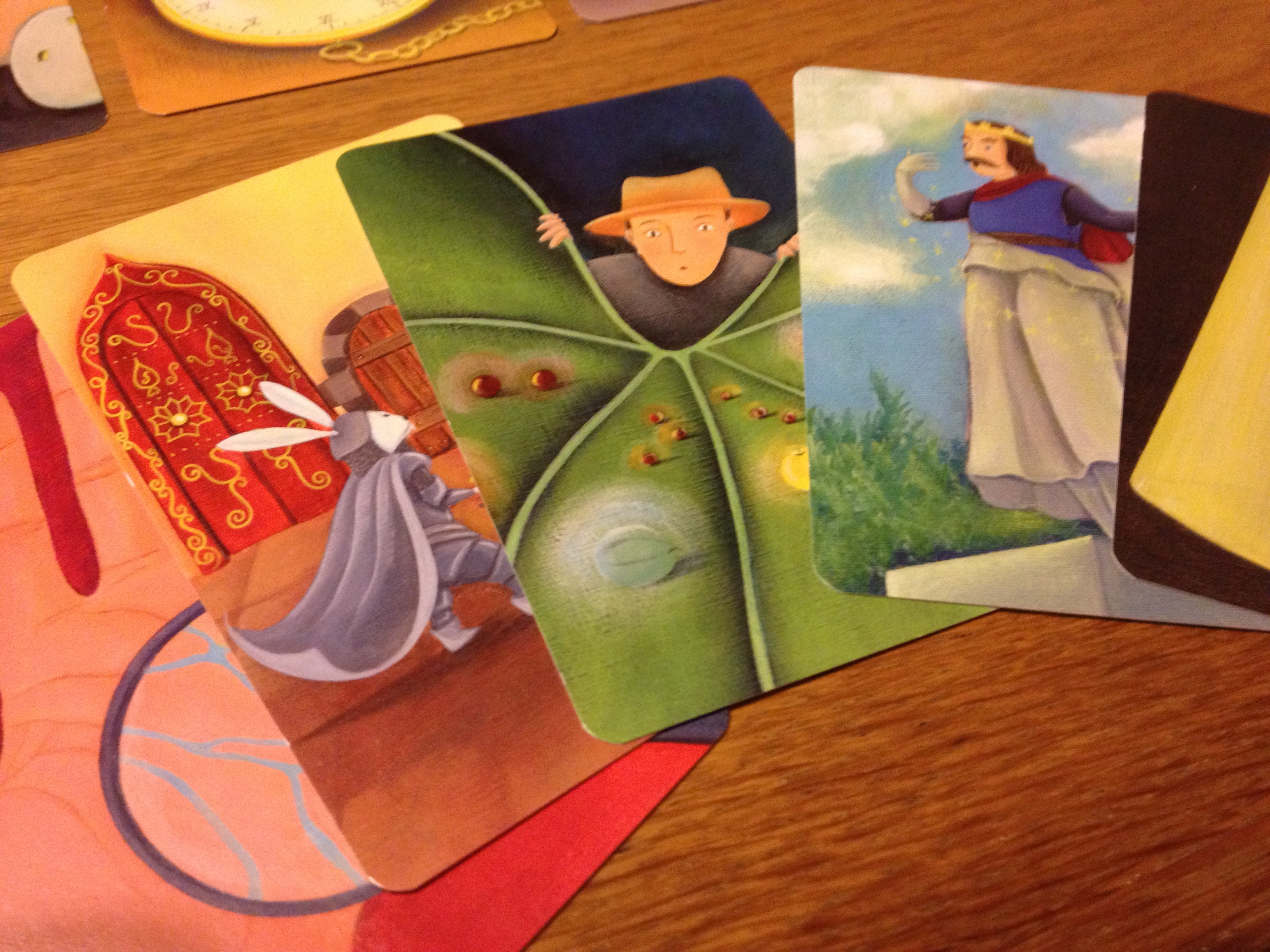
The highlight of Dixit is its 84 oversized cards, each of which depicts a different image. The images — the work of one Marie Cardouat — are all somewhat surreal in nature and deliberately difficult to describe in simple terms, but they have a consistent art style that is pleasingly distinctive and instantly recognisable.

IMG_2714

Scoring is tracked using wooden rabbit markers that proceed around a track printed on the box insert which may be removed if desired. The markers are well-made but their shape makes them somewhat prone to falling over or being knocked around if the table or box is bumped inadvertently, and with the close positioning of the numbers on the board, this can sometimes lead to inaccurately tracked scores. The score tracker also only goes up to 30, and it's possible for games — particularly those with fewer players — to exceed this total, necessitating further "laps" around the board.

Voting is accomplished through coloured cardboard tokens with numbers on one side and the Dixit logo on the back. They're functional but in keeping with the game's playful art style, and the bright, vibrant colours make each player's tokens immediately distinguishable from one another.

Is it Fun?

Dixit's a game you need to play with the right people, and it's also a game that changes over time the more times you play it with the same people. Ideally, you want to play with a group of people who all know each other well so that psychological tricks such as obscure references and in-jokes can come into play. Those who are not very creative or imaginative — or those who find it difficult to grasp more abstract games — probably won't have as good a time playing Dixit.

The more times you play, the more you'll come to recognise various cards as they come up, and how people generally tend to describe them. This forces you to either come up with more creative ways of describing the images — or, of course, to invest in one of the various expansion decks available.

IMG_2716

The game makes for some memorable occasions, however, particularly if someone comes up with a particularly creative (or offensive!) description for one of the cards. It's fun trying to read the other players around the table, and determining how best to bluff your way to victory. It may initially seem like a simple, straightforward party game and indeed there's nothing stopping you treating it as such. But it's also possible to turn the game into a gruelling battle of wits against your rivals as you attempt to take advantage of what you know about all of them.

So yes, it's very much a fun game — and a pleasantly short, light affair that's good for either opening or capping off an evening's gaming. If you have a group of players who would respond well to its creative challenges, it's well worth your time.

1444: 2014 Arrives

…and it was with a bit of whimper, to be honest.

This isn't any reflection on our gracious hosts Tim and Sophie, of course, who not only laid on a sausage-tasting session (no, that's not a euphemism) for us, but also cooked an immense amount of beef and other goodies, but to the fact that we all, as a group, found the moment of that single digit changing on everyone's calendars to be somewhat underwhelming.

Is it cynicism? Jadedness? World-weariness? I don't know, really. Perhaps it's the fact that staying up until midnight isn't really a novelty as a "grown-up", or the realisation we've all had at some point of the fact that a new year doesn't magically mean a new beginning, a fresh start or anything like that.

I mean, sure, the first of January is as good a time as any to say "right, I'm going to get [x] sorted out" but I'd be interested to know just how many people do successfully manage to get [x] sorted out and who are quite happy to maintain the status quo, continuing to allow [x] to do its thing as it's always done.

I don't have many things I'd like to do massively differently this year. I'd like to pick up on the exercise again, even though every time I engage in it I feel like it's an increasingly futile gesture. I'd like to start drawing a few stupid little cartoons on this blog again — not today, though, as it was a busy day; tomorrow perhaps. I'd like to pick up work on my game again. And I'd like to continue learning Japanese.

These are all relatively simple, small and attainable goals. I'm not going to make any grand gestures or promises that are impossible to keep — no "I will be thin in 2014!" bullshit, for example — but I would like my life to continue in a reasonably positive direction, even if my own messed-up brain occasionally gives me days of distressingly dark thoughts.

There's plenty of possible good things to look forward to in 2014, at least, but I shall spare you enthusing about things that may or may not happen for now because… well, they may or may not happen. But we shall see. I'd like to be positive. I'd like for it to be a good year. But I'd settle for it simply to not be a bad one.

Happy new year, everyone; may your 2014 be adequate for your needs.

1443: Death to the Chimera

It's another Final Fantasy XIV post, I'm afraid, but I feel compelled to share the experience I just had, as I think it's something that's going to stick with me for some time.

A bit of context, first, for those who don't play. My character is primarily a Black Mage, which is part of the group known as "DPS" (damage per second" or damage dealers. I don't have a lot of health, but my spells do hit hard and do a considerable amount of damage. When playing as a member of a party, I rely on the "tank" character to keep the enemies' attention off me, and occasionally the assistance of a healer to keep my health topped up if I do happen to get hit by something. For the most part, my responsibility is to avoid getting hit as much as possible, and to simultaneously ensure that I'm doing as much damage as possible.

I'm at level 50 on my Black Mage, which means I'm no longer gaining experience and have instead been gathering better and better equipment. My average item level is now 71, which is significantly stronger than where you are when you first hit 50 — though the effectiveness of all said equipment is scaled down accordingly if you happen to run a dungeon that's lower than level 50.

Which, as it happens, is exactly what I was doing earlier. I decided to run the dungeon Cutter's Cry, because I was well behind on my "Hunting Log" for the Immortal Flames Grand Company, and wanted to actually polish it off and make some progress. (In the game, your Hunting Log is a checklist of specific monsters to defeat, with rewards on offer for completing items on the list, and larger rewards on offer for completing a complete difficulty rank. The Grand Company is an organisation tied to one of the three main city-states in the game, and is effectively where your character pledges their allegiance to.)

Our run through Cutter's Cry didn't go as smoothly as it could have done. Our tank — the guy who stands at the front and gets hit, as well as the guy who generally leads jaunts through dungeons — wasn't especially skilled, and was having trouble maintaining the attention of monsters that really wanted to chomp on our healer's testicles. I spent a lot of the dungeon casting my Sleep spell to take a bit of the heat off the party and allow us to concentrate on a single monster at a time, and it overall seemed to work pretty well, with a few minor mishaps along the way.

We eventually reached the dungeon's boss monster Chimera, albeit with a different healer to the one we started with, who disconnected. Our first attempt failed miserably in a matter of seconds. The second, however, is where things got interesting and exciting.

It was going reasonably well for a while. We were doing decent damage to the Chimera, and the tank was successfully maintaining the attention of the enemy, allowing the party's Bard and I to pelt it from a distance with arrows and fireballs respectively.

Then something went horribly wrong. The tank didn't quite move far enough to get out of the path of one of the Chimera's special attacks, and hit the deck. The Bard followed shortly afterwards, leaving just me and the party's healer to deal with a by now very pissed off Chimera.

I thought this would almost inevitably be the end, but on a slightly selfish whim I decided to see what I could do. We'd already whittled the beast's health down to an amount that certainly looked doable, so I started alternating running away from it and flinging a few spells at it whenever it stopped to try and do one of its special attacks. The healer cottoned on quickly to what I was doing, and supported my efforts while the tank and Bard lay on the floor — the fight's too hectic to make raising party members practical, particularly if the tank's down.

The Chimera's health bar continued to deplete, and I somehow remained standing, successfully dodging each and every one of his special attacks and only occasionally taking damage from an occasional claw swipe. Meanwhile, I'd continue to electrocute him with my Thunder spells — which causes him to continually take small amounts of damage over a short period of time — and pelt him with fireballs whenever I had enough distance between us to make casting practical and safe-ish.

Finally, his health was into the "holy shit, are we actually going to pull this off?" territory — and conveniently, the party's Limit Break bar was fully charged at this point. (The Limit Break bar builds up gradually through combat, and any one party member can trigger it once it's charged high enough for a powerful special ability according to what class they are — in the case of Black Mage, it summons, as you might expect, a devastatingly destructive spell.)

"Limit Break!" called the party members. I was skeptical as to whether or not it would do enough damage, but I put some distance between the Chimera and I, waited for the perfect moment and then began casting.

The screen exploded in fire and my speakers erupted with the sounds of falling meteorites… and then there was a deafening screech as the beast collapsed to the floor and dissipated into a cloud of aether. The Chimera was down!

"Holy shit," said the fallen Bard afterwards as the healer helped him to his feet. "Good job."

I don't often like to toot my own horn, but in this case? Yeah, I have to agree.

1442: Yearly Wasteland

We've reached that peculiarly barren time of year — it's no longer Christmas, but it's not quite New Year either. Some unlucky people have to go back to work for a few days — Andie is one of them — while the rest of us bum around, twiddling our thumbs and wishing we had more presents to open. (Actually, we will have a few more presents to open on New Year's Day, which is nice. I think I know what mine will be, and if I'm right I'll be very pleased with it.)

I feel a bit frustrated by the holiday season at the moment. I miss the "magic" it used to have when I was a kid. I'm not sure quite when it stopped being exciting and fun, but it'd be nice to get that back.

I've mentioned before my curious inability to express genuine-seeming outward signs of excitement, surprise or anything like that, and I have a feeling that may be something to do with it. I love opening presents and getting cool stuff, but I hate the pressure there is to look pleased with what you got. Everyone who buys you something is almost inevitably looking carefully at your face to see if you smile, grin, laugh or look disappointed at the things that have been purchased for you, and given that I feel enormously self-conscious about getting excited or joyful, my reaction often appears to be somewhat more "meh" than it actually is. I generally do like presents, whatever they are — because I'm not an ungrateful twat who returns gifts that other people have bought for him — and I am always appreciative when someone thinks of me and buys me something nice. It's just sometimes a bit difficult to show.

Same with New Year's. Everyone builds it up to be some kind of massive big deal, so when the time comes to actually say "Happy new year!" to people I feel very self-conscious and stupid. It feels like a cliche to say it. Well, it is a cliche to say it, but surely there's no better time to actually say "happy new year!" to someone than at one minute past twelve on New Year's Day. Garrgh.

One day I might get over all these stupid neuroses. Sadly, that day is not today, so if you are, by any chance, hanging out with me for New Year celebrations at any point in the future, I apologise in advance for my seeming lack of enthusiasm about the year increasing by one.

We're off out to a party at my friend Tim's tomorrow night to ring in the new year. There will be sausages. And no, that's not a euphemism; the plan is actually for there to be lots of sausages. This is a situation I am absolutely fine with.

There will be one last post of 2013 before the new year — that will hopefully be before midnight, if I remember — and then it's onward to 2014 and great things. Or just the same things as usual, but with a different number in the "YYYY" section of forms.

Anyway. Happy holidays or whatever.

1441: Panic!

Having tried Escape yesterday, Andie and I gave Castle Panic a go earlier. Despite the title, it's a somewhat more sedate affair than Escape, though you're still dealing with difficult odds and a distinct chance of being horribly defeated at any point.

Castle Panic is a cooperative game in which you and up to five other players are tasked with defending your castle from an incoming onslaught of goblins, orcs and trolls. Your castle is made up of six towers, each of which has a wall protecting it. Lose all the towers (but not necessarily the walls) and everyone loses; get through all the monster tokens and kill everything and everyone wins, but whoever scores the most points wins slightly more than everyone else.

Gameplay is pretty straightforward. The board is split into three coloured sections, each of which is subdivided into two numbered areas and five different rings. The outermost ring is the "forest" surrounding the castle area; the next three rings represent the effective ranges of your archers, knights and swordsmen respectively; the innermost ring is inside your castle walls and is where you're trying to prevent the beasties getting to.

In order to deal with the incoming hordes, you need to play cards from your hand. Many of these take the form of a coloured archer, knight or swordsman, which means you can deal one point of damage to a monster in the appropriately coloured section of their respective ring on the board. Different types of monster take different amounts of damage — goblins only take one, for example, while trolls and some "boss" monsters have three and orcs have two.

There's a selection of special cards in the mix, too — a "lucky shot" card allows a monster to be outright killed rather than damaged when used in conjunction with an appropriate card; "hero" cards can attack any ring in one coloured area of the board; barbarians can attack enemies who have managed to breach the castle walls.

Each turn, more and more enemies show up to make life difficult, and the enemies already on the board move in by one ring. If they hit a wall, they destroy it and take a damage, and likewise for the towers. Certain monster tokens cause more monsters to show up, or move further than they would normally, or rotate around the board. Giant Boulder tokens roll across the board, killing everything in their path but also destroying the first wall or tower they meet, making them something of a mixed blessing.

Andie and I won the game we played earlier, which surprised me somewhat — I'm used to cooperative games smacking me about somewhat more than this one did, but it may have been a lucky combination of card and monster token draws.

I'm interested to try the game with more people, since then you have smaller hands of cards but are able to trade more cards with people at the start of your turn.

It's an interesting take on cooperative because there's a competitive element, too — while you're all working together for a common goal, there is a scoring mechanic to encourage you to try and be the "best", too. This somewhat discourages the "alpha player" problem that some cooperative games suffer from, in which one player takes charge and orders everyone else around. In Castle Panic, there's not so much scope for that to happen and turns are pretty quick, so everyone can feel like they're contributing.

It's a good game, in short. I'm looking forward to trying it some more.

Talking about all these board games has given me a blogging idea for January — I'm thinking I might go through my collection and compile some detailed posts on selected (or perhaps even all!) of the games I own, sharing some thoughts, images and details on them for those curious. I have a pretty decent collection now, and it would be nice to do it justice with some more detailed posts. So look forward to that!

1440: Escape!

I spent some of my Christmas money today on some board games — I grabbed Castle Panic, which I've never played but which I understand is an enjoyable moderate-length game that isn't horrendously complicated, and Escape, which I hadn't heard of prior to today, but which came recommended by some board gamers I follow on G+.

Escape is a really interesting game, as it happens, and I'm looking forward to trying it out with various different group sizes. Andie and I gave it a shot today, initially not quite sure what to make of it, but after a third playthrough — a game is only ten minutes long — we nailed it.

Escape is a cooperative game that unfolds in real time. You and your compatriots play intrepid explorers who have gone and got themselves stuck in the middle of a temple, with no idea of where the exit is. (Presumably they fell in through the ceiling or something.) It's your job to find the exit, then exit through it. Simple, right? NOPE.

The temple, being a mysterious old temple, is cursed, and in order to be able to escape you need to not only find the exit, but also activate some magical gems along the way. Each gem you activate makes it easier to escape, but attempting to activate them takes up valuable time.

Almost everything you do in Escape hinges on the roll of the dice. Each player has five dice they can roll, and there's no need to take turns — you just keep rolling until you get what you want, and you can set aside dice that you haven't used to perform an action. Roll a black mask, however, and that die is out of commission until you roll a golden mask to return up to two of your dice to play. If you're in the same room as another player, you can use your golden masks to "heal" another player's dice, too, so it's in your interests to team up rather than get too far apart.

Activating the gems is generally a matter of rolling a certain number of either torch or key symbols. Certain rooms allow you to activate multiple gems in collaboration with other players by pooling your dice, but obviously rolling 10 of one symbol is going to be a little more time-consuming than rolling, say, 4, so you have to weigh up the risks and potential rewards.

Just to add a little more stress to the mix, at two points during the ten-minute play session, a gong sounds, and then you have a short span of time to get back to the central chamber or lose one of your dice permanently. Conversely, if you manage to escape before someone else does — by both finding the exit and then rolling as many keys as there are gems left in the pool, plus one — you can give one of your dice to another player. If you haven't all escaped by the time the third gong and countdown ends, you all lose, regardless of how many people have escaped.

Escape makes use of an audio CD to manage the time limit, but also provides a sand timer for when you're playing in quieter environments. The CD is a lot of fun, though, being full of ambient noise and dramatic stabs when you're all racing back to the central room. It reminds me of the somewhat more complicated Space Alert, another cooperative game that involves working together against a tight time limit — unlike Space Alert, however, which unfolds in hilariously painful slow motion after the CD is over, Escape happens in completely real-time, which takes a certain degree of getting used to but gives it a pleasingly enjoyable, frantic feel to it.

Looking forward to trying it some more and adding the "Curse" and "Treasure" modules for additional complexity and strategic options. In the meantime, if you're looking for a super-quick game to hit your table as a filler or warmup, it's well worth a look.

1439: Titanic

Been making good progress with Final Fantasy XIV over the last few days and once again I'm pleasantly surprised by how much I've taken to the multiplayer-centric endgame content.

Tonight's job — the last-but-one step in the quest to acquire the almost-but-not-quite-ultimate weapon for my level 50 Black Mage class — was to fell Titan in his "Hard Mode" fight, a notoriously difficult boss battle that I had a considerable degree of uneasiness about going into — and which I was terrified of the prospect of jumping into with strangers.

As it happens, the fight wasn't all that scary if you know what you're doing — much like every other fight in the game. You'd think I'd have learned that by now.

Titan, like Ifrit and Garuda before him, is one of the "Primals" — major bosses that crop up over the course of Final Fantasy XIV's main story, and a good opportunity to test your party's skills against one very strong opponent without having to run through a long dungeon first. The battles against them — known as "trials" in game parlance — tend to be unfold in deceptively simple boss-fighting arenas, but the simplicity of the environment is to ensure there's nothing to distract you from the important thing: paying attention to what your opponent is doing.

Ifrit, Garuda and Titan all have abilities that are far beyond almost anything else you fight in the game, and a party that doesn't know what it's doing can wipe out very quickly if they're not careful. They're highly mobile fights that demand you recognise your opponent's attack patterns and know how to counter them — and how to avoid them. Titan in particular is highly dependent on the party being able to avoid a relentless string of devastating attacks — and the healers being able to deal with the few, less-damaging attacks that are unavoidable for the whole party.

Aside from Titan, I spent a bit of time playing with the Conjurer class earlier — this is the healing class that later becomes White Mage, but also has a few offensive skills, too. It's an interestingly distinctive class to play when compared to Black Mage, and a good demonstration of how Final Fantasy XIV makes even ostensibly similar classes play markedly differently from one another.

Black Mage and its predecessor Thaumaturgist involve highly destructive spells that cost large amounts of magic points to cast. The key mechanic to get your head around with Black Mage is the balance between "Umbral Ice" and "Astral Fire" — the former causes your ice-based spells to cost more to cast, but increases your magic points regeneration enormously, while the latter causes fire-based spells to cost more to cast and deal considerably more damage, and also stops all magic points regeneration. Essentially, Black Mages have a limitless pool of magic points that mean they can continue casting indefinitely, so long as they make the switch between Umbral Ice and Astral Fire at appropriate junctures — and, at higher levels, make good use of the MP-free, instant-cast spells that occasionally trigger.

White Mage and its predecessor Conjurer, meanwhile, are very different. Spells are considerably cheaper to cast, but there's no Umbral Ice mechanic to quickly regenerate magic points in a hurry — so you have to manage your spellcasting a little more carefully. The class also has an interesting "stance switch" option, allowing the white mage to swap their Intelligence (determines spell damage) and Mind (determines healing power) stats around, effectively making them either damage- or healing-focused at the touch of a button. And then, of course, there's the fact that white mages are mainly regarded as healers rather than damage dealers, and as such you have to be a lot more aware of people around you so you can heal them. The tradeoff for this, of course, is that people tend to like you because you can stop them from dying — and, once you reach a high enough level, you can even bring them back from the dead.

I jumped into one of the short party-based "Guildhests" earlier on to have a go at healing as part of a group with a relatively straightforward challenge. The party I was with was clearly very inexperienced — the fighter charged ahead without waiting for me to cast protection spells on him, and the damage-dealing mage seemed to take as much damage as he inflicted. I managed to keep everyone alive, though, and my reward from these random strangers whom I'll probably never see again was three "Player Commendations" — a new system introduced in the latest patch which allows players to show their appreciation for random teammates they were matched up with through the Duty Finder system. It's a very nice, friendly addition to the game, and I can't deny feeling a pleasantly warm and fuzzy feeling inside after a successful dungeon run when I see that little "You have received a player commendation" message in my chat window. Even better when there's more than one.

Anyway. With Titan down, the only thing left for me to do to get my Black Mage relic weapon is to collect 400 more Allagan Tomestones of Philosophy by running dungeons — should be easy enough. Once I've done that, I'll be well on the way to being appropriately geared for the Binding Coil of Bahamut, the most difficult dungeon in the game… or I can just start working on one of the other classes, with the eventual goal of getting their Relic weapons, too.

This post was probably indecipherable to those of you who don't play Final Fantasy XIV but eh. Whatever. Tomorrow I'll write about kittens or something.