I've talked a bit recently about how the adventure game genre is probably in a better place than it's ever been — in fact, I think I'd even argue that now, it's better off than it was in its supposed heyday of LucasArts and Sierra in the early '90s.
The reason is games like Wadjet Eye's Old Skies, which I've played a good four hours of this evening. This is a masterfully put together adventure game in terms of involvement, emotional engagement and just being a plain compelling interactive narrative. While there are some who have criticised it for not having interesting "mechanics" — by that, what they really mean is that it doesn't have any puzzles they got stuck on — I think there's a strong argument to be made that the genre has moved beyond the necessity for being overtly and deliberately obtuse for the sake of inflating playtime.
Y'see, while Sierra and, to a lesser extent, LucasArts games put in deliberately complicated and sometimes baffling puzzles as a means of hiding the fact that their total runtimes were, in many cases, only one or two hours at most, today's adventure game developers have the resources, budget and ability to put together games that are much longer. As such, there's no real need for these games to artificially inflate their length through obtuse puzzles, because the core of what they offer — their narrative, and the player's involvement in it — is compelling enough to stand on its own merits.
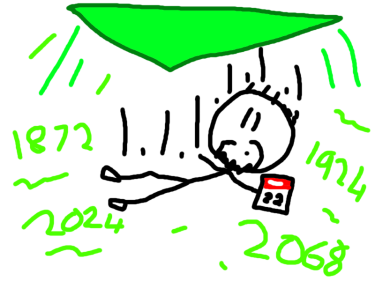
This is definitely the case for Old Skies, which has a thoroughly interesting and enjoyable premise. You take on the role of Fia Quinn, a time-travelling agent who accompanies clients on recreational jaunts to the past in order to ensure that they don't get up to mischief or cause any paradoxes that are too significant. The nature of time travel means that there will always be a certain amount of impact on the future, reflected in the game world by flashes of purple light that signal a "Chrono-Shift", where something notable changes in the "present" due to interference in the past, but the Earth depicted in Old Skies also has sufficient technology to "Chrono-Lock" anything that is particularly important, protecting it from such instances.
Each main chapter of Old Skies focuses on one of Fia's jaunts to the past with her client. The first is a relatively short trip back to the New York of 2024 as a renowned scientist hopes to resolve some lingering regrets. Things… do not go entirely according to plan, setting what one would anticipate to be a template for the rest of the game. But interestingly, the second immediately subverts that expectation by being much longer, more involved and more complex, both mechanically and narratively. In this chapter, set in the "Gilded Age" of the late 19th Century, something still goes "wrong", but in an entirely different way, forcing both Fia and her client to work through a complex series of events in two closely related time periods (six months apart) in order to set things what is, to their best interpretation, "right".
The whole thing raises some interesting questions about the very ethics of something like time travel. How do you ensure someone's selfish actions don't make a real mess for everyone in the future? How, exactly, do you police such things? Who decides who and what is "important" to the coherence of the overall timeline — and how? Why were they given that opportunity?
I'm looking forward to seeing how the story evolves, and it also appears that this game is going to be pretty substantial by adventure game standards. At four hours to complete the first two chapters, and I believe at least seven in total, this is looking like a fairly beefy adventure, though its chapter-based structure also means that it feels nicely episodic, so you can leave it at a natural break and come back to it another day.
Thus far, I haven't really seen the problem that some reviewers argue is the game's "weak mechanics"; the game doesn't rely much on using inventory items on things in the game world to progress, but instead prompts you to think carefully about the pieces of information you gather, how they relate to one another and, in some cases, how closely related time periods might relate to one another, too. There are some particularly clever sequences in the second chapter, requiring you to jump back and forth to revisit the same locations six months apart and manipulate the information you find in order to secure an advantageous outcome for everyone involved… as much as is possible, given your own interference, anyway.
The game is beautifully presented, with some absolutely stellar voice acting and music, and some really nice animation on the main characters. It's also nice to see an adventure game breaking free from the seeming "obligation" that some developers feel to use '90s-style pixel art; Old Skies instead adopts a true high-definition look that feels like a true successor to the brief period of "Super VGA" adventures during the winding-down of the Sierra and LucasArts "golden age".
Anyway, I'm sure I'll have more to say in the coming days/weeks as I work my way through it on evenings where I feel like something a little more chilled out than Donkey Kong Bananza. In the meantime, if you're a point-and-click type, I can highly and confidently recommend Old Skies; it's another fantastic game from Wadjet Eye (developed by them this time, as opposed to the numerous other titles they've published in recent years) and well worth the £17 it costs. Take that, £75 video games!
Want to read my thoughts on various video games, visual novels and other popular culture things? Stop by MoeGamer.net, my site for all things fun where I am generally a lot more cheerful. And if you fancy watching some vids on classic games, drop by my YouTube channel.
If you want this nonsense in your inbox every day, please feel free to subscribe via email. Your email address won't be used for anything else.