Now I've got the MiSTer Multisystem 2 up and running to my satisfaction (not helped by some sort of accident corrupting the entire SD card's filesystem, necessitating a complete reinstall of everything — I'm running games from an external hard drive now, and have taken a complete backup of the system software!) I have been enjoying the pleasurable experience of being able to sit down in front of my old faithful Sony Trinitron CRT and play… pretty much anything I want up to the Saturn, PS1 and N64 era.
As you will doubtless know if you've been following me for any length of time, I am a passionate advocate for physical releases of video games. My living room is effectively a games library, and I wouldn't have it any other way.
But I must say, there is an absolute, definite appeal to having a dedicated box that I can boot up, say "I feel like playing [insert game name here]" and be doing so within a matter of seconds. No fiddling around with SCART cables needed. No digging out the correct power adapter required. No blowing on cartridge pins or isopropyl alcohol on cotton buds required.
Not only that, but a significant portion of software that one can play on the MiSTer has been creeping into "unattainably expensive and/or hard-to-find" territory over the course of the last few years — particularly anything from the 16-bit or 32-bit platforms, and especially role-playing games. I could drop several hundred quid on a copy of Panzer Dragoon Saga, or I could just play it on MiSTer. The choice is pretty clear.
"Now hold on a minute, good sir," I hear you say. "Don't you work in official retro gaming rereleases?" And to that I say, yes, absolutely, I most certainly do. But unfortunately, however much many of us might want them, there are some games that are never, ever, ever going to get an official rerelease for all manner of different reasons. And in those cases in particular, there is zero shame to be felt in experiencing them via… let's just call them "unofficial" preservation methods.
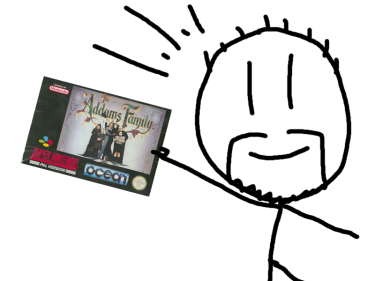
But anyway. I want to talk a bit more specifically about one of those unofficially preserved games I have been playing and enjoying for the past few evenings. It's not a particularly rare or hard-to-find game to my knowledge (checks CEX — £12 loose, £38 complete in box at the time of writing) but it is one I have some fond memories of, and one that I doubt will ever get an official rerelease. It's Ocean's The Addams Family, a platformer based loosely (very loosely) on the 1991 movie, and which was available on numerous different platforms; I've been playing the SNES version.
I'm actually not entirely sure how I attained those memories, mind, because I never owned a copy of The Addams Family on any platform back in the day. I might have had a demo of the ST version (which is surprisingly competent) but I certainly never had the full game on anything. But I definitely played it.
What I suspect happened is that on one of my brother's trips home to visit us — by this point he had left home to go and work on Games-X magazine at Europress up in Macclesfield — he had brought a SNES with him, and one of the cartridges he had also brought along was The Addams Family. The only other possible alternative is that one of my friends from school had it — and I don't think they did. My main SNES-owning buddy at school played various versions of Street Fighter II almost to the exclusion of everything else (although I did borrow Super Star Wars multiple times from him), and my other main console-playing friend was a Mega Drive man.
Anyway, I guess that isn't really important. What is important is that The Addams Family for SNES left a solid impression on me, with probably the most potent part of that memory being the amusing farty noises that play whenever Gomez jumps on an enemy (fart-POP!) or if he takes damage (breathless clown car-horn HONK). Aside from those excellent sound effects (and they are excellent; it's been a delight to hear them again), I remember simply enjoying the game a great deal, too, and I'm pleased to report that It Holds Up.
Lest you've never played The Addams Family on SNES (or any of the other platforms it appeared on), you take on the role of Gomez, who is attempting to rescue the various members of his family from… some sort of unfortunate circumstance that was probably a flimsy reference to the movie's plot. I forget. It doesn't matter. What does matter is that your quest unfolds as an open-structure 2D platformer that eschews a linear level-based structure in favour of giving you a big, open map, the vast majority of which is open to you from the outset, and then inviting you to just get on with it.
I'm not sure I'd call The Addams Family a "Metroidvania", largely because that term can get in the bin, but also because I'm not sure its commonly agreed definition applies here. Sure, you have a big open map to explore, but areas are not gated by abilities that you gradually acquire as you progress. Instead, only the finale sequence is gated by you having completed the rest of the game, and you are otherwise left to tackle the game's various challenges in whatever order you see fit.
These challenges are upgrading your health bar three times, then finding Wednesday, Pugsley, Granny and Fester Addams in whatever order you please. (You can even find them before the health upgrades if you want to, but the extra hearts make it much easier.) After that, the door to the final challenge, where you can rescue Morticia and take on the game's final boss, opens up and you're on the way to beating the game.
Being developed by Ocean, one would expect The Addams Family to have a certain "Euro" feel to it, and this comes across in its structure, with each of the game's main areas being split into named rooms that give a hint as to what hazards the player can expect in there; there's definite shades of classic home computer games like the Dizzy series and Spellbound from the Magic Knight series here, but rather than being single screens, each room in The Addams Family is a scrolling mini-level in its own right.
Thankfully, the game resists the temptation to get a bit too Euro in its structure, as while it is non-linear and often presents the player with multiple possible routes, it's not really possible to get "lost", and any necessary backtracking is generally assisted by helpful shortcuts. There's no map to refer to, either; while it might have been helpful to have one, after spending a bit of time with the game you'll find it pretty intuitive to navigate. The real joy is in discovering the game's many, many, many secret areas.
The Addams Family drew some criticism on its original release for being "derivative" — and by that most reviewers meant that because you jump on enemies' heads, it's a Super Mario clone. And, to be sure, there were a lot of 16-bit platformers around at the time, many of which were based on popular movies.
But for me, something always stood out about The Addams Family, even with its many peers in the genre. It was slick, well-designed and enjoyable to play — and I'm pleased to report that it is still all of those things. It's been a genuine pleasure revisiting it over the course of the past few evenings, and I'm looking forward to creeping my way gradually towards beating it. I've already got all the heart upgrades and rescued Wednesday; next up is Granny, Pugsley or Uncle Fester. It'll be great to finally tick this off my list — and I suspect it won't be the last time I play it through once I've beaten it, either.
Want to read my thoughts on various video games, visual novels and other popular culture things? Stop by MoeGamer.net, my site for all things fun where I am generally a lot more cheerful. And if you fancy watching some vids on classic games, drop by my YouTube channel.
If you want this nonsense in your inbox every day, please feel free to subscribe via email. Your email address won't be used for anything else.