1881: Path to Redemption

I'm in the process of finishing up Criminal Girls: Invite Only on Vita, and I've been really pleasantly surprised how good it ended up being. I'm planning on writing something a bit more in-depth for MoeGamer when I've beaten it properly, but I thought I'd share a few thoughts on here for those who don't visit MoeGamer, or for those who just want to hear some disjointed ramblings about it now.

It's easy to write Criminal Girls off as an oversexualised mess of an RPG, with a gratutiously exploitative minigame in which you spank, electrocute, drip liquid on and tickle a series of young women posing in suggestive positions. And indeed, even with the "pink mist" censorship introduced in the Western release of the game (and the loss of the girls' voices in these sequences) these sequences are pretty clearly sexual in nature: everything from the poses they're in to the provocative outfits they wear and their reactions after you've, uh, finished — all point to something that while it isn't outright explicit, is certainly rather close to the, if you'll pardon the expression, bone.

But, as with most material of this nature, it bears further exploration, and doing so reveals something a lot more interesting. Why are these sequences there in the first place? From a gameplay perspective, you're expected to complete them in order to unlock the girls' new abilities through five different "tiers", with each tier involving a slight variation on the touchscreen-based minigame. From a narrative perspective, you're "motivating" these girls — who are dead and in Hell, but being given a second chance — to try harder in their struggle for redemption, though in the original Japanese script, still audible through the Japanese-only voice acting, the wording was おしおき (oshioki: punishment) rather than "motivation". If we're being super-picky, we're not actually spanking, electrocuting, dribbling on and tickling the girls themselves; in the minigame you're removing "temptations" from their bodies via various means, and the removal of these "temptations" allows them to take a step closer to being free of sin and becoming "Blameless".

Interestingly, the girls' reactions to this treatment changes significantly throughout the course of the game. Early on, they react with fear and anger when you approach them with the intention of indulging in some "motivation time" and clench their teeth in pain afterwards; by the end of the game, however, they're starting to sound like they're actually enjoying themselves, even going so far as to praise you in some instances.

This can be interpreted in a number of different ways, not all of them positive, but given the themes of the game's narrative as a whole, it's pretty apparent that this is symbolic of the growing level of trust between these "delinquents" and the player-protagonist self-insert character. By the end of the game, they trust the player-protagonist completely, and are aware that the removal of their temptations brings them closer to redemption, in turn making them more powerful and more likely to succeed. A turning point in the story comes with all of the main cast confronting the sins that landed them in Hell in the first place, and it's only through the bonds of trust they've built between one another and with the player-protagonist that they're able to make it through this experience unscathed.

I'm yet to see how the story reaches its several conclusions, but I'm very interested to find out. It has been, for sure, one of the most unusual role-playing games I've played for a long time, both in gameplay and narrative terms, and one that I feel I'll be remembering for quite some time after it's left my Vita.

And no, not just for the kinky pictures.
1855: Redemption

Having Platinumed Akiba's Trip — and a lot of fun it was, too, thanks very much — I started on my next non-Final Fantasy XIV game, Criminal Girls.

Criminal Girls drew some attention when it was first announced due to some seriously lewd scenes in which the player character "motivates" the titular girls through some touchscreen-based S&M play. It then drew some further attention when it was revealed that the localisation would seemingly obscure these scenes with pink fog and cut out the somewhat… suggestive voice acting. (As it happens, the voice acting is indeed gone, but as you progress the pink fog does fade away, revealing what's underneath.)

As so often tends to be the case with games that draw attention for their pervier elements, however, Criminal Girls has plenty of interesting stuff going on that doesn't involve spanking. It's a 2D, retro-style RPG of the 16/32-bit mould, and thus far — I'm only an hour or two in so far — it seems to be most intriguing.

At the game's outset, you, as the participant narrator-protagonist, find yourself newly employed by the forces of Hell and presented with a selection of young female "delinquents" who have the opportunity to be redeemed and resurrected if they can successfully pass the "four trials" and climb the tower in which they're incarcerated. It's your job to escort them on this journey and see where things go from there. Along the way, you'll fight monsters, solve puzzles and, as previously mentioned, indulge in a bit of naughtiness in the name of "motivation".

So far so Japanese. Thus far it's an intriguing setup, with the four initial girls not immediately revealing why they have been incarcerated or what their "delinquency" involved. There's also a suggestion early on that things are not quite going as expected in Hell, with the "convict" monsters showing up in places where they're not supposed to. Doubtless all will be revealed — in narrative terms, pervert — as the story progresses, and I'm interested to see how it goes.

What's probably the most interesting thing about Criminal Girls is its combat system. While nothing particularly fancy presentation-wise — in fact, it's one of the most visually bland combat systems I've seen, although the chibi representations of the girls are cute — the execution is the intriguing thing here. Unlike most RPGs, where you have the opportunity to micromanage what every party member is doing, in Criminal Girls you only have four options each turn, and that determines what the whole party will be doing. The available options are determined by which abilities the girls have learned through "motivation" sessions, and simply what they feel like doing on any given turn. Initially, the girls will simply refuse to do anything, but as they're motivated they'll unlock more and more abilities, and each turn it's simply a case of deciding which of the four suggestions the girls offer you is the most appropriate: do you go for an all-out attack with multiple members, or do you allow an individual to do something a little more special? So far it's simple, but I anticipate it becoming a very interesting system as the game progresses and more abilities open up.

I can't say a lot more about it yet as I've only played the opening section. I'm looking forward to discovering more about it, though; perviness aside (which I have absolutely no problem with, as you know) it's shaping up to be one of the more unconventional takes on the RPG genre I've played for quite some time.

1528: Oi, Hyakkihei

Now I've actually written my review for it over on USgamer, I can talk a little more about The Witch and the Hundred Knight, the game I've been playing most recently.

I wasn't quite sure what to make of it initially. It's one of those games where there was a fair amount of negative buzz surrounding it quite early on, led by an early review from IGN that wasn't altogether kind. But if my experiences with Time and Eternity were anything to go by, I knew very well that "popular" opinion was something I was unlikely to mesh with, and thus I went in to The Witch and the Hundred Knight with an open mind.

I was very pleasantly surprised. What we have here is a very unconventional Japanese RPG in every respect. It's not turn-based, it's not party-based, it's not overly moe or ecchi, it's not a comedy. Instead, it's an action RPG with a surprisingly dark, deep storyline, and one of the most interesting main characters I've had the pleasure to hang out with virtually in quite some time.

Metallia, the eponymous Witch, is a horrible person. Or at least she initially puts herself across as one. She's foul-mouthed, she's quick to anger and she's aggressive. She appears to have no qualms about inflicting bloody revenge on those she feels to have wronged her, and she seems utterly miserable and bitter about everything.

Over the course of the game, we learn about her. We get to see her gradually letting new people into her life, and starting to seemingly trust them. We get some hints about where all that bitterness and rage has come from. And, quite early on, we also learn that Metallia is not long for this world — though not why immediately.

We observe all this through the eyes of the Hundred Knight, a supposedly mythical figure that Metallia summons at the outset of the game to do her bidding. The Hundred Knight is the player avatar, though, so you have a certain degree of autonomy from Metallia's wishes, and indeed can express your opinions non-verbally at various points throughout the game. You're still bound to Metallia, so progress in the overall plot is largely determined by eventually fulfilling her wishes of destroying the "Pillars of Temperance" and spreading her swamp around the world, but between those predictable story beats, the Hundred Knight gets involved in a number of distinct adventures, each of which forms itself into a neatly contained episode of the overall narrative.

A particularly effective episode is the seventh chapter in the game. I won't spoil the details for those who are planning on playing the game for themselves, but suffice to say that it tells a complete, surprising and interesting self-contained story with a surprisingly emotional payoff. It explores both Metallia and the other members of the cast who have joined by this point, and blends both humour and pathos to a surprisingly effective degree.

The pathos aspect is what I think I've found most surprising about The Witch and the Hundred Knight so far. Developer Nippon Ichi is typically known for relatively light-hearted fare, though in some cases (ZHP is a good example) there's often a more thought-provoking core underneath the exterior fluff. The Witch and the Hundred Knight is, I think, the first Nippon Ichi game where the "dark" aspect has been very much pushed to the forefront, with any comedic moments being somewhat incidental rather than the other way around. The narrative is bleak and, at times, genuinely sad without resorting to being overly "gritty". It's a stark contrast to what I wrote about a short while ago with regard to triple-A games; compared to Thief, which wants desperately to be treated as an 18-rated movie, The Witch and the Hundred Knight never feels like it's trying too hard and, consequently, ends up coming across as far more genuinely mature than Thief ever did despite being considerably more colourful and stuffed full of stylised, bizarre characters.

Anyway. As I noted in my review for The Witch and the Hundred Knight, I'm sure not everyone will be into the particularly abrasive personality of Metallia and her adventures, but if you're after an interesting action RPG with a compelling, unusual story and some satisfying, challenging game systems, you could certainly do far worse, so check it out if you have the chance.

1084: Darkdeath Evilman

Page_1So, I seem to have jumped down something of a rabbit-hole with regard to my current gaming. Specifically, I seem to have jumped down the NIS America rabbit-hole, which means lots of brightly-colored anime-style JRPGs with heavy degrees of ridiculousness. Hyperdimension Neptunia, which I discussed yesterday (and which I'm aware is developed by Idea Factory rather than Nippon Ichi themselves), is a fine example of said ridiculousness being taken to the extreme with its personifications of gaming platforms and companies as cute anime girls with a habit of flashing their panties.

I decided to start something on portable in parallel, though, so I had something to play on the toilet/in bed/in coffee shops. I wanted to pick something that was portable-friendly — i.e. something you could dip into in short sessions rather than feeling like you need to spend hours at a time playing, but which would last a good long while in total. The game I picked for this purpose was the rather gloriously-titled Z.H.P. Unlosing Ranger vs. Darkdeath Evilman for the PSP/Vita, a game from the Disgaea team and one which wears its influences on its sleeve.

Z.H.P. (as it shall be known from hereon) is an isometric-perspective tactical roguelike RPG that plays somewhat like Disgaea (which is normally a strategy game somewhat akin to Final Fantasy Tactics, if you're unfamiliar) would play if you only controlled one character and could only move them one space at a time per turn. It follows the traditional style of roguelike gameplay, in other words — you move, the enemies move, but between moves you can stand still and contemplate what to do next without fear of getting twatted while you come to your decision. As per usual for the genre, you find yourself exploring a series of increasingly-difficult, increasingly-complex randomly-generated dungeons in an attempt to become as strong as possible and eventually take down the titular bad guy Darkdeath Evilman.

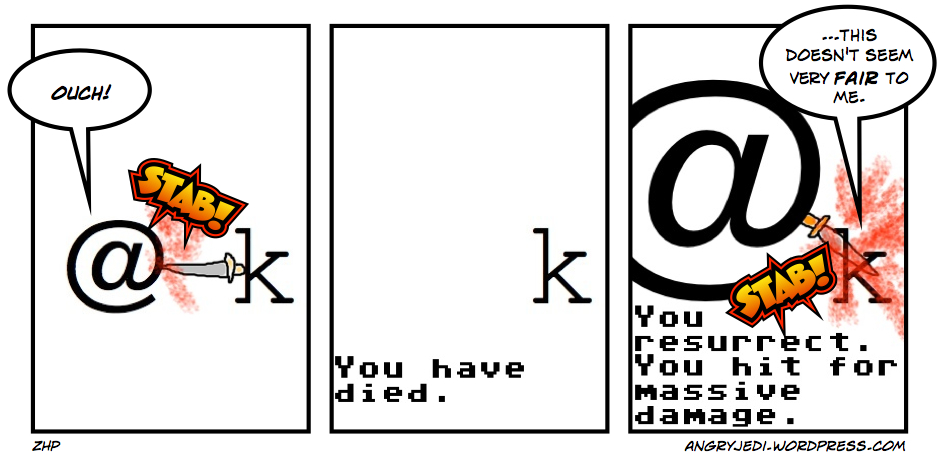
There's a bit of a twist on the usual formula, though. Rather than featuring a permadeath system that forces you to start over when you bite the big one in a dungeon, Z.H.P. instead features a rather odd levelling system whereby each time you enter a dungeon, you start at level 1, but your total levels gained over your lifetime playing the game determines your base statistics. If you die, you lose all the loot you acquired on that particular dungeon run, but any levels you gained are added on to your total level count, boosting your base statistics by a little and meaning that the next time you start a dungeon run, you'll be slightly stronger even though you're still technically level 1. If that makes your head hurt, don't worry — it starts to make sense after playing for only a short period.

The eventual aim of the game is to work your way through the story and make the nameless, voiceless protagonist (who, rather endearingly, is canonically named simply Main Character) into the hero he was supposed to replace — the Unlosing Ranger, the only one who can defeat Darkdeath Evilman. Every so often in the story, you'll find yourself returning to Earth from the Bizarro Earth in which you've been doing all your dungeon-crawling, and thrust into a traditional JRPG-style battle against Darkdeath Evilman, who is your stereotypical "final boss" sort of character. As the game progresses, these battle sequences become increasingly elaborate — they start with a first-person 8-bit sequence somewhat reminiscent of the end of the original Phantasy Star and gradually progress to… well, I'm not sure yet as I haven't got that far.

There are some fun additions to the basic roguelike formula, and it's here that the Disgaea influences are apparent. You can pick up enemies and fling them around, for example, though disappointingly you can't simply lob them off the edge of a precarious platform into the lava below. You can also throw items from your inventory, many of which have special effects. It also provides a use for items that have degraded to a durability level of 0%, meaning that the bonuses they normally provide are completely ineffective until repaired. If you don't want to spend your limited funds on repair bills, simply throw them at the enemies.

Then there's the guest appearances from the Prinnies, the weird explosive penguin-like things from Disgaea. Early in the game, you inexplicably find yourself married to one and gain the once-per-expedition special ability to summon your "wife" and have her bring you a lunchbox to restore your endurance points.

I could go on, but I would like to play the game a bit more before I talk about it too much. Early impressions are very positive, though, and if it's anything like Disgaea this will be a game designed to keep one occupied for a frighteningly long time. If you're looking for something endearingly bizarre but which backs up that bizarreness with solid gameplay and good presentation, you could do far worse than check out Z.H.P. — it works on Vita, too, so you can just download it from the PSN store rather than attempting to track down a physical copy.

See you in the dungeon, dood!