1167: How NimbleBit Finally Nailed It

mzl.dirqlssw.320x480-75If you own a modern mobile phone or tablet, chances are you've encountered NimbleBit's games at least once, most likely in the form of their runaway success Tiny Tower.

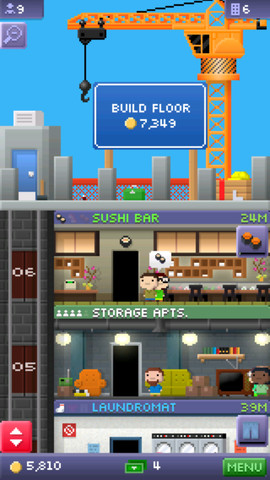
Lest you're one of the few people out there who never played Tiny Tower, let me explain: you run a tower block, presented in Commodore 64-style low-resolution pixel art. In order to progress in the game, you must continue to purchase and build new floors onto your tower, which can be assigned as residential or commercial properties. Residential properties hold, well, residents, while commercial properties must be staffed with residents and can then generate money for you even when you're not actively playing the game. However, there's a limit to how much money they can make, since each commercial establishment only has a limited amount of stock for each of the three items they sell, and when it runs out, you need to manually restock it by tapping on it.

Essentially, that was pretty much all there was to the gameplay. You booted it up, you tapped on a few things, you marvelled at how much money you'd "earned," you felt a bit depressed that the amount you'd earned was less than a tenth of what the next floor costs, you closed the app only to repeat the process a few hours later. In terms of complexity it was little more than FarmVille, and the early comparisons to SimTower it attracted were most certainly not justified in the slightest.

Tiny Tower was a free-to-play game. That means it was free to download but you could purchase things with real money. For the most part, this took the form of "Bux", a premium currency that allowed you to bypass anything in the game that would normally take a long period of non-interactive real time to complete, such as building a new floor. The game was fairly generous about giving out Bux for free, but it was still essentially a "pay to win" experience, whereby the more money you paid in, the faster progress you made. Exactly the same was true for Tiny Tower's follow-up Pocket Planes, which adopted the exact same faux-retro aesthetic and was just as devoid of meaningful decision-making as Tiny Tower was.
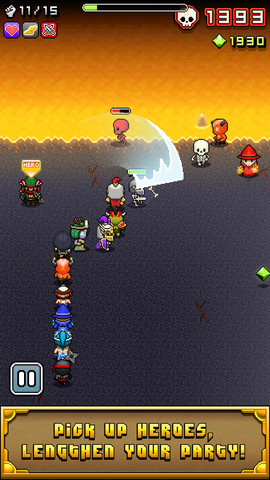
mzl.ugpnqerz.320x480-75NimbleBit are back with a new game. It's still self-consciously retro in terms of both gameplay and presentation, but in terms of being a quality experience it's a huge jump over the company's past work. Nimble Quest is a curious combination of Snake and Gauntlet, it's free-to-play, and it's fabulous.

In Nimble Quest, you select one of a number of unlockable heroes to start the game and then proceed to use that hero's style of attacking to defeat enemies. Different heroes have different styles of attacking — some are melee, some are ranged, and within those groupings there are variations, too: some ranged heroes fire fast-moving arrows straight forwards, others throw short-range bombs at anything nearby and deal splash damage, for example. As you progress through the game, certain enemies will release additional heroes whom you can "collect" — these are then added to your "snake", tagging along behind your lead hero and performing their own individual attacks when appropriate. Heroes other than the lead can be defeated without penalty (besides losing them, obviously) while if the lead hero either runs out of health or ploughs into a wall or enemy they die immediately and the game is over.

To progress through the game, you have to defeat a particular number of enemies on each level. This number increases with each subsequent level, but so too do the number of enemies on screen at once and the different types of assailant you'll have to deal with. The further you manage to get in one playthrough, the more types of hero you'll unlock and the longer your maximum "snake" length becomes in all subsequent games. Heroes also gain experience when they're used as the lead, and level up through three distinct levels. They can also be levelled up early by paying with the gems you find scattered around the levels.

The "free to play" bit primarily comes in the form of "Tokens", which are Nimble Quest's equivalent of "Bux" from Tiny Tower and Pocket Planes. Here, though, they're not used to bypass inconveniences; instead, they're used for actually useful things. They can be spent on buffs before each level starts. They can be spent on continuing after death — and pleasingly, this prevents itself from becoming a "pay to win" scenario by forcing you to restart the level you're on with your score and team as it was then rather than simply magically resurrecting without penalty — and they may also be spent on competing in the social "Arena" leaderboards in cooperation with friends. Like Bux, they're awarded at a healthy rate through normal play, so there's absolutely no obligation to pay for them unless you're a bit spend-happy with them. Crucially, though, the game never stops you from playing if you don't have any tokens — it never forces you to sit through long wait times or anything like that; it just means you need to earn some more before you can use what effectively amount to very slight "cheats".

It's this "monetising without inconveniencing the player" thing that makes me look very favourably upon Nimble Quest. At no point do I feel like I'm being punished for not purchasing currency — in fact, the game has more longevity if you don't pay, because it'll take you longer to level up all your heroes and get good enough at the game to survive the very challenging later levels. Nothing in the game feels like "pay to win" — even the continue feature is well-implemented so as to allow you the opportunity to correct a mistake while still running the risk of actually doing worse than you did on your previous attempt.

Most important, though, is the fact that Nimble Quest is actually a good game. No-one really wanted to admit that Tiny Tower and Pocket Planes just weren't very interesting or fun once you got over the aesthetic and humour in them, but Nimble Quest has been designed as a fun game first and foremost rather than a monetisation vehicle, and it really shows. It's a top-quality mobile game, and one which every iOS owner should have on their device. This is how you do free-to-play right… and this is how you do mobile gaming right, too. Please download and support it to send the right message to NimbleBit. More of this and less tap-tap-tap-snore nonsense, please.


#oneaday Day 879: Flying Away

20120616-014758.jpg

Having gone off on one somewhat about the fetid pile of toss that is Rage of Bahamut yesterday, it's only fair for balance's sake to talk about a free-to-play game that is well-designed, player-friendly and actually rather fun.

I am referring to Pocket Planes, the newest game from Nimblebit, developers of the astronomically popular Tiny Tower, a game which made "tap, tap, tap" gamers out of even the most jaded hardcore members of the games industry.

Tiny Tower, as most people realised after varying amounts of time, was little more than a mindless busywork generator, as RedSwirl over the on Squadron of Shame Squawkbox puts it. You built floors, you attracted people, you stocked up your floors with stuff that made money, you went away, you waited for your phone to shout at you that something needed restocking, you tapped on it to restock it and repeated the entire process for more hours than you really should until you either keeled over dead or got bored.

Tiny Tower, then, had very little in the way of strategy and certainly wasn't a modern-day SimTower, as some referred to it on its original launch. It was an interesting little timewaster with an adorable pixel-art aesthetic, however, and crucially, it allowed the player to make progress without battering them over the head to invite friends, share achievements or purchase things with real money every five minutes. The game featured a premium "hard currency" that allowed you to do things quicker or rapidly acquire more cash, but it was handed out fairly generously just through play, so those who wanted to play for free could.

Pocket Planes builds on this formula and puts a more complex game atop it. There's still not a huge amount of depth there, but it's definitely more than simple busywork now.

In Pocket Planes, you run an airline company, and your goal is to own all the airports in the world. (This alone distinguishes the game from Tiny Tower, which had no long-term goal besides "build a fucking huge tower") You begin the game in one of several regions around the globe with a small fleet of rather crap planes and a desire to make money. Fortunately, there are plenty of jobs waiting for you that want to give you money, so getting started is a simple matter of loading up your planes with passengers, cargo or both (depending on what type of plane it is) and setting them on their merry way.

It's here that an element of very light strategy comes into play. Sending your planes off costs money, and you don't receive payments for flights until they're completed. To be efficient, you might want to try and hit several stops in a single run, but when doing so you need to note whether there's a big enough profit margin to make it worthwhile. Sometimes leaving passengers behind rather than fully loading is more profitable, and scoring a jackpot of customers who are all going to the same place nets a 25% bonus on the income attained.

That's it for the basics of gameplay. Beyond that, once you've earned enough money you can purchase new airports, which allow your flights to go further afield and also provide you with plane parts which can be subsequently assembled into new members of your fleet, assuming you have space for them. Old, crap planes can be retired to make room if you don't have the capital to expand your fleet's maximum size, or you can simply try to get as many aircraft in the air as possible. Plane parts and complete planes can also be purchased through the Market page, which restocks with a random selection of items every few minutes, and parts can also be traded with friends for a small fee.

Like Tiny Tower, a lot of these actions use the game's "hard currency", or "Bux" as they are known, but again like its predecessor, Pocket Planes is generous about handing these valuable commodities out through play. If anything, Pocket Planes is more generous than Tiny Tower, rewarding the player with Bux simply for completing certain jobs, levelling up and various other actions. Sometimes they even just float past the planes in flight, to be collected with a simple tap.

Pocket Planes also includes an interesting social mechanic in the form of its "Flight Crew" system. By simply typing in the same crew tag as other airline tycoons, players can team up in an attempt to complete as many jobs in special global events as possible, with flight crews ranked on a worldwide leaderboard and prizes awarded when the time expires. You can also see how you stack up to the rest of your crew and figure out who needs to pull their weight more — though those players who join your crew but aren't on your Game Center friends list simply show up as anonymous benefactors, which is a shame.

The interesting thing with Pocket Planes' social mechanics is that it assumes the player already knows how to socialise. There are no screen-filling exhortations to share achievements with friends; no "friend gating", where progress becomes impossible unless you have a certain number of friends playing; no demands that you "visit" friends and "help" them. In fact, the game's social mechanics are kept pleasingly minimalist — most screens offer the facility to tweet a screenshot using iOS 5's built-in Twitter functionality, but in the case of Flight Crews and the like, it's up to the player to encourage their friends and acquaintances to join in the fun however they see fit rather than spamming them in-game. This is a Good Thing.

Pocket Planes is, at heart, a simplistic game with very little substance, but it offers the same sort of idle satisfaction that Tiny Tower did with a bit more sense of structure. It will undoubtedly be another big success for Nimblebit and fair play to them for that — their recent games are proof that you can adopt a free-to-play business model without being jerks about it. The goodwill that builds will likely encourage many more people who wouldn't think to purchase virtual goods otherwise to dip into their pockets purely to show the developer their support.

Pocket Planes is out now for iOS. An Android version is following in the near future, but a release date hasn't been announced yet.

#oneaday Day 737: Attack of the Clones

20120125-220706.jpg

So it seems that Zynga, lords of the social gaming space, are cloning Nimblebit's Tiny Tower. This isn't the first time Zynga has ripped off someone else's game and removed all trace of personality from its visuals, and it certainly won't be the last. The different this time is that people are actually taking notice, because Tiny Tower, for all its faults — and it has many, that not even its glorious retro pixel art aesthetic can counter — was extremely popular, made Nimblebit a fair amount of money and was even chosen by Apple as its iPhone game of the year.

Zynga's new game is called Dream Heights and one of the guys from Nimblebit conveniently compared it to his game here. As you can see, it has pretty much all the gameplay of Tiny Tower with none of the visual appeal.

Now, in the mainstream games market, this sort of thing is generally frowned upon quite a bit. For all of the complaining that the big shooter franchises all look very similar, they at least try to differentiate themselves with how they play, the modes they offer and the like. Battlefield 3 offers a very different experience to Call of Duty. I don't care for either of them, but I can appreciate that each appeals to a different subsection of the audience,

In mobile and social gaming, however, developers and publishers seem to have no such scruples. In my current position writing game reviews for Inside Social Games and Inside Mobile Apps, I regularly see games that are almost identical to each other. Most of them follow the FarmVille model to one degree or another — you click on things, there's a countdown timer before you can click on them again to get a reward, there's a list of insultingly simple "quests" on the left side of the screen, you get experience points every time you exhale and, generally speaking, the game is designed to be a series of not very well disguised Skinner boxes.

Other popular genres include the growing hidden object genre, where you're sent into a cluttered room/street/train carriage and tasked with locating lists of completely arbitrary items, with scenes tied together by an often flimsy excuse for a plot. Just in the last couple of weeks, Zynga released Hidden Chronicles on Facebook, only to be followed this week by the almost identical World Mysteries from Brazilian developer Vostu. See, it's not just Zynga doing it — it goes both ways, too.

Fans of Spry Fox's fun puzzle game Triple Town on Facebook and Google+ may also want to check out Yeti Town on iOS by the obnoxiously-named 6waves Lolapps. This game has drawn criticism for ripping off Triple Town completely and releasing on iOS before Spry Fox were ready to release their own iOS version of their game. You may argue that Spry Fox should have been quicker off the mark in getting their iOS version to market, but it's hard to believe that 6waves Lolapps came up with an identical concept (not almost-identical, identical) completely independently of Triple Town.

Independent developer Vlambeer ran into this issue last year when, like Spry Fox, they were beaten to the punch on an iOS game. Gamenauts' Ninja Fishing hit the App Store shortly before Vlambeer was ready to release its own title Ridiculous Fishing, itself a reimagining-cum-sequel of its earlier Web-based title Radical Fishing. I'm very pleased to see that Vlambeer will be speaking publicly about this debacle at GDC this year.

Where does it end, though? Games are a creative art form and for all these clones to hit the market is to do the medium a disservice. You don't get books hitting store shelves where an author has simply done a Find and Replace on all the characters' names from someone else's work, nor do you get movies which are simply shot-by-shot reconstructions of another movie. We get remakes, sure, but at least those are usually reimagined for a contemporary audience — and they're being honest about their source material rather than attempting to pass themselves off as a completely new product.

This practice needs to stop. Unfortunately, cloning, it seems, is already an established part of mobile and social game development. In the long term it will only hurt everyone's business.

So devs? Be bold. Come up with an original idea. Don't call your game "innovative" if it's the same as something someone released last week, and the week before, and the week before. Try something new. Break out of established conventions. The most memorable games in the mainstream are the ones which tried something new. The moment we see a successful social game break out of the market's conventions is the same moment we'll see people willing to be a bit less cynical and a bit more enthusiastic to see what this burgeoning industry has to offer.