#oneaday, Day 344: Bullshit Filters

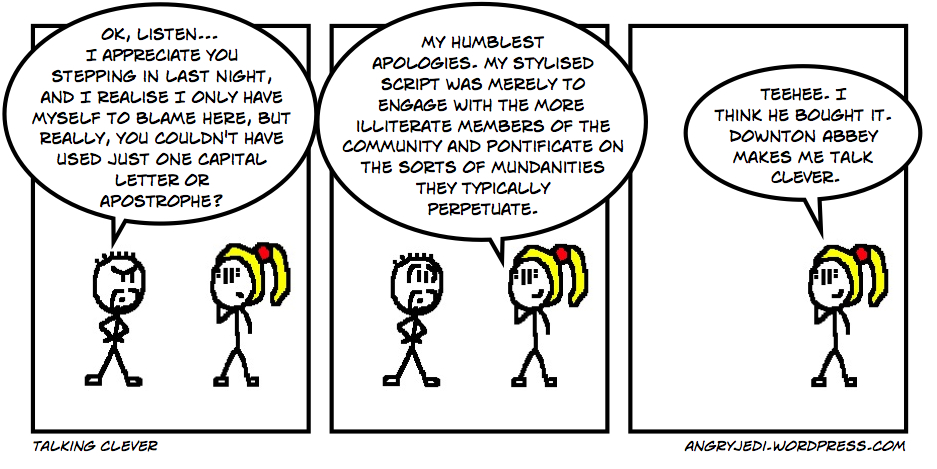
One of the biggest challenges in creative writing is overcoming your own personal bullshit filters—those parts of your brain that point out what you're writing is complete worthless nonsense and garbage that no-one in their right mind would ever want to read.
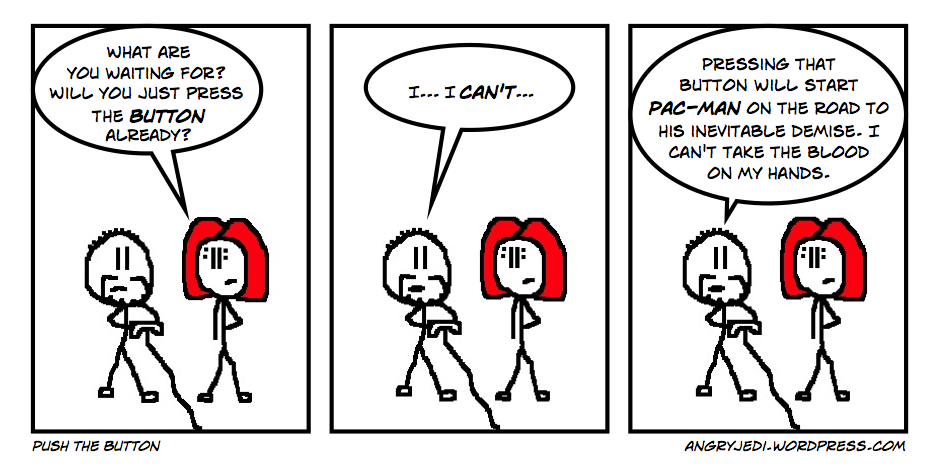
My own tolerance for nonsense is pretty high, as my enjoyment of JRPGs and love of Bayonetta will attest. But even when I'm writing creative stuff myself, I end up picturing some variant on Comic Book Guy reading what I've written and saying "BUT THAT WOULD NEVER HAPPEN!" I guess I have bullshit filters by proxy, as if I were writing stuff purely for myself, it could make as little sense as I please.

One simple way to overcome your own bullshit filters (whether or not they're proxies like mine), though, is to watch some movies or read some books. When you see how much nonsense other people—published people who actually get paid for their bullshit—put out, you'll feel a lot better.

Let's take Tron: Legacy for a moment, which I went to see the other night. This is a movie built almost entirely on nonsensical premises. Why are the programs in the computer personified as humans? Why do they behave in a human way? Why do they need vehicles? And given that the main distinguishing feature of one group in the movie is that they act "more human", what, in fact, is the difference between them and those who are already acting pretty human? How does a virtual projection of an aircraft stall at altitude in a virtual environment which presumably has no air? THAT WOULD NEVER HA—

Stop. Tron: Legacy isn't a bad movie despite the fact that all of the above issues are clearly nonsensical plot holes which spectacularly fail to be resolved by the end of the movie. I enjoyed it very much and intend going to see it again. In fact, Tron: Legacy is a movie which actually benefits from you specifically not trying to read too much into it. The reason the programs act human? Because it's relatable. The reason they drive vehicles? So there can be awesome action sequences. The reason a virtual aircraft stalls at altitude? Because it's exciting. Nothing more than that.

So it is when you're writing. Not everything has to be laced with hidden meanings, metaphors and commentary on the human condition. In fact, some of the best "hidden meanings" come about completely unintentionally, as an unconscious communication on the part of the author, an unconscious expression of something deep-seated in their mind that comes out in the things that they are writing. A window onto their soul, if you will.

Of course, some people can transcend that kind of writing and deliberately do clever things. But then they probably get labelled as "pretentious" and don't get appreciated in their own lifetime. And everyone wants to be appreciated in their own lifetime, right?

So, the next time you're writing something, take care that it makes sense, sure. But if you want to write something which initially appears to be "stupid", think about the rest of what you're writing too. Does it make sense in context, however "unrealistic" it might be when compared to reality? If so, then there absolutely is no reason that the Blood Sausage of Agamemnon can't turn into a semi truck at the push of a button when combined with the Amulet of Lindor under a full moon.

And if you still feel what you're writing is ridiculous, go watch Tron: Legacy.

#oneaday, Day 325: Interactive Fiction

There's a lot to be said for interactivity (or at least the illusion of interactivity) in storytelling. It allows things to be done that are simply impossible with non-interactive media such as books, TV and film.

I spent a couple of hours this afternoon playing Digital: A Love Story, a wonderful game set on the desktop of an Amiga "five minutes into the future of 1988". If you haven't played it yet and are intrigued by the premise, I suggest you play it before reading on, because I'm probably going to spoil some things about it. I'll try not to be too explicit.

At the outset of the game, the player is the proud recipient of a brand-new "Amie" computer with a built-in modem. Your benefactor also provides you with a phone number of a BBS that you might want to check out. And so the story begins with the player dialing into the BBS, complete with terrifyingly authentic-sounding dial and modem tones screeching from your computer's speakers. The player quickly gets friendly with a person named Emilia and things develop quickly in a manner that will be immediately familiar to anyone who has ever had an online relationship.

All is not as it seems, however, and the player, through a bit of investigation, discovers that there are strange things at work. The BBS crashes, and there is no way of getting in contact with Emilia. Just prior to the crash, she said she was "leaving home" and "getting out". Thus begins a quest across several BBSes, ARPANet and Sprint's long-distance calling-card system to track down Emilia and discover what happened.

The game is completely linear. Things happen in a set order, right up to the ending, when the player is faced with an inevitable conclusion that there really is no way around. At this point, we reach one of the most powerful things that gaming can do, and ironically one of the least interactive things about narrative games.

Offer the player the opportunity to do two things: do something, or walk away. Walking away is usually not an option, though Heavy Rain managed to convincingly offer this as an alternative at several points throughout its narrative. Digital: A Love Story, however, makes it abundantly clear that there is only one course of action open to you, and it's an unpleasant one. Given the great pains that the game has taken up until this point to make you "feel" for the characters involved, despite being based around screens of text, it is difficult to make that final mouse click.

This is something you just can't do with a book. Stopping halfway down the page and printing "Turn the page to see what happens next" is not an established literary convention, nor should it be. Same with TV and film; with those media, we're just along for the ride. It's the reason very few books save the Fighting Fantasy and Choose Your Own Adventure series are written in second-person perspective.

But with a game, the player has been driving the story all along, even if there is only really ever one thing they can do at a time to advance the plot to the next "event". That illusion of interactivity allows the player to be all the more invested in the story, as if they're part of the game world. This is further aided in titles such as Digital: A Love Story, which don't break "character" for a moment. As far as the player is concerned, they're using an Amiga… sorry, "Amie". They're not playing a game, they've been transported back in time to 1988, a land of 320×200 graphics, questionable multitasking capabilities and scanlines.

The ending of Digital: A Love Story is bittersweet and if you've engaged with the game up until that point in the way it is intended to be engaged with, you'll find it genuinely emotionally affecting. It's always interesting when a title which looks so unassuming can actually end up being more powerful than self-consciously "epic" CG cutscenes and over-the-top orchestral music with people singing in Latin.

So, if you remember 1988, if you ever had an Amiga or you remember the golden age of the BBS, check out Digital: A Love Story. It's free, and well worth your time.

Meet Dan and Charlotte

So I've been a bit lax on the creative writing front for a while. I thought I'd rectify that with an experimental fiction project I've had in mind for some time.

I present to you Daniel Harris and Charlotte Bristow, two twentysomethings who live in the glamorous city of Southampton. Daniel and Charlotte have the same birthday (29th August) and both studied English at the University of Southampton. In fact, they sat next to each other on a number of occasions. But they don't know each other. They don't even know the other one exists. Not yet, anyway.

They don't have a lot in common. Dan is depressed, lonely and increasingly turning to drink. Charlotte is happy, hopeful and uses the word "party" as a verb. However, both of them enjoyed their study of English and are pedantic to a fault, and they do have a few interests in common. Both of them are struggling to work out what to do with their lives now university is over, and are temping to pay the rent.

This project, which I haven't given a name to yet (working title "Dan and Charlie") is an exercise in improvisatory blogging. I will be playing the role of both Dan and Charlie and improvising their fictional lives, perhaps with a little fact interspersed here and there for local colour. After all, I too live in Southampton and studied English (along with Music) at the University of Southampton, so after all we have a bit in common… conveniently. It will be an interesting exercise in "method acting" (for want of a better description) for me, and an exercise in self-discovery for Dan and Charlie, who are both new to blogging.

If anyone actually reads the blogs, thinks they're real people (so no-one who knows me directly, then) and feels the need to comment or interact with Dan and Charlie (who have their own email addresses and eventually will find their way to at least Twitter and possibly other social networking sites if I can be bothered to "network" that much on behalf of both of them), that may well inspire their independent storylines to develop in particular directions. I have a few "events" in mind for the pair of them and, of course, they will come across each other at some point. What happens from there remains to be seen.

I intend to blog on behalf of the pair of them fairly often. It'll be an interesting exercise in creative characterisation and allow me to keep myself in practice of writing stream-of-consciousness first-person narrative if nothing else – maybe it won't go anywhere, maybe it'll develop in interesting and unexpected directions. Who knows? We shall see.

One rule for those of you reading this: don't let on, at least not on their sites. As far as readers of their sites are concerned, Dan and Charlie are real people, and it'd be cool to have them interacting with strangers and see how that develops their own personal stories. Comments will be moderated and anything "out of character" won't be approved by either Dan or Charlie.

Well, this will either be an interesting exercise or I'll end up with Multiple Personality Disorder. We'll see. I hope you enjoy the mundanity of their everyday lives.

Dear Esther

I remember first hearing about Dear Esther a while back, during one of those interminable "games as art" discussions. It was held up as an example of using one particular genre of gaming (the first-person shooter, in this case Half-Life 2) as an interesting means of storytelling. Half-Life 2 itself is, of course, well-known for integrating storytelling and gameplay together, but Dear Esther set out to be something altogether different. Designer Dan Pinchbeck describes it as a "multimodal, environmental storytelling experiment" which "presents a sparse environment with no embedded agents, relying purely on the player's engagement with and interpretation of a narrative delivered through semi-randomised audio fragments". (source)

That's a very dry description of what this mod is doing, but it's an accurate one.

Dear Esther places the unnamed player on a seemingly-deserted island, starting on a jetty facing an abandoned house. The beautifully-delivered narration begins immediately, reading from a letter to the titular Esther and gradually developing as the player passes around the island.

The interesting thing about the story is that there are several threads running at once, and the randomised delivery of the audio cues throughout means that after a while, they all begin to blur together until it's not clear where one story ends and the other begins. Pinchbeck notes that "two plots develop simultaneously: the avatar's visit to the island following the historical record of a 17th century cartographer, and repressed memories of a car accident". The way these plots intertwine and seem to share themes and ideas in common, as well as wildly disparate elements too, mean that, in Pinchbeck's words, "a closed reading, or understanding, of the events is impossible to ever reach."

In this sense, Dear Esther is a dream come true for people who enjoy finding their own interpretations of games. The mod reminded me a lot of Flower, if not in execution then certainly in atmosphere. Flower makes very little of its story (if indeed there is one) explicit and is very open to wildly different interpretations. One could take it literally or metaphorically – and it is the same with Dear Esther. The game raises unspoken questions about whether or not the island you are walking around is actually real, who the mysterious characters the narrator refers to really are and, of course, who Esther actually is.

Pinchbeck himself was surprised at the positive response to his deliberately open narrative, noting that "the notion of an unfolding mystery that is never solved actually appeals to [players]" and that "the atmosphere and drive to find out more about the story is enough of a pull to get them all the way through the experience".

It's true. Dear Esther presents an intriguing mystery that makes it clear from the outset that there are no specific answers, yet there is a clear "goal" for the player to attain. This was achieved through use of the environment combined with the spoken narrative. Although the environment of the game is very "open-plan", being based on an island, at no point did it become difficult to determine where to go next, as there was always something that "looked interesting" over the next ridge. As the narrative progresses, a huge aerial in the middle of the island becomes visible with a large flashing red light, and the fact that this is almost constantly visible gives the player some indication of 1) where they are going and 2) how much longer they have to go.

Music is also used very effectively throughout. Haunting piano and string themes drift eerily over the speakers as the narrator slowly speaks his lines. As the story builds to something of a climax towards its "conclusion" (for want of a better word) the music becomes thicker, more intense, and with more mysterious, unidentifiable noises creeping into it. It gives a sense of progression in a game which leaves more questions unanswered than answered at the end.

There's certainly no denying that Dear Esther, like Flower, is an experience that will make you feel something. That "something" will be different to different people, as Pinchbeck notes that:

"…we have been surprised how many players report being scared. Several others describe the experience as eerie, moving and very sad. These last two are emotions that normally fall beyond the affective range of games, especially first-person games."

Lewis Denby, writing on Rock, Paper, Shotgun, had plenty to say on this subject, and it's well worth reading his excellent article. One particularly interesting point he had to mention was:

"I love my Marios and what-have-you as much as the next person, but I still feel games have an incredible untapped potential for negative emotions. Some have tried – Braid stands out for having a bloody good go – but we’re still a little too comfortable with enjoying everything we play. Any stretches of sadness in this medium tend to be restricted to self-indulgence or vapid tearjerker fare, and even they invariably make way for happy endings and bunny fluff."

Dear Esther, he says, is noteworthy for taking players into uncomfortable emotional territory and refusing to give in throughout. The whole experience is infused with a kind of melancholy throughout, and the final moments of the story as it comes to a close without any real "resolution" are heartbreaking.

All this in a barren, empty landscape with no human interaction, no speech besides that of the anonymous narrator, no guns, no white-haired pretty boys, no anime cutscenes – and yet somehow, deprived of all that exterior fluff, Dear Esther manages to present an intriguing story which has compelled more than a few people to play it through several times and develop their own interpretations further – and all this using an engine which is renowned for its fast-action run-and-gun FPS gameplay. It just goes to show what a little bit of creativity can achieve.

Dear Esther can be downloaded here.

Pinchbeck's notes on the mod can be read here.