The latest casualty in the ongoing wave of New Puritanism which appears to be spearheaded by Visa and Mastercard is a short, arty game known as HORSES. Thus far, it has been banned from release on Steam and withdrawn from sale on the Epic Games Store and Humble's store. (Edit: apparently Humble have put it back now.) At the time of writing, you can buy it from GOG.com. It's £3.99 and is apparently 2-3 hours long. If you're in the mood for something arty, unsettling and apparently the worst thing that has ever happened to society so far as payment processors are concerned, go grab it while you still can. I'm certainly intending to after this.
This whole ongoing situation has been really disappointing to see, because, as I say, it's a real wave of Neo-Puritanism that has been affecting all sorts of different online storefronts, types of media and subject matter. And, as people working in the more "adult" end of things have been yelling for a long time at this point, once these things start happening to material that you, personally, might find distasteful, it's not long before things that you, personally, are completely okay with start getting affected. Which is what has happened here.
The frustrating thing about this is that no-one wielding any of the power in this is ever honest about things. Visa and Mastercard won't say "no, we're not letting people buy porn". Valve won't say "this specific scene is why you can't put your game on Steam". Epic seemingly even went so far as to overrule the developer's content rating submission to ensure that it couldn't be sold on their storefront. And let's not even get into why it's ridiculous that the ESRB (or equivalent) "Adults Only" rating should preclude adults from being able to purchase material on an online storefront.
For quite some time, it looked like we were making some real progress in that area. The European games rating board, PEGI, allows explicit sexual content under its 18 rating now — there are even Nintendo Switch games that have explicit nudity and sexual content, though the fully "uncensored" versions tend to be physical exclusives. And yet, probably not coincidentally alongside the worst United States politics have been for many, many years, we are seeing legitimate businesses being forced to sit around twiddling their thumbs, potentially not being able to pay the bills, because someone, somewhere got a stiffy and got scared because it had never happened before.
It's ridiculous to see the amount of misinformation flying around, too. In the case of HORSES, the developer admitted that there was, at one point, a scene in the game that featured a 14 year old girl riding on the shoulders of a naked woman clad in a horse mask — and to those inexplicably defending the decisions of Valve, Epic and Humble, this is the same as illegal child sexual abuse material. Never mind the fact that the scene involved nudity but was not sexual — the two things are different! — or that the scene ended up being changed to involve a young woman in her twenties because the developers thought that fitted the tone of the scene better. No! To these people, HORSES is, was and always will be kiddie porn and thus the big, powerful corporations — step on me, Daddy, and I will lick your boots — are absolutely right to banhammer it so hard it leaves a crater right down to the Earth's core.
It's really discouraging to see the world continuing to find new and exciting ways to suck more. But I am glad that people — press and public alike — appear to be rallying behind the HORSES developers, and that people who might have previously gone "ew, porn is icky" are starting to see why sex workers and those who work in various forms of adult media are often considered to be the proverbial canary in the coal mine when it comes to matters of censorship.
I'm off to buy a copy of HORSES now. If this is the world's cleverest marketing campaign, I salute the people responsible. But somehow I think it's just the world reminding us that we're living through a really shitty age right now.
Want to read my thoughts on various video games, visual novels and other popular culture things? Stop by MoeGamer.net, my site for all things fun where I am generally a lot more cheerful. And if you fancy watching some vids on classic games, drop by my YouTube channel.
If you want this nonsense in your inbox every day, please feel free to subscribe via email. Your email address won't be used for anything else.
Finishing up Old Skies today (read my article on it over on MoeGamer!) and then jumping right back into Donkey Kong Bananza, I was suddenly struck with the clearest way yet to express something I've been pondering for quite some time. And it stems from the core differences between those two games.
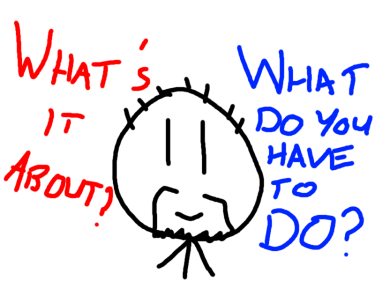
I put it to you, dear reader, that there are just two types of video games: ones where someone watching asks "what's it about?", and ones where someone asks "what do you have to do?"
Old Skies? "What's it about?" (Time travel, regrets, grief, making your mark on the world.) Donkey Kong Bananza? "What do you have to do?" (Find all the bananas.)
Essentially what this boils down to is the game's main priority: does the game primarily exist to tell a story, or does it exist as a form of "play"? To put it even more simply, is it a "narrative" game, or a "mechanics" game?
There's crossover, of course — narrative games can have strong mechanics, and mechanics games can have strong narratives. But pretty much every game you'll ever play will strongly skew one way or the other, to such a degree that in some cases, fans of one won't enjoy something from the other category.
Donkey Kong Bananza is a good example of this. It's a mechanics game; the narrative setup is flimsy at best, and there's not really a "story" to follow as you go through. Instead, you visit a bunch of places, meet some characters, unlock new abilities, then use all of those abilities to explore the broader world and, as noted above, find all of the bananas.
The fact that Donkey Kong Bananza doesn't really have an unfolding story is enough to put some people I know off from playing it completely. And while I maintain that those people are missing out on one of Nintendo's finest games to date, I completely understand. For the longest time, I felt like I favoured narrative games to the exclusion of all else, but as I've grown older — and, perhaps more crucially, I've developed my knowledge of how games are designed, how they work and the many different approaches developers can take when constructing an interactive experience — I have a much more balanced approach: I can (and do) enjoy both. This, of course, stands me in good stead for my day job, which involves enthusing about everything from Atari 2600 and Intellivision games up to PlayStation and NEOGEO titles.
I suspect at least part of this also stems from the fact that I grew up playing exclusively mechanics games, because the technology didn't really exist to deliver narrative games effectively. Except that's not quite true; text adventures and early graphic adventures existed pretty much from when I was old enough to use the computer, but as a child, they often felt a bit too complicated for me, even as an avid reader. So the vast majority of games I played on my first gaming systems — Atari 8-bit, Atari ST, Super NES — were "what do you have to do?" games, where narrative was typically reserved for introduction and/or ending sequences, if indeed the game had any in-game storytelling at all.
Things started to change when we switched over to MS-DOS and Windows 3.1 for our daily driver computer. Point-and-click adventures really came to the forefront, with titles like Indiana Jones and the Fate of Atlantis and The Secret of Monkey Island proving that story-centric games could absolutely be a thing. And by the time I played Final Fantasy VII for the first time, I was absolutely all-in on video games as a storytelling medium, leading me to primarily focus on "what's it about?" games for the longest time.
In fact, you can see the evidence here on this blog how long this attitude lasted: a post which actually got showcased by WordPress.com, back when they actually cared about the community rather than garbage AI, highlighted my desire to play a racing game with a story. I felt that the racing game genre had been done something of a disservice by never having a game that took the Wing Commander approach of alternating narrative scenes with mechanics scenes, and on some level I think this might actually still be a fun idea… except I've played a few games where they've tried that, and the story scenes are just… not very good.
I'm not sure if it's just that the scenes weren't particularly interesting, inspiring or well-written, or if racing games really don't actually need a story to be fun — I suspect a little of both — but these days, I'm much more happy to let the racing game genre, a type of game in which "what do you have to do?" is so obvious that most people don't need to bother to ask, pootle along in the way it always has done. In fact, I've often found it quite refreshing to go back to games like the Project Gotham Racing series, where there's no open world or overcomplicated metagame to engage with, just a series of "levels" that you complete, one at a time, and gradually unlock harder challenges.
I suspect some games may even be different things to different people. Ultima IV: Quest of the Avatar is a good example; to one person, it's a "what do you have to do?" game, where the answer is "wander around, explore, beat up monsters, find treasure", while to another, it's a "what's it about?" game, where the answer is "proving your worth in the Eight Virtues and becoming the Avatar". In other cases — The Last of Us, say — the distinction is probably pretty clear-cut.
Anyway, that was my meandering thought for the day. You're welcome to borrow my theory for your own pointless discussions with your friends if you want to. I'll let you. Or you can just leave it to rot here on this forgotten corner of the Internet as we all, gradually, bit by bit, turn to dust. Your call, really.
Want to read my thoughts on various video games, visual novels and other popular culture things? Stop by MoeGamer.net, my site for all things fun where I am generally a lot more cheerful. And if you fancy watching some vids on classic games, drop by my YouTube channel.
If you want this nonsense in your inbox every day, please feel free to subscribe via email. Your email address won't be used for anything else.
This is a cross-post from my gaming site MoeGamer. I figured if I spent several hours writing this, that absolutely counts as Me Having Written Something for today. So please enjoy, even if you don't normally frequent MoeGamer. I will likely be doing this more going forward.
Last week, I got around to something I've been meaning to do for ages: play through Toby Fox's modern classic Undertale, and attempt to understand why it is so well-regarded and popular.
I'd held off for quite some time for a few reasons: first and foremost was simply a matter of making time for it, since as anyone who knows me will be well aware, I have a lot of video games on my shelves. But I was also quite keen to play the game divorced from the context of its somewhat… passionate fanbase.
I have nothing against the Undertale fanbase, I hasten to add — I've never really come into contact with it directly — but for a game like this, I was keen to approach it with as much of a beginner's mind as possible. I wanted to try and understand what, exactly, it was about Undertale that resonated with people so much when it first released. And I think I got there in the end.
Spoilers follow.
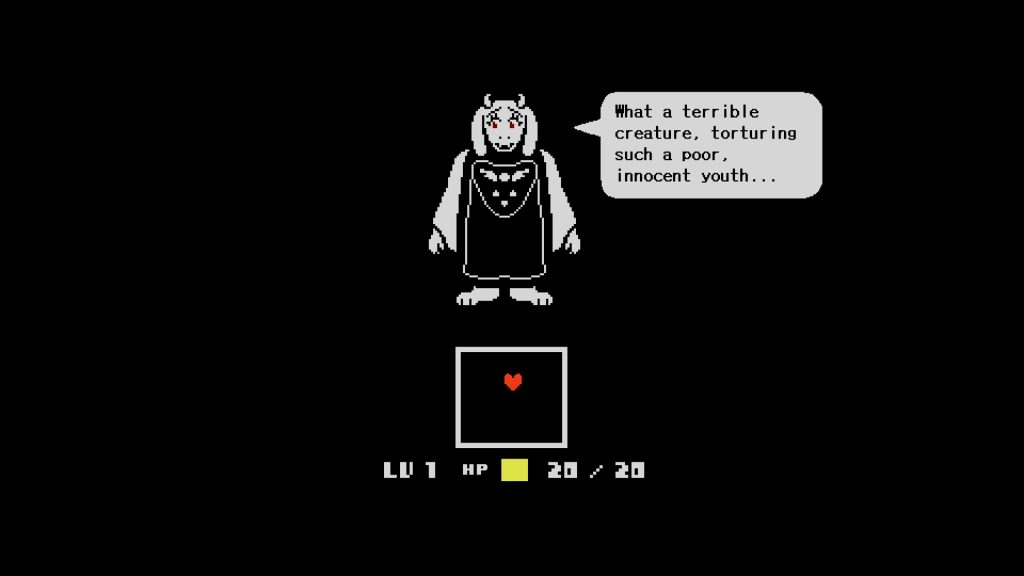
Undertale, for the unfamiliar, casts you in the role of a kind-of-sort-of self-insert character. I say kind-of-sort-of because the protagonist is deliberately gender-ambiguous and you can't customise their appearance. You can customise the way they behave, though, and that's something we'll come back to in a moment.
As Undertale begins, you have fallen down a big hole into the land of monsters. Supposedly, many years ago, humankind and monsters lived together on the surface of the world, but a great war eventually led monsters to becoming trapped underground while humans dominated the surface. This is all the context you're really given at the start of the game; in short order, you meet up with a kind-but-a-bit-too-much monster named Toriel, who wants to take you in and look after you.
Toriel is a rather overbearing, motherly type to a borderline sinister degree, and thus it is natural to want to break free of her clutches and explore the greater world in which you find yourself. You can achieve this in a couple of ways, and herein you get to know probably the most important thing about Undertale, and the tagline it's used in various places in more recent years: this is an RPG where no-one has to die.
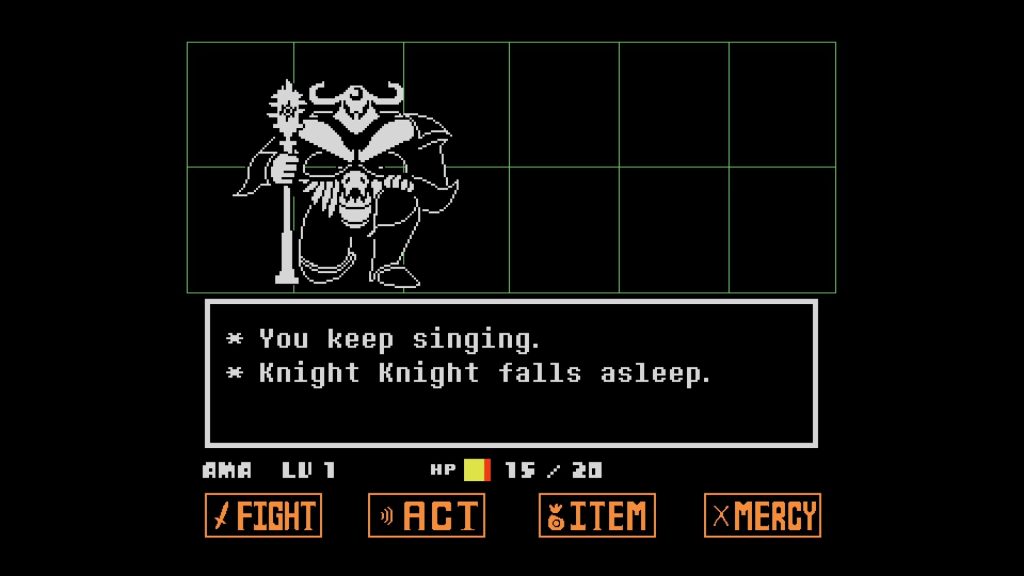
It's true! In every combat encounter you run into throughout Undertale, you have the option of fighting the monsters you come face to face with, or attempting to placate or otherwise peacefully resolve the conflict somehow. The exact way you go about this varies from monster to monster, but it is indeed possible to pass through the entire game without anyone dying by your hand.
Interestingly, resolving conflicts peacefully does not reward you with "EXP" that allows you to increase your "LV", meaning that if you choose to do a peaceful playthrough, your character will never get any "stronger". Undertale takes great pains to never actually use the full terms "experience points" and "level" for very good reason: in its world, that is not what "EXP" and "LV" mean. Instead, "EXP" stands for "Execution Points", hence you only acquiring them when you kill someone, and "LV" is short for "LOVE", which in turn is short for Level Of ViolencE.
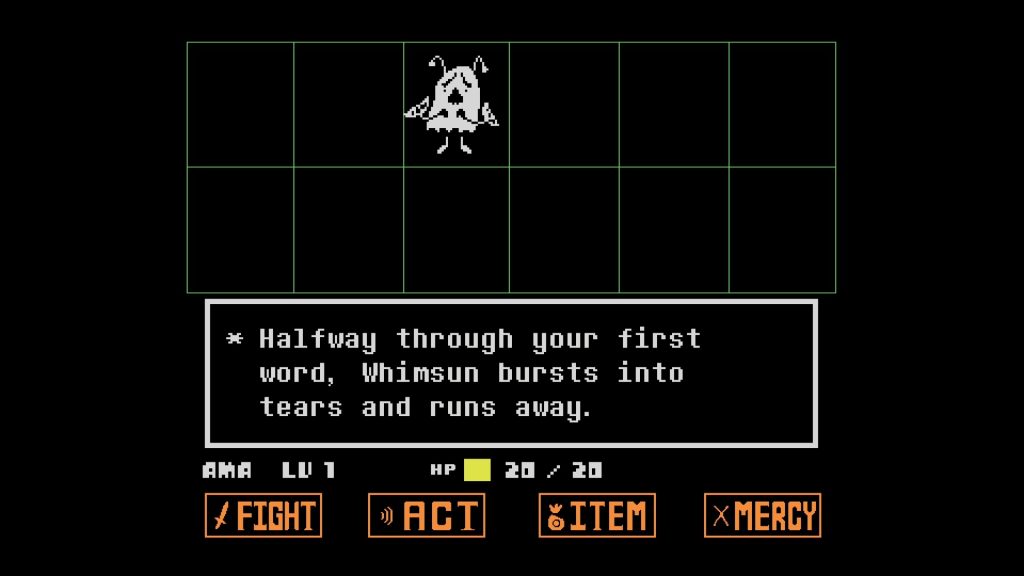
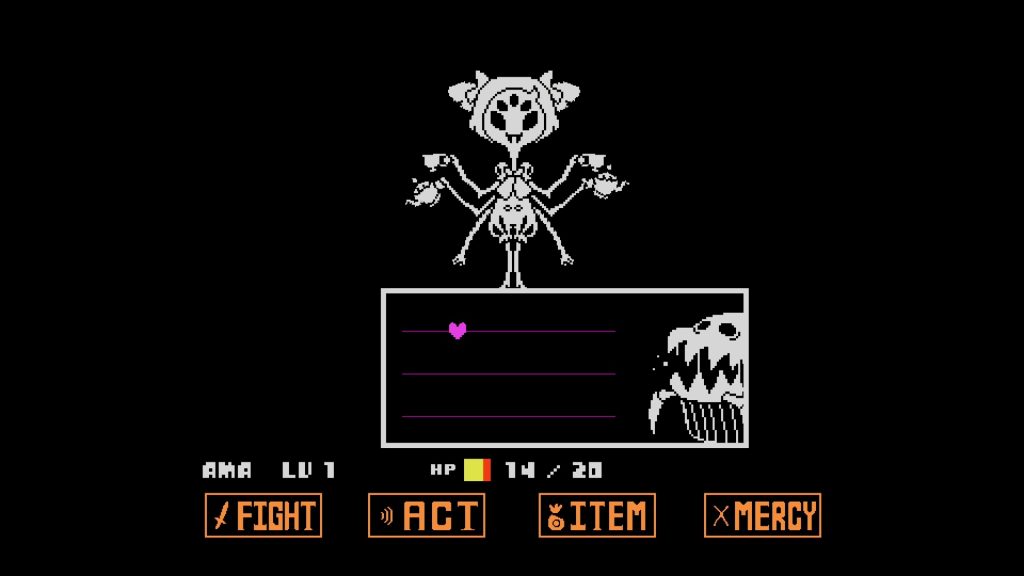
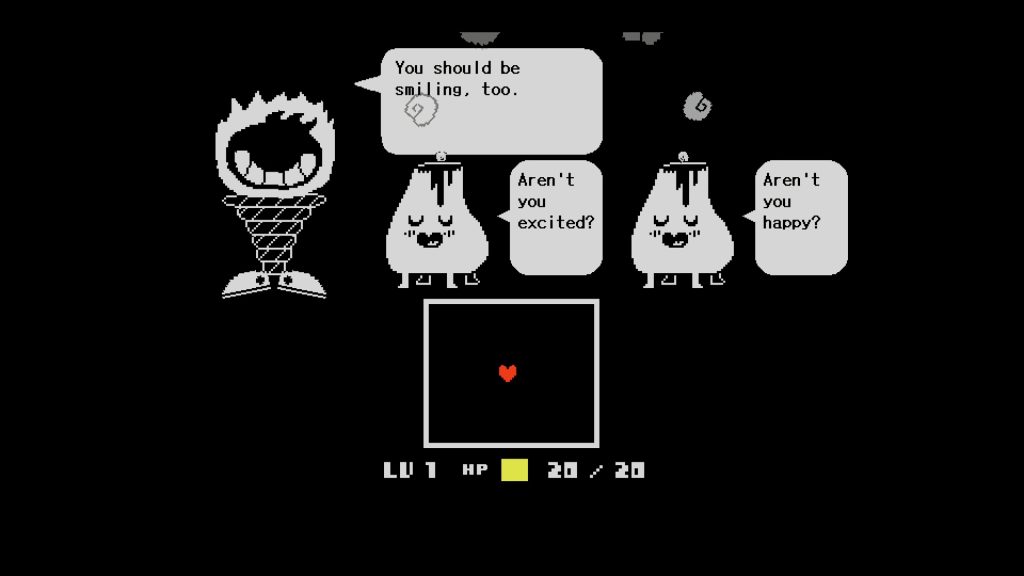
In combat, regardless of whether or not you choose violence, you will have to fend off enemy attacks in short action sequences loosely inspired by shoot 'em up bullet patterns. By controlling the protagonist's SOUL (all caps, but not an abbreviation or acronym to my knowledge), represented as a heart, you can avoid taking damage from enemy attacks. Each enemy type has its own unique attacks, and the further into the game you go, the more varied these become.
One key variation comes with some enemies' ability to change the colour of the protagonist's SOUL. This causes it to behave in various different ways; for example, when it's blue, it's affected by gravity, meaning it has to "jump" over incoming attacks; when it's purple, it can only move between and across set "wires" on the screen. Enemy attacks also have colours, too; blue attacks are harmless if you stay still, orange attacks are harmless if you're moving when they pass through you, and green "attacks" are actually beneficial, providing a small amount of healing and also often triggering special effects. The green attacks most frequently come up when attempting to peacefully resolve conflicts.
But why might you want to spare the monsters of Undertale, when RPG convention has it that you are "supposed" to kill everything in your path? Well, that's because Undertale makes a specific effort to, for want of a better word considering we're talking about "monsters", humanise everyone and everything you come into contact with. Even fodder enemies have personalities and quirks, and it takes the most steely of resolves to look past all that and murder them. But, crucially, the option is there.
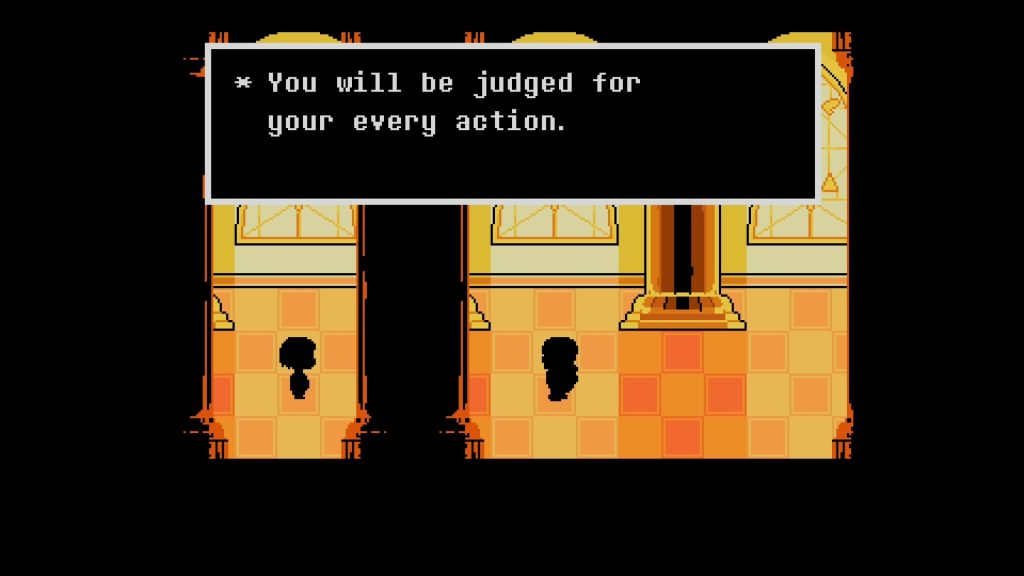
Not only that, but Undertale also keeps track of all manner of other things in the background. If you inadvertently killed someone in a first playthrough and then reset the game without having saved, it will know. On subsequent playthroughs, characters you "haven't met yet" will have recollections of you. And if you went all-out and did a "Genocide" run as your first playthrough, there are some fairly significant differences to how everything concludes.
Undertale is a game that is designed to make you think. Not in the sense that it's especially complicated or difficult to understand, but it really does make you think about the consequences of your actions — and how "game logic" might work were it applied to a "real" situation.
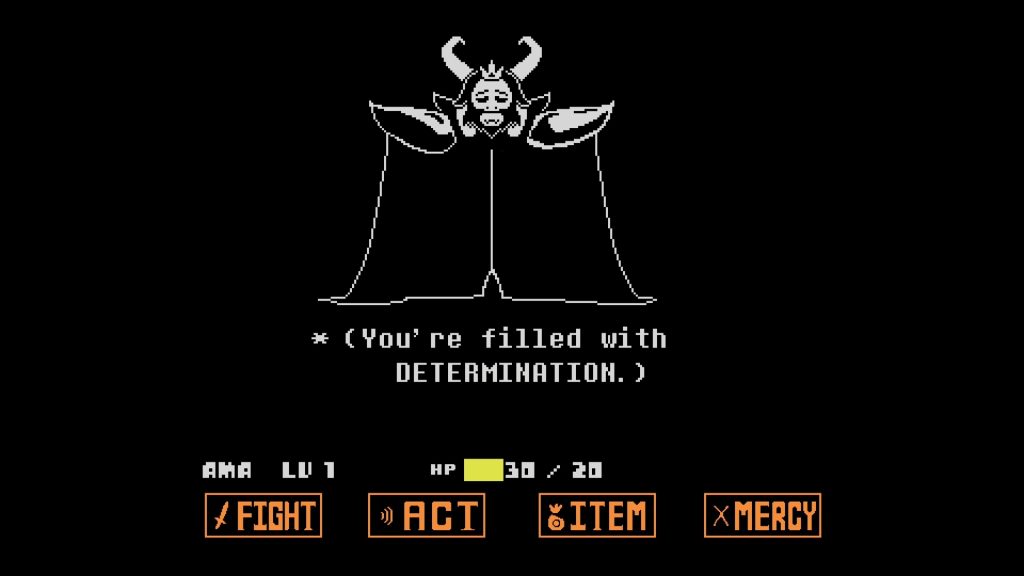
A good example comes if you complete what is known as a "True Pacifist" route. This is only possible after "beating" the game once, and fleshes out the story, resolving in an eventual "true ending" where the monsters finally escape the underground and are able to once again live free on the surface. If you open the game up again after you've reached this ending, the game tells you in no uncertain terms that yes, you absolutely can play again by making use of what it calls a "True Reset", but in doing so you are depriving an entire society — and yourself — of a happy ending. And why are you doing that? Just to see what happens? Is that something you can really justify doing?
A valid response to this is, of course, to say "no, I can't", and to close the game down, never to open it again. You got your happy ending. No need for any "what ifs". No need to satisfy your curiosity as to what might happen if you did the most morally reprehensible thing possible at every opportunity. No need to ruin the lives of a significant number of people.
At the same time, the game absolutely does provide plenty of meaningful changes if you do decide you want to see what might happen if you kill everyone. And then, if you decide to do that "True Pacifist" ending again just to "set everything right", there will be consequences to that, too.
This is the stuff that makes Undertale so clever and noteworthy. The moment-to-moment storytelling and dialogue is charming and memorable — I'd go so far as to say that this is a game with one of the clearest senses of authorial voice I've ever played — but the really interesting stuff comes about once you've been through the whole thing once and you start to contemplate and understand how differently some scenes can unfold depending on your previous actions. Various characters can be seen in rather different lights, and encounters can be resolved in other ways depending on everything from the things you've said to other characters to the objects in your inventory.
Of course, under the hood it's all an illusion based on hidden flags and counters, but in the moment, it absolutely works. Undertale is enormously emotionally engaging from start to finish, and I defy anyone to play through to the conclusion of the True Pacifist route and not at least hesitate before contemplating doing a Genocide run.
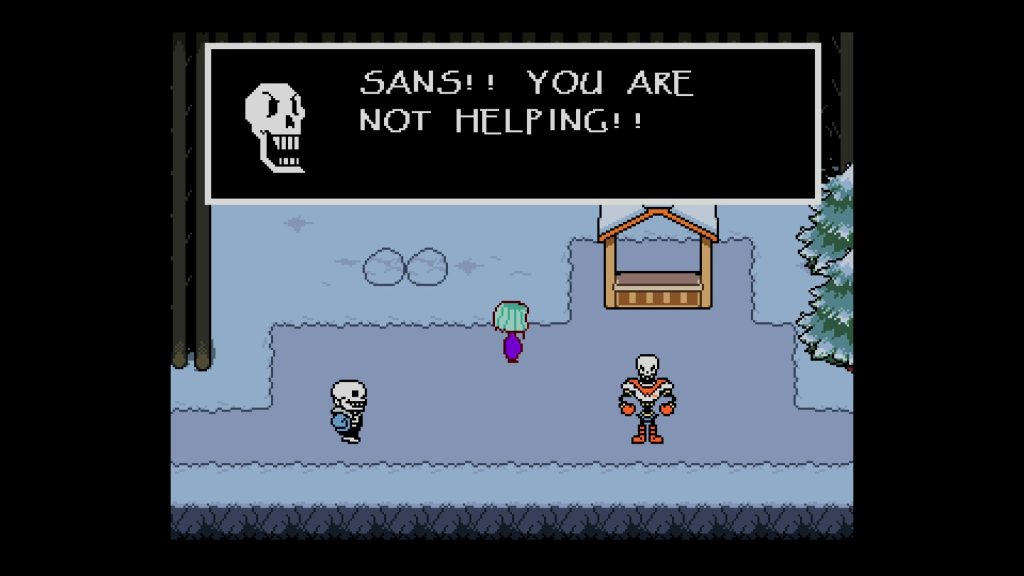
As previously noted, a lot of this is down to author Toby Fox's excellent writing, but Fox doesn't just use well-crafted dialogue to infuse his characters with personality; he uses visual elements such as fonts and the case in which characters' text-only dialogue is presented to help you build up a mental picture of each character. Probably the best example of both of these comes in the case of Papyrus and Sans, two skeletal characters you encounter early in the game after freeing yourself from Toriel's oppressive motherliness.
Papyrus is loud, brash and outspoken — if he had voice acting, he'd absolutely sound like Skeletor — but is this way in order to cover up intense insecurity and loneliness. We can tell this from the combination of his facial expressions, the things he says… and the fact that, as his name suggests, all his dialogue is presented in all-caps Papyrus font, a font that certain types of people tend to use if they want people to like them. Not only that, he's so desperate for validation and friendship that even if you've been on a Genocide run up until this point in the game, your encounter with Papyrus represents a key opportunity to turn back and change your ways.
By contrast, Sans is much more chilled out. Again, we can tell this from the way he looks at us and the things he says, but also the fact his dialogue is all in lower case Comic Sans, a font that everyone knows to be awful, but it serves a function. It's little stylistic things like this that are almost entirely unique to video games; one could get away with the typeface thing in written creative works, but here, it's the way this is combined with other visual and auditory elements that makes it work quite so well.
Expand this to a whole 7-10 hour game, with a variety of other characters who are all equally well-crafted and play very different roles on your overall journey, and you have something that really gets deep into the emotional centres of your brain, and which will stay with you long after the credits roll. This is a game where the characters feel real enough for you to be personally invested in them, and where all but the most hard-hearted will find it very difficult to make the decision to put them to death.
At least, that's how I felt about it, anyway. The nice thing about Undertale is that you can also go in completely the other direction with it, and look at it as an experiment in how video game narratives can manipulate one's emotions so that we believe in things which very much are, by their very nature, unthinking, unfeeling fabrications of someone's imagination. There's no logical reason why you should feel "bad" for "killing" a character in a video game, because you're not actually killing them. After all, think about how many anonymous grunts you've shot in the head in other games; how many slobbering monsters you've hacked and slashed your way through in your average RPG; how many societies you've doomed when you've set a game aside, never to return to it.
Among other things, Undertale makes us think about the context of our actions in video games, and how that might translate to something a bit more real. At its heart, it's not trying in the slightest to be "realistic", hence its deliberately slipshod visual presentation; it behooves us, then, to ask exactly why we end up caring so much more about these characters presented in low-resolution, often monochromatic pixel art than we might do about, say, an anonymous enemy soldier in a Call of Duty, or an enemy knight in a strategy RPG.
The answer, probably, is love. We don't care about grunts in a first-person shooter because we're never given any reason to. We have no opportunity to get to know them; they have a single mechanical function, and that is to stop us achieving our objectives. And, in turn, as Sans points out to us in the late game, "the more you kill, the easier it becomes to distance yourself; the more you distance yourself, the less you will hurt… the more easily you can bring yourself to hurt others."
In Undertale, meanwhile, every potential "enemy" is depicted as someone or something that could also, under different circumstances, be a friend. Even characters like Papyrus, who might initially appear to be set up in such a way to be a "villain", with his fixation on capturing you and seeming inability to actually follow through on this, end up expressing their support and validation for you. And a lot of this happens early on, making those first kills — the ones from before you find it "easy to distance yourself" — hard to perform.
Yes, part of Undertale's effectiveness comes from the fact that it makes you feel good. Because you are playing "you" — despite not being able to customise the player avatar — the game and its characters are effectively able to address you directly. And many of the things both the game and the individual characters have to say are positive, uplifting and supportive. Would you punch someone in the face if they told you that they believed in you, and that they could see you were trying your best?
Some of you might, and Undertale accepts that as a valid response. Some of you, like me, might be a lot more open to what is essentially emotional manipulation (positive), and thus find yourself staring at that post-game screen, unable to click "True Reset" and undo everything you'd done up until this point.
So yeah. I get it. Undertale is excellent. And I'm glad I finally understand why.
Want to read my thoughts on various video games, visual novels and other popular culture things? Stop by MoeGamer.net, my site for all things fun where I am generally a lot more cheerful. And if you fancy watching some vids on classic games, drop by my YouTube channel.
If you want this nonsense in your inbox every day, please feel free to subscribe via email. Your email address won't be used for anything else.
Having finished Death Mark II last night, I kicked off a recommendation today: 1000xRESIST, which is a game title I have no idea how to say out loud.
I played it for a good 6 hours or so in total, so I think it's safe to say I'm having a good time. I thought I'd reached the end, but then a whole new bit started, and with it being half past 1 in the morning I thought I'd probably better stop.
I don't want to spoil too much about the game because it's very much a "story game" that is light on what we'd call traditional "gameplay" beyond moving around various beautifully presented environments, but I thought I'd pen a few words at least.
In 1000xRESIST, you play the role of Watcher, a clone of the mysterious "ALLMOTHER", the sole survivor of a global crisis that wiped out the rest of humanity. An entire society of the ALLMOTHER's clones has apparently sprouted up and is functioning about as well as can be expected in a futuristic post-apocalyptic dystopia where breathing the unfiltered air causes all your bodily fluids to leak out through your eyes.
What's particularly interesting about this game is that you get to see the "past" of the ALLMOTHER via various means, and because your character is from a time period that is completely unfamiliar with concepts like "high school" and "boys", there's a marvellously "uncanny" feel to everything you do and see.
It's not overdone, but it is almost intoxicatingly disorienting to begin with. As time goes on, you get used to it, though; you learn the curious little phrases that have come about as a result of generations' worth of worshipping the ALLMOTHER, and you start to understand why this peculiar society functions the way it does.
There's definitely a lot to unpack in the narrative as a whole, as there's a swathe of different themes tackled at various times. It's intelligently written, never patronising, and dear Lord is it (apparently) compelling, given the amount of time I've spent on it today.
Thankfully, I have a couple of days off work tomorrow and Tuesday, so I should hopefully be able to polish it off in that time. I'm keen to talk more about it, as I suspect pondering it on "paper" will help me process the many varied themes it brings to the table.
I finally got around to finishing the last episode of Life is Strange yesterday. My final feelings about the whole thing were… overall positive, but a little mixed in a number of areas. Personally speaking, I didn't feel it was the utter masterpiece most critics made it out to be; in fact, there were a number of aspects in the final episode that I found fundamentally unsatisfying and downright awkward. More on those in a moment; let's talk more generally.
SIGNIFICANT SPOILERS FOR LIFE IS STRANGE AHEAD. YOU HAVE BEEN WARNED!