#oneaday Day 663: Ten of my favourite Evercade cartridges

I've got a relatively ambitious Evercade-related project in my mental "to-do" pile, but I haven't yet found the time to kick that off. So in the meantime I thought I would spend some time talking a bit more about the thing I spend my days working on.

There's a weird sort of culture a lot of people have about not talking about where they work. I understand it to an extent — if people know where you work, that can open you up to harassment as a result of something your workplace did or announced, plus people can (incorrectly) assume that anything you post on a personal account or site is you somehow acting as a "spokesperson" for that brand. In less enlightened workplaces, too, management can spy on the things you do in your free time and inevitably make the least charitable interpretation of the things you say possible so that they have ammunition to treat you like shit at work.

Thankfully I have not suffered the latter for a good few years now, and I am using this paragraph to make abundantly clear that although I work for Blaze on the Evercade project and related products, this post is my opinion only and does not, in any way, reflect the opinions, values and anything else about my employer. I am writing this post 'cause I love Evercade, and have done since I took a chance and splashed the cash on that "All-In" bundle back in 2020.

Anyway, what I want to do today is pick 10 Evercade cartridges I particularly like and share them with you. There may be some cartridges in this list that are no longer available due to the expiration of licensing agreements between Blaze and the license holders, or all manner of other circumstances, and I make no apologies for this; something good doesn't stop being good just because you can't buy it as easily any more.

With all that in mind then, let us begin:

Namco Museum Collection 1

Although both Namco Museum Collection cartridges for Evercade have not been available for a while due to Namco deciding to be extremely weird about releasing their stuff on physical media these days, they remain highlights of the Evercade's launch lineup — and since they formed the part of several launch bundles, there are a fair few copies out there to be found relatively easily.

I have a tough time picking a favourite out of the two, but on balance I think it has to be the first one, which features some all-time classics and favourites, plus some interesting curiosities. On the classics front, you have good versions of Pac-Man, Dig-Dug, Xevious and Mappy, while on the lesser-known front you have the excellent (and surprisingly accessible) strategy game, Metal Marines, plus the awesome space sim Star Luster. And this is just my personal favourites from the cart; there's also Mappy Kids, Libble Rabble, Battle Cars and Quad Challenge, too, making it a well-rounded and fun collection.

Data East Collection 1

If there's one cartridge I feel like I plop in the Evercade more than any other, it has to be Data East Collection 1, for two main reasons: Burnin' Rubber and Midnight Resistance. Both are truly excellent games for very different reasons, but they do have one thing in common: great music.

That's not all that Data East Collection 1 offers, though. There's the beat 'em up action of Bad Dudes and its spiritual sequel Two Crude Dudes, a good version of BurgerTime, the excellent (if totally unrealistic) pool game Side Pocket, the manic puzzler Magical Drop 2, the colourful platformer Joe & Mac 2: Lost in the Tropics and the one-on-one fighters Karate Champ and Fighter's History. All of these games have something worthwhile to offer in 2026.

Jaleco Collection 1

Jaleco is one of those publishers I feel people often forget about, but when you look at their library of stuff you realise they've actually put out a lot of bangers over the years. Jaleco Collection 1 features some stars from their console lineup, including the beat 'em ups Brawl Brothers and Rival Turf!, the firefighting action-adventure The Ignition Factor, the sci-fi top-down run-and-gun Operation Logic Bomb and more.

I don't think I've ever loaded up Bases Loaded but I believe it's a relatively well-regarded baseball game from the 8-bit era, and likewise for soccer with Super Goal! 2. Super Earth Defense Force is a solid scrolling spaceship shooter, Astyanax and Totally Rad are decent 8-bit platformers, and City Connection is a really fun arcade-style game that only really suffers due to its excruciating music. There's not a bad game in this bunch, so I come back to this cart frequently.

Gaelco Arcade 1

The two Gaelco Arcade cartridges are some of my all-time favourites from the Evercade library, but I think the first one just about has the edge in terms of the number of games I keep coming back to. My personal standouts are the brilliant World Rally, which has possibly the best handling of any isometric racer of the era; the unusual gameplay of Glass; and the wonderfully silly run-and-gun action of Biomechanical Toy.

If you're unfamiliar with Gaelco — and I'd forgive you if you are, since I'd never heard of them prior to us putting this cart out — this is a great way to get to know them. Expect polished visuals, challenging gameplay and some truly excellent digitised guitar noodling.

Renovation Collection 1

This one won't come as a surprise to anyone, as it's an oft-cited favourite from many longstanding Evercade fans. Featuring an extremely cool range of 16-bit games, many of which have an awesome anime style about them, there's a ton of value on this cart. Highlights for most are Valis and Valis III, El Viento and Arcus Odyssey, but there's plenty more to enjoy here, too.

Gaiares and Sol-Deace are good (if very tough) shoot 'em ups. Granada and Final Zone are great multidirectional shooters. Dino Land is a fun and quirky take on pinball. Traysia is a solid RPG if you go into it with the appropriate expectations (it's channelling Ultima, hard). Beast Wrestler is the weak link for many, but I bet you can find some fun there if you try hard enough.

TheC64 Collection 1

In the absence of some good Atari 8-bit cartridges — we haven't yet got a commercially licensable Atari 8-bit emulator we're happy to work with just yet — I will have to satisfy myself with its great rival, the Commodore 64. Fortunately, the three C64 collections we've put out to date include some of my all-time favourite games, and while I will always prefer the Atari versions in most cases, the C64 versions are good, too.

My personal highlights in this collection are Lee (originally Bruce Lee but now not for hopefully obvious reasons), Jumpman and Gateway to Apshai. There's a really broad mix of games in here, including some real legends (Impossible Mission!) — plus the two "Games" games are great with friends. I know home computer games are a hard sell for some people who grew up with consoles, but honestly, the three C64 collections plus the Thalamus cartridge are a great in-road for the curious.

Duke Nukem Collection 1

It felt like we'd finally hit the big-time with this cartridge. Duke Nukem is a huge license to land, and the fact we got the excellent Duke Nukem 1+2 Remastered as an exclusive was, for me, the moment we had really got a proper "killer app" for Evercade.

Duke Nukem 1+2 Remastered is, of course, great, and probably the best way to play these shareware classics today. Duke Nukem 3D: Total Meltdown has its detractors, particularly as there are more recent ports of Duke3D that run more smoothly and control a bit more elegantly with a controller, but it's one of those things where if you take it on its own merits and consider that it was running on a platform that, despite having a 3D focus, was still just a little underpowered, is actually perfectly competent and enjoyable. The exclusive levels are a hoot, too — if extremely tough!

Sunsoft Collection 2

Sunsoft is one of those developers that, again, I suspect few people would count among their absolute favourites, but they have a really solid back catalogue of titles to draw upon. This second collection of their games is my personal favourite, primarily due to the presence of the excellent Ufouria: The Saga, which is a truly great exploration platformer.

I'm also a big fan of Pri Pri Primitive Princess!, which is an interesting puzzle game that very much feels like it may have been a home computer game at some point in the past. By this I mean that it's clunky but creative, and if you come at it with the right mindset you'll be well and truly hooked.

Toaplan Arcade 3

I knew I wanted — no, needed — to include a Toaplan Arcade cartridge in this list, and after much deliberation I settled on this third one, primarily for Batsugun and its variant, Batsugun Special Version. Out Zone and FixEight are a hoot, too, Truxton II is just as punishing as its predecessor (but fun once you get into its groove), Ghox is a weird but cool take on Breakout, and Vimana is probably the company's most accessible shoot 'em up.

Toaplan's arcade games are among some of my favourites in the Evercade library, and this is an excellent cartridge full of some of their best titles.

The Turrican Collection

Despite being a home computer gamer in the '80s and early '90s, Turrican is a series that completely passed me by. I always saw gushing praise for it in magazines of the era, but never actually got around to playing it myself. I don't think I ever even played a demo for it. This is a shame, because with The Turrican Collection I've discovered that I like Turrican a lot.

I've also discovered that, unsurprisingly, those who criticise it for having sprawling, meandering levels in which it's easy to get lost were exaggerating somewhat; there's always a clear path forwards, and whether or not you go exploring for goodies is up to you. Plus as the series goes on, it settles into a more "Japanese-style" linear formula, culminating in the technically gorgeous Super Turrican 2. Absolutely banging soundtrack, too.


And there we are. Ten of my favourite carts. Ten of my favourite carts. They might not be yours. But they are mine. And, honestly, if you asked me on another day, I could probably pick out ten more favourites, and repeat the process many times over. In fact, I can find something to love on every single Evercade cartridge — and I'm not just saying that 'cause I work on them. I really am thrilled to do what I do — and I hope that comes across in my contributions to the products in question!

Now after all that, I think I'll go boot one of these up and have a nice retro evening…


Want to read my thoughts on various video games, visual novels and other popular culture things? Stop by MoeGamer.net, my site for all things fun where I am generally a lot more cheerful. And if you fancy watching some vids on classic games, drop by my YouTube channel.

If you want this nonsense in your inbox every day, please feel free to subscribe via email. Your email address won't be used for anything else.
#oneaday Day 117: Car Racing

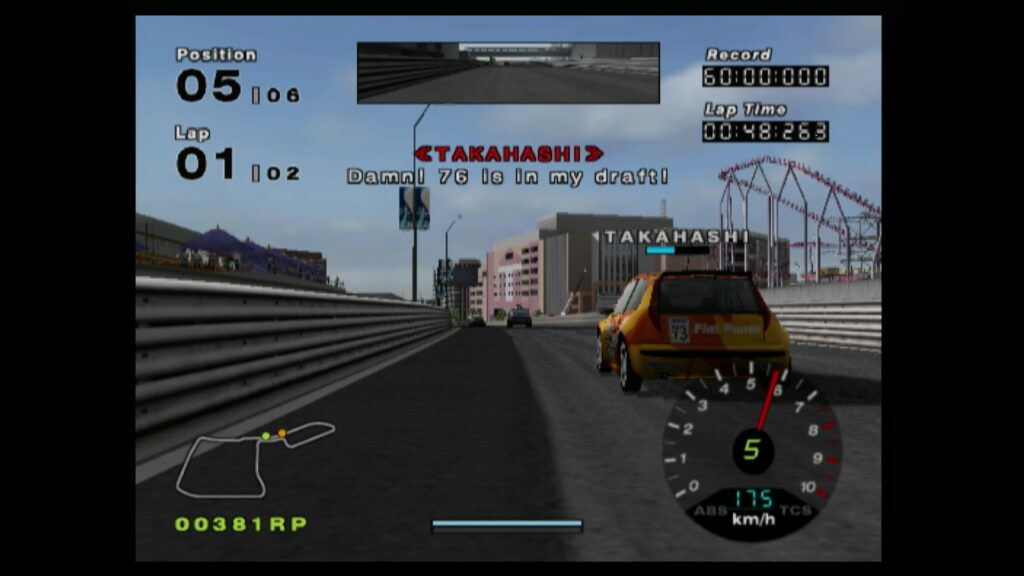
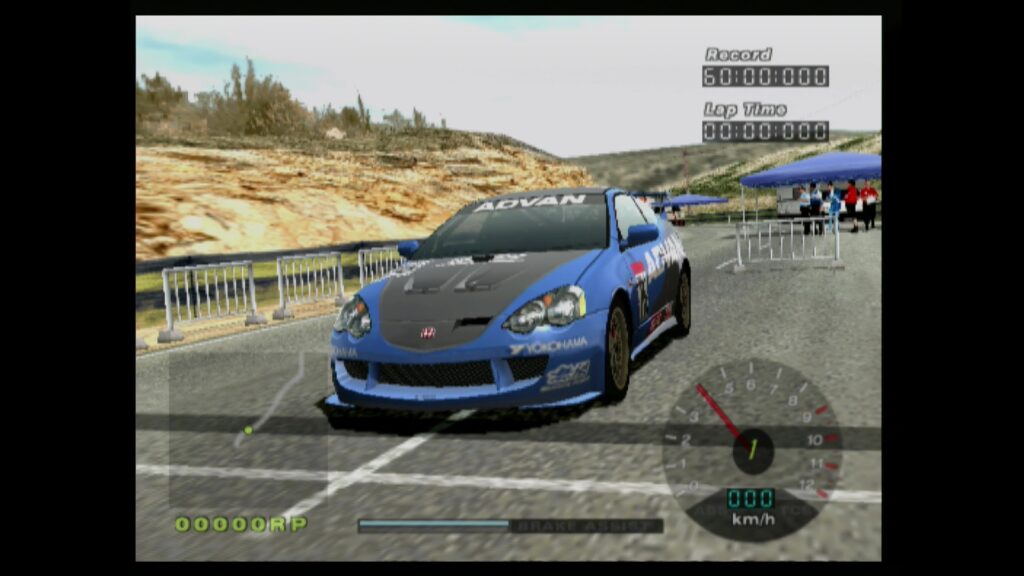
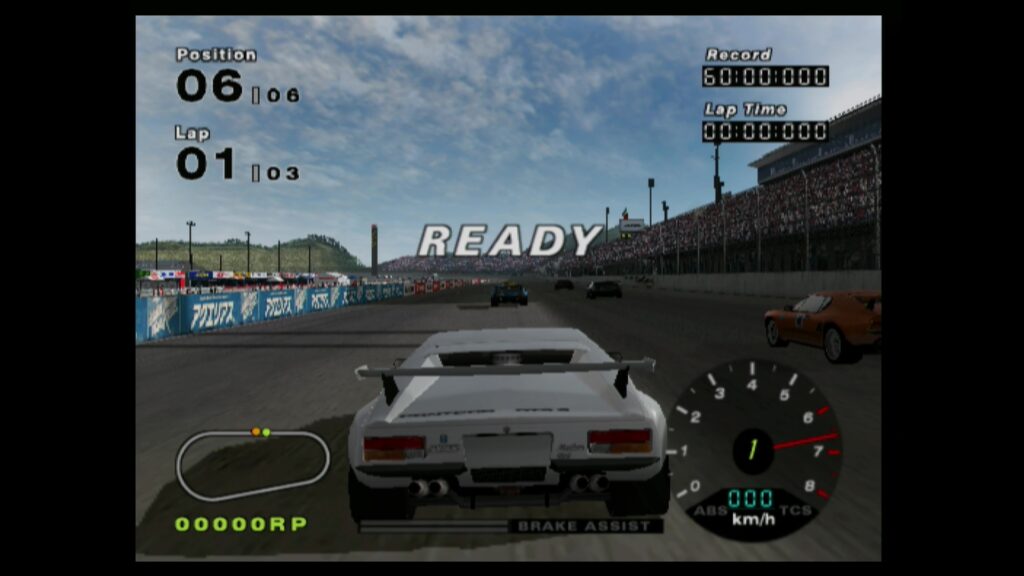
This evening, I felt like playing some random PlayStation 2 shenanigans, so I fired up R: Racing for the first time. (My wife misheard the name as "Car Racing" and was somewhat incredulous; I almost didn't want to correct her.)

For the unfamiliar, R: Racing is a game from Namco where they sort of wanted to make a new Ridge Racer, but also wanted to get in on this "racing sim" action that had been growing in popularity since the original Gran Turismo at the tail end of the previous generation. To that end, they made what is essentially a new Ridge Racer game, but featuring real cars and circuits along with the requisite tuning options that no-one understands.

One of the things that excited me most about R: Racing back when it was originally announced was that it had an actual story mode. This was very unusual for racing games at the time, and when it first released I still hadn't come to the conclusion that no, not all games need stories, a subject that I was sure I'd blogged about at some point in the past, but couldn't find any evidence thereof.

Anyway, long story short, for one reason or another I never picked up R: Racing back in the day, despite it being something that appealed quite a bit… but it is one of the many titles I added to my PS2 collection when I stumbled across it in CEX for somewhere in the region of 50p and subsequently never got around to actually trying. Until now!

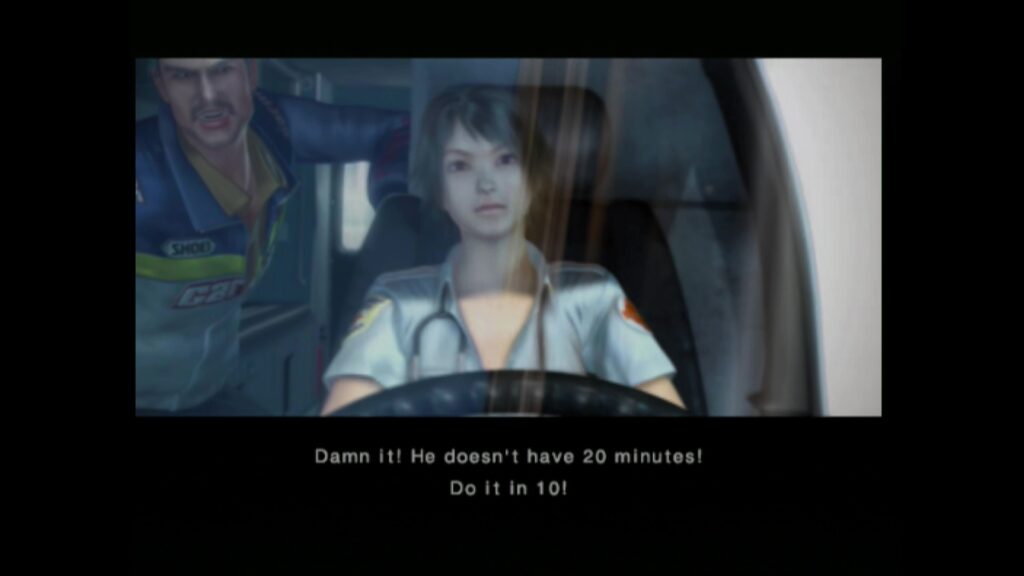
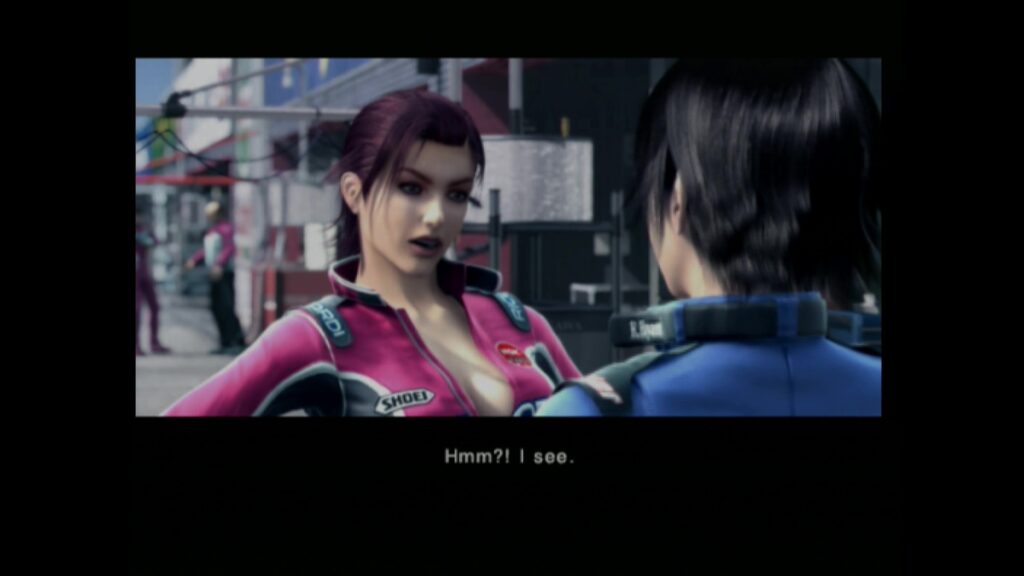
Honestly, of all the things it reminds me of, it's actually most akin to the Ace Combat series. Perhaps not surprising, since they're both Namco titles — and there's a strong argument to suggest the Ridge Racer series unfolds in Ace Combat's Strangereal setting — but it works pretty well. The narrative sequences are kept short and snappy — arguably to a fault — but it provides a certain incentive to progress through the game's 14-chapter "Racing Life" mode, which appears to be primarily intended as an introduction before what I assume is "the real game" starts. Put it this way: I'm 6 chapters into that 14-chapter story after a little over an hour of play, and my save file says it's 12% complete. That suggests you beat the story and there's a whole lot more stuff to fiddle around with.

The narrative involves Rena, a female protagonist — quick, alert the Woke Content Detector idiots! — who works as an ambulance driver. One day, she displays some fancy moves on the job, and her coworker, who apparently never sleeps, signs her up to be part of a mysterious organisation known as "G.V.I." who are somehow involved with motorsports, but in what appears to be a not entirely trustworthy sort of way. Rather than being a racing team themselves, it appears that they work with racing teams and… honestly, I don't really understand at the point I'm at in the narrative because it hasn't really explained anything other than the fact it somehow caused Rena's amply-bosomed rival Gina to be pissy with her pretty much immediately upon first meeting her.

What then follows is a series of races and championships, beginning with a straightforward speedway race that is easy to win, and progressing through track, street and rally racing across several courses, many of which appear to have several variations in the same way that the Ridge Racer series' tracks typically unfold as different routes through the same environments.

R: Racing's unique selling point appears to be its "pressure" mechanic, whereby if you get up another driver's arse for long enough, a bar above their car starts filling up, and when it fills, they'll get so stressed out at your proximity to their rectum that they'll do something stupid, allowing you to pass easily. There's no obligation to fill the bar, and indeed doing so for every opponent is probably quite inefficient, but it's fun nonetheless — and it's a mechanic I've not really seen in a racer before. Presumably it's attempting to reflect the sort of stress the player feels when they have an opponent bearing down on them in their rear-view mirror; in execution, it's a tad "artificial", but, well, it's a mechanic that is there to be taken advantage of, so you might as well do so!

The soundtrack hails from post-Ridge Racer V Namco so unfortunately we've left the funky acid jazz beats of the late PS1 era far behind and are into cacophonous EDM territory. R: Racing's soundtrack isn't quite as obnoxiously awful as Ridge Racer V's, but it's almost aggressively bland, which is a bit of a shame. The Ridge Racer series has some serious highs when it gets music right, so it's always unfortunate when an entry doesn't really live up to those standards.

Still, it's an enjoyable enough game. Although definitely more sim-esque than the mainline Ridge Racer titles, it's also a lot more forgiving than the Gran Turismos and Forza Motorsports (do they still make those?) of the world. There's a braking assist function for those allergic to actually using the brakes themselves, which makes the game feel really arcadey (and a tad easy), but you can still throw the cars into power slides if you're aggressive enough with them. It's just not necessarily the best thing to do at every opportunity in R: Racing, unlike mainline Ridge Racer.

I enjoyed what I played this evening! I'm looking forward to exploring it a bit further. It occupies a nice sweet spot between sim and arcade that I rather like, and the story mode is intriguing, even if, as I suspect, it turns out to be a bit rushed and doesn't really go anywhere. Even if that does end up being the case, I suspect the "Event Challenge" mode, or whatever it's called, will have a fair bit of meat on the bones to fiddle around with. We'll see, I guess, and I'll write something more substantial once I've spent some more time with it.

For now, though, an evening well spent, I say.


Want to read my thoughts on various video games, visual novels and other popular culture things? Stop by MoeGamer.net, my site for all things fun where I am generally a lot more cheerful. And if you fancy watching some vids on classic games, drop by my YouTube channel.

If you want this nonsense in your inbox every day, please feel free to subscribe via email. Your email address won't be used for anything else.
1730: Distant Thunder

I've been playing a bunch of Ace Combat 4 (known variously as Shattered Skies or Distant Thunder depending on where in the world you are) and, frankly, I'm gobsmacked.

This is a game that came out in 2001 for the PlayStation 2, sporting visuals that are still reasonably impressive (albeit low-resolution) today, and which run at an absolutely rock-solid 60 frames per second without breaking a sweat.

More importantly, though, it's a game that manages to be utterly compelling, addictive and thrilling while treating the player with respect and, at the same time, telling an interesting story in a rather unusual manner.

Given what I've experienced of Ace Combat 4 to date, it's easy to see why Ace Combat veterans were a little miffed at Assault Horizon — though I maintain that was an enjoyable enough game in its own right.

Ace Combat 4 is a lot more distinctive than Assault Horizon, though. While the newer game is clad in that unmistakeable "triple-A veneer" that makes a lot of modern games look gorgeous but lack a clearly defined visual identity compared to their contemporaries, Ace Combat 4 is immediately recognisable (although some may argue its interface takes more than a few cues from Metal Gear Solid).

At heart, it's a solid jet fighter sim that throws the odd bit of realism out of the window in the name of fun. Your plane carries an implausibly huge stock of missiles, for example, which is useful, because you'll find yourself shooting down an awful lot of planes and blowing up an awful lot of ground targets in each mission. You can't just fire them off willy-nilly, however — well, maybe you can at ground targets — since enemies will dodge and evade missiles, just like you can. To get a solid lock, you need to manoeuvre carefully behind an enemy and keep them in your sites as you fire off the missiles — and, unlike Assault Horizon with its Dogfight Mode, you have to do this manually rather than pressing a button to do so. It's a lot more challenging, but also a lot more satisfying, too.

The missions are far less scripted than Assault Horizon, too — though that's not to say they don't have interesting things going on. Throughout the first part of the game, you're often under threat from the enemy forces' superweapon Stonehenge, for example, and when you're warned it's about to fire you'd better make sure you're hugging the ground if you don't want to be blown to smithereens. In one particularly memorable mission, you have to fly back to your base while Stonehenge is firing at you, and the only means of getting low enough to stay under its devastating blasts is to fly through a rather perilous canyon.

I'm impressed with the storytelling, too. The game runs two parallel storylines throughout its campaign — one presented in a rather faceless manner to the player, a la many flight and space sims over the years, and another much more personal tale from the perspective of a child living in an occupied city. As you progress through the campaign, the effects of your victories are mirrored in this parallel storyline, until in its later stages you're referred to more explicitly, particularly after the mission where you shoot down the primary sort-of-antagonist-but-not-really's wingman. I haven't yet finished the game, but the smart money is on an epic final confrontation between Mobius One (me) and Yellow Thirteen before the credits roll.

I've been having an absolute blast so far, then. I don't think I'm far off the end of the game, and I'm looking forward to seeing what its sequels have in store.

Now why didn't I discover this series thirteen years ago?

1727: Warwolf One

I beat Ace Combat: Assault Horizon this evening. (Looking at the clock, it's nearly 2am… I guess I was enjoying myself, huh.)

I've already said a lot of the things I want to say about this game in yesterday's post, but having played the whole thing through from start to finish now, I feel I can talk about it with a bit more confidence.

The thing I most want to talk about, I think, is what it was clearly going for and whether or not it was successful.

What it was clearly attempting to go for was a dramatic military-style story with a personal angle. And, well, not to put too fine a point on it, but it failed. Not miserably, but it still fell very short of what I can only assume were the team's ambitions.

To put this in context for those of you unfamiliar with the game, let me explain a little. The majority of Assault Horizon casts you in the role of Colonel Bishop, an ace fighter pilot who is wracked with recurring nightmares about facing off against a "shark-faced" rival ace. (Indeed, the first level is a dream sequence that — spoiler — you re-enact for real later in the game, only things turn out a little differently.) Bishop becomes embroiled in a war between the free world (the real world, unlike many other Ace Combat titles) and an army of Russian rebels. (This latter aspect allows the game to follow the Unwritten Law of Jet Fighter Games, which is that you must spend the majority of your time shooting down MiG-29s and SU-27s.) Said Russian rebels have access to a weapon called "Trinity" — an incredibly powerful nuclear device that you see the devastating effects of firsthand in several of the early levels. Naturally, it's up to Bishop to put a stop to all this nonsense by flying shiny planes very fast and blowing lots of things up.

Except it's not just up to Bishop; there are also a couple of other characters who provide a vehicle (no pun intended) for the other types of mission you'll be flying aside from air-to-air combat and air-to-ground assaults. One guy flies helicopters, so you get to play as him during the helicopter missions; the token ladypilot flies bombers, so you get to play as her during the few bombing missions — including a pretty cool "stealth" one where you have to avoid enemy radar cones.

The setup is fairly interesting, then; Bishop has the potential to be an intriguing character, confronting his own personal demons over the course of the story and developing into someone "human" as it progresses. Unfortunately, this potential is left largely unrealised; a short monologue at the end of the game suggests that he has learned something from his experiences, but the rest of the game's narrative really didn't make that particularly clear.

Things are worse with the other characters, who pretty much only appear to be there for the sake of it. Ladypilot is shoehorned into a rather hasty apparent romance plot in the final scenes of the game, having spent the rest of the game showing no form of interest in Bishop whatsoever, and Helicopter Man is… well, he flies helicopters.

Perhaps the biggest wasted opportunity is the "villain", who is teased a little early in the game — the "shark-faced" pilot from Bishop's dreams — and then introduced rather hastily towards the end. He's given little in the way of explanation, and his own personal motivations are pretty much used to bludgeon the player over the head with to say "This! Is! Why! He's! Evil!" at one point. He's a pain in the arse to shoot down in the final mission, so there's a certain degree of personal satisfaction in blowing him up, but this finale could have been so much more interesting if there were a lot more interaction between him and Bishop throughout the game. It is a poor antagonist who only reveals himself in the final chapters of a story, and it leaves Markov feeling like a rather weak adversary for Bishop.

Despite all that I've said above, however, Assault Horizon was an enjoyable experience in the way that a good action movie (with equally ill-defined characters) is. The missions were varied and fun — though a couple dragged on a little too long — and the presentation throughout was immaculate; the PC version looks lovely, and the action is accompanied by some wonderful music and excellent voice acting just to add to the whole "movie-like" feel.

It's just a pity so many opportunities for interesting narrative development were squandered, leaving the whole experience feeling a bit hollow afterwards. I'm not sorry I played it, as on the whole I did enjoy it immensely, but now my appetite has been well and truly whet for the earlier — apparently much better — installments in the Ace Combat series, which hopefully I will be getting my hands on very soon.

1726: Assault Horizon

Following on from yesterday's post, today I decided to give Ace Combat: Assault Horizon a try, partly because I was impatient to get started on my journey through the Ace Combat series, and partly because I was conscious of the fact it had been in my Steam library since one sale or another and I had never even installed it, let alone tried it.

Ace Combat: Assault Horizon is pretty much the black sheep of the Ace Combat franchise, so I figured it probably wouldn't be a terrible idea to try it first. That way I can see what the series is like now, and then compare it to what it was in the PS2 era. Ace Combat fans do not have the luxury of doing it this way around, so they inevitably see it as a series in decline — particularly now it's made the jump to free-to-play on PlayStation 3.

Now, as noted, I have no frame of reference for the rest of the series as yet, but if the other games are even half as enjoyable as Assault Horizon appears to be — and I'm led to believe that they're considerably better — then I'm very much in for a treat. But more on that when my copies arrive.

For now, let's talk a little about Assault Horizon. It was referred to by some on its original launch as being Call of Duty in the sky, and this isn't an altogether inaccurate comparison. There are lots of characters who have little in the way of… you know, character development, but who provide the framework for the different types of mission (one dude is a fighter pilot, another dude is a helicopter pilot, the token ladypilot flies bombers and transports); the missions and story are very much pre-scripted to fit the overall narrative; the narrative itself makes little in the way of sense but is enjoyable from the perspective of it simply being spectacular to watch.

And, for all the shit Call of Duty gets, this isn't a bad thing for this sort of game. Air combat should be spectacular and exciting — at least, if you're taking the "action movie" approach to it, as this game is — and when you approach it with that attitude, it doesn't matter so much that the game just flat-out defies the laws of physics on numerous occasions with regard to how the various vehicles handle. (The way the helicopter dodges missiles with a ridiculous barrel roll is a particular highlight.)

So far the combat itself has been enjoyable and satisfying, too. Early in the game, you can pretty much get someone in your sights and fire off a missile at them, but as you progress you start having to pull off more and more fancy manoeuvres to get into a position to get a kill. And it's here that the game's most controversial addition to Ace Combat veterans shows its head: Dogfight Mode.

Dogfight Mode is… well, I'm not really sure how it works, but I do know it's ridiculous. Rather than having to worry too much about pointing your plane in the right direction, Dogfight Mode consists of a sort of autopilot as you tail an enemy, though you still have to roll and pitch in order to keep them centred in a large circle on the screen in order to lock on with missiles. It's usually the most reliable means of ensuring you down an enemy — particularly the stronger "leader" enemies — but it's also used for some very silly white-knuckle setpieces throughout, as your quarry leads you on a merry chase between skyscrapers (with things like cranes collapsing around you, naturally) or perilously close to the ground. (And yes; turn the assist options off and the flight controls to the "proper" ones and you can indeed slam into the ground and immediately bring your mission to a premature end, like any good air combat game worth its salt.)

I fired Assault Horizon up out of curiosity earlier and have found myself playing it pretty much all evening. While I'm conscious of numerous things it could do a bit better, I've enjoyed my time with it so far, and I'm feeling like it was a good choice to give this one a try first, because from what I understand, things only get better from here. My mild curiosity has been upgraded to "can't wait" status.

Fox two, fox two.