
I decided today — and not for the first time — that with my interest in all things Japanese, it was high time that I got involved in manga: the print side of Japanese popular entertainment, and, in many cases, the original source of various series that go on to become popular anime series.
People who are big into manga are always going on about how the original manga (or, if you're a real otaku hipster, light novel) is, more often than not, better than the 13-episode anime adaptation. And, to be fair, I can sort of see their point; while anime has a lot more immediacy about it thanks to the combination of colour, music, sound, voice acting and, you know, animation, the longer format of manga allows it by its very definition to go into more detail, to explore characters, themes and storylines further, and to provide a more "comprehensive" experience for fans. Plus it's the otaku equivalent of watching a movie adaptation of a book and going "well, the book was better" (which it often is).
Anyway. The manga I decided to jump into are ones that I'm already reasonably familiar with the anime adaptations of. I considered picking up the Sword Art Online manga, but I kind of want to check out the light novels rather than the manga, since that was the original original version, and most people say that it explores the storyline at a much more manageable pace than the breakneck speed of the anime. Instead, then, I picked up the first volumes of Monster Musume and High School DxD.
I haven't checked out DxD yet, but I've read the first couple of chapters of Monster Musume. So far I'm impressed with how true the anime has stuck to the tone and feel of the manga, though the manga itself is a bit more explicit in a number of ways — most notably with the presence of nipples, but also in another sense in that it fleshes out the storyline and characters' inner thoughts a lot more. So far it hasn't been vastly different from the anime, but I understand that differences between anime and manga tend to come a little later as a series progresses; anime often skip out large chunks of the manga with varying degrees of success, and I believe in Monster Musume's case there are characters who are in the manga who aren't in the anime. Possibly. Maybe.
The other advantage of reading the manga — assuming you stick with it through multiple volumes, of course — is that you can read further on in the story than the anime tends to go. A lot of 13-episode anime seasons end just as they're getting interesting — DanMachi (aka Is It Wrong to Try to Pick Up Girls in a Dungeon?) was the last show to do this — and then present their audience with a substantial and frustrating wait before they can see any more. Meanwhile, in many cases, the manga comes out first, allowing you to continue following your favourite characters' (mis)adventures well before the adaptation hits the airwaves.
So far I don't know how long I'll stick with these series or any others I decide to pick up. I've enjoyed the couple of chapters of Monster Musume that I've read so far, and it's a fun, different way to engage with a series that I've come to enjoy a whole lot since it launched. So we'll see!
I should probably reorganise my bookshelves in anticipation, though…
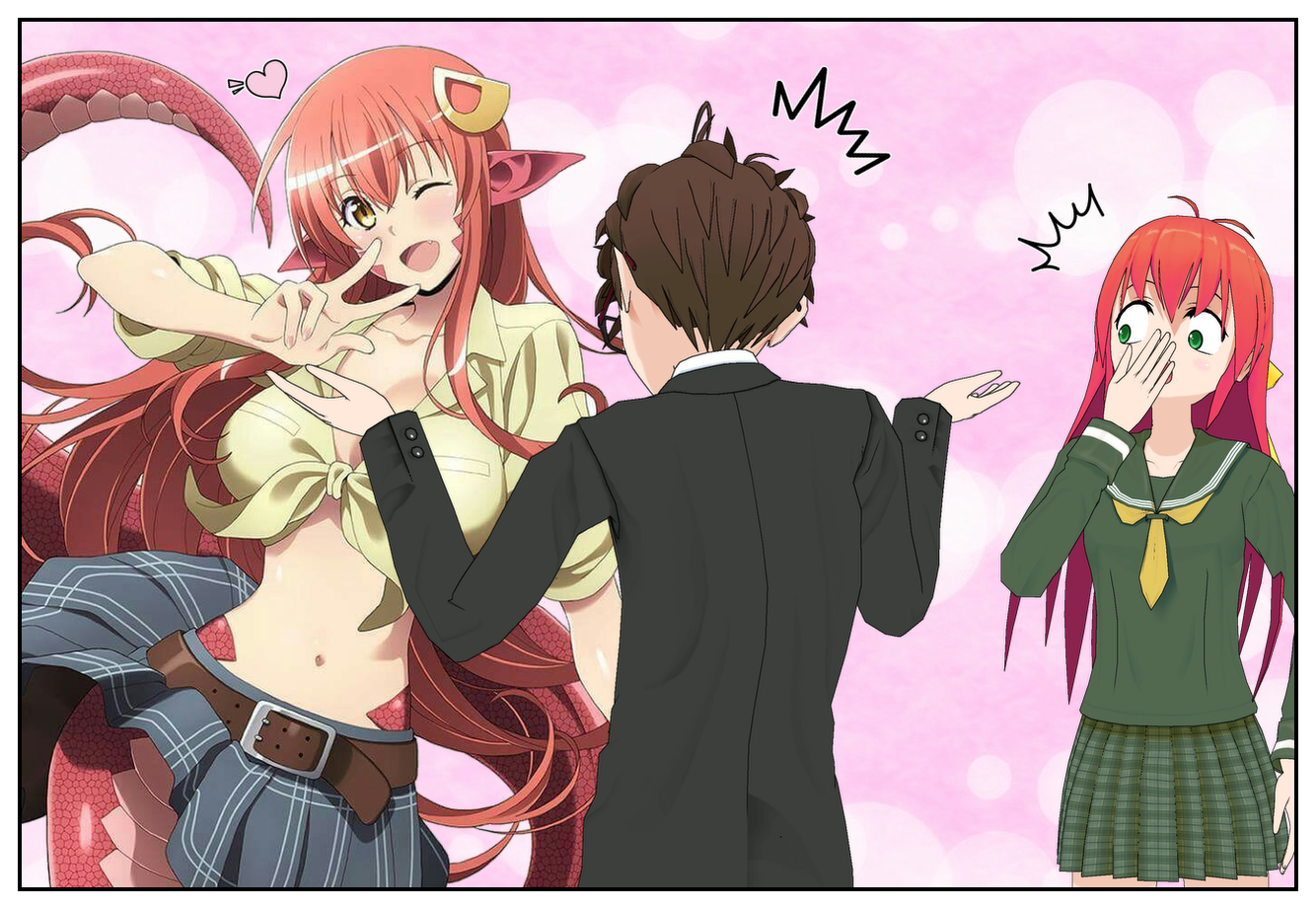 One of the highlights of the current anime season for me right now is Monster Musume: Everyday Life with Monster Girls (typically shortened, as appears to be the custom nowadays, to MonMusu).
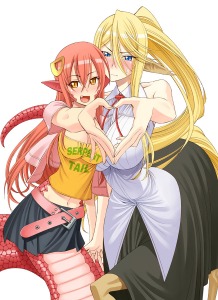 Protagonist Kurusu is a remarkably tolerant individual who takes most things in his stride — and he proves himself early on to be a dependable, reliable sort of person who stands up to people he feels are "wronging" those that he cares about. The main concept of MonMusu is, of course, a thinly-veiled racism allegory, and Kurusu represents an idealised interpretation of what a truly tolerant, inclusive sort of person should strive to be. He doesn't treat the monster girls any differently to how he would treat human girls; he doesn't refer to them as "monster girls"; he's patient and he explains things to them when they don't understand — which is pretty often, as you might expect. But he's not perfect, either; he's a young man who has no experience with women (and even admits outright that he's a virgin in an early episode) and consequently has hormones going pretty crazy in his body — particularly as the girls engage in provocative behaviour or fight over his affections. He's a good protagonist for this type of show, in other words — and mirrors the journey the audience goes on as they overcome the initial hurdle of trying not to judge the monster girls by their "monstrous" aspects and instead see them as just people.