1152: Gaming on the Go

I play a lot of mobile games for my day job. Some of them are great. Some of them are fucking atrocious. Very few of them hold my attention after I have reviewed them. I've been trying to pin down why this is, and it comes down to a variety of factors.

Firstly, and probably most seriously, is that I don't get any real feeling of "accomplishment" (or perhaps more accurately "fulfilment") from playing them for the most part. In the vast majority of cases, I find myself drawn to games that have a bit more "structure" to them, usually in the form of a strong narrative. So many mobile games — particularly those with social features, or which purport to be a "mobile MMO" — completely eschew any sort of narrative in favour of a completely open-ended experience with no discernible end and no real "goal" save for the short-term objectives set by the ever-present quest system. If I have nothing to aim for, I have no incentive to play. And no, "reach level 50" isn't enough of an incentive for me — I know it is for some people, just not for me.

Secondly is the fact that it's often difficult to shake the feeling that in many cases, there are plenty of better games I could be playing. I play something like Candy Crush Saga with its obnoxious £35 in-app purchases and just feel that I'd rather be playing Bejeweled 3 on PC; I play something like Infinity Blade and feel that if I wanted to play an extended Quick-Time Event, I could just play Fahrenheit or Heavy Rain and have a decent story to go along with my occasional carefully-timed button pushing; I play a slot machine game and I'd rather slit my wrists.

Thirdly is the frequency with which in-app purchases ruin everything. If they're not throttling your play sessions (hello, Real Racing 3), they're unbalancing the gameplay so that you need to pay money to progress — that or grind the same level for three thousand years to earn the money you need for the slightly better gun that is always just out of your reach. I also just get a bad taste in my mouth any time I play a game in which I have the choice between using my skill to progress or simply paying up to bypass anything that might be a bit difficult. Again, I know there are people who are fine with this; I'm just not one of them.

Fourthly is the fact that so many mobile games are so fucking completely clone-tastically identical to each other that I have absolutely no need (let alone desire) to play them in my free time. I have no desire to ever play another bubble shooter, Bejeweled ripoff, slot machine game, text-based "card battle RPG", isometric-perspective citybuilder or "hardcore" (hah) strategy (hah) game. I wouldn't mind so much if these developers were ripping off good ideas, but as far as I can tell they rip off the lowest common denominator, "most likely to make idiots pay through the nose in IAP" ideas, flooding the market with complete turds and making the genuinely good games utterly impossible to find if you don't know what you're looking for.

What this leaves me with is a significantly reduced proportion of mobile games that I can actually find enjoyable. If you discount all the directionless free-to-play crap in which the sole purpose of playing is mindless busywork with no long-term goal, there's significantly less in the way of quality interactive entertainment. But thankfully there are still developers out there who cater to people like me, even though people like me don't necessarily lead to obscene monthly profits.

Today I reviewed a title from an indie studio called Vlambeer. The game was called Ridiculous Fishing and has been in development for two and a half years, which is an incredibly long time for a mobile game. The reason for its incredibly long gestation period is that shortly after the team started development, they discovered that a large mobile game publisher called Gamenauts had completely ripped off their game idea (from an earlier Web-based version of what would later become Ridiculous Fishing) and released their own iOS game before Vlambeer could even officially announce their own offering. Understandably demoralised, they put the project on the backburner and almost cancelled it, but this week it finally hit the App Store and has been doing very well. It's a $2.99 paid app with no in-app purchases whatsoever. I bought it immediately without hesitation; I like the developer, and I was sorry to see how bummed they were when their game was cloned. I also want to support the survival of the "pay once, play forever" business model, because it's a dying breed in the mobile sector.

Ghost Trick. Chaos Rings. Sword of Fargoal. Anything by Jeff Minter. Anything by Cave. Support these developers and the great work they do, because if you don't, mobile gaming will become a wasteland even more devoid of creativity than it already is. Fuck it if the price of admission isn't "free" for these games; "free" doesn't mean "free" any more. Forgo a latte and a sandwich from your local coffee house and support the hard work of developers who have brought you quality creative entertainment rather than regurgitated clonesville crap.

1112: Freebies

Page_1It is a truth universally acknowledged, that a mobile game which carries the price tag of "free" must be in want of the contents of your wallet.

There are exceptions, of course, but it's pretty rare to find something that you can download for free that actually is free these days.

It's even rarer to find one of these games that doesn't suck, as the market becomes increasingly-flooded with appalling "card battle" games and gameplay-free tap-fests in which you do little more than log in every few hours for a shower of coins.

The last free-to-play mobile games which really captured the public's imagination came from Nimblebit. Their game Tiny Tower in particular got an alarming number of people hooked, despite the fact that there really wasn't actually very much gameplay there at all, and there certainly wasn't enough strategy to call it a successor to Sim Tower, like some people were. Their follow-up Pocket Planes captured people's interest for a while, too, but by that point a lot of people were starting to get wise to the fact that these games were little more than fairly mindless diversions rather than anything which required something more than the very minimum of brainpower.

It's been a while since Pocket Planes, and a whole ton of free-to-play mobile games have come and gone since then, many of them bloody awful. So it's only fair, then, that I pay a bit of attention to some which aren't complete crap and which are even actually — hush, now, don't tell anyone — quite good.

Here they are. They're free, of course, so you can try them out for yourself and see if they're worth bothering with for more than a single session.

Pixel People

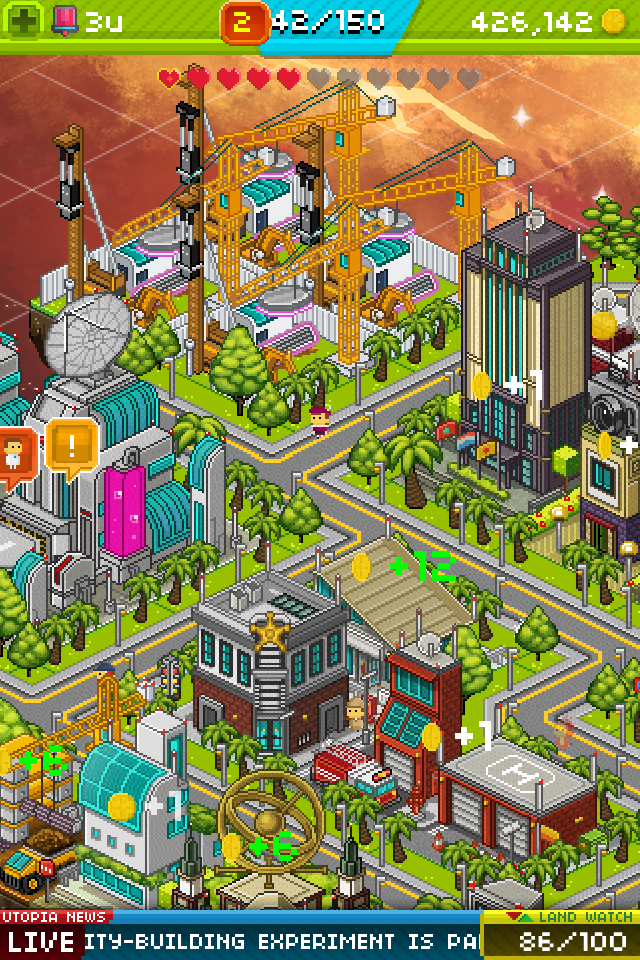
IMG_2147This new title published by Chillingo has more than a little bit in common with Nimblebit's games. It's populated by oddly-endearing pixelated people, there is no real hard "goal" as such and the majority of your time is spent making sure your income stream is as efficient as possible. You don't have any expenses to worry about — it's just a matter of how quickly you can make your pixelated town earn the spondulicks required to level up and expand your territory.

The basic gameplay in Pixel People revolves around genetic splicing. You're building a Utopian colony of clones, you see, and in order for it to run smoothly you need clones in appropriate roles. When clones are delivered to your colony — which will happen regularly so long as you have houses available for them — you are able to pick two "jobs" that you already know and splice them together to hopefully make a new one. The interface gives you feedback as to whether or not the combination you're trying will make a new job, so you won't waste clones or time, and there are various ways to unlock hints (including, yes, paying up) as you progress through the game.

The thing I like about Pixel People is that as you play through, you're constantly discovering new neat little things. You're never doing much more than picking random combinations of jobs and tapping on buildings to keep them producing money, but every so often you'll discover that tapping on a certain building performs a special function. Tap on the police station, for example, and you'll find your achievements list — the game doesn't even log in to Game Center until you've discovered this for yourself — and be able to claim rewards for challenges you've already completed. Tap on the observatory, and you can change the background of your colony — and also score yourself an achievement. While none of these things vastly affect the way you play the game and certainly don't give it any "strategy," they're a nice touch that keeps you wanting to play without resorting to the usual Skinner Box tricks of using experience points and showers of gold.

By far the best thing about Pixel Peoplethough, is that it just looks like one of those awesome gigantic pixel art town pictures. Despite the fact that the placement of your buildings and roads doesn't matter in the slightest — and you can move anything around at will, anyway — I've found it oddly compelling to just want to arrange my buildings into an aesthetically-pleasing, vaguely "realistic" arrangement rather than just clustering them all together haphazardly like I did when I first started playing. So now my cloning centre has a road running from it with shops and other facilities down it, running around a corner (on which the L-shaped university building sits), past a large park and into a residential district. Beyond the residential area is some natural forest land, which is where the sheriff and his deputy live, next to the Utopium mine.

I'm overthinking it. It's not that good, really, but if you liked Tiny Tower you'll probably enjoy Pixel People — and, like Nimblebit's titles, you never feel like you need to pay up to make satisfying amounts of progress.

Book of Heroes

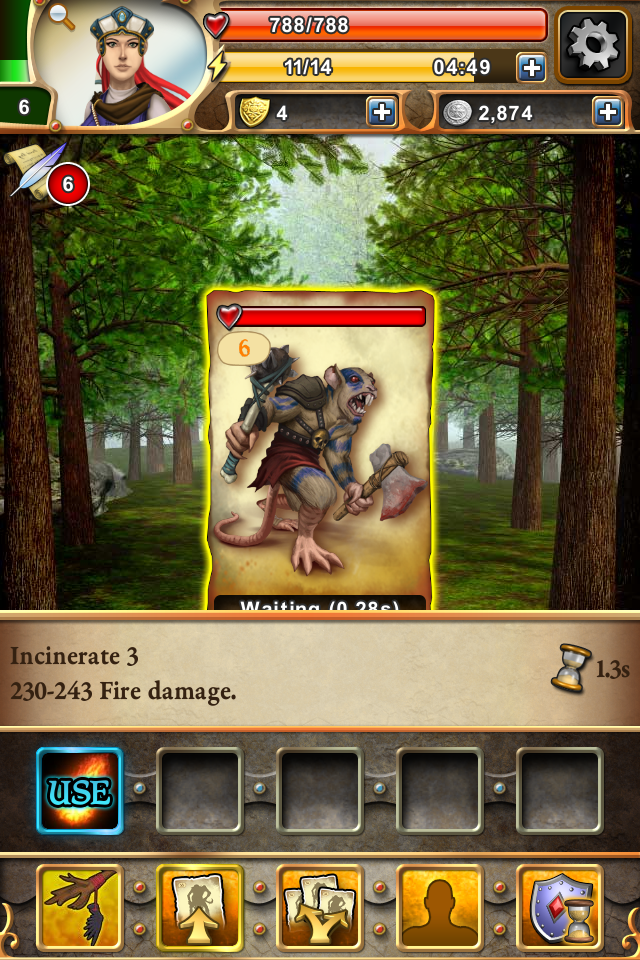
IMG_2148I remember trying this for the first time a good few months back, and I remember quite liking it then. Book of Heroes is a role-playing game specifically designed to be played in short, bite-sized instalments on your phone. It's largely text-based, its interface is designed for touchscreens, and it's not trying to be World of Warcraft or anything.

Since I last tried it, what I believe used to be a single-player experience has gone full-on MMORPG on your ass. Now you can compare your characters with your friends, chat in real time with other people, join guilds and go on "raids" together in an attempt to prove your own supremacy.

Mobile MMORPGs of this type are often utter garbage, usually falling into the "card battle" category and being completely free of any sort of gameplay or strategy whatsoever. Where Book of Heroes differs is in the fact that it actually demands some interaction from its players; rather than following a linear line of quests, you gradually open up a large number of areas in the game world to "explore" (well, fight a string of battles in) and complete various objectives before returning to town to spend all that hard-earned loot.

Combat is the main area where Book of Heroes differs from its rivals. Rather than taking all control away from the player, as happens frustratingly frequently with this sort of game, Book of Heroes allows the player to control their character's actions in a quasi-turn based format. Each action takes a set amount of real time to perform — we're talking seconds here, not "pay up to do this quicker" — and while an action is "charging" the enemies are doing the same thing. It becomes a matter of weighing up whether or not it's worth using the slow-charging super-powerful attack or whether you should try and get some quick hits in before the enemies have a chance to attack. It's a fairly simplistic system, but it works well in the context of a mobile game.

____

The thing with both of these titles is that they understand how mobile players treat games — as a diversion to dip into for a few minutes at a time, not a massively compelling experience intended to keep them hunched over staring at their tiny screen for hours. They're both eminently suitable for toilet play, and they're both simple to pick up but provide plenty of long-term… I hesitate to say "challenge" because neither of them are difficult in the slightest… umm… content, I guess, for players to check out over time. So, in short, they're at least worth a look.

Grab Pixel People here and Book of Heroes here.

1109: Killachine

Page_1Another day, another article declaring the console will be "dead" before we know it. Lots of people — mostly analysts and business-savvy people who work in the mobile and social sectors — have been saying things like this recently, so it must be true, right?

Nah. 'Tis bollocks, as usual. While it's impossible to deny the huge impact that mobile devices have had on bringing the concept of playing games to the masses — the actually-not-all-that-good Temple Run 2 recently surpassed a whopping 50 million downloads — to say that they are going to "kill" consoles and/or dedicated gaming handhelds is, frankly, ridiculous.

Why? Because they cater to completely different markets and tastes. Mobile and social games are, for the most part, designed for players to while away a few minutes while something else is going on — perhaps a lengthy dump, a wait for a bus or a particularly boring meeting with a conveniently-placed table to hide what you're up to — while computer and console games are, for the most part, designed for players to sit down in front of for a more protracted period of time and immerse themselves in the experience. There are exceptions in both cases, of course — hence the "for the most part" disclaimers — but, on the whole, that's where we stand. And there's nothing wrong with either aspect of gaming — they both exist, and they will both more than likely continue to exist.

The word "games" isn't all that useful any more, in fact, because the medium it describes is now too diverse to be covered by a single word. I can say "I like playing games" and that will mean something completely different to what someone else means when they say it. When I say it, I mean that I like relaxing on my couch with a controller in my hand, staring at the TV and immersing myself in a game with depth, an interesting story, or both. When someone else says it, they might mean that they have three-starred all the levels on Angry Birds, or that they fire up FarmVille during quiet periods in the office, or that they have fifteen Words With Friends games on the go at any one time. These are obviously completely different experiences, though there can be a degree of crossover between the two extremes — there's nothing to stop someone who, say, is big into competitive League of Legends play also enjoying playing Scramble With Friends against their less gaming-savvy friends and family.

Where we start to get problems is when developers and/or publishers from one group start to try and step across the invisible line into the other group. More often than not, this is seen in the form of mobile and social developers promising a mobile or social experience that will appeal to "core gamers" — in other words, the group that, like me, enjoys immersing themselves in an experience for hours at a time rather than as a throwaway diversion. It is, sadly, abundantly clear that a huge number of developers who try and take this route have absolutely no clue whatsoever how to design a game that will appeal to these players. The article I linked above is from the CEO of a company called Kabam, who specialise in developing a variety of almost-identical "strategy" (and I use the term loosely) games that supposedly appeal to "core" players. All of their games are the same (literally — I tested three side-by-side as an experiment once, and the quests the player was expected to follow were completely identical, right down to the wording) albeit with a slightly different visual aesthetic, and all of them are as dull as ditchwater.

The bewildering thing is that someone, somewhere, is playing these games — and, more to the point, spending money on them — enough to let them be considered a "success". So more and more of them start appearing, each inevitably following the exact same template, making all the same mistakes and pissing off the same people while somehow convincing the same others that reaching for their credit card is a really, really good idea.

Note that I'm not saying here that mobile, social and/or free-to-play games are inherently bad in and of themselves; it's that in many of these cases — particularly those that are supposed to be designed to appeal to "core" gamers — they are designed by people with an astonishingly strong sense of business savvy, and a complete lack of understanding in what makes a game actually fun or interesting to play. In other words, the fact that something is financially successful should not be the only criteria for it being considered "good" — you just have to look at Mobage/Cygames' shockingly awful Rage of Bahamutone of the top-grossing mobile games in the world, to see how this is the case.

No, the problem that we have is that everything new always has to "kill" something else. This flawed logic has been seen with numerous other technologies in the past; laptops would kill desktops, tablets would kill laptops, TV and video would kill the cinema… the list goes on. In very few cases is it actually true. Okay, DVD killed VHS, but that was a simple case of a superior format doing the same thing rather than two vaguely related — but not identical — things battling it out for supremacy. People still use desktops as well as laptops because big screens are nice and more practical in many circumstances. People still use laptops as well as tablets because typing on a touchscreen is still a horrid experience. People still go to the cinema as well as watching TV or DVD/videos because it's nice to see something on a huge screen with room-shaking sound.

Why does everything have to be reduced to binaries? Why does something new always have to "kill" something else, even if it clearly isn't performing the same function? Can't these people just accept that certain parts of the populace are happy with one thing, and others are happy with another?

Ahh, if only.

1007: Battle of the Cards

I've made my distaste for the growing trend for Japanese "card-battling" mobile-social games well-known on these pages a number of times in the past, but I've been growing increasingly conscious of the fact that I must be missing something. After all, these titles consistently show up in the Top Grossing charts on both Android and iOS, so there must be something to them that keeps people playing and, indeed, spending.

The other day, I reviewed a new mobile game from Zynga called Ayakashi: Ghost Guild. Before I go any further, let me explain something about the way Zynga does business for those who have always given their titles a wide berth for whatever reason.

Zynga behave very much like Apple do, in that they're not trendsetters — or perhaps more accurately, they're rarely the first to try something, as they're both often the ones to make something popular. What both companies are inclined to do is hang back, watch and wait to see what early adopters of new technology and systems are doing. What is proving popular? What are users ignoring? What are the potential pitfalls in doing something new, and can they be avoided?

Once they've done this, they'll swoop in with something fundamentally very similar to that which has come before, but polished to a fine sheen. Zynga's games are rarely, if ever, original, but it's hard to deny that they often have a significantly higher degree of polish than many other games that may have gotten there first. Similarly, Apple's work on iOS frequently lags behind Android in terms of features — a frequent criticism in the interminably tedious fanboy wars — but when said features hit, they tend to be implemented very well. (Of course, there are exceptions in both cases, but these patterns are noticeable enough to be worth commenting on.)

Anyway, I digress; Ayakashi: Ghost Guild is a card-battling title from Zynga, and it follows the outline above to the letter. It's clear that the specific developers behind it have examined what makes early trailblazers tick — many of which, like the inexplicably popular Rage of Bahamut, are very rough around the edges — and then given the whole set of proceedings a pleasing coat of paint. Where Rage of Bahamut is silent throughout, Ayakashi: Ghost Guild has an atmospheric, context-sensitive soundtrack; where Rage of Bahamut's story is completely throwaway and irrelevant, delivered via blocks of text that most players will ignore completely, Ayakashi: Ghost Guild makes an effort to introduce characters and an unfolding narrative with first-person visual novel-style scenes; where Rage of Bahamut's interface resembles a Geocities website from the late '90s… Ayakashi: Ghost Guild's interface resembles a Geocities website from the late '90s designed by someone who owns a copy of Photoshop. (You can't have everything.)

The thing that I've found most obnoxious about these games in the past is their seeming total lack of gameplay. But have I been giving them a fair shot? I have delved into Ayakashi in some detail over the past few days in an attempt to try and understand the appeal a little better, and I'm still not quite sure that I've made my mind up.

For those who haven't played one of these games before, allow me to give you a rundown of how play works, with specific regard to Ayakashi. You start by picking a card, usually from one of three different types that have particular strengths and weaknesses. Cards have an attack rating, a defense rating and a "spirit" value. They also generally have some lovely (and usually rather boob-heavy) Japanese-style artwork on them. Ayakashi: Ghost Guild does not disappoint in any of these regards.

Following this, there are two main components to gameplay — the single-player component, referred to in Ayakashi as the "Story" mode; and the multiplayer component, described simply as "Battle" mode.
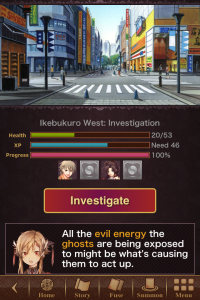
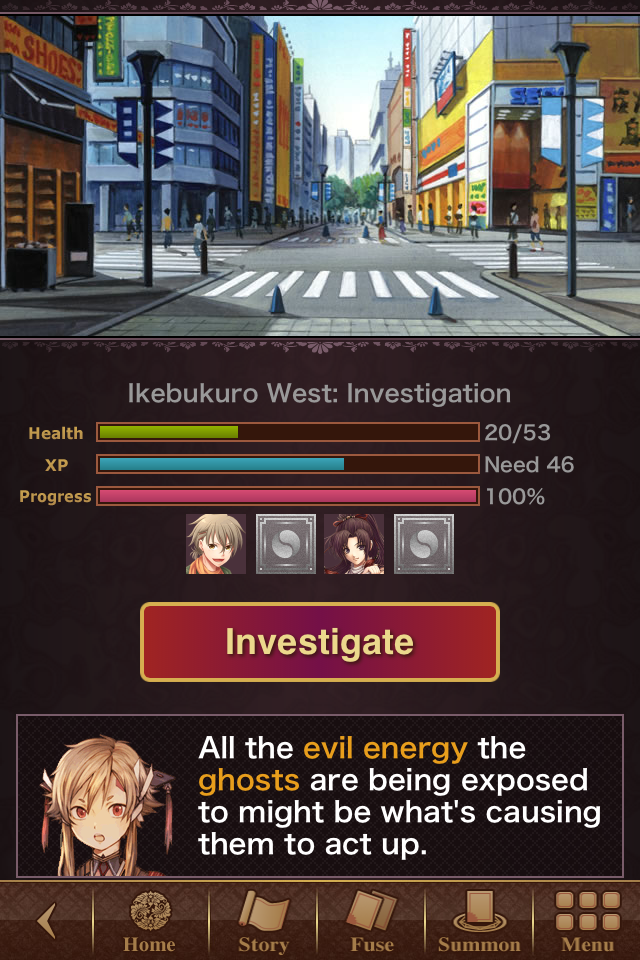
In Story mode, you're presented with a series of linear chapters to work through. To work through a chapter in Ayakashi (and, indeed, in all other games of this type) you simply press a button. At this point, several things happen: an animation plays, you lose some health, you gain some experience and you gain some progress in the chapter. Occasionally you will discover an item or a card — each chapter usually has a set number of hidden items which are clearly marked and discovered completely by chance — or run into another player, at which point you can add them to your "crew" if you have enough slots left. If you fill up the chapter's progress bar, you're given a story scene and can then move on — or stay behind if you want to try and collect the remaining items — and if you fill up the experience bar, you gain a level, gain some points to spend on your basic stats and refill your health to full. Your first few levels give you more health than is needed to level up a single time; after you reach about level 8 or 9, however, you'll either have to wait for health to regenerate (at the rate of 1 point per minute) or purchase restorative items using "Gold", a currency which may only be acquired through in-app purchases. Generally speaking, health is exchanged for experience at a 1:1 ratio; as the story progresses, the health cost and related experience gain for a single press of the "Investigate" button increases.

When levelling up, you have three stats to power up: health, which upgrades the amount in your health pool, allowing you to play Story mode for longer; Attack Spirit, which determines the cards you can hold in your "attack deck" for Battle mode; and Defense Spirit, which determines the cards you can hold in your "defense deck" to protect yourself against attacks from other players when you're not there.

Battle mode consists of you picking an opponent and then letting your attack deck compete against your opponent's defense deck. Some cards have special abilities which boost their base attack and/or defense power, and these are triggered at the start of battle. Following this, the winner is automatically determined with no interaction required from the players. This allows battles to unfold without both players having to be present. After a battle, your available Attack Spirit is depleted by the spirit value of the cards you used, meaning at least initially you can only do one battle at most in a single session if you use your most powerful cards — and why wouldn't you?

There's a reason to play Battle mode in Ayakashi — the collection of Sealstones. If you collect all of the colours of a particular Sealstone set, you'll get a rare card that is usually significantly more powerful than the ones you just find naturally in Story mode. Beat another player in Battle mode and you get to steal one of the Sealstones they have — but naturally, others will be trying to do the same thing to you, meaning you'll have to leave a strong defense deck behind in order to ensure they don't get nicked while you're not playing. You can also, you guessed it, buy special items with that in-app purchase currency Gold to protect your Sealstones against being half-inched by randoms.

Despite being a massively-multiplayer game, direct interaction between players in Ayakashi is, like most other games of its type, very limited. You can add a limited number of other players to your "crew", with the limit increasing as you level up. When you add a new crew member, you get more ability points — more than when you level up, in fact. You then have the option of "poking" or commenting at them once per day, and are rewarded with "Summon Points" for doing so. Collect ten Summon Points and you can get a free, usually shit, card. You can also get two additional free, usually shit, cards per day — one at any time, the other only at lunchtime.

Those free, usually shit, cards have a use, though — fusion. By picking a card to enhance and then choosing up to ten "material" cards to fuse with it, you can level it up, which increases both its attack and defense power and often makes any special abilities it has more effective, too. Some free, usually shit, cards are specifically designed purely for fusion purposes as they are otherwise terrible but provide massive experience point boosts; in other cases, ensuring you fuse cards of the same "type" (ideally identical ones) together nets you the biggest bonuses. Fusion costs in-game money to perform, though it's the type of money you can earn in the game very easily without having to spend real cash — the game bombards you with it throughout Story mode and you can sell those free, usually shit, cards you've been building up over time.

That's about it. You grind through Story mode, stopping when you run out of health (or until you purchase more if you just can't wait); you twat another player or two in the face to nick something, then you set the game down for a few hours and come back later. Then you repeat the process.

Is that fun? I'm honestly not sure. There is a certain degree of satisfaction to gradually levelling things up and making them more powerful — progress bars are, as we all know, a powerful motivational tool. The fact that Ayakashi has actually made an effort with its story makes it considerably more interesting than most games in this oversaturated genre, too. But the lack of interaction bugs me somewhat; if I'm supposed to be "investigating" a location, I'd like to be actually doing that investigating, not just tapping an "Investigate" button over and over again. If I'm fighting an opponent, I'd like to do more than simply sit back and let the battle resolve itself.

On the other hand, there's an argument that all Ayakashi and its numerous competitors are providing is the same experience you'd get from a "proper" MMO, albeit stripped down to its most bare essentials. What do people like to do in MMOs? Level up, so make that easy. What else do people like to do in MMOs? Compete against other players, so make that easy too. What these games are in effect doing is stripping down the conventions of MMOs into something that is a lot more friendly to mobile gamers' lifestyles — you can pick up Ayakashi for five minutes and "accomplish" something, whereas to do the same in, say, World of Warcraft or Guild Wars 2 takes a lot longer. But in that longer amount of time, you actually get to do stuff.

As I say, after having spent a bit of time with Ayakashi in particular, I find myself a little conflicted. With Rage of Bahamut, I felt justified in my dislike; it's a poorly put-together, amateurish effort that actually felt quite insulting to play. With Ayakashi, meanwhile, Zynga has taken the time to do its usual spit-and-polish routine to make something that isn't outright embarrassing to play from a presentation perspective. I'm just not entirely sure there's a game worth playing — much less paying for — beneath the glitz.

I will feel even more conflicted when the Persona 4 card-battling game eventually makes it to Western app stores.
#oneaday Day 977: The Eternal Struggle Between Business and Pleasure

If you own an iOS device and haven't yet purchased a copy of Rayman Jungle Run, congratulations! You are the problem with mobile gaming. I won't get into why you should play Rayman Jungle Run — you can read my review for that — but I will reassure you that it is a game that you pay for once and then never have to pay anything for ever again. (At the moment, anyway.)

On the surface, it's easy to see why the freemium/free-to-play sector has exploded quite so much. People casually browsing for things are always going to be immediately more attracted to things that say "Free" on them rather than things that say "$2.99" on them, regardless of whether or not that "Free" comes with a caveat, which it usually does. But there's a growing level of discontent and frustration with this fact, particularly among "core" gamers — or, more specifically, people who have been playing games for many years. We've reached a stage now where this demographic actually wants to seek out paid games and apps because they know that "Free" tag always comes with a catch — and, sadly, more and more paid games are also coming with "Get More Coins!" buttons and unbalanced gameplay attached in an attempt to squeeze more and more money out of their player base.

I always have a curious sense of hypocrisy over this issue. I mean, my day job is reviewing mobile and social games, after all, and from a critical perspective I have to consider each title from a business perspective as well as that of the player — is the game going to make enough money for the developer for it to have been worthwhile? I can do this with no problem — though I will call out titles that are obviously taking the piss with their monetisation strategies — but it doesn't stop me from having a sour taste in my mouth whenever I'm "off the clock", as it were. I've dialed back my consumption of iOS games massively since realising that the vast majority of them are little more than time and money sinks designed as not-particularly-subtle attempts to extract players' money from them. And many developers and publishers don't even attempt to hide this fact — we're dealing with an industry that refers to users who spend a lot of money on in-app purchases and DLC as "whales", after all, which should give you an idea of the sort of people we're dealing with a lot of the time.

Now, I'm not saying that people shouldn't make money from their creations. Quite the opposite, in fact — I told you at the start of this post that you should pay money and download Rayman Jungle Run, for example, because it's great. But herein lies the rub — you should pay money for things that you think are worth money, things that you want to support, not things that are designed to psychologically manipulate you into pressing that "Get More Coins!" button. As soon as you become aware of a game's business model, it stops being quite so fun — at least, that's how I feel. Apparently I'm in something of a minority, though.

There's a problem with the system as it stands right now, which is partly why this situation has arisen. The distorted sense of value that the App Store has brought means that if people see anything that costs more than a dollar, they won't buy it unless they're absolutely sure it's worth the money. (These people are probably the same people who will happily spend four or five dollars on a coffee — yes, I'm aware that I'm English and automatically using dollars as my default currency, but that's what you get after working for American employers for the last two years — and consequently are quite happy to throw their money at something they will piss out within an hour or two) To exacerbate this fact, there is no requirement for app developers to provide a free trial of their products. Some do anyway, either by offering a free "lite" version of the app or distributing the app for free then unlocking it via in-app purchase, but there are many cases where it is impossible to "try before you buy" — so people end up not buying at all, instead reaching for those ever-tempting "free" apps and their spiderweb of monetisation.

Free trials won't solve the issue entirely, obviously, but they would be a good start. Personally speaking, I just find it a crying shame that a gaming platform with as much obvious potential as iOS (and, to a lesser extent due to lack of support by many developers, Android) finds itself focusing on shallow, fun-free timesinks rather than truly creative games — of which there are many available that go completely unnoticed. Quality games like Rayman Jungle Run should be celebrated and championed; crap like Tap Campus Life should be ridiculed.

That's enough for now.

Oh, one final thing. Buy Rayman Jungle Run.

I thenkyaw.

#oneaday Day 860: Kairobot

20120528-000247.jpg

Have you played any of the games by Kairosoft on iOS and Android devices? If not, you really should. They're quite remarkable little experiences, all the more noteworthy for fitting surprisingly deep gameplay into less than 10MB in most cases. This is a big benefit for those of you who habitually fill your phone and/or tablet device with all manner of crap games that you never play.

Kairosoft's games are business sims/strategy games at heart. All of them feature adorable pixel art and dreadful MIDI music. Most of them involve attempting to make as much money as possible over the course of a fixed period of time which varies depending on the title. Some are almost identical to one another, others take slightly different approaches.

All are utterly bewildering the first time you play them.

Most players' first experience with this little Japanese software company's work tends to be with their breakout hit Game Dev Story which, as the title suggests, sees the player running a fledgling game development company over the course of twenty in-game years. As the game progresses, players develop their staff, produce new games, try to woo the public and even have the opportunity to develop their own game console. Throughout, knowing tips of the hat are given to the games industry with pun-based names and not-quite-real game systems coming on to the market and acting much like their real-life counterparts. Develop for the Game Boy equivalent, for example, and you'll be on to a winner. Decide to support the Virtual Boy equivalent and you may find that your sales aren't quite what you expect.

Basic gameplay in Game Dev Story is pretty straightforward. Through a series of simple menus, you tell your minions what to do and keep a careful eye on your finances. What's interesting about it (and all Kairosoft's other titles, for that matter) is how much is going on beneath the surface. Markets are being simulated; seasonal growth and decline is taken into account; real-world trends form a key part of the game. On your first run-through, you may not discover everything the game has to offer. On each subsequent runthrough, you find out more until you're making ridiculous amounts of money with each one of your blockbusters.

The most recent Kairosoft title I've tried is an Android title known as Cafeteria Nipponica. This, as the name suggests, is a restaurant management game where it's up to the player to take between one and three restaurants to the very top of their game. This is achieved by hiring staff, levelling them up, researching new dishes and, occasionally, sending staff members out into the fields to look for ingredients and "treasure". I haven't got my head around everything the game is doing at the moment, but if nothing else, seeing little pixel people running around making a restaurant work is most entertaining. Like most of the company's other titles, a lot of concepts are treated in a rather "abstract" manner, and so long as you don't go in expecting a literal simulation of how a restaurant actually works, you'll have a blast.

If you've read my previous post How to Play Pocket Academy, you'll know that success in these games is sometimes quite hard to come by, and it's quite easy to mess things up beyond all recognition. That's okay, though, because the game remains so unerringly polite about the whole thing throughout that you can't feel too bad even as your money spirals into the red more and more with each passing month.

In short, then, if you're looking for something to occupy your time on the toilet/bus that isn't Angry Birds, then almost anything by our Japanese friends here is certainly worth a look. While they may not be the cheapest mobile games out there, that's not necessarily a bad thing. They'll provide you with a ton of entertainment for about the price of a single Starbucks coffee. And you can't complain at that, really. That's just good business.

#oneaday Day 827: You Should Back Republique on Kickstarter if You're an iOS Gamer -- And Perhaps Even if You're Not

20120425-005649.jpg

I backed the highly promising-looking project Republique on Kickstarter recently. Despite it looking like a high-quality endeavour from a reputable team (including former Halo 4 creative director Ryan Payton, no less) it's struggling to reach its goal of $500,000 — as of the time of writing, it's sitting at $86,477 with 16 days left to go.

For the unfamiliar, Republique is a bold attempt to create a "triple-A" game experience on iOS. The goals that the team hopes to achieve include designing a game specifically for touch-based devices; creating an intense action game without a focus on killing; creating a game with a believable, non-sexualized female lead; exploring "heavy" topics and saying something "meaningful"; and pushing cutting-edge graphics on mobile devices.

All reasonable ambitions, you might think. The thinking behind the game's design is that "gamers will embrace iOS when more games are made for them."

That, unfortunately, is where the problem lies — a lot of people are still resistant to the idea that a mobile device can play host to a "proper" game — i.e. one that you play for more than five minutes at a time, that doesn't feature a three-star rating system on every level and doesn't offer the possibility of purchasing in-game currency for faster progress. (That said, the ever-greedy EA has been sneaking the latter mechanic into some of its recent games, much to the chagrin of people who hate that sort of thing, particularly when they've already spent $60 on the game itself, but that's beside the point.)

To look at the popular titles on the App Store, you'd be forgiven for thinking that these naysayers had a point. Of the top free iPhone games at the time of writing, pretty much all of them are either casual or social fare, riddled with microtransactions and designed more as a moneymaking "service" than anything with meaningful gameplay. (Yes, even the ridiculously popular Draw Something falls into this category.) Paid apps don't fare much better, either, with the super-casual (and a bit rubbish) Angry Birds Space topping the charts, closely followed by numerous other lightweight titles.

This isn't to say there are no "core" titles on iOS. Far from it, in fact — Square Enix, for example, has put out some excellent role-playing titles including Final Fantasy I, II and III, Chrono Trigger, Chaos Rings and Final Fantasy Tactics. Sega has rereleased a number of its old Genesis titles including strategy RPG classic Shining Force. EA has put out mobile adaptations of its popular franchises such as Dead Space, Mass Effect and numerous others. But why do these titles flounder — relatively speaking, anyway — when compared to more casual fare?

It's a simple numbers game. Not everyone who owns an iOS device is a "core" gamer. Angry Birds et al have their place among those of us who don't know what RPG, HP, MP or FPS stand for, or who think "bullet hell" refers to driving through a particularly unpleasant part of Manchester in the middle of the night. As it happens, these more casual players probably outnumber the more dedicated "core" types to whom "triple-A" titles such as Republique might be marketed to. As such, they appear to dominate the charts on a regular basis.

Does that mean that "core" developers should give up and not even bother trying to put together something impressive on mobile platforms? Absolutely not, though they should be aware of what they're getting into and the problems they will have to overcome in the process.

Firstly, one of these "core" titles probably isn't going to top the charts. The Angry Birds series, for example, has enjoyed well over half a billion downloads in its lifetime and made developer Rovio a worldwide phenomenon in the process. Its simple gameplay and premise mean that anyone can pick it up, play and have fun. (Unless you're me. I hate that stupid game.) Conversely, a "core" title likely has a barrier of entry — "you must be this familiar with video games to ride", if you will. Not only that, but its audience must be people willing to sit down with a game for more than a few minutes at a time while they're waiting for a bus, waiting for the kettle to boil or waiting for their bowels to evacuate.

Secondly, iOS players are curiously resistant to what they see as "high" prices. Square Enix's titles, for example, have caught frequent flak for being anywhere between $8.99 and $17.99. Compared to a new release on PC, console, Vita or 3DS, however, these prices are still eminently reasonable — but they're expensive compared to the $.99 you pay for Angry Birds, and the fact that they're deeper, more impressive, bigger-budget experiences than Rovio's avian-flinging nonsense isn't often taken into account.

The problem here is that in order for a "triple-A" iOS title with high production values to be successful, it will need to overcome that particular resistance that players feel to paying more than, say, $5 for a game. The Kickstarter for Republique will provide those who pledge $10 or more with a copy of the full game when it's released — and going by the pattern of other successful video game Kickstarters, the full version will likely cost more than this "backer's rate". We're likely looking at $15-20 at least, and that's a price point that takes the game well and truly out of "impulse purchase" territory.

Or does it? Consider Thatgamecompany's recent PS3 release Journey. This game costs $15 and lasts approximately two hours. People have been willing to part with this much money for what they already know is a two-hour experience simply because other people have said it is good. In many cases, people have done this without a second thought — going into the game with "beginner's mind" is regarded as an important part of the experience. Does the virtue of the fact that Journey is a game presented on a large television screen make it inherently more valuable than a portable title for a multipurpose mobile device? It's certainly perceived that way, but why on Earth should that be so?

As the Camouflaj team say on their Kickstarter page for Republique, though, developers need to take more risks if "triple-A" gaming on iOS is to be taken seriously. Lengthy, deep games can and do work on the platform, even if they don't chart very highly compared to casual and social juggernauts. The most important considerations for any developer thinking about doing this, however, should be designing it specifically for the device. That means building a game around a touch-based interface, not putting in crappy virtual joypads with no tactile feedback. A game with touch controls needn't be shallow — games such as Undercroft that recreate what would have been the mouse-driven interface of old PC games work well, for example, so there's plenty of scope there.

From what I know of the team behind Republique, I believe that they have a good idea of what they're doing. I believe that their game could prove to be an excellent example of what mobile platforms is capable of for "core" gamers. And I simply believe that the project should be supported, not because I want to see an end to the casual titles on mobile — they have their place — but because as a format, mobile devices' capabilities are more than broad enough to cater to more than a "lowest common denominator" audience. It should be supported because it's a worthwhile project that, if successful, will benefit mobile gaming in general in the long run — not just iOS. That means you embittered Android types upset that this title doesn't mention your chosen platform at all should consider throwing a few quid their way, too. Vote with your wallet, as they say.

Check out the Republique Kickstarter and pledge a donation here.

#oneaday Day 792: When Play Feels Like Work, It's Time to Stop Playing

20120321-002219.jpg

Asynchronous games are a great idea. At the time of writing, everyone is jizzing all over Draw Something (and quietly hoping that Zynga doesn't acquire the developer in order to monetize the game out of the arse even more than it is already) — the latest in a long line of successful mobile asynchronous games that include Hero Academy, the With Friends series and, on a smaller scale, various board and card game adaptations.

Now, in theory, the fact that you can play a turn-based game with someone on the other side of the world at a pace which suits both of your busy lifestyles is a great one. And sure enough, it most certainly is a great thing. Games which previously proved impractical to organise when players span various different timezones are suddenly accessible to all and sundry, and your mobile device becomes a portal to a wide variety of social, multiplayer experiences that you can share with your friends.

Trouble is, everyone wants to get in on this action, meaning that whatever flavour of the month asynchronous hit there is will promptly bombard you with notifications and game requests as absolutely everyone on your Facebook friends list suddenly wants to play. And God help you if you post your username for such a game on Twitter.

Now, having a bunch of people to play against should be a great thing, particularly in a game that occasionally offers such a fascinating glimpse into people's minds as Draw Something does. But, you know, it all gets a bit too much sometimes. When you have twenty people taking their turns in Draw Something, twenty more begging you to play Words With Friends, twenty more wanting you to play Hero Academy, it's easy to find yourself overwhelmed with notifications and game requests, and find yourself spending hours at a time just catching up with games — and meanwhile your opponents are also taking their turns, meaning sometimes it's almost impossible to catch up. You can always exercise self-control, of course, and only accept the number of games you know you can handle — even going so far as to uninstall the games you know you don't want to play, perhaps — but there's always that element of peer pressure going on.

I can't help feeling that developers of these games could do a bit to help out here. The simple addition of a "privacy" button that automatically blocks all new game requests but allows current games to continue would be a good one, for example, or perhaps a hard (and reasonable — perhaps user-customizable) limit on how many games can be running concurrently. At the moment, I often find myself letting games expire accidentally due to the fact that a bajillion notifications come in at once, I have no time to deal with them at the time, and they form a backlog which would require a considerable number of minutes to clear. It's at that point that play starts to feel like work, and that's a situation you shouldn't find yourself in.

When something becomes an effort to play and there's no discernible payoff for doing so, that's when you have to question why you're playing in the first place. The thing with all these asynchronous games is that victory is a very hollow experience — win or lose, after a brief "You Win!"/"You Lose!" message, the first thing most players will do is immediately hit the "Rematch" button. Most don't even do any particularly detailed stat-tracking, meaning you can't even gloat over your winning streak against your friend. Some, like Draw Something, don't even make it clear whether or not you're supposed to be competing against or cooperating with your friend, and then patronise you with primary school-esque "Good Try!"s when you get one wrong. (Notable exceptions: the adaptations of card and board games such as Carcassonne and Ascension do a good job of both stat-tracking and providing a good victory screen for winners to gloat over and losers to quickly skip past.)

These games have their markets, though. They let people connect with one another in new ways, and they open up the medium of gaming — specifically, multiplayer gaming — to massive new audiences. That's a great thing for the industry as a whole, but there's only so many "It's your turn!" notifications I can take before I go completely mental.