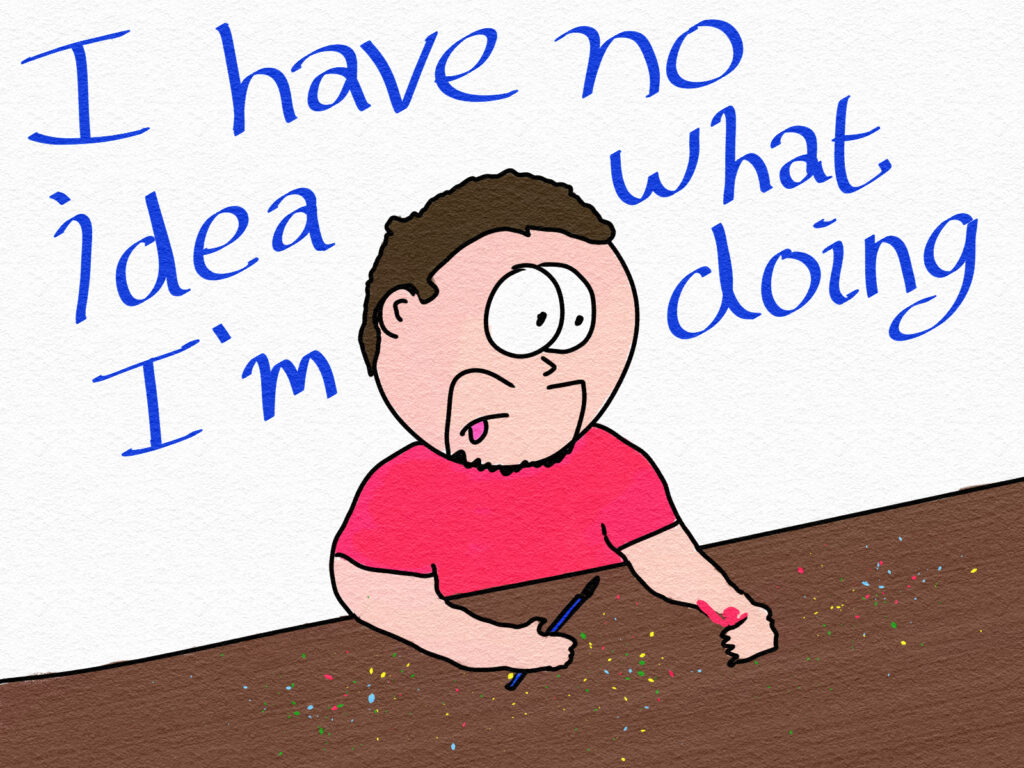
Today I've been doing something that I haven't done for probably 30 years or so: I have attempted to paint some miniatures. As I alluded to a while back, this is a field where "technology" (for want of a better word?) appears to have come on quite a bit in the years since I last tried it, and I was particularly interested in trying out something called "Speedpaint".
Speedpaint is a formulation of paint that, in contrast to the usual thick matt acrylics, is very thin and semi-transparent. You brush it all over a model and the nature of its formulation means that it works its ways into all the little nooks and crannies by itself and naturally darkens and lightens according to the undulations of the model. In other words, it goes darker when it gets into deep cracks, and creates natural highlights in elevated sections.
I was especially interested in trying out the "Speedpaint Markers", which combine the simplicity of Speedpaint with the straightforward, mess-free approach of using a pen rather than a brush and palette. And for the most part I'm very impressed with the Speedpaint Markers; they're a convenient and easy way to get some colour on to a model, and the Speedpaint within them works exactly how it's supposed to, making it easy to create convincing and realistic effects with just a single coat.
I've been painting some of the furniture from HeroQuest today, as these are fairly large pieces that are, for the most part, relatively straightforward to paint. And in doing so, both the strengths and the weaknesses of the Speedpaint Markers have become apparent.
They're great for covering large areas. Painting one of the door miniatures, the tomb, the tables and the stonework around the fireplace was simplicity itself. The paint did its thing and created some nice shadows and highlights with minimal fuss; I found that it needed just a little more than a single coat to look good, but it's still a very quick way to get something painted.
The weakness of the Markers is that although their tips are relatively fine, they're still a long shot from a proper detail brush, and as such it's difficult to paint very fine details with any great accuracy. This means that it's difficult to, for example, paint the books on the bookshelf miniature, or the little bits and pieces scattered around the alchemist's table.
Thus I have concluded that the best approach, for now, is to have both the Markers available for large, simple areas, and some more conventional brushes, paints and a palette around for more fine detail work. This means that I have spent considerably more on this little experiment than I perhaps initially intended — and part of me, the cynical part, suspects that this is how they "get" you — but will hopefully be able to do a much nicer job once I have some more appropriate bits and pieces.
I've enjoyed what I've tried, though. The results I've had with the Speedpaints today are considerably better than the cack-handed attempts with acrylics I did back when I was in my early teens and didn't really have the right brush for the job. In fact, in retrospect, it was not having the right brush for the job that put me off taking things any further; I got frustrated that I felt it was too difficult, and just sort of gave up.
After today's little experiment, I'm keen to have a proper crack at it though. It'd certainly look very cool to have at least some painted minis on the table the next time we play HeroQuest (which, all being well, will be next weekend).
So I guess I'm Someone Who Paints Miniatures now. I suspected that Someone was always inside me, what with the inherently nerdy nature of the surrounding hobby. I've just come to it a little… late, is all.
Want to read my thoughts on various video games, visual novels and other popular culture things? Stop by MoeGamer.net, my site for all things fun where I am generally a lot more cheerful. And if you fancy watching some vids on classic games, drop by my YouTube channel.
If you want this nonsense in your inbox every day, please feel free to subscribe via email. Your email address won't be used for anything else.