#oneaday Day 285: On that thing what Gareth Southgate said

Former England manager and renowned penalty whiffer Sir Gareth Southgate recently delivered the prestigious Richard Dimbleby lecture, as reported by The Guardian (and doubtless some other places, but The Guardian is where I saw it).

The thrust of Southgate's speech was the plight of young men, and how they are, I quote, "feeling isolated, grappling with their masculinity and with their broader place in society".

I agree with this part, though I'd probably broaden it to "most men" rather than just "young men". We are encountering a problem I could have predicted a decade ago: that strides forward in progressive attitudes are leaving some men feeling somewhat cast adrift.

This isn't to say that the broad shifts in progressive attitudes are in any way wrong, I hasten to add, whatever the current United States administration might be attempting to do right now. No, on the contrary, it's good that, on the whole, we have much less sexism, racism, homophobia and transphobia than we used to have. We haven't eliminated any of these problems, unfortunately, but progress has been made.

As part of all that happening, though, there was a certain amount of demonisation of privileged groups in society. Not universally, by any means, and again, I'm not saying that white men deserve to be "better" than anyone else. But for a good decade or more, men have been facing something of an existential crisis as society attempted to "make up" for their historical position of privilege. And this, in turn, has led to things like the loneliness epidemic among young men, the alt-right pipeline and all that business. That's a thing that has happened. The question is why.

Southgate argued that these men "spend more time online searching for direction and are falling into unhealthy alternatives like gaming, gambling and pornography". This quote, unsurprisingly, is the one that has been largely taken out of context and objected to. And I don't disagree with the people who did that. While gambling is hard to defend, I firmly believe there's a place in society for both gaming and pornography, and that neither of them are inherently evil things. The problem, as with so many things, is the groups that spring up around those things.

Which, as it happens, is what Southgate's speech went on to criticise.

"This void is filled by a new kind of role model who do not have their best interests at heart," he said. "These are callous, manipulative and toxic influencers, whose sole drive is for their own gain. They willingly trick young men into believing success is measured by money or dominance, never showing emotion, and that the world — including women — is against them. They are as far away as you could possibly get from the role models our young men need in their lives."

The key nuance that Southgate is missing here is that while some "influencers" (ugh, I hate that word, but I'll use it for the sake of quotations in this instance) in the gaming, gambling and pornography spaces are having a harmful effect on young men's wellbeing, this is not a universal thing by any means. (Again, I'd make the argument that gambling is the hardest to defend here, but even that's by no means a universal negative — look at things like The National Lottery and the charitable organisations attached to them.) I hate to be all "not all [x]", because people seem to take that as you having lost an argument, but it really is the case in this instance.

What he's getting at is exactly what I described above (and back in this post) — disenfranchised young men are finding what they believe to be "role models" in figures like Andrew Tate and Jordan Peterson, who are saying the things they want to hear, and reinforcing harmful attitudes. And these figures "recruit" from fields that young men are interested in — like gaming, gambling and pornography.

The nuance is that gaming, gambling and pornography aren't themselves to blame for the existence of Tate, Peterson and others like them, but rather they just happen to be where figures like that found their most fertile markets. Being into gaming, gambling or pornography doesn't mean you're immediately going to get sucked down the alt-right pipeline into a life of perpetual fury at the world — but I can see how that happens, as I've described elsewhere.

I think it's important to highlight the positives of these things. Gaming, in particular, is probably the fastest growing creative medium in the world, and is a truly democratised form of art. Anyone from a solo independent developer to a huge multinational corporation can make a game, and the market will support that. Granted, it's harder for a solo independent developer to make as much of a splash as a huge multinational corporation with an army of marketing specialists, but it's not impossible — look at stuff like Vampire Survivors and even Minecraft's origins.

Gambling, as I say, is harder to defend, but not impossible. While a gambling addiction can be utterly devastating to individuals and families alike, I don't see the harm in an occasional flutter on the National Lottery, particularly when the money is going to Good Causes™. Sports betting, I'm not even going to try and defend. But you hopefully see my point.

And pornography. While there has always been exploitation and suffering surrounding the production of pornography, today we have a society where sex workers aren't treated as something shameful to be swept under the rug, but where they have meaningful contributions to online discourse, and where the most prolific, uh, performers can make a surprising amount of money, often for just posting videos online. We have artists who focus on drawing pornography as a means of self-expression, or to cater to the tastes of their audience. And that audience gets to explore their fantasies and learn about their tastes in a safe environment.

All of these fields have their negative, toxic ends. "Gamer" discourse surrounding the recently released Assassin's Creed Shadows, for example, shows that we still have a lot of work to do with regard to racism. I don't know anything about the gambling influencer sphere, but it doesn't seem like… something I want to get involved with. And, of course, pornography still has the exploitation element, even in seemingly democratised scenarios such as OnlyFans.

But then… doesn't anything have its toxic element? Southgate's own field of football has its own problems with racism, homophobia, xenophobia, hooliganism and violence, but I don't see him acknowledging that. It feels just a little disingenuous to specifically pick out the things he did in his speech; it's approaching "moral panic" territory, and while there are things we can work on with regard to all of those fields, I don't think it's justified to make blanket statements like "gaming is an unhealthy alternative to having a father figure".

Toxic influencers are a different issue to the games industry in general. The games industry has its own problems that it still needs to grapple with, but it is not a direct, straight line from gaming to Andrew Tate. Southgate argues that "success is about much more than the final score; it isn't a straight line, and it's not a single moment". The same is true for negative cycles, too; you can't point to one single thing and go "that is the cause of all my woes".

For my part, I believe the increasingly abusive practices of algorithm-driven social media are more harmful than anything else when it comes to the situation men find themselves in these days. Because social media is how those harmful messages get out and how they are spread — often with the full approval of the platform holders, because they know the most toxic waste of the Internet is that which gets the most "engagement". But social media is just part of a much more complicated picture, and one we could do well with trying to zoom out and see the entirety of.

Men are suffering. Men are feeling isolated. Men are grappling with their masculinity and with their broader place in society. Gaming and pornography, like anything else, within reason, can be a comfort for those men when engaged with in moderation. They are not the enemy. It is, however, correct to say that toxic "influencers" are a real problem, so that is what we should perhaps be looking at more closely.


Want to read my thoughts on various video games, visual novels and other popular culture things? Stop by MoeGamer.net, my site for all things fun where I am generally a lot more cheerful. And if you fancy watching some vids on classic games, drop by my YouTube channel.

If you want this nonsense in your inbox every day, please feel free to subscribe via email. Your email address won't be used for anything else.
2308: An Open Letter to @wilw About Games as a Lifeline, "Male Tears" and Inexplicable Blocks

0308_001

Hi Wil,

You don't know me, and I don't know you. Apparently I've done something to offend you in the past, though, because you have me blocked on Twitter. I don't know why and I don't know when this happened because as far as I know, we've had no direct interaction on any occasion ever, but I will apologise for whatever it was anyway. I will also express my sincere disappointment that someone I used to look up to as a bastion of what modern nerd culture should aspire to feels somehow threatened or upset with something I've done in the past — threatened or upset enough to simply cut me off from the prospect of ever interacting with him.

I was an avid viewer of many of the Geek and Sundry videos when it first launched — particularly Tabletop, which introduced my friends and I to a number of board games that are still in our regular rotation. Tabletop was an excellent show that gave a good flavour of how the various games played — even if there were occasional bits of fuzzing over the rules in the name of keeping things snappy! — as well as providing a great opportunity for some of the most entertaining, fun people in geek culture to come together and have a good time. A good time that was infectious — so enjoyable was the atmosphere on Tabletop that it felt like the audience was right there with you all, sitting around the game table, rooting for your favourite player to win and commiserating with you when you inevitably came lost. (As the resident person in our tabletop gaming group who perpetually comes last in pretty much everything, I could relate to your position quite a bit.)

On a more serious note, nerd culture in general is something that I've talked a lot in the past about giving me a lifeline when I needed it. In the case of video games, they've provided a constant and much-needed centre of stability in a life that has often been chaotic and beyond my control and understanding; in the case of tabletop gaming, they provide one of the few means of face-to-face social interaction in which I feel completely comfortable, whether it's with close friends or, as it was for me this Friday evening just gone, complete strangers. I think it's the fact that interactions over a tabletop game are, for the most part, clearly structured: it's why I gravitate towards games with clear rules, turn structures and player roles as well as those with strong themes that include flavour text I can read out dramatically to our group. Conversely, those games that require a certain degree of negotiation or freeform interaction are those I feel less comfortable with, since I'm sometimes not quite sure what I'm "supposed" to say.

But all that's by the by; it's just a bit of context of who I am. Needless to say, games of both the video and tabletop variety are extremely important to me; as you said in your keynote speech at PAX East in 2010, "some of the happiest days of our lives would not exist without games and gaming. Games are important. Games matter." I agree entirely, and when I took a risk, flying from the UK to Boston, MA for that PAX East — my first time attending such an event, and only, I think, the second time I'd taken a solo trans-Atlantic flight — I found somewhere that I really felt like I belonged. My life was, at that point, a bit of a mess: my marriage was falling apart — my wife at the time would go on to leave me shortly after I returned from Boston — and I didn't have a reliable source of income. Games gave me a sense of being grounded; somewhere to retreat to when I couldn't face the terror that everyday life at the time confronted me with. Games gave me common ground with which I could interact with other people; games gave me something to talk about, something that I could call "mine".

That time in my life was turbulent. I've had ups and downs since then, and as I type this I'm very much in a "down". Over the years since 2010, I've come to recognise the importance of acknowledging one's emotions, the causes of these emotions and the ways to deal with them. I'm not afraid to cry as I once was back in high school; as someone who sometimes has difficulty expressing exactly what he wants to say verbally, there are times when bursting into tears says more than words ever can; there are others when the act of opening those floodgates allows the repressed emotions to be released in a more controlled manner once you've calmed down a bit, letting you communicate what's really bothering you after the storm has subsided. Crying is important. Crying matters.

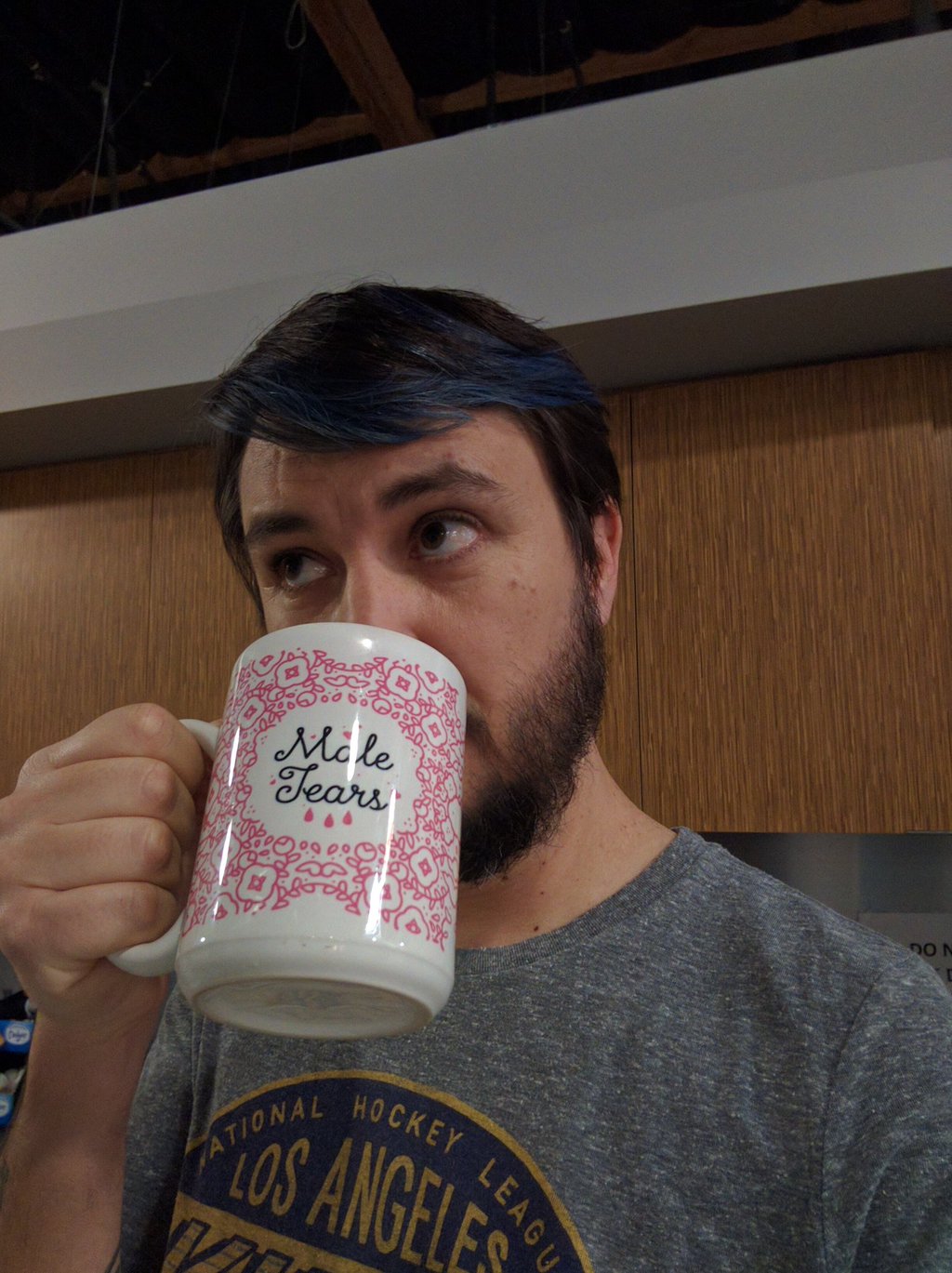
Which is why this image you posted on Twitter bothers me so much:

CiWuwtnUoAEcRkF

For anyone reading this letter who doesn't already know, the expression "male tears" is usually used by the more toxic side of online activism as a means of demonising men — usually straight, white men — when they wish to express themselves. It's largely brought out during arguments between the more militant side of feminism and those — usually, but not exclusively, men — who are tired of all the sociopolitically charged fighting that takes place every day on the Internet, particularly those who fight back somewhat aggressively with foul language, threats and exhortations for people to kill themselves. The "joke", such as it is, is that all this unpleasantness just bounces off the noble "progressive" types — referred to disparagingly by their critics as "Social Justice Warriors" or "SJWs" for short, an epithet which these people flip-flop between absolutely hating and trying desperately to reclaim in the same way black culture has largely reappropriated "nigga" for itself — and is just interpreted as straight, white men crying about something not going their way for once; the fact that "male tears" is written on a mug allows the "progressive" activist the opportunity to drink from it, suggesting that they relish the opportunity to feed on the tears of their enemies.

Pretty unpleasant however you look at it, and while the original intention may not have been to reinforce traditional ideals of what these same people call "toxic masculinity" — stereotypes such as "big boys don't cry" and "be a man for once" — I can't help but look at it that way. Speaking as a (straight, white) man who does cry, isn't ashamed of the fact that he cries and, in fact, has cried quite a bit over the last few months due to his own life situation and the suffering of the person he loves most dearly in the world: to see the idea of "male tears" used so gleefully and indiscriminately as a means of oneupmanship, of proving one's "progressiveness" feels grossly distasteful and insensitive. To have it proudly promoted by someone I once looked up to as almost an idol; someone I thought I could aspire to follow in the footsteps of; someone who proved that a person with my interests could find success and a place for themselves in the world? That just feels like a stab in the back, with a few good twists for good measure.

I don't deserve to feel like that, and I'm pretty certain I'm not the only person who feels this way. Some may express their disappointment and upset with this more eloquently or more aggressively than others, but however they choose to register their discontent and however much or little I agree with their methods of expressing it, I understand it completely. As someone who, now 35 years of age, was often ostracised and ridiculed for his interests and hobbies in his youth, was subsequently delighted when geek culture started to become fashionable over the course of the last decade and most recently has noted with a growing sense of discomfort that the things he finds most relatable, most important to him are those that are getting relentlessly torn down in the name of being "progressive"? It hurts. A lot.

I haven't done anything wrong. I haven't hurt anyone. I just want to be left alone to enjoy the things I enjoy with friends who also enjoy those things, and likewise to leave those who are interested in different things to do what they enjoy. I don't care about this perpetually raging culture war that has all but destroyed meaningful online discourse around video games in particular over the last five or six years, and put a serious strain on a number of friendships. I don't believe in a "one size fits all" approach to inclusivity and diversity, which is what many "progressive" types seem to argue for; I instead subscribe to a "many sizes fit many" ethos, which makes for a more vibrant, interesting and cross-pollinating culture in the long-term. And yet somehow, at some point, I've been branded with a scarlet letter, thrown in the pit with all the other social rejects. I've also been called a paedophile, a pervert, a misogynist and plenty of other things besides. My crime? I like Japanese video games with pretty girls in, and frequently argue against the misrepresentation of these games as soft porn in the mainstream press by those who won't take the time to engage with them.

Frankly, the whole situation makes me want to cry, but now I feel I shouldn't, because it will just, apparently, give you some sort of satisfaction. And that, to be honest, seems like the very inverse of your own credo, your own Wheaton's Law, of "Don't be a dick!"

You almost certainly won't read this, Wil, because having blocked me on Twitter I'm not sure there's any way you'll see it outside of someone you haven't blocked directly sharing it with you, and I don't see that happening. But I wanted to post it anyway; even if you don't read it, hopefully it will bring some sense of comfort to those who feel the same way I do about all this; put some feelings into words; provide a sense of solidarity.

As you argued in your speech, this feeling of solidarity, of belonging, is extremely important. We should all strive to help each other feel like we belong doing the things we love with the people we love in the places we love. With photos like the one posted above, you deliberately block off people from feeling like they can engage with this part of culture they adore, and people they might well otherwise get on with. And whether or not you believe that "male tears" only applies to men who don't know how to behave themselves politely and appropriately, know that it can — and will, and has — been interpreted in a way that just comes across as exclusive, combative and gatekeeping: the exact opposite of what you yourself argue we should aim for.

This whole situation needs to stop, as soon as possible. I hate it. Everyone else I know hates it. Can't we all just get around a gaming table and settle this the old-fashioned way: with dice, cards and chits — maybe even some fancy miniatures?

Thank you for your time, and thanks for reading, whether you're Wil Wheaton (unlikely) or some random passer-by who just wanted to see what I had to say.

Love & Peace
Pete