As a pleasant perk of my job, I get copies of all the Evercade cartridges ahead of when they actually release. Consequently, I have been enjoying the two upcoming Visco Arcade collections for a little while now, and, shush, come over here where no-one will overhear — I think they're my favourite carts this year.
Yes, I know we have some Big Names lined up for the rest of the year, one of which everyone already knows about (The Banjo-Kazooie Double Pack, which is releasing alongside Evercade Nexus in October) and another of which is pretty bloody obvious if you've been paying any sort of attention, even though it hasn't officially been announced as yet. And don't get me wrong, both of those carts are great. I am proud of the immense amount of work we put into them, and I think people are going to have some thoroughly pleasant surprises with them besides just rediscovering some old favourites. (There are also two more carts we haven't talked about at all yet, which are also going to be a fun time.)
But Visco Arcade 1 and 2? These carts reflect one of the main reasons I, personally, got into Evercade in the first place: the celebration and enjoyment of weird and wonderful stuff that I've never heard of before, and which has never seen official rereleases for one reason or another. (That's not quite true in the case of the Visco games, in that current rights holder PixelHeart sells NEOGEO cartridges, but the ability to enjoy those is dependent on you owning a working NEOGEO, which is… not something a lot of people have just lying around… although it will be interesting to see what effect, if any, the upcoming NEOGEO AES+ has on the market. But I digress.)
Anyway, yes. Visco Arcade 1 and 2 are both jam-packed full of games I'd mostly never heard of prior to working on the cartridges, and which are now titles I find myself playing and enjoying quite a lot. I'd previously come across the shoot 'em up Andro Dunos and the fighting game Breaker's (although we all learned recently about the apostrophe in the name, which is seemingly not common knowledge despite it being right there in the logo) and I also knew the Drift Out series by reputation (if only because everyone always mistakes Gaelco's excellent World Rally series, which is on Evercade too, for Neo Drift Out) but the others? Brand new to me.
Helicopter shoot 'em up action in Ashura Blaster! Time-travelling jet fighter shoot 'em up fun in Asuka & Asuka! Triple weapon space blasting in Galmedes! Driving a definitely-not-Volkswagen Beetle around mazes and hunting for treasure in Maze of Flott! Hacking and slashing Sengoku-style in Ganryu! Delightful, one and all.
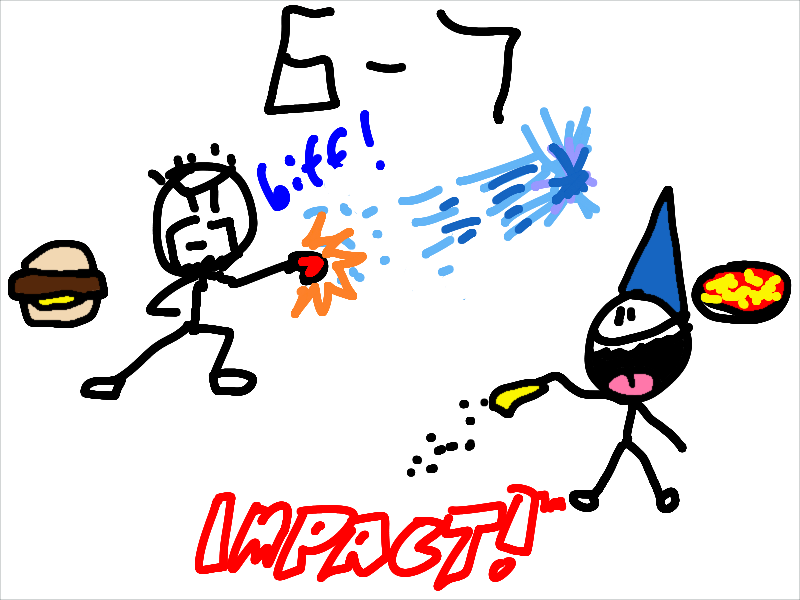
Two of my favourite discoveries are Battle Flip Shot and Bang Bead, two games that are effectively evolutions of Pong, in which you control colourful anime-style characters and try to knock down targets behind your opponent. I partly like these because they're just simple, fun, well-presented arcade games — and I suspect they'd be great with a friend — but I mostly like them because they remind me of a Klik and Play project my friend Edd made once, which he dubbed Impact!
Impact! was a game in which two of the default, included sprites from Klik and Play — "Merlin" and "Street Puncher" — faced off against one another on a top-down representation of a tennis court. They then proceeded to knock an energy ball back and forth, each attempting to hit the item of fast food behind their rival in order to either score points or deplete the opponent's energy bar, I forget which. I believe Street Puncher guarded a hamburger, while Merlin guarded a pizza, though it may have been the other way around. There were lots of burping and farting noises, and it was an endearingly stupid, completely unbalanced but enormously fun way to while away an afternoon with a friend.
I couldn't stop myself from laughing when I booted up Battle Flip Shot for the first time and realised what the game was. "This is just Impact!" I said to myself, realising that there was absolutely no-one around who would have any idea whatsoever what I was talking about. That made me a bit sad, but mostly I smiled at the good memories, and consequently both Battle Flip Shot and its fairly similar (but notably different) successor Bang Bead suddenly became quite special to me, despite me only learning about them relatively recently.
In fact, if I think about the dates we were most likely fiddling with Klik and Play — between 1997 and 1999, during our time at sixth form, primarily — it's entirely possible that Impact! did, in fact, predate Battle Flip Shot, which came out in 1998. And certainly none of us were playing NEOGEO at that time; around then, the NEOGEO was a mythical beast, spoken of only in hushed tones in multiformat games magazines, and we didn't have any arcades anywhere near us to go play an MVS cabinet, either. So Edd's creation was all original do not steal.
I have idle thoughts of trying to get The Old Gang™ back together for some sort of Event that will likely involve drinking, cake and video games. I am also not entirely sure how to go about organising such a thing, as there are several members of said Old Gang I have not spoken to, let alone seen, for many years at this point. But that is, at least partly, why I think it would be fun to get everyone together and have a drunken Battle Flip Shot tournament. And see how long it takes Edd to notice that we're really just playing Impact! – Pro-Gear Spec Edition.
[Obligatory note, since I am talking about Work Stuff: the above is my opinion and my opinion alone, and does not reflect or represent the views of my employer and all that guff.]
Want to read my thoughts on various video games, visual novels and other popular culture things? Stop by MoeGamer.net, my site for all things fun where I am generally a lot more cheerful. And if you fancy watching some vids on classic games, drop by my YouTube channel.
If you want this nonsense in your inbox every day, please feel free to subscribe via email. Your email address won't be used for anything else.

 [Side note: Day 100! Yay. This marks my 448th day of blogging every day. I've been half-tempted to start numbering the posts from when I originally started again, but then that will just get confusing. Perhaps I'll put the total number at the end of each post or something. I don't have an eventual goal number in mind—I fully intend to keep doing this until I can't do it any more, for whatever reason. But given that I continued writing through the disastrous events of last year, it'll take something pretty severe to stop me being here every day. Now, on to your regularly scheduled blog post.]