
At least, I hope this is peak idiot: I present to you an actual article that appeared in the actual business section of the Washington Post, which sported the headline "Is your dog's Halloween costume sexist?"
No. No, your dog's Halloween costume is not sexist. It is a costume for a dog.
Between this and Vice's recent monstrosity of an article about Forza Horizon 3, in which the writer proceeds to spend 1,500 words using the Australian setting of Forza Horizon 3 (a game about nothing more than driving pretty cars very fast around pretty scenery) as an excuse to go off on a tirade against Australian politics in general (actual specific references to the game come in just two out of the article's 13 paragraphs), it's hard to imagine if online journalism can get any worse. It's even harder to imagine exactly why there are people out there who still defend this kind of garbage.
I've been continuing to read old back issues of Page 6, Atari User, ANALOG, Antic and ACE recently, and one thing that repeatedly strikes me whenever I read any of these magazines is that the writers know their audience because they are part of that audience. And in the case of all those magazines, that audience is computer enthusiasts; who better to write for them than fellow enthusiasts? Should be a no-brainer, surely.
Nope; instead we get dross that reads like it was written by a recent Social Sciences graduate and which inevitably takes a negative tone of some description — usually of the "Here Are All The Reasons You Should Feel Bad for Liking the Things You Do" variety — rather than performing what, I believe, is a much more valuable function: bringing people together under the banner of the things they love, celebrating those things and perhaps teaching them some intricate, specialist details.
Take the old Atari magazines. Every single one of these, without fail, opened its first issue with a comment from the editor about how Atari computers are far more than just the games machines that people at the time apparently assumed they were. The stated aim of Page 6, ANALOG, Antic and Atari User alike was to explore the length and breadth of titles available for the Atari computer, teaching enthusiasts new things along the way. These old magazines had type-in BASIC listings with full breakdowns of what was happening where in the program, memory maps of the computers so you could learn to program in machine code, special techniques that could elevate your programming from "eh" to "wow!" and all manner of other stuff.
The most negative things ever got was in the editorial section, where editors would occasionally vent their spleen about Atari's repeated failures to market their own products, or about how they had been let down by industry contacts. This was always framed as an explanation of why, say, the issue didn't have a feature that readers might expect, rather than being the sole point of the article. The articles themselves were all positive in tone, often educational and far less frustrating to read than the daily garbage modern online journalists seem to be expected to churn out to order.
Times have changed, of course. Magazines used to be published monthly or, in some cases, bi-monthly. Internet publications are expected to be updated on a daily basis, otherwise they are seen as "irrelevant" and "not up to date". With the amount of pressure on Internet writers, it's little surprise that they pluck something out of their arse that they know will "get people talking" (i.e. is contentious for one reason or another) rather than spending the time to do proper research or to enthuse about the things they are passionate about.
There's too much negativity in the world as it is, and it's coming from all angles: both traditional media and social media. Negativity begets negativity, and the longer it goes on, the more cynical we get. We're at a stage now where many people simply don't trust the online press to cover things as an enthusiast would, and that's going to be hard to recover from. Meanwhile, the Men In Suits see outrage-bait like the articles linked above as "successes" because they bring in the clicks and consequent advertising revenue.
Advertising impressions lie, however. An impression on an article in the commercial press doesn't mean someone liked what the author had to say. More often than not, it's the result of someone having a look at an article out of sheer disbelief that someone really wrote an article about dogs' Halloween costumes being sexist, or about how Forza Horizon 3 depicts a "better Australia than [Australians] deserve".
I wish it were possible to just make this mess stop, and for us all to go back to a world where enthusiasts write about the things they are knowledgeable about rather than everyone, everywhere trying to make everything somehow "political". There's a time and a place for politics, and, unless you are reviewing a game that deals with political issues — either through its narrative or its mechanics — then that place is emphatically not in the games press. Certainly not in an article about a driving game; and certainly not in an article about a driving game that exists solely to revel in the sheer joy of driving.
Also, you can dress your dog up however the fuck you like so long as you're not hurting it. Make it extra slutty, take loads of photos for Facebook and immediately unfriend anyone who whines about sexism. You don't need dickholes like that in your life.



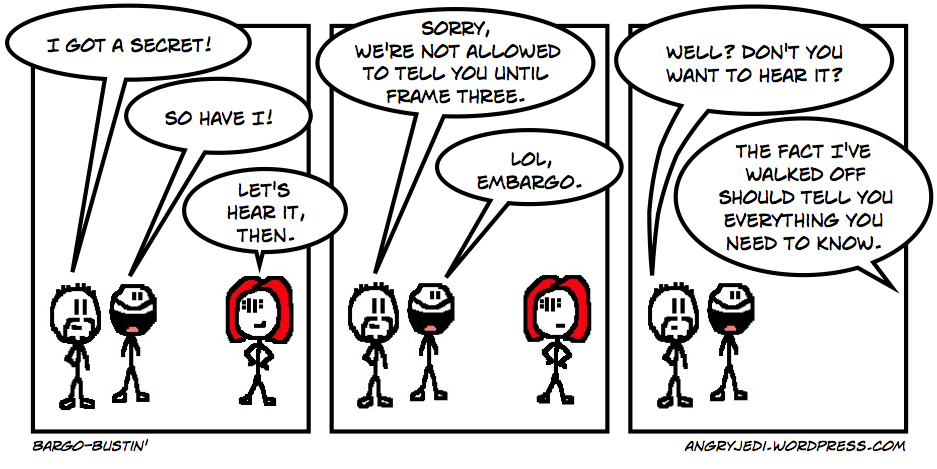 This won't be news to any of you, but sometimes in the games industry, you find out things and you're not allowed to talk about them. The technical terminology for this is an "NDA" or non-disclosure agreement, or an embargo preventing publication of something until a particular time.
 Earlier today, a story broke that divided opinions somewhat. The point and content of the story at this stage isn't especially important or relevant to what I'm particularly interested in right now, but the gist of the arguments that people are having is that it was a report based on anonymous sources that sounded like "just another rumour".
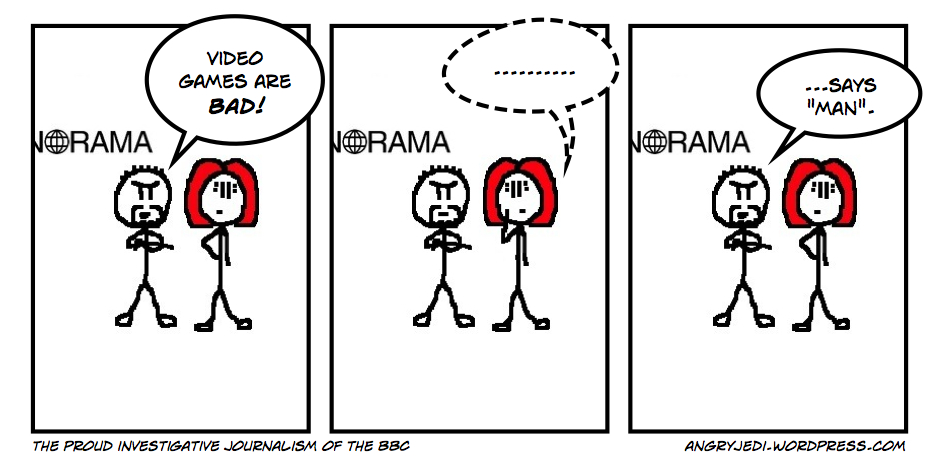 An hour ago, the BBC aired an episode of Panorama, our go-to investigative journalism programme, on the subject of video games. The subject, predictably, was the ever-present "are video games addictive?" question that has been raised and not answered many, many times prior to now.
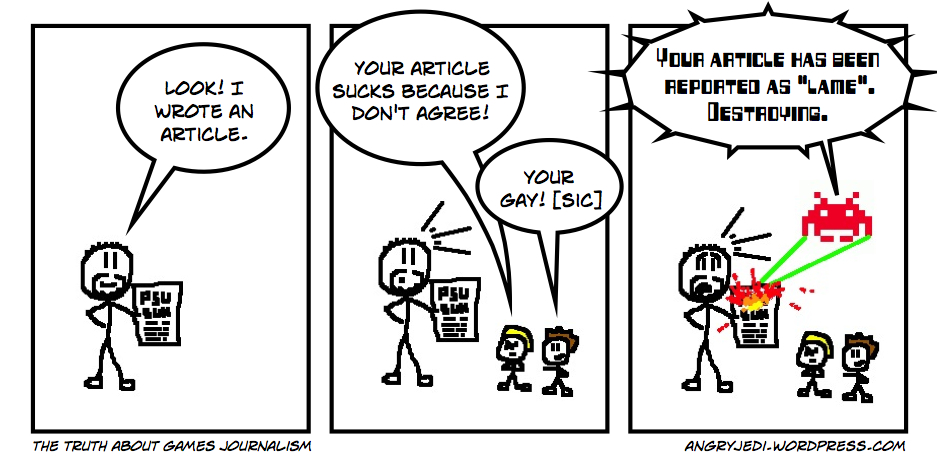 There is an increasingly popular—and increasingly worrying—tendency for games journalism and writing about games (which some people are keen to point out are two different things) to be judged as "broken" or "lame".
 Yes, you have read that correctly; one of the options for reporting an article as unworthy of appearing in the N4G news feed is that it is "lame".