#oneaday Day 703: Peepo!

I finished a rewatch of Peep Show the other day, confirming for myself that I had indeed never watched it right to the end. Now I have, and I came away from it with some thoughts that I wanted to share, so that's what I'm going to do today.
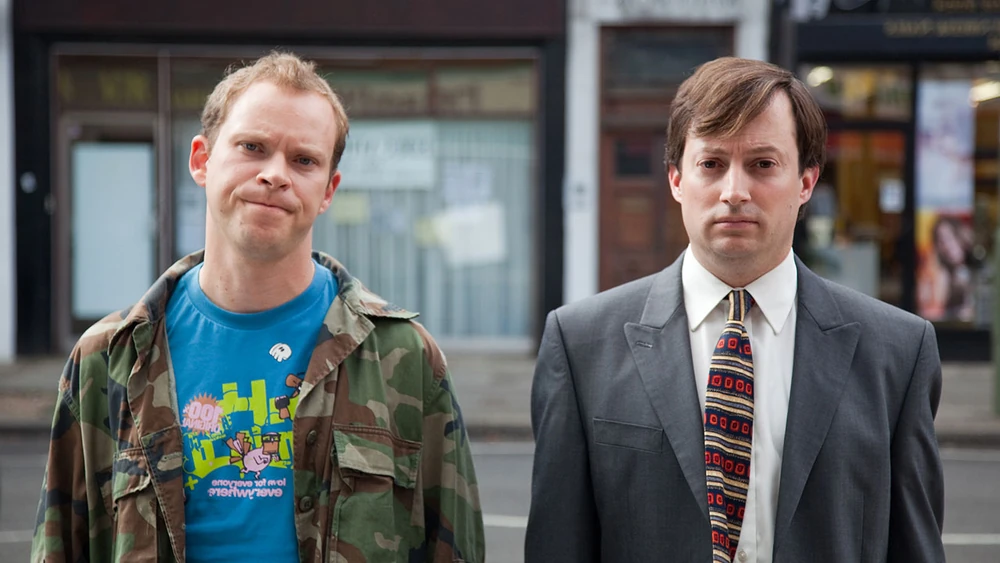
Peep Show, for the unfamiliar, is a Channel 4 comedy show starring David Mitchell and Robert Webb, written by Sam Bain, Jesse Armstrong and Andrew O'Connor, with occasional contributions from Mitchell and Webb themselves. It's the show that put Mitchell and Webb on the comedy map for many people, and is noteworthy for its main gimmick of being shot entirely in "first-person" from the perspective of the various characters, including the occasional ability to hear their thoughts — hence the name. We're getting to "peep" into the most intimate parts of their lives, including their private thoughts, in a way that simply isn't possible in "reality".

From the beginning, Peep Show sets itself up as a show where its two main characters are heavily, heavily flawed. Mitchell's Mark Corrigan character is stuffy, socially anxious, nerdy and, at times, rather arrogant, while Webb's Jeremy Usborne is also arrogant, albeit in a different way, self-obsessed, selfish, unambitious and, at times, borderline deluded about the possible directions his life could go in.

Early in the series, one could argue that Mark is somewhat set up to be the "protagonist" of sorts, since much of the ongoing storylines follow his attempts to woo his work colleague, Sophie. As time goes on, though, the show becomes more generally about how both Mark and Jeremy find themselves on their own separate pathways towards self-destruction, each coming at the concept from a different direction. Mark approaches it from the angle of repeatedly fucking up the genuinely good things that happen in his life, while Jeremy's obsession with drugs, alcohol and sex to the almost complete exclusion of building a "normal" adult life makes his trajectory clear pretty early on.

In many ways, Mark and Jeremy are polar opposites, but they are also a lot more similar than they would care to admit. And, as the show progresses, one comes to realise that perhaps the "El Dude Brothers" perhaps aren't as close friends as they thought they were; indeed, the very last line of the show comes from Mark, looking at Jeremy, reflecting on the many trials and tribulations they have both faced — and inflicted on one another — and thinking "I simply must get rid of him". The implication, of course, is that Mark will never be able to get rid of Jeremy — not because the pair of them are incredibly close friends, but because they're stuck with one another, thanks to each other's most awful tendencies having rubbed off on each other to an exceedingly unhealthy degree.

Thus one could probably say that Peep Show is about toxic masculinity. And indeed there are plenty of examples of that throughout the show, with the main ones being Mark's erstwhile boss, Alan Johnson, who is an obnoxious "alpha male" business leader type — although later shown to have enjoyed success primarily through luck and charisma rather than actual talent — and Jeremy's friend "Super Hans", who in many ways is far more fucked up than Mark or Jeremy will ever be — though at times he does seem to have his shit together a lot more than the pair of them.

Interestingly, though, neither Mark or Jeremy are examples of toxic masculinity in quite the same way. Jeremy likes to talk a big game and make out that he's always getting women, but we see repeatedly throughout the show that he is completely incompetent in developing close interpersonal relationships. Mark, meanwhile, has aspirations for a while of being a big balls businessman like Johnson, but over time comes to accept that he is, at heart, a fairly unremarkable person — and that that is not necessarily a bad thing.

To be sure, the pair of them do engage in behaviour that is plenty toxic, often in the name of pursuing masculinity. But a lot of the time they do this for the sake of living up to a misguided sense of "ideals" rather than because they actually feel that way. Neither of them have a clue how to navigate the challenges that life repeatedly confronts them with, and neither of them really know how to be a stereotypical "man", in terms of the unattainable ideal they both have in their minds. And this leads them both down destructive paths that ultimately bring them both to their own downfall — multiple times.

But Peep Show isn't a bleak tragedy. While I'm sure many people watching the show do feel a bit bad for Mark and Jeremy, particularly by the time the final episode rolls around, the central duo are, at their core, figures to laugh at. The show is a comedy because the situations they keep getting into are so ridiculous, but I think a lot of the humour lands because it's plausible. You can picture people you know going down some of the roads that both Mark and Jeremy fling themselves headlong down. You might even have broken off friendships with similar degrees of toxicity that the pair of them demonstrate.

It's a cautionary tale in many ways, then. Neither Mark or Jeremy are "villains" as such, nor are either of them fundamentally "bad people". But one thing Peep Show demonstrates more than anything else is that it is very easy to find yourself circling the drain if you don't make at least a bit of an effort to get your life under control — and that, as you grow older, if you don't find a good balance between "things that make your life better" and "things that make you feel good in the short term", where those two things are seemingly in conflict with one another, you will almost certainly find yourself bitter, twisted, and if not alone, then certainly stuck with someone who is bad for you, and that you will never, ever be able to get rid of.

A downer ending? Perhaps. But it was perfect for the story the show was telling. It would have been easy to give everyone on the show a "happy" ending for the final episode, but as harsh as it sounds, I'm glad they didn't get it. They got the ending that they deserved — and that has pretty much ensured I will remember the way things concluded a lot more vividly than if everything was all neatly resolved and tied up with a little bow.


Want to read my thoughts on various video games, visual novels and other popular culture things? Stop by MoeGamer.net, my site for all things fun where I am generally a lot more cheerful. And if you fancy watching some vids on classic games, drop by my YouTube channel.

If you want this nonsense in your inbox every day, please feel free to subscribe via email. Your email address won't be used for anything else.
2492: Fresh Meat

0492_001

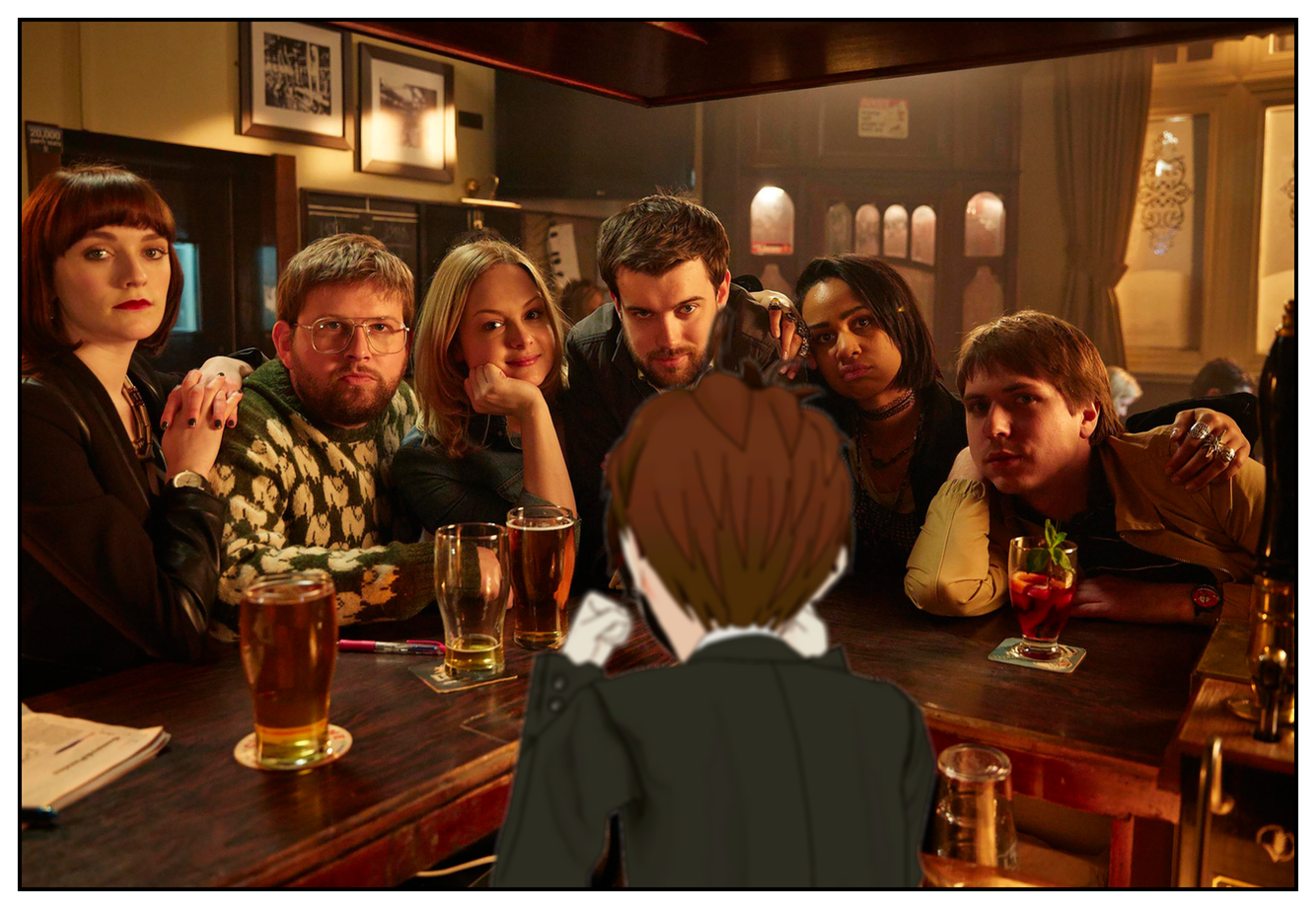
Fresh Meat is a show by Jesse Armstrong and Sam Bain, of Peep Show fame. Across four seasons, it concerns the lives of a houseful of university students from their initial arrival at university through to the end of their final exams.

I remember watching the first few episodes of the first season and really enjoying it, but for one reason or another I never finished watching that season. More recently, however, I've been watching the complete run on Netflix and enjoying it a great deal; much like one's university life, it evolves and changes over the course of the three years/four seasons, but it manages to maintain enough coherence throughout to feel like a convincing serialised story rather than simply an episodic comedy-drama, which it could have easily turned into.

Part of the reason for its feeling of coherence is the fact that it managed to keep its core cast together for the entire run, and said cast is an excellent lineup. All of them are flawed to one degree or another, but none of them are so far beyond redemption as to become dislikeable. On the contrary, the show frequently demonstrates that behind prominent displays of bravado, there is often someone crying for help or struggling to express themselves.

One of the first characters we see in Fresh Meat is Greg McHugh's portrayal of Howard. His first appearance is wearing only a jumper, no trousers or underpants, and drying some dead poultry on a washing line across the kitchen using a hairdryer. It would have been easy for the show to keep Howard as a deranged character, only coming out for comedy relief or gross-out factor, but even within the first episode, we quickly see that he's been designed with a lot more thought behind him. Across the entire run, Howard actually becomes a character that it is easy to sympathise and empathise with, since in many regards he's the character who makes the biggest strides outside his comfort zone — particularly with regard to social situations and taking perceived "risks" like asking a girl he likes out — and who manages to pick himself up repeatedly after numerous setbacks.

Zawe Ashton's portrayal of Vod is also noteworthy, as Vod initially comes across as an arrogant, dislikeable young woman with an attitude problem. Her abrasive edge doesn't dull throughout the entire run of the series, keeping her as a formidable person that most people would probably find tough to get close to, but piece by piece, we start to understand the difficulties she's endured through her life and why she has ended up as the person she is. Most people probably won't end up liking Vod as such, but we certainly understand her pretty well and can sympathise with her by the series' end.

Kimberley Nixon's Josie subverts the "sensible girl" trope often found in series of this nature. While initially appearing to be the cast member who has it together the most among the group, Josie's character goes into a downward spiral early in the series, succumbing to a combination of alcoholism, stress and depression that sees her getting kicked off her dentistry course for drunkenly putting a drill through a woman's cheek, moving to Southampton, moving back to Manchester in the hope of a relationship with fellow cast member Kingsley, and from there seemingly repeatedly sabotaging her own potential for happiness. Outwardly, Josie is one of the most cheerful, optimistic-seeming characters, but as the show progresses, she becomes one of the most tragic figures in it.

Joe Thomas' depiction of Kingsley initially appears almost identical to his portrayal of Simon in The Inbetweeners — mostly due to his trademark rather sardonic delivery — but over time Kingsley becomes a distinctive character in his own right. Whereas Simon was fairly aloof and detached from the idiocy of the rest of the group in The Inbetweeners, Kingsley becomes a character who consistently tries too hard and often finds himself coming a cropper as a result. His relationship with Josie is initially set up to be the "Ross and Rachel" of the show through its on-again, off-again nature, but in the latter seasons in particular it becomes clear that the two are simply not right for one another. Kingsley repeatedly puts across the impression that he desperately wants to "grow up" but isn't entirely sure how, with his attempts ranging from developing an interest in composing his own rather emo music to growing an ill-advised and rather pathetic soul patch. His desires are perhaps most explicitly demonstrated in the final season, when he gets together with an older woman and is initially ecstatic about the prospect, even when it becomes abundantly clear that she is not going to treat him well.

Charlotte Richie's portrayal of Oregon is one of the strongest performances in the show, ironically because of how understated a lot of her delivery is. Oregon, or Melissa as she's really called, desperately wants to appear cool and it's immediately apparent from the outset that she's attempted to "reinvent" herself for university life after a privileged upbringing. She has a habit of getting drawn into positions that initially seem like a good idea at the time, but which quickly turn sour. In the first season, this is exemplified through her relationship with her English tutor Professor Shales; in the final season, we see her mount a successful campaign to become Student Union president only to be lumbered with massive debt, impending legal action and the realisation that she's little more than a "ribbon cutter" for the people who actually have power. To her credit, Oregon always tries to fight her way out of these situations and is often successful in doing so; while the adversity she encounters throughout the series is usually of her own creation — perhaps deliberately so, given the life of privilege she grew up with — she doesn't ever buckle under the pressure, and usually comes out stronger and having learned something from her experiences. Of all the characters, she's probably the least overtly "tragic" in one way or another; in many ways, she becomes the most admirable after initially being one of the biggest fakers there is.

Finally, Jack Whitehall's depiction of J.P. largely consists of Jack Whitehall playing an exaggerated version of himself, but it really works, at least partly because J.P. is written as more than a one-dimensional "posho" laughing stock of a character. Over the course of the four seasons, we come to understand J.P. as a deeply confused, conflicted young man who doesn't understand how the world works — like Oregon, he grew up with a life of privilege, but unlike her, he initially makes no attempt to reinvent himself, instead preferring to try and solve his problems by throwing money at them. In an early episode, he learns the folly of this approach when he gets taken advantage of to a ridiculous degree by his former schoolmates, and from here his growth as a character begins. Each time he proclaims that he wants to have "a large one" or that he is desperate to be regarded as "a legend", it rings a little less true; inside, he's a man who sees his future looming ahead, but he can't see what lies beyond the veil at the end of his university life. That's a scary feeling, and not just limited to university students; J.P.'s struggle to understand how life as a whole works is something that a lot of us can relate to.

All in all, Fresh Meat is an excellent (if occasionally mildly unrealistic) look at student life in the early 21st century. It captures both the soaring highs — the excitement of meeting new people and striking up relationships that may last the rest of your life; the nights out that seem like the most enjoyable, fun times ever — and the crippling lows — mounting debt; loneliness; the uncertainty of your (and everyone else's) future — and in the process manages to depict a collection of flawed but interesting, likeable characters as they work through one of the most turbulent periods in their respective lives.

#oneaday Day 631: Meaty Goodness

A lot of people, both inside and outside the UK, assume that the best TV comes from the BBC. Sure, Doctor Who is great and there have been some great drama series from our publicly-funded friends over the years, but on balance, it's clearly Channel 4 that has the best stuff.

Spaced, Black Books, Brass Eye, Peep Show — there's a veritable plethora of excellent shows out there, most of them in the comedy genre, and the vast majority of which involve –and are written by — the same people.

The latest Channel 4 show to be up and coming is Fresh Meat, a new show from the creators of Peep Show. Peep Show is known for featuring that uniquely British brand of uncomfortable humour, and Fresh Meat continues that tradition suitably aptly, though with something of a more surreal edge at times.

The show is based around a small ensemble cast of first-year students, and is mostly set in their shared house where they've been thrown together as tends to happen in the early days of university. The setup is perfect for some character-based comedy, and writers Jesse Armstrong and Sam Bain take full advantage of this fact. The characters have some great chemistry between them, and each of them is just bizarre enough to be memorable without crossing the line into complete stupidity. Highlight of the show has to be Howard, a Scotsman of indeterminate age who has lived in the shared house for longer than he perhaps should have. Howard is introduced drying off some chickens (if I remember correctly) with a hair-dryer, while not wearing any pants.

Ironically, throughout the subsequent episodes, it's Howard that turns out to be, if anything, the most normal, sensible of the characters. Man-eating Vod regularly overindulges in various chemical substances and isn't quite aware of what she's doing; Oregon is self-consciously trying not to be lame (and ends up regularly cracking those jokes that no-one ever laughs at); Josie and Kingsley have an infuriating will they-won't they relationship and Jack Whitehall's JP character is endearingly obnoxious.

If nothing else, it's nice to see a show based around a cast of students which doesn't take itself too seriously. It's all too easy for shows to get caught up in interpersonal relationships and betrayal and whatnot, and before you know it you're Hollyoaks. And no-one wants to be Hollyoaks. Thankfully, Fresh Meat is not Hollyoaks.

It's early days for the new show as yet, but early indications are promising. It's amusing and filled with entertainingly puerile gags in a Peep Show/The Inbetweeners sort of style, but has a good sense of an unfolding plot, strong characters and a pleasing cameo appearance from Robert Webb.

If you haven't had a chance to check out the show yet, UK residents can catch up with it on YouTube.