Okay. I mentioned it yesterday, so I may as well talk about it today, since apparently I'm on an "old TV" kick at the minute. Pages from Ceefax, right? It's something that I sometimes find hard to believe was actually broadcast on television, but the evidence is out there.
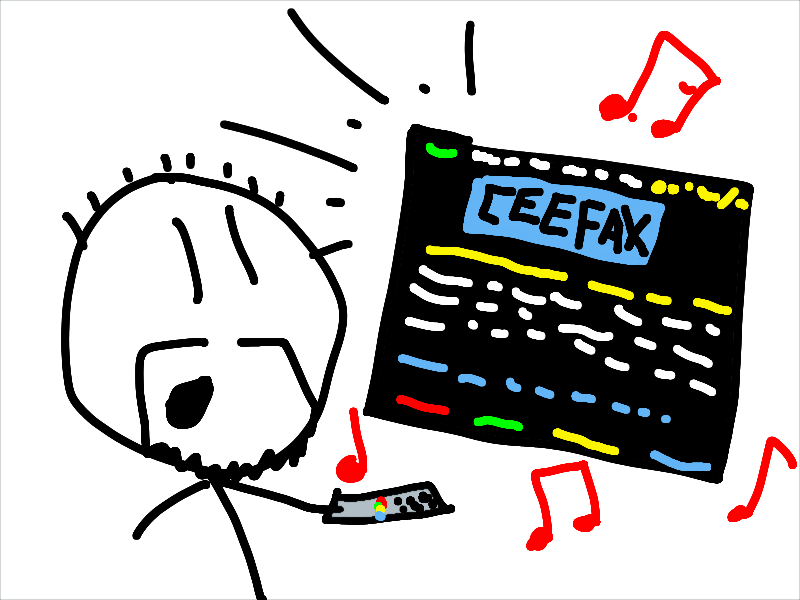
For the unfamiliar, Ceefax is the name for the teletext service that was available on the terrestrial BBC TV channels, BBC1 and BBC2. Over time the distinction between the two channels' service developed in such a way that you looked on BBC1 if you wanted to find something out quickly (they eventually managed to make the "page seek" on BBC1 work faster) while on BBC2 you'd get more in-depth material. This was in keeping with the channels' main remit; BBC1 had all the mainstream, primetime programming on it, while BBC2 had more niche-interest, specialist or cult favourite shows. And lots of Star Trek repeats, like, all the time.
I realise there may be a few of you reading this who don't even know what teletext was, since it's not been A Thing for most of the world for a while now, but basically it was an information service you could access through your television using your remote control. You'd press a button to switch from live TV to teletext mode, and the programme would continue in the background as just audio while you entered a world of coloured text and, occasionally, extremely low-resolution pixel art. Some TVs provided the ability to "mix" the teletext and TV programme, so anything that was blank, black space normally would allow the programme to show through. It wasn't a terribly practical means of either watching a TV programme or accessing teletext, but it was nice that the option was there.
Anyway, the interesting thing about the various forms of teletext, including Ceefax, was that you could type in a number on your TV remote and it would take you to that page, allowing you to browse through information in a non-linear manner many years ahead of domestic Internet access becoming commonplace. Okay, there were limitations, probably chief among which was how most "pages" on teletext services were actually made up of multiple sub-pages, and you had to wait for them to cycle around rather than be able to browse them completely freely. For a practical example, if you were looking at what's on TV this evening and when the page came up it was only showing things late at night, you'd have to wait for it to cycle back around to showing what is on currently and up next, rather than just being able to immediately call up that information.
But! You might ponder at this point: what about people who do not have a television that can access teletext services, or which they have lost the remote control for? Well, never fear, for Pages from Ceefax is here! This is a chunk of time that the BBC carved out each day specifically for showing a selection of… well, pages from Ceefax, accompanied by some delightful elevator music. You'd normally get things like the news headlines, the weather, maybe the sport. Things that normal people might be interested in. It didn't tend to delve into more "magazine-esque" features or special-interest areas; if the legendary Digitiser had been on Ceefax rather than Oracle or Teletext with a capital T (which were the teletext services that were on the terrestrial TV channels ITV and Channel 4) it probably wouldn't have come up in Pages from Ceefax.
And, I mean… that's a bit weird, right? You would think that the BBC would want to fill up its timeslots with actual programming, rather than a clunky text-based interface that was designed to be interactive, but which was not, in fact, interactive at all when it was broadcast as part of the linear TV signal. But, like the "Follows Shortly" slides we saw yesterday, I guess Pages from Ceefax provided the opportunity for things to happen behind the scenes. Perhaps it's during Pages from Ceefax that continuity announcers swapped over, or had a break, or something like that.
It definitely broadcast when there was no other programming planned, such as before the first programme of the day or late at night, but I have definite memories of it coming up in the middle of the day, too. Like the "Follows Shortly" slides, I found Pages from Ceefax frustrating and boring as a child, but now I am oddly nostalgic for it.
Thankfully, as with literally everything you might be nostalgic for, you can recreate the Pages from Ceefax experience for yourself right now in various ways. Firstly, there's this delightful website, which presents today's headlines in the style of an authentic Pages from Ceefax broadcast, complete with optional music.
Then there's a whole channel devoted to the full playlists that were used for the various Pages from Ceefax broadcasts, an example of which you can enjoy right here:
Anyway. Yeah. That's that. Pages from Ceefax. Stupid. Pointless. Annoying. A waste of time that could have been used for more interesting programming. And yet I miss it. How strange.
Want to read my thoughts on various video games, visual novels and other popular culture things? Stop by MoeGamer.net, my site for all things fun where I am generally a lot more cheerful. And if you fancy watching some vids on classic games, drop by my YouTube channel.
If you want this nonsense in your inbox every day, please feel free to subscribe via email. Your email address won't be used for anything else.