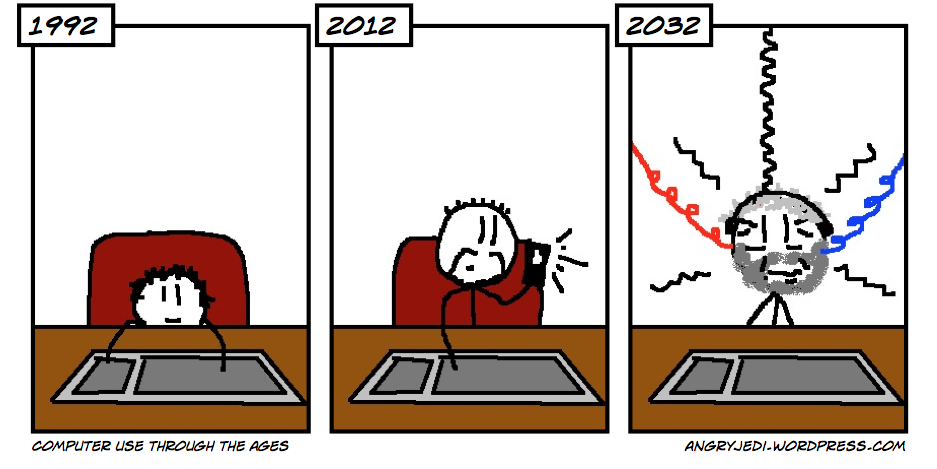
1306: Mark Book

My brain occasionally lapses into childhood when I contemplate looking at comment sections, because, as full of cretins as they sometimes are, comment sections are the modern-day equivalent of the red (sorry, green — red's too aggressive) pen scribblings your teachers would scrawl after your assignments at school.

Imagine if the two scenarios were reversed, though. That'd be weird, wouldn't it? Get your maths homework back with "lol fake and gay" written after it; read a New Statesman article and discover the entire comment section is nothing but people writing variations on "You have the beginnings of a good argument here, but your overuse of the word 'problematic' displays a disappointing lack of creativity that ultimately hurts the piece's credibility. See me to discuss."

Actually, I think in the latter case, that'd probably be preferable, to be honest.

I joke, but I do genuinely feel like I'm being "marked" when I see that there are comments on things that I've posted. In some senses, when you put something up for public perusal — particularly on something with a wider audience than this teeny-tiny personal blog — you are being marked, particularly if you've written something contentious.

A lot of writing on the Web is designed to persuade people of something or other, whether that's that the reader should go and buy Gone Home (you probably should) or that the art in Dragon's Crown is going to bring about the downfall of society as we know it (it's probably not), and as such when someone feels compelled to leave a comment, they're going to be going through your arguments, deciding whether or not they agree with them and then leaving their "judgement" on the piece. If someone agrees with you, it's like getting a nice big tick, a "Good." and a gold star; if someone disagrees with you — particularly if they do so aggressively — it's like not only having a lengthy teacher comment that you hope your parents don't catch a glimpse of, but it's like having that comment publicly read out to the rest of the class.

Except there's one key difference between comments and marks — comments are (theoretically, anyway) a dialogue; marks from your teacher are a one-way thing. (At least they were when I was at school; I wouldn't be at all surprised if modern education invited pupils to "respond" to their teacher's comments and/or "appeal" if they didn't feel they'd been treated fairly.)

That's a pretty big difference. Even if someone gives you a "bad grade" through a negative comment or a complete disagreement/dismissal of your opinion, you can attempt to engage with that person and start a conversation. Sometimes interesting discussions can arise; other times, utterly pointless shouting matches can result, leaving you wishing you'd never written the fucking thing in the first place.

Are comments valuable? There's no easy answer to that question. I don't think they're valuable in all circumstances — it's extremely rare to find a helpful YouTube comment, for example, and comments left on Facebook are 95% pointless, regardless of whether they're left on personal posts or adverts — but at other times they can be the source of thought-provoking discussion and even the fostering of friendships. (Comments on this site have certainly fallen into that latter category, which I'm happy about, and over on USgamer we've mostly enjoyed respectful, well-considered discussion and debate from our commenters so far, which is immensely encouraging to see.)

Would the Internet be a better place without comment sections? Quite possibly; but it would also remove a lot of the ability to converse and engage with things that we take for granted today. So, for better or worse, they're clearly here to stay.

Just remember to give your favourite writers a good mark every now and then!
1214: Inner Sanctum

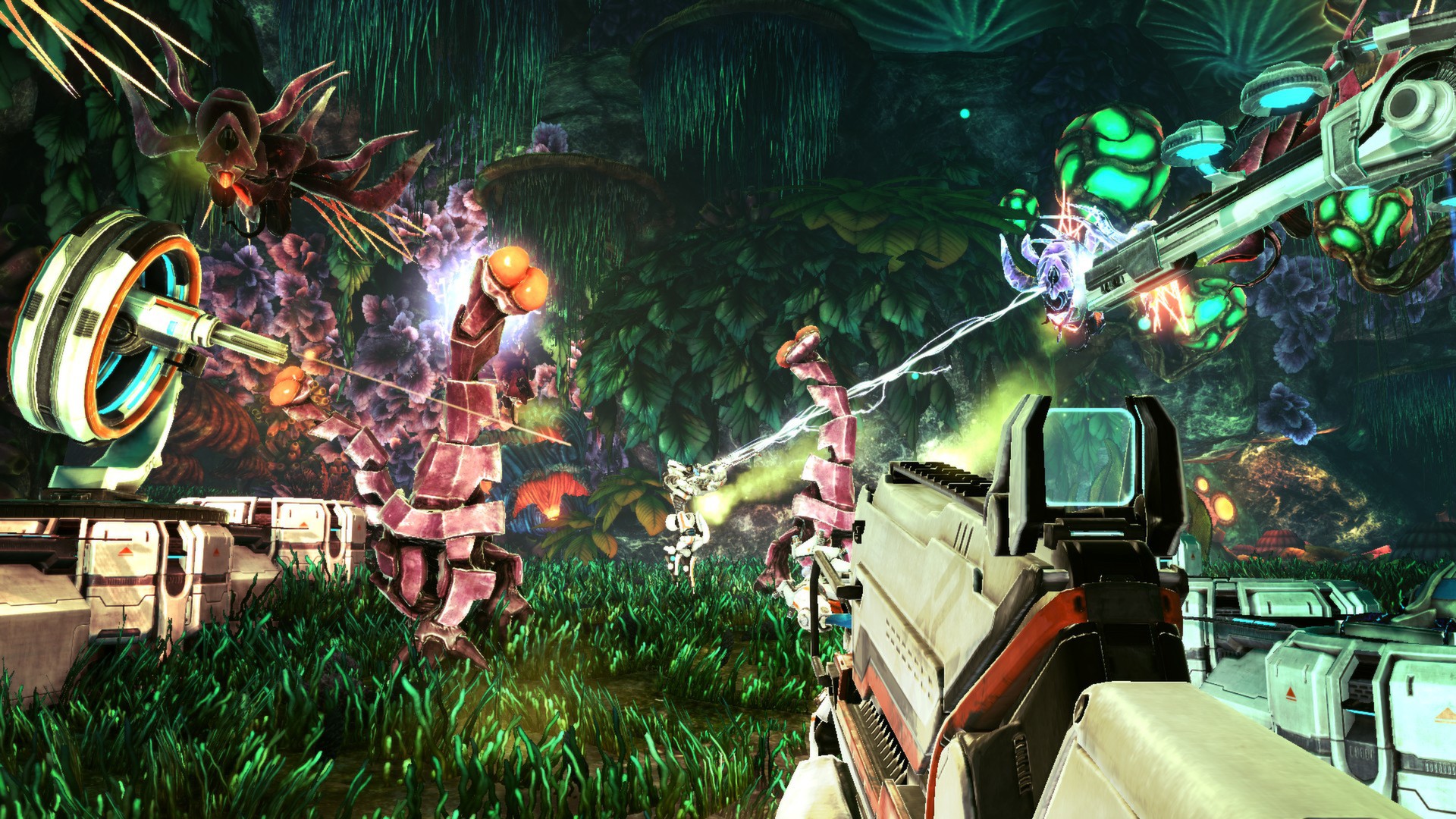
ss_41673936cf0df5cdf2b4c0549e118829730d8e88.1920x1080Mark and I played a bunch of a recently-released indie game today. That game is Coffee Stain Studios' Sanctum 2, which I purchased a copy of for Mark as a thank-you present for putting us up for the last couple of weeks, and which I was also interested in playing. I enjoyed the original game's interesting fusion of tower defense and first-person shooter mechanics as well as its distinctive presentation and excellent music, so I was actually quite interested to try the second game, and purchased a copy without a second thought.
Then the game was released, and I decided to take a peep at the Steam Community page to see what the rest of the world thought of it.

Big mistake.

It seems that Sanctum 2 is the latest victim of elitist players expecting one thing from a game and getting something slightly different, then throwing all their toys out of the pram, demanding refunds and hurling abuse at the developers. Because Sanctum 2 is not the same game as the original Sanctum, it seems, it is worthy of scorn and vilification. Because Sanctum 2 incorporates a number of features that not only make it workable on console — it's also being released on Xbox Live Arcade — but change the game balance significantly from the original, apparently it is worthy of review-bombing on Metacritic and endless, endless whining on forums.

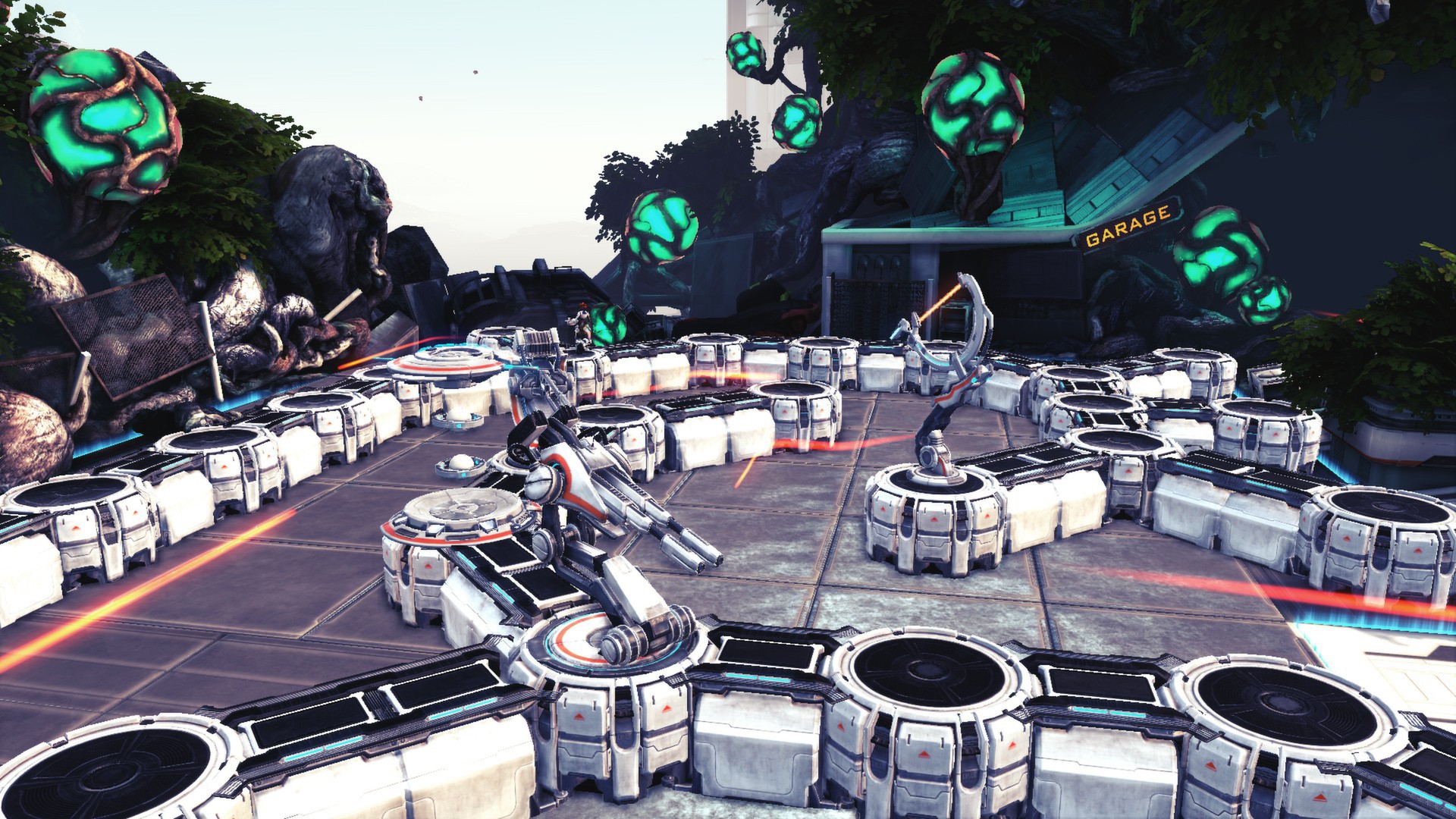
ss_18b928231ce4b8b50c8e6f1bd11e9ef7cbd88164.1920x1080You know what, though? I've played a good 4 or 5 hours of Sanctum 2 today in total, and it's great. It isn't the original game, no, but why would you want it to be? Sanctum is still available for download, so if you like that, go play that. Sanctum 2 is a distinctive experience that, while in possession of a couple of strange design decisions, is a lot of fun to play both solo and cooperatively with other people. It is both strategic and action-packed; challenging and fun; and it offers a significantly greater amount of content and depth than the original game did when it came out of the gates.
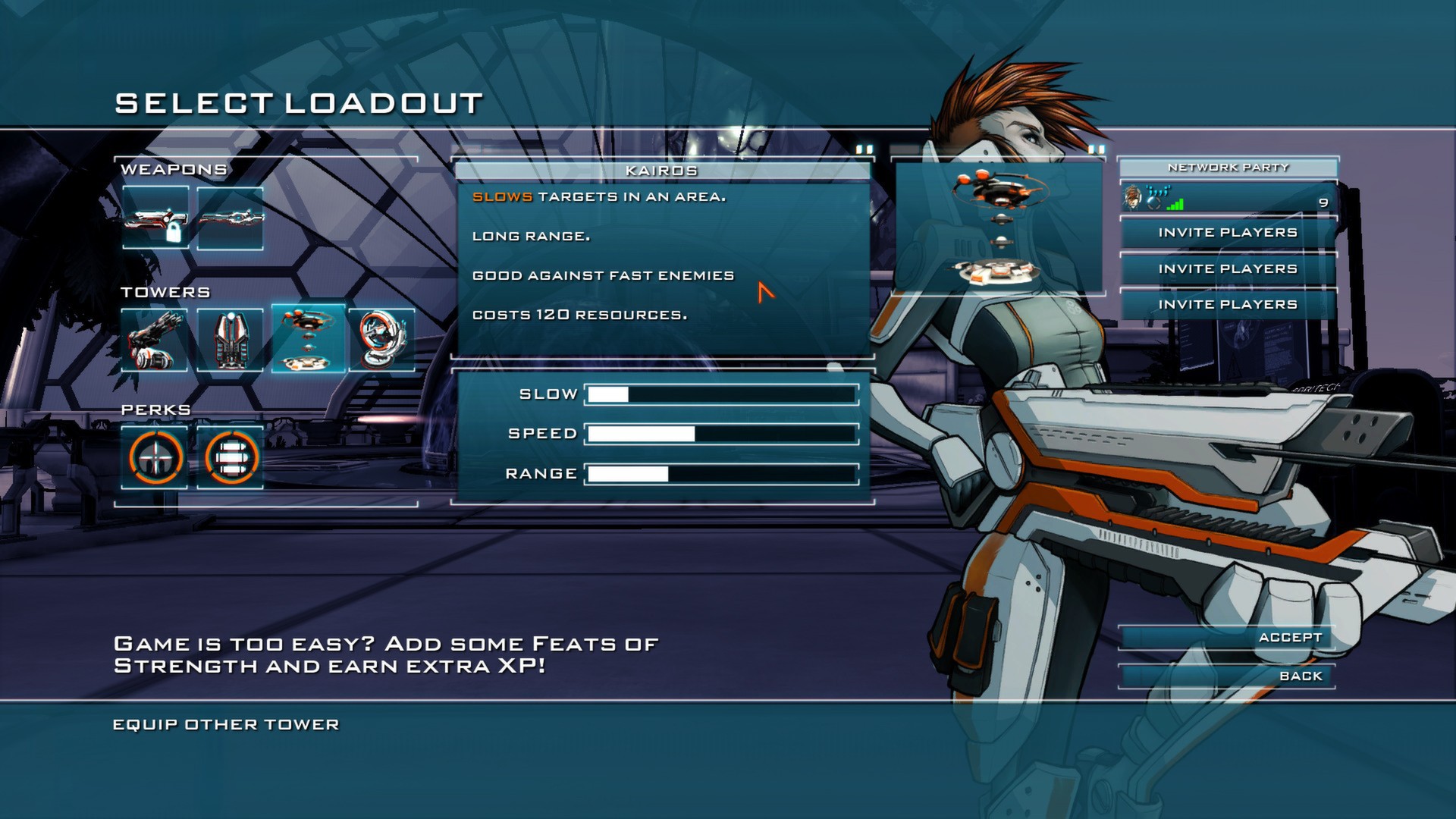
The complainers' biggest issues with the new game seem to be the fact that resources to build towers are now delivered as "drops" that have to be picked up manually, and that there is a hard limit of ten towers per level. The "drop" system means that everyone playing has to either agree on who is going to be in charge of building what — or charge off and race to be the first to pick up the resources. If you're playing with friends or people with whom you can communicate well, no problem. If you're playing with griefers and trolls, potential problem, but not insurmountable. (For what it's worth, I always prefer playing cooperative games with people I actually know anyway, and I'm sure I'm not the only one — and as such I probably won't run into this problem personally.)

The ten-tower limit also simply isn't an issue in practical terms. I am yet to hit said limit, because plonking down "tower base" blocks to create a maze to hold up enemies does not count towards this limit, and the limited quantity of resources on hand means that it's only really practical to build a few towers per level anyway — you have to support your towers with your own gunplay in order to succeed. It's a true hybrid, in other words; you can't win without your towers, and your towers can't win without you.

Some complainers have also whinged about the fact that you supposedly can't make complex mazes in this new game. To those people, I would invite them to have a go at the level Mark and I were playing before we wrapped up for the evening, in which we were defending two cores simultaneously from assault, and built impressive mazes on both sides of the level in order to keep the enemies away from our precious charges as long as possible. Careful tower placement and resource management was a must, and the nature of many of the enemies that came along made it necessary to cooperate, communicate and use skill and tactics to take them down rather than simply firing blindly at anything moving.

ss_8a9cbab892d41cb1734508a572f1471a5b5a2117.1920x1080In short, Sanctum 2 is a very good game if you enjoy both first-person shooters and tower defense games that demand a slightly heavier degree of thought and strategy than normal. It's an excellent fusion of two fairly disparate game genres, and while there are a few things that could be tweaked here and there, it's perfectly enjoyable as it is. Not only that, Coffee Stain Studios have demonstrated that they are open to constructive feedback, too, and will likely continue to improve the game after its release. Given the abuse and vitriol that has been hurled their way today, they would be perfectly within their rights to just say "fuck you" to all the ungrateful gamers who are bitching about their new release, to be honest, so I have to admire them for their self-restraint in dealing with these people.

It is, essentially, yet another case of a not-insignificant number of people suffering under the assumption that Their Way is the Right Way, and that anyone who disagrees with them is somehow an awful person. These people preferred the original Sanctum to its sequel and that's absolutely fine; their behaviour towards Coffee Stain Studios and anyone who has expressed a liking for the new game is not.

1139: Just Shut Up

Page_1I think I'm "over" social media. Allow me to clarify that bold statement, however, as it's perhaps not entirely accurate as is. I think I am over social media as it exists today — a sprawling, disorganised mess of ill-defined concepts that contribute very little to the people's understanding of one another, and more often than not is about vanity rather than actual socialisation.

In other words, I yearn for the days when social media was simple and straightforward — when its sole intended purpose was to allow people to stay in touch with each other and perhaps, occasionally, share a photograph or two with them.

Looking back on this blog, I see I have written about this subject at least twice in the past, and my disillusionment with it has only grown over the last year or so — perhaps due in part to the fact that as part of my job I come into contact with some of the most utterly pointless examples of social media that I've ever seen.

These days, there are social media apps to share anything you can think of. I mean, there are literally (YES LITERALLY) apps and services that allow you to share anything you can think of. There are also more specialised ones with questionable usefulness to society as a whole. I reviewed one recently where the entire purpose was to share what your current mood was — you couldn't add any text explaining said mood, only an emoticon — and another where you could share the weather in your local area, then "like" or comment on the weather in other places. Another still allowed you to send a video or photo to someone, but they were only allowed to look at it for ten seconds, after which it locked itself and became useless (I swear I'm not making this up).

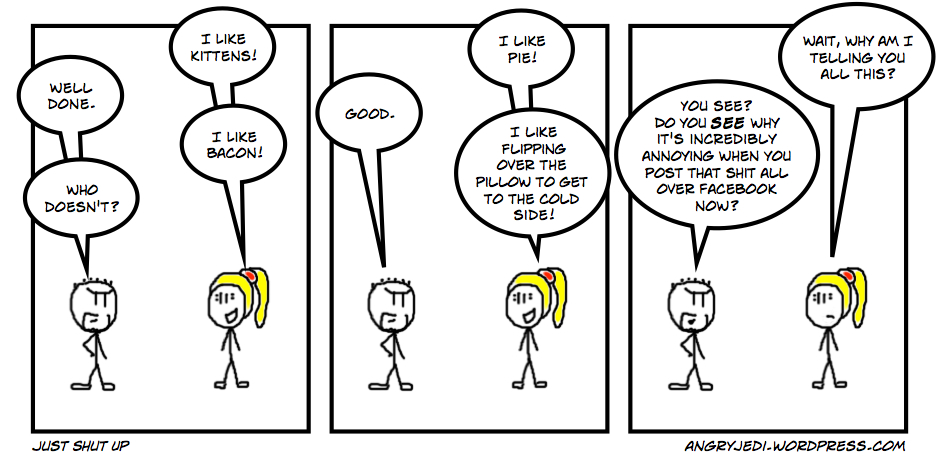
The trouble with these things is that despite their pretensions towards being "social media," they're not actually all that social at all in terms of the way in which people use them. They're a means of broadcasting things and seeking approval of other people rather than a means of actually engaging in conversation with anyone. Take a look at the average comments thread on an Instagram picture of a moderately-attractive person (usually a woman) and you'll see what I mean. No-one's actually talking to each other — everyone's just dropping an asinine opinion bomb and then never coming back. The poster of the selfie is seeking approval from commenters telling them how attractive they are; meanwhile, the commenters are seeking approval from the poster and hoping that their specific compliment is the one that will get them some specific attention.

This isn't the case universally, obviously. There are still some actual conversations that go on on Facebook, for example, but these can easily be lost in the torrent of people resharing crap from pages like "I fucking love science" (do you? Then go do some rather than recycling endless fucking memes) and "LIKE AND SHARE!!" (NO!!). Twitter is a reasonable platform for discussion at times, but conversations are easily derailed and, as has been proven hundreds of times in the past year alone, 140 characters is really not enough to make a coherent argument about a complex issue. It's also incredibly easy to be taken out of context on Twitter.

Google+ perhaps fares the best out of all of these services in my experience, though even that's variable. Join a good, small community that has a clear focus and whose moderators keep a tight leash on discussion and you'll have a good experience chewing the fat with people who may well become good friends. Follow Felicia Day or Wil Wheaton and you might see some interesting content, but the quality of discussion goes out of the window. Follow Google+'s own page and all you get are blithering idiots making ill-informed political rants any time the team behind the page even dare to mention the President.

I think the thing that's been striking me most heavily recently is "do I really need to share this? Do people really need to know this?" And more often than not, the answer is "no". I don't feel the need to collect an arbitrary set of "Likes" with services like CircleMe or GetGlue. I don't feel the need to "check in" to places with Foursquare. I don't even really need to use stuff like Raptr to broadcast my gaming activity, but that has, on occasion, sparked some good discussions — as, I'm sure, the other services do in some cases. Just not mine. Not any more. Perhaps once in the past — I met some good friends through Foursquare's now-defunct competitor Gowalla — but not now.

Consequently, since quitting Twitter a while back (and not really missing it, to be honest — though I do miss some of the people) I've been paring back my personal social media use hugely. I've closed my Tumblr account — I never really understood the point of that site, and these days all it seems to be used for is white people shouting about how guilty they are about being white and how we should all stop being such racists/misogynists/fedora-wearing perverts — and I've unistalled the vast majority of social apps from my phone, including Twitter and Instagram. Facebook made the cut, because as much as I dislike it at times, it's still a good way of staying in touch with a lot of people, and Google+ also survived, as it's the new home of the Squadron of Shame and serving our needs well.

Obviously this blog is still going, too (and will be for a long time to come, hopefully!) and I still comment on friends' blogs — but I don't really count that as "social media" in the same way, particularly as the discussions had tend to be (for the most part, anyway) wordy and thought-provoking rather than inspiring little more than a knee-jerk "lol".

Everything else, though? Out the window. And life is much calmer and more pleasant as a result.

1125: Low Ebb

After the events of the last few days, which I won't go into right now, I feel compelled to write a few words about bullying in general. I've already written a considerable number of words on the time I suffered workplace bullying towards the end of my time working at an Apple Store (check it out here) but I wanted to talk a little more about the subject in general.

The word "bullying" is an incredibly loaded one that brings to mind images of schoolkids taking the piss out of each other for the most ridiculous reasons. When I was a young child at primary school, it was my ears. They stuck out and looked quite large, so naturally I was picked on and ridiculed for that — not just occasionally, but pretty much daily. The experience left me with mental scars that  are yet to heal, and which manifest themselves in my cripplingly low sense of self-esteem.

But bullying isn't just something that children suffer from. Adults can suffer bullying, too, in a variety of forms. It could be workplace bullying such as that described in my previous post, where those in a position of "power" or "authority" use their influence to negative, unfair ends; it could be one group of people taking an irrational dislike to another group and expressing that dislike through verbal or physical abuse; it could be organised campaigns of hatred using the Internet.

The latter is an option that didn't exist when I was a youngster. The Internet wasn't a widespread thing until I was well into my teenage years, and social media certainly was nowhere to be seen. As such, any instances of bullying tended to confine themselves to the "real world" where they could normally be dealt with relatively easily, since there was usually an identifiable perpetrator to pin the blame on. It wasn't always easy for the victim to come forward and report the perpetrator, of course, for fear of reprisals — that "knowing them in real life" thing worked both ways — but if they could muster up the courage to do so, then the situation could often be dealt with.

With online bullying, though, it's a much more difficult proposition. There isn't always a visible perpetrator, because they often choose to hide behind a veil of anonymity. Some particularly arrogant online bullies do so under their real name because they've also taken steps to ensure that they will never get caught, and herein lies part of the problem: the very nature of online crime makes it extremely difficult to police, meaning that more often than not the groups responsible for making some people feel really, really shitty go completely unpunished and thus receive the message loud and clear that what they are doing is Okay.

The worst thing about bullying in all its forms is the degree of self-doubt it can instill in its victim. Am I worthless? they'll think. Do I deserve this? Are those things they're saying actually true? Do people really think that about me? Is that how other people see me? These are, of course, all things that I've found myself thinking at various points in my life.

It's useless and irrational to think that way, of course, but sadly, often the sort of people who are affected the worst by the actions of bullies are those who, like me, turn irrational when they have to deal with a difficult situation like this. Because it's not easy to stay rational in the face of totally irrational, unprovoked hatred, either, for in many cases these instances of bullying are born from little more than boredom rather than feeling particularly strongly about the person or group in question. It becomes a sport for the bullies, more about the chase and the observation of the victim's behaviour than specifically trying to hurt a person. This is particularly apparent when it comes to online bullying, where it's very easy to conveniently forget that the target of your vitriol is actually a real person with real feelings, and that any hurtful things you send off into the ether after you click that "Send" button may have a very real impact on that person's emotional, mental and, in some cases, physical wellbeing.

There's no easy solution, either. And that's sad. What's even more sad is the fact that we seem to have got to a stage as a society where we just accept that this sort of thing happens, and we don't do anything about it. I don't have any suggestions or solutions, either, mind you, but surely by the year 2013 you'd think humanity might have gotten over irrational hatred by now.

But apparently not.

(Sorry for the lack of comic today. I'm emotionally exhausted and there's no real way I can make all this shit funny.)

1058: Badvertising Revisited

[Preamble: I know I said comics would be back, but I realise this was a rather foolish promise to make given that I am in the process of moving house and my Mac (which holds the Comic Life software I use to produce them) is now packed up. So you can live without them for a little while, I'm sure — at least until the chaos of the next couple of weeks is resolved!]

As I grow older, I find myself less and less tolerant to the tactics of marketing people. I can't quite work out if this is simply my own intolerance building up as a result of my advancing years, or if adverts really are significantly more annoying than they were in the past. I have a feeling there's a touch of both, because there's a whole lot of new technology to make advertising more annoying these days.

Specifically, let's consider Internet-based advertising. Now, the vast majority of content on the Internet is available for free (connection charges notwithstanding) so it has to make its money somehow — and it just so happens that advertising is a reasonable way to do that. (Whether or not it's a "good" way is a matter of some debate, as traditional advertising models seem to be becoming less and less effective among savvy Internet users, many of whom use ad-blocking software to make their life considerably less intruded-upon by marketing people.)

I have no real problem with advertising being used as a means of keeping content free. I'll sit through a couple of pre-roll adverts when watching, say, 4OD on YouTube. I'd have to sit through adverts on TV, and there are actually fewer adverts on YouTube than when it's broadcast live on TV. No problem there.

What I do have an issue with is when adverts start to get too big for their boots and start engaging in any of the following behaviour:

  • Making noise without me telling them to
  • Monopolising my web browser and/or actively getting in the way of what I'm trying to do
  • Urging me to "interact" with them
  • Urging me to share them on Facebook.

All of these things are monumentally irritating, albeit for different reasons.

In the case of noisy adverts, they are a pain simply because they make noise and it's usually difficult to shut them off. And there tends to only be a couple of them available at once, meaning that it's entirely possible that several times in a session you'll hear that stupid woman from the air freshener advert whingeing about being "stuck in bad odours" or something. You can stay there, love.

Monopolising my web browser is something that really pisses me off because it ruins the experience of the site. The most recent example I've seen is on GameFAQs' mobile site, which occasionally gets completely taken over by a Samsung advert. You'll be looking at the page, trying to tap on a link when suddenly these stupid arrows appear, inviting you to "swipe". "Fuck off," you'll say — possibly out loud — until you realise that you can't do anything on this page until you do as it says, and then you're stuck in a stupid interactive "experience" about a phone you probably don't give a shit about. (Alternatively, you refresh the page until it goes away.)

This brings me on to another point: interactive adverts. Why? Why would I want to play your stupid game where I get to actually clean the grime off the filthy worktop? Why would I want to pick which one of your vapid Z-list celebrities tells me about your awful product? "Get ready to interact!" they'll say. "Get ready to fuck off!" I'll say, particularly if, as they so frequently are, are also browser-monopolising and noisy ads.

Finally is the seemingly-obligatory necessity to connect everything to Facebook and Twitter. I've lost count of the number of adverts I've seen recently that include hashtags, Facebook pages or even, in some cases, buttons to share the advert on Twitter or Facebook directly. Pro-Tip: if you click either of those buttons, you are a dickhead. And if you don't know why, well, I don't think I can help you.

Advertising serves a purpose, and if it keeps out of my way I'm happy to let it sit there to help pay the bills for a particular site — I don't use an ad-blocker and will probably keep it that way for the moment. But the moment advertising starts actively obstructing what I'm trying to do, that's when I start thinking about installing one. And that's not going to make me think positively about your product; it means I'm not going to see it at all.

1003: Isolation Chamber

Last night I spent a thoroughly pleasant evening in the company of the few "real-life" friends I see on a regular basis. We played Descent, I made some poor tactical decisions and lost yet another quest (seriously, I am the most incompetent evil overlord of all time) and we had fun.

As always, though the experience was, for me, tinged with a certain hint of bittersweetness. Said friends, you see, all live back in the Southampton/Winchester area, which is where I used to live before the rather inconvenient and upsetting collapse of almost my entire existence over two years ago. I, however, am not located there; instead, I am nearly two hours' drive away in Chippenham, Wiltshire. It's not a difficult drive, to be sure, but it isn't something I can particularly do on a sudden whim. Well, I can, but I do need to have plenty of time on my hands before I do it, and there are other considerations as well.

It's frustrating, though. Regular readers will know that I am not an especially "social" person a lot of the time, but I do appreciate and enjoy the time I get to spend with these friends. We've built a strong Social Link as a group together in recent years, and most of us have had to take on some difficult challenges in that time. Although in a lot of cases, said group of friends didn't necessarily help and support directlythe fact that they were simply there was often enough. I know I certainly felt that way, though naturally I can't speak for the others.

It's hard to feel that way when you're two hours away, though; when you have to make full on capital-P Plans to see them rather than just sending a text and asking if people are up for something. I miss being able to do that, and not just with the particular group of friends I saw last night, either; there are ex-colleagues still in the area whom I used to love being able to just call up (well, text up) and hang out with.

I feel more than a tad isolated, in short.

And in more ways than one, if I'm honest. Leaving aside the geographical issue that gets in the way of seeing "real life" friends for a moment, there's also the whole issue of having like-minded friends who are into similar things that you are. I have a number of interests that I am perfectly willing to describe as "niche", and at times it can be difficult and frustrating to be a fan of these things when there's no-one nearby to share the experience and enjoyment of them with. It's not as if I have absolutely no-one, obviously — Andie is good at taking an interest in the things I like (for the most part, anyway!) and aforementioned friends share at least some of my interests.

The "simple" solution seems obvious — take an interest in more "mainstream" things so you can more easily share the enjoyment of things that everyone enjoys. But it's not that simple. I have tried on a number of occasions to engage with things I know various friends and acquaintances are interested in — everything from football to The X-Factor — and every time I have come away feeling like I'm forcing myself to try and enjoy something I dislike immensely, and it just doesn't seem worth it. Apparently your tastes are hard-wired into your head somewhere, and it is very difficult to change them. I am predisposed to like the things I like (board games, video games, anime, soundtracks, music, writing, The Internet, My Little Pony) and similarly to dislike the things I despise (too many to list).

Knowing that doesn't help with those feelings of isolation, though. Knowing that the things I enjoy are only appreciated by certain specific subcultures can be a difficult pill to swallow at times, but it's the situation that my own tastes have gotten me into. Don't get me wrong, I don't regret or feel embarrassed about anything that I enjoy; it'd just be nice to be able to enthuse about it with people who are a bit closer sometimes.

But at least I can enthuse about it with people thanks to the trappings of modern society. I can chat with my friend in Canada about anime; I can discuss strategies for failing to beat the hideously difficult secret boss in Persona 3 with another friend in the States. I can rant and rave in private about the things that are getting my goat to someone in yet another disparate geographical location; I can share my pride in something I have achieved with yet someone else entirely.

Things could be worse, in short — but it doesn't stop those occasional feelings of loneliness and isolation. I've been having more than a few of them recently, and it's getting me down a bit, so apologies if the tone of these posts may be a bit on the melancholy side at times.

Oh well. I'll deal. I always do.

#oneaday Day 989: Blackout

I was all set to write something profound tonight, then the Internet died and I'm relegated to blogging from my phone.

All right, I didn't have anything hugely profound to say and even if I did I could clearly still say it from my phone, but the Internet has gone down, which is, as everyone thoroughly immersed in 21st century living knows, incredibly annoying.

Given its prevalence in our everyday lives, it's very easy to forget what life without the Internet was like. Something as simple as checking the news or finding out what time something was on TV relied on you having… oh, it's back. I'll return when I finish watching this episode of The World God Only Knows. Ja ne!

… … … …

20 minutes later…

There we are, that's better.

Shit, now there's pressure on me to write something meaningful. Umm…

Nope, I got nothing. And fuck all that Internet talk. I've written that exact same post at least five or six times already in the last 989 days.

I finished watching Welcome to the NHK today. The last few episodes were major-league Feels territory. It was a fascinating show, all-told, that I may write about in more detail at some point in the near future. What I particularly liked was that it wasn't particularly easy to pigeon-hole into a specific category of genre. It had elements of comedy, drama, romance, surrealism and all manner of other stuff too. On the whole it was quite an emotional experience for me — I'm not sure how much it would resonate with someone who couldn't relate to some of the issues therein, but I certainly found it to be an excellent, worthwhile, enjoyable and moving watch.

Tonight, as I mentioned earlier, I've started watching The World God Only Knows after recommendations from several people. I'll blog in more detail about this when I've watched more than two episodes, but it seems to be highly entertaining so far.

The premise, for the unfamiliar, is that dating sim addict Keima inadvertently enters into a contract with the unfeasibly cute and broom-wielding demon Elsie to help round up "Loose Souls", runaway spirits that hide themselves inside the hearts of girls. Keima is thus tasked with making said girls fall in love with him, thus releasing the Loose Soul for Elsie to catch. Keima, sadly, is more than a little socially awkward, having spent all his time dating 2D girls rather than interacting with real people. However, since reneging on the contract means that both he and Elsie will be decapitated by the magical collars placed upon them, he has no choice but to go along with the outlandish plan. Consequently, he attempts to use his knowledge of dating sim tropes to figure out girls in the real world and, of course, Hilarity Ensues.

I've watched two episodes so far and already I want my own Elsie to hug. Certain characters just nail the whole adorableness factor, and she has this particular characteristic in spades. The show as a whole is rather endearing, too, though, regularly lapsing into heavily-stylized and chibi sequences rather than trying to remain too grounded in reality. The concept is, after all, ridiculous, so rather than trying to take itself too seriously the show appears to very much embrace its silliness. I'm fine with that, and am looking forward to exploring the rest of the episodes.

Anyway, on that note I think it's probably time I hit the sack. Hopefully tomorrow will see a more coherent entry and less in the way of Internet outages.

#oneaday Day 909: The Internet Is As Big As You Make It

Over the years, my Internet habits have changed significantly. This has been at least partly due to changes in technology over the years, but I still find it an interesting observation to think back on how times have changed since I first "got online."

My earliest experiences were with CompuServe which, for the unfamiliar, was somewhat like an online "walled garden". It included much of the things we take for granted on the Internet today — email, topic-specific forums, places to download stuff, real-time chat and probably, if you looked hard enough, something which could be used by someone as porn. Initially, you were limited to talking only to other CompuServe subscribers, but over time access opened up: firstly to allow emailing to Internet email addresses, and eventually to access the Web proper. I remember vividly trying (and failing) to get the browser Mosaic to work with CompuServe.

At this time, since I was just a kid and living at home, my Internet (or equivalent) access was severely limited. I had to plan out what it was I was going to look at (usually the Gamers' Forum and occasional delves into the "CB Simulator" — aka real-time chat rooms — to try (and fail) to pick up girls. (a/s/l?)

Over time, the Internet opened up to all, and we were all able to gain access to the information we wanted and some we didn't. The best free porn sites were (apparently) passed around in the schoolyard; the best sites to download shareware games were common knowledge; little communities started to spring up as people figured out things like "forums", "personal homepages" and "search engines".

Fast forward to today and, with an Internet that is growing at a frightening rate, I find myself limiting what I'm doing to a very small number of sites. Despite becoming increasingly irritated with it, I check Facebook. I check my GMail. I check in on the Squadron of Shame Squawkbox if there's been a new post. I write this blog. Occasionally I might check a gaming site for news of something I'm interested in, but that's really about it. I tweet from my phone and everything else that I really want to do is covered by those sites — and Google if I can't find the information I'm looking for straight away. I find myself going around and around and around the same sites over and over, hoping that something new and interesting has come up in the five minutes since I last looked. (It never does.)

One thing I've found myself not using anywhere near as much as I used to is dedicated, specific communities. Every time I find a forum that looks vaguely interesting, I might check it out and post there for a few days and then promptly forget all about it — even if it's a community I have little doubt that I'd really enjoy being a part of. This is kind of sad, since it limits my contact with people who are specifically in to the exact same things as me, but it's primarily a result of the fact that forum software tends to not play overly-nice with mobile devices — which, nine times out of ten, is the place where I want to be casually browsing. (Okay, a lot of forums bring up that annoying popup about Tapatalk, which I've never tried and might be the best thing ever, but still.)

It's mostly a time issue. I have lots of things I want to do every day, and I rarely (no, make that never) get to do all of them. So far as "priorities" go, checking forums, posting things and getting to know yet another online community is not particularly high up the list.

Perhaps it should be. There are a lot of things I am into that I would like to talk more about with others. Without thinking very hard, I can immediately point to both My Little Pony and The Secret World as communities I would like to be more involved with. And there are doubtless more out there. When I think about how vapid and pointless 95% of the conversations on Facebook are, I do sometimes wonder if my "social" time online could be better spent in a more focused community rather than browsing creepy baby photos posted by people I haven't seen since school.

Perhaps I should leave my own prejudices at the door and jump in to one of these communities to see what will happen. You never know where new friends are lurking, after all.

#oneaday Day 876: Gamers, Men, Everybody... Stop Being a Dick

20120612-233522.jpg

I have mentioned these issues a couple of times over the past few days but I've come to the conclusion that they're actually making me feel a bit depressed. I know that there's little point in getting depressed or upset over "the way the world is" and there are far bigger problems in the world, etc. etc. but, I mean, wow. Something really needs to be done.

I am referring primarily to the treatment of Anita Sarkeesian, better known on the Interwebz as Feminist Frequency, the author of a number of feminist perspective critiques on popular culture. Sarkeesian recently launched a Kickstarter campaign to fund her newest piece of research and criticism, dubbed simply "Tropes vs. Women in Video Games". The proposed series of videos Sarkeesian is intending to produce will deconstruct the most commonly-seen female character tropes in video games, highlighting recurring patterns and discussing them rather than simply pointing the finger and going "LOOK! THIS IS BAD."

The response to Sarkeesian's campaign was both good and bad. On the positive side, the campaign was fully funded in the first 24 hours, and since that time a number of "stretch goals" have been smashed, allowing Sarkeesian to produce a much larger amount of content than initially proposed.

On the negative side, this happened. And this happened.

I really shouldn't be astonished by things that people say on the Internet any more, given that it is widely regarded as a wretched hive of &c &c despite all the lovely and intelligent people who also populate it. But these incidents really bothered me. They happened quickly and relentlessly… and they were clearly organised — likely by noted Internet cesspits 4chan and 9gag. This fabulous piece by Foz Meadows sums up the key aspect of the problem, I think: in attempting to defend themselves against accusations of sexism, misogyny and the promotion of a rape culture, those who deliberately and maliciously harassed Sarkeesian resorted to, you guessed it, sexism, misogyny and the promotion of a rape culture.

Sarkeesian's suffering isn't in any way the only time this has happened, of course, though it may have been the most high-profile one in recent weeks. The Hitman: Absolution trailer I mentioned a few posts ago stirred up plenty of controversy, and anyone speaking out against it tended to get shouted down by people who couldn't see the problem with it in the most abusive manner possible. Disagreements and differences in taste; threatening others and calling them abusive names because of those disagreements is not.

Even princess of geekdom Felicia Day wasn't immune to this bullshit. Her recent video "Gamer Girl, Country Boy", released as part of her entertaining "Flog" series on Geek & Sundry, attracted a swarm of completely unprovoked hateful comments. The hornets' nest had already been stirred up, so another target for their ire was just a happy bonus. Whatever you think of Day's past work, it should be clear to most people that there's clearly not a malevolent bone in her whole body, and the whole incident clearly upset her very much. I'm not "white knighting" here, it's a clear and simple fact. Who wouldn't be upset by an organised campaign to troll and flame something you'd worked hard on?

All of this is just a bit much to take. I've always been someone who likes to try and see the best in people — to a fault, really — but to see that some people hiding behind that ever-present veil of anonymity prove themselves to really be complete and utter cunts doesn't make me feel great. Obviously my own take on the matter pales in comparison to what Sarkeesian, Day and anyone else who has suffered at the hands of these trolls must be feeling about all this, but it's genuinely upsetting to know that there are people that vile and disgusting out there — people who supposedly share the same passions and hobbies as I do.

It needs to stop. That will only happen with concerted efforts from everyone involved, and it goes back to what school always told you about handling bullies. Be assertive, but not aggressive. Tell the bully that what they are doing is upsetting and unpleasant. And tell someone else. Don't be afraid to talk about it. Don't suffer in silence. Because while someone (or, indeed, a thrown-together Internet lynch mob) being a complete arsehole can utterly ruin your day, week, month, year, it's infinitely worse if you have no-one to turn to for support.

Let's stamp this odious attitude out. Freedom of speech is one thing; using said freedom to intimidate, harass and silence others is not its intention. I fully support and endorse Sarkeesian's Kickstarter campaign, and while I won't insist that you do so too, I would certainly like to encourage you all to stand up to bullying when (not if, sadly) you see it happening — even if it's not directly involving you. Good Samaritan and all that.

Above all, don't be a dick. And if it all gets a bit much, then pay this site a visit.

#oneaday Day 834: RUMOUR: Rumours 'Rumoured', Says Rumour-Monger

20120502-005626.jpg

If you've ever started a conversation with "I heard that…" and then gone on to explain exactly how you heard somewhere/from some guy in the pub/from "The Internet" that something awesome/awful is going to happen, then I urge you to think before you speak in future. Because if you continue with that sentence, you're simply feeding the rumour mill, and the rumour mill doesn't produce good things and help us make the Bread of Truth. It produces garbage and poo, and then squishes it all out into the world's most unpleasant pâté.

Tortured (and gross) metaphors aside, it's a fact that I wish more people — particularly in the press — would cotton on to.

Today, for example, saw news that Liberty X "might be" reforming for a new album and a tour. Firstly, I don't think anyone wants that, and secondly, the only evidence that such a reunion "might be" happening is the fact that they were photographed together outside the ITV studios and — get this — they were smiling. Stop the fucking presses.

There are a ton of journalism sectors that are particularly prone to this. Showbiz columns report who might be sleeping with whom. Sports columns report who might be moving to some other club for a disproportionately enormous amount of money. Music and arts columns report who might be working on what. And then, of course, there are the tech-related industries.

Anything related to Apple is accompanied by an inordinately huge amount of rumourmongering, for example. In the run-up to the company's announcement of the third-generation iPad, all sorts of nonsense was flying around. This ranged from suggestions that it might not have a Home button to the frankly astonishing assertion that the reason iOS apps had started having textures like leather and the like in the background was because the new iPad would have a haptic display — i.e. one where you could feel textures as well as see them.

The video games industry is far from immune, either. Rarely a week goes by without one outlet reporting on some rumour from a mysterious, anonymous source and the "story" then being picked up by every other news site on the Web as if it were fact. This particular rumour mill goes into overdrive as a hardware generation starts to wind down and people start wondering what the next generation of consoles might look like. Inevitably, the vast majority of stories turn out to be absolute bollocks, and on the rare occasions when an outlet or reporter writes something that turns out to be true, there's at least a day's worth of smug, self-satisfied cries of "Called it."

No you didn't. You were throwing darts blindfolded, and you happened to hit a lucky bulls-eye. Your other fifteen darts are embedded in the barman's testicles, the barmaid's left boob, the right ear of that hard-looking dude who drinks absinthe by the pint and the TV that was showing the Bolton v Wigan match. (Everyone is angry. I'd run, if I were you.)

So why do we persist on reporting on these festering sores on the very arse of journalism? Because they attract attention, particularly if they're controversial. If one site prints a story that Liberty X is reforming, or that the next Xbox will feature a system to prevent used games from working on it, or that the iPhone 5 really, totally, absolutely positively is coming out this time, then that will attract commenters like flies around shit. And that means page hits, advertising revenue and the little graphs that make the men in suits happy moving in an upward direction. Who cares if it's absolute nonsense dreamed up by someone who cleans the toilets at Microsoft? Print it!

I make a point of not reading any stories that start with the prefix "RUMOUR:" now. And should I ever find myself back on the news desk for a popular gaming website, I will most certainly do everything in my power to avoid reporting on such nonsense — unless some actual investigation turns up something interesting, of course. But blindly parroting another site's "anonymous source"? No. Just no.

So, then, I reiterate: think before you speak/write/publish. Because rumours are rarely helpful. Remember that time it spread around the whole school year that you'd shat your pants when in fact you'd just sat in some mud?

Yeah. That.