Good morning from Dublin! Today has been a very long day. Technically it's already "tomorrow" but I haven't yet made it home from Boston (my connecting flight leaves in a couple of hours) so I thought I'd take the opportunity to scribble a quick post.
This PAX weekend has been pretty much everything I hoped it would be. I had a great time with my friends, I saw some cool stuff at the show and I picked up some fun swag.
Most importantly, we successfully carried a number of formerly Internet-only relationships into the offline realm. Doing this is always a nerve-wracking experience — regardless of whether said relationship is platonic, romantic or anything else — and so it's always a pleasure when things come together and we all get along.
I actually wasn't too worried this time around, though. Something brought us all together in the world of Final Fantasy XIV and the fact most of us have been together for nigh on two years now says something positive about us and what we mean to one another. There have been tough times, as with any relationship, and people have come and gone over time, but the people with whom I spent my weekend represent a core group that I have always very much enjoyed spending virtual time with — and it turns out I enjoy spending real time with, too. It's just a pity we're all so scattered.
"I'm glad everyone is exactly how they seem to be," said one of our number last night, possibly slightly fuelled by a beer or two. "It means that everyone's genuine. And that we're all as fucked up as each other."
That latter point is key, and not necessarily a bad thing. Almost without exception, we've all had Shit to Deal With to varying degrees over the years, and our adventures in Eorzea have provided not only some much-needed escape at times, but also an outlet through which we can talk about the things that have been bothering us with like-minded individuals.
And that is immeasurably valuable; in an age where it seems people are drifting further and further apart from one another for various reasons, it's comforting to have a group that is pretty much always there for you. I know I'm grateful for these friends, and I'm sure they are too.
Now coffee is calling, closely followed by a connecting flight, a taxi ride back home and then almost straight back out (hopefully with time for a shower first!) to go and teach clarinet to kids. It's all go, huh. I shall sleep well tonight, for sure.
I rarely leave user reviews on things, be they App Store/Google Play downloads, Amazon purchases, eBay sellers or Steam downloads. And I've realised that in not doing so, I'm being a bit of a fool.
Why? Because whenever I consider purchasing something, one of the first things I do is have a look at the user ratings and reviews and determine whether or not they're 1) genuine 2) worth listening to and 3) something that might need to make me reconsider or confirm my purchase.
But when they work, they can be extremely useful — and every time I write one, I'm reminded how much I have always enjoyed reviewing things. Not necessarily critiquing them in depth or from any sort of theoretical perspective, but providing a simple, straightforward analysis of how much I liked something, how it made me feel, whether I think other people would like it and all that sort of good stuff.
It's also really fun to write a negative review, though it's also very easy to be extremely unfair when you're doing so, which is why I try and remain positive most of the time. (People are also more inclined to disagree with something negative than positive in my experience, too, and I really don't enjoy arguing with people.) I have made one fairly consistent exception over the years, though, and that's with mobile games that have been truly, truly awful, particularly those that have desecrated beloved franchises like Dungeon Keeper, Theme Park and SimCity. (Oh, hi, EA.)
But I've decided as a belated and rather lame resolution that I'm going to start making an effort to review things that I've bought, played, used, whatever. Because if I make use of user reviews for their intended purpose — to find out what the average Joe on the street thinks of something that I'm considering purchasing — then I'm sure other people will do too. And, not to blow my own trumpet too much, but I feel like I'm quite good at expressing myself about the things I do and don't like about something.
I give it a couple of weeks before I stop doing it, but for now it's a little something I can do to help make the Internet as a whole a slightly better place. I made a start this evening by reviewing HuniePop on Steam; see if you can spot my review if you're pondering whether to drop some cash on a pornographic puzzle game!
I know I've been very anti-Twitter and very anti-social media in general recently, but an unfortunate side-effect of "going dark" is, to be perfectly frank, loneliness.
It kind of sucks that social media is the default means of people communicating with one another today. I'll grant that it's a convenient and easy means of people to talk to each other without sharing completely "personal" details like email addresses or phone numbers, but I sort of miss the days of sending lengthy emails back and forth with people. I know the option is still there to do that, but how many people would actually respond, I wonder?
This is a preamble to the fact that I have rejoined Twitter in an attempt to reconnect with the people I effectively severed social ties with when I went dark a while back. I don't regret doing that — remaining clear of some of the most ridiculous Internet drama in years has been thoroughly pleasant, and it makes me glad to have the close friends I do have who have stuck by me even as I was harder to get hold of — but I have found myself somewhat wanting for conversation at times.
And so we come to this, then: an attempt to recapture whatever it was that attracted me to Twitter in the first place, and kept me as an avid user for a long time until I became thoroughly disillusioned with the whole thing.
The temptation with Twitter is to follow everyone and everything. A follow isn't the same as a friendship request on other forms of social media: it's not reciprocal. You can follow someone and they remain completely unaware of your existence. This isn't necessarily as harsh (or creepy) as it sounds, since many Twitter users make use of the social network primarily as a broadcast medium for keeping people up to date on the latest happenings or pointing them in the direction of posts, forums and articles that are a better place to hang out and talk in detail. Twitter is, after all, shit for nuanced discussion, as anyone who has ever attempted to discuss anything deeper than how nice the sausage you're currently eating is will have undoubtedly discovered.
I'm not going to do that this time, though. I'm not going to use Twitter as the noisy, messy hodgepodge of microblogging tool, text messaging service and RSS reader that it once was: the emphasis for me now is on the thing I always enjoyed using it for most: talking to people from all over the world.
I'm not going to follow hundreds of people. I'm not going to feel obliged to follow people who follow me unless I find them interesting. If people start retweeting things that upset or annoy me, I'll simply turn off their retweets — retweets, after all, are by far the most irritating feature of Twitter in my experience since it's a means of someone shoving a third party's opinion in your face — and if they remain annoying or upsetting after that then, well, maybe I don't really want to be following them after all.
My account is public at present, but once I have a nice little collection of followers gathered once again, I'm turning my account back to private, which means my tweets won't be public and people will have to request to follow me rather than just being able to do so. My professional life is now completely separate from my online existence, and as such I have no need to "network" online by sucking up to "important" people and trying to make them aware of my existence by building up as much "social capital" (to co-opt a phrase that means something else) as I can.
I can instead concentrate on using Twitter as a means of talking with friends and — hopefully, anyway — having a bit of fun. And with any luck, this will help at least partly deal with the feelings of isolation and loneliness I've been feeling recently.
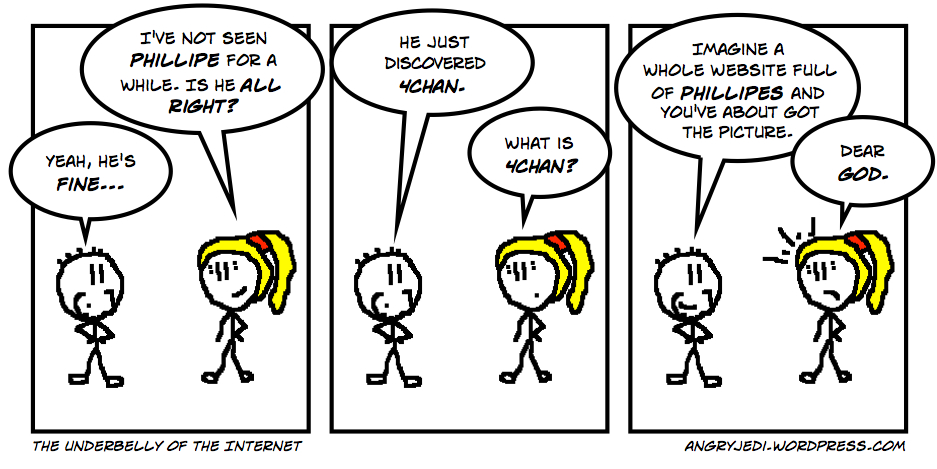
I find Internet culture endlessly fascinating and, at times, more than a little terrifying.
One of the most interesting things about Internet culture is how small it makes the world seem at times. I recall when online connectivity was just starting to become a thing — beyond the old-school world of direct-dial bulletin board systems, that is — and as well as the obnoxious phrase "information superhighway" being coined, a second, lesser-known but rather accurate phrase came into brief usage: "global village".
The concept of the Internet — or, perhaps more accurately, the Web — as a global village is an interesting one, and if you spend some time wandering around online, you'll come to recognise the village's various haunts. There's the village hall that hosts everything from coffee mornings to neo-Nazi rallies (Facebook). There's the pub where everyone is always talking over everyone else and no-one's really listening to one another (Twitter). There's the deceptive village shop that looks small but actually carries a frighteningly comprehensive array of products of all descriptions (Amazon). There's the coffee shop where socialites of all descriptions like to hang out and have in-depth discussions about everything from literature to their sexual conquests (Reddit). And there's that dark, unlit back alley that very few people go down, but down which you'll find either an army of like-minded outcasts or a horde of terrifying monsters, depending on your outlook (4chan and its successor 8chan).
There's far more to the Internet than this, of course; the global village has become more of a town over the years, but it's never really lost that sense of having "landmarks" around the place: easily recognisable places from which you can easily get your bearings and which, should you choose to make them your regular hangouts, provide a sense of comfortable (or sometimes uncomfortable) familiarity.
They've all evolved over time, too. Take Facebook; when it originally launched, it was designed for college students. Then it expanded to take in young, cool people in general, and allow them to keep in touch with their close personal network of friends easily. Then it expanded again to become more public and open. And today, of course, almost everyone is on Facebook to some degree or another, regardless of age, gender, interests and even level of computer literacy.
Change hasn't always been for the positive, of course — although how you regard these changes, positive or negative, is partly down to your own individual feelings and how you want to communicate online. Twitter and I, for example, parted ways when it was becoming increasingly apparent that the microblogging service was being used by a lot of people more as a broadcast medium — and sometimes an echo chamber — than a means of communicating effectively. Its inherent limitations started to strain at the seams as people, for some inexplicable reason, started to think that it was an appropriate medium for having in-depth debates about complex issues. (It really isn't.) Then the marketers found it, trying to encourage us to tweet using the hashtags for their products seen on adverts or TV shows — who does this? And over time the noise built and built and built until, much like Facebook, it was not what it once was. For some people, it's still fun; for me, it had lost much of the charm that caused me to use it a great deal in the first place.
There's a lot going on behind the scenes in a lot of places, too. Take Wikipedia, for example; at face value, it appears to be a perfectly reputable source containing a vast array of information about pretty much anything you would care to name. Ostensibly being a reference work, much of it is written in an impartial, unbiased manner — though there are exceptions. And it's in those exceptions you start to see that yes, this is something that is put together and constantly maintained by humans, many of whom are doing it simply because they enjoy doing it. Dig further and take a peek at the inner workings of Wikipedia and you'll see that it's far from a solo effort; teams of editors are constantly discussing, debating, arguing and even fighting over the most peculiar of topics; in order to deal with such situations, the site has formed its own quasi-government to arbitrate disputes, with unfortunate instances going through strict, formal procedures managed not by Wikipedia creator Jimmy Wales, but by councils of users. It's fascinating to observe.
There are billions of people on the planet, a significant proportion of whom now have some form of access to the Internet. With that in mind, it's kind of crazy how small the Internet feels sometimes. That "global village" really is a thing and, while just like any other village, not everyone gets along with everyone else, the virtual world we've all helped build together is a fascinating thing indeed.
Just be careful if you venture into some of those dark corners. You might not like what you find… but on the other hand, there's always the possibility of being pleasantly surprised, too. Explore at your own risk!
Over the weekend, mankind enjoyed a significant step forward in the field of space travel. Unmanned spacecraft Rosetta successfully detached its probe, named Philae, and landed on Comet 67P, aka Chryumov-Grasimenko. It was the culmination of a ten-year mission for Dr Matt Taylor and his colleagues at the European Space Agency, and a historic moment for humanity: we finally had the chance to examine a comet up close, and perhaps make some steps forward in understanding the way the universe works; how the solar system formed; perhaps even how there came to be life on this planet.
As much as it was a historic moment for humanity, then, imagine how Dr Matt Taylor felt as a significant portion of his life's work finally came to fruition as the probe successfully touched down and began transmitting data back to Earth.
Then imagine how Dr Matt Taylor felt when confronted with a giddy press more concerned with his sartorial choices than with the scientific milestone he had just passed — the shirt in question being a rather loud Hawaiian-style number featuring rather vivid, camp, retro-style imagery of women in PVC outfits shooting guns and generally looking pretty badass. (A shirt, I might add, made for and given to him as a gift by his friend Elly Prizeman.)
"I don't care if you landed a spacecraft on a comet," read a headline on The Verge put together by the two-person team — yes, this garbage took two people to put together — of former Polygon editor Chris Plante and his colleague Arielle Duhaime-Ross, "your shirt is sexist and ostracizing." And this was far from the only article published that day attacking him and his wardrobe rather than celebrating his achievements.
We don't have to imagine how Dr Matt Taylor felt. Because it was captured on film.
Can you imagine. Can you imagine reaching the culmination of a ten-year project, making such a significant step forward, and then some blowhard on the Internet telling you that your shirt is directly responsible for women not wanting to enter the fields of science, technology, engineering and mathematics? Can you imagine having to deal with abuse seemingly supported by the mainstream media, whom you previously thought would be keen to celebrate your achievement but now are, quite rightly, somewhat wary of?
Welcome to a world dominated by bullies.
The Internet has brought with it many great things, one of the most powerful being the principle that "everyone has a voice". The Internet has done more to advance the concept of free speech than pretty much anything else in the world, but while some people use this for good — to share information, to reach out to people who need help, to make friends in far-flung corners of the world without having to physically travel there — there are others who use it for ill. To lie, to cheat, to accuse, to blow things out of proportion, to bully.
This particular breed of unpleasant individual has been seemingly growing in numbers — or, if not numbers then certainly prominence — in the last few years, largely thanks to social networking sites Twitter and Tumblr. Ostensibly concerned with admirable-sounding concepts such as "social justice" and feminism, these individuals purport to be progressive thinkers who want to make the world a better place for everyone, but in actual fact are nasty, narrow-minded bullies who simply attack anyone who doesn't see the world in the same way they do.
The mission is a colossal achievement. Millions of us have been watching Philae's heart-stopping journey. Everyone in this country should be proud of Dr Taylor and his colleagues, and he has every right to let his feelings show.
Except, of course, that he wasn't crying with relief. He wasn't weeping with sheer excitement at this interstellar rendezvous. I am afraid he was crying because he felt he had sinned. He was overcome with guilt and shame for wearing what some people decided was an "inappropriate" shirt on television.
Why was he forced into this humiliation? Because he was subjected to an unrelenting tweetstorm of abuse. He was bombarded across the Internet with a hurtling dustcloud of hate, orchestrated by lobby groups and politically correct media organisations.
And so I want, naturally, to defend this blameless man. And as for all those who have monstered him and convicted him in the kangaroo court of the Web — they should all be ashamed of themselves.
Sadly, Dr Matt Taylor's trials were far from the first time this sort of outrage has erupted, and it will be far from the last time this happens, too. These supposed advocates of social justice — referred to in the vernacular by their opponents as "social justice warriors" or "SJWs" — are renowned for two things: taking offence at everything it's possible to take offence at, and then bullying people into submission, often until those suffering the bullying end up apologising, as Dr Taylor did.
This sounds ridiculous, but it's all too painfully familiar for me. I was bullied repeatedly throughout primary and secondary school — and once again at one of my previous workplaces — and the execution was exactly the same. Wear down the victim's defences with repeated, unprovoked, unwarranted attacks until they snap in one way or another — be it violently, at which point the bullies can point at the victim and say "look how violent they're being!", or tearfully, as in Dr Taylor's case, at which point the bullies can point and laugh at the victim and claim that they're only upset because they know they did wrong — and then move on in the knowledge of a job "well done".
It keeps happening, too, and these people never get called on it because they wield a considerable amount of influence and power — influence and power that lets them get away with a whole lot of nonsense.
Consider, if you will, the recent case of Independent Games Festival judge Mattie Brice, an outspoken, anti-men feminist who has claimed to be "leaving" the games industry on several occasions due to the abuse she was supposedly receiving.
Brice tweeted that she was "automatically rating low any games with men in them" during the course of her IGF judging duties and that she was "loving all this power". Understandably, this tweet — whether or not made in jest — upset a number of people, who complained to the IGF, who subsequently, admirably and promptly asked politely that she, you know, stop doing that lest people think that their judging was rigged. Brice then complained publicly to her Twitter followers about how she was being "harassed" and how the IGF were treating her poorly, and continued until the IGF issued an apology, not her. Her defence in all this? "It was a joke" — the last fallback of the bully, and an excuse I heard many a time when working as a teacher. It was never, ever, true, and you'll forgive me for being skeptical of this particular instance being a "joke" when we're talking about a person who made a game called "Destroy All Men" and has often posted anti-men rants on Twitter.
And lest you think I'm singling out Brice here, she is far from the only one; she's simply one of the most recent examples. I've thankfully remained largely free from this sort of nonsense up until now (though it remains to be seen if this blog post will attract zealots) but I've witnessed friends and former colleagues being attacked too many times over the last few years for me to sit here continuing to bite my lip.
YouTuber and PC gaming enthusiast TotalBiscuit demonstrated a good understanding of the issue in a recent post, and came to what is quite possibly the crux of this whole social justice thing and why it bugs me so much:
It's so goddamn American.
A lot of this social justice stuff seems to be focused on a very American set of ideals and circumstances that doesn't take into account much going on outside the country's borders. I mean the idea that racism against white people doesn't exist: let's take that one on for a second. [Fellow YouTuber and Irishman] Miracle of Sound accurately pointed out the genocide perpetrated against a portion of the Irish population and the hundreds of years of oppression that they suffered under the English. Sounds pretty damn racist to me.
The concept of white privilege is very American, too. You'll find a lot of British people, particularly Northerners like myself, bemused by it. I grew up in pit towns, or should I say, ex-pit towns, because Thatcher destroyed our economy when she broke the miners' unions and put a lot of people out of work. Our towns were vast white majorities but I can safely say we had no privilege, no advantages for being white. Some of the richest and most successful people in our towns were Indian and Pakistani.
He's absolutely right. These social justice types take a very American — specifically, West Coast — view of the world and assume it is the correct one, then shout down anyone who doesn't agree with them. They release the hounds on Twitter; they publicly shame them on Tumblr; they encourage the media to buy in to the narrative, and, worryingly, they succeed. Compare, for example, the media portrayal of consumer revolt "Gamergate" as a misogynist hate campaign that wants to drive women out of gaming with the reality of it being one of the most articulate, passionate, genuine, diverse, intelligent and inclusive — albeit at times somewhat ill-focused — groups of gamers of all genders, races and creeds that I've ever observed. (As an aside, I haven't involved myself in Gamergate's activities — as a former member of the press I don't agree with everything they stand for, though I feel they do have a number of fair points to be made — but I have spent a couple of weeks lurking around their regular online haunts to see what made them tick. It's been eye-opening to see the dissonance.)
It is worth clarifying at this juncture — and it pisses me off that I have to add this disclaimer — that I am not against the concept of "social justice" or, more accurately, equality. Quite the opposite; I believe in equal opportunities and equal, fair treatment for everyone, and my behaviour towards other people in my own life reflects this. Meanwhile, however, these keyboard crusaders make themselves immune to criticism by simply responding to any critics with "so you're against social justice, are you? You're against progressiveness?" but there is a right way and a wrong way to go about things — and bullying people until they seemingly agree with you is very much the wrong way to go about it. That is what this post is about, not about standing against the very principles of progressiveness.
All this has been going on for several years now — longtime readers will doubtless recall a number of posts where I've alluded to this in the past, and I've seen more friends than I'd care to mention either fall victim to these Internet bully mobs for a careless word at the wrong time or get swept up in their twisted ideology, never to have a rational word to say ever again — and it's time it stopped.
Why do I bring this up now? Why do I feel that this one lone blog post can make a difference?
Well, frankly, I don't; I am but one voice shouting into the void, and I would doubtless be argued to be a textbook example of a white cishet male privileged neckbeard shitlord (yes, this is genuinely something that these believers in "social justice" call people), but it's worth mentioning — particularly as the debacle over Dr Matt Taylor's shirt has brought this whole sorry situation very much into the public eye. I hope that this helps more people to see what has been brewing in online culture for a few years now — and I hope it helps put a stop to it.
This is not a move towards a progressive society. It's a move towards 1984-style Thought Policing, and it's not the direction that we as a society should be moving.
The bullying needs to stop. And it needs to stop now.
As the years have passed, the Internet has undergone continuous improvement for the most part. It's now one of the most — if not the most — democratic media in the world, for better or worse, allowing pretty much anyone around the world to speak their brains on pretty much any subject they'd care to share with anyone who wants to listen. (This blog is, of course, a prime example of this in action; I'm still frankly bewildered anyone reads this at all.)
But not every improvement in the Internet has been a positive one. In fact, one thing specifically appears to be on the rise, and it's not at all a positive thing, despite usually being implemented with good intentions.
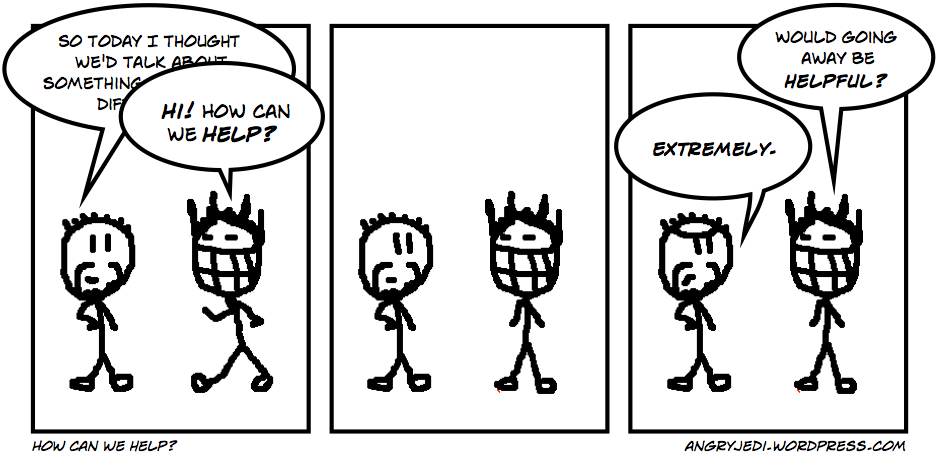
I am referring to websites that, within moment of you arriving, pop up a Google Hangouts-style chatbox in the corner of the screen, often featuring a photograph of some overly-chipper looking person, and invite you to "chat" if you need help.
Now, in principle this isn't a terrible idea. Those who are less familiar with the Internet will probably appreciate having guidance on hand — immediately, and without having to seek it out — should they run into difficulties. (That said, assuming that "those less familiar with the Internet" are too dim to determine that clicking on a link that says "Help" — as most (vaguely useful) websites offer — will actually provide them with assistance is, to be honest, rather insulting towards those who are "less familiar with the Internet". And yes, I'm primarily talking about old people.) Having a live person on hand is, theoretically, a great thing, as it means you can ask questions without having to work out what the specific search terms to describe the problem you're having are — and then discover the only vaguely useful search result is an unanswered forum post from three years ago of someone having the exact same problem and never resolving it, of course.
The implementation, however, leaves something to be desired. Take WordPress here, for example. I started composing this post and not five seconds after the post editor had appeared, up popped a little blue box in the corner of the screen cheerfully enquiring "Hello! How can we help?" It's distracting, it's annoying, it's patronising and it is, in this case, unnecessary: I have been using WordPress for… (checks) quite a long time now, and thus it's probably reasonable to assume I know my way around most of it — and that anything I don't know how to do I'm perfectly comfortable with looking up in help files and forums.
That doesn't stop this silly little box from popping up every few times I start creating a post, however — yes, it's not even every time I start writing a post. No, apparently WordPress believes that maybe two or three times a week I'll reach some sort of existential blogging crisis and rather than, as most bloggers would do, pontificate about it for a thousand words in a self-indulgent stream-of-consciousness post, I would like to "chat" with someone about it. I do not want to "chat" with anyone from WordPress. I would like them to be on hand if I have a specific question, but I'm more than happy to use the already established channels for that — I don't need live support.
And it's not as if this "live" support is particularly live, anyway. Owing to the fact that most chat support people are juggling a number of different conversations at the same time — each of which is with someone who has a markedly different thinking and typing speed from everyone else they're interacting with — it can often take minutes at a time to get a response. Not exactly "instant" messaging. And, okay, it's still quicker than waiting a day or two for an email response — or more, if you ever have the misfortune to deal with any sort of government agency via email — but the benefit of instant messaging is supposed to be that you can get an immediate response, and if that one benefit isn't even present in these ever-present "How can we help?" boxes, then there's no fucking point them being there in the first place.
I might write a letter. That's always seemed like the most satisfying — albeit least time-efficient — means of expressing your dissatisfaction. Although sadly, it's also one of the easiest to ignore in this digital age. But the recipient actually receiving and reading it isn't necessarily the point in many cases; often putting pen to paper is a cathartic experience that makes the frustrated party get a few things off their chest and calm down a bit. It may not resolve anything in the long run, but, speaking from personal experience, by golly does it sometimes make you feel better.
So that's how you can help me, WordPress. You can bugger off with your patronising little chat box, otherwise you might just find yourself on the receiving end of a sternly-worded letter written on actual paper.
Or not. I might just stop getting worked up over stupid little things like this and go and do something fun instead. Hah! That'll be the day, eh?
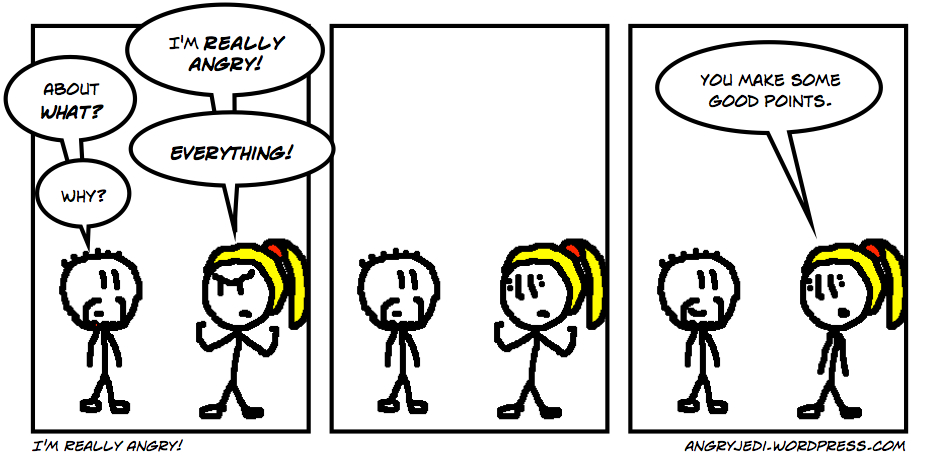
Just slightly over two years ago (really quite surprisingly close, now I look at the dates), I pondered the subject of how I Don't Care about certain social issues.
That particular rant — kind of shocked how little things have changed in two years, to be honest — was inspired by the amount of time certain people spent pontificating on Twitter about how awful certain groups were towards other groups. Whether it was racism, sexism, ableism or any of the other bad -isms, there was always someone on hand to loudly denounce anyone who displayed one or more of these traits as The Worst Person Ever.
I've tended to find over the years that the more I find myself seeing the same things said over and over — and the more hyperbolic those things are — the less I'm inclined to care about them, until eventually you cross some sort of apathy event horizon and find yourself feeling completely and utterly unmoved by even the most tragic of human suffering. Desensitisation is very much a real thing — although I'll qualify that at this stage by saying that I am by no means desensitised to things like violent imagery or things happening to those who are close to me and that I care about.
I was reminded of this feeling today when a friend got in touch and told me about some dude I'd never heard of supposedly sexually assaulting a whole bunch of people, the dodgy things he'd said on Facebook and the rather specific, creepy details that his alleged victims had said independently of one another. Now, I knew that I was probably supposed to feel outraged about this apparent miscarriage of justice, but the fact is, I just couldn't bring myself to care even a little bit about it. I couldn't bring myself to Google who this dude I'd never heard of was; I couldn't bring myself to look at the news stories; it just didn't matter to me.
And, you know what? I don't actually think that's necessarily a bad way to be thinking about things. While it would be nice if all the good people in the world could wave their respective magic wands and make all the bad people's dicks fall off (where applicable), we all know that isn't the way things work. And it's all very well and good and probably morally admirable to get upset on other people's behalf, but there are an awful lot of bad people out there and only so many hours in the day. I know I'd much rather be concentrating on my own life and the wellbeing of those immediately around me (in social, not necessarily geographical terms) than wasting time — yes, I do think it is a colossal waste of time — getting angry on behalf of people I've never met, will likely never meet and have absolutely no means of relating to, helping or indeed having any impact on the lives of whatsoever.
Why do I say this is a good thing? Doesn't that make me some sort of woman/ethnic minority/disabled person-hating narcissist? Well, no, of course not — although a woman/ethnic minority/disabled person-hating narcissist would say that, wouldn't they? The simple fact is this: very few people are real "heroes". Very few of us have the power to make a true difference in the lives of people we've had absolutely no contact with whatsoever. And it's not good for one's mental health to continually get upset and angry on behalf of everyone who is wronged in the world. I've seen one friend go down that road, and frankly they became rather insufferable as a result. More than that, though, it seemed impossible for them to ever be happy, because there was always something new to get upset and angry about; they were perpetually in a state of anguish and fury, because there was no way to fix this broken world we live in. It was heartbreaking to see, and there was nothing I could do to help them.
Ultimately all most of us do is try to be the best people we can be to the people who do matter to each of us: family, friends and the acquaintances we come into contact with on a regular basis through work or other activities. If everyone simply tried to be a bit more excellent towards one another in their own social circles, the world would probably be a much more pleasant place overall.
Unfortunately some people simply appear to be hard-wired to be as un-excellent as possible to the people around them. And that's not at all cool, but if you have nothing to do with those people, harsh as it may sound, they're not your problem. They have to either recognise the problems they have themselves and do something about it, or the people who are close to them and care about them have to take action. You, as some random stranger on the Internet, have no influence, no power and, moreover, no real right to interfere with that person's life. Concentrate on dealing with your own issues, because everyone's got them to varying degrees, and if you're one of the lucky few to be in a place of relative contentment? Enjoy it, for fuck's sake; don't go looking for trouble.
So, to sum up: I Still Don't Care. And, I have to say, ditching social media has made it a whole lot easier to do just that. While my own issues mean that I'm still a way off feeling truly, completely 100% happy and content with my own life, I sure feel a lot closer to that ambition than I once was. And, should I ever reach it? I'm damn well going to enjoy every minute of it.
Something a friend of mine said in an online chat earlier made me think about the way we, humanity, use the Internet on a daily basis — and particularly the role that social media plays in many of our lives.
He said that as human beings, we crave information. It doesn't matter what that information is, we're just hungry for it; forever consuming, devouring any input we can get our brains wrapped around, however mundane, stupid or fury-inducing.
After he said this, I took stock of my online existence since leaving Facebook and Twitter behind. I still haven't looked at the former at all; I've peeped at the latter once or twice to see if I had any mentions or direct messages — I didn't (apart from a share of this post by a dentist who clearly hadn't read it at all), which, I won't lie, smarted a bit, but I'll live.
What I have done, however, is almost immediately replace them with other things. I was always intending to make more active use of the Squadron of Shame forums, for example, but they have become my primary go-to hangout online — which makes their occasional lack of activity a little frustrating. (Come join up and talk in a chin-strokey fashion about games!) But that's not all I'm doing: instead of relying on what Twitter is talking about for a picture of the day's news — a practice which tends to give you an inherently biased picture of what is going on, due to the political tendencies of some of Twitter's most vocal users — I'm specifically seeking out sites like the BBC and the Guardian to read about stories at my own pace. (I still skip over anything that just offers me a video and no text, though; fuck video.)
I am not, however, reading a great deal about video games. This is less about losing interest in them — which my marathon Xillia 2 session this evening will emphatically attest that I am not — and more about feeling there aren't really any sites out there that speak to (or for) me. I've discussed this with a number of people with whom I share similar proclivities, and many of us tend to feel the same way: while the ad-based revenue model for these sites continues to be in place, we're never going to see the sort of coverage that we're interested in seeing. Those sites that do try different things — like Polygon with its now-defunct features section, or 1up with its community-driven nature — end up either closing down altogether, or at the very least shedding the things that made them unique and becoming yet another identikit site of daily triple-A and indie darling news churn.
But I digress. The point is, the information void I left when I cut social media out of my life was immediately filled by something else. It's a compulsion; an uncontrollable urge. As a human being, my brain demands information; it needs input. More input.
I'm not entirely sure if that's a healthy compulsion, since as I noted above, the 21st-century brain doesn't appear to be all that selective about what it wants to absorb into itself. Perhaps if the brain craved nothing but new knowledge — information that would allow it to let its host function as a better human being — that might be absolutely fine.
The human brain is a mysterious thing. Whatever you may feel about the information you stuff into it on a daily basis, though, I think we can probably all agree that the Internet has had a profound impact on how we perceive, seek out and consume information these days, hmm?
Given the ubiquity of technology these days, there's a lot more competition between apps and online services than there ever was in the past. This means that all of them have to stoop to increasingly low levels in order to get people to "engage" with them, leading to a situation we've simply not had prior to the last few years.
That situation comes in the form of apps and services begging you to use them. It's obnoxious, obtrusive and, more to the point, makes me disinclined to make use of that app or service ever again. In fact, in most cases, if an app or service begs me to use it or come back, I will simply uninstall it or unsubscribe from their mailing list.
The most egregious example I can think of recently was an app called TuneIn Radio. I was recommended this as a good means of listening to both streaming Internet radio and podcasts, but was dismayed to discover after firing it up just once that it then insisted on reminding me of its own existence at least once a day via a push notification that was usually recommending something I had absolutely no interest in whatsoever. ("Listen to TalkSport!" Oh, how little you know me.) However good the app is, notifications bug me enough at the best of times, so in the bin it went.
I'm still getting email messages from services I had to sign up for when I was reviewing endless reams of shitty mobile-social apps for Inside Mobile Apps, too. Eventually I simply registered for these services with an email address I don't use any more, and this mitigated the problem somewhat, but there are still times where there are services that I haven't touched for a year or more feel the need to email me and remind me that they exist.
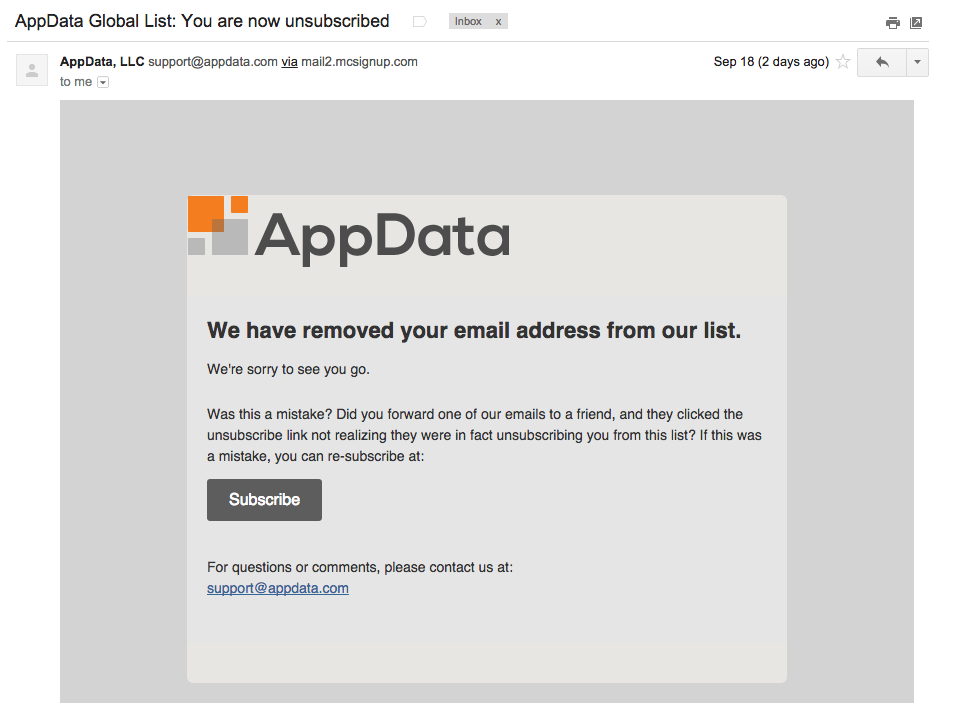
Worse, when you unsubscribe from these mailing lists you inevitably end up signed up to, you're often questioned as to why you'd ever want to stop your inbox being cluttered up with this meaningless crap. I had one email the other day from a service called AppData, a ludicrously expensive analytics service that was attached to the Inside Social Games and Inside Mobile Apps sites I used to write for, which asked whether I had unsubscribed "by mistake". Seriously. Look.
The sheer arrogance of this is absolutely astonishing. "Oh, no, whoops, I unsubscribed from your marketing spam by mistake. I actually do want you to try and sell me things! Sign me back up, quick!" Or, indeed, "oh no, the pointless marketing spam I forwarded on to my friend [who does this?] annoyed them so much that they tried to unsubscribe themselves and instead unsubscribed me! Sign me back up, quick!"
I kind of understand why this happens. As I said at the beginning, the sheer amount of competition between mobile app and online service providers these days is ridiculous, so they have to resort to ever more drastic measures to retain their users, and hopefully convert them into paying customers — or at least people who will click on ads.
I can't say I feel much sympathy, though. Surely having to resort to this is not a signal that you should market harder. Surely having to resort to this is, instead, a sign that there is far too much pointless, useless crap on the market, and maybe you should try a bit harder to come up with an idea that is actually innovative and helpful to people rather than a rehash of other things people already use? Harsh as it may sound, these days I find myself smiling a little with every email I receive that informs me a pointless, stupid mobile-social service that I reviewed a year or more ago is closing down. I'm glad; there's too much noise in our lives anyway even with just the well-established services like Twitter and Facebook, so stop adding to it.
Posts that essentially boil down to "I'm Leaving [insert site name here] And Here's Why You Should Care" are the very worst kind of egocentric narcissism, as most of you probably know. This is because they usually amount to someone attempting to attract attention to themselves flouncing off in a huff after they feel they've been slighted, only to return a week/month/year later to repeat the cycle anew. If you've had the patience and willpower to follow Fez developer Phil Fish over the last couple of years, you'll have witnessed this action firsthand.
And yet here I am making a largely similar post, and not for the first time. I shall try and keep the egocentric narcissism to a minimum, however — though I'm making no promises.
This post is about two things: 1) why I don't intend for Twitter, Facebook and Google+ to be part of my daily routine any more, and 2) how you can reach me if you'd still like to talk to me online — because despite the things I'm going to say under heading 1, I can't deny that I've made a lot of good friends across all three networks over the years, and it would be a shame to abandon that completely.
To begin at the beginning, then. There are a lot of words ahead, but I would appreciate you sticking around to read them — particularly the last section about keeping in touch.
Don't worry, there will be pictures. They'll be irrelevant pictures, but there'll be pictures.
Why I don't intend for Twitter, Facebook and Google+ to be part of my daily routine
Those of you who have been following this blog recently will know that I decided to subject myself to a voluntary social media blackout this week. Specifically, I logged myself out from Twitter, Facebook and Google+, deleted the relevant apps from my phone, ensured that anything that might bug me with notifications from them was well and truly switched off and finally settled down to a week of peace.
It's now a week since I started that blackout, and the time at which I decided I was going to review whether or not I needed social media in my life any more. And the conclusion I've reached is that I don't think I do. I opened Twitter earlier today to see how I felt, and felt no urge to scroll down to see if I'd missed anything — I closed it straight away without even scrolling off the first page of tweets. I didn't even feel the urge to open Facebook or Google+ at all. I have broken the "habit", it seems, and I don't feel like I "need" to develop it again.
Because it is a habit. It's compulsive behaviour — at least it was for me. You may do it yourself without realising it; you reach a quiet moment in the day, and out comes the phone or up comes the web browser, and you do your "rounds" of your social networking sites of choice. You scroll through the reams and reams of content the millions of members of these sites worldwide have made, rarely taking anything in, rarely stopping to appreciate, say, the composition of a photograph on Instagram, or the witty headline that someone came up with for a news story on Facebook. It's page after page of noise, little of it meaningful, all of it vying for your attention with equal fervour. And yet still around and around and around you go.
Some people deal with this noise better than others. Some people can discipline themselves to set aside a little bit of time to check their networks, then put them aside for hours or even days at a time. That can be a valid strategy, but with the speed at which modern social networks move, if you're not there when something happens, your contribution to the "discussion" — and I use that term loosely — is likely worthless, since conversation will have moved on by then.
This matter of "discussion" is worthy of consideration, so let's ponder that a minute.
The approach most people tend to take to discussion online.
One of the things that drove me to start my week-long blackout a couple of days earlier than I intended was the whole #GamerGate thing on Twitter. For those who don't follow the video games field — or those who simply aren't on Twitter — in simple terms, this was an argument between video game journalists (particularly those who err on the "feminist" side of the sociopolitical spectrum) and those who self-identify as "gamers", i.e. people who play, enjoy and are passionate about video games and would rather not be told they're awful people whenever possible.
I don't really want to get into the details of the events surrounding #GamerGate as that would be long, tedious and, more to the point, has already been summed up in a great amount of detail elsewhere on the Internet. (As always, note that there are two sides to every story — something that both sides on this particular argument have been guilty of forgetting.)
Suffice to say, however, that #GamerGate brought out the very worst in a lot of people. It brought out some of the most unpleasant trolls the Internet had to offer, who, predictably, went after a number of people who — let's be honest here — often court controversy to make a point. On the other side, those loud-voiced members of the press and their numerous sycophants continued down a path that I've been unhappy to see them proceeding down for the last year or two: belittling, ridiculing, publicly shaming and even outright insulting the very people they are supposed to be writing for.
Whatever fair points both sides had — and make no mistake, both sides had fair points — were lost amid the noise, and discussion never got anywhere. It was frustrating to watch; I tended not to participate as much as possible as I learned a while back that any attempts to call for moderation in such matters tended to result in accusations of "tone policing" — which, ironically, is itself a form of deflection attention away from a point being made — rather than genuine attempts to calm down and discuss things like rational adults. And thus nothing was ever resolved.
As I said above, different people deal with different things in different ways. My frustration with these endlessly circular arguments — in which no-one was really listening to anyone else and in which any fair points were inevitably lost in all the blind anger and insults being thrown in both directions — manifested itself as anxiety, stress and depression. I was genuinely afraid to contribute to these discussions for fear of attracting the wrath of one, the other or both of the angry mobs involved. And it was having an effect on my mental health.
If you can take yourself out of a situation that is causing you problems with your mental health and not cause yourself further problems, you should do. So that's exactly what I did. I extracted myself from the whirling miasma of rage, quietly slipped away for a while to reflect, contemplate and heal — and now, here I am, a week later, with no desire to jump back into the fray.
This isn't to say that Twitter, Facebook and Google+ are nothing but whirling miasmata of rage and other negative emotions, but frankly, the other stuff there has seemed of little value to me for some time, too. There's only so many "You Won't Believe What Happened Next!" videos you can take seeing before you just don't care What Happened Next; only so many "adorbs" pictures of cute things you can see before you never want to see another squirrel again; only so many baby photos you can scroll past before your only reaction to a friend enjoying a new addition to the family is… well, nothing.
It's all noise to me, in other words; an overwhelming swathe of constant content; a never-ending stream of consciousness in which meaningful life events are ascribed equal importance to a video of a cat drinking water from a squirt bottle. I don't need that. I've always been one for social anxiety, but right now I'd rather hear important things from the lips of the people involved rather than read it on Facebook or Twitter; I'd rather actually hang out with friends than hope I get more than a couple of "Likes" on the picture of the bag of chips I'm about to eat, or a couple of comments on a post I made about how much I'm enjoying Tales of Xillia 2.
I'm not saying there's no place for these sites in society at all — clearly a lot of people get great joy, excitement and enjoyment out of them. But for me, their value has dwindled significantly over the last year or two, so it's starting to make sense to cut them out of my daily routine and instead seek other means of staying in touch with the people I actually care about.
Which brings us neatly on to the second part of this post.
Well done for reading this far. Have a cake.
How to stay in touch with me
I'm not retiring from the Internet altogether. Rather, I'm being more selective with how I communicate and with whom. Consequently, I'm focusing on ways of communicating that allow me to take more control over my online presence, and which are more inherently personal than just shouting into the void of social media.
Note that I'm not closing down my Twitter, Facebook and Google+ accounts — they'll be used to broadcast these blog posts — but I won't be actively checking any of them, so please don't @mention or comment via any of those means if you want a reply from me.
Here are the main ways through which you'll be able to contact me in future:
This site. I post one blog entry here every single day, and have done for the last 1,699 days. Leaving a comment on my most recent post is a good means of getting a message to me. I'll try and be better about replying than I have been in the past!
Email. Close friends probably already have my email address. I don't mind sharing it, but I'm not putting it out in the open on this site. If you'd like to chat via email, you can start a private conversation via the contact form on my About Pete page and, assuming you're not some sort of crazy stalker, I'll probably get back to you.
Google Hangouts. For real-time chat, I use Google Hangouts almost exclusively. I don't do voice and I don't do video, but text chat is something I'm happy to engage in with you, assuming I know who you are before you just pop up saying "hi" and nothing else. If you don't already know my Google Hangouts info, drop me a message via the aforementioned contact form.
The Squadron of Shame forum. Most of my "public" conversations — "broadcast-type" messages, I like to think of them as — will now be found over on the Squadron of Shame forum. Although the Squad was originally set up as a small but well-formed group back in the 1up.com days, the modern Squad is very open to new members, with the only requirements for membership being that 1) you're interested in games, particularly those a little off the beaten track and 2) you're respectful to other people's tastes in games, even if they don't coincide with your own. Come and sign up and say hello, since that forum is where I'll be spending most of my online "social" time these days.
Final Fantasy XIV. If you happen to play Final Fantasy XIV and find yourself on the Ultros server, look up Amarysse Jerhynsson and say hello.
Thanks for taking the time to read this post; I appreciate it. To those of you that I've only interacted with on social media in the past: I'm sorry to leave you behind just as, in some cases, we're starting to get to know one another (I'd like to give particular, specific shoutouts to @FinalMacstorm and @SonyofLastation here, both of whom I've very much enjoyed talking to recently) — but I hope you'll consider staying in touch via one of the means above, and I hope you understand my reasons for wanting to eliminate stressful, anxiety-inducing and unnecessary noise from my personal life. To those of you who are already firm friends beyond the boundaries of social media — well, the same, really; I hope you'll respect my decision here, and that you'll stay in touch via other means.
Onwards to a brighter future, then: one largely free of pop-up notifications, pointless arguments and unnecessary stress. I'm looking forward to it very much indeed.
 I find Internet culture endlessly fascinating and, at times, more than a little terrifying.
 As the years have passed, the Internet has undergone continuous improvement for the most part. It's now one of the most — if not the most — democratic media in the world, for better or worse, allowing pretty much anyone around the world to speak their brains on pretty much any subject they'd care to share with anyone who wants to listen. (This blog is, of course, a prime example of this in action; I'm still frankly bewildered anyone reads this at all.)
 Just slightly over two years ago (really quite surprisingly close, now I look at the dates), I pondered the subject of how