A lot has been made about the supposed proliferation of "fake news" and, regrettably, because discussion about it started around the time of Trump's last ascendancy (and to quite a significant degree from the Trump camp), not everyone takes the concept entirely seriously. But it's definitely something that happens, and it's making the Web less and less useful.
Earlier today, a member of a Discord I'm in posted a link to the following tweet:
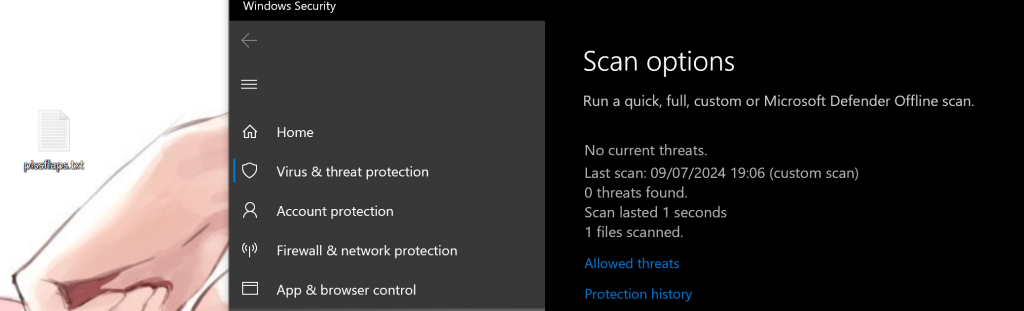
The screenshots are of Windows Defender supposedly finding a plain text file containing nothing but the text "This content is no longer available." to be a piece of malware — specifically a Trojan called Casdet!rfn. Obviously a plain text file is not malware, so this is ridiculous, and thus Microsoft must have made a silly mistake and we can all laugh at them, ho ho ho.
I tried it.
Windows Defender did not find it to be malware.
I Googled it and found several outlets reporting on this "story", including some that really should know better (looking at you, Tom's Hardware) — and not one of them had seemingly put in the minimal amount of effort required to verify that this was actually a thing. In other words, none of them had done what I did above: recreate the situation by composing a blank text file, putting the words "This content is no longer available." in it and then scanning it with Windows Defender. A two-minute job, tops.
No, instead the most rigour anyone put in was to look at the replies to the Twitter post, which are fairly slim in number, making me wonder exactly how this misinformation had spread in the first place. The tweet in question has nearly 700,000 views, though only 800 of whatever the Muskrat is calling "Retweets" this week, suggesting the majority of its minor virality has come about through situations exactly like the one I describe above: people sharing it via means other than Twitter.
Now, I don't blame the chap on Discord. He was just sharing something he thought was funny. I don't even blame the original Tweeter, because it's entirely possible that this was true once and it was quietly fixed in a Windows update. But I do blame all these people, and Google.
Not only for reporting on this without doing the absolute bare minimum of fact-checking, but for not correcting these stories if indeed it was once true and now is no longer correct.
Either way, the result is the same: a lot of misinformation gets spread very easily, often by people who have no ill intent. It's not the fault of the people who share this stuff — although I personally would check any sort of claim like this before resharing it myself — but it absolutely is the fault of outlets authoritatively sharing this as "news" without doing any sort of research beyond looking at a few Twitter posts.
Sadly, this is what "news" is these days. Get a good hook for a story that might be the slightest bit clickable and/or shareable, then write it up (with at least 600 words for SEO purposes, of course) and just make some shit up in the middle if you need to. Doesn't matter if the story is true or not; by the time people have clicked or shared, the article has done its job, and it doesn't matter if anyone twigs that it's bollocks or not.
In some respects, I'm sad that I'm no longer working the games journalism beat. But in others, I know that if I was still a newshound, I'd likely be gently encouraged into this sort of odious practice in order to get the numbers up.
I had more integrity and rigour when I was covering stuff for GamePro and USgamer. I'd find stories, research them myself and report on them only when I was good and sure that there actually was a story there. And I didn't have to make a big deal out of doing that at the time, because that was the expectation for someone working a News Editor position.
Now? Engagement above all. Who cares if something is true? Numbers go big, suits stay happy. Fuck the actual audience who might want the publications they read to be reliable and trustworthy; they are, after all, the least important part of the whole equation these days.
If you're looking for the Web as it once was, then I'm sorry to inform you that This content is no longer available.
Want to read my thoughts on various video games, visual novels and other popular culture things? Stop by MoeGamer.net, my site for all things fun where I am generally a lot more cheerful. And if you fancy watching some vids on classic games, drop by my YouTube channel.
If you want this nonsense in your inbox every day, please feel free to subscribe via email. Your email address won't be used for anything else.
See? I told you I'd be back. And I thought I'd talk about something other than Final Fantasy XIV: Dawntrail. Specifically, as the title says, I want to talk about how trends have made the Internet boring. Or perhaps more accurately, why everyone all wanting to do the same thing all at once makes things deathly boring.
There are a few practical examples I'd like to give. First is a YouTube channel I was introduced to recently called Obscurest Vinyl. This channel is run by a designer and musician who found some joy in creating fake record sleeves for songs with names you definitely wouldn't have gotten away with in the eras they're parodying. Songs like the wonderful Pullin' Out My Pubes (She Loves Me Not) by The Sticky Sweethearts:
You'll notice from that video that the record label now has some music attached to it. I was initially a little perturbed to discover that the person behind the Obscurest Vinyl YouTube channel had been using AI music generation to create the tracks, though my mind was set somewhat at rest by how he had written the lyrics (which are generally far too offensive to be the product of the typically rather po-faced Large Language Model AI bots) and tinkered with the initial output to make it flow properly, incorporate all the filthy language and sound consistent with the other works from the same fictional "artists" on the channel.
Of course, what the YouTube algorithm then did was go "oh, you watched a video about a fake record with lyrics about someone gluing their balls to their butthole, HERE, HAVE A MILLION MORE OF THEM". And it became very apparent that Obscurest Vinyl has a lot of copycats out there, none of which have anywhere near the same magic; these other channels are just trying to ride a trend.
This, of course, is symptomatic of one of the main things that is killing the Web right now: excessive Search Engine Optimisation or SEO. Have you ever searched for some information on something, only to find a billion unrelated websites all magically having articles headlined "What Time Is The Superbowl On?" or "Where Do You Unlock Pictomancer in Final Fantasy XIV?" That's SEO at work, and that's a problem that is only getting worse with the amount of AI sludge that is being fed into the Internet at large. Sites want quick and easy clicks, so they look at what people are searching for — the trends of the hour — then provide a hyper-specific article about the thing.
Helpful? Arguable. I hate it, because I'd rather have the information directly from the original source — in the latter case above, for example, it took me a fair bit of scrolling before I got past all the websites jockeying for SEO juice to the actual website for Final Fantasy XIV, the thing I was looking for.
More than being frustrating if you want the information straight from the horse's mouth, it just makes the Web boring as fuck, because every site (including a lot that should really know better) are doing the exact same thing. Daily Wordle solutions. Individual articles for things that would have been much better incorporated into an FAQ. Outright copying and plagiarism of other sites. It really is a shame to see what online media has become — and frustrating to see that certain portions of the creative types on sites such as YouTube are more obsessed in chasing trends with transparently copycat material rather than, you know, being creative.
I don't know what the endgame of all this is. I hope we're in a "things will get worse before they get better" kind of situation, but honestly right now, it feels unlikely that the "get better" part will happen. The Web gets demonstrably worse, less useful and less fun day by day. And we've all let it happen. I don't know if we can undo that.
Want to read my thoughts on various video games, visual novels and other popular culture things? Stop by MoeGamer.net, my site for all things fun where I am generally a lot more cheerful. And if you fancy watching some vids on classic games, drop by my YouTube channel.
If you want this nonsense in your inbox every day, please feel free to subscribe via email. Your email address won't be used for anything else.
I'm compelled to write today by the thoroughly lovely Neil and Dave of the This Week in Retro podcast, who had a discussion about "the youth of today", and how some parents are concerned that their children spend the vast majority of their time on an endless cycle of Fortnite, Roblox and Minecraft, perhaps punctuated by social media in between times. The show and its discussion can be found below:
People who grew up pre-Internet doubtless all have their own experiences to share. The listener who wrote in with the question described how while they did spend time with their computer playing games, they also played outside, rode their BMX bike and all manner of other things, while both Neil and Dave described their own experiences as being a bit different, both from one another and from the listener's recollection. So I thought I'd share my own experiences, with the benefit of hindsight.
I grew up in a country village that, at the time I lived there, had somewhere between 800 and 1,000 people living there. It was seven miles away from the nearest town, there was no bus service unless you went to the next village over (and even then, it was pretty much a "once a week" sort of affair) and… I guess you could look upon it as either being ideal or terrible for growing up in. Ideal because it was quiet, safe and full of places to go on childish "adventures"; terrible because, particularly once I reached adolescence, all of my friends were a car journey away.
I went back and forth on my feelings about living in that village. When I was of primary school age, I attended the village school, and as such my social circle was pretty much all people who lived nearby. I had a small group of friends, only one or two of whom I actually went to see outside of school time, but mostly kept myself to myself. In retrospect, my relative lack of socialisation compared to some of my peers was likely down to the social anxiety I felt as a result of my then-undiagnosed autistic spectrum condition.
But at the time, I didn't really begrudge living in the village. I knew it was a nice place, that I lived in a nice house with supportive parents and a stable home life. I enjoyed when my grandparents came to visit and we'd go for a walk, inevitably to landmarks around the village that had acquired nicknames; "The Kissing Gate" (one of those awkward gates into a farmer's field), "The Brook" (a pathetic little stream that, these days, has mostly dried up and smells awful), "The Bullocks" (the farmer's field beyond The Kissing Gate that sometimes, but not always, had bulls in it). Looking back on it now, I have lots of fond memories.
When I entered my teens and started attending school in the aforementioned town seven miles away, my feelings changed a bit. While I was still somewhat anxious about social situations, I started to feel a bit more left out. As I grew older, I started to feel like there were lots of things that I couldn't do because I didn't live close enough. These feelings persisted until I turned 17, passed my driving test and suddenly had a lot more independence… so long as my Mum didn't mind me borrowing her car of an evening.
I promise I'm getting to the video games.
Point is, I don't remember spending a lot of time as a kid or a teen "playing outside". I didn't learn to ride a bike until well after many of my peers — memorably, I suffered a rather large setback on my initial efforts when I came a cropper and skidded along a rough concrete farm road, shearing a significant chunk of skin off my legs and arms, which made me a little hesitant to try again for a while — and I didn't spend much time with many of my peers, except on rare occasions when I'd go over to a friend's house for one reason or another.
Throughout all that time, I was fascinated with computers. Not just games, but computers in general. I knew my Dad worked for IBM, but didn't really know what he actually did (and still to this day don't think I could actually tell you). I knew my brother and Dad both contributed to an Atari computer magazine that we got regularly known as Page 6. And I knew all of my family, at one point or another, were keen computer users for various reasons. My Dad used it for "serious" software and subLOGIC's Flight Simulator II (which he insisted was "not a game" and was thus still counted under the "serious software" category"); my Mum liked the occasional blast on Millipede and Space Invaders; my brother was the one who was into games, though he had a much more active social life than I did, helped at least partly by being ten years my senior.
Since I determined quite early on that I rather enjoyed — or at least felt most comfortable — in solitude, I was grateful for the company of the computers of our household: initially the Atari 8-bit and ST, then later the MS-DOS and Windows 3.1/95/98 PCs. In the early days of the Atari 8-bit, I devoured books and magazines about the computer, typing in listings and learning how to program in BASIC myself. I never really got what I'd call good at it, but I developed a basic (no pun intended) competence that was greater than that of someone who just used their computer to play games.
But I also played games. A lot of games. I learned a lot from those games, too. Text adventures helped me with my reading (and, indirectly, my writing); keyboard-based games played a significant role in developing the typing skills I still have to this day; puzzle games helped me with my general intelligence and problem-solving; action games helped me develop my imagination and my motor skills.
It's stereotypical to say that "games help with hand-eye coordination", but I was diagnosed dyspraxic in primary school, which basically meant I was a bit clumsy with certain things; video games helped me feel like I was competent at something, even if I was unable to hold a pencil "properly". Playing games, and more broadly "going on the computer", was important to me. It felt like it was something I could enjoy without compromise; I didn't feel like I had to make any sort of adjustments, or have people "go easy on me" as I did in activities like sports. It was just something for me to enjoy. And, as I moved into my teens and broadened my circle of friends at secondary school, they proved to be a good backdrop for social interactions, too.
More often than not, if I went over to a friend's house or had a friend over to mine, we would spend our time playing games together, or at the very least just using the computer. I have fond memories of spending time with several friends just messing around with speech synthesis programs on the Atari ST and Amiga, and even programming in STOS, a dialect of BASIC for the Atari ST, or making silly in-joke games with Clickteam's wonderful Klik and Play and The Games Factory. I was happy that my formerly solitary activity was something I could share my enjoyment of with others.
This continued as I came to the end of my time at school and moved into university. I made new friends, at least partly through computing and video games, and many of those folks are people I still make an effort to spend time with today — even if sometimes that effort doesn't feel like it's reciprocated with quite the same enthusiasm. Computing and gaming remained something that was important to me, even as the Internet came into its mainstream ascendancy in the late 1990s.
I have some fond memories of those early days of the Internet. Chatting with strangers on CompuServe's "CB Simulator", aka just a public chatroom. Posting messages on CompuServe's GAMERS forum, which eventually let to me earning $200 for making ten Wolfenstein 3-D levels that were included in an official expansion pack. Chatting with my friends from my course on MSN Messenger. Randomly getting into a conversation with a young woman on AOL Instant Messenger, only to discover that, completely by chance, she was the housemate of one of my existing friends.
Computing was always there as part of my life, but I think a key difference between then and now is that in my formative years, it was there as a backdrop to socialisation, rather than the means of socialisation itself. The This Week in Retro listener commented that their children feel genuine anxiety and FOMO ("Fear Of Missing Out") if they have gaming time privileges revoked for whatever reason, because rather than Fortnite, Roblox and Minecraft being the backdrop for their socialisation, those activities are the socialisation.
There's also social media to take into account. I am genuinely glad that social media did not exist when I was a child, because I'm not sure I would have made it through my adolescence intact. Sure, there are positive aspects to it, such as being able to reconnect with people you haven't spoken to for a long time, but there's also the insidiously manipulative nature of all the major platforms today, and how none of them are really concerned with being a platform for communication; they are, instead, platforms for advertising.
The thing that really makes me feel like social media may well have done me in, though, is how easy it is for it to be used for bullying. I suffered a fairly significant amount of bullying throughout both my primary and secondary school life, and it was hell. It left me wary of trusting people; it made me frustrated about communicating with others; it made me feel like it was, at times, simply not worth making the effort to interact with people.
For a long time, I used to say that the Internet allowed me to "be myself" for the first time… well, ever, really. I could find like-minded people who understood me and respected me for who I was, and I felt like I was among friends. I don't feel that way any more; nowadays, I feel the same way about online interactions as I do about interacting with real strangers: genuine anxiety and fear. I dread getting notifications in apps or on websites where I've posted something publicly. And yet, I still do it — here I am, after all — because I feel like it's important to not let the bullies win, whether they're real or imagined. I need to feel like I can still express myself the way I want to express myself; to enthuse about the things I want to enthuse about. That's why I write here and on MoeGamer, and why I make videos over on my YouTube channel.
Even then, though, I feel a lot of frustration, because I know a significant portion of the world looks on the Internet, social media and general social interactions in a different way to me. That can often leave me feeling lonely and isolated. But the one thing I've always had as a constant is being able to immerse myself in a video game or other activity on the computer, and feel like I am, for once, at peace — even if, with each passing year, it feels like it's getting harder to share that haven of peace with others.
That went a tad deeper than I perhaps thought, and I'm not sure I have an answer to the original poster's questions or concerns. I do know, however, that spending time on the computer isn't necessarily a bad thing in and of itself, particularly when it brings someone comfort and stability. It's when that "safe" activity starts to get "unsafe" things encroaching on it that you need to perhaps take action — but that's going to be something that is different for everyone. For me, it's meant largely removing myself from the public-facing part of the Internet except in places where I can very much control and curate my experience, and continuing to enjoy those things that I always have enjoyed in peace and quiet. No video game ever betrayed me, after all.
Want to read my thoughts on various video games, visual novels and other popular culture things? Stop by MoeGamer.net, my site for all things fun where I am generally a lot more cheerful. And if you fancy watching some vids on classic games, drop by my YouTube channel.
If you want this nonsense in your inbox every day, please feel free to subscribe via email. Your email address won't be used for anything else.
One of the "innovations" of modern tech and software that I am most consistently baffled by is the concept of "Suggestions".
Don't get me wrong, I am under no illusions as to what "Suggested Content" really means on websites and social media platforms (it's advertising, in case you somehow weren't savvy enough to know that by now) but I'm talking more in contexts where it's not obviously advertising, or where it doesn't make sense for advertising to try and worm its way into places.
Places like, you know, just Microsoft Windows in general. Or Google Drive. Both of those have features where they provide you with a list of "Suggested" files, and I absolutely, genuinely do not understand why that feature is there or what it is for. Right now, for example, my Google Drive "Suggested files" list is a non-chronological index of things that I have opened or edited recently. Fine, you might say, except there is a perfectly good "Recent" option in the sidebar which does give me a chronological list of things I have opened or edited recently.
Likewise, the Windows 11 start menu on my "work" computer (it came preinstalled, otherwise I would have been quite happy continuing with 10 as I do with my "play" computer) appears to "suggest" applications almost completely at random, with its first two suggestions usually being the things I have installed most recently, and the others being… pretty much anything that I have installed, for no discernible reason.
Under certain circumstances, I get the idea. When it comes to media, a "suggestion" feature might inspire you to look at photos or listen to music that you haven't enjoyed for a while — though this can also backfire somewhat. Earlier today, my phone's "Gallery" app decided to send me an unasked-for notification that I presume someone somewhere thought was "cute", with the text "Feline footprints in Southampton". The attached image? Our dearly departed cat Meg. I'm still quite upset about Meg's passing, so I emphatically do not want my phone randomly bringing her up out of the blue for no apparent reason. I will look at pictures of her when I'm good and ready, thanks very much.
The push for "AI" in everything is only making this shit worse, too; the Gallery app on my phone recognising that the image in question was a picture of a cat is a result of improving image recognition technology, and I suspect as generative AI becomes more and more pervasive and invasive in our daily online life, situations like this are only going to become more and more common — because you can bet your bippy that all these "Suggestion" features are going to be turned on by default.
What happens when your phone decides to "suggest" a photo of something you'd rather keep private at an exceedingly inappropriate moment? Well, some might say you should keep your private photos private, but realistically, practically speaking, most people these days are not that organised, because we've made the mistake of trusting our software and online services to do the organisation for us. I actually like the fact that Google Photos can pick out, say, pictures of cats, or pictures that mention something specific in a piece of text, because that is indisputably useful — but what I don't want is my phone going "HEY REMEMBER YOUR CAT THAT DIED? HUH? HERE SHE IS, I PICKED HER OUT FROM ALL YOUR PHOTOS, AREN'T I SMART?"
There's a place for some — some — of the innovations that are currently going on in tech. But, as always, it seems we're going to have to endure a period of people pushing things to absolute breaking point before we settle into something approaching a useful routine. And, unfortunately, that period appears to have been going on for quite a while now… and people don't seem to be willing to push back against the more unreasonable uses of these features.
"Suggested Content" can get in the fucking bin. I know what I need on my computer and when. And, more often than not, when I'm browsing the Web, I know what I'm looking for, too. Sadly, it feels increasingly unlikely that I'm going to be left in peace these days.
If anyone mentions Linux, they are getting a slap.
Want to read my thoughts on various video games, visual novels and other popular culture things? Stop by MoeGamer.net, my site for all things fun where I am generally a lot more cheerful. And if you fancy watching some vids on classic games, drop by my YouTube channel.
If you want this nonsense in your inbox every day, please feel free to subscribe via email. Your email address won't be used for anything else.
I'm sure discussing things with people online wasn't always as exhausting as it feels these days.
I have some extremely fond memories of time spent on 1up.com's forums and "club" pages talking about games with a varied crew of folk, all of whom had come together through our shared interest in the video game medium. We didn't always agree on things, but that made for interesting discussions as we strove to understand one another's viewpoints. There was no shaming, there was no telling each other we were wrong (apart from on one podcast, where a couple of participants got a little more heated than a reasonable person perhaps should over whether Fallout 3 was playable from the third-person camera) and there was just a nice atmosphere of mutual respect.
These days, it's becoming more and more of an effort to open my virtual mouth online in places supposedly made for "discussion", because to a disproportionately large number of people, "discuss" appears to mean "disagree vehemently and aggressively". And it's inevitably over something that simply doesn't matter, but the nature of such exchanges make it easy for hot heads to prevail and things to get stupidly, absurdly aggressive over an absolute nothing of a subject. (No, I'm not citing specific examples, for reasons that I hope are already obvious.)
This is a disappointing development to me, because 20 years ago, I would have sat here and quite confidently said that on the Internet, I could be my "real" self much more than I could be in "the real world". I actually do still feel that way to a certain extent — outlets such as this blog, MoeGamer and my YouTube channel allow me to express myself in the way I want to, rather than how I'm "supposed to" — but even in those places, there's always the risk of some weirdo turning up and getting weirdly angry about something which absolutely does not matter.
Thing is, I sort of get it. I get why those people exist, because there are times when I'll read something online and I'll feel my own heckles rising (you feel it start around the balls) and contemplate posting some sort of snippy remark in response. Most of the time, I've conditioned myself to not do that. Occasionally one slips through, and I pretty much always regret it, because it inevitably leads to a disproportionately furious argument over something I actually don't feel that strongly about, because the whole "sense of honour" thing kicks in and you want to save face, no matter the cost.
It's exhausting. It's exhausting when you get pulled into situations like this, and it's exhausting making an effort to avoid situations like this, because it's very easy to take things much too far and end up simply not wanting to talk to anyone. I have definitely reached that latter end of things, as there are times when I feel extremely lonely but unable to reach out to someone because I simply don't have the mental fortitude to be able to fully process how today's online interactions tend to work.
I think about this sort of thing quite a lot, and when I do, I always end up asking myself if it's really worse than it used to be, or if my perspective has just changed. And honestly, I'm not completely sure of the answer to that. I suspect it's a bit of both, because I know I have deliberately changed my online habits for the sake of a quiet life — but then I'll look at something like this legendary thread from Usenet circa 1997 and see that people getting really very cross about things that don't matter was still a thing back when I thought the Internet was much nicer.
I guess the difference is that there was a certain "barrier to entry" for the "tougher" parts of the Internet back then; I never went on Usenet, so I never saw any of that sort of thing. These days, that aggressive means of interacting with one another is just the norm; social media has become what Usenet was, only rather than being neatly segregated into interest groups, everyone has all been plunged into the same vat of boiling piss to fight it out among themselves and see who has the loudest voice. I'm aware that was an utterly tortuous metaphor but I don't care. My blog, my rules.
The other difference, of course, is that today I am aware of my own mental health conditions, including depressive and anxious episodes that occur sporadically, along with my underlying condition of Asperger's. Being aware of why I find certain things about socialising difficult is useful, but it can also make me feel more hesitant than I perhaps "should" be to engage with certain scenarios.
I don't really have a conclusion for all this; I just felt like thinking "out loud", as it were. And so there you have it. Now I'm off to go and eat chilli.
Want to read my thoughts on various video games, visual novels and other popular culture things? Stop by MoeGamer.net, my site for all things fun where I am generally a lot more cheerful. And if you fancy watching some vids on classic games, drop by my YouTube channel.
If you want this nonsense in your inbox every day, please feel free to subscribe via email. Your email address won't be used for anything else.
There are a few main reasons for this, and I'd like to talk about them a bit today.
Firstly, Elon Musk's idiotic changes to the terms of the Twitter API, which has priced literally everyone out of being able to use it, have made the platform next to useless as a means of automatically sharing your work to an audience that supposedly signed up to follow your updates. It's both hilarious and tragic to see company after company sharing news posts that effectively say "lol, fuck Twitter".
Secondly, my previous justification of keeping my Twitter account around for the sake of friends and contacts just doesn't really feel like it's… justification any more. The friends in question rarely bother to get in contact, and there are other means for professional contacts to get in touch.
Thirdly, I'm just fucking sick of the most likely response you get to posting literally anything on there being vitriol and hate.
On the latter point, I recently posted an article about my negative experiences trying Ubisoft's Riders Republic via PlayStation Plus. The gist of the article, if you're one of those Internet denizens whose attention span has been shot too much to bother clicking on a link, was that the game was designed in such a way that it is genuinely insulting to the intelligence of anyone over the age of about 12. It doesn't let you just play; instead, you're bombarded with hours of mandatory tutorials and obnoxious zoomer slang, and this was enough to make me not even want to bother seeing if the game "got good" later.
I think this is something worth talking about, because it's the first time that I, as a 42 year old video game enthusiast who has been involved in the medium since the Atari days, felt completely alienated by a brand new, supposedly mainstream game. So I talked about it. Then I shared that article on Twitter.
One of the first responses I got was from someone who yelled at me, based entirely on the assumption that I'd said the exact opposite to what I'd actually written in the article. He'd obviously read the headline, made an assumption and then decided to shoot his dribbling, zit-encrusted mouth off at me, despite it taking nothing more than a single click and a minute or two of reading for anyone to see that he was talking complete horseshit. But you can bet anyone who "liked" his dumbshit comment wouldn't go and check whether or not he was right.
I spent a few hours last night and this morning feeling stressed and anxious about this. But then it just sort of dawned on me: fuck it. Why the fuck should I care what some obnoxious cunt on the Internet thinks? Why the fuck should I let one idiot have such power over my mental wellbeing, based entirely on the fact he's too much of a lazy shit to actually read something I wrote?
And the answer to that is that I shouldn't care; I shouldn't let one idiot do that. And since Twitter is the primary means of allowing idiots to do that, it needs to go. Completely. So it has.
On a related note, this news isn't finalised or official as yet, but it's pretty much confirmed that as of the beginning of July, I will be getting out of the professional "content creation" (ugh) game completely.
I won't go into details for now because things are still being hammered out, but suffice to say for now that it's nothing anyone needs to worry about — I'm simply changing my professional role in such a way that it means I can focus my attention entirely on the Evercade project, which I'm incredibly passionate about and is something where I feel genuinely valued by both my colleagues and by my "audience", such as they are.
I'm both happy and sad about this. I'm happy because it means that I can focus my professional life on something that I love, and because it means my free time will genuinely, completely be my own again. No more will I find myself "having" to play something for the sake of timely coverage; instead, I can just enjoy things at my own pace, and I'm really looking forward to that.
I'm sad, however, because I spent so much of my early life desperately wanting to follow in my brother's footsteps and be part of the games press — and yet by the time I actually managed to get there, it had changed irreversibly from what it used to be. And it only got worse from there.
Again, I won't go into details for now, as that's something to talk about in more detail once everything here has been finalised. But I'll say again, it's nothing to worry about — I'm proud of what I've worked on to date, will continue to work on things like this until the beginning of July, and this change is my decision rather than anyone else's.
I'm just tired. So very tired of "content creation" being such a completely thankless task. The modern Internet has set up a completely adversarial relationship between writers and their audiences, exemplified by the Twitter exchange I described above, and that is emphatically not why I got into this.
I got into writing about games because I love them. I got into games writing because I think they're culturally important. I got into games writing because I think despite that cultural importance, they're not being written about and analysed in anywhere near the depth they deserve.
And I got into games writing because while the big, dumb, obnoxious games like the aforementioned Riders Republic get to ride the wave of commercial success regardless of how shit they are, there are myriad games released literally every day that run the risk of languishing in obscurity without people telling others about them.
The trouble is, I've discovered over the last decade and a half or so, is that no-one really seems to actually care. Online, "content" is piss in the wind. It's only relevant for the day it's posted — if you're lucky enough to get anyone to notice it in the first place — and it's fucking impossible to get people to give a shit about something after the fact, unless, as I've seen on MoeGamer, you're literally the only person to have written something meaningful on a particular topic. (In my case, sex sim Honey Select Unlimited.)
Google is flooded by manipulative, exploitative, SEO-optimised sites posting vacuous individual "guide" articles for things they don't care about for no other reason than it brings in the clicks. And no-one at any point in the process gives a shit; the average Internet user doesn't have enough in the way of critical thinking skills to see the cynical way all this has been set up, and the writers at the sites themselves don't give a toss as long as the numbers go up.
All of this is the fault of everyone who has normalised the idea of "consuming content" rather than "reading interesting articles" and the like. You, collectively, have ruined both the games press specifically, and the broader Internet in general.
It's demoralising and infuriating, and if you've been around all this for as long as I have, seeing the way things have been going, it should be no surprise that I very much feel like stepping down from it all.
And so that's what I'm doing. From hereon, my professional work will be in something that actually matters, that I care about — and that other people actually care about, too. I suspect I'll be a lot happier as a result, but I can't help but feel a bit bad about that dream young me once had, and how it was never really possible.
Today's post is inspired by a few things. Firstly, the culture of mistrust I wrote about the other day. Secondly, a YouTuber that my wife Andie and I used to like resorting to "I MADE THE MOST VIRAL TIKTOK RECIPES!" format. (Andie doesn't have a problem with this. I emphatically do, as will become clear shortly.) And thirdly, some of the outright lies I've read online today while attempting to find a perfectly simple piece of information.
Let's address these one at a time, as each of them are symptomatic of something slightly different.
As someone who does YouTube as a hobby, it's infuriating to see the supposed "professionals" fall into a rut of simply baiting The Algorithm with the exact same types of "content" all day, every day.
I Played 100 Days of [Game]. I Made Viral TikTok Recipes. This is the Worst [x] Ever. Thrifting with My Completely Charisma-Free Mom.
There's stuff on YouTube that I like and continue to watch. But this is the stuff that tends to languish in the wake of TOP CRINGE COMPILATIONS!! and FUNNIEST TIKTOKS I COULD FIND!! And this pisses me off. Because it demonstrates a complete and utter lack of creativity.
Yes, one could argue that there's at least some creativity at play in editing these videos and picking the material to use in them — but even then, they're incredibly predictable, regardless of who they are. You can expect to hear the Metal Gear alert noise, Kevin MacLeod's Local Forecast, that "anime oooooh" noise in a significant proportion of popular videos out there, and you'll see all the same visual tricks, too — jump cuts, crash zooms with a red tint on the screen and heavy screen shake, "A Few Moments Later" SpongeBob memes.
It's infuriating. Like, it makes me genuinely angry. I know it shouldn't. I know it's dumb to get angry at people following trends. But it really does make me legitimately furious.
Why? Because I know there are lots of people working their arses off to make quality YouTube videos (note: not "content") and getting very little reward, relatively speaking for doing so. Instead, the endless assembly line of identikit Content continues to churn, cluttering up everyone's YouTube feeds with worthless garbage that provides precisely 0% more cultural enrichment value than simply staring at the wall for 12 minutes.
It particularly sucks to see video makers I used to like resort to this sort of thing — but I guess if you're making a job out of it, it becomes an unfortunate necessity after a while. For every viewer like me who unsubscribes from a channel once it becomes a clickbait factory, it seems at least a hundred more take my place. So there's zero incentive to change.
The PS5 Pro's release date has NOT been "revealed"
Earlier today, Andie and I were talking about how long various consoles were on the market, and as part of this discussion we looked up the release dates of the PlayStation 4 and PlayStation 5, pondering if and when a PS6 might ever be a thing — and if it would have a disc drive, which was the main point of our conversation.
When Googling the latter case, I was promptly confronted by a wall of articles that claimed the PS5 Pro's release date had been "revealed".
Needless to say, it had not been revealed. Instead, what had happened was a single gaming site that no-one had ever heard of had claimed that "insider sources" (anonymous, of course) had "confirmed" the PS5 Pro was "in development" and would "probably" release in "late 2024". This had then been parroted pretty much verbatim (albeit with some variation in the supposedly "revealed" release date) by a variety of other gaming sites you've never heard of, and this had happened so much that Google had figured it was worth showing to anyone who was searching for a simple piece of information: the actual, real PS5's release date. You know, the one where a product that actually exists was actually released.
Essentially, what we ended up with was a page of search results that were nothing but speculation at best, outright lies at worst. And there will be no consequences whatsoever for any of the sites that were engaging in this behaviour; in fact, they will almost certainly have been rewarded with happy big traffic numbers, and you can bet those pages have ads coming out the wazoo on them, too.
As someone who, as a child, had aspirations of joining the games press, and hoped he would be able to do that more than pretty much anything in the world, this is heartbreaking to see. And it's doubly frustrating when I run a site on which our writers take pride in composing honest, thoughtful, well-researched pieces rather than simply rushing to jump on the latest trend in order to squeeze out another few cents of ad revenue.
How to find all the blue medallions in Resident Evil 4 Remake
Speaking of which, one trend which was just starting to take hold when I left USgamer in 2014 was the odious rise of "guide content". For the unfamiliar, this is an SEO-baiting tactic in which sites post individual articles that supposedly answer each and every possible question people on Google might have about anything vaguely relevant and popular.
It's a completely unsustainable approach to "content generation", particularly if you have any standards about the quality of the articles on your site whatsoever, and it means that, again, if you're searching for specific pieces of information, you have to wade through 500 sites that have clickbaited their way to the top of Google's search results, with no guarantee that their information is reliable or helpful.
I'll give you an example. Prior to picking up my PS5, I was curious how the "PS4 Boost" mode worked. This is where the PS5 is able to run certain appropriately updated PS4 games with better performance than the original PS4 (and in some cases, PS4 Pro) would have been capable of.
The things I were curious about were simple: did this work with all PS4 games, or just select ones, and did I have to do anything to make it work?
The answers to these questions, by the way, are "no" and "no".
While attempting to uncover these simple answers, I stumbled across a full-blown, surprisingly lengthy article entitled "How to Enable PS5 Game Boost". Please recall that the answer to the question "do you have to do anything to make Boost mode work?" is "no", and then marvel at the fact that multiple sites, not just the one I found, managed to spin this simple answer out into at least 600 words of complete garbage, because you need at least 600 words for SEO purposes, don't you know.
I'm so tired of this. To the layman, it might seem like it's very convenient. But as someone who has worked in the commercial press and now works on the more "indie" side of things, it's infuriating, because I know these articles do not exist out of a desire to be helpful. As with all other clickbait — because that's what these articles are — the aim is simple: gain traffic, and, by extension, ad revenue.
I'm so tired. So tired. The Internet was an exciting place when I was a kid and everyone was just getting to know it. Now, it's nothing more than a mindless, soulless content factory where everyone is bidding for your attention so they can inject yet more ads directly into your eyeballs.
There are little havens where this isn't the case, of course. But they become more and more difficult to find with each passing day. And it honestly worries me quite a bit.
But at this point, it's also hard to know what to do, if anything. If I criticise this sort of thing, no-one listens. (I'm writing this today largely to vent my own spleen rather than to convince anyone else.) If I give up and engage in it myself just to join the rat race, I'm part of the problem. And if I abandon the Internet entirely, I deprive myself of something that is still, in some ways, a useful resource — and in some other ways, an essential utility for modern life.
So I guess I'll keep doing what I always do. Do my own thing, occasionally complain about how much everything else sucks, then repeat until my inevitable death from a brain aneurysm.
The other day, I received an SMS text message. This in itself was fairly unusual, as the only texts I tend to get these days are automated confirmations of deliveries and suchlike, but there was another layer of unusual to it.
"Hi mum," the text said. "My phone's not working, so please contact me on WhatsApp at [number] xxx".
Initially, I thought this might be an honest-to-goodness wrong number, which is a phenomenon that used to be widespread, but today, where we tend to do everything via pre-populated contact lists, doesn't tend to happen much. Something about it made me feel a bit suspicious, though, so I decided to Google the text of the message.
Sure enough, it was a scam. I was both disappointed and unsurprised to discover this, but it got me thinking: I used to be someone who really, honestly wanted to believe the best about my fellow man, but these days, it feels nigh-impossible to trust almost anything you see.
That "wrong number" is actually a scammer trying to get you to send them money, or to steal your personal information. That heartwarming post you saw on social media is actually a viral marketing campaign. That "look at me I'm so empowered" sex worker doing hot tub streams on Twitch is actually being forced into exploitation by darker forces working behind the scenes rather than because she wants to.
It's exhausting to think that, more often than not, these days what you see is most definitely not what you get. The world feels like a darker place that is full of mistrust, and aside from the necessity for constant vigilance being very tiring, it also makes it difficult for those of us who do want to go about our business in a genuinely honest sort of way.
You see it everywhere. Creative types being forced to churn out "content" with clickbait titles just to get eyes on their work. Workplaces and brands jumping on silly trends like TikTok for no discernible reason other than "it's popular, so we should be seen to be doing it". The growth in various forms of AI-generated text, images and sounds making misinformation and lies easier to spread than ever before.
On top of all that, the services we've come to increasingly rely on over the years actively make themselves worse over time, and we just sit back and take it. For example, it used to be that I could click "Publish" on this post and it would automatically share it to my friends on Facebook and Twitter, but that's not possible any more because of supposed "improvements" that both of those services have made.
This happens outside the online sphere, too. My last car I bought was worse than my previous one in terms of the features it had, but cost more. This despite me telling the car salesman to their face that I wanted to spend "about the same" on the new vehicle and have the same features.
And no-one seems particularly bothered by all this. I mean, sure, people comment on it occasionally, but no-one actually does anything about it. They keep posting their wacky MidJourney images, increasingly believing that "they" created the image through stringing words together. Scam text messages are a way of life, with people just shrugging at them rather than attempting to report them.
And those supposed to be "in charge" don't do anything anyway, so why bother? There's a house down the road from us whose front garden is constantly filled with obviously stolen motorcycles, which local kids can frequently be seen riding around making a nuisance of themselves on, without wearing any sort of safety gear or having any concern for the people around them.
It increasingly feels like we are a people blighted by absolute apathy and laziness, and despite countless warnings from dystopian popular media and the arts over the years, no-one really cares. So long as you have your content to consume and your vacuous "approval" of your fake life on social media from other fake people living fake existences, nothing seems to matter to anyone.
I'm really fed up of it. And it doesn't feel like there's a way to escape from it all. Because this isn't just "an Internet thing" any more. It's a "this is the world we live in now" thing.
People love to complain. This is a trait traditionally and historically associated with the British, but it's most definitely not an exclusively British thing. Perhaps it once was, but it most certainly isn't any more. And as with so many things, we can probably blame the way in which the Internet has brought people together — something which should, inherently, be a good thing, but which has somehow become corrupted along the way.
As I've noted elsewhere, I'm not spending a ton of time on Twitter any more due to a combination of the horrible atmosphere that seeps from every pore of that website and the constant ridiculous changes Elon Musk keeps making on a seemingly daily basis. But occasionally, I can't help myself from clicking on one of the Trends out of sheer curiosity.
The other day, I happened to see that Evri was trending. Evri, if you're unfamiliar, is the new name that the courier company formerly known as Hermes decided to adopt for themselves a while back. I don't know the reasons for the rebrand and honestly I really don't care, because they're inevitably absolute bullshit and everyone knows that Evri is "really" Hermes anyway, so it's largely irrelevant.
However, what I found when looking at the Evri trend was that everyone was complaining about Evri. Everyone had the same stories to tell of parcels being lobbed over their fence, of packages arriving broken or tampered with, or generally some tale of misfortune and woe related to getting their package delivered from this one specific carrier.
Here's the thing: I've never had a problem with Evri or Hermes. I spent a brief period working for them while I was looking for a proper job and I know what it's like "from the inside" also. While it was a time-consuming, underpaid and largely thankless task for the couriers, it was a reasonably well-run operation in general, and there were various ways in which said couriers were encouraged to do a good job, up to and including being "watched" through the scanny things they're supposed to carry around with them.
As fortune would have it, for some reason during my brief time with the company I never actually got a scanny thing, so I never had to worry about such things — not that I had anything to particularly worry about anyway. But I digress.
I'm not saying no-one has ever had a problem with Evri or Hermes. But if you were to look at that trend on Twitter, the conclusion it would be easy to come to would be that they were a company that should be absolutely, completely and without doubt avoided at all cost, because literally every delivery they do is the absolute worst possible thing that has ever happened to someone, and they have ruined too many Christmases and children's birthdays to count.
This is nonsense. While it's foolish to assume that they're completely without fault — in any sort of "gig economy" sort of situation, you have a risk of bad apples, but this is also true for more formally structured corporations — it's also ridiculous to put across the impression that they're a complete failure that should never be trusted.
It's just one of many examples of the Internet painting the worst possible picture of something. And I could provide plenty of other examples at this point, but I'll refrain from doing so for the sake of time.
What I will urge you to do, however, is that if you see any sort of seemingly universally negative reaction towards something — particularly on any sort of standards-free platform such as social media or user reviews — then be cautious. Chances are the thing that is being ranted and raved about is nowhere near as bad as people are trying to put across — because let's face it, people are a whole lot more likely to complain about something than post about how they had no problems whatsoever with a company or service.
Perhaps we should change our outlook on such things. Perhaps we should start posting positive comments when a company does the right thing and does what is expected of them. Or perhaps that's ridiculous — after all, a service that is being provided to you conforming to your exact expectations should not be particularly worthy of comment at all, because, well, it's what you expected.
But then that means the negativity will always win, because the complainers will always speak up, while the satisfied customers will just quietly get on with their day, thinking nothing more of the company they've interacted with or the service they've received.
Perhaps the answer is just not to listen to anyone and make your own mind up.
Earlier today, I was browsing through the digital editions of the old magazines I downloaded from AtariMania and came across a short series of articles written by my Dad about "going online".
This was pre-Internet "going online", however, involving a 64K Atari 800XL, a 300 baud modem and an external interface for plugging in such devices, and as such involved dialling up bulletin board services (BBSes) directly to access their information and files.
What struck me when reading my Dad's wide-eyed wonderment at being able to phone up a computer in Birmingham, read messages and download programs (a much more cumbersome process than we take for granted today, involving downloading the program into a "buffer" and then saving it to floppy disk or cassette afterwards) was the fact that any time he mentioned interacting with other people — usually through the BBSes' approximation of a "forum", which allowed people to post and reply to short, simple text-based messages — he was struck with how pleasant, polite and enthusiastic people were. These BBSes were generally run by enthusiasts rather than professional, commercial organisations and consequently tended to attract people in a similar vein.
Fast forward to today and I witness this somewhat sad, plaintive monologue from PR superhero Tom Ohle of Evolve PR:
Read Twitter feed for 5 minutes. Remember why I avoid the internet more often than not. Oh, people.
I'm with Tom here, but I'm at a loss as to how we got from the enjoyably enthusiastic experience my Dad described in these articles to a situation where the default tone on the Internet is aggressive, confrontational, cynical and negative.
This isn't universal, of course — there are still plenty of community groups that are made up of genuine enthusiasts, and interestingly enough many of them are still centred around the Atari community — but even among such community groups you find trolls, naysayers and people who are always keen to see the negative in everything.
This is particularly apparent in the gamer community, who are seemingly never satisfied by anything — blockbuster triple-A games are too formulaic, indie games are too weird, imported games are too "censored" — but it happens right across the Internet, make no mistake.
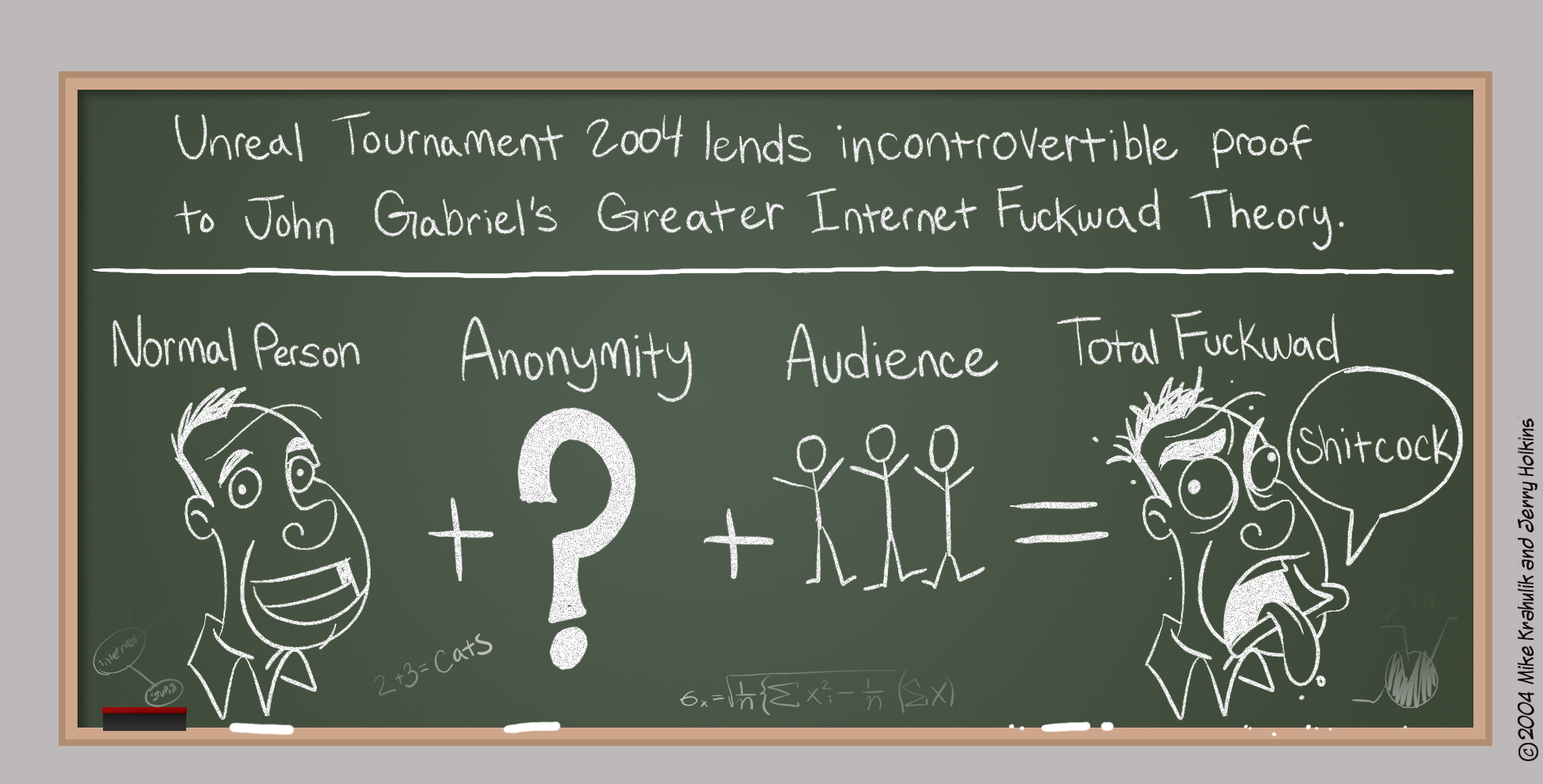
It's usually explained away by the John Gabriel Greater Internet Fuckwad Theory:
And for a while that was plausible. But it's not as simple as that any more: the rise in services such as Facebook means that people are quite comfortable being total fuckwads even with their real name attached to the nonsense they're spouting. And it seems to be the default tone these days, which is disheartening; it's actually unusual when you find a community that isn't full of complainers.
Perhaps it's a consequence of throwing everyone from all different backgrounds all together into a melting pot, resulting in inevitable culture clash. Or perhaps the world of today really does engender negativity rather than positivity — I know that I certainly don't feel particularly happy about the way the world is these days, though my way of attempting to counter it is instead to focus on the things that I do love.
Whatever the explanation, I feel it's sad how things have developed since those innocent days of dialling up that BBS in Birmingham and having to explain to my mother why we were on the phone for so long. I feel we've gone backwards rather than forwards, and that it's probably too late to do anything about it now.
All an individual can do, I guess, is try their best not to be part of it.