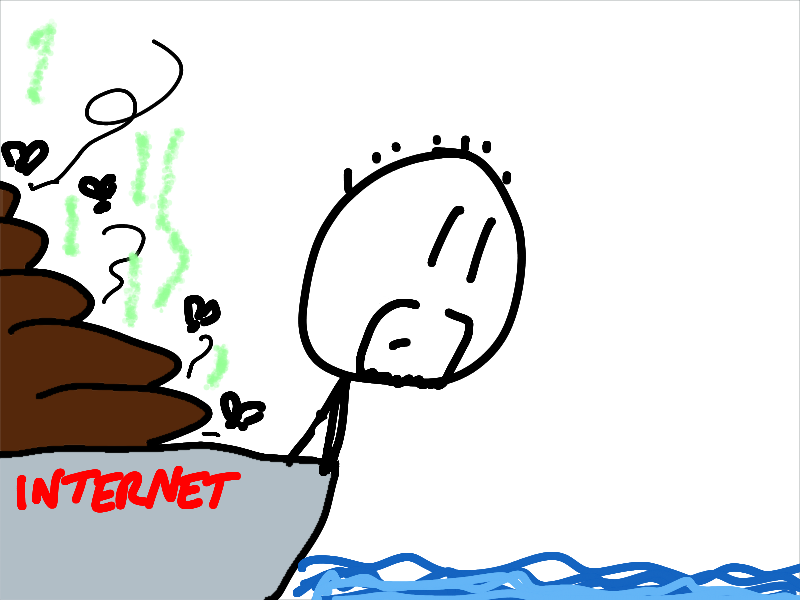
#oneaday Day 596: Sad little men

I've had two angry emails this week, one from someone who was upset I was covering Wolfenstein over on MoeGamer and drawing some parallels between the alt-history 1960s Nazi world order depicted in the game and the heinous shit going down in the United States right now, and another, likely a sock puppet, from someone who was angry that I said mean things about a particularly notorious revolting little troll that occasionally tries to start shit with the UK retro gaming YouTube community.

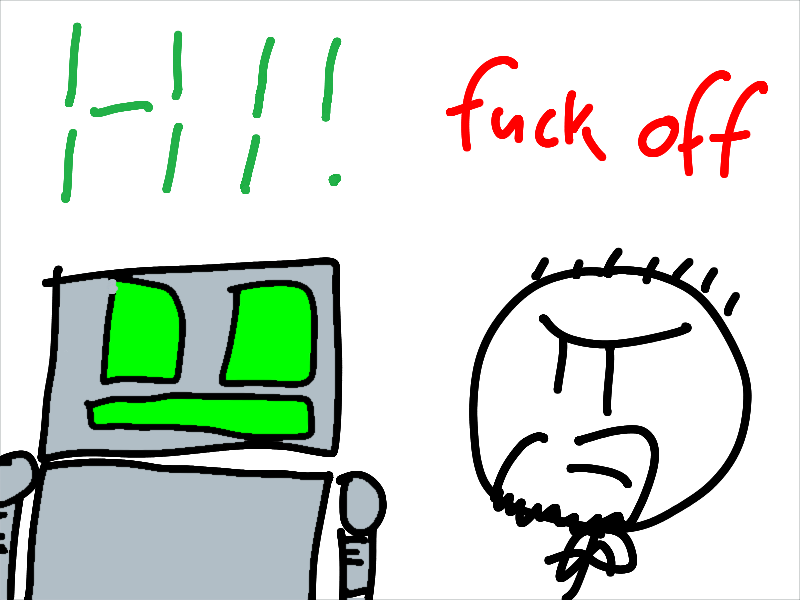
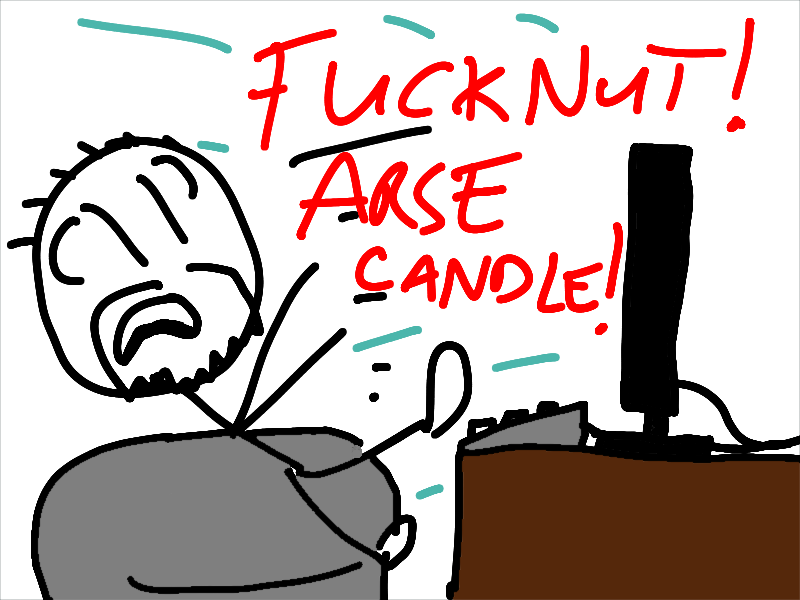
To both of these individuals, I extend my middle finger in an unmistakeable gesture and invite them, politely, to eat an entire bag of dicks. Because neither of these people were up for any sort of discussion — not that I wanted to discuss their odious viewpoints with them — and just wanted to spew a wall of vitriol at me before flouncing off into the sunset, likely to never think of me ever again. And I'm 100% fine with that last bit.

The first bit is a shitty thing to have to deal with, though. I, unfortunately, know quite a few people who have been on the receiving end of abusive messages from people like these two fucknuggets, and none of them have deserved what they have gotten. The people who spew this kind of hatefulness are, without exception, bigoted, intolerant fuckheads who are angry that the world doesn't cater specifically to them. They don't like that certain types of people who are different from them exist, whether those differences come in the form of their skin colour, gender identity, sexuality or how many YouTube subscribers they have. They are angry at the simple existence of people they see as different from them; they think these differences make those people somehow dangerous.

They fear them, and that's why they lash out in the way they do — they hope to break the spirit of people they have decided that they dislike. They have no endgame; no real purpose in mind. They just want to hurt people. And it's fucking pathetic. Particularly because the targets they pick, like me, are, frankly, completely harmless individuals who they likely never would have come into contact with were it not for the increasingly potholed Information Superhighway.

It sucks that we have to tolerate the existence of pathetic little trolls like this, because practically speaking, there's not a lot that can really be done about them. Law enforcement aren't interested in some mean messages on the Internet, social media platforms are increasingly lawless zones, and hosting your own sites means you have the joy of having to deal with moderation tasks yourself. At least WordPress and YouTube make it easy enough to block commenters via various means.

It's a shitty world out there, both online and offline, and there are days when it doesn't feel like there's anything worth "saving" any more. If you encounter any little shits like the ones I've described today, my best advice is to remember that their pathetic little lives are almost certainly full of more self-inflicted misery than you can possibly imagine, and that they're lashing out precisely because of that fact because they're unwilling to admit that they're at fault. Once you start down the path of being an Internet Dickhead, it's very difficult to pull yourself back and save face. Because, frankly, even if these two clagnuts came to me with a genuine apology tomorrow, I would not have the time of day for them.

You get one chance in life to make a first impression, and if that first impression is violently shitting yourself while screaming and waving a knife around, I'm not going to let you into my house, ever.


Want to read my thoughts on various video games, visual novels and other popular culture things? Stop by MoeGamer.net, my site for all things fun where I am generally a lot more cheerful. And if you fancy watching some vids on classic games, drop by my YouTube channel.

If you want this nonsense in your inbox every day, please feel free to subscribe via email. Your email address won't be used for anything else.
#oneaday Day 555: Silly things from around the Web

I can't think of anything in particular to write about today, so I'm going to just talk about a few random things I happen to have seen around the Web recently, or perhaps not-so-recently in a few cases. Hopefully that will at least provide me with some inspiration to say something about each of them. So let's begin.

Lord Heath's farts

This is one of those things that I don't remember the specifics of how I stumbled across it, but I was thoroughly glad that I did. There's a chap on YouTube who goes by the name "Lord Heath", and his channel primarily consists of him doing short, light-hearted review videos of various soft drinks.

However, at various points in his past, he has also committed to video some of the most impressive flatulence ever emitted by a human being. I present to you exhibit A, which still makes me literally cry with laughter every time I watch it (and, more importantly, listen to it):

Everything about this is perfect. The earnest explanation. The explosive opening. The gradual howling of descending pitch. The crescendo towards the end as it comes in to land. The final thrust that accompanies the last burst. The fact that he's naked. Absolutely no notes whatsoever.

Five years I have been pissing myself laughing at that specific video. And I suspect I will continue to do so for many more years to come.

Jucika Daily

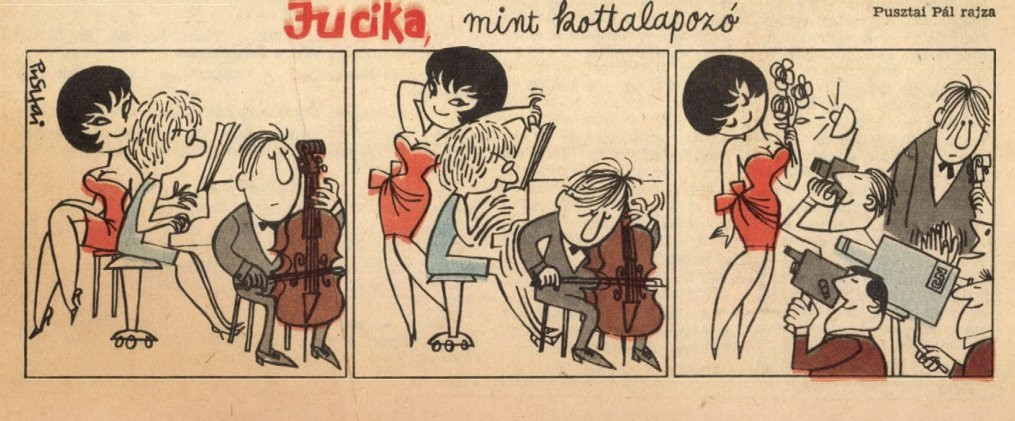
Jucika Daily originated on Twitter before migrating over to Bluesky when everyone realised that the place had become a Nazi bar. It's an account that posts Jucika strips, with Jucika being a mostly wordless Hungarian comic strip that ran from 1957 up until its creator's death in 1970.

Jucika centres on the life and times of an attractive young woman called Jucika and the various misadventures she has. She is depicted as being somewhat saucy, risqué and romantically forward, but the comic mostly parodies sexist attitudes rather than objectifying Jucika herself. Indeed, more often than not, Jucika is shown taking advantage of the sexist attitudes of the men around her in order to put herself at an advantage.

The Jucika Daily account posts comics from the 500 strip strong Jucika archive every day, and often includes helpful context in the alt text for each image. While the comics are almost always entirely free of dialogue, there are occasional Hungarian terms that appear on signs and suchlike, so the creator goes out of their way to explain these things where necessary.

At the time of writing, the account's creator is facing a large medical bill for an emergency kidney operation, but they are continuing to post strips while promoting their crowdfunding efforts. Even if you have no intention of handing over money to a complete stranger on the Internet, do at least go and check out the comic strips — they will make you smile.

CheapShow

The CheapShow podcast is ostensibly a show about going through the bargain bins and Poundlands of Great Britain and coming back with the treasure from amongst the trash, but really it's an excuse for best friends Paul Gannon and Eli Silverman to hang out and get very silly with one another — and to include us, the audience, in with their nonsense.

CheapShow has a number of regular features, including The Price of Shite, where Paul and Eli have to guess the prices of various pieces of tat purchased from charity shops; Off-Brand Brand-Off, where one or the other does a blind taste test of branded and unbranded variants of a particular product to determine which is best; and Eli's Country Urban Noodle Test-lab Kitchen, in which the pair taste-test different varieties of instant noodles. Alongside these, which tend to rotate in and out with each episode, the pair also often go on real-life "walkabout" episodes, where they decide to follow a walking tour on a route that falls outside of the usual "tourist" spots in London, and perhaps learn something along the way.

CheapShow works so well because Paul and Eli have magnificent chemistry with one another, and brilliant senses of humour that will resonate well with anyone around the age of 40 or so — particularly those who enjoy a good bit of old-fashioned British toilet humour. Paul and Eli are also both thoroughly lovely chaps outside of the podcast, and they deserve your support.


That'll do for today. I hope you find some enjoyment from these — I certainly have!


Want to read my thoughts on various video games, visual novels and other popular culture things? Stop by MoeGamer.net, my site for all things fun where I am generally a lot more cheerful. And if you fancy watching some vids on classic games, drop by my YouTube channel.

If you want this nonsense in your inbox every day, please feel free to subscribe via email. Your email address won't be used for anything else.

#oneaday Day 543: Tabbed browsing

I like browser tabs. I think they were a good invention, and a good addition to modern user interfaces in general — although not universally, as some application and website designers seem to think.

I find it convenient to be able to switch back and forth between things I might need to keep looking at. But I quite regularly come into contact with opinions that make me feel like I'm not using them in the same way as a lot of other people on the Internet.

For example, these are my tabs that are open right now:

Yes, that's all of them.

And yet just a few minutes before I started writing this entry, I saw this Bluesky post from Aidan Moher, one half of the delightful FunFactor Podcast that I've extolled the virtues of previously on this site. (Twice, in fact.) The fact the post is from Aidan isn't particularly relevant to what I'm talking about here. I just thought I'd take the opportunity to plug the excellent podcast he's involved in.

What Aidan's talking about here is by no means unusual, but it is completely alien to me. I have never left a browser tab open longer than 24 hours, and even then it's only to remember something that I will need in the very immediate future; in most cases I will use either a bookmark or a note in Google Keep instead and close a tab when I'm not using it.

This is the bit where I, apparently, differ from the "norm": when I'm done with the contents of a tab, I close it. Why would I leave it open if I no longer need that information right now?

These are my tabs right now, incidentally:

A few more, due to me checking the links on things that I've mentioned above, but all still mostly relevant to what I'm doing right now. In fact, hold on.

There. I don't need my email right now, so I closed it. See how easy that is? In fact, you know what?

Fuck yeah. Two tabs. One window. I probably don't even need Bluesky right this moment. In fact, yeah. Let's remove all distractions.

Hoo boy. I bet some of you are getting the collywobbles right now. How can this human being function with only one tab open? Quite easily, as it happens! The Thing I Am Doing Right Now is Writing A Blog Post, so that's all I need to have open. If I needed to research something specific while I was writing, I would have a tab open for it (or perhaps a separate window so I could see the research materials side-by-side with my post while I was writing it) — but since I don't, I don't have anything else open.

I hear horror stories about people having literally thousands of tabs open at once, and all I think when I hear that is… how the hell did you get yourself into that situation? This, for me, is the threshold of when it is Time To Close The Entire Browser And Start Again:

You know, the point where if you don't know a site's favicon, you're never going to find the right tab again? (It probably says something that I actually found it very difficult to find enough websites to open that many tabs without resorting to stuff like PornHub and Wikipedia.) Honestly even this is uncomfortable:

Basically I reach that right margin — the point where tabs start to contract and become less useful — and I find myself contemplating existence. Once you get to this point — which is everything on my Bookmarks bar, incidentally — I feel like you really start questioning whether you can feel God's light any more:

Like… help me out here. How is that useful? This isn't even a lot of tabs before it becomes a nigh-unusable mess of icons, and there are people out there using hundreds or even thousands of tabs at once? How do you function? How do you sleep at night?

There, that's better. Sorry, was hyperventilating a bit.

But seriously, I don't understand this peculiar relationship some people seem to have with tabs. Are you the sort of person who reads a magazine or a book and then just leaves it lying around randomly in your house, open on the page you last read? Do you open all your emails in individual windows and then leave them all open? Do you have over a hundred active WhatsApp messaging groups?

I ask these questions because I know there are people who do those things. And yet I, as someone who can often be disorganised and messy, is definitely autistic and quite possibly has ADHD tendencies (though those are undiagnosed, so I don't wish to concretely label myself in that regard) feel physically uncomfortable if more than about five tabs are open at once — and the concept of leaving some tabs open for a week or more is completely alien to me.

Browser tabs might have been a mistake for some people, apparently. But I feel like I'm using them "correctly", if such a concept exists. Put your shit away when you're done with it. It's very easy to do that in the digital realm. Just click that little cross button!

And mobile browsers who think I might want "tab groups"? I do not want "tab groups". Please stop adding new tabs to "tab groups" seemingly at random based on some indeterminate (and possibly inconsistent) context clues that I am not privy to. Just follow the basic rules of the Old Web: open a new tab if you're taking me off the website I'm on; just change the page if you're taking me to a different page on the same website.

Am I the only one who remembers that?


Want to read my thoughts on various video games, visual novels and other popular culture things? Stop by MoeGamer.net, my site for all things fun where I am generally a lot more cheerful. And if you fancy watching some vids on classic games, drop by my YouTube channel.

If you want this nonsense in your inbox every day, please feel free to subscribe via email. Your email address won't be used for anything else.

#oneaday Day 502: Another reminder that traditional games journalism is all but dead

It emerged today that the entire Features team of the gaming website TheGamer has been laid off, after owner Valnet decided that it likes money more than having actual employees who are capable of writing.

I'll admit that I was never a particular fan of TheGamer for a variety of reasons, but regardless of my own personal feelings about the site, this sucks. It's the latest instance of something that has continued to suck for a while now, with even big names of the games journalism industry — if such a thing even exists any more — suffering widespread layoffs, cutbacks and significant worsening of what they offer for their audiences. Enshittification, if you will. And yes, even longstanding behemoths like IGN and Eurogamer have been subject to this. According to VideoGamesChronicle and PressEngine, more than 1,200 journalists have left the business entirely in just the last two years — and that's not taking freelancers into account. (That puts the figure nearer 4,000.)

Honestly, seeing this happen to TheGamer isn't a surprise, though. This is just what the site's owner, Valnet, does. They buy up sites that were once successful, rip out everything that made them distinctive and unique — i.e. the people who worked hard on establishing the site's identity — then proceed to replace everything with slop. I would not be surprised at all if in short order we start seeing casino advertorials and AI-generated garbage on what remains of TheGamer.

Valnet and their big rival, Gamurs, are a scourge on what was once a thriving sector. They both take this model: they buy "verticals" (ugh) that they want to add to their portfolio, and then think that just because they now own, say, Polygon, that they have unlocked an infinite money glitch. But they have not — for a variety of reasons, not which is the model on which ad-supported commercial games journalism has been forced to operate for years now.

This article by Luke Plunkett of Aftermath sums it up nicely: these sites had been stuck in operating in the same way as 2000s-era Kotaku, which is to post as much as possible, as often as possible, and it didn't matter too much if nothing of any real substance was being said. It was all about the content.

I've been through this, too. During my time on both GamePro and USgamer, I was specifically hired to be someone who operated on a different time zone to the rest of the staff, with my responsibility being to ensure that there were things ready to read on the site by the time North America woke up. These typically end up being "news" posts, which, in the churn of having to produce so much content every day, often end up being little more than you could learn from just following a company's social media account or signing up to their mailing list.

"Guide content", that odious practice where every single site has to have 5,000 articles explaining every minutiae of every hot new game (and often badly, to boot), is also at play here, with the entire Internet gradually being flooded by "what is today's Wordle solution?" posts, individual articles explaining each and every shrine in The Legend of Zelda (often badly) and inconclusive, vapid answers to questions no-one was really asking with any great seriousness. It's all about the pursuit of endless, relentless content, and it doesn't matter if it's any good or not, it just has to be fresh, constantly updated and now.

And it sucks! It's not doing anyone any good! It's not making the writers on these sites look good, it doesn't make the games they're covering look good, it doesn't make the site look good, and it doesn't inform the readership of anything worthwhile. It just means those readers have something new to scroll through every time they refresh the page while they're staring, glassy-eyed, at their phone for the 14th consecutive hour that day.

It sucks that it has to be this way, too, because the presence of a specialist press is important. The idea that we might, one day, be completely without a games press altogether is absolutely baffling, but with every round of layoffs like the one we've seen today, we get closer to that dystopia.

Reader-supported sites such as Aftermath, 404 Media (not games, but relevant) and Giant Bomb are doing great work, but it remains to be seen how sustainable that model is — particularly as so many of the bloody things are starting to pop up that it is no longer possible or affordable for anyone to be "widely read" when it comes to good-quality games coverage. That's not necessarily a bad thing, given that back in the '80s and '90s we tended to be loyal to individual magazines rather than reading all of them, but it's a big shift in how the Internet has traditionally worked.

I don't even know what to think any more. It's bleak out there. And I wonder if it's ever going to get better again. I just want to have some fun websites to read again, by people who know their craft and are passionate about it. We used to have that — why can't we have that again? Why can't we have 1up.com again?

Those are rhetorical questions.


Want to read my thoughts on various video games, visual novels and other popular culture things? Stop by MoeGamer.net, my site for all things fun where I am generally a lot more cheerful. And if you fancy watching some vids on classic games, drop by my YouTube channel.

If you want this nonsense in your inbox every day, please feel free to subscribe via email. Your email address won't be used for anything else.
#oneaday Day 413: Our tedious cyberpunk future

So, it seems like today is the day that the UK's "Online Safety Act" rolls out, which means all manner of sites and services, from Bluesky to PornHub via Discord, have started demanding that you "verify" your age, either by gurning into your device's camera (or, indeed, providing a photo of Norman Reedus from Death Stranding 2) or by — fuck this all the way to hell and back — sending over a photo of your ID, or registering your payment card details.

The reason for this is ostensibly to "protect children" from all the nasty, terrible awful things on the Internet, but as we've seen it can be circumvented by a few nerds on X, The Everything App or enlisting the services of a VPN — exactly the sort of thing these services are for — then it all seems a bit pointless really. Plus then you have to consider what might be the real reason this is all happening. It may sound a bit tinfoil hatty, but most people aren't entirely comfortable associating a photograph of themselves, their ID or their payment information with, among other things, something they fancy cracking one off to.

The ID verification services, of course, assure us that your photographs and data are deleted immediately after you've been verified, but we have no real way of knowing if that is actually the case, or if the deletion process simply copies them to a server somewhere offshore that isn't subject to GDPR. And if the latter is true, given that the services associate your ID information with your email address in most cases, it's probably straightforward enough to tie any sort of "unsavoury" (regardless of legality) activity back to an individual — be it hammering one out to stepsisters stuck in washing machines, looking up instructions on how to make a bomb or attempting to organise political protests.

Over the course of the last few years, with the rise of AI and all manner of other tech enshittification, I can't help but feel — and I'm not alone in this — that we're getting all the downsides of a cyberpunk future that authors warned about, and none of the upsides. Our city centres are not the sprawling, darkly beautiful neon landscapes they're supposed to be — though you might have a backlit, animated ad for Persil on your local bus stop — and no-one is going through life kitting themselves out with cybernetics to do interesting, unusual, creative, daring and illegal things.

Worse, and this is probably the biggest kicker, is that all the "villains" of the piece are so very boring. Cyberpunk villains are vibrant, exciting, dramatic — but not in reality. We have Trump, whose name literally means "guff", and Elon Musk, who is just a fucking idiot, and Sam Altman, who is a delusional cunt. None of them have the charisma to make them worth hating; they're just… there, making the world worse, bit by bit, one little nibble at a time. The world is suffering death by a thousand cuts, and it feels like there's not much we can do about it other than to subscribe to NordVPN (and feel weird about it after all the jokes about YouTubers shilling it) and just try to muddle on the best we can.

Perhaps this will mark a grand return to finding discarded porn mags in bushes. That'll be a blast from the past, won't it? Though hopefully not a blast you come into direct contact with.

If you're in the UK, you might want to sign this.


Want to read my thoughts on various video games, visual novels and other popular culture things? Stop by MoeGamer.net, my site for all things fun where I am generally a lot more cheerful. And if you fancy watching some vids on classic games, drop by my YouTube channel.

If you want this nonsense in your inbox every day, please feel free to subscribe via email. Your email address won't be used for anything else.
#oneaday Day 397: Cool Sites: where are they now?

Earlier today, prompted by some discussion online, I found myself pondering the concept of the Cool Website. You know the kind of thing: the places you used to point your browser at on a semi-regular basis before everyone collectively agreed (apparently) that the only websites worth a damn now are social media, "newsletters" and whatever "legacy media" rag people are angry at this hour.

I've been trying to think of some Cool Websites that I used to visit at various points in my long-term Internet history, and I thought it might be interesting to see what happened — if anything — to each of them that I can remember. Sound like fun? No? Well, I'm doing it anyway.

1up.com

I must confess familial bias here: since my brother helped launch it and was a key part of its team that helped to establish what we know today as The Gaming Podcast, 1up.com will always be special to me. But it will always be special for another reason, too: it's where I met a number of like-minded folks that I enjoy discussing video games in great depth and at great length with. Honestly, I always spent at least as much time on 1up.com with the community features as I did with the staff's writing, but it was just a damned good website all round, really.

Where it is now: 1up.com officially closed in July of 2013, but everything that had once made it special had disappeared long before that. I put it probably around 2008-2009 or so when most of us made a grand exodus off the site to try and find a new collective home; we never quite settled in one place since, more's the pity, though most of us had at least brief dalliances with Facebook, Twitter and even Google+. 1up.com itself though is long-gone, now, though; not even a holding page remains, and the nature of how the site was programmed means that archive.org can't even get particularly reliable snapshots to pull out of the ether. So this one is, sadly, long dead.

Persian Kitty's Adult Links

Picture, if you will, a land and a time before PornHub. Indeed, a time before YouTube. A time where watching a pornographic video meant a significant commitment in order to download a 10-second video that filled a quarter of your screen, because no-one was streaming filth over dial-up connections. In that environment, Persian Kitty's Adult Links became legendary for me and my friends after one of us saw it mentioned in a magazine. This was a site that updated daily with new links to free galleries of ladies with their kit off. Sometimes there were even videos. Most of these galleries were trying to get you to sign up for a pay site, but there was plenty of material available that was perfectly suitable for a wafty crank of an evening.

Where it is now: Astonishingly (or perhaps not, given the enduring nature of online pornography), Persian Kitty's Adult Links still exists as a website… though it is a shadow of its former self, consisting of little more than some banner ads for various adult livestreaming sites. Four, to be exact, two generic "sex/adult cam" sites, one BDSM-themed site and one MILF-themed site. I'm happy that the Persian Kitty flag still flies, but less thrilled at what the site has become. It always kind of was a big ad, but now it's not trying to hide that.

Kongregate

For quite a while, Kongregate was the place to go for online Web-based games. All the big Flash game makers posted their stuff there, and the site had a bunch of interesting features like achievements, real-time chat, online multiplayer and even a site-wide metagame where you could collect trading cards by playing individual games, then battle other players with those cards in its own self-contained area. While I never got as big into Flash games as some others did, there were some legit all-time classics on Kongregate, with Desktop Tower Defense being the one that springs most readily to mind.

Where it is now: The site still exists and still offers many of the features I mentioned above, but the distinctive Web-based nature of the old Flash games has disappeared with the retirement of Flash as a commonly used Web technology. What we have now are pretty much the same free-to-play games you'd see on your average storefront, including licensed junk and a bajillion Raid: Shadow Legends knockoffs. Of greater concern is the site's new tagline at the bottom, which states "Kongregate is an open platform for all web games and a pioneering game developer in the blockchain space." Yeah. Fuck that.

hairytongue.com

I don't even remember what the main point of this site was — I think it was just a general "Internet humour" site similar to b3ta.com (which still exists and I don't think has updated its design since about 2005, but which still appears to be quite active) — but I do recall there being an extensive gallery of photoshops based on the easily provable hypothesis that Jamie Oliver is a flabby tongued Mockney wanker.

Where it is now: It is nowhere, save for a GoDaddy holding page. Thankfully, archive.org just managed to grab its last wheezes of life on this Earth. I was surprised and saddened to discover that it was as long ago as 2003-2004 that this site apparently ceased to exist. Oh, and if you were wondering, it was a site about hangovers. But mostly about mocking Jamie Oliver.

Weebl's Stuff

This was, among other things, the home of badger badger badger badger badger badger badger badger mushroom mushroom, and was a mainstay of popular Internet culture for many years. As with several of these other sites, the decline of Flash meant there's now a whole generation who (probably) haven't grown up with the adventures of Weebl and Bob, Magical Trevor and numerous other pieces of absolute nonsense.

Where it is now: It's still there! Not only that, but Weebl himself is still making videos, and from the sounds of some recent posts on Bluesky, has found himself a creatively fulfilling Actual Job involving writing.

I think that's probably a nice place to leave this, isn't it? Definitely a subject I might return to at some point, though… once I can remember what websites used to exist, that is…


Want to read my thoughts on various video games, visual novels and other popular culture things? Stop by MoeGamer.net, my site for all things fun where I am generally a lot more cheerful. And if you fancy watching some vids on classic games, drop by my YouTube channel.

If you want this nonsense in your inbox every day, please feel free to subscribe via email. Your email address won't be used for anything else.

#oneaday Day 376: The death of ambition

Earlier today, Dave Gilbert, renowned modern adventure game developer and publisher, happened to point out that Adventure Gamers, a website with a near 25-year history, had, at some point, sold out and become an online casino shilling site, leeching off the prior content — which, after 25 years, you can bet had some decent SEO juice, even with the myriad changes to such algorithms over the years — in order to hook people into shady gambling sites.

My immediate reaction to this was "ew, gross", shortly followed by "I bet I could make a really good adventure game site". Unfortunately, this thought was then almost immediately followed by "…but why should I bother?"

This isn't the first time I've thought something along these lines. The modern Web is killing, stifling any sense of ambition I might have once had. It's not one, single thing like generative AI causing me to feel this way — though you better believe the amount of AI slop out there is a big part of it — but rather a continual piling-up of little micro-enshittifications. Over the course of the last 10 years in particular, these micro-enshittifications have all accumulated into the garbage fire that is the Web of 2025: a place where it's hard to find reliable information, where it's even harder to verify whether what you're looking at is reliable information, and where the people with the power to make a difference don't seem to give a shit.

Let me tell you a little bit about myself, in case you've not been here on the previous occasions I've done so.

When I was a kid, I grew up surrounded by computers: specifically, the Atari 8-bit and ST, with MS-DOS and Windows PCs following along around the early '90s. For pretty much my entire childhood, my Dad and my brother were both regular contributors to an Atari magazine initially called Page 6 and later New Atari User, after it took over the name from a publication that was bowing out of the Atari 8-bit scene.

I loved getting a new issue of Page 6 every couple of months; I loved reading through all the features, even if I didn't understand all of them, and it gave me great pride to see my Dad and my brother's name in print pretty much every issue after a certain point. My Dad would cover flight simulators, productivity software and the use of music technology, while my brother would cover Atari ST games. We got a lot of free software out of this arrangement — much of which is now in my possession — and it's fair to say that this played an instrumental role in defining my interests and hobbies growing up.

When my brother left home, he had decided to forego university in favour of a staff writer position on a magazine called Games-X. This was a risky and ultimately unsuccessful venture on the part of publisher Hugh Gollner, but it was a nice idea: a weekly games magazine that covered new releases for the home computers and consoles that were around at the time — the tail end of the 8-bit era, the heyday of the ST and Amiga, and the days when the Mega Drive and SNES were just starting to get some attention.

I was immensely proud to have a family member in the games press, published every week in an actual magazine you could walk into a newsagent and buy. (Page 6 had a stint on newsstands, too, but it eventually went back to its roots as a subscription-only magazine, clinging on to dear life until 1998, impressively.) And my pride only continued after Games-X folded and my brother followed Gollner to the then-fledgling Maverick Magazines, where he initially worked as a staff writer on Mega Drive Advanced Gaming, while his girlfriend at the time held the same position on its Super NES counterpart Control.

It continued further still as he worked his way up the ranks, through several publications and publishing companies, until eventually he found himself in the United States working on the Official PlayStation Magazine and Electronic Gaming Monthly, and helping to launch the pioneering video game social networking site 1up.com — dearly missed.

Every step of the way, I followed his career with interest, conscious of the fact that I was 10 years younger than him, thinking "one day I'll get my chance; I really want to follow in his footsteps, and one day I'll have that opportunity if I just keep trying."

I did keep trying. I did some articles for Page 6, just as my brother had. I did some freelance contributions to PC Zone and the Official Nintendo Magazine, back in the days when one article would get you the money that two months' worth of news posts nets you today. I worked on some little sites, most of which have now disappeared, sadly, and I eventually had the opportunity to work on both GamePro and USgamer, two decent-sized but, admittedly, American sites.

For some reason I had found the UK games press perpetually impossible to crack after a certain point, and after attending a few PR events on behalf of both GamePro I understood why: there was very much a heavily cliquey, old boys' club thing going on, and as a socially awkward (and what I now know to be) autistic loser, that was not something I felt in any way able to crack my way into.

But still I wanted to believe. I wanted to believe that GamePro was the start of something big, until we were told via email one morning just before Christmas that none of us had jobs any more. I wanted to believe that USgamer was another opportunity for something big, until I found myself screwed over and, once again, informed via email, this time on my actual birthday, that I no longer had a job.

After that, I didn't seek any further positions in the games press. I'd taken too many beatings. But I didn't want to give up. That's when I started MoeGamer, which initially began as a means of continuing some of the work I'd done at USgamer covering Japanese games that other publications didn't give the time of day. This was work that people in both the industry and from the "public" side of things told me that they found valuable and helpful, because I wasn't just going "ew, anime art" and writing things off as "pandering" or whatever.

Long-term, I wanted to build MoeGamer into something that really stood by itself: a site where you could look up information on a wide variety of games and find some thoughtful, well-considered writing about it. And I think I have achieved that, even if I don't have the time or energy to update it as often as I'd like; the one positive about my previous job, which was beyond tedious, was that it gave me ample time and energy to write new articles and make new videos.

I still never really "made it", though. Few people online know who I am; even fewer go "oh, wow, a Pete Davison article, gotta read that" — although I do have a pleasingly enthusiastic following in the Evercade community, at least, thanks to my work on the official site — and I just find myself wondering… was all this for nothing? Is there even any point trying any more?

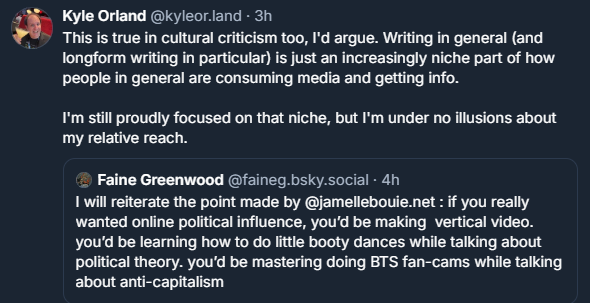
The Adventure Gamers thing stings, because were it 10-15 years ago, I'm pretty sure I could have put together a banger of an adventure game-centric website, developed a decent following and kept it up and running for 25+ years without selling out to online casino shills. But now, from every corner of the Web I read horror stories about sites struggling for discoverability, struggling to earn the money to keep the lights on and struggling to get anyone to give a shit about the written word. There are rare outliers, and the rise of worker-owned, reader-supported initiatives such as Aftermath and Giant Bomb is encouraging — but both of those (and others like them) already had ready-made, built-in audiences thanks to the people involved and their prior positions; how long would a brand-new website with a specialist focus even last these days, if it wasn't "the next project from [insert big name site] alumnus, [name]"?

I feel utterly demoralised. I feel like what was once my dream career just doesn't really exist any more. I recognise that I'm extraordinarily fortunate to have fallen into the position I'm in now, where I get to work on games that I care about, crafting written material to help people understand and appreciate quite why I love them so much — and hopefully help said readers learn to love them, too — but there are days of increasing frequency when I wonder if anyone really gives a toss. The days when I have people screeching obscenities at me on social media because they can't buy a cartridge that is out of print. The days when I have to deal with endless, mind-numbing, Queen's Duck-level "feedback" from people who absolutely don't care about the games I'm working on as much as I do. The days when I'm genuinely fearful for the history and legacy of the hobby I love so much, and where I weep for the traditional, written-word games press, a side of the industry which almost doesn't exist at all any more.

I was born 10 years too late. And believe me, it really sucks to have spent a significant portion of your life thinking "I really want to do that", only to find out, much too late, that "that" just isn't really a thing any more.

The obvious answer to all this is something I've thought of and felt before — that even if there doesn't seem to be a "place" for something, you should do it anyway, because someone, somewhere, will appreciate it. But with every site sold to private equity companies and gutted to turn into an AI slop factory, the motivation and ambition to do something significant and meaningful diminishes, bit by bit. What was once a roaring flame of determination is now little more than a flicker. And I hate that.


Want to read my thoughts on various video games, visual novels and other popular culture things? Stop by MoeGamer.net, my site for all things fun where I am generally a lot more cheerful. And if you fancy watching some vids on classic games, drop by my YouTube channel.

If you want this nonsense in your inbox every day, please feel free to subscribe via email. Your email address won't be used for anything else.

#oneaday Day 339: Eras

I remember when I was growing up, and I'd hear about life when my parents were young, and thinking "gosh, that was all jolly primitive, how on Earth did people get by without televisions and computers and the Internet?" Sitting here in 2025, thinking back to my own childhood, I feel like we've gone through shifts almost as big once again.

I grew up surrounded by computers. My Dad worked for IBM, and I'm pretty sure we had at least one Atari computer in the house from the moment I was born. I learned how to use computers from an early age — not just playing games, but also using them for productivity, programming and creativity. And my enjoyment of computing helped me make some friends, too.

But by modern standards, those computers were limited. They could run one program at a time, and you had to do everything using removable physical media. Want to play a game? Put in a disk, tape or cartridge and load it up. Want to do something creative? Put in a disk, tape or cartridge and load it up, then make sure you have another separate disk or tape handy to save your work onto. Hard disks existed, but they were something like £700 in '80s money for 20MB, and thus very few people had them — more to the point, not much software supported them, either, at least until the 16-bit era, when they became a little more commonplace.

"Going online" was something you could do from quite early on if you had the necessary hardware, and it was a very different experience to what using the Internet (really the Web) is today. To even get logged on you'd have to enter a cryptic string of commands to the modem, and sometimes it felt like a bit of a roll of the dice as to whether or not it would actually work at all. When you did get online, it was pages and pages of text, no pictures, and an understanding that you had a limited amount of time to do what you had to do before either 1) your family kicked you off for tying up the phone line for too long or 2) the SysOp kicked you off remotely for spending too long, preventing others from using the service.

When "online" spaces other than bulletin board systems came along — accompanied by computers that could do more than one thing at once — it was a revelation. I have immensely fond memories of exploring CompuServe on my Dad's account, spending time on the GAMERS forum, reading and replying to messages, and, on one memorable occasion, making $200 from some custom Wolfenstein 3-D levels. But it was still very different to today; CompuServe was a walled garden of curated stuff to explore, and access to the broader Web didn't come about until later. I remember us having great difficulty setting up the Mosaic browser to view simple websites, and how exciting it was when we finally got to look at, say, pictures from NASA for the first time.

I don't think anything tech-wise has changed things as much as the rise and growth of the mobile phone, though. Getting a mobile phone when I was in my late teens made me feel like I had a whole new degree of independence, free to communicate with my friends on my own terms when and how I felt like it (Pay as you Go credit permitting). I recall long, drunken text conversations with people important to me at university; there was even a time when I'd voluntarily phone people up for a chat. I used to have long phone conversations with my perpetually absent university housemate, for example; she was a good friend, but I didn't see her all that much for a variety of reasons.

Then, when smartphones arrived, everything changed. It didn't seem like it at first, because the earliest implementation of the iPhone was very limited. There were no installable apps; you had to do everything via the Web. But sites were starting to get savvy to the rise of this exciting new technology, and were starting to serve up "responsive" pages that looked nice on the small screen of an iPhone.

I was working at an Apple Store when the iPhone launched. It was an exciting time, for sure, and it only got more exciting when the App Store launched. Suddenly, there was this brave new frontier for software, and we'd all download and experiment with all manner of different apps; not just games, but productivity tools, creativity tools and silly joke apps — who can forget the "drinking a beer" one?

When in-app purchases were announced, my heart sank. We were already starting to see some nickel-and-diming in the console gaming space, and it was about to get much worse in mobile. Free-to-play became the default, and aggressive monetisation came along with it. And there were people who would make excuses for this. People who are still making excuses for it to this day, to such a degree that we're never going to get rid of free-to-play and microtransactions at this point.

But I think the biggest change was how addicted people became to those black plastic slabs. And I'm not excluding myself from that description, either; I could feel myself being compelled to fiddle with it constantly, and I didn't like it. I still don't like it. I'm better at controlling it today, but I still feel the "urges" near-constantly.

Things only got worse with the rise of content designed to be deliberately addictive, such as short-form videos. For quite some time now, I've found a lot of tech to be scary and unpleasant; definitely a far cry from the excitement I'd feel every day when I booted up the Atari 130XE to do some BASIC programming.

It's not all bad, of course. It's great having satellite navigation in your pocket when you're trying to find things. It's great being able to stay in touch with people via a whole host of different means. And it's great being able to quickly snap a photo or video of anything without kicking yourself for not bringing your camera with you.

But there have been some big changes. Whether or not they're as big as the differences between my parents' childhood and my childhood, I don't know. But I suspect the realisation that you've lived through some huge changes in the world and society is an important part of progressing through life; you often don't notice these changes while they're in the middle of happening, but when you look back on them you realise that they were pretty massive. And not always for the better.

Would I like to go back to earlier, less technologically advanced, less convenient days? Some days, I honestly do think that yes, I would. There are a lot of great things about our modern, connected society — and a lot of terrible things, too — but sometimes I just miss the simplicity of life as it was back then.

I find myself wondering exactly what I mean by "back then"; if it was possible to go back, exactly what point would be the optimal one? I think, for me, it would probably be the early 2000s. Mobile phones would exist but wouldn't be the life-consuming soul suckers they are today; computer and video game technology would be at a good point; and we might all see a bit more of one another in the real world.

I might not have this blog, though. Or maybe I would. Perhaps it wouldn't be in quite this form. Perhaps I'd be a trailblazer in the blogging space.

Who knows? You can't go back, more's the pity. So we're stuck with what we have, regrettably, constructed for ourselves. At least for the moment.


Want to read my thoughts on various video games, visual novels and other popular culture things? Stop by MoeGamer.net, my site for all things fun where I am generally a lot more cheerful. And if you fancy watching some vids on classic games, drop by my YouTube channel.

If you want this nonsense in your inbox every day, please feel free to subscribe via email. Your email address won't be used for anything else.
#oneaday day 335: Broken links

I like looking back over the mountains of nonsense I've posted on this site since 2010, but one thing that makes me a bit sad is quite how many of the links I posted years ago are now broken. You can tell at a glance, 'cause I have a plugin running that makes any broken links appear as crossed-out text, and the further back you go in my archives, the more likely you are to find these. (EDIT: I turned it off, because it was throwing up a lot of false positives.)

The same is true for YouTube videos I've posted. More often than not, any YouTube video I've posted that is more than maybe five years old has been taken down, made private or copyright claimed by someone. And, of course, with the mass exodus from Twitter since Elon went… the way he went, formerly embedded tweets that belonged to now-deleted accounts are just… gone.

One of the things I thought was supposed to happen with the Internet was that there would be a certain degree of permanence. You'd make something online, it would be your mark on the world. But, unfortunately, it doesn't work like that. There is no infallible means of making something on the Internet and having it stay as a permanent fixture. If it's your own website, it will cease to exist the moment you stop paying for hosting (or have something happen to you that precludes you from continuing to pay for hosting, like, say, dying) and if it's something you've hosted on someone else's service, such as a social media platform, your stuff is only as permanent as that social media platform.

There are exceptions to this, of course. The amazing work that the Internet Archive does with its Wayback Machine makes it possible to travel back in time and see websites as they appeared back in the day. Okay, it's not perfect — the archiving process often loses images and layout information, any interactive functions will inevitably be broken and anything built using defunct technology like Flash will remain inaccessible — but it's something, at least. I can still visit my website from 2004, for example. And, in slightly more broken form, my short-lived games blog from 2010.

But what about the stuff that, for one reason or another, has been impossible to archive? There is no longer any trace of the discussions the Squadron of Shame once had on the 1up.com Radio forums, for example, and while some of 1up.com itself has been archived, the Club pages, which is where a lot of our conversations took place, are not among that which has been saved from oblivion. Likewise, my old iWeb site, which I hosted on iCloud precursor .mac, no longer exists because at some point Apple discontinued the "iDisk" online storage that the site was hosted on. Those things are all long gone, and that's a bit sad.

This is one reason why I was so upset when WordPress.com made a hash of this site some time ago — against what some might call all odds, I have managed to keep this site in existence for 17 years, which is positively ancient in Internet terms, and the threat of having that all taken away based on a false positive from a stupid automated system was absolutely heartbreaking.

I guess the lesson is that if there's stuff you care about, back it up as well as having it online. Because one day, the online version might not be there any more, and it might not be through any fault of your own!


Want to read my thoughts on various video games, visual novels and other popular culture things? Stop by MoeGamer.net, my site for all things fun where I am generally a lot more cheerful. And if you fancy watching some vids on classic games, drop by my YouTube channel.

If you want this nonsense in your inbox every day, please feel free to subscribe via email. Your email address won't be used for anything else.

#oneaday Day 244: Is "best practice" the enemy of expression?

I, as you probably know, have a YouTube channel. I have had it for a grand total of about seventeen years at the time of writing, though I would say I've only really been actively, semi-regularly using it since about 2018, initially to host video versions of a podcast I was doing, and subsequently to kick off the series that I'm still running in one form or another to this day.

Over the course of those 17 years, I have picked up just over 3,600 subscribers at the time of writing, with the vast majority of those showing up since 2018. While that is obviously a drop in the ocean compared to big, successful channels out there, I am pleased with it, and honestly I don't particularly want my channel to grow any faster.

In order to acquire those 3,600 subscribers, I have done… nothing particularly special, to be perfectly honest. I have steadfastly ignored the advice of YouTube "gurus" to pursue trends, to be clickbaity with titles and thumbnails, and to "edit for engagement". In short, I consistently reject what is supposed "best practice" in favour of just doing whatever the hell I want — and I have seen some success doing just that. Could I see more success if I was following the supposed "rules" to the letter? Quite possibly. But then I don't think my channel would be mine any more.

One of the things I object to most about online culture in general these days — not just YouTube, but this applies all over — is how no-one really seems to have a personality any more. Everyone says the same things, everyone responds to things in the same way, everyone uses the same bank of reaction GIFs when they can't be bothered to use their words. In YouTube, this is best exemplified by the way you could watch five randomly chosen videos from five moderately sized channels, and I bet you'd hear the exact same sound effects and music clips, and see the exact same visual memes, in at least half of them — if not all of them.

This is because these things, supposedly, work. But in using that "best practice", you are eliminating a lot of the soul from your own work. You're making something that caters to the mysterious "algorithm" — or rather, an imaginary audience — rather than expressing yourself, as yourself. It's the same with the way people talk to one another online; because those reaction GIFs and snippy retorts like "skill issue" are universally understood by everyone, everyone uses them because they're seen as an efficient means of communication.

But, again, there's no personality there. Any time someone comes out with "skill issue" or "tourist" or whatever the derogatory term-du-jour is, I lose all interest in getting to know that person, just as I lose interest in a YouTube video the moment they start busting out the Metal Gear Solid alert noise, The X-Files theme and Spongebob "a few moments later" interstitial cards… and just as, at some point in the last 20 years, you've probably lost interest in someone who won't shut up about bacon, won't stop saying "the cake is a lie" or thinks declaring that pineapple on pizza is "weird" is a daring and brave opinion to express.

People like that don't have a personality of their own; their personality is The Internet, Circa 2025. And, as we've pretty comprehensively established at this point, The Internet, Circa 2025 is not someone you'd want to bring home to meet your parents. It's someone who deserves to be kicked into a ditch 50 miles from the nearest town and left to rot.

So, as much as there are probably things I could do "better" with my YouTube channel, I choose not to do them. I don't feel the need to. I didn't create that channel to be famous, I didn't create that channel to be a huge "thing", I created it as a means of expressing myself and sharing my own, personal enthusiasm for things that are important to me. That's it. That 3,600 people like what I do enough to want to follow it without me resorting to "best practice" says something to me: it says "if you're happy, just keep doing what you're doing".

So that's what I intend to do.


Want to read my thoughts on various video games, visual novels and other popular culture things? Stop by MoeGamer.net, my site for all things fun where I am generally a lot more cheerful. And if you fancy watching some vids on classic games, drop by my YouTube channel.

If you want this nonsense in your inbox every day, please feel free to subscribe via email. Your email address won't be used for anything else.