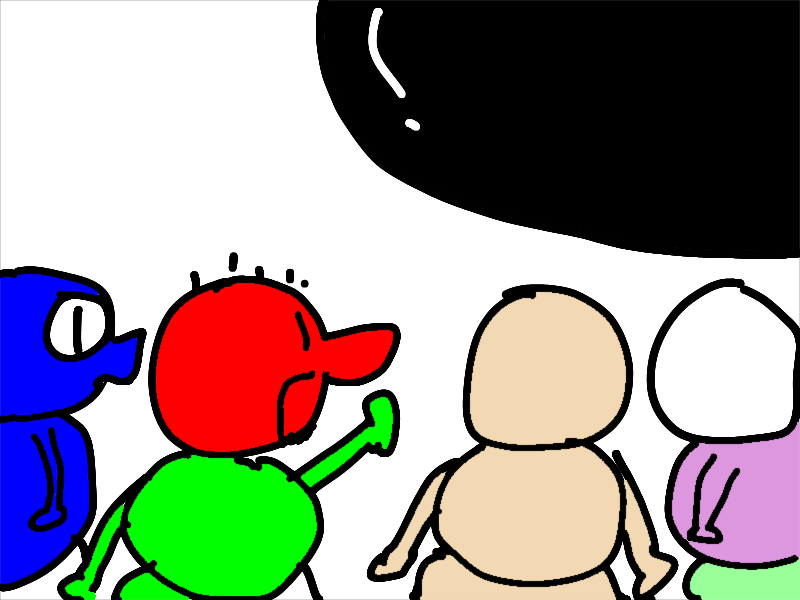
Remember how yesterday I said a group of friends and I were going to play Big Walk "this afternoon"? Yeah, well, we started in the afternoon, my time… and concluded twelve fucking hours later. I have never, ever had a multiplayer session so long that the batteries in my headset went flat. Until now! (It's also been a very long time since I pulled an all-nighter on a video game, but those are usually solo.)
There are some mild Big Walk spoilers ahead. I will not be sharing complete puzzle solutions, but I may talk a bit about the thought process involved in some of them. You have been warned.
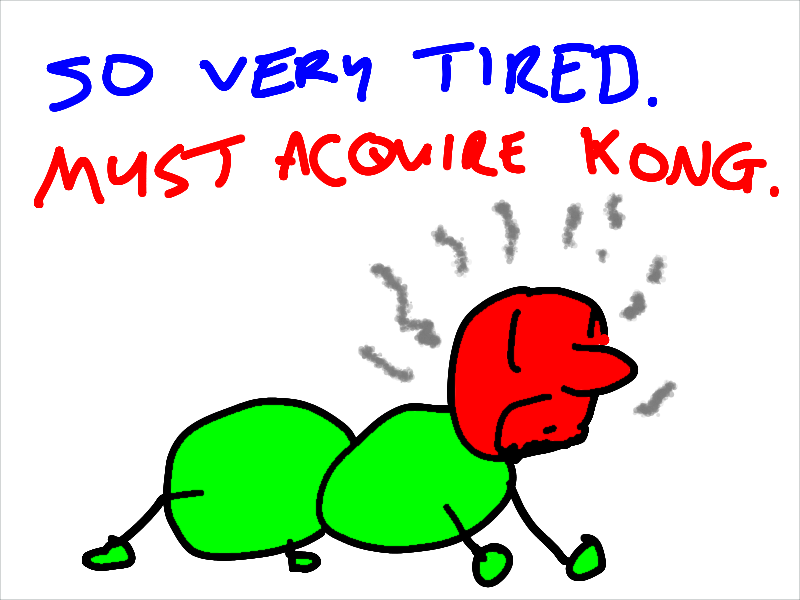
I don't think any of us expected the session to go on for so long, since we were in Big Walk's "postgame". We had partly (and correctly) assumed that the postgame would just involve going around and cleaning up any puzzles we didn't complete as part of the process you go through to "beat" the main game, but we were also aware that we'd discovered a place where there were fifteen empty slots for the "Kong" figurines that are your rewards for completing the various puzzles, and thus there was probably still a fair amount of work to do. We didn't know what the end result of doing said work would be, though.
We should have known, really; in our process of beating the main game, there weren't fifteen puzzles left over. And sure enough, once you get into the postgame, a selection of "purple Kong" puzzles unlock in a part of the map that was previously inaccessible. These mostly take the form of challenges similar to puzzles found elsewhere in the game, but made significantly more difficult and/or time-consuming somehow.
That said, there were also two puzzles from our "main game" leftovers which had left us reasonably stumped, so we had intended to come back to them. Both of those proved to be extremely time-consuming, too, so in retrospect it's no surprise that solving fifteen puzzles in total took twelve hours. We did make up for it with one of the other main game leftover puzzles taking us less than two minutes, though, because our team are now Big Walk pros, apparently.
Some of the most interesting challenges we encountered involved having to split up the party in various ways. One puzzle tasked us with looking through telescopes to find a series of four pedestals, and once there was at least one person at each pedestal, we then had to find a way to synchronise our button presses. Another challenged us to find a specific sound somewhere on the island. Another still involved locating things that we had used in various other puzzles and taking them to another location. In each of these situations, the challenge was communicating over a long distance: the game does have walkie-talkie items, but given you are limited in what you can carry — you can hold one thing in your hands, one on a belt loop (once you've found one) and one on a backpack (likewise), but you cannot access the belt or backpack items yourself — it's not always practical for everyone to carry one of these. And besides, you have to find them first anyway!
We found a way in each instance, though. And it wasn't just the long-distance puzzles that gave us these communication challenges, either. One of the "purple Kong" puzzles required us to figure out how to communicate complex information between two different rooms, when one room could use an intercom but the other could only respond by turning a light on or off. Another tasked us with communicating auditory information between rooms with a completely soundproof barrier between them. Another still tested the limits of how precisely we could verbally communicate visual information.
The one we left for last was a harder version of an earlier "golf" puzzle involving an extremely heavy ball that we had solved earlier in the game. The initial, main game implementation of this puzzle was fairly easy to solve, but the postgame variant involved getting the ball over a significantly longer distance, which required some creative thinking and teamwork. Among the many talents and skills that Big Walk tests, patience is one of the most significant of all of them. In this modern, attention-deficit world, I suspect there will be at least some groups who find the patience and endurance challenges to be some of the most taxing.
Still, the "true" ending was worth it, and I was grateful we didn't have to go through the immensely difficult "finale" of the main game again. That finale was a great experience, but having to do it again after twelve hours would have probably killed me.
One thing I really appreciated about Big Walk as a whole is that it's just an excellently designed game. It's a game which understands that when you're tasking people with confronting some significant, cooperative challenges together, it pays to have a clear, distinct visual language that everyone can learn to understand quickly and easily. Subtly, and without explicitly telling the player at any point, it introduces you to various concepts as you progress through the game — many of which are in the "starter area" — and coming to recognise those different elements of the game and what they mean is a key part of learning to play Big Walk effectively. Communicating your understanding of those elements to the rest of your group is important, too; if you know something but the others don't, it won't help the group as a whole if you keep it to yourself!
Anyway, we successfully completed all of the game — with the only thing (I think) we didn't find in our playthrough being the "shiny paint station". It was very much worth it, and if you have at least one good friend to play it with, I highly encourage you to do so — and to take the time to play it from start to finish. It takes a while, but it's very much a worthwhile activity to spend a few sessions on together. I certainly won't be forgetting our experiences in a hurry.
Want to read my thoughts on various video games, visual novels and other popular culture things? Stop by MoeGamer.net, my site for all things fun where I am generally a lot more cheerful. And if you fancy watching some vids on classic games, drop by my YouTube channel.
If you want this nonsense in your inbox every day, please feel free to subscribe via email. Your email address won't be used for anything else.