I feel like I've talked about this before, but whatever. I feel like talking about it today, so talk about it I will.
In this age of being able to easily emulate the original arcade versions of games, I feel like one thing gets easily lost from the "preservation" aspect of retro rereleases on today's systems: home ports that are notably different from simple attempts to recreate the original arcade games.
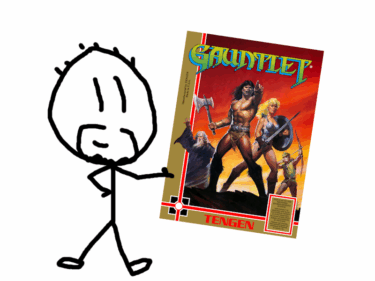
I was reminded of this when watching the YouTuber Classic Gaming Quarterly playing Gauntlet for NES earlier. I legitimately had no idea that Gauntlet for NES is not, in fact, a straight port of the arcade game and is, instead, a completely different game. I did know that Gauntlet IV for the Mega Drive also pulls this stunt, but I did not know that this extended back to the NES version. And for my money, pretty much all the home ports of Gauntlet are much more fun than the quarter-munching arcade version — particularly if you're playing on emulation and thus have infinite credits and therefore infinite health.
There are others, too. The Mega Drive port of Toaplan's Slap Fight features an entirely new game mode. The NES versions of the Double Dragon games are completely different to their arcade counterparts. And I'm sure there are countless others — to say nothing of the "home-exclusive sequels" we saw to numerous arcade games, often put together by western developers who didn't quite get what made the Japanese originals so good. (That said, I will happily go to bat for OutRun 2019.)
A few publishers are cottoning on to the fact that there is value in preserving multiple versions of classic games, including both the arcade originals and popular home ports, but it's by no means the norm. The reasons are likely due to licensing complications — in many cases, while the rights to the original arcade game remain with the original creators (or a company that has succeeded the original creators and/or bought the rights), home ports were developed by different teams, meaning that the rights would, I assume (IANAL), be split between the original creators of the arcade game and whoever made the port. This is not a problem when those are one and the same — like the Double Dragon games, for example — but there are plenty of situations where the home versions of a game were made by a completely different company, or even an individual at times.
The takeaway I have from all this is something that I've thought for a while: in many cases, I actually prefer playing the home conversions of games to the original arcade versions, even when the arcade version is obviously technologically superior. There are several reasons for this: firstly, those home conversions are often a good example of what their host platforms are (and are not) capable of. Secondly, since home ports are not obliged to keep people feeding coins into a machine, they are often balanced much better than their arcade counterparts. And this, in turn, makes them considerably more enjoyable to play.
Because there absolutely are arcade games out there that take "quarter-munching" way too far. I adore the beat 'em up genre, for example, but I'd much rather play Streets of Rage 2 than the arcade version of Final Fight, simply because Streets of Rage 2 is balanced much more fairly — and the beat 'em up genre appears particularly prone to this issue. The same is true for any sort of competitive game with a "1P vs COM" mode, be it a fighting game or a puzzle game. In their arcade incarnations, these tend to become absolutely impossible after just one or two levels, whereas in their home incarnations, they tend to save their biggest bullshit for their final challenges. Still annoying at times, yes — particularly in puzzle games, where final bosses tend to have superhuman capabilities as well as, more often than not, ways to "cheat" — but a little less galling than only being able to get through two or three stages before having to wipe your score and "Continue?"
Thankfully, while official licensors are seemingly hesitant to let those often flawed ports back out into the wild when one can just emulate the arcade version on a veritable toaster of a machine these days, one can make use of alternative means to enjoy them through software emulation or FPGA solutions. And I would encourage everyone to do so, because while everyone will inevitably have a preference as to which version of something is "best", it's worth exploring those versions rather than simply assuming the most technologically advanced version is automatically the most enjoyable.
Now, I think I might give Gauntlet on the NES a bit of a go for myself!
Want to read my thoughts on various video games, visual novels and other popular culture things? Stop by MoeGamer.net, my site for all things fun where I am generally a lot more cheerful. And if you fancy watching some vids on classic games, drop by my YouTube channel.
If you want this nonsense in your inbox every day, please feel free to subscribe via email. Your email address won't be used for anything else.