#oneaday Day 488: Home ports deserve remembering too

I feel like I've talked about this before, but whatever. I feel like talking about it today, so talk about it I will.

In this age of being able to easily emulate the original arcade versions of games, I feel like one thing gets easily lost from the "preservation" aspect of retro rereleases on today's systems: home ports that are notably different from simple attempts to recreate the original arcade games.

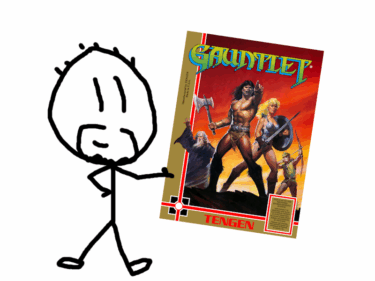
I was reminded of this when watching the YouTuber Classic Gaming Quarterly playing Gauntlet for NES earlier. I legitimately had no idea that Gauntlet for NES is not, in fact, a straight port of the arcade game and is, instead, a completely different game. I did know that Gauntlet IV for the Mega Drive also pulls this stunt, but I did not know that this extended back to the NES version. And for my money, pretty much all the home ports of Gauntlet are much more fun than the quarter-munching arcade version — particularly if you're playing on emulation and thus have infinite credits and therefore infinite health.

There are others, too. The Mega Drive port of Toaplan's Slap Fight features an entirely new game mode. The NES versions of the Double Dragon games are completely different to their arcade counterparts. And I'm sure there are countless others — to say nothing of the "home-exclusive sequels" we saw to numerous arcade games, often put together by western developers who didn't quite get what made the Japanese originals so good. (That said, I will happily go to bat for OutRun 2019.)

A few publishers are cottoning on to the fact that there is value in preserving multiple versions of classic games, including both the arcade originals and popular home ports, but it's by no means the norm. The reasons are likely due to licensing complications — in many cases, while the rights to the original arcade game remain with the original creators (or a company that has succeeded the original creators and/or bought the rights), home ports were developed by different teams, meaning that the rights would, I assume (IANAL), be split between the original creators of the arcade game and whoever made the port. This is not a problem when those are one and the same — like the Double Dragon games, for example — but there are plenty of situations where the home versions of a game were made by a completely different company, or even an individual at times.

The takeaway I have from all this is something that I've thought for a while: in many cases, I actually prefer playing the home conversions of games to the original arcade versions, even when the arcade version is obviously technologically superior. There are several reasons for this: firstly, those home conversions are often a good example of what their host platforms are (and are not) capable of. Secondly, since home ports are not obliged to keep people feeding coins into a machine, they are often balanced much better than their arcade counterparts. And this, in turn, makes them considerably more enjoyable to play.

Because there absolutely are arcade games out there that take "quarter-munching" way too far. I adore the beat 'em up genre, for example, but I'd much rather play Streets of Rage 2 than the arcade version of Final Fight, simply because Streets of Rage 2 is balanced much more fairly — and the beat 'em up genre appears particularly prone to this issue. The same is true for any sort of competitive game with a "1P vs COM" mode, be it a fighting game or a puzzle game. In their arcade incarnations, these tend to become absolutely impossible after just one or two levels, whereas in their home incarnations, they tend to save their biggest bullshit for their final challenges. Still annoying at times, yes — particularly in puzzle games, where final bosses tend to have superhuman capabilities as well as, more often than not, ways to "cheat" — but a little less galling than only being able to get through two or three stages before having to wipe your score and "Continue?"

Thankfully, while official licensors are seemingly hesitant to let those often flawed ports back out into the wild when one can just emulate the arcade version on a veritable toaster of a machine these days, one can make use of alternative means to enjoy them through software emulation or FPGA solutions. And I would encourage everyone to do so, because while everyone will inevitably have a preference as to which version of something is "best", it's worth exploring those versions rather than simply assuming the most technologically advanced version is automatically the most enjoyable.

Now, I think I might give Gauntlet on the NES a bit of a go for myself!


Want to read my thoughts on various video games, visual novels and other popular culture things? Stop by MoeGamer.net, my site for all things fun where I am generally a lot more cheerful. And if you fancy watching some vids on classic games, drop by my YouTube channel.

If you want this nonsense in your inbox every day, please feel free to subscribe via email. Your email address won't be used for anything else.

1721: Run the Gauntlet

I tend to be rather wary of reboots that are simply named after the thing they're rebooting, because in my experience of them they often end up either being 1) not very good or 2) not particularly true to the original. (Or, in some cases, 3) both.)

As such, I was a bit skeptical about the prospect of a new Gauntlet game, particularly as the screenshots for it on Steam made it look like the worst kind of drab, brown, "gritty" modern-day reboot that we've seen all too frequently recently.

However, my friend Tim dropped by for a visit today, and we decided to give it a shot. £15 is a price at which I'm more than happy to take a punt on something I don't know a lot about, and so I downloaded and installed it, and we jumped into the action.

I was very pleasantly surprised to discover a very solid game indeed — and one that clearly shines the way Gauntlet was always intended to be played: in local cooperative play, with up to four players crowded around playing together.

In other words, Gauntlet, as the new game is simply called, deftly addresses my two main concerns above by being 1) good and 2) true to the original. Let's look at both elements in turn.

It's good

Gauntlet's mechanics are pretty solid. It's not trying to be Diablo or anything more complicated than the original game was: it's a straightforward hack-and-slash arcade game in which 1-4 players take on a variety of dungeons while attempting to gather as much treasure as possible.

Each of the four characters is made unique through the use of their own individual attack skills, including a super-skill that works on a cooldown. The Warrior and Valkyrie both specialise in close-combat, with their main distinction being that the Valkyrie can attack more quickly and block things with her shield, while the Warrior focuses on smashing his way through enemies. The Elf is a ranged attacker, in possession of a rapid-fire shot that works like a twin-stick shooter, a slower, more powerful sniper shot that is the only means of damaging some more powerful enemies, and a bomb, which can blow up groups of enemies. The Wizard, meanwhile, makes use of Magicka-style button combinations to cast spells — discovering which combinations do what is, seemingly, part of the fun.

These mechanics are supported by some arcade-style shenanigans where if you kill enough enemies at once (usually using a special skill) and then keep killing enemies repeatedly after that, you'll build up a chain with a score multiplier for as long as you can keep the carnage going. It's immensely satisfying to keep pressing your luck and keep the enemies coming as your score shoots through the roof — and if the Steam leaderboards are anything to go by (and if they aren't filled with cheaters, which I sadly suspect right now) it's possible to get some astronomical scores through careful combo-management. Far better than simple fire-and-forget.

When playing in co-op mode there's an element of competition, too; at the end of each level, you'll be shown how you stacked up compared to your companions in terms of points you earned by killing things and points you earned through snagging treasure. There's also a bonus for anyone who managed to keep hold of a shiny gold crown until the end of the level, making for some enjoyable scuffles as enemies knock it from your head and everyone scurries to be the first to reclaim it.

There's some interesting "progression" mechanics, too; as you play the game and achieve various milestones, you'll unlock various small bonuses to each of the four characters. None of them are game-breakingly powerful, but on occasion they can provide access to new abilities or allow you to approach things in a slightly different way. In other words, they keep things on a level playing field for those who have been playing for different amounts of time while simultaneously letting people feel like they're making "progress".

It's true to the original

While a lot is different, the core is the same: you make your way through fairly linear but maze-like levels, defeating enemies — which keep coming from enemy-spawning structures until you destroy these — and grabbing treasure. Every so often, you'll be faced with the powerful (and, in this incarnation, seemingly undefeatable) Death and have to run for your life, and, of course, there's always the risk of shooting the food, making healing somewhat more difficult. (Thankfully, the one aspect of the original which isn't maintained is the ever-ticking health bar, declining over time as a means of getting you to feed more money into the arcade machine; now, you simply have a stock of lives shared between all players which you can recharge pretty easily.)

The four-character dynamic is very true to the original, and they even keep their original colours — though they've had a bit of a makeover in some cases. The Valkyrie is no longer a sexy, skinny, bikini-clad supermodel, for example — instead she looks like a rather more formidable woman of war, as any good Valkyrie should. (Whether or not you still find that "sexy" is up to your own tastes, of course.) The characters all have voices and personalities, too, and while it's initially a little odd to hear a regional accent coming from the mouth of Questor the elf, the voices and personalities are well-chosen and give some much-needed flavour and humour to the game as a whole.

These may all sound like differences from the original rather than being true, but in reality they support the core gameplay and the core appeal element of Gauntlet, both back in the day and in this new incarnation: simple, straightforward, no-commitment dungeon-crawling with friends. It's a huge amount of fun even with just two people — I perhaps question its value as a single-player title but am willing to give it a shot — and I can imagine with four, each taking on the role of a different character, it will be an absolute blast.

And if you want even more trueness to the original? You'll be pleased to know that the sounds for picking up keys and potions are intact from the original game, the main theme plays on the title screen, and there's even a "Classic Mode" filter for the graphics, though I'm yet to try that for myself.

A pleasant surprise, then, and one I hope I'll have the opportunity to play with people again sometime soon.